This content has been downloaded from IOPscience. Please scroll down to see the full text.
Download details:
IP Address: 140.113.38.11
This content was downloaded on 28/04/2014 at 23:04
Please note that terms and conditions apply.
A high-power harmonically self-mode-locked Nd:YVO4 1.34-m laser with repetition rate up to
32.1 GHz
View the table of contents for this issue, or go to the journal homepage for more 2014 Laser Phys. 24 045803
(http://iopscience.iop.org/1555-6611/24/4/045803)
Laser Physics
Laser Phys.24 (2014) 045803 (5pp) doi:10.1088/1054-660X/24/4/045803
A high-power harmonically
self-mode-locked Nd:YVO
4
1.34-
µ
m laser
with repetition rate up to 32.1 GHz
T W Wu
1, C H Tsou
1, C Y Tang
1, H C Liang
2and Y F Chen
1,31Department of Electrophysics, National Chiao Tung University, 1001 Ta-Hsueh Road, Hsinchu 30010, Taiwan
2Institute of Optoelectronic Science, National Taiwan Ocean University, Keelung 20224, Taiwan
E-mail:[email protected]
Received 3 December 2013
Accepted for publication 14 January 2014 Published 7 March 2014
Abstract
We develop a practical method to achieve harmonically self-mode-locked operation in a Nd:YVO41.34-µm laser for the generation of high-repetition-rate pulse trains. We exploit a gain medium with partial-reflection coating at the lasing wavelength to introduce effective mode selection. We numerically demonstrate that the coated gain medium can effectively modify the mode spacing of the laser cavity to be the harmonics of the free spectral range of the gain medium when the optical cavity length is adjusted to be commensurate with the optical length of the gain medium. We further employ a coated Nd:YVO4crystal to realize harmonically mode-locked operation with a highest repetition rate of up to 32.1 GHz. At a pump power of 11.5 W, the average output power of 2.3 W is generated with a pulse duration as short as 5.7 ps. The locking range for the cavity length is also experimentally explored. Keywords: harmonic mode locking, GHz repetition rate, mode selection
(Some figures may appear in colour only in the online journal)
1. Introduction
Light sources with wavelengths near 1.3 µm have many potential applications, such as telecommunication, fiber sensing, ranging, and data storage. Due to their potential, numerous Nd-doped crystals have been developed for the generation of 1.3-µm lasers at cw or pulsed operation [1–5]. Nd-doped yttrium vanadate (Nd:YVO4) has been identified as an excellent laser host material for all-solid-state lasers. Recently, it has been demonstrated that the large third-order nonlinearity of Nd:YVO4 crystals can be used to achieve efficient self-mode-locked operation at frequencies of several gigahertz (GHz) [6]. The physical mechanism for the self-mode-locking is attributed to the combined effects of Kerr lensing and thermal lensing [7–9].
Nowadays, laser sources with pulse repetition rates higher than 10 GHz are the key components in a great variety 3Address for correspondence: Department of Electrophysics, National Chiao Tung University, 1001 Ta-Hsueh Road, Hsinchu 300150, Taiwan.
of applications such as large-mode-spacing supercontinuum generation [10], high capacity optical networks [11], optical clocking [12], wireless communication [13], telecommun-ication [14], and quantum communication [15]. To generate >10 GHz mode-locked pulse trains, the cavity lengths generally need to be shorter than 15 mm. Solid-state lasers with such short cavity lengths, however, are difficult to achieve with high-power operation. Harmonic mode-locking is a useful method to achieve high repetition rates at harmonic multiples of the fundamental mode spacing. Harmonically mode-locked operation has been studied in diverse lasers, such as fiber lasers [16,17], vertical-external-cavity surface-emitting lasers [18,
19], and Nd:YLF lasers [20]. Nevertheless, there are no reports to date addressing the realization of harmonic mode-locking in Nd:YVO41.34-µm lasers. It would be very useful to develop a practical method to achieve harmonically self-mode-locked operation in Nd:YVO41.34-µm lasers.
The aim of this work is to develop a practical approach to achieve harmonically self-mode-locked operation in a
Laser Phys.24 (2014) 045803 T W Wu et al Nd:YVO41.34-µm laser. We exploit a specially coated gain
medium with an appropriate tilt angle to introduce effective spectrum modulation for mode selection. We numerically show that Fabry–Perot filtering of the coated gain medium in combination with a cavity length satisfying the commensurate condition L∗c/L∗g=q/p can lead to the overall mode spacing being equal to the pth harmonics of the free spectral range of the gain medium,1fg, where L∗cand L∗gare the optical cavity length and the optical crystal length, respectively. We further employ a coated Nd:YVO4 crystal with 1 fg=10.7 GHz in a concave–plano cavity to demonstrate harmonically mode-locked operation with a highest repetition rate of up to 32.1 GHz. At a pump power of 11.5 W, we obtain an average output power of 2.3 W, corresponding to an optical conversion efficiency of 19.6%. The pulse duration at 32.1 GHz is found to be as short as 5.7 ps.
2. Analysis
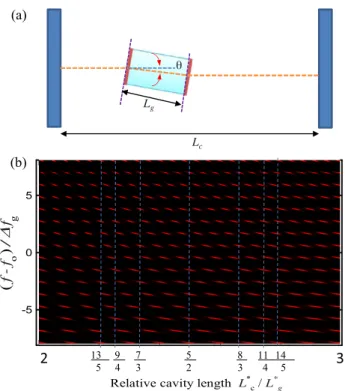
For a typical solid-state laser cavity as shown in figure1(a), the mode spacing of the longitudinal mode is given by 1 fc=c/(2L∗c), where L∗c=Lc+(nr−1)Lgcosθ, Lcis the geometric length of the cavity, Lgis the geometric length of the gain medium, θ is the internal angle between the laser beam and the normal axis through the gain medium, and nr is the refractive index of the gain medium. Provided that the lasing longitudinal modes are phase locked in the cavity, the frequency distribution can be ideally expressed as
I( f ) = M X
m=−M
am δ( f − fo−m1fc), (1)
where am is the weighting coefficient and fo is the central frequency. To include the effective line width, theδ-function in equation (1) is explicitly replaced with a series of Lorentzian functions, I( f ) = 1 π M X m=−M am0c1fc2 [( f − fo) − m 1fc]2+(0 c1fc)2, (2) where0cis the effective linewidth of the cavity mode.
Provided that both end surfaces of the gain medium are coated to have a reflectance R to introduce a Fabry–Perot modulation effect, the frequency distribution of the laser emission is modulated with an effective transmission function:
I( f ) = " 1 π M X m=−M am0c1fc2 [( f − fo) − m 1fc]2+(0 c1fc)2 # × " X n 0g1fg2 ( f − n 1fg)2+(0g1fg)2 # , (3)
where1 fg=c/(2L∗g) is the free spectral range of the gain medium, L∗g=nrLgcosθ, and 0gis given by(1/2π) ln(1/R). The value of θ can be directly associated with the tilt angle of the gain medium. Although θ = 0 can minimize the cavity losses to reach the maximum output power, this value cannot be used to obtain effective loss modulation for
Figure 1. (a) Schematic diagram of the cavity setup for harmonically self-mode-locked operation. (b) Numerical results for the frequency spectrum as a function of the ratio L∗c/L∗gin the range 2.0–3.0.
mode selection. On the other hand, if the tilt angle θ is too large, the cavity losses may rapidly increase to reduce the output power significantly. Practically, the appropriate range for the tilt angleθ is approximately 0.8–1.6 degrees. Figure 1(b) depicts the numerical results for the frequency spectrum as a function of the ratio L∗c/L∗g in the range 2.0–3.0. The values for the parameters are am=1,0c=0.03, 0g=0.1, and θ = 1.0◦. It can be seen that when the cavity length leads to a ratio L∗
c/L∗g=1fg/1fc close to a simple fraction q/p, the frequency spectrum can form a structure with an effective mode spacing of p1fg=q1fc. In other words, the Fabry–Perot filtering of the coated gain medium in combination with the cavity length satisfying L∗c/L∗g=q/p can lead to the effective mode spacing being equal to the pth harmonics of the free spectral range of the gain medium,1fg, and simultaneously equal to the qth harmonics of the cavity mode spacing,1fc.
3. Experiment
To realize harmonic mode-locking, the gain medium was coated to have a reflectance of approximately R = 10% on both end surfaces at 1.34 µm. The resonator was a concave–plano cavity. The gain medium was an a-cut 0.5 at.% Nd:YVO4crystal with dimensions of 3 × 3 × 6.4 mm3. With a refractive index of 2.187, the optical length L∗g can be found to be approximately 14 mm, corresponding to a free spectral range of1fg=10.7 GHz. In addition to the partial reflection at 1.34 µm, both end surfaces of the Nd:YVO4 crystal were coated for high transmission (T > 97%) at the wavelength of 808 nm for the pump light. The laser crystal 2
Laser Phys. T W Wu et al was wrapped with indium foil and mounted in a water-cooled
copper holder. The water temperature was maintained at 16◦C to ensure stable laser output. The input mirror was a 500-mm radius-of-curvature concave mirror with antireflection coating at 808 and 1064 nm on the entrance face and with high reflection coating at 1342 nm (>99.8%) and high transmission coating at 808 and 1064 nm on the concave side. A wedged flat mirror with 7% transmission at 1342 nm and high transmission at 1064 nm was used as an output coupler. The pump source was a 16-W, 808-nm fiber-coupled laser diode with a core diameter of 400 µm and a numerical aperture of 0.22. A focusing lens with 25-mm focal length and 90% coupling efficiency was used to reimage the pump beam into the laser crystal. The average pump diameter was approximately 200µm. The separation between the laser crystal and the input mirror was fixed to be approximately 3 mm. The cavity length L∗c could be precisely controlled in the range of 28–70 mm. The temporal behavior of the laser output was analyzed by exploiting the first- and second-order autocorrelations. The first-order autocorrelation trace was performed with a Michelson interferometer (Advantest, Q8347) with a resolution of 0.003 nm that was also able to perform optical spectral analysis by Fourier transforming the first-order field autocorrelation. The second-order autocorrelation trace was obtained with a commercial autocorrelator (APE Pulse Check, Angewandte Physik and Elektronik GmbH).
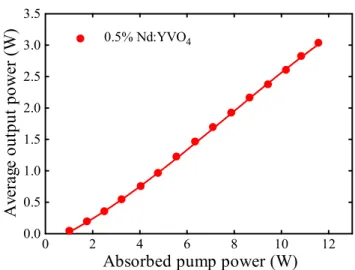
To begin with, the cavity length L∗c was set to be near 28 mm to satisfy L∗c/L∗g=2, corresponding to a mode spacing of 5.35 GHz. The gain medium was aligned to be θ ≈ 0 to obtain the maximum output power. Figure 2 depicts the average output power versus the pump power in maximum output power operation. At an incident pump power of 11.5 W, the average output power was 3.1 W and the slope efficiency was approximately 28.3%. Under the condition θ ≈ 0, the temporal behavior of the laser output displays irregular pulse trains. To obtain regular mode-locked pulse trains, the gain medium needed to be slightly tilted. We set the angle to be approximately θ = 1.0◦ and finely tuned the cavity length to optimize the mode-locked operation by monitoring the autocorrelation trace. When optimum mode-locked operation was achieved, the average output power was found to be approximately 2.3 W at a pump power of 11.5 W. In other words, the average output power in mode-locked operation is approximately 75% of the maximum average output power in
Figure 2. Average output power versus pump power in maximum output power operation under the conditionθ = 0.
free running. Figure3(a) shows the experimental first-order autocorrelation trace of mode-locking at an average output power of 2.3 W. The pulse repetition rate was measured to be 10.7 GHz, which is two times the cavity mode spacing and just corresponds to the free spectral range of the optical crystal length. As shown in figure3(b), the optical spectrum was found to be centered at 1342.16 nm with a full-width at half-maximum (FWHM) of 0.268 nm. The longitudinal mode spacing of 0.06 nm agrees with the pulse repetition rate of 10.7 GHz. Figure3(c) depicts the FWHM width of the central peak of the second-order autocorrelation trace. Assuming the temporal intensity to be a Gaussian profile, the pulse duration can be derived as 10.1 ps. Therefore, the time–bandwidth product of the mode-locked pulse is found to be 0.45, which is very close to the Fourier-limited value of 0.44.
By scanning the cavity length, we experimentally confirmed that when the cavity length was adjusted to be near the region of L∗c/L∗g=q/p, the laser output could turn into harmonically self-mode-locked operation. Figures
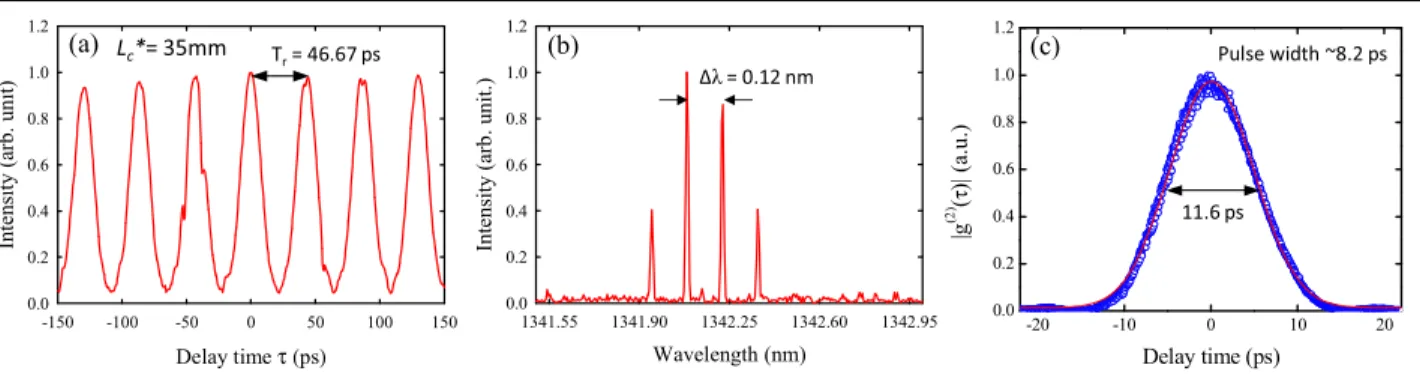
4(a)–(c) are the same plots as shown in figures 3(a)–(c) for experimental data obtained with the cavity length near L∗c/L∗g=5/2 at a pump power of 11.5 W. The average output power approximately remained at 2.3 W. It can be seen that the mode-locked behavior just corresponds to the second harmonic of the free spectral range1fgand simultaneously corresponds
Figure 3. Experimental results obtained with L∗c/L∗g=2 at a pump power of 11.5 W: (a) trace of the first-order autocorrelation; (b) optical spectrum; (c) trace of the second-order autocorrelation.
Laser Phys.24 (2014) 045803 T W Wu et al
Figure 4. The same as figure3for the case of L∗c/L∗g=5/2 at a pump power of 11.5 W.
Figure 5. The same as figure3for the case of L∗c/L∗g=8/3 at a pump power of 11.5 W.
to the fifth harmonic of the cavity mode spacing 1fc. As shown in figure 4(c), the pulse duration is approximately 8.2 ps. Figures5(a)–(c) are the same plots as shown in figures
3(a)–(c) for experimental data obtained with the cavity length near L∗
c/L∗g=8/3 at a pump power of 11.5 W. The average output power was also unchanged. The experimental results clearly reveal that the mode-locked performance corresponds to the third harmonic of the free spectral range 1fg and simultaneously corresponds to the eighth harmonic of the cavity mode spacing 1fc. The pulse duration can be seen to be as short as 5.7 ps.
Figure 6 shows the observed repetition rate in harmonically mode-locked operation for the cavity length in the range between L∗c/L∗g=2 and L∗c/L∗g=5. It can be seen that the repetition rate can be locked in the region of frep=p1fgwith p = 1, 2, and 3. The gain bandwidth of the laser crystal limit hindered the repetition rate frep=p1 fg with p greater than 4. We also found that the locking range for the cavity length could be empirically expressed as L∗c=(q ± ν)L∗g/p with ν = 0.16. In other words, the locking range for the cavity length is proportional to the crystal length and inversely proportional to the integer p. When the cavity length is out of the locking range, the laser output generally displays the feature of multi-pulse mode-locking. The locking range is an interesting phenomenon and further investigation is underway.
4. Conclusions
In summary, we have successfully generated high-power and high-repetition-rate Nd:YVO41.34-µm lasers by developing a
Figure 6. The observed repetition rate in harmonically mode-locked operation for the cavity length in the range between L∗c/L∗g=2 and L∗c/L∗g=5.
method to achieve harmonically self-mode-locked operation. It was numerically revealed that when the optical cavity length is adjusted to be commensurate with the optical length of the gain medium, the gain medium with partial-reflection coating at the lasing wavelength can effectively modify the mode spacing of the laser cavity to be the harmonics of the free spectral range of the gain medium,1fg. We further exploited a coated Nd:YVO4 crystal to realize harmonically mode-locked operation. The experimental results revealed that the repetition rate could be locked in the region of frep=p ×10.7 GHz with the index 4
Laser Phys. T W Wu et al p =1, 2, and 3. At a pump power of 11.5 W, the overall average
output power was up to 2.3 W with the pulse duration as short as 5.7 ps. We also experimentally explored the locking range for the cavity length and found that it is proportional to the crystal length and inversely proportional to the index p. References
[1] Di Lieto A, Minguzzi P, Pirastu A, Sanguinetti S and Magni V 2002 A 7-W diode-pumped Nd:YVO4cw laser at 1.34 µm
Appl. Phys.B75 463–6
[2] Zhang X F, Li F Q, Zong N, Le X Y, Cui D F and Xu Z Y 2011 37 W 888-nm-pumped grown-together composite crystal YVO4/Nd:YVO4/YVO4oscillator at 1342 nm Laser
Phys.21 1393–7
[3] Pavel N, Dascalu T, Vasile N and Lupei V 2009 Efficient 1.34-µm laser emission of Nd-doped vanadates under in-band pumping with diode lasers Laser Phys. Lett.
6 38–43
[4] Du C, Ruan S, Zhang H, Yu Y, Zeng F, Wang J and Jiang M 2005 A 13.3-W laser-diode-array end-pumped Nd:GdVO4
continuous-wave laser at 1.34 µm Appl. Phys. B80 45–8
[5] Ding X, Yin S J, Shi C P, Li X, Li B, Sheng Q, Yu X Y, Wen W Q and Yao J Q 2011 High efficiency 1342 nm Nd:YVO4laser in-band pumped at 914 nm Opt. Express 19 14315–20
[6] Liang H C, Huang Y J, Huang W C, Su K W and Chen Y F 2010 High-power, diode-end-pumped, multigigahertz self-mode-locked Nd:YVO4laser at 1342 nm Opt. Lett.35 4
[7] Xie G Q, Tang D Y, Zhao L M, Qian L J and Ueda K 2007 High-power self-mode-locked Yb:Y2O3ceramic laser Opt.
Lett.32 2741
[8] Liang H C, Chen R C C, Huang Y J, Su K W and Chen Y F 2008 Compact efficient multi-GHz Kerr-lens mode-locked diode-pumped Nd:YVO4laser Opt. Express16 21149
[9] Paiella R, Capasso F, Gmachl C, Sivco D L, Baillargeon J N, Hutchinson A L, Cho A Y and Liu H C 2000
Self-mode-locking of quantum cascade lasers with giant ultrafast optical nonlinearities Science290 1739
[10] Bartels A, Heinecke D and Diddams S A 2009 10-GHz self-referenced optical frequency comb Science326 681
[11] Hu H, Mulvad H C H, Peucheret C, Galili M, Clausen A, Jeppesen P and Oxenløwe L K 2011 10 GHz pulse source for 640 Gbit/s OTDM based on phase modulator and self-phase modulation Opt. Express19 B343
[12] Sun Y, Pan J Q, Zhao L J, Wang W, Wang L, Zhao X F and Lou C Y 2010 All-optical clock recovery for 20 Gb/s using an amplified feedback DFB laser IEEE J. Lightwave Technol.25 2501
[13] Federici J and Moeller L 2010 Review of terahertz and subterahertz wireless communications J. Appl. Phys.
107 111101
[14] Tomaru T and Petek H 2000 Femtosecond Cr4+:YAG laser with an L-fold cavity operating at a 1.2-GHz repetition rate Opt. Lett.25 584
[15] Silberhorn Ch, Lam P K, Weiß O, K¨onig F, Korolkova N and Leuchs G 2001 Generation of continuous variable Einstein–Podolsky–Rosen entanglement via the Kerr nonlinearity in an optical fiber Phys. Rev. Lett.86 4267
[16] Yoshida E and Nakazawa M 1996 80–200 GHz erbium doped fibre laser using a rational harmonic mode-locking technique Electron. Lett.32 1370
[17] Schr¨oder J, Coen S, Vanholsbeeck F and Sylvestre T 2006 Passively mode-locked Raman fiber laser with 100 GHz repetition rate Opt. Lett.31 3489
[18] Quarterman A H, Wilcox K G, Apostolopoulos V, Mihoubi Z, Elsmere S P, Farrer I, Ritchie D A and Tropper A 2009 A passively mode-locked external-cavity semiconductor laser emitting 60-fs pulses Nature Photon.3 729–31
[19] Klopp P, Griebner U, Zorn M and Weyers M 2011 Pulse repetition rate up to 92 GHz or pulse duration shorter than 110 fs from a mode-locked semiconductor disk laser Appl. Phys. Lett.98 071103
[20] Kong M N, Chee J K and Liu J M 1991 Passive mode locking with a nonlinear external coupled cavity at high pulse repetition rates Opt. Lett.16 73