Environmental Technology, Vol. 26. pp 663-672
© Selper Ltd, 2005
TRANSFORMATION OF CHLORINATED METHANES BY
ZERO-VALENT ALUMINUM COUPLED WITH Pd/Al
2O
3H. L. LIEN*
Department of Civil and Environmental Engineering, National University of Kaohsiung 700 Kaohsiung University Rd., 811 Kaohsiung, Taiwan
(Received 19 November 2004; Accepted 7 February 2005)
ABSTRACT
The transformation of chlorinated methanes by zero-valent aluminum under various pH conditions has been examined in the presence and absence of Pd/Al2O3. In the absence of Pd/Al2O3, carbon tetrachloride was primarily transferred to
chloroform (65%) and dichloromethane (15.3%) at pH 2.5 while little of the hydrodehalogenation intermediates (~5%) was found at pH 10.8. This indicates that carbon tetrachloride undergoes hydrodehalogenation at low pH but not at high pH. The low production of hydrodehalogenation intermediates at high pH could be attributed to the base-catalyzed hydrolysis of carbon tetrachloride resulting in the formation of products that can not be detected by the provided analytic methods. In the presence of Pd/Al2O3, degradation rates were increased by a factor of 10-43 compared to the system without Pd/Al2O3,
suggesting Pd/Al2O3 serves as a catalyst. Further, complete degradation of carbon tetrachloride by zero-valent aluminum
with Pd/Al2O3 led directly to methane (86.4%) without formation and accumulation of dichloromethane at pH 9.0. The
direct transformation of carbon tetrachloride to methane can be rationalized by the catalytic hydrodehalogenation occurring at the palladium surface. The study indicates aluminum coupled with Pd/Al2O3 is an environmentally-friendly technology
for treatment of chlorinated organic contaminants.
Keywords: Hydrodehalogenation, zero-valent metals, groundwater remediation, pollution control, palladium
INTRODUCTION
The use of zero-valent metals for reductive dehalogenation of halogenated organic compounds (HOCs) represents a promising remedial technology for the treatment of groundwater or industrial wastewater contaminated by HOCs [1-7]. Many metals have been chosen as reducing agents such as iron, zinc, and tin [8-10]. Among them, iron has received most attention since Gillham and O’Hannesin revealed the granular iron metal can be used for in situ groundwater remediation [1-2]. More recently, innovative extensions such as bimetallic catalysts and reductants (Pd/Fe, Ni/Fe, and Cu/Al) [10-14] and supported palladium catalysts (Pd/C and Pd/Aluma) coupled with H2 [15-16] have been
developed. In general, these improve zero-valent metal technology by enhancing degradation rates and reducing toxic intermediates.
Reductive dehalogenation of HOCs by zero-valent metals involves metal corrosion. For example, in the reduction of carbon tetrachloride with zero-valent iron, iron serves as an electron donor that releases electrons through iron corrosion (eq. i) while contaminants such as carbon tetrachloride undergo hydrodehalogenation gaining electrons
to form less-chlorinated intermediates such as chloroform in the presence of protons (eq. ii) [5].
Fe0 → Fe2+ + 2e– (i)
CCl4 + H+ + 2e– → CHCl3 + Cl– (ii)
It is clear that the reduction rate is a function of proton concentrations (i.e., pH) and reducibility. Studies have shown that the rate of the carbon tetrachloride reduction by iron metal is a function of pH where increasing pH decreases reduction rates [5]. On the other hand, the reducibility is also dependent on pH. Little reduction of carbon tetrachloride was observed at high pH because the formation of iron oxide precipitates on the iron surface limits the reducibility of iron. Fe2+ + 2OH– → Fe (OH)
2(s) (iii)
Zero-valent aluminum (Al0), however, provides a great
opportunity to investigate the reduction under alkaline conditions. It has been found that aluminum corrosion proceeds under both acidic and alkaline conditions. Under alkaline conditions, an electron-rich but proton-deficient
environment can be created because the presence of OH
-removes the aluminum oxide layer [17-18].
Al2O3 + 2OH– → 2AlO2– + H2O (iv)
The electron-rich but proton-deficient environment may allow investigators to study a solid-phase proton donor that could enhance the effectiveness of zero-valent iron system. For example, some aquifer materials containing aluminosilicates have been proposed as proton donors that increased the rate of Cr(VI) reduction by zero-valent iron [4]. The difficulty in investigating the solid-phase proton donor in the iron system is because the reducibility of iron is only valid at low and near neutral pH where hydrogen ions (H+)
dominate the protonation process.
It is well known that chemisorbed atomic hydrogen is formed readily through the H2 dissociation when molecular
hydrogen adsorbs onto Pd [19-22]. The H-covered surface of Pd (Pd-H) has been used to hydrodehalogenate HOCs [21-22]. Studies have shown that a small amount of Pd deposited on iron increases reduction rates by at least a factor of 10 [11, 13-14]. Using H2 as a reductant, supported Pd catalysts have also
shown an excellent performance for dehalogenation of many HOCs [15-16]. In addition, the formation of Pd•H2 by
adsorbing H2 with Pd has been proposed as a powerful
reducing species in the reduction of 4-chlorophenol [19]. In this work, the research strategy was developed, in part, to gain evidence for Pd-H serving as the solid-phase proton donor by conducting the metal-mediated degradation of carbon tetrachloride with palladium in an electron-rich but proton-deficient environment. Carbon tetrachloride was chosen as a model compound because it undergoes different pathways at various pH.
Dehalogenation of carbon tetrachloride has been proposed to involve both one- and two-electron transfer reduction [23-25]. The one-electron transfer process yields trichloromethyl radicals (eq. v) while two-electron transfer reaction involves a dichlorocarbene (eq. vi).
CCl4 + e– → •CCl3 + Cl– (v)
CCl4 + 2e– → CCl2 : + 2Cl– (vi)
The competition between eqs. (v) and (vi) leads to the different product distribution in the dehalogenation of carbon tetrachloride. Under alkaline conditions, dichlorocarbene is readily hydrolyzed to carbon monoxide [25].
CCl2 : + H2O/OH– → CO + 2HCl (vii)
At acidic pH, the base-catalyzed hydrolysis of dichlorocarbene is no longer a favorable reaction while trichloromethyl radicals formed by one-electron transfer reaction may undergo a hydrodehalogenation reaction to
produce chloroform.
•CCl3 + e– + H+ → CHCl3 (viii)
Accordingly, at high pH (the proton-deficit condition) if Pd-H could serve as the proton donor, the presence of Pd should promote hydrodehalogenation to compete with hydrolysis leading to change the product distribution toward hydrodehalogenation products. The product distribution from the carbon tetrachloride degradation can therefore be used as an indicator to verify the reactions. In this work, specific objectives included to (1) elucidate the mechanistic differences in the presence and absence of Pd for the degradation of carbon tetrachloride by Al0, and (2) investigate
pH effects on the reduction of carbon tetrachloride.
MATERIALS AND METHODS
Treatment of Al0
Zero-valent aluminum was treated by sodium hydroxide for the study at high pH and hydrochloric acid for the study at low pH. Typically, Al0 was rinsed by 20 ml of
0.75 N NaOH aqueous solution for the high pH study. After vigorous stirring for 3 minutes, metal particles were collected via vacuum filtration and washed by distilled water. For the experiment at acidic pH, 10 ml of concentrated HCl were used to clean the surface of Al0. As soon as fume evolution was
immediately observed, the suspension was quenched with 30 ml distilled water and kept stirred for three minutes. Solution pH was adjusted with 1 N HCl or 0.75 N NaOH and measured before and after the experiment.
Preparation of Zero-Valent Aluminum Coupled with Pd/Al2O3 (Al0-Pd/Al2O3)
For a typical experiment, 2.0 g of Al0 and 1.0 g of
aluminum oxide mixtures were added into a palladium solution prepared by dissolving 0.022 g of palladium acetate into 20 ml ethanol. Sodium hydroxide solution (20 ml of 0.75 N) was then added into the suspension. The dark palladium solution turned colorless quickly. This indicated Pd2+ was
converted to Pd0. Meanwhile, the white aluminum oxide
became gray particles, which indicated Pd0 was deposited
onto the Al2O3 surface. After stirring for 3 minutes, the
suspension was filtered and washed by distilled water. Assuming that all the Pd metal was reductively precipitated onto the Al2O3, the maximum content of Pd on the Al2O3 was
calculated as 1% by weight. Batch Experiments
Batch experiments were conducted in 150 ml serum bottles (Wheaton glass). For each batch bottle, 20 µl of methanol solution of a chlorinated methane was spiked into a 50 ml aqueous solution to achieve a desired concentration.
Typical metal loading of Al0 and Pd/Al
2O3 was 40 g l-1 and 20
g l-1, respectively unless otherwise indicated. The serum
bottles were capped with Teflon Mininert valves and mixed on a rotary shaker (30 rpm) at room temperature (22±1 °C). Batch bottles containing the chlorinated methane in the absence of metals were used as controls. Analyses of organic mass in the controls indicated that the mass varied by less than 5% over the course of a typical experiment. Hydrogen evolution by the dissolution of water was observed in both Al0
alone and Al0-Pd/Al
2O3 at high pH. The evolution of
hydrogen should result in a minor effect on the mass losses in Al0-Pd/Al
2O3 systems, which reflected a high recovery of
carbon mass (~90%) in the transformation of carbon tetrachloride. In the use of Al0, a preliminary experiment
showed that no degradation of dichloromethane was found. More than 90% of dichloromethane remaining in the system indicated that the maximum mass losses due to the hydrogen evolution was less than 10%.
Methods of Analyses
At selected time intervals, 5 µl of headspace gas aliquot were withdrawn by a gastight syringe for GC analysis. Concentrations of chlorinated methanes were measured by a HP5890 GC equipped with a DB-624 capillary column (30 m x 0.32 mm, J&W) and an electron capture detector (ECD). Calibration curves for each compound were made initially and the variability was checked daily before analysis (<15%). Temperature conditions were programmed as follows: oven temperature at 50 °C, injection port temperature at 200 °C, and detector temperature at 300 °C. Hydrocarbon products in the headspace were quantified with GC analysis. The GC was equipped with a flame ionization detector (FID) and an AT-Q column (30 m x 0.32 mm, Alltech). Oven temperature was set at 30 °C, injection port temperature at 250 °C, and detector temperature at 300 °C.
Soluble chlorine anions (Cl-) produced from the
transformation of chlorinated methanes were identified and quantified by ion-exchange separation using a Dionex DX-120 Ion Chromatograph equipped with an anion self-regenerating suppressor ASRS-I. Separation was carried out with an IonPac AS 14 (4 x 250 mm) ion-exchange column coupled to an AG 14 guard column (Dionex). A 3.5 mM Na2CO3/1.0 mM
NaHCO3 eluent solution prepared by deionized water was
used. The elution time of chlorine ion was 3.52 minutes when an isocratic flow rate of 1.2 ml min-1 was conducted.
Chemicals
HPLC grade carbon tetrachloride (99+%), chloroform
(99%) and dichloromethane (99.9%) were purchased from Aldrich. The standard gas mixture for GC analysis was obtained from Supelco, which included 1% of ethane, ethylene, acetylene, and methane. Single standard gases of 1.04% ethylene and 1.04% methane were acquired from Aldrich. Palladium acetate ([Pd(C2H3O2)2]3), 47.4% was
obtained from Alfa Aesar. Aluminum (~20 micron, 99+%) and
aluminum oxide (activated, acidic, Brockmann I, ~150 mesh, 58 Å, surface area 155 m2 g-1, standard grade) were obtained
from Aldrich.
RESULTS
Transformation of Carbon Tetrachloride by Al0
The transformation of carbon tetrachloride by Al0 was
conducted under various pH conditions. The results for the degradation of carbon tetrachloride under acidic conditions (pH 2.5) are shown in Figure 1(a). Carbon tetrachloride was primarily dehalogenated to chloroform and subsequently to dichloromethane. Chloroform was the major byproduct, which accounted for about 65% of the carbon tetrachloride lost. The yield of dichloromethane was about 15.3%. Methane was detected in a relatively minor amount (~ 8%). The carbon mass balance, which is a sum of chlorinated methanes and methane, at the end of the experiment was about 94% (including 6% of remaining carbon tetrachloride). This indicates that the hydrodehalogenation is the primary reaction in the transformation of carbon tetrachloride by Al0
at acidic pH.
The results for the degradation of carbon tetrachloride under alkaline conditions (pH 10.8) are given in Figure 1(b). Chloroform, dichloromethane and methane were all detected in minor amounts. The carbon mass balance at the end of the experiment was less than 10%. Nevertheless, the chlorine mass balance was determined to be about 87%. This indicates that carbon tetrachloride is almost completely dehalogenated; however, more than 90% deficit in the carbon mass balance shows that the hydrodehalogenation is not the major reaction at high pH.
At near neutral pH (pH 7.5), about 93% of carbon tetrachloride remained in the system within 24 hours. Only minor amounts of the lesser-chlorinated intermediates such as chloroform (3%) and dichloromethane (< 1%) were detected. Transformation of Chlorinated Methanes by Al0-Pd/Al
2O3
The transformation of chlorinated methanes by Al0
-Pd/Al2O3 was conducted at pH 9.0. Attempts were not made
to carry out experiments at low pH because the presence of H+ deactivates the activity of Pd [26]. The results for the
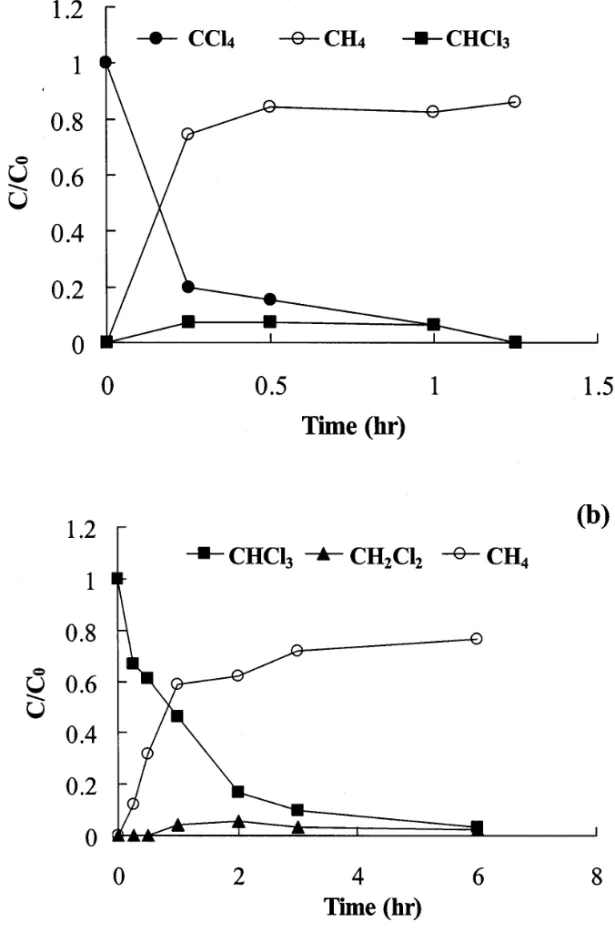
degradation of carbon tetrachloride and chloroform are shown in Figure 2. As shown in Figure 2(a), complete and rapid degradation of carbon tetrachloride was observed. Methane appeared as the major product accounting for about 86.4% of the carbon tetrachloride lost. Chloroform was initially detected in a small amount (~ 6%) and declined to below detection limit at the end of the experiment. No dichloromethane was found. The use of Pd in the treatment of HOCs often results in the low yield of lesser-halogenated intermediates [14, 15, 21, 22], which is consistent with this
Figure 1. Transformation of carbon tetrachloride by Al0 at (a) pH 2.5 and (b) pH 10.8. Initial concentration of carbon
Figure 2. Transformation of chlorinated methanes by Al0-Pd/Al
2O3. (a) Carbon tetrachloride (32 mg l-1) and (b) Chloroform (30
mg l-1). The loading of Al0 and Pd/Al
2O3 was 40 g l-1 and 20 g l-1, respectively.
study. For example, no dichloromethane was observed in the degradation of carbon tetrachloride by supported Pd catalysts and H2 [15]. The degradation of chloroform to methane by
Al0-Pd/Al
2O3 was also found as shown in Figure 2(b).
Chloroform (30 mg l-1) was completely dehalogenated within
6 hours. Methane accounted for about 77% of the
disappearance of chloroform and a small amount of dichloromethane (~5%) was detected after one hour. A control test (Al0-Al
2O3) containing the same amounts of
aluminum and aluminum oxide without palladium was conducted under an identical condition as the above-mentioned studies. The degradation of carbon tetrachloride in
the control system exhibited results similar to the use of Al0
alone shown in Figure 1(b).
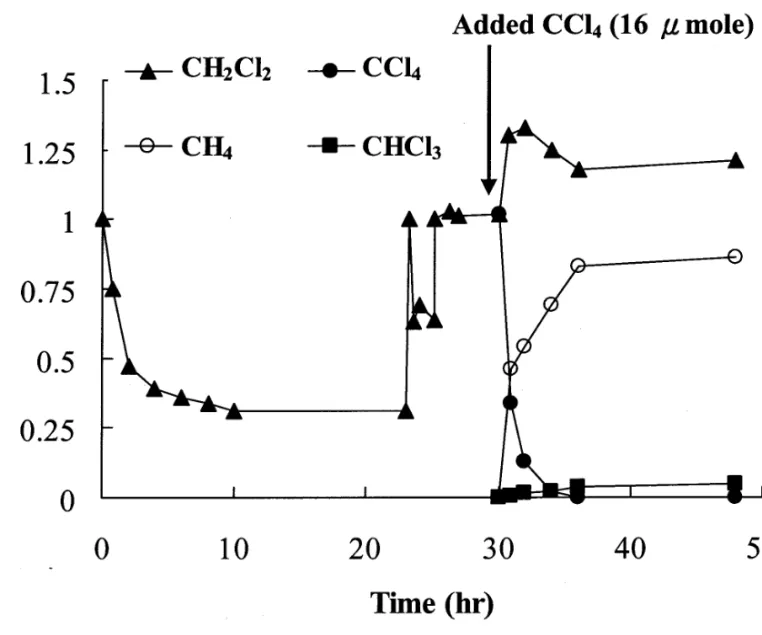
A preliminary experiment on the removal of dichloromethane showed that approximately 80% of dichloromethane was removed within 10 hours but no reaction byproducts were detected in the presence of Al0
-Pd/Al2O3. In order to understand whether the disappearance
of dichloromethane was caused by a simple sorption process or a chemical reaction, experiments were conducted by a repetitive spiking test. The batch bottle containing 20 g l-1 of
Pd/Al2O3 and 20 g l-1 of Al0 was spiked with 16 µmol of
dichloromethane for three times. Figure 3 shows the normalized total µmoles of dichloromethane and reaction products in the bottle as a function of time. Removal of dichloromethane stopped after the total addition of about 48 µmol of dichloromethane while no intermediates were found. This suggested that the removal of dichloromethane by Al0
-Pd/Al2O3 was through the sorption process.
The addition of carbon tetrachloride was then used to investigate the activity of Al0-Pd/Al
2O3 after the surface sites
were saturated with dichloromethane. A rapid degradation of carbon tetrachloride was found (Figure 3) and is consistent with the results shown in Figure 2(a). This indicates no loss of activity of Al0-Pd/Al
2O3 although the surface sites had been
saturated with dichloromethane. In addition, a rebound of dichloromethane concentration was observed after the addition of carbon tetrachloride.
The sorption of chlorinated organic compounds such as tetrachloroethylene and trichloroethylene onto zero-valent iron surface has been studied [7]. It was found that competitive sorption can often be observed in a system where two or more adsorbates compete for the same sorption sites. Molecules that are held by physical forces could be easily replaced by those that are chemisorbed. The rebound of dichloromethane concentration suggests that there would be a competitive sorption between carbon tetrachloride and dichloromethane. The chemisorbed carbon tetrachloride resulting in the reduction of carbon tetrachloride overwhelmed the physisorbed dichloromethane. Accordingly, dichloromethane that was repulsed from the
Figure 3. Removal of dichloromethane by Al0-Pd/Al
2O3. Sixteen µmol of dichloromethane were repetitively spiked into the
batch bottle containing 20 g l-1 of Al0 and 20 g l-1 of Pd/Al
2O3 for three times. After the Al0-Pd/Al2O3 was saturated
sorption sites resulted in the rebound of dichloromethane concentration.
Reaction Rates
The reaction kinetics were modeled with a simple pseudo-first-order rate law.
C
dt
dC
obsk
−
=
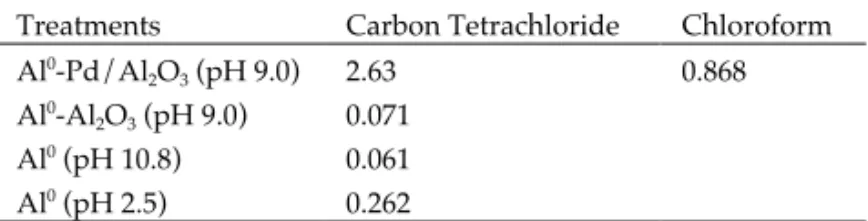
(ix) Where C is the concentration of chlorinated methanes, and kobs is the observed first-order rate constant (hr-1). The observed rate constants for the transformation of carbon tetrachloride and chloroform were determined by the best fit of the experimental data shown in Figures 1 and 2 to eq. (ix) (Table 1). Table 1 shows that the presence of Pd/Al2O3 (Pd ~1wt%) significantly increased the rate of the carbon tetrachloride degradation by a factor of about 10-43 compared to the Al0-Al
2O3 system and the Al0 alone at both low and high
pH. This implies that the reduction of carbon tetrachloride with Al0 is catalyzed by Pd/Al
2O3. DISCUSSION
Zero-valent aluminum (Al0) with a high reductive
potential (-1.67 V) seems reasonable to serve as a good electron donor in the reduction of chlorinated methanes. However, quick formation of a protective oxide layer inhibits the reductive capacity of Al0 when it reacts with water at near
neutral pH. Aluminum corrosion is subject to a very low rate at near neutral pH and its rate becomes increasingly rapid as pH decreases below 4.0 or increases above 9.0 [17]. Consequently, the reduction of carbon tetrachloride proceeding under both acidic and alkaline conditions is corresponding to aluminum corrosion. Little degradation of carbon tetrachloride was determined at pH 7.5, which could be attributed to the poor reducibility of Al0 under neutral
conditions.
While the reduction of carbon tetrachloride by Al0 can
occur under both acidic and alkaline conditions, the product distribution was significantly different. As illustrated in Figure 4, the product distribution from the carbon tetrachloride reduction at acidic pH included chloroform (65%) and dichloromethane (15.3%). This indicates carbon tetrachloride undergoes the hydrodehalogenation at low pH.
However, only minor amounts of chloroform and dichloromethane (~ 5%) were detected at high pH. The low production of hydrodehalogenation products has also been observed in the photoreduction of carbon tetrachloride in which it could undergo base-catalyzed hydrolysis to carbon monoxide at high pH [23]. Accordingly, the rest of the carbon in the study may be attributed to the formation of non-halogenated products such as carbon monoxide (eq. vii). They were undetectable of using the provided analytic methods. The low production of lesser-chlorinated intermediates might suggest that the base-catalyzed hydrolysis dominates at high pH in the degradation of carbon tetrachloride by Al0.
Unlike the above-mentioned study conducted in the absence of palladium, the system of aluminum coupled with Pd/Al2O3 led to the formation of methane (86.4%) as the
primary product for the degradation of carbon tetrachloride at pH 9.0 (Figure 4). This indicates hydrodehalogenation is the dominant reaction process. Under alkaline conditions, the base-catalyzed hydrolysis should be a favorable reaction for carbon tetrachloride degradation (eq. vii); however, reactions shifted from the possible base-catalyzed hydrolysis to the complete hydrodehalogenation in the Al0-Pd/Al
2O3 system.
Because of the low activation barrier for H2 dissociation on Pd
(2 kcal mol-1 or less [20]), Pd-H could be readily formed in the
Al0-Pd/Al
2O3 system through dissolution of water by Al0
supplying H2. This suggests that Pd-H serves as the proton
donor that promotes the carbon tetrachloride reduction toward the hydrodehalogenation. Although H2 was also
generated in the Al0 alone system at pH 10.8, the
hydrodehalogenation appeared to be the minor reaction (Figure 4). This indicates that H2 gas does not promote the
hydrodehalogenation in the Al0 alone system, which could be
attributed to the lack of chemisorbed atomic hydrogen on Al0
(Al-H). Because the intrinsic barrier to H2 dissociation is too
high (over 90 kcal mol-1), it is extremely difficult to form Al-H
on the Al surface [20], which also relates to a very small sticking coefficient of H2 on the surface of Al (10-4) compared
to Pd (1.0) [27].
Although both Al0 (pH 2.5) and Al0-Pd/Al
2O3 systems
led to the formation of the hydrodehalogenation products in the reduction of carbon tetrachloride, the product distribution was notably different (Figure 4). Chloroform (65%) was the major product in the acidic Al0 system whereas
methane accounted for 86.4% of the carbon tetrachloride lost and became the dominant product in the reaction system of
Table 1. Observed rate constants (kobs, hr-1) for the degradation of chlorinated methanes using various treatments.
Treatments Carbon Tetrachloride Chloroform Al0-Pd/Al 2O3 (pH 9.0) 2.63 0.868 Al0-Al 2O3 (pH 9.0) 0.071 Al0 (pH 10.8) 0.061 Al0 (pH 2.5) 0.262
Figure 4. The product distributions from the reduction of carbon tetrachloride by Al0 at pH 2.5 and 10.8, and Al0-Pd/Al 2O3 at
pH 9.0.
Al0-Pd/Al
2O3. The selectivity towards benign product
(i.e., methane) indicated the system of Al0-Pd/Al 2O3 is
more environmentally-friendly than that of aluminum alone. Metal-medicated degradation of carbon tetrachloride has been extensively studied and suggested reactions
may involve the sequential dehalogenation (i.e., CCl4→CHCl3→CH2Cl2→CH3Cl→CH4) [5]. In the case of
acidic Al0 system, the formation of chloroform as the major
product is in good agreement with the sequential reaction pathway. Because of the lack of the reactivity for dichloromethane, the degradation of carbon tetrachloride inevitably leads to the accumulation of chloroform in the system (Figure 1(a)). However, for the transformation of carbon tetrachloride by Al0-Pd/Al
2O3, attempts to rationalize
selectivity towards methane using the sequential dehalogenation were unsuccessful. In this pathway, the formation of dichloromethane is the required transitional step to methane, which is inconsistent with our results indicating no reactivity of dichloromethane (Figure 3).
Studies have shown that the degradation of carbon tetrachloride by Pd involving the Pd-H usually leads to the direct transformation of carbon tetrachloride to methane (CCl4→CH4) without the sequential dehalogenation [15, 22].
The direct transformation is likely to be attributed to the
catalytic hydrodehalogenation that is favorable to occur at the surface of the low cathodic hydrogen overpotential metals such as Pd [28]. Catalytic hydrodehalogenation of carbon tetrachloride results in the carbon-chlorine bond dissociation to carbide [22]. The carbide is capable of reacting with Pd-H to carbyne (≡CH), carbene (=CH2) and eventually to methane,
which is analogous to Fisher-Tropsch synthesis [29-30]. Although detail transformation steps are still unclear, the surface intermediates have quite often been observed in other studies. The formation of carbene and carbyne has been reported in the electrocatalytic reduction of carbon tetrachloride at Pd electrode [31]. Carbene has also been proposed as the intermediate in the formation of hydrocarbons by zero-valent iron through Fisher-Tropsch synthesis [32]. Because the formation of dichloromethane is no longer the necessary step, the catalytic hydrodehalogenation occurring on Pd surface is therefore a likely reaction mechanism for the reduction of carbon tetrachloride with the Al0-Pd/Al
2O3 system. CONCLUSIONS
In this study, metal-enhanced degradation of chlorinated methanes, including carbon tetrachloride,
trichloromethane and dichloromethane, was examined using zero-valent aluminum coupled with supported palladium at various pH conditions. The results of the study suggest that aluminum coupled with supported palladium is an environmentally-friendly technology for treatments of chlorinated organic solvent contamination. In particular, the following conclusions can be drawn:
• In the absence of palladium, carbon tetrachloride was hydrodehalogenated by zero-valent aluminum to chloroform and dichloromethane under acidic conditions while it could undergo the base-catalyzed hydrolysis at high pH.
• In the presence of palladium, the significant increase of reaction rates for the degradation of carbon tetrachloride suggested that palladium serves as a catalyst. Methane was the major product and no accumulation of dichloromethane was observed. Disappearance of dichloromethane was found when
aluminum coupled with supported palladium was employed; however, no intermediates were detected. The disappearance of dichloromethane can be attributed to the physico-sorption rather than chemical reactions.
• In the use of aluminum coupled with supported palladium, high methane selectivity and near-zero reactivity of dichloromethane implied that catalytic hydrodehalogenation was involved in directly transforming carbon tetrachloride to methane on the palladium surface without the formation of dichloromethane.
ACKNOWLEDGEMENTS
The author would like to thank National Science Council (NSC), Taiwan ROC for the financial support through NSC Grant (NSC 93-2211-E-390-006-).
REFERENCES
1. Gillham R. W. and O’Hannesin S. F., Enhanced degradation of halogenated aliphtics by zero-valent iron. Ground Water, 32, 958-967 (1994).
2. Orth S. W. and Gillham R. W., Dechlorination of trichlorethene in aqueous solution using Fe(0). Environ. Sci. Technol., 30, 66-71 (1996).
3. Roberts A. L., Totten L. A., Arnold W. A., Burris D. R. and Campbell T. J., Reductive elimination of chlorinated ethylenes by zero-valent metals. Environ. Sci. Technol., 30, 2654-2659 (1996).
4. Powell R. M. and Puls R. W., Proton generation by dissolution of intrinsic or augmented aluminosilicate minerals for in situ contaminant remediation by zero-valence-state iron. Environ. Sci. Technol., 31, 2244-2251 (1997).
5. Matheson L. J. and Tratnyek P. G., Reductive dehalogenation of chlorinated methanes by iron metal. Environ. Sci. Technol., 28, 2045-2053 (1994).
6. Johson T. L., Scherer M. M. and Tratnyek P. G., Kinetics of halogenated organic compound degradation by iron metal. Environ. Sci. Technol., 30, 2634-2640 (1996).
7. Burris D. R., Campbell T. J. and Manoranjan V. S., Sorption of trichloroethylene and tetrachloroethylene in a batch reactive metallic iron-water system. Environ. Sci. Technol., 29, 2850-2855 (1995).
8. Boronina T., Klabunde K. J. and Sergeev G., Destruction of organohalides in water using metal particles: carbon tetrachloride/water reactions with magnesium, tin, and zinc. Environ. Sci. Technol., 29, 1511-1517 (1995).
9. Arnold W. A., Ball W. P. and Roberts A. L., Polychlorinated ethane reaction with zero-valent zinc: Pathways and rate control. J. Contam. Hydrol., 40, 183-186 (1999).
10. Fennelly J. P. and Roberts A. L., Reaction of 1,1,1-trichloroethane with zero-valent metals and bimetallic reductants. Environ. Sci. Technol., 32, 1980-1988 (1998).
11. Grittini C., Malcomson M., Fernando Q. and Korte N., Rapid dechlorination of polychlorinated biphenyls on the surface of a Pd/Fe bimetallic system. Environ. Sci. Technol., 29, 2898-2900 (1995).
12. Lien H-L. and Zhang W., Enhanced dehalogenation of halogenated methanes by bimetallic Cu/Al. Chemosphere, 49, 371-378. (2002).
13. Wang C. B. and Zhang W., Nanoscale metal particles for dechlorination of TCE and PCBs. Environ. Sci. Technol., 31, 2154-2156 (1997).
14. Lien H-L. and Zhang W., Dechlorination of chlorinated methanes in aqueous solutions using nanoscale bimetallic particles. J. Environ. Eng., 125, 1042-1047 (1999).
15. Lowry G. V. and Reinhard M., Hydrodehalogenation of 1- to 3-carbon halogenated organic compounds in water using a palladium catalyst and hydrogen gas. Environ. Sci. Technol., 33, 1905-1911 (1999).
16. Schreier C. G. and Reinhard M., Catalytic hydrodehalogenation of chlorinated ethylenes using palladium and hydrogen for the treatment of contaminated water. Chemosphere, 31, 3475-3487 (1994).
18. Birnbaum H. K., Buckley C., Zeides F., Sirois E., Rozenak P., Spooner S. and Lin J. S., Hydrogen in aluminum. J. Alloys Compd., 260, 253-254, (1997).
19. Cheng F., Fernando Q. and Korte N., Electrochemical dechlorination of 4-chlorophenol to phenol. Environ. Sci. Technol., 31, 2443-244 (1997).
20. Masel R. I., Principles of Adsorption and Reaction on Solid Surfaces, John Wiley & Sons, Inc., New York, (1996).
21. Coq B., Cognion J. M., Figueras F. and Tourinigant D., Conversion under hydrogen of dichlorodifluoromethane over supported palladium catalysts. J. Catal. 141, 21-33 (1993).
22. Weiss A. H., Gambhir B. S. and Leon R. B., Hydrodechlorination of carbon tetrachloride. J. Catal., 22, 245-253 (1971). 23. Choi W. and Hoffmann M. R., Photoreductive mechanism of CCl4 degradation on TiO2 particles and effects of electron
donors. Environ. Sci. Technol., 29, 1646-1655 (1995).
24. Choi W. and Hoffmann M. R., Kinetics and mechanism of CCl4 photoreductive degradation on TiO2: The role of
trichloromethyl radical and dichlorocarbene. J. Phys. Chem., 100, 2161-2170 (1996).
25. Calza P., Minero C. and Pelizzetti E., Photocatalytically assisted hydrolysis of chlorinated methanes under anaerobic conditions. Environ. Sci. Technol., 31, 2198-2203 (1997).
26. Rajagopal S. and Spatola A. F., Mechanism of palladium-catalyzed transfer hydrogenolysis of aryl chlorides by formate salts. J. Org. Chem., 60, 1347-1351 (1995).
27. Azofeifa D. E., Clark N. and Sáenz A. A., Determination of hydrogen absorption in Pd coated Al thin films. Thin Solid Films, 300, 295-298 (1997).
28. Brewster J. H., Mechanisms of reductions at metal surfaces. I. A general working hypothesis. J. Am. Chem. Soc., 76, 6361-6363 (1954).
29. Satterfield C. N., Heterogeneous Catalysis in Industrial Practice, 2nd ed., McGraw-Hill Inc. New York, NY. (1991).
30. Hardy L. I. and Gillham R. W., Formation of hydrocarbons from the reduction of aqueous CO2 by zero-valent iron.
Environ. Sci. Technol., 30, 57-65 (1996).
31. Müller U., Dülberg A., Stoyanova A. and Baltruschat H., Reactions of halogenated hydrocarbons at Pt-group metals - II. On the adsorption rate at Pt and Pd electrodes. Electrochim. Acta., 42, 2499 (1997).
32. Deng B. L., Campbell T. J. and Burris D. R., Hydrocarbon formation in metallic iron/water systems. Environ. Sci. Technol., 31, 1185-1190 (1997).