ELSEVIER S0032-3861 (96)00215-7
Polymer Vol. 37 No. 17, pp. 3899-3905, 1996 Copyright (~3 1996 Elsevier Science Ltd Printed in Great Britain. All rights reserved 0032-3861/96/$15.00 + 0.00
Transesterification and cyclization of
polycarbonate-epoxy blends cured
with anhydride
Ming-Shiu Li, Yi-Feng Su and Chen-Chi M. Ma*
Institute of Chemical Engineering, National Tsing Hua University, Hsin- Chu 30043, Taiwan, R.O.C.
and Jyh-Luen Chen, Ming-Shiu Lu and Feng-Chih Chang
Institute of Applied Chemistry, National Chiao Tung University, Hsinchu 30043, Taiwan, R.O.C.
(Received 6 November 1995; revised 18 December 1995)
Infrared spectra have been investigated to study the curing mechanisms of polycarbonate epoxy blends using anhydride as a hardener catalysed by tertiary amine. Due to a significant difference in the reaction, curing reactions of the system can be considered as two sequential stages: (1) an anionic alternating copolymerization of cyclic anhydride and epoxy resin, and (2) a homopolymerization of oxirane initiated by a quaternary ammonium salt zwitter ion. The transesterification/cyclization of carbonate groups proceeds in the later stage if the oxirane is still available. Degrees of transesterification/cyclization and homopolymer- ization are higher when a higher epoxy/anhydride ratio is used. This study positively confirms the mechanism of transesterification/cyclization proceeding through a zwitter ion. The zwitter ion is formed from epoxide and tertiary amine, which attacks the carbonate group. Copyright © 1996 Elsevier Science Ltd. (Keywords: epoxy; blend; polycarbonate)
INTRODUCTION
Interaction of carboxylates with oxiranes has been the subject of numerous investigations 1-6. Funahashi I stu- died the ring opening reactions of oxirane with aryl carboxylates catalysed by tertiary amine, and concluded that the reaction proceeds through zwitter ions, R3N+CHzCH(R')O and R3N+CH(R')CH20 -. Nishi-
kubo et a l 2 investigated the addition reaction of the
pendant epoxy groups with active esters using quatern- ary salts as accelerators, and proposed the formation of intermediates containing epoxide, ester and quaternary
3
salts. Komarova et al. synthesized the polymers from
the reaction of oxirane ring and ester groups, and proposed an 'insertion' mechanism of the oxirane ring into the ester bond without scission of the polyester molecular chain. However, relatively little research has been carried out on the interaction of carbonates with oxiranes such as polycarbonate (PC)-epoxy blends. Most prior studies were carried out by adding poly- carbonate into epoxy simply as a toughening modifier, and had rarely considered the chemical reactions involved between the epoxide and the carbonate groups
of polycarbonate. Yu et al. 4 studied the transesterifica-
tion reaction between carbonate and epoxide resulting in
a PC-epoxy crosslinked network structure. Abbate et al. 5
utilized F T i . r . spectroscopy to study the PC-epoxy
blends cured with nadic methyl anhydride and tertiary
* To w h o m correspondence should be addressed
amine as accelerator and reported that the presence of PC does not affect the overall curing mechanism. In our previous study on PC-epoxy blends cured by tertiary amine, the transesterification reaction converted the original aromatic/aromatic carbonate into aromatic/ aliphatic and aliphatic/aliphatic carbonates, and a cyclic carbonate structure eventually formed in the later stages of the reaction 6. The formation mechanism of the cyclic carbonate was assumed to proceed through a zwitter ion and a nucleophile attacking the aromatic/aliphatic or the aliphatic/aliphatic carbonate group. In this study, a P C - epoxy blend system using anhydride as hardener cata- lysed by tertiary amine is reported. I.r. results indicate that this system is similar to that cured by tertiary amine, which also involves the tranesterification/cyclization reactions. EXPERIMENTAL
M a t e r i a l s
The epoxy prepolymer used in this study is DER 331 which is the low molecular weight liquid diglycidyl ether of bisphenol A (DGEBA) with an epoxide equivalent weight of 188. The polycarbonate used in this study is Calibre 301- 15 with a melting index of 15. Both PC and epoxy were purchased from Dow Chemical Company (USA). The hardener used is Lindride 32 (methyl tetrahydrophthalic anhydride, METHPA) which was purchased from Lindau Chemicals Inc. (USA). The tertiary amine used as accelerator is benzyl dimethyl amine (BDMA), purchased from Aldrich Chemical Co. (USA).
Polycarbonate-epoxy blends with anhydride. M.-S. Li et al. /q' ~ O--CH~HCH O H2CHCH~ L CH3 OH J n CH3 EPOXY DER331 (n=0.1) o I-~-~ ~H9 o ~ c.~ c% L cH8 j , Iol
Procedures and &strumentation
Before dissolving PC into epoxy, both PC and epoxy were dehydrated at 120°C for 24h under vacuum. Polycarbonate (25phr) was dissolved into the epoxy resin at 220°C by stirring for 1 h under dry nitrogen gas. The resulting solution was clear, homogeneous and viscous. When the mixture is cooled to room tempera- ture, various amounts of M E T H P A and 2 phr B D M A were added and mixed using a high torque stirrer. One drop of mixture was removed and pasted between two sodium chloride plates which were then mounted on a sample holder in the i.r. instrument. Infrared spectra were obtained on a Perkin-Elmer 842 infrared spectro- meter with a resolution of 2.4cm -1 using transmission mode. Spectra recorded at elevated temperature were obtained using a heating cell mounted inside the sample chamber. The glass transition temperature of the blend was determined by a Du Pont differential scannin~ calorimeter (DSC 10) with a heating rate of 10°C m i n - ' . The various blend compositions investigated, together
with their codes, are listed in Table 1.
RESULTS A N D DISCUSSION
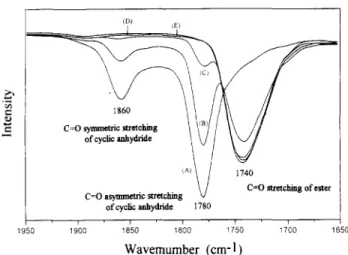
Study on the finished product of PC-epoxy blends Figure 1 shows the infrared spectra of the epoxy/ M E T H P A / B D M A (100" 50 : 2) (R50, Table 1) system in
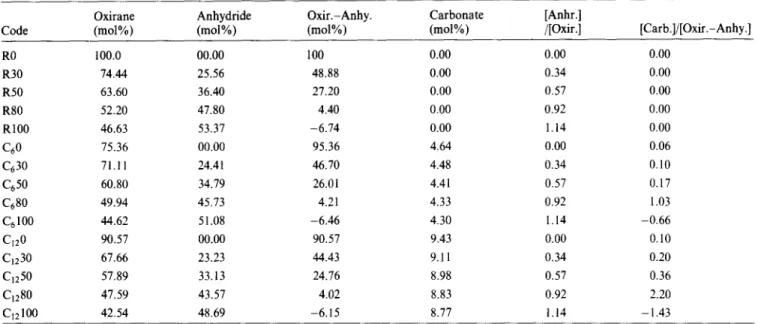
the carbonyl stretching regions during the progress of curing. This system contains excess oxirane (27.2 mol%,
Table 2) relative to anhydride. Comparing curve A with curve B shows that the absorptions of C = O symmetric and asymmetric stretch at 1860 and 1780cm ] decrease substantially after 60 min at 80°C. The intensity increase at 1740 cm- J is due to the formation of the ester group. The variations of these spectra can be explained as an anionic alternating copolymerization of the epoxide/ anhydride/tertiary amine system. The anhydride is believed to undergo a nucleophilic attack by the unbonded electron pair of the tertiary amine to form the quaternary ammonium salt zwitter ion which then reacts with epoxide to yield an alkoxide anion. The alkoxide anion is followed by attacking the anhydride to yield a carboxylate anion, which then repeatedly reacts
(D)
of
cyclic
anhydride
' / ~ / / ~iA)~/
1740C~O a s ~ c ~retching C=O stretching of ester of cyclic anhydride 1780
1950 19~00 18150 18'00 17~50 17100 1550
Wavemumber (cm-1)
Figure I Infrared spectra of the unmodified epoxy system (R50) in the carbonyl stretching region: (A) initial at 80°C, (B) 60min at 80°C, (C) 120 min at 80°C, (D) 180 min at 80°C, and (E) 300 min at 80°C, 120 min at 100°C and 120min at 120°C
Table 1 The compositions and codes of the PC-epoxy blends
Epoxy + METHPA + BDMA PC
Code Epoxy METHPA BDMA PC (wt%) (wt%)
R0 100 0 2 0 100 0 R30 100 30 2 0 100 0 R50 100 50 2 0 100 0 R80 100 80 2 0 100 0 R100 100 100 2 0 100 0 C60 100 0 2 6.51 94 6 C630 100 30 2 8.43 94 6 C650 100 50 2 9.70 94 6 C680 100 80 2 11.62 94 6 C6100 100 |00 2 12.89 94 6 C]20 100 0 2 13.91 88 12 C1230 100 30 2 18.00 88 12 C1250 100 50 2 20.73 88 12 C1280 100 80 2 24.82 88 12 C]2100 100 100 2 27.55 88 12
R is the virgin epoxy system not blended with PC C 6 is the PC-epoxy blend system with PC content 6 wt% C12 is the PC-epoxy blend system with PC content 12wt% 0, 30, 50, 80 or 100 is the phr of METHPA in the blend
Polycarbonate-epoxy blends with anhydride: M. -S. Li
et al.Table 2 The mole ratio of functional groups of the PC-epoxy blends
Oxirane Anhydride Oxir.-Anhy. Carbonate [Anhr.]
Code (mol%) (mol%) (mol%) (mol%) /[Oxir.] [Carb.]/[Oxir.-Anhy.]
R0 100.0 00.00 100 0.00 0.00 0.00 R30 74.44 25.56 48.88 0.00 0.34 0.00 R50 63.60 36.40 27.20 0.00 0.57 0.00 R80 52.20 47.80 4.40 0.00 0.92 0.00 R100 46.63 53.37 -6.74 0.00 1.14 0.00 C60 75.36 00.00 95.36 4.64 0.00 0.06 C630 71.11 24.41 46.70 4.48 0.34 0.10 C 650 60.80 34.79 26.01 4.41 0.57 0.17 C680 49.94 45.73 4.21 4.33 0.92 1.03 C 6100 44.62 51.08 -6.46 4.30 1.14 -0.66 CI20 90.57 00.00 90.57 9.43 0.00 0.10 C1230 67.66 23.23 44.43 9.11 0.34 0.20 C1250 57.89 33.13 24.76 8.98 0.57 0.36 C1280 47.59 43.57 4.02 8.83 0.92 2.20 C12100 42.54 48.69 -6.15 8.77 1.14 - 1.43
See Table 1 for explanation of codes
- If') .
"~ cycfic anhydride * \ /
(A) CH out of plane wag
ofpm'a-mbst~ted
overlapped strcte, bJng 910 beazeaes
ofo:uran¢ and cyclic aahych'ide
1 0 0 0 ' 9 8 0 ' 9 6 0 ' 9 4 0 ' 9 5 0 ' 9 0 0 ' 8 8 0 ' 8 6 0 ' 8 4 0 ' 8 2 0 8 0 0
Wavemumber (cm-
1)
Figure 2 Infrared spectra of the unmodified epoxy system (R50) in the
oxirane stretching region: (A) initial at 80°C, (B) 60 min at 80°C, (C) 120min at 80°C, (D) 180min at 80°C, (E) 300min at 80°C, 120min at 100°C and 120min at 120°C, (F) 300min at 80°C, 120min at 100°C, 120min at 120°C, 120min at 150°C and 120min at 180°C, and (G) 300 min at 80°C, 120min at 100°C, 120min at 120°C, 120min at 150°C, 120min at 180°C and 300min at 200°C
with an epoxide to yield an alkoxide anion 7. After 180 min at 80°C, the anhydride o f the system has been completely converted to ester (curve D).
Figure 2 presents the spectra o f the same system as
Figure i near the oxirane stretching regions of the epoxy. The absorption at 9 1 0 c m -1 is contributed by the overlapping o f absorption peaks o f oxirane and
anhydride. Curve A o f Figure 2 is the spectrum at the
beginning o f reaction. Curve B shows that the band decreased substantially after 60min. After 180min at 80°C, the anhydride o f the system has been completely
converted to ester, confirmed by curve D in Figure 1.
Therefore, the absorption at 910cm -1 of curve D in
Figure 2 is the absorption o f oxirane, which indicates that after 180min, the alternating copolymerization is
completed. Curve F in Figure 2 shows that the oxirane
peak disappears, and curve G shows no further change was detected thereafter. This p h e n o m e n o n can be interpreted as the h o m o p o l y m e r i z a t i o n of the oxirane groups o f the epoxy resin during the later stages o f curing. The tertiary amine attacks the oxirane to form a quaternary a m m o n i u m salt zwitter ion, which then reacts with the residual oxirane to yield an alkoxide anion. The alkoxide anion then reacts with other oxirane to complete the homopolymerization. The h o m o p o l y m e r - ization o f oxirane competes with the copolymerization o f epoxy/anhydride/tertiary amine during the curing pro- cedure, however, the reactivity o f h o m o p o l y m e r i z a t i o n is significantly lower than that o f copolymerization 8. Therefore, the curing reaction o f the system can be considered as two sequential stages: (1) an anionic alternating copolymerization o f cyclic anhydride and epoxy resin, and (2) a h o m o p o l y m e r i z a t i o n o f oxirane initiated by a quaternary a m m o n i u m salt zwitter ion. The mechanisms of the copolymerization of epoxy/ anhydride/tertiary amine and the h o m o p o l y m e r i z a t i o n
of oxirane are shown in Scheme 1.
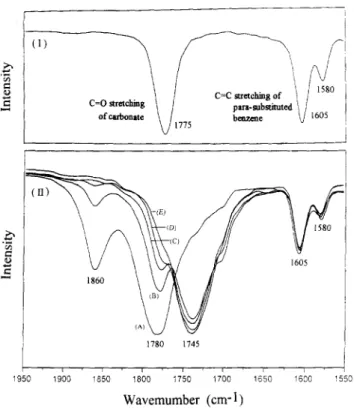
Figure 3(1) shows the a r o m a t i c / a r o m a t i c carbonate absorption peak o f p o l y c a r b o n a t e at 1775 c m - 1. Curve A
o f Figure 3(11) shows the spectra of the C1280 composi-
tion ( e p o x y / M E T H P A / B D M A / P C , 100 : 80 : 2 : 24.82). The system contains only a slight excess o f epoxy over
the anhydride (4%, as illustrated in Table 2). After
300rain at 80°C and 120min at 100°C, the absorption peaks at 1860 and 1780cm -1 have been reduced significantly and the band at 1745cm -l is apparent (curve C). The 1745 cm -1 band is the characteristic band of the ester group formed in the reaction between epoxy and M E T H P A . The 1780cm -1 band is due to the overlapping of the absorption peaks o f polycarbonate and anhydride. Curing proceeded after 300 min at 80°C, 120min at 100°C, 120min at 120°C and 120min at 150°C, the absorption of C = O symmetric stretch f r o m the M E T H P A at 1860cm -~ disappeared completely
(curve D, Figure 3(11)). At this stage o f curing, the
absorption o f C = O asymmetric stretch contributed from
1
P o l y c a r b o n a t e - e p o x y blends w i t h anhydride." M.-S. Li et al.
C O P O L Y M E R I Z A T ION
E--CHzCHCH2 +
O=~__t~=O'~+
NR3
~? ~ _ ~
E~CI-12CHCH2 + ~cl ~ - O--C C :L:~!: ~i>
___. ,o~_ ,~ 2 +
- , ? , ~ r I 7 % +
O--C C--O-I-CH2CH--o--C C~I-NI~
J ' ' ' ' Jl ' l L I 1 , ] h..,,~,. J ~ (3} E H O M O P O L Y M E R I Z A T ION E ~CH2CHCH2 --I~R3
+
°L..
E EScheme 1 Copolymerization of epoxy/anhydride/tertiary amine and the homopolymerization of oxirane
e. _= (l) i, 0 C = O stretchiag / ] para-substituted o f c-.~'bonite V 1775 beazlme _= 1950 1900 1780 1745 i i ' t i ~ , | 1850 1800 1750 1700 1660 1600 !550 Wavemumber (cm- 1)
Figure 3 (I) Infrared spectrum of polycarbonate in the carbonyl stretching region. (If) Infrared spectra of PC-epoxy blend with 12 wt% PC (C1280) in the carbonyl stretching region: (A) initial at 80°C, (B) 180 rain at 80°C, (C) 300 rain at 80°C and 120 min at 100°C, (D) 300 rain at 80°C, 120 rain at 100°C, 120 min at 120°C and 120rain at 150°C, and (E) 300rain at 80°C, 120min at 100°C, 120rain at 120°C, 120min at 150°C, 120min at 180°C and 300min at 200°C
s a m e time. T h e b a n d s h o w n a t 1 7 7 5 c m - I s h o u l d be the one c o n t r i b u t e d solely b y the c a r b o n y l g r o u p o f p o l y - c a r b o n a t e (curve D). A s curves D a n d E reveal, the intensity o f the b a n d at 1775 c m - l is g r a d u a l l y reduced.
!950 Figure 4 1860 1605 ' ~ > ~ J 1745 1780 1900 1850 1800 1750 1700 1650 1600 1550 Wavemumber (cm-1)
Infrared spectra ofPC-epoxy blend with 12wt%PC(Cx250) in the carbonyl stretching region: (A) initial at 80°C, (B) 60 min at 80°C, (C) 120 min at 80°C, (D) 300min at 80°C and 120 rain at 100°C, and (E) 300min at 80°C, 120min at 100°C, 120min at 120°C, 120 rain at 150°C, 120min at 180°C and 300min at 200°C
i t i 1805 1775 1605 1980 ~900 18;0 18;0 17;0 17;0 l & 16;0 1550 Wavemumbcr (cm-1)
Figure 5 Infrared spectra of PC epoxy blend with 12wt% PC (R0) recorded in the earbonyl stretching region: (A) initial at 80°C, (B) 60 min at 80°C, (C) 300 min at 80°C, (D) 300 min at 80°C, 120 min at 100°C and 120min at 120°C, and (E) 300min at 80°C, 120min at 100°C, 120min at 120°C, 120min at 150°C, 120rain at 180°C and 300min at 200°C
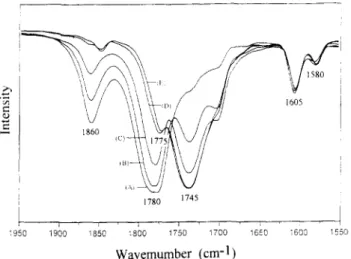
Figure 4 s h o w s the s p e c t r a o f the C1250 c o m p o s i t i o n ( e p o x y / M E T H P A / B D M A / P C , 100 : 50 : 2 : 20.73), which are similar to t h o s e o f R50 ( e p o x y / M E T H P A / B D M A / PC, 1 0 0 : 5 0 : 2 : 0 ) e x c e p t the presence o f 1 2 w t % PC. C o m p a r i n g w i t h the p r e v i o u s C1280 system, the C1250 s y s t e m c o n t a i n s excessive e p o x y relative to M E T H P A (24.76%, as i l l u s t r a t e d in Table 2). C u r v e A p r e s e n t s the initial s p e c t r u m o f the e p o x i d e / a n h y d r i d e / t e r t i a r y a m i n e / P C system w h e r e the b a n d s a t 1860 a n d 1 7 8 0 c m - l a r e c h a r a c t e r i s t i c o f M E T H P A . C u r v e C shows t h a t the b a n d at 1860 c m - 1 d i s a p p e a r e d c o m p l e t e l y , a n i n d i c a t i o n o f c o m p l e t e c o n s u m p t i o n o f M E T H P A . T h e r e f o r e , the l r e m a i n i n g p e a k at 1775 c m - o f curve C is the a b s o r p t i o n b a n d m a i n l y f r o m the c a r b o n a t e g r o u p o f PC. F r o m curves D a n d E, the a b s o r p t i o n b a n d o f c a r b o n y l s t r e t c h i n g c o n v e r t s to a b r o a d b a n d n e a r 1805 c m -1.
Figure 5 gives the s p e c t r a o f the C120 system, as
i l l u s t r a t e d in Table 1, w h i c h has a c o m p o s i t i o n
Polycarbonate-epoxy blends with anhydride." M.-S. Li
et al.T a b l e 3 Characteristic i.r. bands of carbonyl groups
Band (cm-i ) Assignment Ref.
1776 1762 1746 1865 1785 1740
C=O stretch of Ar-O-CO-O-Ar 9
C=O stretch of A r - O - C O - O - R 9
C=O stretch of R - O - C O - O - R 9
C=O symmetric stretch of anhydride 7
C=O asymmetric stretch of anhydride 7
C=O stretch of ester 7
TRANSESTERIFICATION E~CH2CHCH2 + NR3 O __~ ~-o,~,c,,-,,~ . , o - L ~ - o - c - o - ~ , . . ~ c + NR3 ~ o
E~CH2C4-t-- O-- C--O ~ _ ~ pC + PC
E~,~CH2 (6) + NR3 (7) P C @ C m o C H 2 ~ P C ~ C H - - O - C - - O - - q H - -i i E~CH2 CH2~E S c h e m e 2 Transesterification mechanism (8)
1 0 0 : 0 : 2 : 13.91), by varying the reaction time o f the system. Curve A shows the absorption band of the
1
carbonate group of polycarbonate at 1775 c m - . Curve B shows that the carbonyl absorption band splits into two
1
bands, 1755 and 1805cm- . Curves B and C show the
band intensity decreases at lower frequencies
(1755cm-1), while increasing at higher frequency band
l
(1805 c m - ). The shift o f absorption of the carbonate at 1775 to 1755cm 1 can be interpreted as the trans- esterification reaction, converting the original carbonate group o f the PC between two aromatic nuclei
A r - O - C O - O - A r , into either one aromatic and one
alkyl group A r - O - C O - O - R or two alkyl groups
R - O - C O - O - R by the zwitter ion. Table 3 lists the
infrared carbonyl band parameters reported pre- viously 7'9. The mechanism o f transesterification is illustrated in Scheme 2.
After post-curing, the intensity of the higher frequency absorption band increases drastically, while the band
intensity at 1755 cm-1 decreases gradually then
disappears (curves C - E ) . This phenomenon has been studied by a model reaction using diphenyl carbonate and phenyl glycidyl ether, leading to the formation of a cyclic carbonate, 4-phenoxymethyl-l,3-dioxolane-2-one (PMD) l°. In other words, a cyclic carbonate structure can be formed from the cyclization of the carbonate substituted with an alkyl group(s). The mechanism to form the cyclic carbonate is assumed to proceed through a zwitter ion and a nucleophile attack o f the aromatic/ aliphatic or the aliphatic/aliphatic carbonate group. It must be emphasized that this cyclization requires the presence o f oxirane in order to form the zwitter ion. That
CYCLIZATION
. _ @
o- • ~.-o-o-o-~. R3 /% ( o @ c~2 ~ c - - - .... @. o-i:a_
~
O - - C H e ~....A I t ?, / c \ q 9 ~O~CH2/GH-cH2Scheme 3 Cyclization mechanism to form cyclic carbonate
(1o) 1605 I (Bi (£) ~11745 1805 "~ ~ ' ~ , # , 4 5 ~ - - " \ p . / \ , / ',/ '\ / ' , f / \, 1860 \' \ 45 ~ / --'~ ~ . ~ . ~ ,, \ // 'J \ / \/,, ] 775\ / / 1745 , // \K./' ~ 1775 1950 19100 ' 18~50 1800' 1 ; 5 0 ' 17100 16r50 1600 1550 Wavemumber (cm-1)
Figure 6 Infrared spectra of PC-epoxy blend with 12 wt% PC in the carbonyl stretching region: (A) C1~0, (B) CI230 , (C) C1250, (D) C1280 ,
(E) C12100, and (F) pure PC
means excess epoxy related to M E T H P A in the feed is essential to proceed with this cyclization reaction. The
cyclization mechanism is illustrated in Scheme 3.
Comparing Figure 5 with Figures 3(11) and 4, we can
Polycarbonate-epoxy blends with anhydride. M.-S. Li
et al.two bands, 1755 and 1805cm -1, which is due to the transesterification/cyclization reaction. Another charac- teristic feature of the spectra from this epoxy/anhydride/ tertiary amine/polycarbonate system is that the transesterification/cyclization reaction occurs mainly during the later stage of homopolymerization. The phenomenon observed is consistent with the previously proposed mechanism of transesterification/cyclization proceeding through a zwitter ion by tertiary amine and oxirane l°. An approach to verify this mechanism was made by varying the epoxy/anhydride ratio of the epoxy/ anhydride/tertiary amine system (Table 2). Curves A - E of Figure 6 show the i.r. spectra of the end products of the
PC-epoxy blends with various epoxy/anhydride ratios
(C120, C1230, C1250 , C1280 and C12100, Table 2). Curve F
of Figure 6 represents the i.r. absorption of PC. By
comparing curves A - C of Figure 6, the intensity of
absorption at 1805cm I decreases with decreasing epoxy/anhydride ratio, an indication of a decrease of the homopolymerization fraction. With only a slight excess of epoxy relative to anhydride, curve D of Figure 6
shows the presence of the unreacted carbonate absorp- tion of PC, while the absorption of cyclic carbonate at 1805cm I is not present. This phenomenon can be explained by the cyclic carbonate not being obtained in significant amount from the composites with higher mole ratio of oxirane to anhydride and carbonate. The low fraction of homopolymerization indicates the depletion of the oxirane for possible cyclization reaction to occur. In other words, only some transesterification reactions occurred, thus decreasing the carbonate absorption at 1775cm -1 (curve D of Figure 6). Curve E of Figure 6
shows the i.r. spectrum of the reaction product from the PC-epoxy blended with slight excess anhydride relative to oxirane where the carbonate absorption of the unreacted PC is higher than that in curve D.
Figure 7 represents the spectra during curing progress
for the C12100 composite with excess anhydride relative to oxirane (C12100 , Table 1). The absorption band at
1860 cm I indicates that residual METHPA existed and the band at 1745 cm-I represents the ester formed. The
1775cm I band is due to the overlapping band of polycarbonate and anhydride as mentioned earlier. However, no absorption band of cyclic carbonate at 1805 cm I could be detected. Abbate et al. 5 studied P C -
epoxy blended with excess anhydride, the i.r. spectra they obtained also confirmed that the carbonyl group of PC does not participate in the curing process and they did not detect any cyclic carbonate formation as would be expected. These results demonstrate that the system with a higher copolymerization content relative to homo- polymerization tends to reduce the degree of trans- esterification due to the decrease of the residual oxirane to react with tertiary amine to proceed with the transesterification/cyclization.
The characteristic feature of these results is the drastic difference in reaction rate of copolymerization, homo- polymerization, transesterification and cyclization. From the reaction mechanism mentioned above, the copolymerization, homopolymerization and trans- esterification actually compete with each other. How- ever, the evidence of the experimental results shows that the reactivities of homopolymerization and trans- esterification are significantly lower than that of copolym- erization. This assumption can be proved by investigating the spectrum of curve D, Figure 6. The
composition for this spectrum is C1280, and the mole ratio of oxirane to anhydride is 1.09, near the stoichio- metric ratio of pure copolymerization. If the reactivities of homopolymerization and transesterification are not significantly less than the copolymerization, then these reactions will consume a noticeable portion of the oxirane during the first stage of curing (copolymeriza- tion), and the anhydride should be in oversupply. However, no absorption of the residual anhydride at 1860cm -I can be detected. For the same reason, the reactivity of transesterification is less than the homo- polymerization, otherwise the shoulder at 1775cm 1 which indicates the existence of original PC carbonate would not appear. As the substrate of cyclization is the product of transesterification, there is no doubt that cyclization should occur at the latest stage of curing.
120 - e- 1860 /
f ,
1605 1580 1780 1745 1950 1900 1850 18 0 1750 17 0 16£9 160,9 1550 Wavemumber (cm -l)Figure 7 Infrared spectra of PC-epoxy blend with 12wt% PC (Cl2100) in the carbonyl stretching region: (A) initial at 80°C, (B) 60min at 80°C, (C) 180rain at 80°C, (D) 300rain at 80"C, 120min at 100°C, 120rain at 120°C, 120min at 150°C and 120rain at 180°C, and (E) 300min at 80°C, 120min at 100°C, 120rain at 120°C, 120min at 150°C, 120rain at 180°C and 300min at 200°C
115 - %.. 0) i~o- © o_ 105- F-
._~
C I 0 0 - I-- (9 95 x X ,, ._ i i / ' / " / Ii" . / ' / ' A / / // . / 90 0 0 1.0 ./ / / / / // [ . - / - , . - - P C 0 w t % • P C 6 w t % • P C 1 2 w t %0'2
0'4
0'8
8'8
M E T H P A / E p o x y ( B y W e i g h t )Figure 8 Glass transition temperatures of the blending systems at
Polycarbonate-epoxy blends with anhydride." M.-S. Li
et al.The glass transition temperatures (Tg) of the finished products o f all the blending systems measured by differential scanning calorimetry (d.s.c.) are shown in
F i g u r e 8. The Tg o f the blending system decreases with increasing polycarbonate content. All of the Tgs o f these blending systems are lower than that of the pure polycarbonate. These data do not fit the predictions of the Fox relationship. This predicts that the Tg of an ideal polymer blend is between the pure components 1t. A reasonable explanation is that the transesterification reaction occurs, hence the epoxy was inserted into the polycarbonate, or a chain end was formed in the network in the cyclization reaction. Both reactions may change the chemical structure and decrease the crosslink density o f the original system. Thus, increasing the homopolym- erization fraction would increase the cyclization reaction and decrease the Tg of the P C - e p o x y blend. F o r example, the Tg of the C120 system is 25°C lower than that o f the R0 system. The Tgs of the C1230 and C1250 systems are 15 and 5°C lower than those of R30 and R50, respectively. The Tg of the C1280 system is almost the same as those of C680 and R80. This result can be explained from the i.r. spectrum (curve D of
F i g u r e 6) that there is only a low degree of transester- ification reaction and so the cyclization reaction does not occur. However, the Tg o f the blended system which uses excess anhydride decreases with increasing PC content. Although the presence of PC does not affect the overall curing mechanism, it may decrease the final conversion o f reactants 5. The reduced conversion causes a deviation from the Fox law, even the original PC carbonyl group does not transesterificate with the epoxy. These phenom- ena cause the Tg of the P C - e p o x y blend to be lower than that of the pure components.
C O N C L U S I O N S
The curing reaction o f the epoxy/anhydride/tertiary amine system can be considered as two sequential stages: (1) an anionic alternating copolymerization o f cyclic anhydride and epoxy resin, and (2) a homopolym- erization o f oxirane. The transesterification/cyclization
reactions in the P C - e p o x y blends occur during the later stages o f curing. A mechanism has been proposed to explain the formation o f the cyclic carbonate compound by proceeding through a zwitter ion followed by a nucleophile attack at the aliphatic/aliphatic carbonate group. Conversion of transesterification/cyclization increases with increasing fraction of homopolymeriza- tion. This result confirms that the mechanism o f transesterification/cyclization proceeds through a zwitter ion. The cyclization reaction causes a chain end in the network and decreases the Tg o f the blended system, as expected.
A C K N O W L E D G E M E N T S
This research is financially supported by the National Science Council, Taiwan, R.O.C. under contract No. NSC 84-2622-E-007-001. We thank Professor Chiu- Ming Chen for helpful discussion, and Epolab Chemical Co. for materials.
R E F E R E N C E S
1 Funahashi, K. Bull. Chem. Soc. Jpn 1979, 52, 1488
2 Nishikubo, T.. Iizawa, T. and Saita, S. J. Polvm. Sci. A 1986, 24, 1685
3 Komarova, L. I., Salazkin, S. N., Bulgakova, 1. A., Malaniya,
M. I., Vinogradova, S. V. and Korshak, V. V. J. Polym. Sci., Polym. Chem. Ed. 1978, 16, 1643
4 Yu, Y. and Bell, J. P. J. Polym. Sci. A 1988, 26, 247
5 Abbate, M., Martuscelli, E., Musto, P., Ragosta, G. and Scar-
inzi, G. J. Polym. Sci. B 1994, 32, 395
6 Li, M. S., Ma, C. C. M., Chen, J. L., Lin, M. L. and Chang, F. C.
Macromolecules 1996, 29, 499
7 Luston, J. and Manasek, Z. J. Macromol. Sci. Chem. A 1978, 12, 983
8 Ellis, B. "Chemistry and Technology of Epoxy Resins', Chap- man & Hall, London, 1994
9 Yang, X., Painter, P. C. and Coleman. M. M. Macromolecules
1992, 25, 4996
10 Li, M. S., Ma, C. C. M., Chen, J. L, Lin, M. L and Chang, F. C. 'Proc. Int. Chinese Symp. on Polymer Blends', Hsin Chu, Tai- wan, 1995
11 Sperling, L. H. 'Introduction to Physical Polymer Science'. John Wiley, New York, 1986