Analysis of Puerariae radix and its medicinal preparations by
capillary electrophoresis
*
Chin-Yu Wang, Hsi-Ya Huang, Kuang-Lung Kuo, You-Zung Hsieh
Department of Applied Chemistry, National Chiao Tung University, Hsinchu 30050, Taiwan, R.O.C.
Abstract
This study presents a high-performance capillary electrophoresis (CE) method to analyze five constituents of Puerariae
radix, an important crude herb used in Chinese medicine. Puerarin, daidzin, daidzein, genistein and biochanin A are the
bioactive constituents of Puerariae radix. Herein, those analytes were successfully separated within 6 min using a pH 10.1 borax–NaOH buffer. The effects of pH value and concentration of the running buffer on the separation of the five analytes were also examined. The relative standard deviations of the analytes’ migration times were less than 0.38% under the optimized separation conditions. Notably, the correlation coefficients of the analytes’ linear calibration graphs exceeded 0.998. Moreover, the amounts of the five constituents in three different Puerariae radix samples were determined by the CE method with a relatively simple extraction procedure. 1998 Elsevier Science B.V.
Keywords: Puerariae radix; Pharmaceutical analysis; Puerarin; Daidzin; Daidzein; Genistein; Biochanin A
1. Introduction why this investigation selects the five compounds for analyzing Puerariae radix.
Traditional Chinese medicine has been extensively Thin-layer chromatography (TLC) is the conven-used to prevent and cure many diseases that have tional means of analyzing traditional Chinese medici-inflicted humans for over a millennium. In particular, nal preparations. However, this technique can only the merits of low toxicity and rare complications analyze one or two components in a crude herb or in have subsequently led to considerable attention in a concentrated preparation [3]. Several studies have various fields. Among pertinent investigations in- demonstrated that high-performance liquid chroma-clude the analysis of active ingredients and / or major tography (HPLC) can individually or simultaneously components of the medicine, treatment of diseases determine puerarin, daidzin and daidzein in and the search for alternative drugs. Puerariae radix or in traditional Chinese medicinal
Puerariae radix, referred to as ‘‘Ge-gen’’ in preparations [4–8]. However, the HPLC method
Chinese, is an important crude herb used in Chinese takes more than 40 min if puerarin, daidzin and medicine [1–5]. This herb has been used primarily to daidzein are simultaneously determined in the tradi-treat the common cold, influenza and wrist or tional preparations [6,7]. Therefore, this study fo-shoulder stiffness. The fact that Puerariae radix cuses primarily on establishing a rapid and efficient comprises puerarin, daidzin, daidzein, genistein, and analytical method to analyze the constituents of biochanin A as the major constituents accounts for Puerariae radix and its medicinal preparations.
Capillary electrophoresis (CE) is highly effective *Corresponding author. in analyzing many kinds of compounds in various 0021-9673 / 98 / $19.00 1998 Elsevier Science B.V. All rights reserved.
tion produced by CE is minimum, thereby offering boiling in water, drying and powdering. Water was advantages over the HPLC method. Consequently, purified with a Milli-Q water system (Millipore, CE has been employed to analyze Chinese crude Bedford, MA, USA) and filtered through a 0.22-mm herbs and Chinese medicinal preparations [15–18]. filter.
In the present study, CE was employed to separate
and determine puerarin, daidzin, daidzein, genistein 2.3. Procedure and biochanin A in Puerariae radix. The influences
of pH value and concentration of buffer solution on 5 mg / ml standard solutions of five analytes were the separation of the analytes were also investigated. prepared in methanol. Sample solutions with various The reproducibility of the CE method was also concentrations were prepared by diluting the stan-examined. Moreover, the five analytes in Puerariae dard solutions with methanol. Borax–NaOH buffer
radix and its medicinal preparations were determined solutions were prepared by mixing appropriate
by the optimized CE method. amounts of 0.1 M borax with 0.1 M NaOH in
deionized water.
3 g of Puerariae radix root and each concentrated
2. Experimental commercial medicinal preparation were accurately weighed. The weighed sample was mixed and
ex-2.1. Apparatus tracted with 20 ml methanol for 15 min in an
ultrasonic bath. The extract was then filtered through The experiments were performed on Beckman a filter paper. The extraction procedure was repeated P/ACE 2000 and P/ACE 5500 CE systems (Beck- three times. Next, a total of 60 ml extracted solution man Instruments, Fullerton, CA, USA). A personal was concentrated to dryness. Methanol was added to computer controlled the P/ACE instrument. Data dissolve the residue to a final volume of 4.0 ml analyses were performed on System Gold software. before analysis by CE.
A 47 cm (40 cm to the detector)350 mm I.D. fused-silica capillary tube (Polymicro Technologies,
Phoenix, AZ, USA) was used. The capillary column 3. Results and discussion
was assembled in a cartridge format. Temperature of
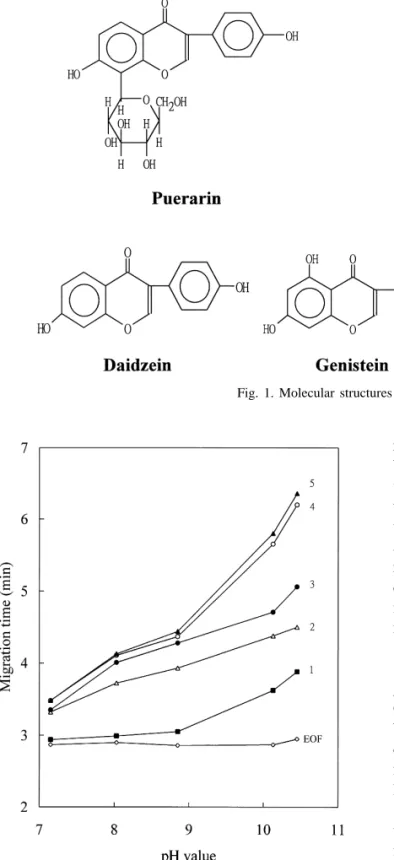
the capillary tube during electrophoresis was main- Fig. 1 illustrates the molecular structures of the tained at 258C by the P/ACE thermostatting system. five analytes. Those analytes have similar primary The applied voltage of the electrophoresis separation structures with different functional groups at their was set at 21 kV. Samples were pressure injected at benzene rings. Among those analytes, the hydroxyl 0.034 bar (0.5 p.s.i.; 1 p.s.i.56894.76 Pa) for 2 s. group is the common functional group for those analytes; two of the analytes have glucosyl moiety.
2.2. Chemicals The difference in the functional group among the
analytes is attributed primarily to the number and Sodium hydroxide was purchased from Fluka position of the hydroxyl groups at the benzene ring. (Buchs, Switzerland). Borax, biochanin A and genis- Based on UV absorbance spectra of those analytes, tein were purchased from Sigma (St. Louis, MO, 200 nm was selected herein for detection.
USA). Daidzin and daidzein were obtained from
Extrasynthese (Genay, France). Puerarin was pur- 3.1. Effects of buffer pH value and buffer chased from Yoneyama (Osaka, Japan). Methanol concentration on the separation
was obtained from Merck (Darmstadt, Germany).
Fig. 1. Molecular structures of the five analytes.
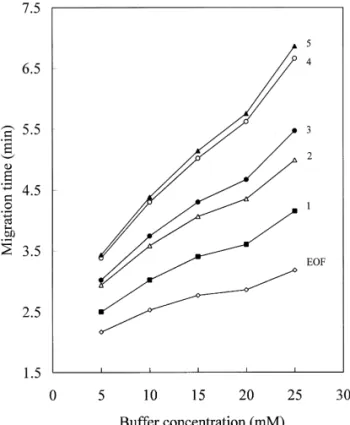
ranging from 7.2 to 10.4, on the analyte migration behavior. Both phosphate and borate buffer systems were used as the running buffers. The migration times of analytes increased with an increasing pH value of the running buffer. This phenomenon can be attributed to that the hydroxyl group at the benzene rings of the five analytes could be dissociated and the degree of the dissociation of the hydroxyl group increased with a rising pH value. However, the migration sequence of the five analytes remained the same within the pH range.
As Fig. 2 indicates, the migration velocity of genistein was the lowest among those analytes. Genistein, having three hydroxyl groups at the benzene ring, could carry more negative charges than other analytes. In contrast, daidzin has the largest molecular mass with only one hydroxyl group, thus leading to the shortest migration time.
Experimental results indicate that the buffer pH value heavily influenced migration velocities of the five analytes. Also, the differences between the analyte migration velocities were altered with an Fig. 2. Effect of buffer pH value on the analyte migration times. increasing pH value. Daidzin and electroosmotic 15Daidzin; 25biochanin A; 35puerarin; 45daidzein; 55
flow migrated at a similar velocity at pH 7.2. genistein. Conditions: capillary, 47 cm (40 cm to detector)350
Biochanin A and puerarin similarly migrated with
mm I.D.; applied voltage, 21 kV; detection wavelength, 200 nm;
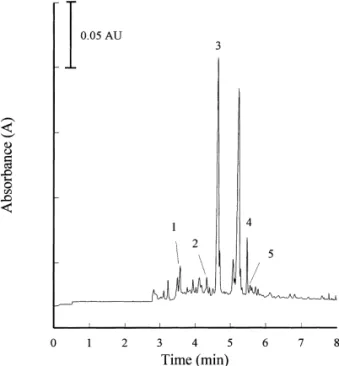
group dissociation. The five analytes were adequate- ration time, the optimized condition of the pH 10.1 ly separated at pH 10.1 and 10.4 buffers. Moreover, borax–NaOH buffer for separating the five analytes the separation time at pH 10.4 surpassing that at pH was at 20 mM.
10.1 implied that the pH 10.1 borax–NaOH was the Fig. 4 depicts the electropherogram of the five preferred choice to separate the analytes. analytes under the optimized conditions. The five The buffer concentration plays a prominent role in bioactive components were adequately separated electrophoretic separation. Consequently, more within 6 min by the CE method. Table 1 lists the closely examining the effects of buffer concentration average migration times, the reproducibilities on the separation of the five analytes is highly (R.S.D.s), slopes, intercepts, linearities of the cali-desired. A borate buffer of pH 10.1 was employed bration graphs and the detection limits of the five with the concentration ranging from 5 mM to 25 analytes. The R.S.D.s of the migration times were mM. Fig. 3 summarizes the effects of buffer con- lower than 0.38%. Peak area of the electropherogram centration on the analyte migration behavior. Ac- was employed for quantifying the analytes. The cording to this Figure, the migration times of the five linearities of the calibration graphs for the analytes analytes increased with an increasing buffer con- were at least two orders from 5 mg / ml to 500 centration. Although the separation time could be mg / ml, in which correlation coefficients exceeded reduced with a decreasing buffer concentration, the 0.998. The detection limits for those analytes ranged from 1.22 mg / ml to 1.77 mg / ml. Thus, the CE method has the advantages of high resolution, high efficiency and short separation time.
Fig. 4. Separation of the five analytes under the optimized Fig. 3. Effect of buffer concentration on the analyte migration conditions. Conditions: separation solution, 20 mM borax–NaOH times. Conditions: separation solution, borax–NaOH buffer, pH buffer, pH 10.1; concentration of each analyte, 150 mg / ml. Other 10.1. Other conditions as in Fig. 2. conditions as in Fig. 2.
Table 1
Average migration times, reproducibilities, slopes, intercepts, correlation coefficients of calibration graphs and the detection limits of the five analytes
a
Analyte Migration time R.S.D. Slope Intercept Correlation coefficient of Detection limit
(min) (%) calibration graph (r) (mg / ml)
Daidzin 3.57 0.21 0.0037 20.0073 0.999 1.77 Biochanin A 4.34 0.38 0.0051 20.0134 0.999 1.37 Puerarin 4.67 0.34 0.0032 0.0006 0.999 1.66 Daidzein 5.61 0.38 0.0060 20.0731 0.998 1.22 Genistein 5.76 0.38 0.0027 20.0098 0.999 1.33 a n510.
3.2. Extraction and determination of the analytes on above results, we can infer that methanol is a
in Puerariae radix and its medicinal preparations better solvent to extract the samples.
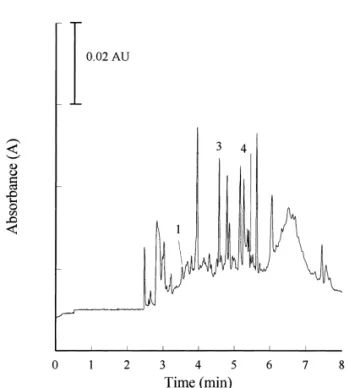
Figs. 5–7 display the electropherograms of the The amounts of the five analytes were determined extracts of Puerariae radix, medicinal preparation of in three different samples, including Puerariae radix, Puerariae radix and medicinal preparation of
Ge-medicinal preparation of Puerariae radix, and gen-tang, respectively. As those Figures reveal, more medicinal preparation of Ge-gen-tang. Methanol and than ten peaks appeared in the electropherograms. methanol–water (7:3, v / v) were initially employed However, daidzin, biochanin A, puerarin, daidzein as the extraction solvents. According to experimental and genistein were adequately resolved from other results, the five analytes solubility in methanol– unknown compounds and could be clearly identified. water solution was inadequate. Also, the extract by The five components could be determined in methanol–water solution contained some interfer- Puerariae radix and medicinal preparation of ences which intensified the background noise. Based Puerariae radix. With the extract of the medicinal
Fig. 5. Electropherogram of Puerariae radix. Conditions as in Fig. Fig. 6. Electropherogram of medicinal preparation of Puerariae
of the analytes in the medicinal preparation of
Puerariae radix surpassed those in Puerariae radix.
This finding is likely ascribed to that the medicinal preparations are concentrated and powdered from crude herbs. Since Ge-gen-tang includes other herbs, the amount of Puerariae radix in Ge-gen-tang is only 20% (w / w) [1]. Thus, the analyte contents in Ge-gen-tang were lowest among those samples. Also, the ingredients of the traditional Chinese medicinal preparation is quite complex and some components may alter during the manufacturing process. In addition, the relative ratios of the amounts for the five analytes varied among those actual samples, likely owing to different sources of crude herb or different manufacturing processes. Experimental results presented herein demonstrate Fig. 7. Electropherogram of medicinal preparation of Ge-gen-tang.
Conditions as in Fig. 4. that the CE method can rapidly and efficiently analyze constituents in crude herb and traditional Chinese medicinal preparation.
preparation of Ge-gen-tang sample, only daidzin, In summary, the five analytes were completely puerarin and daidzein were determined. Biochanin A separated within 6 min using a 20 mM borax–NaOH and genistein could not be detected. Those analytes (pH 10.1) buffer. The CE method successfully in actual samples were identified by comparing both analyzed the five constituents in Puerariae radix and the migration times and the UV spectra of standards its traditional Chinese medicinal preparations. The with those in actual samples. Those analytes were extraction method for actual samples was relatively further confirmed by spiking standards in actual simple and efficient. Consequently, the CE method is samples. The specific constituents in actual samples a promising alternative to analyze other crude herbs could be adequately identified through those pro- and traditional Chinese medicinal preparations.
Re-cesses. sults presented herein can hopefully further advance
Table 2 lists the quantities of the five analytes in current knowledge of Chinese traditional medicine. Table 2
Content of the five analytes in actual samples
Analyte Puerariae radix Medicinal preparation of Medicinal preparation of
Puerariae radix Ge-gen-tang
Mean R.S.D. Mean R.S.D. Mean R.S.D.
a a a a a a (mg / g) (%) (mg / g) (%) (mg / g) (%) Daidzin 63.0 1.37 292.1 0.32 52.1 4.96 b Biochanin A 51.4 1.77 78.7 3.14 – Puerarin 994.1 5.83 3238.4 0.91 298.5 0.82 Daidzein 54.7 1.29 207.9 5.12 45.7 1.58 b Genistein 65.0 4.53 66.4 – a n53. b Not detected.
[6] Y. Ohshima, T. Okuyama, K. Takahashi, T. Takizawa, S.
Acknowledgements
Shibata, Planta Med. 54 (1988) 250.
[7] T. Yasuda, N. Momma, K. Ohsawa, Yakugaku Zasshi 113 This study was supported by Grant NSC 86-2113- (1993) 881.
M-009-016 from the National Science Council of [8] K.-C. Wen, C.-Y. Huang, F.-L. Lu, J. Chromatogr. 631
Taiwan, R.O.C. (1993) 241.
´ ´
[9] F. Foret, L. Krivankova and P. Bocek, Capillary Zone Electrophoresis, VCH, Weinheim, 1993.
[10] J.P. Landers (Editor), Handbook of Capillary Electrophoresis,
References CRC Press, Boca Raton, FL, 1994.
[11] R. Kuhn, S. Hoffstetter-Kuhn, Chromatographia 34 (1992) [1] H.Y. Hsu, Y.P. Chen, S.J. Sheu, C.C. Chen and H.C. Chang, 505.
Chinese Material Medica—A Concise Guide, Modern Drug [12] M. Novotny, H. Soini, M. Stefansson, Anal. Chem. 66
Press, Taipei, 1985. (1994) 646A.
[2] H.-Y. Hsu and C.-S. Hsu, Commonly Used Chinese Herb [13] H. Nishi, S. Terabe, J. Chromatogr. A 694 (1995) 245. Formulas with Illustrations, Oriental Healing Arts Institute, [14] Y. Kim, M.D. Morris, Electrophoresis 17 (1996) 152. Long Beach, 1990. [15] H.-R. Chen, S.-J. Sheu, Chromatogr. A 704 (1995) 141. [3] The Analysis Methods for Chinese Medicine, National [16] M.-C. Lee, W.-C. Chuang, S.-J. Sheu, J. Chromatogr. A 755
Laboratories of Foods and Drugs, Department of Health, (1996) 113.
Taipei, 1995. [17] Y.-Z. Hsieh, H.-Y. Huang, J. Chromatogr. A 759 (1997) 193. [4] J. Hayakawa, N. Noda, S. Yamada, K. Uno, Yakugaku Zasshi [18] H.-Y. Huang, K.-L. Kuo, Y.-Z. Hsieh, J. Chromatogr. A 771
104 (1984) 50. (1997) 267.
[5] Y. Kitada, M. Mizobuchi, Y. Ueda, H. Nakazawa, J. Chroma-togr. 347 (1985) 438.