1446 IEEE ELECTRON DEVICE LETTERS, VOL. 31, NO. 12, DECEMBER 2010
Characteristics of the Fluorinated High-
k
Inter-Poly Dielectrics
Chih-Ren Hsieh, Yung-Yu Chen, Kwung-Wen Lu, Gray Lin, and Jen-Chung Lou
Abstract—In this letter, the reliabilities and insulating charac-teristics of the fluorinated aluminum oxide (Al2O3) and hafnium
oxide (HfO2) inter-poly dielectric (IPD) are studied for the first
time. Compared with the IPDs without fluorine incorporation, the results clearly indicate that fluorine incorporation process is effec-tive to improve the insulating characteristics of both the Al2O3
and HfO2IPDs, mainly ascribed to the trap density reduction and
the smooth interface. Although HfO2 possesses higher dielectric
constant to increase the gate coupling ratio, the results apparently indicate that the fluorine incorporation process is more effective to improve the dielectric characteristics of the Al2O3 IPD than
the HfO2IPD.
Index Terms—Al2O3, fluorine, HfO2.
I. INTRODUCTION
T
HE FLASH memory market has shown exponential in-creases, particularly in the area of mass storage applica-tion. In the coming decade, we will be required to provide flash technology that is compatible with the read/write speed of embedded dynamic random access memory and high non-volatility. For the floating-gate flash memory, the inter-poly dielectric (IPD) requires a high breakdown voltage and a low leakage current to obtain better data retention [1], [2]. Incorpo-rating alternative high dielectric constant (high-k) materials to replace current oxide/nitride/oxide (ONO) IPD of the floating-gate flash memories can be a way to increase the floating floating-gate capacitance without extending the cell area and complicating the fabrication process while suppressing the charge loss [3], [4]. However, direct deposition of high-k dielectrics without interface treatments either on the polysilicon (Si) or on the Si substrate would inevitably result in a poor interface between the gate dielectrics and the poly-Si or between the gate dielectric and the Si substrate due to undesirable interface reoxidation [4], [5].Recently, dielectric properties and device characteristics with fluorine incorporated high-k gate stacks have been studied comprehensively [6], [7]. Fluorine implantation prior to the gate dielectric deposition can widely distribute fluorine atoms within the high-k films, then recover interfacial dangling bonds and
Manuscript received August 15, 2010; accepted August 29, 2010. Date of publication October 18, 2010; date of current version November 24, 2010. This work was supported by the National Science Council of the Republic of China under Grant NSC 97-2221-E-009-165. The review of this letter was arranged by Editor T. San.
C.-R. Hsieh, K.-W. Lu, G. Lin, and J.-C. Lou are with the Department of Electronics Engineering and the Institute of Electronics, National Chiao-Tung University, Hsinchu 300, Taiwan.
Y.-Y. Chen is with the Lunghwa University of Science and Technology, Taoyuan 333, Taiwan (e-mail: [email protected]).
Digital Object Identifier 10.1109/LED.2010.2074181
bulk oxygen vacancies during subsequent processes, which is useful to reduce gate leakage current and to improve dielec-tric reliabilities [8], [9]. Nevertheless, the effects of fluorine incorporation within the high-k dielectric, serving as the IPD of the floating-gate flash memory, are seldom investigated. In this study, for the first time, the reliability characteristics of the fluorinated high-k IPDs are studied in order to further enhance the dielectric insulating properties.
II. EXPERIMENT
In the experiment, the n+-poly-Si/IPD/n+-poly-Si capacitors
were fabricated on 6-in p-type (100)-oriented silicon wafers. Then, a 200-nm poly-Si gate was deposited on the buffer oxide by a low-pressure chemical vapor deposition (LPCVD) system using SiH4 gas at 620 ◦C and subsequently implanted with
phosphorous at 5× 1015cm−2, 20 keV to form the n+poly-Si bottom gate. Prior to the aluminum oxide (Al2O3) or hafnium
oxide (HfO2) dielectric deposition, the bottom gate was
sub-jected to fluorine ion (F+) implantation at 5× 1013 cm−2,
10 keV (defined as AlOF and HfOF in the figures, respectively). After conventional RCA cleaning and sequentially etching in diluted hydrofluoric acid to remove particles and native oxides, Al2O3 and HfO2 IPDs were then deposited by metal-organic
chemical vapor deposition with O2gas at 500◦C followed by
postdeposition annealing at 900◦C and 600◦C in N2 ambient
for 30 s, respectively. Subsequently, a 200-nm n+ poly-Si
top gate was fabricated in the same way as the n+ poly-Si bottom gate, followed by dopant activation with rapid thermal annealing at 950◦C in N2ambient for 30 s. After the gate stacks
were patterned, the 500-nm TEOS oxide passivation and the Al metallization were defined.
The high-k IPDs without interface treatment (defined as AlO and HfO in the figures) were also fabricated to evaluate the impact of the fluorine incorporation. Scaled ONO IPD was used as a reference. The ONO IPD consists of a 1.5–2-nm thermally grown bottom oxide on the n+ poly-Si bottom gate
at 850◦C in an O2/N2environment, a 4–9-nm LPCVD nitride
layer deposited on top at 700◦C using SiH2Cl2and NH3gases,
and lastly, a 1–1.5-nm top oxide formed by wet oxidation of the nitride layer at 950 ◦C in an O2/H2 ambient. In addition,
the insulating characteristic of the ONO IPD with equivalent oxide thickness (EOT) varying from 4–8 nm was extracted as the trend line shown in the figures. EOT was obtained from the high-frequency (100 kHz) capacitance–voltage measurement using a Hewlett-Packard (HP) 4284 LCR meter. The electri-cal properties and reliability characteristics of the inter-poly capacitors were measured using an HP4156C semiconductor
HSIEH et al.: CHARACTERISTICS OF THE FLUORINATED HIGH-k INTER-POLY DIELECTRICS 1447
TABLE I
EXTRACTEDDIELECTRICCONSTANT(k)OF THEHIGH-k IPDs
Fig. 1. Low-field (3 MV/cm) current density of the fluorinated high-k IPDs measured in (a) positive and (b) negative polarities.
parameter analyzer. The extracted k-value of the Al2O3 and
HfO2IPDs was listed in Table I.
III. RESULTS ANDDISCUSSIONS
Fig. 1 plots the leakage current density at a relatively low electric field (3 MV/cm) for the fluorinated high-k IPDs mea-sured in (a) positive and (b) negative polarities in order to simulate the bias condition during data retention and to examine the charge loss. Compared with the ONO IPD, both high-k IPDs without interface treatment (AlO and HfO) can obviously reduce leakage current density in both polarities at the same EOT due to physically thicker thickness. Fluorine incorporation can further reduce the leakage current greater than one order of magnitude. Since a critical issue in the design criteria of the stacked-gate flash memory is eliminating the leakage path between the floating gate and the control gate to sustain charge retention, flash memory with high-k IPD is expected to signifi-cantly suppress charge loss more effectively than ONO IPD.
Breakdown voltage comparison between high-k IPDs and ONO IPD is shown in Fig. 2. Compared with ONO IPD in both polarities at similar EOT, the improvement of breakdown voltage for Al2O3 IPD without fluorine incorporation can be
larger than 3 V, whereas the breakdown voltage for fluorinated Al2O3IPD can be further increased to larger than 4 V. However,
fluorine implantation process is ineffective in increasing the breakdown voltage of the HfO2IPD.
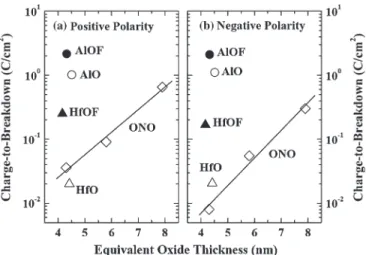
Directly deposited HfO2IPD without interface treatment
ex-hibits extremely poor charge-to-breakdown (QBD) value than
ONO IPD, as shown in Fig. 3. Although the result indicates that HfO2IPD with fluorine incorporation can increase the QBD, the
extracted QBDof the fluorinated HfO2IPD seems too small to
be implemented. On the other hand, Al2O3IPD can obviously
increase the QBD. Fluorine incorporation within the Al2O3IPD
can further improve the QBDin both polarities. The 63% failure
Fig. 2. Breakdown voltage comparison of the fluorinated high-k IPDs mea-sured in (a) positive and (b) negative polarities.
Fig. 3. Comparison of 63% charge-to-breakdown failure rate of the fluori-nated high-k IPDs under constant voltage stress in (a) positive and (b) negative polarities.
QBD of the fluorinated Al2O3 IPD is larger than 2.1 C/cm2
in both polarities, which is much higher than the QBD of the
fluorinated HfO2IPD.
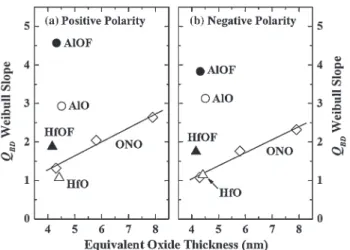
Since the slope of the Weibull distribution is an important factor in reliability calculation to extrapolate lifespan to differ-ent percdiffer-entiles, the Weibull slope (β) of the QBDdistribution is
further extracted to examine the dielectric reliability as shown in Fig. 4. Obviously, Al2O3IPD exhibits much higher Weibull
slope than HfO2 and ONO IPD in both polarities. Fluorine
incorporation can be used to further tighten up the Weibull slope of the Al2O3 IPD. Since higher and symmetric device
characteristics can contribute to further IPD scaling, the results clearly demonstrate that the fluorinated Al2O3 IPD is more
effective to promote the device performance of the stacked-gate flash memory.
The apparent dielectric characteristics improvement of the fluorinated Al2O3IPD can be partially ascribed to the
dimin-ishing of the dangling bonds and the oxygen vacancies with fluorine atoms [6], [9]. Fluorine incorporation is effective to replace low-k oxygen vacancies (vacuum) by the fluorine atoms [9] and results in higher dielectric constant as shown in Table I. For the Al2O3IPD with fluorine incorporation, binding energy
1448 IEEE ELECTRON DEVICE LETTERS, VOL. 31, NO. 12, DECEMBER 2010
Fig. 4. Weibull slope of the charge-to-breakdown (QBD) distribution for the
fluorinated high-k IPDs under (a) positive and (b) negative stresses.
Fig. 5. XPS spectrum of the (a) Si2pand (b) Al2psignals for the fluorinated
Al2O3IPD.
increment which is larger than 0.5 eV is obtained for both the Si and the Al signals as shown in Fig. 5. The results clearly indicate that fluorine incorporation is effective to terminate the bulk oxygen vacancies and the interface dangling bonds, which will create stronger Al–F and Si–F bonds within the fluorinated Al2O3 IPD, respectively. Higher Si and Hf binding energy is
also detected for the HfO2 IPD with fluorine incorporation,
which forms stronger Hf–F and Si–F bonds within the fluori-nated HfO2IPD (not shown).
Moreover, the fluorinated high-k IPDs obviously reveal polarity-dependent properties. The dielectrics stressed in posi-tive polarity (electron injection from the poly-Si bottom gate) clearly exhibit superior dielectric characteristics than those stressed in negative polarity (electron injection from the poly-Si top gate) as shown in Figs. 1–4. The polarity-dependent dielectric properties of the fluorinated high-k IPDs can be hypothetically explained by the surface roughness of the bottom gate and the top gate. Fluorine implantation prior to the high-k dielectrics deposition is believed to form hydrophobic Si–F bonds during subsequent high-temperature dielectric deposition and annealing, which is beneficial to the reduction of the interfacial reoxidation and interface roughness [9]–[11]. This also results in higher dielectric constant as shown in Table I.
A smoother interface is helpful in reducing the localized field, which can also suppress trap density generation [4]. In con-sequence, less trap density generation and smooth interface at the bottom gate will inevitably contribute to superior dielectric characteristics when the fluorinated high-k IPDs are stressed in positive polarity.
IV. CONCLUSION
The leakage current density, breakdown voltage, QBD, and
Weibull slope have been compared between the fluorinated high-k IPDs and ONO IPD in this letter. Fluorine incorpo-ration process can be used to further improve the insulat-ing characteristics of both high-k IPDs. Moreover, fluorinated Al2O3 IPD clearly indicates the best dielectric characteristics
at similar EOT. Fluorination of the Al2O3 IPD can promote
the IPD characteristics more effectively than the fluorination of the HfO2IPD. The results undoubtedly demonstrate that the
fluorine incorporation process possesses higher potential to be implemented for future stacked-gate flash memory application due to the superior insulating properties.
REFERENCES
[1] C. Cobianu, O. Popa, and D. Dascalu, “On the electrical conduction in the interpolysilicon dielectric layers,” IEEE Electron Device Lett., vol. 14, no. 5, pp. 213–215, May 1993.
[2] T. One, T. Mori, E. Ajioka, and T. Takayashiki, “Studies of thin poly-Si oxides for E and E2PROM,” in IEDM Tech. Dig., 1985, pp. 380–383. [3] D. Wellekens, P. Blomme, B. Govoreanu, J. D. Vos, L. Haspeslagh,
J. V. Houdt, D. P. Brunco, and K. V. D. Zanden, “ Al2O3based flash
interpoly dielectrics: A comparative retention study,” in Proc. Solid-State
Device Res. Conf., 2006, pp. 238–241.
[4] Y. Y. Chen, C. H. Chien, and J. C. Lou, “Characteristics of the inter-poly Al2O3 dielectrics on NH3-nitrided bottom poly-Si for next-generation
flash memories,” Jpn. J. Appl. Phys., vol. 44, no. 4A, pp. 1704–1710, Apr. 2005.
[5] S. C. Chen, Y. Y. Chen, Y. T. Chang, J. C. Lou, K. T. Kin, and C. H. Chien, “Improvements of ozone surface treatment on the electrical characteristics and reliability in HfO2gate stacks,” Microelectron. Eng., vol. 84, no. 9/10,
pp. 1898–1901, Sep./Oct. 2007.
[6] H.-H. Tseng, P. J. Tobin, S. Kalpat, J. K. Schaeffer, M. E. Ramon, L. R. C. Fonseca, Z. X. Jiang, R. I. Hegde, D. H. Triyoso, and S. Semavedam, “Defect passivation with fluorine and interface engineer-ing for Hf-based high-k/metal gate stack device reliability and perfor-mance enhancement,” IEEE Trans. Electron Devices, vol. 54, no. 12, pp. 3267–3275, Dec. 2007.
[7] C. R. Hsieh, Y. Y. Chen, and J. C. Lou, “Effect of fluorinated silicate glass passivation layer on electrical characteristics and dielectric reliabilities for the HfO2/SiON gate stacked nMOSFET,” Microelectron. Eng., vol. 87,
no. 11, pp. 2241–2246, Nov. 2010.
[8] H.-S. Jung, S. K. Han, H. Lim, Y.-S. Kim, M. J. Kim, M. Y. Yu, C.-K. Lee, M. S. Lee, Y.-S. You, Y. Chung, S. Kim, H. S. Baik, J.-H. Lee, N.-I. Lee, and H.-K. Kang, “Dual high-k gate dielectric technology using selective AlOx etch (SAE) process with nitrogen and fluorine incorporation,” in
VLSI Symp. Tech. Dig., 2006, pp. 162–163.
[9] M. Inoue, S. Tsujikawa, M. Mizutani, K. Nomura, T. Hayashi, K. Shiga, J. Yugami, J. Tsuchimoto, Y. Ohno, and M. Yoneda, “Fluorine incorpo-ration into HfSiON dielectric for Vth control and its impact on reliability for poly-Si gate pFET,” in IEDM Tech. Dig., 2005, pp. 413–416. [10] R. A. Haring and M. Liehr, “Reactivity of a fluorine passivated silicon
surface,” J. Vac. Sci. Technol. A, Vac. Surf. Films, vol. 10, no. 4, pp. 802– 805, Jul./Aug. 1992.
[11] C. S. Lai, W. C. Wu, T. S. Chao, J. H. Chen, J. C. Wang, L. L. Tay, and N. Rowell, “Suppression of interfacial reaction for HfO2on silicon by
pre- CF4plasma treatment,” Appl. Phys. Lett., vol. 89, no. 7, p. 072 904,