PHYSICAL
REVIE%
B VOLUME21,
NUMBER10
15
MAY1980
Generalized
path-integral
formalism
of
the polaron problem
andits
second-order
semi-invariant
correction to
the ground-state
energy
J.
M. LuttingerDepartment ofPhysics, Columbia Uniuersity,
¹w
York, New York 10027Chih- Yuan Lu
Institute ofElectronics, National Chiao Tung UniUersity, Hsinchu, Taiwan 300,Republic ofChina (Received 31January 1980)
Feynman's path-integral formalism ofthe polaron problem is generalized, by which it is easy and natural
to get the second-order perturbation result in the weak-coupling case and the Pekar result in the strong-coupling case, even in the crudest ground-state, approximation. With the harmonic approximation, the polaron energy for the whole range ofthe coupling constant is obtained, but it isfound there isatransition
at coupling constant 5.8.This generalized formalism is translationally invariant. The best self-consistent variational potential canbe determined by anumerical method. Also, in this model it is particularly easy to
estimate the second-order semi-invariant correction to the Jensen inequality. This second-order semi-invariant correction explicitly iscalculated. Itgenerates the perturbation expansion to fourth order in the weak-coupling case, and it improves Feynman's result by 0.5% for strong coupling. Discussion and suggestions forfurther study are included.
I. INTRODUCTION
The problem offinding the ground-state energy of the Frohlich polaron Hamiltonian has
a
fairly substantial literature. Itis
well known that amongall the methods, Feynman's path-integral theory gives the best ground-state energy in the overall
range of the coupling strength.
'
It is our purposeto generalize the Feynman formalism, and we find that in the generalized theory it is much
easier
to estimate the second-order semi-invariant cor-rection in the harmonic approximationcase.
InSecs. II
andIII,
we present the generalized for-malism of the path-integral theory ofthe polaron problem.In
Sec.
IV, we apply this theory to theground-state energy in the ground-state approximation and harmonic approximation. In
Sec.
V, we esti-mate the energy correction due to the second-or-der semi-invariant term. Both numerical resultsand analytic results in the extreme
cases are
giv-en. In
Sec.
VI, we summarize the results and some suggestions for further studyare
made.II.PATH-INTEGRAL METHOD APPLIED TOTHEPOLARON
PROBLEM
p&, q&
are
the momentum and coordinate operatorsof phonons of mode
j,
and the interaction terms w&(x)q&are
(8&2vn/V)'~'[u& &(x)/k,]q&, whe.re
u~ ~(x}is given as follows:u,
,
(x}=coskx,
u»(x)
=sinkx.
The two real waves
uz, (x},
P=1,
2, constitutea
completeset
when the nonzero values of kare
re-stricted to run only over a half-space, that
is,
a space inwhich, ifa
vector koccurs,
-k
does notoccur.
The partition function of the polaron may be written as
z e-~F
Tr(e
'")
when P
-
~,
the leading termis
e Eo. Therefore lim [ (1/P) lnz]=E-o,where
E,
is
the ground-state energy of thepolar-on. Thus we may calculate the partition function to evaluate
E,
.
In particular, we would like to know the partition function for large P.Using the path-integral representation, the
par-tition function is written asThe Hamiltonian of the idealized
electron-pho-non system by Frohlich is given by ~2
H=
—
+Q-,'(p,
'.+ q,')+ Qw,
.(x)q,,J J
where we use the units
8=
m= co=1. p,x
are
the momentum and coordinate operators of electron,e~~=
Tr(e
~)=
exp — H(t)dt(path) 0
Here, let us define our notation clearly as follows:
We divided the time axis from 0 to P into
N+1
subintervals, each of length
7,
i.
e.
, g= (N+1)r,
a.nd the superscript denotes the time sequence
in-dices.
z=
dx"'
dq~"'0—
—
—
exp—
II
tdhA A
B
B
x6&2&'''g
N &exp—
7' zq& +w&x
qwhere the end point coincides with the initial point
X(N+1)=X(0) (N+1)— (0) where We define
[dx]
=—dx ~~dx~ ~ with ~&~-&'~I(
—+I)
+e+Il&-\&'I— A A A A n =I/(ee—1}
.
dq~ dq,"'
dq~" dq,' 'B
B
B
B
(dx)-=dx"'[dx],
similarly for the definition of(dq&) and (Dq&), and
/
=(2pg} & H=—(2pg} ~p„=(
)„,
exp[-(x"'
—x"')'/2~],
1
d'„,
-=,„„exp
f-(q,
"'
—
q,'")'/k.
],
.
.
.
(2F
f)
Now let us define
Z'
byZ
Tr(e»)
Z,
„Tr(e-»
h} 'where
H~„=
,
g(P,
'+
q,'-)-.Ifwe integrate out the phonon coordinates
(elim-inate the phonon
oscillators),
then we obtainFeyn-man's
result.
gdxppQ
~/pe(x)~
gr xXOM) M)~A&~~ ~~x IFor
P-
~,
thenI-
0,
hence we have-Il~-l'~I
M,l,
-e
The physical motivation of our variational meth-od comes from a intuitive belief that in some sense the reaction of the lattice (phonon) system to the motions of an electron might be represented
approximately by the reactions ofa small number (hopefully, one) ofparticles coupled in some
sim-ple way to the electron and to one another. In the most simplecase,
we choose the variational Ham-iltonianas
H„=
—
+ +v(x—
R),
where
P,
R, and Mare
the momentum,coordi-nate, and mass of the fictitious
particle.
We as-sume the electron couples with the particle by acentral
force
potentialv(x-
R).
Let us carry out the variational method as
fol-lows: by adding and subtracting the termf
eov(x(t}—R(t})
df to the exponent of(1),
pathinte-grating over the coordinate R, and dividing by the
partition function of
a
free particle.
Also by multiplying and dividing this expression by thepath-integral expression of the partition function of
a
system with Hamiltonian H„, therefore, we haveZ'=
DK e~f
(DX)(DR)
exp(W+f
v(X-
OR)df—
f
(x-
ovR)df)f
(Dx)(DR)
exp(f',
„(x
R)df)f
(Dx)(DR) exp(-
f
Nv(x
-
R)df)f
(DR)
21
GENERALIZED
PATH-INTEGRAL
FORMALISM
OFTHE.
. .
4253 wheref{Dx}{DR}exp(-
f
eov(x—
R)dt)f
{DR}
as
1v'
1v'
ff =--
"
--
—
'+
v(t'),
2(M+1)
2 pf
{DR}
is the path-integral form of the partitionfunction of the
free
fictitious particle,where p
is
the reduced mass,1/p
=1+
1/M. Therefore, the Schrodinger equation of this sys-tem can be separated as follows:V=— v
xt
-Bt)dt,
0
and the average ( &„is defined by
(A)„=
f
{Dx}{DR}Aexp(-
f
eov(x —R)dt)f
{Dx}{DR}exp(-
f
tv(x—R)dt) ByJensen's inequality, we havezt
=(evvv&z
~e«v&&vz V (3) 2V„(
(,
:
-„)(
(,
.t.
-,)
V-' ll()(&((
&,c',,((l
and the total energy E(&t, ») is given by
((t,n& &t n 2(M+
I)
tt'(4)
The lower bound for Z'
is
given by theright-hand side of
(3),
therefore an upper bound forthe polaron energy is
E
inZ(V&„(IV&„
'
'=p
p"-
p'
This variational formulation
is
different fromthat of Feynman's' which has used
a
specific formof interaction
—
"harmonic interaction"—
between the electron and the fictitiousparticle.
By thatspecial choice, the form ofinteraction is given
explicity, and fortunately, the exact integration
over the Rvariable can be
carried
out, therefore,in the Feynman's formulation; what remains is
the integration over the electron's coordinate
x.
In the generalized formulation, we do not specify the form ofthe interaction which can be varied tomake the inequality
(3}
as strong as possible.The disadvantage of this formulation [as can be
seen in
(3}]
is
our use ofJensen's inequalitytwice, once
for
the path-integral average overthe electron's coordinate
x,
and the other for thevariable R. Therefore the lower bound of (3)may be weaker than that of Feynman's method ifwe
also assume the interaction
is
harmonic.%e
will show this fact by explicit calculations in a latersection. In general, our method can be better, because we can adjust the interaction form
self-consistently, as an example, we can obtain thePekar result (which is better than Feynman's
re-sult in the strong coupling limit) very naturally even in the crudest approximation.III. THE PARTITION FUNCTION OFPOLARON FORAN
UNSPECIFIED GENERAL FORM OF VARIATIONAL POTENTIAL
Inthis section, we formulate the upper bound ofthe polaron energy
for
the general form ofvariational potential v(x
—R).
If the relative coor-dinate $ and coordinate of the center of mass gare
used, then the Hamiltonian can be expressedNow, let us calculate Z, (V&„,and (W&
„separate-ly in order to obtainZ'.
First,
Zis
defined asf{Dx}{DR}exp(-
f
eov(x- R)dt)Z=
f
{DR}
Tr(e
N&iv}Tr(e
e~'~~)
The denominator
is
the partition function of afree
particle with mass M; this is well knownas
M
Tr(e
~'
'"}=
{DR}=e
«"=
V2mP
The partition function of the system
H„can
be ex-pressed in ($,&})representation as (asP-~)
v'(t
'""l
=J
d(f
dtt((tt
It'"
l(V&,
,(M
()"
*
Therefore we have
Z=
(I/p"
')e
"o.
Secondly, let us evaluate the (V&„
term.
Thereare
many ways to do this; the following oneis
avery simple one:
(vl„=(J(
(x—R}dt)
=——
ln Dx DRxexp
-A.vx
—
Rdt
0 }isldx'"d
R'"
x—
—
[lnG(x"'
R("
x'"
R'"
(&(.v)] ex (5)G,
(X(",
R"'x"',
R"'
~Xv)=(X"',R'"
~e"»
~X'",R"')
is
the Green's function of the Hamiltonian(p'/2) +(P'/2M) + Xv(x
—
R) beginning at(x'", R"')
and ending
at
the same position (x&'&,R&o&).For
Pvery large,
G (x«» R«» x«» R&(»l&&v) ly (x&o& R&o&}loe oeo&»&
Therefore the integrand in Eq. (5)can be
calcu-lated by using perturbation theory (X=
l+
e, e-0),
thatis,
(V)„=
P dx&o&dR&o&=P
dx'"dR"'v
x'"
—
R'"
tt)x'"pR'"
written as 2 E(W)„=
—
g
g
M»(.
u,((x(»)u,&(x&& &)).
r, r'=0Setting
t=(l
—f')~&0,
we can write this as follows:(W)
Tr(e»o)
d P
-
t e'
Tr
e '~"~~
e '~~zg0
As
P-~,
we only take the ground state of thedis-crete
level &„, and sum over the continuous quan-tum number y in the e '"
~term in calculatingthe
trace.
Ifwe also use thefact
thatQ~,
(&),$)~,
(&)',t')
=jg-g'+
&—
&'I=P
d'$v $ u,(
(6)g(n,=T-I'; k,
h'),
(8)Last, we evaluate
(W)„.
From Eq. (2), (W)„is
the right-hand side of Eq. (7) is given asM+
df B o &&u+&&('o&&(o o&
Qu+($'}u
($)u+($)u„($'}e
'"
2 2 0 pt v) n
the g and q' integration can be done explicitly,
t3/'
cia-
g'Ie-r.(&+&)/2t)(n-0')
(/~2'
erf
M+1
p]g
$ j where and, because M [2(M+i)]"'
'(M+()"*
"
Therefore we have the expression for
(W)„:
(w)
='
Q
((&((')
dt f)
o yg
where
+&n=&n
-
&O~Now the t integration can be done by partial integration, and using the definition of
erf
function we have(W)„=
&rp uo*(g')u,($}u*„($)u„(t')
1—e'«o'
"&
v 2p neo &q„+1
Ifwe make use ofthe Fourier transform
dk 4m
ejlr.r
IrI (2&&)'
(b'+
k'}
(9)
then
( W)„can
also be expressed asOO
]
2 oon
21
GENERALIZED
PATH-INTEGRAL
FORMALISM
OFTHE.
.
. 4255 where we defineb
„2=
—C(he„+
1}'
~Therefore, it is
clear
that every G„termis
positive. Ifwe just take any kind ofpartial sum or a singleterm, the variational bound
still
holds true, but makes the inequality weaker. Let us now summarize the results as follows:Eo~
E„=
e, —(V)„/p
—(W)„/pu($') u(o$) „*u($) „u($') 1—
exp[-2C(1+4&„)' 'I
)
—$'I]
v2p.~~o n
where we combine the
first
two terms onthe right-hand side as(lo)
d$v $ Qp) Qp P 2P Qp
and it is noted (
W)„can
also be expressed as(9').
2
Ep- E„=
Qp g—
Qp(
d(
a
lup g up g ISince E'„is afunctional ofQpalone and the only
constraint
is
that Qp is normalized, thestation-ary condition for the best choice of v, 5E'„/bv(g) =0, is equivalent to
&
E„-A
up g' 'd$' u,(6)
=o.
This gives at once=
e.
u.
((
)(11)
From the above equation, we
see
the best self-consistent potentialis a
Hartree-type potential.For
the strong couplingcase,
we assume C—
~,
'
Eq.(11)
will just reduce tothe semiclassicaltheory of
Pekar.
'
According to the work ofPekarin strong coupling
case,
the polaronis
localizedin a Hartree-type potential well, and the polaron energy
is
then calculated by a variational method.Pekar took the
trial
functionas
u,(r)
= N[1+
br+a(br)']
e ~",IV. GROUND-STATE APPROXIMATION AND HARMONIC
APPROXIMATION FORTHEPOLARON ENERGY
From (10)in the
last
section, it is obvious that if we take only the ground-state term (n =0) in the summation of(W)„,
then the right-hand sideof(10) is still an upper bound of the polaron en-ergy. Therefore we can write
then obtained the energy E'„=
-0.
1088m'.Recently, Miyake' recalculated the
Pekar
energy by both exact numerical integration andPekar's
variational method. Itwas found that the
varia-tional energyis
-0.
108504m' whichis
a
littlehigher than the exact numerical quadrature value
(-0.
108513n') as it should be. Therefore, the often quoted result-0.
1088m' ofPekar's
varia-tional calculationis
not quiteaccurate.
But fromMiyake's work, it
is
found thatPekar's
variation-al calculation gives an excellent approximation; the energy differs byless
than0.
01%&and theerror
in the wave functionis less
than 1% where the val-ue ofthe wave function is appreciable.For
very small coupling,n-0,
assumeC-O,
then by expanding(11),
we obtain an equation whichdescribes
an electron moving in a constant potential of magnitude-o.
, and from(11},
we can easily see in this limit(n-0}
the polaron energyis
-n,
which agrees with that of the second-orderperturbation calculation. By this variational meth-od, without any specific form of v(x
—
R), we cannow obtain the
correct
energy values in both weak and strong limitingcases.
In order tofind theeffects of the inclusion ofall the excited
states,
we takea
specific example ofinteractionpoten-tial
—
harmonic interaction. By this harmonic-interaction approximation, we can get the explicit results whichare
fairly good for all valuescou-pling constant.
As
a
matter offact
for
this particular choice ofinteraction,
v(x
—
R)=—,'Z(x —
R)',
(12)=p-'~'~Q
~'~+
Q' —~'
0x(1 —
e~))
'
'e d7,
(13)be exactly equal to the A which appears in
Eqs.
(21)and (31)in Feynman's original paper,'
whereA=2'
'a
1S,
e'
"ds
Ix(t)
-x(s)
I~'=
K/M, O'=K/p,.
We can also obtain this result by summing up the
expression
(9')
by taking u„($)as the wavefunc-tions of harmonic oscillator
as
an alternative wayto obtain the
(W)„;
we include this calculation in the Appendix.For
the harmonic approximation,z.
-
&~ l~(&)l~ )=&~.lp'/2t l~ )is
given by 4Q. Therefore the upper bound of the polaron energyis
given by1 t
E0&
E„=
~Q—
&Qdt.
Wz
(
't+
[(Il' —
~')/11](1
—e"'))"'
(14)BE„/B~= 0, BE„/Bn=
0.
(15)Butfrom
(14),
we cansee
that only the integral A containse,
and Ais
an even function of~,
sothe derivative ofA with
respect
to~
is alwayszero
at~=
0,
and we cansee
from following thisthat
~=
0is a point which makes A maximum.Ifwe
set
cu=yQ andQt=y,
From this expression, it
is
easy tosee
that y=0 will make A maximum, therefore, the best value of &u iszero.
Hence the energy expression (14)can be reduced to
Unfortunately, the integral in (14)cannot be
eval-uated in closed form, so that a complete
determi-nation ofthe polaron energy requires numerical
integration.
Equation (14)has two parameters which we
varied to give the lowest energy; there we have
This means that when
n-
5.8, the best value ofQ-0.
This can also be seen by plotting Eq. (16) di-rectly as a function ofQ for various values ofa.
It
is
found that when ca&5.8,
thereis
no minimumfor
E„but
the end point E„(A=O)corresponding to the least energy; fora&5.
8, thereis a
minimumfor E„with nonzero
0
(&0).
Plotting theseE„as
a function of n, we find
a
transition at n=
5.
8,that
is,
dE (a)/do,is
not continuous at n=
5.8.
And for large n we can have large Q; then
Q
'
'1r-,
'
r1
Q Q'
'
1
2ln2+C
C
is
the Euler number here. With this expressionofA, we can determine the best choice of Q as
0
=
4 n'/9w—
4 ln2 —2C,
and hence the polaron energyr(1/fl)
I'(-,
'
+I/O) (16)G
11
E„=
—
—
—
2(21n2+C)+0
3m Qj' (19)
The condition
(15),
BE /BA= 0, yields 3 1 r(-'.+z)
[q(1+z) —g(2+z)
]
4z'
I'(1+
z) vjzwhere
z= 1/Il,
and g(z)=Idldz) lnI'(z) whenz-
~
(i.e.
,Q-O);
the condition (1V) determining nyields
a-5.
8,
where we have used the asymptoticrelation
I'(1+
z) 1=vz
1+
—
+,
z-~,
I'(-,"+z) 8z 1 1y(1+z)
—q(-,'+z)
=
—
—+.
8z2for
a
large coupling constant.For
a
thatare
small,0=0,
then (16)becomesE„=
-a.
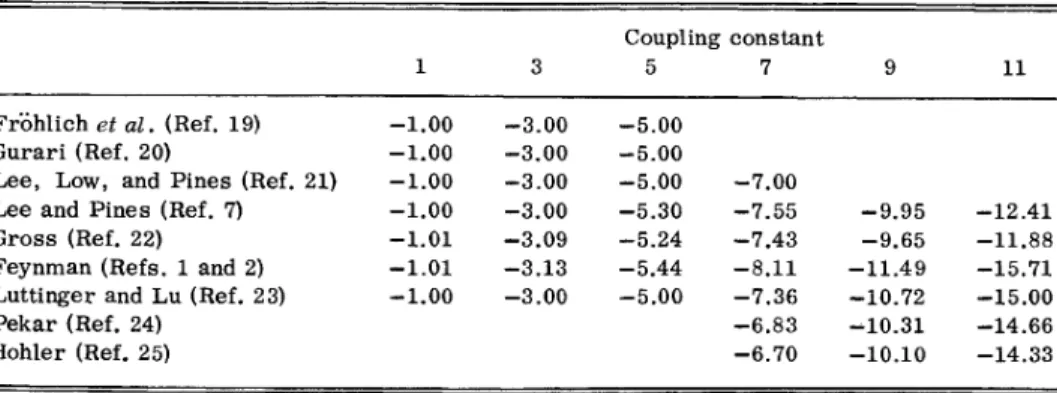
InTableI,
a comparison ofvarious pre-vious results about polaron energy in the range of intermediate coupling constanta
isgiven. Here,both Luttinger-Lu and Feynman's results
are
in the harmonic approximation. From this table, it isfound that our resultis
inferior to that ofFeyn-man'
s, as
itshould be, because we have Jensen'sinequality one more time than Feynman. But it
is
known for very strong coupling thatPekar's
energy will be lowest, and we have seen that even our re-sult of the ground-state approximation fora
gen-eral
form of potential will approach that ofPekar's
result.
From this result, we know that in the strong-couplingcase,
the electronis
trapped inGENERALIZED
PATH-INTEGRAL
FORMALISM
OFTHE.
.
~ 4257For
strong coupling, it reduces toE„-
—(1/Sv)a'-
-0.
106a'.
(21)Comparing (21)with
(19),
we can see that the ex-citedstates
contribute only to the "fluctuationen-ergy"
(ofordera ).
Therefore if we include allthe excited states in the calculation of
a
generalpotential, the constant "fluctuation-energy" term
must come out
as
it does in the harmonicapprox-imation.
V. ESTIMATION OF THE ENERGY CORRECTION DUE
TOTHE SECOND-ORDER SEMI-INVARIANT
When we use the path-integral variational meth-od to evaluate the ground-state energy of the po-laron, we have assumed the Jensen inequality
&eA&
)
e(A) (22)where A=W+t/'. However, Jensen's inequality
is
actually thefirst
term of the exactsemi-invari-ant or cumulant expansion
a potential which
is
not like the harmonicpoten-tial and the contribution from the
states
other than ground stateis
not significant. Those excitedstates
only contribute to the constant term instead of thea'
term.
This can be seen clearly in the following example of harmonic interaction but ex-cluding excitedstates.
Ifwe take only the ground-state harmonic wave function in the expression
(9),
instead of takingall the excited states into account, it
is
trivial to calculate the upper bound ofthe polaron energy [this result, of course,is
worse than(16)],
andit
is
n
nli
n
E
~ E'„=-',fl—a
—
exp—,
Ierfc
—,
—
~]
(20) (22) and4E,
is
given bynE,
=-(1/p)(&wv)„-
&w)„&v&„).
To evaluate (24), we replace Vby i(Vin (W)„, then
(24)
(
")=
p(&A&—,
(&A*)—
&A)*)—,
[(A')—3(A)((A') —(A)')—.(A&
['
")
.
Therefore, if the approximation
&eA& e(A)
is
very good, we expect that the fluctuation(1/2})((A'& —&A)')
should be
a
small correction to the inequality(22}.
With this second cumulant term, we no longer have the Jensen inequality, thatis,
exp[(A)+-,
'((A')
—
(A)'}]
may not be a lower boundfor
(e").
The second-order semi-invariant is
F'"=
[&(w+v)'&-(w+ v)']
= [&w')—&w&'+2(&wv) —(w&&v))+
(v')
—&v&'].
The second-order semi-invariant correction to
the ground-state polaron energy
is
n.
E=
-(1/2P)F'"
=
-(1/2P) [((W')„—
(W)'„)+2((WV)„—(W)„(V)„) (&v'&„-&v&„')]=b,E~+ AE2+
EE3.
Therefore, for harmonic interaction, we
calcu-late4E,
first,
r
E,
=—»
1((v')„-
&v&'„)TABLE
I.
Polaron energy from previous work.Coupling constant
5 7
Frohlich eg~l.(Ref.19) Gurari (Bef.20)
Lee, Low, and Pines (Ref.21) Lee and Pines (Ref.7)
Gross (Ref.22)
Feynman (Refs.1and 2)
Luttinger and Lu (Ref.23) Pekar (Ref.24) Hohler (Bef.25)
-1.
00-1.
00-1.
00-1.
00-1.
01-1.
01-1.
00-3.
00-3.
00-3.
00-3.
00-3.
09-3.
13-3.
00-5.
00-5.
00-5.
00-5.
30-5.
24 544-5.
00-7.
00-7.
55-7.
43-8.
11-7.
36-6.
83-6.
70-9.
95-9.
65-11.
49-10.
72-10.
31-10.
10-12.
41-11.
88-15.
71-15.
00-14.
66-14.
33&E,
=--
1—
8 (W) P ~P ~v =t
(&())'~'Is(s
-)
~B((
~—,
—
—
)
1+—
or 4~
r1
u+-,'
where
B(x,
y) is the beta function defined asB(
)= t'-'(1
—
)'
'dt=-and P is defined by
(25)
Now let us concentrate on the expression (W')„ —(W)'„. From the definition of
(W')„,
it can be ex-pressed asa'
(W ) = ' ' ' dt ds dt ds e-(tt st-l-its ss(-v 2 2 1 .1 0 (26)lr,
-r,
Ilr,
-r,
lHere, we may express
1/Ir,
—r,
I by a Fourier 1 1 transform: 1 dk
,
,
exp[ik~(r,
—r,
}),
~ 1 1=B(x,
1—x)[He(x)&0].
and similarly for
1/
Ir,
—
r,
I.For
this reasonwe need to study
f—
:
(exp[ik(r,
-r,
)+ik'(r,
—r,
)])„
dr
e 0expjk r,
-r,
+ik'
r,
-r,
dre
o,where
$0=——
'
—
dt — dtdgr,
—r
0
The path integral in the numerator
is
of the formN=
dr
exp S0+ f trtdt
(28}where specifically
f(t)=ik[5(t
—
t,)—
&(t—
s,
)]
+ik'[&(t—t,
)—
5(t—
s,
)]
.
Following Feynman'strick,
'
the exponent ofI
is obtained byJ=
-(k'A+
k"B+
k'k'D},
where2 Q2 2
0
M2 /72
(e Alto- tl+e-01st ttl s-Alt-2 ttl e-ols-s-stl) 203
hence we can write
(W')„as
B 1 dk dk'
(W') =
—
' ' dt ds dt ds e"t
'& ed'(k,k')v 2 2 1 1
4'
y2yI2
21
GENERALIZED
PATH-INTEGRAL
FORMALISM
OFTHE.
. .
4259After k and k' integration, we have
Q 2
(W') =
—
dt ds dt ds e"1
st~"2
'2'—
—
tan'
V
0
(3o)
Recall that best value of (d
for
minimum energyis
always0,
so in our theory the expressionfor
A.,B,
Dis
particularly simple, t1( ~t S ~) (1 e-Qltt st I-) 1 2ng(
~t S ~) (l e-Altt stl )-1/e-Ql tt 321+
-e-
lQt 2 slt-e
Qltt t21-e-Qlst-ssl)
2g
and also, (W)„
is
given, by the sametrick,
asB B
(W)„= dt, ds,e
"1
'1',
7T o 0 k~gj
This is the expression which appeared in the Eq.
(31)
of Feynman's paper' with (d=0.
Ifwe define 8by sin28 = D22/4n,n2,
then we havea'
-It -syl-It -s I 8 0 1 2In order to evaluate this expression, we need
a
theorem on multiple integration; the theoremis:
(31)
(32)
dx„dx
x dx2''
~j,
&x &2 ~~~+
+'
~
d+ 1~-2
~1Fs
(33)where
F,
is
the symmetrizedF,
which is defined byF,
=x„x„.
.
.
nf,
P
the
Q~
means to sum over all the possible permutations of the arguments of the functionF,
thatis,
1Fs ( IF(«lt «2t «3t ' '
')
F(«2t«tt«3t '' ')+F(«3t
«2t «it '' ' ) ] PlsFor
ourcase,
from Eq.(26),
it can be easily found that (W')„is
symmetric under these interchanges:s,
—
t„s,
—
t„and
(s„
t,
)(s„
t,
)simultaneously. Therefore we have only three independent expres-sions inF„.
theyare
F(s,
t,s,
t,
),
F(s,
s,
t,t,
),
andF(s,t,
s,
t,).
Hence we can write(W')„—
(W)'„as~2 t2 S2 tg
(W')„—
(W)'„=—
m' 4i dt,ds,
dt, ds,3[F(s
t,stt
)2F2(+s,s,
t,t,)+
F(s,t,
s,
t,
)],
0 0 0 0
where we assume
t,
&s,
&t,
&s,
.
Ifwe define(34)
S2
—
t~—t,
tg —~g-t
jwe can have b
E,
"'
equal to thefirst
term of(-1/2P)((W'), —
(W)'„):2 ~ t (O
e t
(l
eAt)/
3(1
eAt)/
sin8,where sin8,=—,
'(1
—
e"')'
'(1
—e"')'
'.
/2E,'"
equals the second term of(-1/2p)((W')
—(W)2):2
(l e A(r+t))1/2(1
-e
A(t+tt)3/2-(35)
J.
nE(3) equals the third term of
(-1/2p)((W')„—
(W)'„):(8,
/sin8,—
1)dte
dte
dte
p p p
[(I
e-G(t+t+t)}(I e ot-)]l/2Now, we arrive at the final result for second-order semi-invariant
correction;
the correction ist).
E= (tlE
'+rtE
'
+t)E,
")+
ttE2+dE3.
(3'I }
(38)
Recalling that
for
o(& ()tc=58,
0=
0is
the best choice. In thiscase
(0=
0),
we have t) El(t)=t)E2=nE3= 0, and b.E,
'"
and b.E,
"'
reduce toAEf dt e dt e dte
~/
(2 t t 2( (82/si118 1)
p p p
[(t+
t)(t+7)]"'
bE,
=—
—
dtedte
dte
,
—,(83/sin8'—
1)2 2 2
[t(t+t+t)]'
'
(39) (40) where t ((t+t)(t+
t)]"
'
(t
)1/2 sine,'=(t+
t+t)
SU16),'=—
Therefore, for
a~
5.
8, we have~E=
b.E&"+ b.E,
"&=-a'g,
where
g
is a
pure number. We can evaluate thispure number by numerical integration, and it
is
equal to 0.0157. Therefore,bE=
-0.
015Va.
Bythis value of
0,
we can obtain the approximate energycorrections:
From(35), (36),
a,nd (3't),we can have
nE(1) 1 ~2/v t)E(2) 1 ~2/v t)E(3) 1 ~2/v
This result
is
superior to both that ofHaga andLee and
Pine',
Haga's result does not reduce to perturbation theory to order (22(whena
is small).Feynman's result will reduce to that ofHaga in the weak-coupling limit. Hohler' has done the straightforward fourth-order perturbation
calcu-lation, and our result agrees with that of Hohler. Hence in this limit the cumulant
series
generatesthe perturbation expansion.
Also for large o(, from (16)we know the best choice of
0
isn-
(4/9)/)a'.
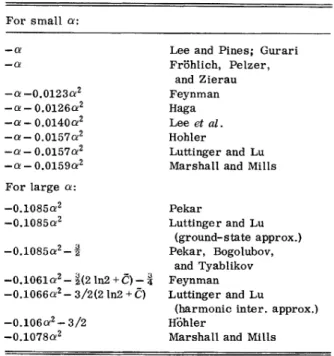
TABLE II. Polaron energy. For small n:
-~
-0.
0123~2-o
—
0.0126~-~
—0.0140~'-
~—
0.0157~'—
~—
0.0157~ -G.—0.0159~' For large o.'
Leeand Pines; Gurari Frohlich, Pelzer, and Zierau Feynman Haga Lee etal,
.
Hohler Luttinger and LuMarshall and Mills
l
This means the coefficient of
n'
iscorrected
toE+ ttE=
-(a'/St()(1+
—
)—
-0.
1066(2.
The coefficient ofn'
is0.
4-0.
5%lower than thatofour previous
result.
(Thatis, -I/St/:
Thisis
also Feynman'sresult.
) The ratio of our cor-rected coefficient to that ofPekar's is
0.
980.Comparing with
0.
9'?4 whichis
the ratio ofFeyn-man's to
Pekar's,
thereis
a
small improvement. A summary ofresults of our work and that ofother authors is given in Table II(in both the weak- and strong-coupling limits). In Table III,
a
comparison between our results, with the sec-ond order semi-invariant term added, andFeyn-man's is given. The second-order energy
cor-rection was also
carried
out by Marshall andMills' in Feynman's harmonic model; their
sec-respectively.
Also, from (23)and (25), one can easily obtain
ttE2-
ct'/6)/,tlE3-
——,'
(2/)t.
Therefore, in the strong-coupling limit, the
en-ergy correction
is
given bytlE= (tt
E"'+n.
E)2'+ rtE,"')
+rtE,
+tlE3'
(2'/)t. 720-0.
1085~2-0.
1085& -Q.lQ85+—
23 0.1061~2 -',(2ln2+C)—
4-0.
1066n —3/2(2 In2+ C)-0.
106A2 3/2-0.
1078&2 Pekar Luttinger and Lu (ground-state approx.) Pekar, Bogolubov, and Tyablikov Feynman Luttinger and Lu(harmonic inter. approx.) Hohler
GENERALIZED
PATH-INTEGRAL
FORMALISM
OFTHE.
.
. 4261 TABLEIII. Plaron energy: Comparison between Feynman's result and Luttinger and Lu'smodel with second-order semi-invariant term.
Ey
-1.
012 3.44 2.55-3.
134.
02 2.13-5.
44 5.811.
60-8.
11 9.851.
28-11.
48 15.501.
15-15.
710
+LL &ELL ELL++ELL 0.0-1.
00-0.
016-1.
016 0.0-3.
00-0.
14-3.
14 0.0-5.
00-0.
40-5.
403.
95-7.
36-0.
65-8.
01 8.45-10.
72-0.
84-11.
56 14.30-15.
00-1.
305-16.
31ond-order correction
is
larger than our model of harmonic approximation,as
it shouldbe.
VI. DISCUSSION AND SUMMARY
The problem of polaron has received
consider-able attention in the past
years,
many authorsconjectured that there might be
a critical
coupling constant n,(Refs.
10andll};
when n exceeds thiscritical
value(n,
-
5.
8), the wave function abruptly shrinks(self-traps),
and the slope ofE(n}
changes discontinuously, althoughE
is
stilla.continuous function of the coupling constant n.
By the path-integral representation ofpartition function, the problem of an electron moving in a
random system
is
very similar to the polaron problem. Bythis close similarity and some other arguments, thereis
a
long-standing conjectureabout the possibility of
a
"phase transition" be-tween localized states and extendedstates.
Our modelis
very similar to the path-integral methodofFeynman which gives nondiscontinuous curve of
E'(n},
but our method indeed has the discontinuity phenomenon atn-
5.8.
Gross"
has suggested that the transition between the localized and extended functionis
abrupt. This abrupt change seems tobe
a
common feature ofseveral approaches. But, because Feynman's treatmentis
the most success-ful overall theory of polaron, therefore, itis still
an unanswered theoretical question—
whether thisfeature
is a
property of the general typeor
ifitjust
comes from approximation.Our theory
is a
variational method; hence anychoice of
trial
potentialor
wave function wiQ give an upper bound of the exact answer. According to the previous work ofmany other authors and ourexperience, the harmonic interaction potential
seems to be the most reasonable, exactly soluble potential form.
Frohlich"
has used the wavefunc-tion appropriate to the lowest-energy state of an
electron in a Coulomb potential in
Pekar's
approx-imation; the wave function has the form: (P'/8w)'~'exp(=,
'P
~x~).It
is
found the best value is when P=5n/8 and the corresponding value for energyis
S=
-0.
0977n'.
In addition, Allcock' has shown in ground-state
approximation
(Pekar's
theory), "harmonicoscil-lator's
wave function"or
"improved Gaussian wave function" gives a better result than that of the Coulomb potential wave function. Also,Mat-suura"
formulates the problem by path-integralrepresentation with an effective local Hamiltonian (Feynman's model and our model have a two-time-difference retarded effective Hamiltonian) which
is
not translationally invariant. This effectivepo-tential method gives the same result
as
thatob-tained from second-order perturbation theory.
"
Matsuura takes his choice ofeffective potential
as Coulomb potential, the results show that the Coulomb potential
is
inferior to that of harmonic potential. Clearly the calculation based ona
har-monic potential will be reasonably satisfactory ifthe exact potential and harmonic potential agree
wherever the electron's wave function
is
large,and it
is
indeed soas
shown by Allcock.According to our model, the most general
ex-pression of the polaron energyis
given by:E,
-(,
ip'/2i,
&—
(W&„/P,[p'/2p+
v($)]u„(]}=
eQ„(]),
where (W&„is given by Eq. (9)
or
Eq.(9').
Ourformalism
is
translationally invariant. Byignor-ing this translational invariance, our formalism
can be reduced to the same equation and energy
results
as
that of the Green's-function equation of motion analysis bg Matz etal.
"
and the effective local Hamiltonian theory of Haken" andMatsurra 's
Although it
is
too complicated to get the expres-sion of the self-consistent potential ina
closed form, we suggest some iterative procedure,which might be very tedious, but can be done in
result will be reported elsewhere.
By the experience from the harmonic interaction
potential approximation, it
is
noticed that thehigh-er
excited states contribute only to the constantterm
(n',
the fluctuation energy term); it should bea
goodstart
byfirst
taking the ground-stateapproximation. From this approximation, we have the self-consistent potential as the following:
(f)
—
aP2f
dpi,
(,4')~I'(y
Using this numerical self-consistent potential
as the starting potential, we may calculate the
ex-cited wave functionsu„($)
from the Schrodinger equation. By these higher excitedstates,
we canestimate an improved value for (W)„by every
giv-en
p. %e
guess the self-consistent potential ap-propriate tothe polaron problem must be likea
Coulomb potential at large distances and like the harmonic potential in the region where the elec-tron wave functionis large.
Using our model, it
is
easy to connectPekar's
result to our theory, whichis
difficult tosee
in Feynman's formulation. And itis
shown clearlyand explicitly that the higher excited states will contribute to the fluctuation energy. This model
is not
restricted
to the harmonic approximation, although it isa
pretty good one; in principle, any kind oftrial
potentialis
possible, and the best one certainly will be the self-consistent one. In order tosee
the order ofmagnitude of theerrors
which might occur due to the Jensen's inequality, thismodel
is
particularly easy to evalute the second-order semi-invariant correction explicitly.Because we
are
dealing witha
three-dimensionalcase,
the quantum number n actuallyis a
triplet(n„n„n~}
—= (o),
and let us define n,+n,+n,=p7.Hence where we define In In fy (A1) and +00 cos(yx) e
"H,
(x}dx=7r''y'"e
"'~',
~00r
+DO»n(yx)e"H
(x)dx=(-x
~ )y~
e"~
wOQ 2~ ~ ~I i~I I~II~t I 2&n,tI
„=
Jtu„($,
)u,($.,)e'~~'~d(„ i=1,
2,3.
(A2)Ifu(x
—
R)=
zK(X—
R)',
then u(()=.
~=(""}"'(.
',
";:";:")
xe'"'
"H„(v'pQ),
)H„(l
pQ),
)H„(v'pe),
),
where &v=4K/M, and 0=v'K/p,.
By the
Fourier
cosine and sine transform identity, we haveAPPENDIX: EVALUATION OF(W)„BYSUMMING OVER
COMPLETE STATES OFHARMONIC OSCILLATOR
From Eq.
(9'),
we writeTherefore
(W)„=
Q
G„.
V 2p n=o
for n, even
or
odd. We have defined y,. -=k,./v'p.
Q.
So 4C dk y n,!
n,!
n,!
2v'k'(k'+
b ) (A3) (W)„=Q
G,v2p
g (yP 8C 2 N ~ 2dke~
~2 dty gy n2y n3e ~~fy+"t
~2p,
&,
„„„n,
ln, in,ISince b,
'
is proportional toN, which is the sum ofpfy &f2 ($3 we try to make it as aproduct of+] +g &3,so
we use the identity 2, 221
GENERALIZED
PATH-INTEGRAL
FORMALISM
OF THE~.
.
4263to separate n» n»
n„by
writing b,'
=4C'(dg,+1)=4C AN+4C',
(t)
='
"*
u
tan-"'*--"*&» &
"&"""-"*""
"~"'1
w v2p 0 0 Jt.
J.
Qp 8+2 ttO tto 3dke"
~' ''
"@[exp(-y
et«~'}]
V2p. ~ o o j=1 oP 8C' 1 ewe«
e'dt
dk exp — ~ t+ k' v 2p. ~ o o 2ttAoP,
2p.a,"'
eWC4C2 dt
(1+
2ttAt—e~e
«)'
»'
(A4) Therefore,(~)"-
A'
et"=
nQ dt(&o't+[(A'
—
td')IA](1—
e«))'
'
=A(A,
~).
(A5)T. D. Schultz, Phys. Rev. 116,526 (1959).
~R. P. Feynman, Phys. Rev. 97, 660(1955).
3From our work inharmonic approximation, itcan be
seen that, in the strong-coupling case, M ~ will
give the lowest ground-state energy.
4S.Pekar,
J.
Phys. 10, 347 (1946); Zh. Eksp. Teor. Fiz. 19,796 (1954).S.
J.
Miyake,J.
Phys. Soc. Jpn. 38, 181 (1975).~H. Haga, Prog. Theor. Phys. 11,449 (1954).
~T. D. Lee and D. Pines, Phys. Rev. 92, 883(1955). G. Hohler, Nuovo Cimento 2, 691(1955).
SJ.
T.
Marshall andL.
R. Mills, Phys. Rev. B2, 3143 (1970).' D. Larsen, Phys. Rev. 172, 967(1968).
' D. Larsen, Phys. Rev. 187, 1147 (1969).
'
E.
P.
Gross, Ann. Phys. (New York) 8, 78(1959).' H. Fribhlich, Adv. Phys. 3, 325(1954).
' G. R.Allcock, Adv. Phys. 5, 412 (1956).
SM. Matsuura, Can.
J.
Phys. 52, 1 (1974).'6M.
E.
Engineer and N. Tzor, Phys. Rev. B 5, 3029 (1972).' D. Matz and
B.
C. Burkey, Phys. Rev. B3, 3487(1971).
H. Haken, Z. Phys. 147, 323(1957).
~
H. Fr5hlich, H. Pelzer, and S. Zienau, Philos. Mag.
41,221 (1951).
2M. Gurari, Philos. Mag. 44, 329 (1953).
T.
D. Lee,F.
Low, and D. Pines, Phys. Rev. 90, 297(1953).E.
P.
Gross, Phys. Rev. 100, 1571(1955). Here we estimate the ground-state energy byhar-monic approximation.
24S.