國 立 交 通 大 學
應 用 藝 術 研 究 所
碩 士 論 文
創新服務的共設計方法研究
Co-Design Method for Service Innovation
研 究 生:孫菁妏
指導教授:鄧怡莘 教授
創新服務的共設計方法研究
Co-Design Method for Service Innovation
研 究 生:孫菁妏
Student : Ching-Wen Sun
指導教授:鄧怡莘
Advisor : Yi-Shin Deng
國 立 交 通 大 學
應 用 藝 術 研 究 所
碩 士 論 文
A Thesis
Submitted to Institute of Applied Arts
College of Humanities and Social Science
National Chiao Tung University
in Partial Fulfillment of the Requirements
For the Degree of Master of Arts in Design
October 2010
Hsinchu, Taiwan, Republic of China
I
中文摘要
服務無所不在的存在生活中,當使用網路銀行,購買高鐵車票,在星巴克
喝咖啡,服務平台與系統正以各式各樣的互動方式支援著人們的各種生活
需求。隨著數位時代的來臨,科技的進步賦予了服務業新使命,也開始顛
覆人們對服務的想像,因為各種科技的應用,使取得服務的方式變得更多
元也更複雜,人們有了更多的機會去選擇真正能滿足需求的服務,而服務
創新的契機就在於掌握人們的使用目標,並且考量使用者的使用經驗。
本研究期望透過一套共設計方法的建立,幫助設計師在設計過程中,可以
更了解使用者真正的需求。同時,將對於使用者與設計師在進行共設計時
所遇到的困難進行理解,並進一步探索方法的設計。研究的工作主要分為
三階段進行,在初步探索的階段,著重於目前共設計方法應用的問題,並
嘗試提出解決方案。接著,第二階段執行所提出的解決方式,並測試與分
析所提出方法的優缺點。經過測試與改良後,定案階段整理出一個應用於
創新服務的共設計方法,
U-Service
。
U-Service
的內容為共設計方法的實施指南,提供設計師與使用者合作服
務設計的做法。透過有效實行
U-Service
三階段的方法(準備階段,設計工
作坊階段,結果整理階段),與激發想像力的設計工具應用,設計師與使用
者在工作坊中,直接的交流意見,互相了解不同的想法,而良好的溝通方
式也帶來了更好的設計品質。
此研究致力於方法的探索與研發,期望為現今的服務設計師,設計一個能
夠有效取得使用者潛在需求的方法。本論文完整呈現方法研發過程,詳細
說明實施方法的步驟,並且提供方法應用的設計案例說明。
關鍵字: 服務設計、共設計、設計方法、使用者導向創新
II
A
BSTRACT
Technological developments have a profound influence on people‟s lives, and introduce the prospect of diverse new service developed to provide users with a higher quality of life. Unfortunately, a number of technologies remain new to most users, and services that adopt these high-end technologies often confused users or make them uneasy. These services are meant to help people to accomplish their goals, but it doesn't necessarily turn out the way they expected. To create services that fulfill the needs of users, designers must listen to those needs, and take those needs into consideration.
This study aims to develop a co-design method, enabling designers to uncover the inner demands of users. n addition, we unravel the difficulties faced by designers and users in the co-design process, and explore methods for developing processes. In addition, we establish U-Service, a method for implementing co-design based on the theory and methods of participatory design.
The three main stages of this study are developed through the process of experimentation. First, the exploration stage focuses on the difficulties involved in co-design. Next, we propose an initial method to overcome these difficulties, and test it for further modification in the second stage. Finally, we propose our U-Service in the finalization stage.
U-Service is a method for guiding the implementation of co-design for the development of ideas inspired by user insight. The entire process comprises three stages. Through this three-stage (preparation, workshop, and organization) procedure, a better understanding is developed, and trust between the designer and user is established. As a result, a better design outcome can be achieved. This study is dedicated to developing a co-design method for service designers today and the proposed U-Service method is explained in detail. In addition, an illustrative case study is also provided.
III
致謝
兩年多的研究所生活就要告一段落了,從當初入學時,對於設計的一知半解,時 而靠運氣,時而靠靈感,時而腦筋一片空白,百思不得其解;一直到入學後,老 師提及「專業的設計師是有方法的」。起初,對於設計方法感到排斥的我,在經 過兩年的「誤會澄清」後,開始對於設計方法有所改觀,而後來竟變成了論文的 主題。這一切的轉變,都不是入學前預料得到的,但這些轉變都是很美好的驚喜。 感謝在應藝所的日子裡,看似沉悶的理論都會在這裡轉化為有趣的知識。 感謝我的指導教授,鄧老師,在兩年多的時間裡,給我許多的機會,跳脫原有的 舒適圈,嘗試不同的挑戰,去發現自己可能可以做的事情,在勵志與歡樂的氣氛 中學習。除了知識上的啟發,老師對於生活的看法,或是新鮮事的分享,都能引 導我從打結的思緒裡,找到拆解的方向。 謝謝埔里單車案所有參與人的大力協助,幫助了各場工作坊順利進行,也謝謝曾 經參與過工作坊的每個人。謝謝媲美知識+,給予許多疑難解答的神人放克腳, 謝謝超貼心的雨虹大大、超聰明的聰明王育婕、影片大師承捷、強者如薇,與想 像無限的風鈴。 謝謝我最愛的家人,開朗的媽媽、認真的爸爸,與搞笑的弟弟,在我寫得慢吞吞 的時候,適時的提醒我該加快腳步,幫助我擺脫當局者「迷惘」的困境。謝謝小 軒忍耐我寫論文時,宅女般的行徑。謝謝一直關心我的姑姑們,還有陪我一起喜 怒哀樂的室友們,婉婷與彭彭。 論文寫到了這篇謝誌,算是要畫下句點了,最後,也是最重要的,謝謝口試老師, 莊老師與簡老師,給這篇論文許多的建議與指導。也謝謝學姊采芳與鈺喬的英文 大搶救。 謝謝這些美好的遇見! 菁妏 2010.11.22IV
C
ONTENT
INTRODUCTION ... 1 1.1BACKGROUND ... 1 1.2MOTIVATIONS ... 3 1.3ISSUES ... 3 1.4OBJECTIVES ... 4 1.5SCOPE ... 4 1.6OUTLINE OF THESIS ... 5 LITERATURE REVIEW ... 6 2.1CO-DESIGN ... 6 2.1.1 Co-design session ... 6 2.1.2 Communication ... 7 2.1.3 Collaborative insight ... 82.1.4 Concept design games ... 10
2.1.5 Summary ... 11
2.2SERVICE DESIGN ... 11
2.2.1 Characteristics ... 11
2.2.2 User driven innovation ... 12
2.2.3 Summary ... 13
2.3METHODOLOGY ... 13
2.3.1 Design methodology ... 13
2.3.2 Service Design methodology ... 14
2.3.3 Paradigms ... 15
2.3.4 Summary ... 17
METHODOLOGY ... 18
3.1PROCEDURES OF THE STUDY ... 18
3.2FIRST STAGE:EXPLORATION ... 20
3.2.1 Pilot workshop ... 20
3.2.2 Initial method design ... 22
3.3SECOND STAGE:TESTING AND ANALYSIS ... 22
V
3.3.2 Observation ... 27
3.3.3 Interview ... 27
3.3.4 Data analysis ... 29
3.4THIRD STAGE:FINALIZATION ... 30
3.4.1 Final workshop... 30
3.4.2 Focus group ... 31
RESULTS ... 32
4.1. AMETHOD DEVELOPMENT ... 32
4.1.1 Reviews on Process ... 32
4.1.2 Consideration of designing a co-design method ... 33
4.2. WORKSHOPS ... 34
4.2.1 Collaborations between Designers and Users ... 34
4.2.2 Influence of Inspiring Tools ... 35
4.3TESTING RESULTS OF THE U-SERVICE ... 35
4.3.1 The Benefits ... 35
4.3.2 The Difficulties ... 36
4.3.3 Improvements ... 37
U-SERVICE: THE CO-DESIGN METHOD ... 38
5.1THE U-SERVICE METHOD ... 38
5.1.1 First Stage: Preparations ... 38
5.1.2 Second Stage: Co-design workshops ... 44
5.1.3 Third stage: Organization ... 48
5.2DESIGN PRACTICE ... 48
5.2.1 Design case and process ... 49
5.2.2 Design concept ... 49
5.3.1 Consideration of this method ... 52
5.3.2 Suggestions for using method ... 53
5.3.3 Strengths and weaknesses ... 53
CONCLUSION ... 55
6.1 CONCLUSIONS ... 55
6.2 REVIEWS ... 57
VI
REFERENCE ... 59
APPENDIX ... 61
APPENDIX1: WORKSHOP SCRIPT ... 62
APPENDIX2: MOODBOARD PICTURES ... 67
APPENDIX3: SCENE CARDS ... 71
VII
T
ABLE CONTENT
TABLE 2. 1 The six categories of design methods. ... 14
TABLE 3. 1 The procedure of the pilot workshop ... 21
TABLE 3. 2 The composition of the workshop members ... 24
TABLE 3. 3 The timetable of the workshop ... 24
TABLE 3. 4 The interview questions ... 28
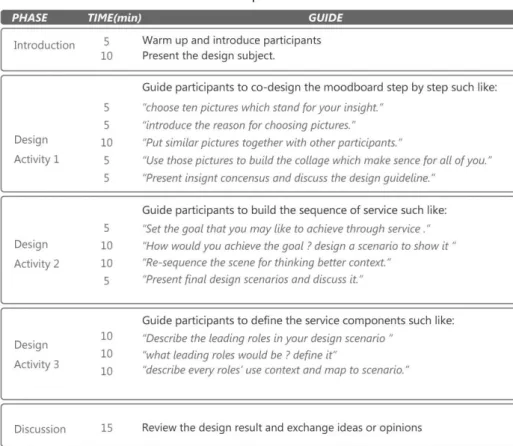
TABLE 3. 5 Timetable of the final workshop ... 30
TABLE 5. 1 The checklist of recruiting participants ... 39
TABLE 5. 2 The timetable of the service co-design workshop ... 45
VIII
F
IGURE CONTENT
FIGURE 2. 1 The procedure of the “dialogue-labs” session ... 7
FIGURE 2. 2 The procedure of a context mapping study ... 9
FIGURE 2. 3 The empathy probe process ... 10
FIGURE 2. 4 The touchpoints cards ... 16
FIGURE 2. 5 The touchpoints matrix ... 17
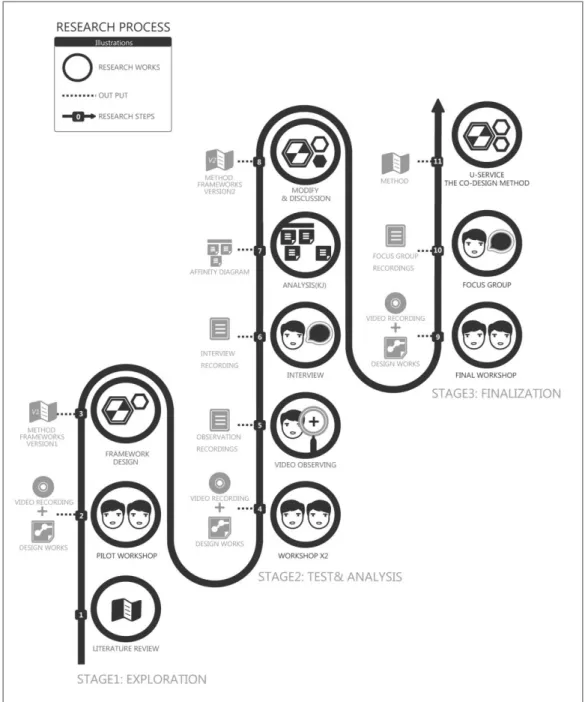
FIGURE 3. 1 The process of the u-service method development ... 19
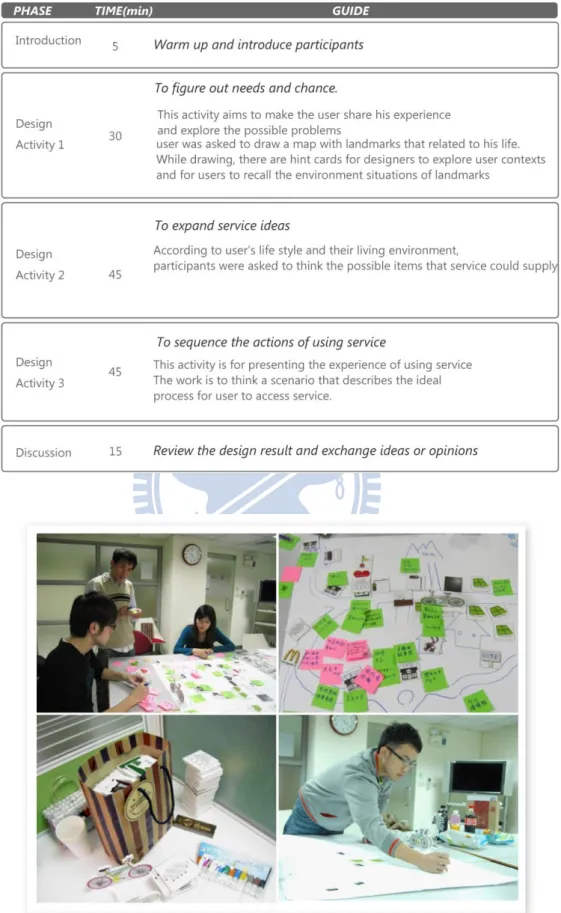
FIGURE 3. 2 The participants were co-designing the service in pilot workshop. ... 21
FIGURE 3. 3 The criteria of recruiting participants ... 23
FIGURE 3. 4 Participants were making a moodboard to present their ideas... 25
FIGURE 3. 5 The picture shows one participant was planning his service journey by sequencing scene cards. ... 26
FIGURE 3. 6 The participant was looking at the description of each scene card and they wrote down the ideas of touchpoints. ... 27
FIGURE 3. 7 The pictures show the interview situations and environment. ... 29
FIGURE 3. 8 Data analysis ... 29
FIGURE 5. 1 The suggested procedure of implementing u-service method ... 38
FIGURE 5. 2 The layout for space decorating of design lab ... 40
FIGURE 5. 3 The moodboard pictures which are collected by above guidelines. ... 42
FIGURE 5. 4 A set of scene cards that used in designing a cycling service. ... 43
FIGURE 5. 5 The pattern form ... 44
FIGURE 5. 6 Participants works on moodboards to present their feelings by the collage toolkit ... 46
FIGURE 5. 7 Participants use “scene cards” to design the process of interaction ... 47
FIGURE 5. 8 Participants use “scene cards” to present their journeys of using new service. ... 47
FIGURE 5. 9 The process of the service design case... 49
FIGURE 5. 10 From left to right, the moodboards for “peaceful atmosphere”, “companion”, ”natural” and “insight” ... 50
FIGURE 5. 11 The workshop participants are designing the service journey by scene cards ... 50
1
Chapter 1
Introduction
Currently, ubiquitous service provides a higher quality of life.
However, some services do not meet the expectations of users.
To create a service that can satisfy the needs of users,
designers should listen to their hearts when considering their
opinions. This study is devoted to developing a service design
methodology that helps designers to understand the inner
demands of users.
1.1 Background
Service is highly common in our daily life, such as with online banking and online ticket booking. Due to the progress of technology, the ways to receive service have become more diverse. While customers have more choices to obtain service, the experience of using service becomes paramount. Many studies have indicated that the turning point of service innovation comes from realizing the goals and expectations of users (IDEO 2008, Chris 2009).
The service design
Shostack (1982) proposed that service design is the integrated design of tangible products and intangible services. “Service design is the design of intangible experiences that reach people through many different touch-points, and that happen over time.”(Live| work) When planning a way for providing service, designers should listen to users and facilitate users to have great using experiences.
Currently, the progress of technology brightens the prospects of the service industry. Increasingly diverse service has developed to provide users with a higher quality of life; however, this is sometimes a result of expectation, especially when the users are not familiar or have difficulties in using service. Therefore, service
2
must help people accomplish their goals, but this may eventually cause more confusion.
To create a service that can satisfy the needs of users, some service companies are dedicated to exploring user viewpoints, and adopt the co-design method as a key technique for innovating service (live|work, engine, IDEO). Eric (2001) also suggested that using a co-design toolkit could help users express their real demands.
Designer’s role
In recent years, design has played a vital role in the experience economy and user-driven innovation (Palsbro, 2008). The problems designers must solve are more complex than before. To overcome these challenges, Parker (2006) stated that designers of the next generation would become management consultants with graphic skills. That is, designers should not only handle original design issues, but also be concerned about service.
Additionally, designers are considered the once have ability to understand people Designers acquire the strength required to produce innovative ideas from understanding the demands of people.
Co-design with customers
Co-design originated from the participatory approach that has been led by Northern Europeans since the 1970s. The method helps designers and users produce design results by working together.
A growing number of studies have discussed the issue about co-designing with customers. Sanders and Stappers indicated that the approach to co-designing changes the roles of designers and users to facilitators and collaborative designers (2007). When accepting users as co-designers, designers need appropriate methods and tools for involving them, such as creating an inspiring space (Lucero & Vaajakallio, 2009), co-designing activities in an artificial environment (Kirsikka, 2008), and facilitating collaboration through design games (Brandt, 2008). These are ways to facilitate communication, explore the ‟ needs of users, and develop leading ideas.
3
1.2 Motivations
When co-designing service, there are difficulties arise, such as the communication between members from different backgrounds and the service concept being troublesome to present. Describing initial service concepts is difficult for designers. Also, expressing ideas and real needs clearly is challenging for users. The results of co-design should meet the needs of users, but sometimes designers fail to do so because of inappropriate methods.
Additionally, planning a co-design workshop is sometimes more complex than the act of designing itself. Numerous concerns must be considered when conducting a workshop, such as facilitating collaboration and guiding participants to generate ideas. Therefore, this study expects to learn more about the co-design method and to create such a method for service design.
Therefore, the proposed method was developed to help designers propose ideas that satisfy user demands. Also, the appropriate manner of conducting a co-design workshop is explored further.
1.3 Issues
In a co-design workshop, users are expected to provide insight from life experience and the designers are responsible for generating ideas. To maximize use of user ability, the method should be designed to help users collaborate effectively. Three related issues are presented as follows.
The way to improve communication
First, this issue is about how to encourage people to exchange ideas with each other. That is, finding a way to help users express needs and help designers introduce ideas.
The inspiring tools
The inspiring tool plays an important role in a design workshop, because it encourages participants to have more imagination. Moreover, the intangible service is not easy to imagine in the early design stage, so this study was conducted to determine what tools help participants generate service ideas.
4 The ways to deliver service concepts
To extend design ideas further, the context of ideas should be presented clearly. This issue focuses on how to assist workshop participants in delivering the context of service design concepts clearly.
1.4 Objectives
The basic idea of this study is to develop a method that helps designers to design service with users. The three main objectives are provided below.
Find out the difficulties in co-design
To learn about problems that could happen in co-design, the collaborative condition of the design members was observed. Members with different backgrounds may have different difficulties in co-design; therefore, this point of view should be considered.
Create a method of implementing co-design
This study explores an appropriate method for implementing co-design and expects to implement improved design quality. Moreover, to apply co-design easily, the proposed method must be presented with steps and guidelines.
Explore the way of developing a method
This study expects to provide an example for developing a method through presenting the entire process with accompanying reasons. In this way, the in-depth discussion on how to design a method and what should be noticed is provided.
1.5 Scope
This study aims to improve the service design quality by co-designing with customers. The service should meet the needs of users first and encourage them to continue using. Although the service design should also consider marketing cooperation or stakeholder‟s demands, determining the potential needs of customers is of greater value to service innovation. The scope of this study focuses on improving service.
5
Additionally, this study seeks an example of a service design case to develop the method. In the process, the design team aims to design workshops with customers and apply the method to generate service concepts.
1.6 Outline of thesis
To provide an overall view, this chapter introduces the backgrounds, objectives, related issues, and the scope of this thesis. The comprehensive literature is then reviewed in Chapter 2, which includes theories of co-design and service design. Chapter 3 presents the process of this study in detail and explains each research task, such as conducting workshops, interviewing, and analyzing data. After that, Chapter 4 discusses results of the study and reviews the process. The final production of this study, the co-design method U-Service, is presented in Chapter 5. The U-Service is introduced by explaining how to use and what should be noticed. An example of implementing U-Service is also provided. Finally, Chapter 6 concludes study results and reviews mistakes of the study process. Recommendations for further work are also provided.
6
Chapter 2
Literature Review
The related works of our study are organized in this chapter.
First, the co-design studies are divided into three aspects to
review. The second session introduces the notion of innovating
services. Finally, the studies of design methodology are
reviewed.
2.1 Co-design
The co-design method originated from the participatory approach that led by Northern Europeans, since the 1970s. It‟s the method that produces the design results through the collaboration between users, stakeholders, and designers. Sanders and Stappers (2007) point that, the co-design method is different from user-centered design method, which is seeing users as co-designers not just the subjects that be observed by researchers. Moreover, the rising design categories are more complexity than before and concern the experiences of using, such as the service design and interaction design. The design activities are changed from designing of products into designing for people‟s purposes. (Sanders and Stappers 2008) And, the design method should more concern to the future users of what they design. Thus, the increasingly method researches are dedicated to deeply knowing users goals and desires through co-design with them.
2.1.1 Co-design session
Sanders and Stappers (2007) proposed that the new landscape of design research has become co-designing with users and it changes the roles of designers and users to facilitators and collaborative designers. (Sanders & Stappers 2007) Therefore, it‟s important for designers to communicate with users and facilitate effective ideas by using appropriate methods and tools in the co-design sessions. (Vaajakallio, 2007) Lucero and Vaajakallio (2009) proposed the inspiring co-design space that promotes participants be involved. (Lucero& Vaajakallio2009) Vaajakallio and Mattelmäki focus on an artificial environment that helps
7
participants have things to communicate. (Vaajakallio and Mattelmäki 2007) Brandt and Messeter (2004) developed a series of board games to inspire participants to produce ideas with each other. (Brandt and Messeter 2004) These paradigms of co-design sessions would be individual presented as following, including their background, methods for communications, collaborative insights, and the concept design games.
2.1.2 Communication
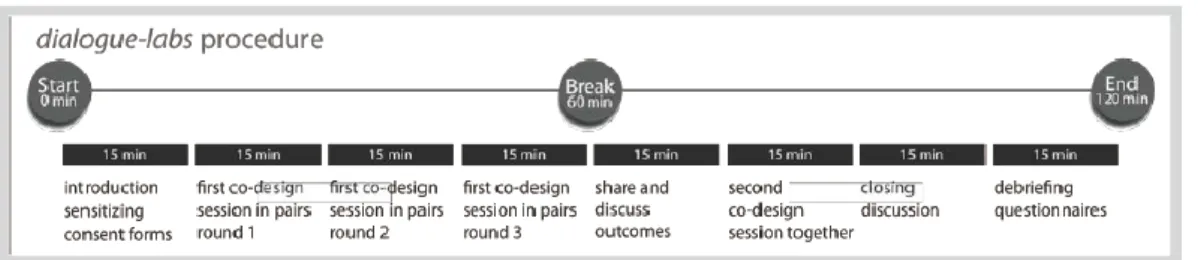
The precondition for using co-design method is in believed that all people are creative. However, the people with creativities of diverse domain and life experiences need to be integrated through appropriate tools and methods. The related studies that dedicated to develop methods and tools were emphasized on the communication between participants in the co-design workshops. "The dialogue-labs method"(Lucero 2009) provides the way that help participants to create dialogues through the appropriate tools, which is an inspiring space that full of visual and tangible design materials for designers to collaborate with users. There are seven communication tools for using, such as collage toolkit, video, and make tools, and participants could choose their preferred one to finish three-phase design exercises. Each co-design session had four participants form two pairs consisting of one designer and one end-user and its procedure is as the figure 2.1, that participants evaluated the effect of tools and design results in the end of co-design sessions. The research has pointed that it was important to have diverse materials and strategies to motivate participants to get started and to keep them on a creative mood throughout the session. (Lucero 2009)
Figure 2. 1 the procedure of the “dialogue-labs” session
From “Co-designing interactive spaces for and with designers: supporting mood-board making. “A. Lucero, (2009). Unpublished PhD Thesis, Eindhoven University of Technology.
8
Vaajakallio (2007) proposed that the key issues of co-designing are rely on arranging the artificial environment, setting the design tasks and supplying design tools and materials. In their research, the design environment was divided into three areas that belong to each design activities and there were related materials such as magazines, postcards, work table and sketch tools put in areas. The actions, discussion contents and the move line of participants were observed by researchers to explore the effect of co-design methods. Especially, the author mention that although some researchers have suggested that the more ambiguous the tools, the more surprising design openings it provides, but after their research, the tools that help participants to present ideas which make sense should not provide for them a huge amount of either abstract tools or recognizable tools such as readymade figures. Additionally, the research figure out the evolving situation that two individual designers having their own parallel conversations in the beginning, then they start to do things at the same time sharing the same conver-sation while they getting familiar with the situation and later their actions become united and thus they work as one entity.
These two studies of co-design methods provide the paradigms for facilitating the communication through design tools and inspiring space. Also, they provide the research methodology to explore co-design methods by holding workshops and observing the evolving situation of participants.
2.1.3 Collaborative insight
The co-design method is seeing user as the expert of their life experience and become the co-designer in the design process. In order to fit this role, users should be given appropriate tools to express their context of life. (Roberta Tassi2008) Designers and researchers have developed methods in context mapping and should use the techniques to get the user experiences of diverse aspects such as discovering user needs through contextual inquiry, observing the actions of the user, and using co-design method to create innovative products or service with user. (Visser, 2005) Because knowing these techniques and tools, designers have more opportunities to innovate service. (Samalionis, 2009)
According to Visser (2005), there was a method structure be built to conducted a study of context mapping and it typically involves a sequence of research steps,
9
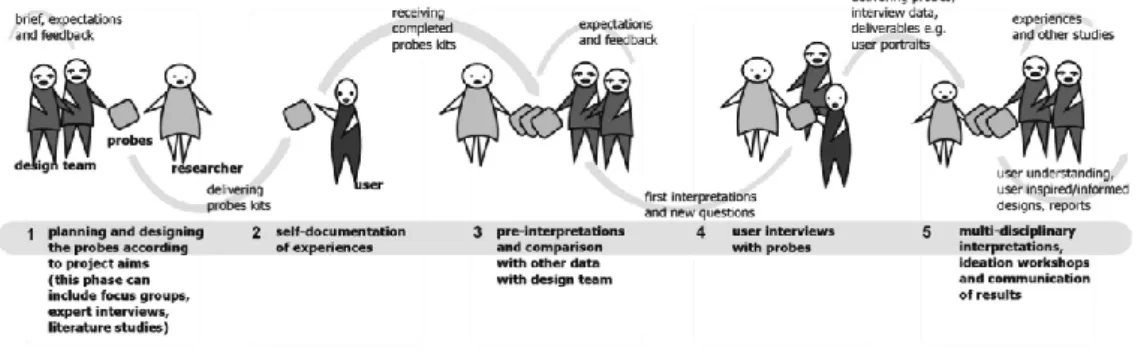
including preparation, sensitizing participants, group sessions, analysis and communication. The study of context mapping could begin with the preparations such as setting up the study involves the formulation of goals, planning, selecting participants, choosing techniques, and so on. Sensitizing participants mean to prepare them for group sessions by encouraging and motivating them to think, reflect, and explore aspects of their personal context in their own time and environment. In third stage, the session is a meeting in which participants do generative exercises that researchers or facilitators could explore their context and unexpected directions through it. The design results and data collected in the sessions were continuously analyzed and discussed in last stages. ( Visser 2005) The authors illustrated the procedure of a context mapping study as figure 2.2.
Figure 2. 2 the procedure of a context mapping study
In the stages of preparation and sensitization, the probe approach was used similar to preparation works that facilitate users to express their creativity in later
participatory sessions. The probe is the increasing approach of exploring user context through interesting ways of recording life. It promote users to become positive to get involved in design process and invite them to express the experience, mood and personal attitude through the workbooks, which might contain the diary, open-end questionnaire, tasks of sketching, making collages, or taking pictures and so on. Mattelmäki(2005) pointed that the probe approach could apply not only to be the inspiring notes but also the collaborative insights. It was used through the empathy probe process that begins with designing the workbooks, and then
recruiting users for taking life records. After that, user was invited to interview for understanding the context and ideas in their records and involved in co-design workshops. The authors illustrated the empathy probe process as figure 2.3. From “Contextmapping: experiences from practice.” by F. S. Visser, P. J. Stappers, R.van der Lugt, & E. B. Sanders, -N. (2005). CoDesign: International Journal of CoCreation in Design and the Arts, 1(2), 119 - 149.
10
Figure 2. 3 the empathy probe process
The author mentions that “the probes data opens fresh and holistic perspectives and vivid information on individuals and their contexts. However, the data may be too ambiguous and fragmented with too broad a focus to be used for concrete design decision-making in companies.” (Mattelmäki 2005) So, using probe approach to sensitize and prepare participants should be together with other methods for collecting completely data for the design decision. The Active@work (Vaajakallio 2007) presents a series of make tools that help to explore user context in the session stages. It helps users to bring up their real needs or expectations by making prototypes and imaging the situation of using new products.
These studies provide the paradigms for exploring users‟ insight and context, such as the probe approach, the frameworks of context mapping studies, and the make tools.
2.1.4 Concept design games
The concept design games were proposed by N. John Habraken (1987) and originally applied in architecture design and urban planning, which explore the process of design thinking by observing the actions of designers in playing design games. Brandt and Messeter (2004) emphasize that concept design games are different to the games which have win and lose, it not consider the competition between players, but focus on facilitating the ideas generation. According to Brandt and Messeter„s research, they presents a set of four design games to facilitate collaboration, improves idea generation and communication between participants.
From “Applying probes – from inspirational notes to collaborative insights. “ by T. Mattelmäki, (2005).
11
2.1.5 Summary
The paradigms of co-design method above are categorized into two major types: one is devoted to improve the communication by developing tools or creating an inspiring lab that helps participants express ideas. The other one focus on exploring the user context, such as using probe approach, makes tools that applied to get user insight. Both of them have same concept that visual, tangible artifact and tools could effective support participants to communicate ideas or express experience. However, it still need some adjustment to use in intangible service design, because the studies gather here are mostly applied in designing products. From this session, we can see the ways about how to get user insight and how to communicate with them through the co-design session. And we hope to combine the advantages of both and design the method that help designers and users to easily prototype and discuss their service ideas.
2.2 Service design
What is service design? To take mobile phone property for an example, it was originally the communication product but became to have complexity system after supplying service. However, while the various service functions that due to the commercial considerations and technology combination without considering the experience of using, it would make using new service functions like training people to get services that even not really fit their needs. Service design is not intended to increase consuming but make people use it continuously.(LIVE|WORK) Thus, the key of promoting service values is not to develop various service functions and items but consider people. The service design could be understood as an experience design by having empathy for user, and the good service should always put people‟s needs and expectations first. (IDEO)
2.2.1 Characteristics
Shostack (1982) has pointed out that service design is the integrated design of tangible products and intangible services (Shostack 1982). And the company, LIVE|WORK introduced that, “Service design is a method for designing experiences that reach people through many different touch-points, and that happen over time.”(LIVE|WORK) Unlike products, service come to existence at the same moment they are being provided and used.( Eiglier 1977; Normann 2000; Morelli
12
2002 ) in conclusion, service design focus on organizing the tangible and intangible elements and constructing the system which allow each particular people to have good service experience. To achieve this goal, the service design can be seen as an experience design (LIVE|WORK) and concern the value, system, journeys, peoples and propositions. It helps to have useful questions and tools with which to design (Engine)
2.2.2 User driven innovation
Because the user is goal-directed, good service should allow people to accomplish their goals than just complete tasks. (Chris, 2009) On the other hand, with the increasing of technology, people have chance to get service through their own way instead of completing tasks which might not satisfy their needs.(IDEO) So, to improve the service that fit requirement, it should put people first and figure out their using goal and intentions. (Chris, 2009)
However, it‟s not easy to predict user‟s goal because there are quite different using needs and expectations of each particular user. Moreover, some users might used to current service products and have no expectation of new one, even if the current one is not appropriate for them.(Leonard) That is, to understand the real need would base on making people figure out the problems and express it.
Samalionis(2003) point that, the demand of customers are more than ever before, but some traditional market research are no longer to deal with. The research is unable to tell anything new which just regurgitates the past marketing campaign but without articulating what people need. To get more understanding of user need, the author is in favors of using empathic human factors research techniques as an integral component of every project. From this, it helps to get insight of customers and clarify the real needs of each role in the service ecologies. Similarly, Parker (2006) proposed that service design should start with understanding people‟s life instead of consider the system organization. That is, to figure out what people need and how people use service can make designer to find new aspect of innovation. Besides, there‟s different way to explore the innovative ideas of service. According to Hippel and Katz (2002), they try to translate the design ability to user and facilitate them to explore their real need and express ideas. To help user design the
13
products or service for their own, the user friendly design toolkits are created by authors. They mention that user friendly toolkits aim to make user have chance to try and error, then learn by doing, and explore their real expatiation by designing it.
2.2.3 Summary
After reviewing the literature of service design, we can find that the key of promoting service values is always considering people. From the observation of service property, it became complexity with the increasing technology which allows customers have more demands than before. And in order to maintain the service quality, the responsibility of design includes understanding people‟s need and satisfying their diverse requirement. It should be supported people‟s life and provide great experience instead of asking them to get the job done. That‟s why service design is more than just design system.
For improving service quality, there were many studies try to define what is service design and how to design. According to the results of studies, we learn that service design seems like to integrate tangible products and intangible services (Shostack ), to create the best value for customers and providers(Engine) and come to existence only at the same moment they are being used (Eiglier 1977; Normann 2000; Morelli 2002) It‟s a challenge for designers to deal with these new elements, but it‟s also a good moment for us to explore the methods for solving and thinking service design.
2.3 Methodology
First, the design methodology is reviewed. Then the studies that focus on service design methodology are organized. In the end of this session, the method paradigms for designing service are gathered.
2.3.1 Design methodology
According to Jones (1992), the design methodologies are divided into six categories (see table ) which include methods of controlling strategy, methods of exploring design situation, methods of searching ideas, methods of exploring problems and methods of evaluation. (Jones 1992) The methodologies are provided to solve design problems with different purposes.
14 Table 2. 1 The six categories of design methods.
CATEGORIES PURPOSE METHODS
1 Strategies prefabrication Systematic search, Value analysis 2 Strategies control Strategy switching
3 Exploration of design situations Interviewing users, Questionnaires 4 Ideas search Brainstorming, Synectics,
5 Problems exploration Interaction matrix, system transformation 6 Evaluation Selecting criteria, Specification writing
Base on above categories of design methods, this study would focus on developing the method for exploring situations and searching ideas.
2.3.2 Service Design methodology
“Services need to be understood as a journey or a cycle – a series of critical encounters that take place over time and across channels.” (Parker 2006) While describing and organizing a service, the framework of a customer journey is helpful to think the experience of a service (Samalionis 2003) And, according to the book “journey to the interface “(Parker 2006), the language of service are organized with definition. The definitions of touchpoints and service journey are as following. 1. Touchpoints
Touchpoints refers to diverse channels that customer can get the service. It seems like the physical elements of a service system. “Touchpoint is everything that a person accessing the service sees, hears, touches, smells and interacts with.” 2. Service journey
The journey refers to the process for customer getting service. They might interact with numbers of touchpoints in a service journey. “Tracing the person‟s journey enables service providers to reflect on the effectiveness and appropriateness of each intervention.”
For improving the design quality, there are related techniques proposed by Design Council (2009), which are the service designer works with.
15 1. Observe the situation
2. Involve user 3. Create a blueprint
4. Analysis the quality of service 5. Evaluate the ideas
6. Prototype a new service. 7. Test
According to Morelli (2006), the overviews of the methodologies for designing service are proposed. There‟re three main directions that include the method for identifying actors in the service system, defining the logical structure of the service and representing the service:
1. Identification of the actors
Identify the actors in the service environment, which might have customers and stakeholders. Also, use the appropriate method to figure out their requirements, such as observation techniques, culture probes.
2. Definition of possible service scenarios
The method that helps to describe the characteristics of the interaction in the service. The related tools include scenario and use case. Morelli point that, these methods of service design should concern tangible and intangible component of a service, time sequences and flows.
3. Representation of the service
The method that can clearly present all the components of a service, define the specific interaction process, and physical elements. The blueprint is an example for representing the service.
2.3.3 Paradigms
Service Touchpoint Cards
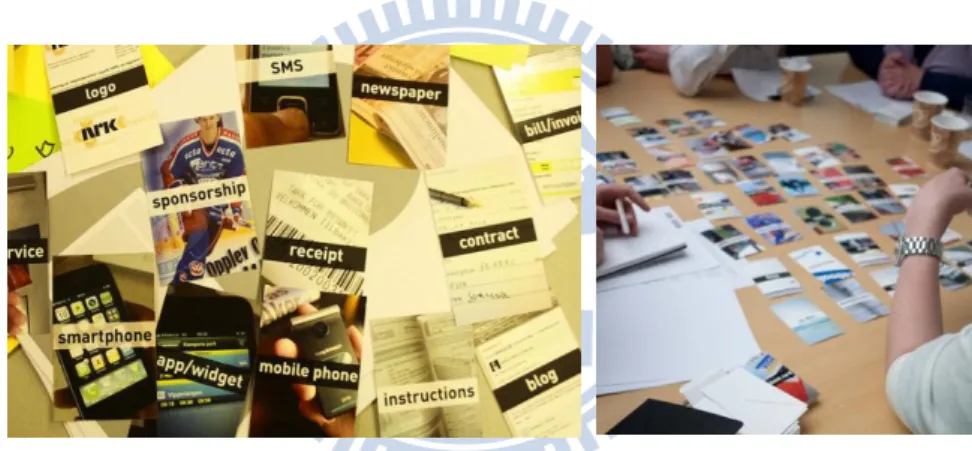
The case, AT-ONE Project (2009) that created a set of Service Touchpoint Cards for the Nordic Service Design conference, provides the useful methods to deliver service ideas by thinking collaborations of actors in the form of value network (AT-ONE 2009). The card set contains about 52 touchpoints examples that might
16
be found in a typical service. (See figure 2.4) And the cards are grouped into five categories: Media, Graphics, Servicescape, Communications, and Ephemera. The first category refers to media outlets, such as TV, radio, newspaper or the latest social community like YouTube, Facebook, and Twitter. The next stands for graphic production, including business cards, brochures, and advertising. The servicescape refers to the environment of the service, such as wayfinding, call-centre or building. The communications category contains the channels that people get in touch with others, such as smart phone, e-mail, SMS and the person who deliver information are also included, such as friends or family. Finally, the ephemera category refers to the objects of business that connect services together, such as receipts, bills, credit cards. This project provides a considerable way for inspiring designers to thinking service through actors‟ definition and card sorting.
Figure 2. 4 the touchpoints cards
Touchpoints matrix
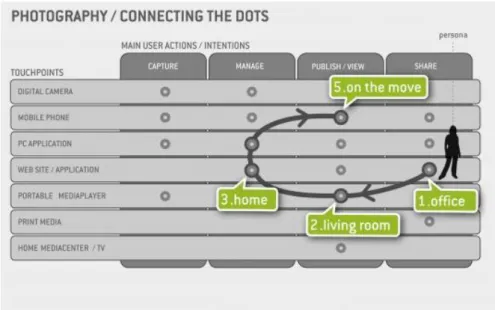
Touchpoints matrix is the method that developed by Gianluca Brugnoli -teacher at Politecnico di Milano and designer at Frog Design. Roberta (2008) introduces this method that “this method merges the features of the customer journey and the features of the system maps and is based on the use of personas.”
This method provides a visual framework for helping designers to plan the experience of using service. The first step is defining touchpoints that might be the component of the service system, and fill the ideas in the vertical axis form. Then, the actions that service system can support are listed in the horizontal axis form. After that, designers could clearly design several specific journeys that personas
17
might experience. Figure 2.5 illustrated this touchpoints matrix graphic.
Figure 2. 5 The touchpoints matrix
2.3.4 Summary
According to the six categories that Jones (1992) proposed, the design method of this study belongs to the method of searching for ideas or the method of exploring design situation. The method is expected to make designers create the innovative ideas which can meet the user‟s demand.
For helping designers and users can easily design the service, seeing service as a journey provide us a basic idea to plan the design method. The three directions of service design methodologies that Morelli (2006) proposed forms the initial framework of the method design. The elements of the proposed methodology would base on those directions, which include the method for defining the actors in service environment, the method for defining the possible service scenario.
18
Chapter 3
Methodology
This study aims to develop a co-design method that helps
designer to reveal the users‟ inner demands. For a better
understanding, the three-stage study procedure (exploration,
testing and analysis, finalization) is designed. And through a
series of research works, including literature review, framework
draft, workshops, interview and data analysis, the U-Service
method is formed and proposed. In this chapter, the process of
the U-Service development would be explained in detail.
3.1 Procedures of the study
At the outset of this study, a comprehensive literature review was conducted. And an initial framework of the U-Service method was drafted. Then the framework was implemented and tested in a series of workshops for a bicycle touring service. After that, the participants were interviewed to further understand the usability of U-Service method. Finally, the data collected from these workshops and interviews were analyzed to modify and finalize the proposed method. The process for developing the U-Service method is shown in the figure 3.1.
19
20
3.2 First Stage: Exploration
To gain the understanding of method development and clarify its directions, the related works, such as the co-design session (Brandt and Messeter 2004, Vaajakallio 2007, Lucero and Vaajakallio 2009), communication tools (Lucero 2009, Vaajakallio 2007) and service method design (Morelli 2002, 2006) were reviewed. And an exploratory workshop was applied.
3.2.1 Pilot workshop
In this exploratory stage, the intention of the pilot workshop does not consist in evaluating the draft method is effective or not, but in figuring out needs and problems that participants may met, and then organizing the possible answers. To get closer to the truth, the workshop goes through a real design project and makes users and designers involved. It takes about two hours for workshop participants accomplishing design tasks collaboratively. And each participant was given the same design tools for observing if there is different performance between them or not. (To compare designers and the person without design background) From this way, we try to find the possible different requirements of method using. The workshop was mainly divided into three stages from user experience sharing, ideas co-expanding to design results delivering. And in the end of the workshop, we have a discussion with participants to talk about their experience and comments of method using. Finally, the guide for developing frameworks of U-Service method was provided from this result. Table 3.1 presents the process of pilot workshop and the figure 3.2 shows the situation in workshop.
After this workshop practicing and reviewing, there are two obvious problems being found as below:
The first one is that inspiring tools didn‟t work as our expectation. The inspiring tools was created to help users to recall the related experience but failed in facilitating user‟s imagination. Second, the task of designing service journey was misunderstood for participants. They seem to sequence different kinds of services in a daily process.
21 Table 3. 1 The procedure of the pilot workshop
22
3.2.2 Initial method design
After conducting the literature review and the exploratory workshop, frameworks of the U-Service method was formed. It was designed base on the theory and methods of participatory design first and reformed according to the workshop results, which show the difficulties that participants might have in co-designing service. Finally, the clearer method framework was built from repeatedly practicing above steps and would be implemented and tested in the next stage.
3.3 Second Stage: Testing and Analysis
Because of the previous exploration, the framework of the U-Service method was formed and clarified. For a better understanding of its usability, it was implemented and tested in a series of workshops. Then, the video record of workshops was observed and the participant‟s interview was conducted to realize the potential problems and its causes. After that, data collections form workshops, observation and interview were analysis by KJ Method.
The intention of this stage is to test effects and figure out existed problems of the U-Service method. And the suggestions for modification are also provided.
3.3.1 Workshops
The workshop consists of three collaborative activities and participants were asked to complete them for generating innovative concepts. The first step we worked is to prepare design material and propose the plan. Then, participants were recruited contain designers and customers balance. After that, design activities were conducted and the observer was involved for taking notes. In the meantime, whole process was video recorded for later coding and analysis. Through running workshop activities, the framework of U-Service method was implemented and tested.
Preparation
To facilitate the design workshop and generate effective results, we spend time in preparation for setting up a space for co-design activity, and making material. Then produce a workshop plan that guides each design activity to working successfully. In each workshop, the bright, clean and comfortable discussion space was selected to be a design lab. It‟s decorated with wide desktop for sketching, the projector for
23
ideas presenting, and the video equipment for recording design process. The inspiring materials are also prepared, such as magazine, pictures, stickers. Additionally, music and snacks are helpful to facilitate participants having high involvement. Besides, the brief introduction of design subjects and the guide of each activity are arranged to a presentation slide.
Participants recruiting
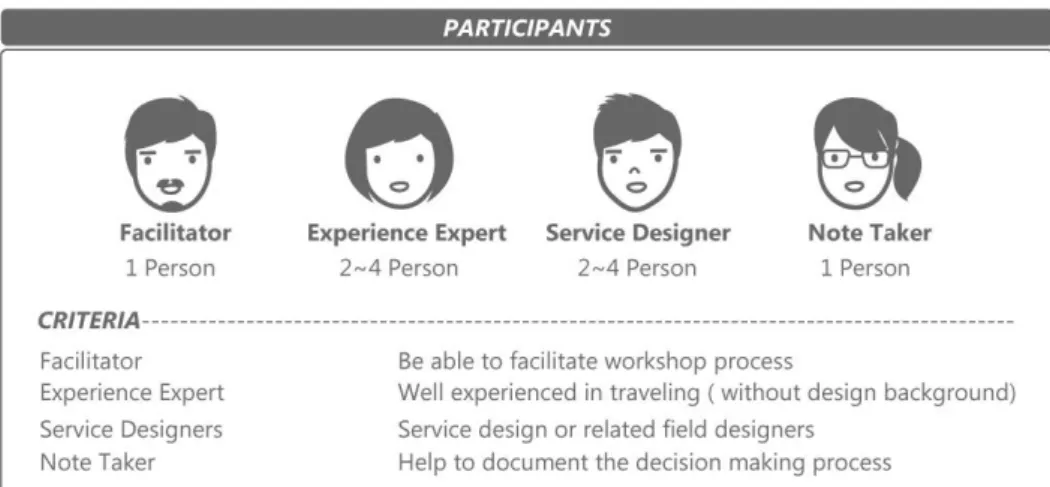
Participants for these workshops are selected balance including designers and customers (without design background). The customer participants were recruited through BBS information post or friends, and the designer participants are mostly members of the simultaneous design project. They are invited to join the inspiring design activities. Figure 3.3 lists the criteria of participants recruiting.
Figure 3. 3 The criteria of recruiting participants
Besides, to lead design activities going and to record the process, there are the moderator and the observer in workshops. The numbers of participants are about
24
Table 3. 2 The composition of the workshop members
Workshop Process
There are three main activities in a co-design workshop and it takes about two hours. Table 3.3 shows the timetable and guides of design activities. The following session would introduce each stage of the workshop with details.
25 Introductions (15 min.)
Before main design activities, there was the introduction to warm up and guide participants to gain an overall view of the design subject.
First Design activity: Concept exploration (30 min.)
In order to generate service that fulfills user‟s needs and takes users opinions into consideration. This activity was created to facilitate participants exchanging ideas with each other. The service concepts were first explored through the collaboration between designers and users. That is, each participant should express their subject related opinions or ideas and then discuss with others.(see figure 3.4) In the meantime, amount of pictures and collage tools were provided to inspire participants‟ imagination and help communication. The design production would have collages with stories.
Figure 3. 4 Participants were making a moodboard to present their ideas. Second Design activity: Service journey (30 min.)
After concept exploring, the following activities are both dedicated to further specify the concept. In this design activity, service concept was expanded through the consideration of service journey. And the scene cards, which present the divers service moments were provided. Participants were asked to plan the service process and deliver a scenario with a series of scene cards.
26
It‟s similar to the comic strips that describe a story in sequence. The situation of this design activity is shown in figure 3.5
Figure 3. 5 The picture shows one participant was planning his service journey by sequencing scene cards.
Third Design activity: Service touchpoints (30 min.)
This activity applied with same purpose of previous one, but further specifies the service concept through designing touchpoints. Participants were asked to
think the touchpoints that supplying services, such as website, e-mail, intelligent mobile phone etc. The ideas like that should base on the service journey (which was designed in previous activity). They wrote down the ideas on the Post-it. (see as figure 3.6)Finally, participants told a story that contains
27
Figure 3. 6 The participant was looking at the description of each scene card and they wrote down the ideas of touchpoints.
Discussions (15 min.)
Same as the pilot workshop, to gain an understanding of their experience and opinions of each design activities, there‟s a discussion with participants in the end of the workshop. Also, the design results are discussed and organized.
3.3.2 Observation
The view of observations consisted of three main parts: (1) The difficulties that come with co-designing service; (2) The outcomes of inspiring tools used;
(3) The collaborations between participants, and their role in the team.
Besides, some behavior or phenomenon that beyond understanding in this step would further interprets by interview. The collected data from observation were analyzed to direct the further interpretation and modify the proposed method.
3.3.3 Interview
To further understand the usability of U-Service method, workshops participants were interviewed individually for inquiring their co-design experience.
Before inquiring, the interview script was framed to control the progress and directions. And the open-end questions were set to gain an understanding of
28
participants‟ mind, design context and their opinions. However, in process, the set questions would be a little bit adjusted depends. The interview questions are listed in six categories as Table 3.4.
Table 3. 4 The interview questions
After workshops, participants (including designers and customers) were invited to a ninety minutes interview. It‟s a little difference between the inquiring with designers and customers. For designers, we are interested in their requests and expectation of the method. And for customers, we concern if the method is helpful to them in communication and imagination or not.
The interview was conducted through three steps, which includes discussing the design results, reviewing the video record and inquiring the design context. The interview environment and situations are as shown in figure 3.7. This work aims to make respondents describe their opinions or experience in more detail. And in order to call up their memory, the design production and video records of workshops were provided.
29
Figure 3. 7 The pictures show the interview situations and environment.
3.3.4 Data analysis
The analysis is consisted of two main parts: the benefit and difficulties of the method. The benefit of method applied is analyzed through comparing results from different workshops. And, to detail understand method user‟s context in workshop, the part of analysis are focus on their difficulties and expectations in process. Figure 3.8 illustrate the data analysis. After taking notes from workshops, observations and interview, the data was logically organized and grouped through affinity diagram. Since that, the problems and requirements are revealed with context and the improvements of the U-Service method are provided.
30
3.4 Third Stage: Finalization
To develop a user driven co-design method, the whole study is dedicated to find a better way for inspiring and take user‟s insight in considerations. And, the U-Service method with its developing process is proposed here for an example but not the only answer. The final stage is conducted to conclude our study results for opening the discussion of further exploring.
3.4.1 Final workshop
The U-Service method was revised and finalized base on the results of previous testing and analysis. And it‟s implemented in workshop again for reconfirm. The design spaces, equipment, inspiring tools are controlled as previous workshops and the rule of design activities were modified to improve the collaborations. There were four participants (designer and consumers balance) involved to practice the revised method. The timetable and guides of final workshop as shown in table 3.5.
31
3.4.2 Focus group
To in-depth understand the usability of proposed method and to guide the exploring, focus groups was conducted after each design activity in workshop. The participants were gathered to discuss about their collaborations, the difficulties in process, the understandings of the method and comments. From this way, it is efficiency to get a brief review of the method to help method further developing. After above works, the method which named U-Service was proposed. Review this chapter, the methodology was presented through three sections. First, the section 3.2 explained the way to explore the difficulties in co-design and frame the draft method. Then we introduced how the draft method be implemented and tested in workshops. To further understand the effect of using method, the interview was conducted. Above works of test and analysis was shown in section 3.3. After that, the draft method was reconfirmed and modified through workshop and focus group. And it was explained in section3.4. After these study works, the results and findings would be presented in the next chapter. And the proposed method (U-Service) would be detailed introduced and discussed in chapter 5.
32
Chapter 4
Results
In this chapter, the results of analysis are presented and three
topics which we were interested were chosen into discussion
further. First, the process of developing a method is reviewed
and the comparison of co-work condition in each workshop is
discussed. In the end, the testing result of the U-Service
method is provided.
4.1. A Method Development
During the process of the U-Service method development, the U-Service was modified efficiently by means of practicing the method. This session would introduce how to design a method and what to consider.
4.1.1 Reviews on Process
Reviewing our study, it‟s not only a method was created but also a manner for developing a method was explored. An example for designing a method was provided here. The following presents what we have learned from the method creating process.
The basic idea of this study is to create a way to help designers co-designing services with users. Thus, the workshops were held repeatedly for exploring the possible way. In the beginning, the methods we developed were usually failed to use. However, we learned how to design a better one by examining previous works and correcting the mistakes.
Afterwards, clearer ideas of the method were emerged. Meanwhile, the method was continually tested in the workshops. In the whole process, the participants‟ behavior of using method was observed, because we were curious about what kind of conditions may cause the problems. Then, the results of observing may help us to understand the reasons caused the method failed to use.
33
However, there were still some problems with this method, which we can‟t get the solutions from practicing the method. Therefore, we further interviewed the participants in addition to testing the method. Through the interviews, we could realize the real problems from users‟ description. Moreover, the data that collected from the interviews were analyzed to find out the defects of the method. After the previous analysis, the key points of modifying the problems were caught. Then the method for co-designing the service would be more appropriated.
In the whole process of developing the u-service method, we could directly feel the benefits and the damages of the method by practicing it continuously. To developing a co-design method, practicing the method and discussing with the participants are especially indispensable.
4.1.2 Consideration of designing a co-design method
The challenge we need to face while designing a co-design method is that we should make the method be useful by helping both designers and users. They would have quite different requirements during the co-design process. Additionally, we take the using stage into considerations because the goals of each stage might be different.
In this study, we are focused on developing a method that can help the co-work between designers and users. Moreover, we found that they had different requirement while co-designing a service. We expected that the method could help designers generate ideas and help users provide their opinions through designing service. Therefore, we tried to design the method which is easily to be used by both designers and users. Furthermore, their imagination should be inspired by means of the method. Finally, we tried to help designers and users easily organize their ideas by using the method.
The goals of different stage also need to be taken into consideration while the method was created for design projects. With the change of the goals, the purposes of the method may also be changed. The U-Service method is developed for helping generate concepts in the initial design stage. Therefore, we considered that the method should help people generate lots of ideas firstly. Secondly, it should help users to deliver concepts clearly. Besides, the U-Service was applied to a real design case to confirm its effect.
34
4.2. Workshops
There are four main workshops be hold in the process of this study. And, the co-work condition of each workshop was compared. There is some interesting phenomenon be found by observing the workshop‟s participants. The findings of the co-work condition would be introduced as below session. And, the effect of using inspiring tools is also provided.
4.2.1 Collaborations between Designers and Users
In this session, the co-work condition between designers and users are discussed. The key point of observation is concentrated on how participants work together and share the work.
In the beginning of a workshop, the participants are confused with their responsibility of the work. Originally, designers hope to gain new ideas from user because they seeing user as co-designers. However, the result is less than their expectation. In fact, users are good at describing the experience rather than proposing the ideas. Thus, designers and users start to share different parts of the work.
A designer seems like the facilitator in a co-work. They try to propose lots of ideas base on user‟s opinion. They help users to accomplish the design works. And also, they provide ideas to inspire other co-designer‟s imagination.
While making a collage of ideal service, designers and users is doing the same work but have quite different mind. Designers make a collage to display the process of providing a service (e.g. the process of renting a bicycle). And, users make a college to show their experience (e.g. one experience of cycling tour). This is showing that design results indeed contain user‟s opinion but it still needs change into design ideas.
Most of workshop participants glance at others‟ work before the conversation. They try to understand other‟s ideas through this way. Some design results provide an opportunity for them to start a discussion with others, such as the collages of their ideas. They open the communication by sharing ideas that they presented in a college.
35
4.2.2 Influence of Inspiring Tools
In the workshops, there were a series of pictures or magazines provided in order to help the participants have more ideas. And we create a series of inspiring tools for each design activity.
The contents of picture need to be carefully chosen. From the observation, we found that the participant‟s ideas were based on what they saw in the pictures. They felt that the pictures with whole background are better than the graphics only, because the picture with the specific object may limit their imaginations. Therefore, the better content is to present the situations, space or activities.
In the process of the study, we have experimented with two different types of inspiring tools. One is providing pictures that we have cut and the other is providing magazines. The design results of using magazines are better than using the cutting pictures. The participants of the workshop preferred to cut pictures from magazine by themselves because they can organize their ideas by doing this step.
4.3 Testing Results of the U-Service
The collected data from the workshops and the interviews were analyzed by doing Affinity Diagram. After that, the benefit, the difficulties and the improvements of the U-Service method were organized. They would be introduced in the following sections.
4.3.1 The Benefits
The benefits of the U-Service method were listed from the interviews and the results of the workshops. There were mainly tree benefits: One is to help participants organize their ideas. Another is to make designing service become easier. Still another is to help participants have efficient discussion.
Participants felt easy to organize their ideas because of the provided tools. The users designed the service for themselves that also stands for their real needs. The basic concept of inspiring tools is to make participants feel free to compose their ideas. The tools help participants to easily present their ideas, and they also help them to adjust ideas. For an example, participants could present a service journey by aligning the scene cards. Then, they could exchange the sequence of the scene cards to adjust ideas.