國
立
交
通
大
學
資訊科學與工程研究所
碩
士
論
文
在無線隨意式網路中可抵抗蟲洞攻擊
之路由協定
An auto-resilient routing protocol against
wormhole attacks in Mobile Ad-hoc network
研 究 生:王偉民
指導教授:蔡文能 教授
i
在無線隨意式網路中可抵抗蟲洞攻擊之路由協定
An auto-resilient routing protocol against wormhole attacks in mobile
Ad-hoc network
研 究 生:王偉民 Student:Wei-Ming Wang
指導教授:蔡文能 Advisor:Wen-Nung Tsai
國 立 交 通 大 學
資訊科學與工程研究所
碩 士 論 文
A ThesisSubmitted to Institute of Computer Science and Engineering College of Computer Science
National Chiao Tung University in partial Fulfillment of the Requirements
for the Degree of Master
In
Computer Science May 2009
Hsinchu, Taiwan, Republic of China
ii
在無線隨意式網路中可抵抗蟲洞攻擊之路由協定
研究生: 王偉民 指導教授:蔡文能教授
國立交通大學
資訊科學與工程學系碩士班
摘要
無線隨意式網路是一種在節點間可自我組態的網路並且在網路內的節點皆可自由 移動以及擁有路由的能力。然而,這些無線隨意式網路的特性無形中也增加了蟲洞攻擊 發生的危險性。近幾來來,關於如何在無線隨意式網路中防範蟲洞攻擊一直是熱門的研 究議題。然而之前所提的方法,大部分將重點擺在如何根據蟲洞的行為來設計解決的方 法,然而在我們的研究中認為從根本的路由協議中找出其路由弱點並且加以克服解決將 可以有較好的防制效果。我們將在本論文研究在無線隨意式網路中路由協議的弱點並且 進一步提出健壯的路由協議來避免攻擊。iii
An auto-resilient routing protocol against wormhole attacks in
mobile Ad-hoc network
Student: Wei-Ming Wang Advisor: Wen-Nung Tsai
Department of Computer Science and Information Engineering
National Chiao-Tung University
Abstract
The Mobile Ad-hoc networks (MANETs) are self-configuring network and each node in
MANETs is free to move and has the ability to route packets. However, these characteristics
will give rise to Wormhole attack which will increase the influences of network attacks. In
recent years, the methods how to avoid wormhole attacks have become attractive research
issues. However, many previous works focus on observing the behavior of wormhole node to
solve the attack issues. We thought against wormhole attack utilizing the routing
characteristics of MANETs will has the better resulting of avoiding attacks. We researched the
routing protocol of MANETs, present the wormhole attacks using the weakness of routing
iv
誌
謝
本論文能夠順利完成,首先要感謝蔡文能老師這兩年來的指導,不論在研究議題以及論 文內容都給了很多寶貴的建議。再來要感謝宗易學長一路上熱心的幫忙以及協助指導。 另外,還有實驗室的同學彥寧、昱華和安勝,陪我度過這兩年愉快的研究所時光。最後 要感謝家人還有女朋友鈺穎的一路上的鼓勵和支持,讓我可以如期完成論文和碩士學 位。
v
Contents
Contents ... v
List of Figure ... viii
Chapter 1 Introduction ... 1
1.1 Research Motivation and Goals ... 2
1.2 Thesis Organization ... 2
Chapter 2 Background ... 4
2.1 Routing Protocols in mobile Ad-Hoc Networks... 5
2.1.1 Table-Driven Routing Protocols ... 6
2.1.2 Reactive Routing Protocols ... 7
2.1.3 Hybrid Routing Protocols ... 7
2.2 Security Issues in Mobile Ad-Hoc Networks ... 8
2.2.1 The Vulnerable Characteristic of Mobile Ad-Hoc Networks ... 8
2.2.2 Routing Security in MANETs... 10
2.3 Wormhole Attacks in Mobile Ad-Hoc Networks ... 11
2.3.1 Wormhole Attack ... 12
2.3.2 The effects of Wormhole Attacks ... 15
vi
3.1 Wormhole Attacks Prevention ... 18
3.1.1 Distance or Time Limiting Detection Approaches ... 19
3.1.2 Topology detection Approaches ... 20
3.1.3 Graph Theoretic and Geometric Approaches ... 21
3.1.4 Other Mechanisms and Protocols ... 22
3.2 Comparison of Main Mechanisms ... 23
Chapter 4 The Proposed Protocol: AR-AODV Routing Protocol ... 25
4.1 Observation of Wormhole Attacks on AODV ... 25
4.2 The Proposed Protocol: AR-AODV ... 29
4.2.1 Design Conception ... 30
4.2.2 Route Establishment ... 32
4.2.3 Route Maintenance... 33
Chapter 5 Simulation and Results ... 36
5.1 Simulation Environment ... 36
5.2 Simulation and Results ... 39
5.2.1 The impact of wormhole attack ... 39
5.2.2 Overhead of AR-AODV ... 41
Chapter 6 Conclusion and Future Work ... 46
vii
6.2 Future Work ... 46 Reference ... 48
viii
List of Figure
Figure 2-1 Classification of routing protocols in MANET ... 6
Figure 2-2 Wormhole attack ... 11
Figure 2-3 Wormhole attack against Routing ... 12
Figure 2-4 Illustration of wormhole attack ... 13
Figure 4-1 Routing request ... 27
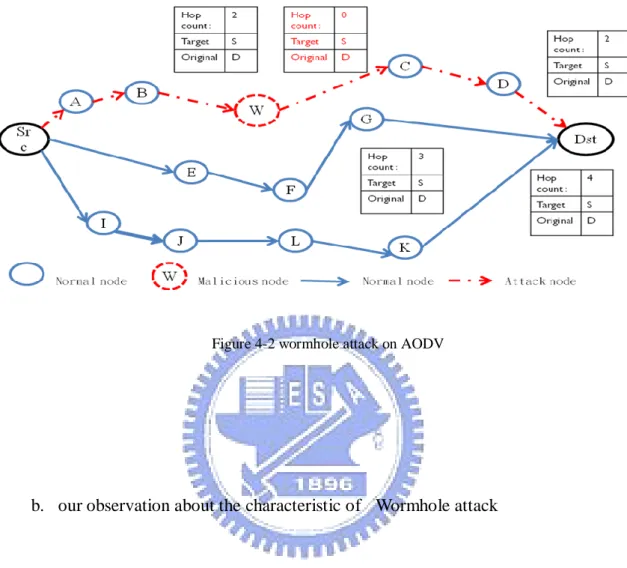
Figure 4-2 wormhole attack on AODV ... 28
Figure 4-3 Path Record ... 29
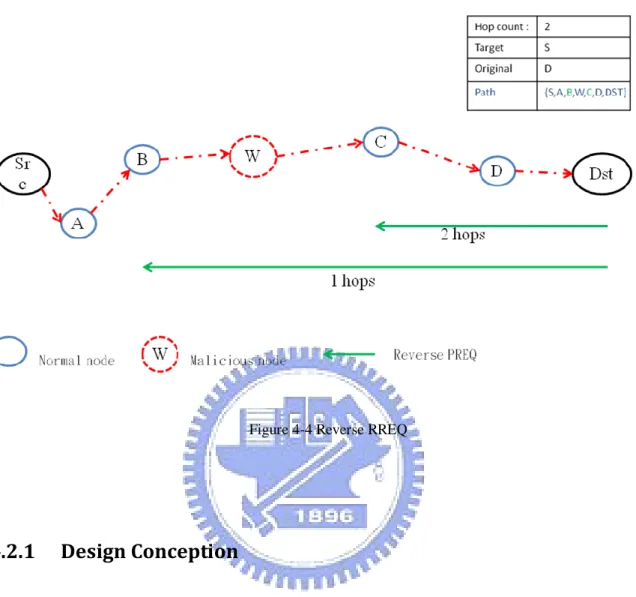
Figure 4-4 Reverse RREQ ... 30
Figure 4-5 Illustration of route establishment ... 32
Figure 5-1 simple grid (10M*10M, 50 nodes) ... 38
Figure 5-2 large grid (50M*50M, 1000 nodes)... 39
Figure 5-3 impact rate (simple grid) ... 40
Figure 5-4 impact rate (large grid) ... 41
Figure 5-5 latency of RREQ packets (simple grid) ... 42
Figure 5-6 latency of RREQ packets (large grid)... 43
ix
1
Chapter 1 Introduction
In recent years, the MANET (mobile ad hoc network) technology has become a mature
technology and also it has been more and more popular. The MANET is a self-configuring
network of mobile devices connected by wireless links. Each device in a MANET is free to
move independently in any direction, and will therefore change its links to other devices
frequently. In comparison with traditional network environment that depends on some
infrastructure, mobile ad hoc network can communication each other without infrastructure.
However, some characteristics of mobile ad hoc network will increase their vulnerability
to attacks. Wireless links are inherently vulnerable to eavesdropping and message injection, as
well as jamming attacks. In these security issues, security routing in MANET is an especially
hard task to accomplish securely, robustly and efficiently. The MANET is constrained in
memory, computing power, and battery power in mobile devices. These restrictions will result
that routing protocol of MANET should be faced a tradeoff between security and resource
consumption.
In this theme, we conduct a study for the wormhole attack and we proposed a routing
2
attacks and it is very suitable for MANET environment due to it does not require too much
computing or any special hardware.
1.1 Research Motivation and Goals
In our research, we introduce the wormhole attack which has formed a serious threat in
wireless networks, especially against many ad hoc network routing protocols and
location-based wireless security systems. The wormhole attack is possible even if the attacker
has not compromised any hosts and even if all communication provides authenticity and
confidentiality. Also, most existing ad hoc network routing protocols, without some mechanism
to defend against the wormhole attack. In this theme, we design an effect approach to against
wormhole attacks and this approach can not only detect the wormhole attack but also auto
resilient from wormhole attack. Many of the existing methods have requirements of time
synchronization, GPS receiver, etc. However, our proposed protocol does not require special
hardware and only need few computing resources.
1.2 Thesis Organization
The rest of this thesis is organized as follows: In Chapter 2, we discuss the background
3
3, we discuss the related works and compare their advantages and disadvantages. In Chapter 4,
we present our Auto-resilient Routing against Wormhole Attacks in Ad Hoc Networks. In
Chapter 5, we discuss our evaluation methods and the results. Finally, we conclude this thesis in
4
Chapter 2 Background
In the section, we will discuss three topics about mobile Ad-Hoc networks include routing
protocol of MANETs, related security issues of MANETs and wormhole attacks. Unlike
traditional wired network or infrastructure-based wireless network, each node in mobile
Ad-Hoc network has routing capabilities; the prototype of mobile Ad-Hoc network composes
when a collection of mobile nodes link together and create a network by agreeing to route
messages for each other. There is no shared infrastructure in an Ad-Hoc network such as
centralized routers or defined administrative policy.
However, these feathers of ad hoc network routing protocol bring new security problems.
Unlike traditional wire network or infrastructure-based wireless network, each node in Ad-Hoc
network has routing capabilities and can be regarded as independent; it means each node in the
Ad-Hoc networks can arbitrarily attack other nodes by changing the routing rules. We will
introduction these security issues in section 2.2 and Wormhole Attack, the most intractable
5
2.1 Routing Protocols in mobile Ad-Hoc Networks
A mobile Ad-Hoc network is a collection of mobile nodes that are dynamically and
arbitrarily located in such a method that the interconnections between nodes are capable of
changing on a continual basis. In order to facilitate communication within the network, a
routing protocol is used to discover the path between nodes. An Ad-Hoc routing protocol is a
convention, or standard, that controls how nodes decide which way to route packets between
computing devices in a mobile ad-hoc network. The primary goal of such an ad hoc network
routing protocol is exact and efficient route establishment between a pair of nodes so that
messages may be delivered in a timely manner. Route construction should be done with a
minimum of overhead and bandwidth consumption.
In Ad-Hoc networks, nodes do not start out familiar with the topology of their networks;
instead, they have to discover it. The basic idea is that a new node may announce its presence
and should listen for announcements broadcast by its neighbors. Each node learns about nodes
nearby and how to reach them, and may announce that it, too, can reach them.
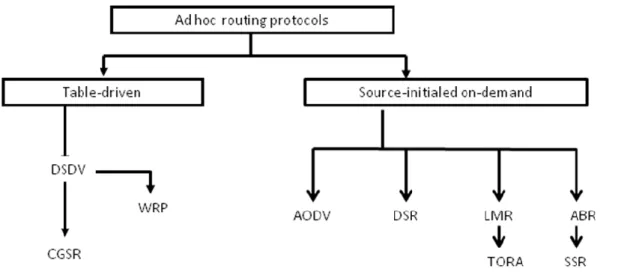
Classification of routing protocols in MANET’s can be done in many ways, but most of these are done depending on routing strategy and network structure [13][14]. According to the
6
Figure 2-1 Classification of routing protocols in MANET
2.1.1 Table-Driven Routing Protocols
These protocols have the same characteristics that they maintain the routing information
before it is required. For this characterize, the protocols also called as proactive protocols.
Every node in the network maintains routing information to other node in the network. Routes
information is usually kept in the routing tables and is periodically updated when the network
topology changes. Many of these routing protocols come from the link-state routing. There are
some differences between the protocols in this group depending on the routing information and
the routing table. These protocols are not suitable for larger networks, as they need to maintain
node entries for each and every node in the routing table of every node. This causes more
7
2.1.2 Reactive Routing Protocols
These protocols have the main characteristic that they don’t maintain routing information
or routing activity in advance when the network in initial step. If a node wants to send a packet
to another node then this protocol searches for the route in an on-demand manner and
establishes the connection in order to transmit and receive the packet. The route discovery
usually occurs by flooding the route request packets throughout the network.
2.1.3 Hybrid Routing Protocols
This type of protocols couples the benefit of proactive and of reactive routing like HSLS (Hazy
Sighted Link State routing protocol) [15], ZRP (Zone Routing Protocol) [16], etc. The routing
is initially established with some proactively prospected routes and then serves the demand
from additionally activated nodes through reactive flooding. The choice for one or the other
method requires predetermination for typical cases. The main disadvantages of such algorithms
are
1. Benefit should rely on number of nodes in network.
8
2.2 Security Issues in Mobile Ad-Hoc Networks
In recent years MANETs (mobile ad hoc networks) have received great attention due to
their capabilities of self-configuration and self-maintenance. While security issues have
become a primary interest in order to provide safe communication. Mobile Ad-Hoc networks
were proposed to support dynamic scenarios and situations where no wired network
infrastructure exists. In fact most Ad-Hoc routing protocols are collaborative by nature and rely
on implicit trust among the participating nodes to route packets through without any security or
information integrity guarantees. However, this is not always suitable especially when
information security and integrity is an important issue of the application
Although security issues have been an active research topic for a long time in wired
networks and there are a lot of research results. However, unlike the wired networks the
unique characteristics of MANETs present a new set of nontrivial challenges to security design,
such as open peer-to-peer network architecture, shared wireless medium, stringent resource
constraints and highly dynamic network topology.
2.2.1 The Vulnerable Characteristic of Mobile Ad-Hoc Networks
In general, the wireless MANET is especially defenseless due to its fundamental
9
cooperation, and constrained capability. In this section, we briefly list the following
vulnerable characteristics about MANET.
First, use of wireless links causes an Ad-Hoc network vulnerable to security attacks
include passive eavesdropping and active impersonation, message replay, and message
distortion. Eavesdropping might give an adversary access to secret information, violating
confidentiality. Active attacks might allow the adversary to delete messages, to inject erroneous
messages, to modify messages, and to impersonate a node, thus violating availability, integrity,
authentication, and non-repudiation.
Secondly, nodes, roaming in an unfriendly environment with relatively poor physical
protection, have non-negligible probability of being compromised. Therefore, we should not
only consider malicious attacks from outside a network, but also take into account the attacks
launched from within the network by inside nodes.
Thirdly, an Ad-Hoc network is dynamic because of frequent changes in both its topology
and its membership (i.e., nodes frequently join and leave the network). Trust relationship
among nodes also changes, for example, when certain nodes are detected as being
compromised. Unlike other wireless mobile networks, such as mobile IP nodes in an ad hoc
network may dynamically become affiliated with administrative domains.
Finally, an ad hoc network may consist of hundreds or even thousands of nodes. Security
10
2.2.2 Routing Security in MANETs
Routing protocols in MANETs are very different than traditional network, it has the
advantage of free configuration and high flexible. However, the features of routing protocols
in MANETs also causes many security attacks be launched by finding the loophole in routing
protocols in MANETs. Here we list the a few common attacks by utilizing the leak of routing
protocols of MANETs.
Black hole: In this attack, a malicious node uses the routing protocol to advertise itself
as having the shortest path to the node whose packets it wants to intercept. We provide a
detailed description herein.
Denial of service: The DoS attack results when the network bandwidth is hijacked by a
malicious node. It has many forms: the classic way is to flood any centralized resource so that
the network no longer operates correctly or crashes. For instance, a route request is generated
whenever a node has to send data to a particular destination. A malicious node might generate
frequent unnecessary route requests to make the network resources unavailable to other nodes.
Routing table overflow: The attacker attempts to create routes to nonexistent nodes. The
goal is to have enough routes so that creation of new routes is prevented or the
11
Information disclosure: The malicious node may leak confidential information to
unauthorized users in the network, such as routing or location information. In the end, the
attacker knows which nodes are situated on the target route.
2.3 Wormhole Attacks in Mobile Ad-Hoc Networks
Wormhole attack is a particularly severe control attack depends on the routing
functionality of wireless networks. It has been introduced in the context of Ad-Hoc networks.
During the attack, a malicious node captures packets from one location in the network, and
“tunnels” them to another malicious node at a distant point, which replays them locally. In fact, the wormhole attack is considered particularly insidious since it can be launched without
having access to any cryptographic keys or compromising any legitimate node in the network.
12
Figure 2-3 Wormhole attack against Routing
2.3.1 Wormhole Attack
Wormhole attacks happen when one wormhole node eavesdrops and records packets at
one location, and then tunnels the eavesdropped packets to a certain faraway collusive
wormhole node. After receiving the tunneled packets, the faraway collusive wormhole node
replays these packets (Figure 2-2). The tunnel between collusive wormhole nodes can be
established in various ways, such as direct wire connection, high power transmission, and
out-of-band hidden channel.
In a wormhole attack, an attacker forwards packets through a high quality out-of-band link
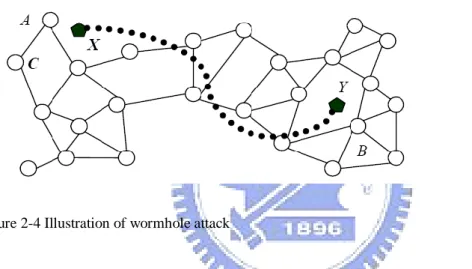
13
wormhole attack. The attacker replays packets received by X at node Y, and vice versa. If it
would normally take several hops for a packet to traverse from a location near X to a location
near Y, packets transmitted near X traveling through the wormhole will arrive at Y before
packets traveling through multiple hops in the network. The attacker can make A and B believe
they are neighbors by forwarding routing messages, and then selectively drop data messages to
disrupt communications between A and B.
Figure 2-4 Illustration of wormhole attack
For most routing protocols, the attack has impact on nodes beyond the wormhole
endpoints’ neighborhoods also. Node A will advertise a one-hop path to B so that C will direct packets towards B through A. For example, in on-demand routing protocols (DSR and AODV)
or secure on-demand routing protocols (SEAD, Ariadne, SRP), the wormhole attack can be
mounted by tunneling ROUTE REQUEST messages directly to nodes near the destination node.
Since the ROUTE REQUEST message is tunneled through high quality channel, it arrives
earlier than other requests. According to the protocol, other ROUTE REQUEST messages
14
routes from being discovered, and the wormhole will have full control of the route. The attacker
can discard all messages to create a denial-of-service attack, or more subtly, selectively discard
certain messages to alter the function of the network. An attacker with a suitable wormhole can
easily create a sinkhole that attracts (but does not forward) packets to many destinations. An
intelligent attacker may be able to selectively forward messages to enable other attacks.
To show how much damage a single wormhole can cause to routing, we simulated
randomly distributing nodes in a rectangular region and used the shortest path algorithm to find
the best route between any node pairs. If a wormhole is formed, some far away nodes will
appear to be neighbors and some node pairs will be able to find a “shorter” path through the
wormhole. Hence the route between them is disrupted by the wormhole. In simulation
experiments, a single wormhole with two randomly placed endpoints disrupts over 5% of all
network routes. A more intelligent attacker may be able to place wormhole endpoints at
particular locations. Strategically placed wormhole endpoints can disrupt nearly all
communications to or from a certain node and all other nodes in the network. In sensor network
applications, where most communications are directed from sensor nodes to a common base
station, wormhole attacks can be particularly devastating. If the base station is at the corner of
the network, a wormhole with one endpoint near the base station and the other endpoint one hop
away will be able to attract nearly all traffic from sensor nodes to the base station. If the base
15
quadrant of the network. Figure 2 shows the effectiveness of a wormhole in disrupting
communications from sensor nodes to a base station. One endpoint of the wormhole is within
one hop of the base station; the position of the second endpoint varies along the x axis. When
the base station is in a corner of the network, a wormhole with the second endpoint near the base
station can effectively disrupt all network communications. If the second endpoint is placed in
the opposite corner, approximately half of the nodes in the network will send messages for the
base station to the wormhole.
2.3.2 The effects of Wormhole Attacks
Wormhole attacks have very different features from other attacks: an adversary does not
have to breach the cryptography nor compromise any nodes for launching wormhole attacks,
because the adversary nodes need not decapsulate any frames or packets during attacks. What
an adversary needs to do is to setup collusive wormhole nodes in wireless networks, to capture
radio signals and to build tunnels between the collusive nodes. Then the wormhole nodes can
eavesdrop, capture and tunnel radio signals or steal private information that flows via collusive
wormhole nodes, although they have no identities or cryptography keys required in the network.
Additionally, since wormhole nodes replay signals at a place and can attract network traffic,
16
Hence, it is much more difficult to detect and prevent wormhole attacks. In fact, if the
wormhole nodes conduct no mal-behaviors in the network or are configured by network
administrators, wormhole tunnel may be a very pleasing feature. They may provide alternate
and faster routes, and even reduce the use of wireless bandwidth and save energy of mobile
nodes. But quite often the wormhole nodes may be laid down by malicious adversaries.
Wormhole attacks affect a network most significantly while nodes are establishing route to
another node. Wormhole attacks can make particular nodes in a network generate improper
routing tables for themselves. For example, if a wormhole attack is launched on a periodic
routing protocol, such as optimized link state routing protocol (OLSR), the collusive wormhole
nodes can let a regular node trust some other nodes are its neighbor nodes. In figure 1.2, node S
broadcast a Hello message periodically. If no wormhole nodes exist, only node A and B learn
that S is their neighbor nodes; however, if wormhole attacks exist, M1 can tunnel the Hello
message to M2, and M2 replays the Hello message. As a result, node W, X, Y and Z also believe
that S is their neighbor nodes
Besides periodic routing protocol, wormhole attacks can also cause great disruption on
on-deman routing protocol, such as DSR [9] and AODV [10]. Firstly, we suppose no wormhole
attacks happen in figure 1.3. We assume that S is attempting to establish a new route to W. S can
establish a good route to W by sending a route request (RREQ) through node A, C, D and W
17
-> A -> C -> D -> W. On the other hand, we assume that wormhole attacks exist, nodes.
It is worth noting that in the network, although both M1 and M2 physically exist, they virtually
vanish. M1 and M2 have no network identities but are repeaters in; i.e., none of the good nodes
in the network is able to aware of the existence of M1 and M2.
This is the major reason why wormhole attacks are difficult to deal with. As it is not able to
easily find out wormhole nodes in a network, a specific mechanism to prevent and detect
18
Chapter 3 Related Work
In this chapter, several research works related to wormhole attacks will be introduced.
These research works address the detecting mechanisms and prevention methods of Wormhole
Attack in mobile Ad-Hoc networks. For these methods defend against wormhole attack, it can
be classified into distance or time limiting detection approaches, false geometry or topology
detection approaches, and neighbor nodes monitoring approaches. We will discuss the theoretic
these three types of detecting approaches below. Moreover, we analyze and compare of these
methods.
3.1 Wormhole Attacks Prevention
Dahill[8],Papadimitratos[9] and Hu[6] have separately introduced detail about Wormhole
attacks in wireless networks. Initial proposals to avoid wormhole attacks propose using secure
methods of bits over the wireless channel that can be recognize only by authorized nodes. This
only defends against outside of network attackers who do not own cryptographic keys.
19
cannot be prevented by cryptographic mechanisms alone
3.1.1 Distance or Time Limiting Detection Approaches
The concept behind this approaches are intuitive, it restricts the distance or the period that
packets can traverse between nodes in network. When node in network receives packets, it will
check the transmission range of nodes or the transmission time. If a packet traverses more than
a default value, this packet is perhaps being affected by malicious attacks or goes through the
wormhole tunnel. Hu, L. and Evans et al [6] proposed a general mechanism related to this
concept called “Packet Leashes”. It add the information to the packets, this information is
designed to restrict the packet’s maximum allowed transmission distance, we called the packets are “Packet Leashes”. Two types of packet leashes were presented: Geographic Leashes and
Temporal Leashes. The first leashes, each node has to know its precise location and all nodes
have to know another node’s location information. Before sending a packet, each node adds the
information of its current location and time in the packet. When the receive node receives the
packet, it checks the packet by computing the distance to the sending node or the transmission
time of the traverse path. The receiving node can use this computing result to decide whether
the packet was transmitted through wormhole nodes. In Temporal Leashes, all nodes require
20
the packet. When receiving the packet, the receiving node compares the temporal leash of the
packet to its time, and computes the distance to the sending node by assuming the propagation
speed is equal to the light speed. As a result, it can determine if the packet traveled an overlong
distance caused by wormhole attacks. The drawbacks of Packet Leashes are that all nodes in
network need accurate time and close time synchronism; and Geographic Leashes require extra
hardware such as GPS or location service to let each node obtain its precise location.
This method is the earliest proposed method to defend against wormhole attack. The idea
of this mechanism is very simple and ordinary. However, this method requires time
synchronization or accurate location information on each node to calculate the distance
between nodes.
3.1.2 Topology detection Approaches
These methods use geometric or topology information to detect wormhole attacks. If the
analyzed results of the collected information violate the predefine situation, wormhole attacks
may occur in the network. These methods do not require time synchronization, but need more
complicated processes and message exchanges to observe and collect the information of
packets. Lazos et al. [5] proposed a topology detection approach using cryptographic
21
neighbor nodes to prevent wormhole attacks. LBK does not need any time synchronization, but
require a few additional network nodes, the guard nodes, which know their location and own
broader transmission range than the regular nodes. While establishing LBKs, all guard nodes
broadcast their fractional keys and location information to the network; and then regular nodes
collect every fractional key they received. If two regular nodes share more than a threshold
number of fractional keys, they use these keys to generate a pair-wise key. Finally, every node
generates an LBK and unicast it to the nodes which it shares with same pair-wise key. After
establishing the LBKs, each node can only communicate with their real nodes. In addition,
Lazos et al. also provide a simple mechanism, called closet guard algorithm (CGA), which
adopts the observation that a regular node should not receive fractional keys from guard nodes
that are at a distance of more than two times of the transmission range of guard nodes, to
distinguish which guards are infected by wormhole attacks.
3.1.3 Graph Theoretic and Geometric Approaches
In Geometric approaches, the nodes have to send their neighbor list to their neighbors.
The neighbors are guards to each other and monitor the transmission of their neighbors.
Like[26], LITEWWORP is geometric method proposed by Khalil et al. In the LITEWORP,
22
unreasonable actions of node are detected, the malicious counter increases. Once the
malicious counter on a particular neighbor is higher than a threshold, the neighbor revoke the
node from its neighbor list and trigger an isolation algorithm to isolate the node which is
thought as malicious. In their analysis, if the coverage of neighbors is not wide enough or too
many/less neighbors aggregate in a region, the performances both go down. The neighbors of
a node have to be kept in about 9~25 nodes, the system may work well above 90% detection
rate. However, the false alarm rates of LITEWORK are between 10% and 28% when the
neighbors number is about 17~29. As the result, we think only when the neighbors of a node
around 9 to 17, the scheme do work. And hence the nodes in LITEWORP have to monitor the
communication s of all neighbors, the energy consumption also be a problem.
3.1.4 Other Mechanisms and Protocols
Some Wormhole Attacks detection methods use the extra hardware or physical property to
detect attacks. In [6], Hu and Evans utilize directional antennas to prevent wormhole links.
Unlike our method, every node of the network is equipped with directional antennas and all
antennas should have the same orientation. Different directions called zones are sequentially
numbered and every node includes the transmitting zone at each message. A receiver hearing
23
where A, B are opposite zones. Based on information provided by neighbors that assist the
wormhole detection by acting as verifiers, every node discovers its neighbors. As pointed out
by the authors of [6], a valid verifier must exist in order for the wormhole to be detected, since
not all neighbors can act as verifiers. Finally, as noted by the authors of [6], this method can
only prevent single wormholes and does not secure the network against multiple wormhole
links [6].
3.2 Comparison of Main Mechanisms
We will discuss the main difference and conceptions of the mechanism mentioned above.
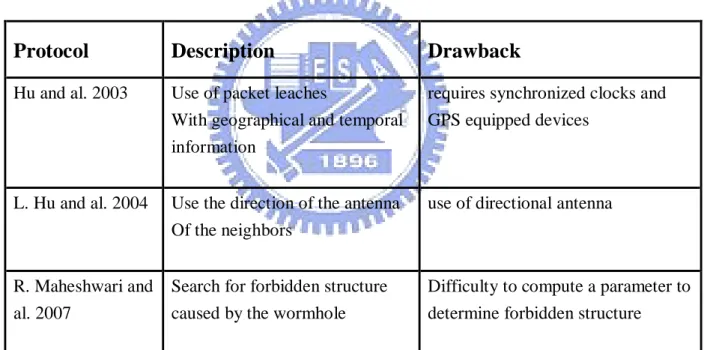
Look at Table 1, here we list the main ideas of the mechanisms, the original routing protocols
they based on or the improved, and their special assumptions, hardware or special nodes needed
in the mechanisms. Finally, we compare their computational and control overheads.
First, Distance or Time Limiting Detection Approaches use the packets transmission
distance to judge a node. This way can detect the Wormhole attacks effectively due to
transmission distance cannot forge except that malicious nodes have capacity of moving the
node’s location rapidly. However, this solution needs accurate location information or precise
clock synchronization. And this way assumes the nodes are not movable, this drawback greatly
24
pairs have to be encrypted by local broadcast key of the sending end and decrypted at the
receiving end. As a result the time delay in each node is extended a lot. Finally, the Statistical
analysis methods use a central authority (CA) or coordinate node to monitor the Ad-hoc
networks. If the central node can collect and analysis the network information, it will aware the
behavior of Wormhole attacks as soon. But, practically, most ad-hoc network routing protocols
are tend to non-central authority. So, this statistical solution requires particular routing
protocols or specific hardware to implement.
Protocol
Description
Drawback
Hu and al. 2003 Use of packet leaches
With geographical and temporal information
requires synchronized clocks and GPS equipped devices
L. Hu and al. 2004 Use the direction of the antenna Of the neighbors
use of directional antenna
R. Maheshwari and al. 2007
Search for forbidden structure caused by the wormhole
Difficulty to compute a parameter to determine forbidden structure
25
Chapter 4 The Proposed Protocol:
AR-AODV Routing Protocol
AR-AODV protocol presents Auto Resilient AODV routing protocol. In this Chapter, we
introduced the AR-AODV protocol include design conception and the future. In Section 4.1, we
first describe our observation about the Wormhole Attacks using AODV routing protocol; and
later we proposed our design protocol against Wormhole Attacks. Also, we described
particularity how to implement our AR-AODV routing Protocol in final.
4.1 Observation of Wormhole Attacks on AODV
We proposed a routing protocol for preventing the Wormhole Attack on Ad-hoc Network,
called AR-AODV (Auto resilient Ad hoc On-Demand Distance Vector Routing). This Protocol
is based on AODV (Ad hoc On-Demand Distance Vector Routing) protocol. The original
AODV routing protocol cannot prevent from wormhole attack. Our Protocol, AR-AODV, uses
the node hop numbers difference to detect the Wormhole Attack.
26
discuss our observation about the characteristic of the network it was be infected by Wormhole
Attack.
a. How Wormhole Attack take place on AODV
The major mission for malicious node intended to execute Wormhole Attack is how to
get many chances to achieve the maximum packages on network. As soon as malicious node
can obtain more and more packages, the Wormhole attack’s destruction will be more serious.
On Ad-hoc network, routing cost is an important concern. So if any router can decrease the
routing cost, it will get many chances to achieve the packages. For this reason, Wormhole
attacks will try all the means to decrease the routing cost. Next, we will introduce how
Wormhole attacks decrease the routing cost on AODV.
Protocol such as AODV discover and decide routing path by comparing the hop counts in
the RREQ package. Hop Count is the number of hops from the Originator IP Address to the
node handling the request. A typical Wormhole attack occurred on AODV is possible by Type D G Reserved Hop count
Broadcast ID
Destination IP address
Destination sequence number
Originator IP address
27
modification of the hop count field in route discovery messages RREQ. When routing decisions
cannot be made by other metrics, AODV uses the hop count field to determine a shortest path.
In AODV, malicious nodes can increase the chances they are included on a newly created route
by resetting the hop count field of the RREQ to zero.
28
Figure 4-2 wormhole attack on AODV
b. our observation about the characteristic of Wormhole attack
Based on the above described, we observation the changes in packets. There is a
difference about the hop count between before packets through the wormhole node and after
packets through the wormhole node. According to the clues, we monitor the hop count of
packets immediately. Therefore, when one hop counts of RREQ with the dramatic changes, we
can take appropriate measures to prevent attack in time. However, it is not enough to guard
against such wormhole attacks. The measure of monitoring hop count can only determine
29
wormhole node. Our goal is not only discover attacks but also auto resilient the network
barriers, so we must do more to meet our requirements. Reviewing the packets message of
AODV, we think there are not enough clues to identify specific wormhole node. For this reason,
we have added one column to the RREQ packet. This column is recorded the path history from
source node to destination node. After adding this path column to track the path and collecting
the monitor of hop counts, we can determine whether Wormhole Attacks has occurred, and
more importantly, this method can identify the wormhole node specifically.
4.2 The Proposed Protocol: AR-AODV
In this section, we will bring up our ideas to solve the security problem as mentioned above.
In our proposed protocols, we can detect the malicious node altering the RREQ’s hop counts.
30
Figure 4-4 Reverse RREQ
4.2.1 Design Conception
First, our AR-AODV protocol will add one column into the RREQ package. The original
RREQ packages on AODV protocol do not contain the any information about the routing path
history. The fewer packet size perhaps can increase routing efficiency and speed up the duration
of data transmission. However, we find if the packages do not contain the routing information,
it will become a huge security loophole on Ad-hoc network. For this reason, we slightly modify
31
Type D G Reserved Hop count
Broadcast ID
Destination IP address
Destination sequence number
Originator IP address
Originator sequence number
Routing history
Table 2 Traceable RREQ
Second, our AR-AODC protocol will add a new routing packet type: Reverse RREQ.
Comparing with the RREQ packets sent from source node, Reverse RREQ packets are sent
from destination node, and traced back along the RREQ’s path to find the malicious node.
Reverse RREQ are like RREQ, when destination nodes send reverse RREQ package, the node
should assign a goal. After assigning the goal, Reverse RREQ package will go along the old
path to count the routing cost. And we find, we can detect malicious node if we send
continuously two reverse RREQ packets that target nodes are different and malicious node is
32
4.2.2 Route Establishment
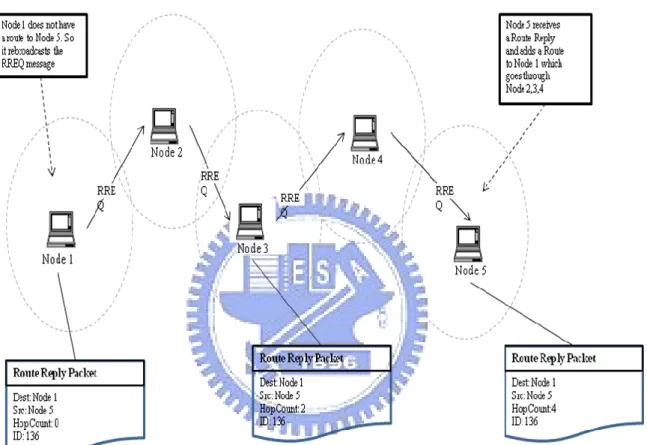
Figure 4-5 Illustration of route establishment
1. Send Request
When one node needs to send a message to another node that is not its Neighbor it broadcasts a
Route Request (RREQ) message. The RREQ message contains several key bits of information:
the source, the destination, the lifespan of the message and a Sequence Number which serves as
a unique ID.
2. Receive request
When Node 1’s Neighbors receive the RREQ message they have two choices; if they know a route to the destination or if they are the destination they can send a Route Reply (RREP)
33
Neighbors. The message keeps getting rebroadcast until its lifespan is up.
3. Forward
When one node receives a RREQ message and it does not know how to route to the destination,
it will forward this RREQ message to neighbors.
4. Send Reverse Request
When destination node receive the RREQ message, it should check the RREQ whether the
routing path contain Wormhole nodes.
5. Send Reply
If setp.4 has checked and the routing path does not contain wormhole nodes, then destination
node will send out a RREP message to source node from the request routing path.
6. Receive Reply
When source node receives the RREP message, in our methods, it means that the path is safe.
4.2.3 Route Maintenance
When wormhole nodes have been detected, the next most important thing is how to disable
the wormhole nodes. Actually, it is not as simple as wired network which can easily find the
physical location of any nodes or just disable the attack node from the router. In Wireless
Ad-Hoc network, node can easily change its location and we cannot disable one node from a
34
Yes
No
node in Ad-Hoc network directly, we adopt an indirect approach to achieve the purpose of the
prohibition of attack node. Reviewing the AODV routing protocol, it define a HELLO message
to maintain the network. We used this HELLO message to disable the Wormhole attack node.
HELLO message can be communicate with directly are considered to be neighbors. In our
methods, we add one column to record the list of wormhole attack nodes. When nodes in the
network receive the HELLO message, it will check the list of wormhole attack nodes and add
the list to the routing table. Our mechanism is when a node receives RREQ from neighbors, it
should query the routing table to judge whether the neighbor can be trusted. If the neighbor’s id
is in the list of wormhole attack nodes, the AR-AODV will automatically add a weighted value
to the hop count number of RREQ message. The effect of doing so is to reduce the chance of the
routing path include wormhole node be selected.
In the route table
Broadcast RREQ packet from source
Intermediate nodes receive the RREQ
Generate a REPLY
Cache Src. Address, Dst. Address
35
Yes
Send REPLY message
Hop count +1
Destination node
Send Reverse RREP The existence of wormhole nodes
Yes
No
Drop the RREQ package
Route maintenance Send Hello message
36
Chapter 5 Simulation and Results
In this Chapter, we will evaluation our AR-AODV protocol through simulations. The first
section will explain out simulation environment, include the simulation tool ns-2[7]. The
second section, we will show three scenarios of simulations to evaluation the AR-AODV
including its performance, the rate of detecting Wormhole Attacks. Finally we will show the
simulation results.
5.1 Simulation Environment
In our simulation, we use the NS-2 as the simulation tool. NS -2 is a discrete event
simulator targeted at networking research. Ns-2 provides substantial support for simulation of
TCP, routing, and multicast protocols over wired and wireless (local and satellite) networks.
Also, we chose NAM as our network animation tool. Nam is a TCL / TK based animation tool
for viewing network simulation traces and real world packet traces. It is mainly intended as a
companion animator to the ns simulator.
37
transmission range of simulator are a fixed value of 0.25m. In order to simulate the more
realistic situation, we evaluate two types of Ad-hoc network model. One is smaller network
used usually in room or classroom; the other one is larger network used in indoor buildings. The
smaller network we define the length and width of 10 meters with 50 nodes; the larger network
model we define the length and width are 50 meters with 1000 nodes.
CPU Intel(R) Core(TM2) Duo CPU T7250 2.00.GH
Memory 4 GB
OS Microsoft Windows XP
NIC Inter(R) PRO/1000 Ethernet
Hard Disk SCSI 250G
38
Simulation parameter value
Radio-propagation model Propagation/TwoRayGround
MAC type 802.11
Routing protocol AODV/AR-AODV
Time of simulation end 300.0s
Antenna model OmniAntenna
Table 4 Simulation parameter
39
Figure 5-2 large grid (50M*50M, 1000 nodes)
5.2 Simulation and Results
In this section, we show the simulation results of AR-AODV protocol and the analysis of
simulation outcome. In our simulation scenarios, we focus on two parts: detection rate and
overhead. We will use charts to show it.
5.2.1 The impact of wormhole attack
The main purpose of this experiment is to measure the detection rate of routing protocols.
We define a measurement criterion: Wormhole attack impact rate. It means the probability of
data packets through the wormhole attack node. The higher of this impact rate of routing
40
three cases. The first case that T is 0 means the original AODV routing protocol. This case will
have a high impact rate due to AODV routing protocol does not have defense mechanism to
wormhole attack. In other two cases, they all use the AR-AODV routing protocol. But these two
cases are not the same as the timing of the use of detecting methods. When T is”average path
length”, it will check the RREQ packets just when hop count number less than average path
length. However, when T is ”the longest path length”, it will check the RREQ packets all the
time.
41
Figure 5-4 impact rate (large grid)
5.2.2 Overhead of AR-AODV
The main purpose of this experiment is to assess the overhead of AR-AODV. In 5.2.1
section, the simulation results show that AR-AODV can suppress the wormhole attacks.
However, we evaluate a routing protocol also should consider the overhead of the methods. If
the overhead of new approach are much heaver than original protocol, it is not a
high-perfomance method.
In first part, we show the overhead about the latency of RREQ packets. The latency means
the speed of finding a routing path form source node to destination node. If the value of latency
42
the original routing protocol AODV has the smallest delay. The latency of AR-AODV routing
protocol are more than twice as high as AODV. However, the latency will gradually become
smaller with the time. This is due to that AR-AODV should send Reverse RREQ packets at first
time if the routing table has no cache data, but next time the AR-AODV can query the routing
table data, it will reduce the delay time. The latency will reduce to just higher than the latency of
AODV a little. Extra latency is because AR-AODV should do some routing maintaining
actions.
43
Figure 5-6 latency of RREQ packets (large grid)
In second part, we show the number of RREQ packets in network. When AODV routing
protocol is in the initial stage, it should send the RREQ packets to discover network topology.
Our AR-AODV routing protocol also uses the initial stage to detect the wormhole attack. The
purpose of this experiment is to compare the overhead of number of RREQ packets. The lower
number of RREQ packets will be able to mitigate the load of network. From the simulation
results, the original routing protocol AODV has the smaller number of RREQ packets in the
beginning, it is three times less than AR-AODV. However, the number of RREQ packets will
44
the network after the network initial stage. If the routing table has cached the routing data, the
RREQ packets will never be sent out. Another reason about the our protocol has smallest
number of packets at final is because some nodes have be disabled, it also will reduce the
number of RREQ packets.
45
46
Chapter 6 Conclusion and Future Work
6.1 Conclusions
In this thesis, we studied the effect of the wormhole attack in mobile Ad-Hoc networks
(MANETS) and analyze the security issues of MANETs. We proposed a new on-demand
routing protocol, Auto-Resilient Ad hoc On-Demand Distance Vector Routing (AR-AODV),
to against wormhole attacks on mobile Ad-Hoc networks (MANETs) and recover the network.
AR-AODV utilizes Reverse RREQ packets to detect wormhole attacks and disable the
wormhole node using Hello packets. The original AODV routing protocol has no mechanisms
to against wormhole attack, the malicious can tamper the hop number of RREQ to cause huge
amounts of packets gathering into wormhole node. In our proposed method, it can effectively
prevent the wormhole attack on MANETs. Also, the Hello messages can auto disable the
wormhole node, we call this is “Auto-resilient”. Indeed, the simulation results showed that
wormhole nodes are disappeared gradually.
6.2 Future Work
Our proposed routing protocol is mainly used in AODV routing protocol. However, we
47
step of finding the routing path and routing maintain. In the future, our method can be ported
to other routing protocols like: DSDV (Destination-Sequenced Distance-Vector Routing), this
routing protocol used Bellman–Ford algorithm to find the routing path; DSR (Dynamic
Source Routing), this routing protocol also has the Routing Request packets, so we can port
48
Reference
[1] (AODV) Routing,” IETF MANET Working Group, Internet Draft 2003. Computer, vol.
35, no.10, pp. 54-62, 2002.
[2] Lionel M. Ni , Philip K. McKinley, A Survey of Wormhole Routing Techniques in Direct
Networks, Computer, February 1993 , v.26 n.2, p.62-76
[3] Y. Hu, A. Perrig, D. Johnson, Packet leashes: a defense against wormhole attacks in
wireless networks, in: IEEE Annual Conference on Computer Communications
(INFOCOM), 2003, pp. 1976–1986.
[4] W. Wang, B. Bhargava, Visualization of wormholes in sensor networks, in: Proceedings
of the ACM workshop on Wireless security (Wise’04), 2004, pp. 51–60.
[5] L. Lazos, R. Poovendran, C. Meadows, P. Syverson and L.W. Chang, Preventing
wormhole attacks on wireless ad hoc networks: a graph theoretic approach, IEEE
Wireless Communications and Networking Conference (WCNC05) 2 (13–17) (2005), pp.
1193–1199
[6] Hu, L. and Evans, D. 2003b. Using directional antennas to prevent wormhole attacks. In
Proceedings of the 11th Network and Distributed System Security Symposium.
131--141.
49
[8] B. Dahill, B. N. Levine, E. Royer, and C. Shields, “A secure routing protocol for ad-hoc
networks,” Electrical Engineering and Computer Science, University of Michigan,Tech. Rep. UM-CS-2001-037, August 2001.
[9] P. Papadimitratos and Z. Haas, “Secure routing for mobile ad hoc networks,” in SCS
Communication Networks and Distributed Systems Modeling and Simulation
Conference (CNDS), 2002.
[10] Y. C. Hu, A. Perrig, and D.B. Johnson, “Packet leashes: a defense against wormhole
attacks in wireless networks,” in Proceedings of the 22nd INFOCOM, pp. 1976-1986, 2003.
[11] Radha Poovendran , Loukas Lazos, A graph theoretic framework for preventing the
wormhole attack in wireless ad hoc networks, Wireless Networks, v.13 n.1, p.27-59,
January 2007 [doi>10.1007/s11276-006-3723-x]
[12] Khalil, I., Bagchi, S., and Shroff, N. B. 2006. MOBIWORP: Mitigation of the wormhole
attack in mobile multihop wireless networks. In IEEE International Conference on
Security and Privacy in Communication Networks.
[13] Xiaoyan Hong, Kaixin Xu, and Mario Gerla. Scalable routing protocols for mobile ad
hoc networks. 2002.
[14] Elizabeth M. Royer and Chai-Keong Toh. A review of current routing protocols for ad
50
Institute of Technology, USA, 1999.
[15] C. Santivanez and R. Ramanathan, Hazy Sighted Link State (HSLS) Routing: A Scalable
Link State Algorithm Cambridge, MA: BBN Technologies, Aug. 2001, BBN Tech.
Memo BBN-TM-1301.
[16] Zygmunt J. Haas , Marc R. Pearlman, ZRP: a hybrid framework for routing in Ad Hoc
networks, Ad hoc networking, Addison-Wesley Longman Publishing Co., Inc., Boston,