Directors
’Share Collateralization, Earnings Management
and Firm Performance
董監事股權質押、盈餘管理與公司績效相關性之研究
Lanfeng Kao (高蘭芬) Assistant Professor Department of Finance National University of Kaohsiung
This version: Sept. 2005
Directors’Share Collateralization, Earnings Management
and Firm Performance
Abstract
This study examines the association between director’s share collateralization and
earnings manipulation. The results indicate that directors’share collateralization is
significantly positive with earnings management and the positive association is
stronger when the directors own more shares. Earnings management attributable to
boards’share collateralization causes severe agency problems and hurts firm
performance. I find that earnings management attributable to share collateralization
is negative related with firm performance.
Keyword: Share collateralization, Directors’personalleverage,Board of directors, Earnings management, Abnormal accruals
.
董監事股權質押、盈餘管理與公司績效相關性之研究
中文摘要
本研究探討董監事持股質押是否降低公司盈餘品質,以及與董監事質押有關 的盈餘操縱行為是否傷害公司績效。研究結果顯示,董監事股權質押與公司異常 應計項目存在顯著正向關係,顯示董監事個人的融資行為會影響公司盈餘報導的 品質。此外,董監事質押與異常應計項目間的正向關係會隨著董監事持股的增加 而增強,隱含當董監事與公司存在利益衝突時,董監事持股增加會使董監事質押 所引發的盈餘品質下降的問題更嚴重。實證結果也發現因董監事質押所引發的盈 餘操縱與公司績效存在顯著負相關。 關鍵字:董監事質押、盈餘管理、董事會Directors’Share Collateralization, Earnings Management
and Firm Performance
1. Introduction
The effects of board-of-director characteristics and ownership structure on
financial reporting process have been a popular research topic in corporate
governance (for example, Klein (2002), Fan and Wong (2002), and Peasnell et al.
(2000)). Researchers focus on the monitoring role of board of directors and examine
the effectiveness of the board characteristics (such as board size, independent
directors, and remuneration committees) as internal corporate governance
mechanisms. However, there is a growing literature suggesting that the boards of
directors are ineffective and even address the interest conflicts between board of
directors and outside shareholders. In Asia, most listed companies are controlled by
families or owner groups and the role of board of directors in a family-controlled
business attracts attentions of the SEC and investors. Typically, the controlling
groups have tight control over the listed companies and the majority shareholders
serve as the chief executive officer (CEO) and directors of the companies. Board
members could influence the CEO’s decisions including financial reporting to
maximize the wealth of directors (or controlling families) and expropriate the benefit
of outside minority shareholders when interest conflicts exist between directors (or
families) and outsider shareholders.
Share collateralization of directors which is the focus of this paper, reflects the
financial pressure of directors. Because shares of listed firms are widely accepted by
financial institutions as collaterals and because the voting rights and control rights of
the collateralized shares are still kept by shareholders, many directors facing financial
money. However, directors who pledge their shares as collaterals need to pledge
more shares once the market value of the collateralized shares falls below the required
margin. Due to threat of margin requirement, the collateralizing directors have
incentives to manage reported earnings to avoid the drop of shares prices leading to
the downgrade of the quality of reported earnings. The potential agency conflicts
related to the creditability of accounting reporting between directors and outside
shareholder are worth examining. However, since the share collateralization is
directors’personal financial decisions, most countries (such as USA and Hong Kong)
do not impose any regulation on share collateralization even disclosure requirement.
Lack of the information about the personal leverage of board members, little research
works on this issue. Since Taiwan SEC requires the listed firms to disclose the
directors’share collateralization information, I have an opportunity to study the
agency problems of share collateralization by board members.
Agency problems of share collateralization by directors have been an important
governance issue in Taiwan after the Asian financial crisis in 1997. The main reason
is that the financial distress Taiwanese companies generally experience high
percentage of share collateralization by directors. Not only for distressed companies,
according to statistics from the securities exchange, board of directors in Taiwan
pretty much collateralize their shares for personal funding. Up to November 2000,
the year after the Asian financial crisis in 1997 and Taiwan local financial turmoil in
1998, only 28% (147 firms) of the listed firms did not have shares collateralized by
their boards of directors. There are 312 firms (34% of the listed firms) with a
collateralization ratio (defined as the number of shares collateralized by the board of
directors divided by the total number of shares owned by the board of directors) lower
50%; 103 firms (20%) with collateralization ratio higher than 50%; 21 firms (4%)
with collateralized share ratio higher than 90%; 17 firms (3.24%) with
collateralization share ratio between 80% and 90%; 16 firms (3.05%) with
collateralization ratio between 70% and 80%. Moreover, 40% of the stocks traded in
the over-the-counter market experience share collateralization by their board of
directors.
In this study, I examine the relation between earnings management and share
collateralization by board members and investigate whether the earnings management
attributable to share collateralization hurts firm performance. There are two main
contributions from this study. The first contribution is that this paper extents the
research about the effects of board-of-director characteristics on earnings
management. To date, the literature has focus on identify the association between
characteristics of board of directors and financial report quality. Especially, the link
between the dependence of board and activities related to earnings manipulation
behaviors has been most emphasized (Dechow et al., 1996; Beasley, 1996; Klein,
2002). However, the percentage of listed Asian companies affiliated with business
groups are quite high (Claessens, Fan, and Lang, 2002). It is easy to find that most
of boards of directors of listed firms in Asia are controlled by a family and majority of
board members lack of independence. Chen, Fan and Wong (2004) find that the
governance function of board of directors is weak in China. Thus, it is not
comprehensive to only focus on the governance role of board without considering the
interest conflicts between board of directors and outside shareholders. The second
contribution of this paper is to study the interest conflicts induced by board members.
In this paper, I address that directors’personal leverage conducts could induce the
earnings manipulation and argue that the requirement by SEC to disclosure the
information to investors is necessary.
Share collateralization by board of directors is very popular and is an important
issue of corporate governance in Taiwan. However, previous studies about structure
of board of directors on earnings management or earnings quality generally neglect
the effect of share collateralization on the earnings reporting. This paper tries to
make up the deficiency.
2. The mechanisms of share collateralization
Stock investors in Taiwan can take their shares to the financial institutions as
collateral to raise a debt. Due to the liquidity of the listed stocks, financial
institutions in Taiwan prefer the debt-raisers to use listed shares as collaterals. The
debt raisers who collateralize their shares at the financial institutions still keep the
voting rights and the cash flow rights of the shares unless they default. When
shareholders collateralize their shares at financial institutions, they can borrow up to
60% of the base value of collateralized shares and hold the debt up to one year. The
base value of the collateralized shares is measured based on the preceding closing
price or the average closing price three months prior to the collateralization date
whichever is lower. The stock price fluctuates leading to the appreciation or
depreciation of the collateralized shares. On the one hand, when the market value of
collateralized shares increases, the collateralizing shareholders can continue to hold
the debt. On the other hand, when the market value of the collateralized shares
decreases and falls below the required margin, the financial institutions will ask the
collateralizing shareholders to collateralize more shares. If the debt-raisers cannot
to be closed.
There is no particular regulation on the share collateralization of minority
shareholders. However, Taiwan SEC asks the firms with their directors
collateralizing shares at financial institutions to disclose the details of share
collateralization on the website of Taiwan Stock Exchange everyday. When a firm
with directors’share collateralization would like to issue equity offerings, the details
of share collateralization must be disclosed in the prospectus.
As we mentioned in the introduction, directors’share collateralization is very
popular in Taiwan. What is the purpose of collateralizing shares to raise a debt?
The Commercial Times1 (October 7, 2000) reports that the minority shareholders
collateralize their shares to increase the leverage on their stock investments. The
Commercial Times also indicates that the directors collateralize their shares and use
the fund raised from share collateralization to buy more shares of the firm to gain
control over the firm. For example, a director holds 100 shares of the firm, which is
10% of the ownership of the firm. The director can raise debt through collateralizing
all his shares and buy 60 more shares of the firm from the open market. In this case,
the director’s holding increases from 10% to 16% and he gains more control over the
firm. Anecdote evidence shows that the capital from collateralized shares is hardly
contributed to firms’projects.
3. Related literature
3.1 Board-of-director characteristics, corporate governance and financial reporting quality
The research to date in this area examines the association between the
characteristics of board of directors (such as size and composition of the board,
number of outside independent directors, and remuneration committees) and financial
reporting quality, earnings manipulation and financial statement fraud (McMullen,
1996; Dechow et al., 1996; Beasley, 1996; Carcello and Neal, 2000; Klein, 2002;
Anderson et al., 2004). Generally speaking, these studies suggest that independence
of board or auditing committee has linkage with the activities associated with earnings
manipulation behaviors. For example, Beasley (1996) and Dechow et al. (1996) fine
that the proportion of independent directors on the board (used to proxy for board
independence) is inversely related to likelihood of financial statement fraud. Klein
(2002) also finds a negative association between the abnormal accruals and board
independence.
Since the basic design of corporate governance is that the shareholders elect the
board of directors and then board of directors selects the management, researchers
focus on the monitoring role of board of directors and examine the effectiveness of
the board membership and characteristics as internal corporate governance
mechanisms. However, for family-controlled businesses, board of directors is
controlled by families or owner groups and is inefficient on behalf of shareholders in
monitoring management which is common dominated by controlling family. Even
for a non family-controlled firm, it is not unusual that board itself is the source of
conflicts of interest. In common practice, many firms establish conflicts of interest
policy to prevent a board member develops an actual or potential or conflict of
interest with the company (for example, FedEX, Micorn).
Previous studies find that the deviation of ownership (cash flow right) and
control right of controlling shareholders (or directors) in Asia produces agency
quality of reported earnings (Fan and Wong, 2002). Fan and Wong (2002) find that
the increase of control right and deviation between control and cash flow rights make
the agency conflicts more severe and the purpose of providing accounting information
by management is not to reflect the firm’s true transaction. For self-interest,
controlling shareholders tend to manipulate earnings to cover the effect of
expropriation of wealth on earnings, or to report earnings in total instead of details.
Those behaviors hurt the creditability of accounting information. If investors do not
trust the accounting reporting, the relation between earnings information and stock
return will decrease. Share collateralization is quite popular for public firms in
Taiwan. Related research in accounting discipline finds that the share
collateralization decreases the informativeness of accounting earnings (Kao and
Chiou, 2002). Kao and Chiou (2002) find that the higher the extent of share
collateralization by directors, the lower the relation between corporate earnings
information and stock returns. They conjecture that due to worries of providing
more shares for margin requirements, managements who collateralize their shares
have stronger incentives to manage earnings to avoid the drop of share prices. The
strong incentive of earnings management makes reported earnings less creditable and
therefore decreases the relation between reported earnings and stock return.
However, Kao and Chiou (2002) do not test whether the management does manage
earnings. This study will try to make clear the relation between share
collateralization and earnings management. Once the relationship is valid, the
arguments by Kao and Chiou (2002) can be more powerful.
3.2 Share collateralization by board of directors and firm performance
research ever examines the agency problem of share collateralization by board of
directors and the relationship between share collateralization and firm performance.
The listed firms in Taiwan are required to disclosure periodically the information of
share collateralization by the board members, manager and major shareholders. This
disclosure requirement provides data for researcher to study the effect of the directors’
personal loan on firm performance. To date, research on collateralized shares
generally focuses on the relationship between financial distress and collateralized
shares or focuses on the relationship between firm performance and collateralized
shares during the period of Asia financial crisis. Previous studies do not reach
consistent conclusion about the relation between performance and collateralized
shares. Chiou et al. (2002) point out that collateralized shares of board of directors
raise the possibility of being in distress. Chen and Hu (2003) show firms with a
higher shareholders’personal leverage will have a higher risk and worse performance
in the future. Kao et al. (2004) indicate that there is an inverse relationship between
collateralized shares and firm performance and that the inverse relationship exists
only for group-controlled firms. Kao et al. (2004) also provide evidence that
monitoring mechanisms by institutional investors, creditors and dividend policy can
effectively reduce the agency problem of shares used as collateral and thus can
improve firm performance.
4. Empirical design
4.1 Hypotheses development(1). Share collateralization and earnings management
The effects of board-of-director characteristics (such as size, composition and
manipulation and financial statement fraud have been a topic of corporate governance
in accounting research (McMullen, 1996; Dechow et al., 1996; Beasley, 1996;
Carcello and Neal, 2000; Klein, 2002; Anderson et al., 2004). To date, researcher
mainly focuses on the overseeing functions of board of directors. For example,
Beasley (1996) and Dechow et al. (1996) find that board independence is inversely
related to likelihood of financial statement fraud. And, a negative association
between the abnormal accruals and board independence are documented by Klein
(2002). However, board of directors in Asia is often controlled by families or owner
groups and it is inefficient on behalf of outside minority shareholders in monitoring
management and controlling shareholders. Previous studies find that the deviation
of ownership and control right of controlling families (or directors) in Asia produces
agency problem and decreases firm value (Claessens et al., 2000) and therefore hurts
the quality of reported earnings (Fan and Wong, 2002).
This paper examines whether the directors’personal leverage has negative
impact on quality of financial reporting process and eventually hurts firm
performance. A director is not prohibited to pledge his shares for a personal loan.
Share collateralization is personal financial decision of board members and should not
be related to firm activities under the assumption of separation between ownership
and management. However, Claessen et al. (1999) point out that, except in Japan,
most of listed firms in East Asia are affiliated with business groups or families. For
example, 65.6% of listed Taiwanese firms in 1996 are family-controlled. Yen and
Lee (2001) also find that the 76% of listed firms in Taiwan are family-controlled and
66.45% of board of directors is controlled completely by families. For a
family-controlled or group-controlled firm, majority of board members are related to
opportunity of participating in management activities (including earnings reporting
process) makes the director’s personal loan linked to firm operations.
Due to the liquidity of the listed stocks, financial institutions in Taiwan prefer
the debt-raisers to use listed shares as collaterals. The directors usually also prefer to
collateralize their shares at the financial institutions because the collateralizing
shareholders still keep the voting rights and the cash flow rights of the shares unless
they default. Therefore, the change of share collateralization level can reflects the
personal financial pressure of an individual director. Due to worries of providing
more shares for margin requirements, managements who collateralize their shares
have stronger incentives to manage earnings to avoid the drop of share prices. Kao
and Chiou (2002) show that share collateralization of board members decreases the
informativeness of accounting earnings, measured by the earnings-return relation.
The findings provide evidence of the possible earnings manipulation and decrease of
earnings quality attributable to share collateralization of board members. Based on
the reasoning, I propose the following hypothesis:
Hypothesis 1: The more shares collateralized by board of directors, the higher the extent of earnings management.
The function of the board of directors is to monitor the managers and to
maximize shareholder value. However, directors should have proper incentives for
performing their job well. One incentive comes from having directors own shares of
the company they oversee. Since directors who own shares of the firm will benefit
directly from the increase in values, they are willing to monitor manager and make
sure managers maximize share value. Thus, in theory, the governance function of
directors improves as directors’ownership increases. Nevertheless, once there exist conflicts of interest between directors and firms, directors who own more ownership
are more influential over firms to benefit their own. For directors who have
incentives to influence management to exercise extra earnings manipulation, the more
ownership could help them to achieve their purposes. Based the above argument, the
hypothesis 2 is proposed.
Hypothesis 2: The positive association between earnings management and pledged shares by board members is stronger when board members own more shares.
(2).The effect of earnings management attributable to share collateralization on Firm
performance
Shares collateralization by boards of directors or other large shareholders is
considered as personal conducts and is not prohibited. In theory, it should be
irrelevant to the operations of the firm under the separation of ownership and
management. However, the separation of ownership and management does not fit
firms in Taiwan leading to a connection between personal share collateralization of
board members and firm performance.
To date, research on collateralized shares supports that share collateralization by
board members is related to financial distress and future worse performance (Chiou et
al, 2002; Chen and Hu, 2003; Kao et al., 2004 ). The possibility of being in distress
increases with the level of share collateralization of board of directors (Chiou et al.,
2002). Researchers also find that firms with higher shareholders’personal leverage
tent to have higher risk (Chen and Hu, 2003) and worse future performance (Chen and
Hu, 2003; Kao et al., 2004). Kao et al. (2004) indicate that there is an inverse
relationship between collateralized shares and next period firm performance for
family-controlled firms. In addition, they show that outside governance mechanisms
improve firm performance. Due to worries of the agency conflicts induced by the
directors’personal leverage, Taiwan’s SEC requires the listed firms to disclose the
information of share collateralization by the board members, manager and large
shareholders and remind the investors to notice this disclosure before making
investment.
In this paper, in addition to reexamining the association between firm performance
and share collateralization, I emphasize on opportunistic earnings manipulation of
management induced by share collateralization of directors (proposed by hypothesis 1)
and study whether earnings management attributable to share collateralization by
directors hurts firm performance. Therefore, I propose the following hypothesis.
Hypothesis 3: There exists a negative association between earnings management attributable to directors’share collateralization and firm performance.
4.2 Empirical methodology
(1). Earnings management and the characteristics of board
To examine the association between earnings management and the characteristics
of board, I employ the following regression.
dummies year IND BM LEV SIZE T OWN T OWN PLEDGE PLEDGE EM ) ( * ) ( * ) ( * ) ( * ) _ ( * ) _ * ( * ) ( * 7 6 5 4 3 2 1 0 (1) where,
EM = the measurement of earnings management measured by absolute value of
abnormal accruals. Abnormal accruals are accruals that can be manipulated and
is typically used as the measure of earnings management. This paper applies
absolute values of abnormal accruals as a measure of earnings management.
Accruals are the difference between net income and cash flow from operations.
Accruals consist of discretionary and non-discretionary accruals. I use a
modified Jones (1991) model to estimate expected or nondiscretionary accruals
for each two-digit industry code for each year from 1997-2004. Abnormal or
discretionary accruals are measured by subtracting normal accruals from total
accruals.
PLEDGE = PLED, PLED_T or DIFPLED_T. These three variables measure the
extent of shares of common stock that is held by board members and used as
collateral to financial institutions to borrow money. PLED= share
collateralization ratio of board members which is defined as total shares owned
by board members divided by the total shares outstanding.
PLED_T=ln(PLED+0.5/N), the logarithm transformation of PLED (share
collateralization ratio by board members) which is practically from 0% to 100%
and is highly skewed to the right. Here, 0.5/N is added to accommodate the
cases where PLED is zero. DIFPLED_T=ln(1+DIFPLED), the logarithm
transformation of DIFPLED which is the difference of share collateralization
ratio of board members between a year and its preceding year with range from
-100% to 100% . One is added to DIFPLED to accommodate the case where
DIFPLED is equal to -100% (Cox, 1970).
OWN_T=ln(OWNERSHIP), the logarithm transformation of OWNERSHIP, where OWNERSHIP, is ownership of board members defined as the total shares held
by the board members divided by the total shares outstanding.
SIZE= logarithm of sales. LEV= debt-to-asset ratio.
equity.
IND= industry dummy. The value is 1 for electronic firms; 0 otherwise.
Following Klein (2002), this paper includes 2 control variables: financial
leverage (debt-to-asset ratio) and political costs (measured by logarithm of the sales).
In addition, Loebbecke et al. (1989) argue that financial statement fraud is related
with rapid company growth. If a company has been experiencing rapid growth,
management may have motivation to misstate the financial statements during a
downturn to give the appearance of stable growth. Book-to-market value (BM) is
used here to control for the effect of growth on possible accounting manipulation. In
addition, one industry dummy and seven yearly dummies are also employed to
account for the unobserved variation.
Hypothesis 1 examines the association between earnings management and
pledged shares by board members. If hypothesis 1 is valid, then the regression
coefficients ( in equation (1)) of three share collateralization measures should be1
significantly positive implying that share collateralization increases the willingness of
board member to influence the accounting reporting. Hypothesis 2 tests whether the
positive association between earnings management and pledged shares proposed in
hypothesis 1 is more severe for firm with high percentage of share holding by board
members than in firm with lower percentage. While regression coefficient in1 equation (1) represents the impact of collateralized shares on earnings management,
the magnitude of 1 2(OWN_T) in the equation measures the impact of collateralized shares on earnings management conditional on different levels of board
ownership. When hypothesis 2 is supported, results should indicate positive,
statistically significant estimates s on the interaction terms PLER*OWN_T,2
collateralized shares on earnings management varies directly with the holdings of
board members and board members with higher ownership have higher incentive to
engage in accounting manipulation due to share collateralization.
(2). Firm performance and earnings management attributable to share collateralization
Hypothesis 3 tests whether the earnings management attributable to share
collateralization hurts the firm performance. The following empirical model is
employed to test the hypothesis:
es year dummi IND LEV PERF LAG SIZE PERF STD edicted_EM PERF ) ( * ) ( * ) _ ( * ) ( * ) _ ( * ) Pr ( * 6 5 4 3 2 1 0 (2) where,
PERF=CFO, ROA, ROE or ROE1. These four variables are used to proxy for firm
performance. CFO=cash flow from operations deflated by lagged total assets.
ROA= return on assets. ROE= return on common equity. ROE1= income
before extraordinary items scaled by lagged common equity.
Predcited_EM = predicted component of abnormal accruals that is related to share
collateralization by board members.
) _ * ( * ˆ ) ( * ˆ _
Predicted EM 1 PLEDGE 2 PLEDGE OWN T , where ˆ1 and 2
ˆ
s are the estimates of equation (1) and the variable PLEDGE is either
PLED_T or DIFPLED_T depending on level or change of share collateralization
ratio are used.
STD_PERF = standard deviation of CFO, ROA, ROE or ROE1 over the sample
period.
SIZE = logarithm of sales.
LEV = debt-to-asset ratio.
IND = industry dummy. The value is 1 for electronic firms; 0 otherwise.
I use accounting profit ratios (cash flow from operations deflated by lag total
assets, return on assets, return on equity and income before extraordinary items scaled
by lagged common equity) to measure firm performance. The accounting profit ratio
is an estimate of what management has accomplished and is not affected by investor
psychology (Demsetz and Villalonga, 2000). Predcited_EM is the predicted
component of abnormal accruals that is related to share collateralization by board
members, including the predicted component of earnings management induced by
share collateralization ratio itself and predicted component induced by the effect of
ownership of directors on association between earnings management and share
collateralization ratio. The sign of coefficient is expected to be negative,1 implying that these earnings manipulation due to share collateralization reduces the
firm performance.
Follow Core et al. (1999), variables STD_PERF and SIZE are included in the
regression equations to control for the possible effects of risk and size on accounting
performance, respectively. Variable IND is included in Equations (2) to control for
the relatively high performance of electronic industry in Taiwan stock market. Prior
period performance and yearly dummies are also employed to account for the
unobserved variation.
5. Empirical Results
5.1 Sample
This paper examines the relationship between earnings management and share
attributable to share collateralization hurts firm performance. Our sample consists of
listed firms in Taiwan, and the data on collateralized shares held by boards of
directors and financial data are from the TEJ database. Since TEJ began to report the
proportion of collateralized shares owned by stockholders in 1996 and the differences
of the proportion of collateralized shares are measured, our sample period covers a
8-year period from 1997-2004. I delete firm-year observations with (1) missing
beginning-of-year total assets or insufficient data to calculate accruals; (2) fewer than
six observations in any industry-and-year combination; (3) operating cash flows,
earnings before extraordinary items, discretionary accruals, or nondiscretionary
accruals more than three standard deviations away from their respective means. In
addition, firms in the banking industry are also excluded because the nature of their
financial reports is different from those of firms in other industries. Based on the
above criteria, the total number of observations is 5433.
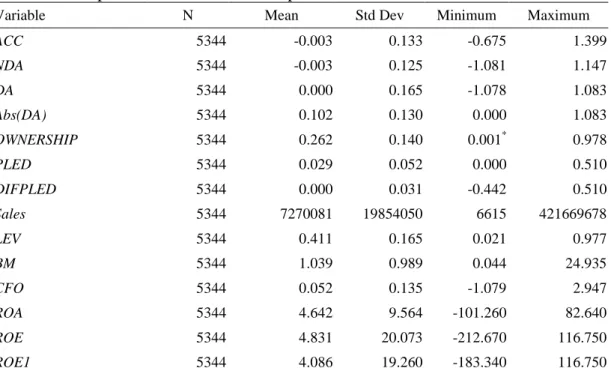
Table 1 shows the descriptive statistics for the sample firms. The average total
accruals (deflated by lagged total asset) are less than zero (-0.3%) and meet the
expectation. Because of the depreciation, on average the reported net income is
expected to be less than cash flows from operation. Accruals are decomposed into
the nondiscretionary (expected) and discretionary (abnormal) parts based on the
modified Jones (1991) model. The average nondiscretionary accruals (NDA) are
-0.3% with standard deviation of 12.5%. The average abnormal accruals (DA) are
0.0% and thus no evidence of systematic upward or downward earnings management
is detected. The absolute values of abnormal accruals (Abs(DA)) are employed to
measure the extent of earnings management. Table 1 report that the average extent
of earnings management is 10.2% of the total assets. The maximum value of
26.2%, with the minimum of 0.13% and the maximum of 97.8%. On average, the
level of share collateralization ratio (PLED) and the change of share collateralization
ratio (DIFPLED) are 2.9% and 0.0%, respectively. The highest pledge ratio in the
sample is 51%. The standard deviations of PLED and DIFPLED are 5.2% and 3.1%,
respectively. The mean and standard deviation of sales of sample firms are 7.27
billions and 19.85 billions. The mean and standard deviation of leverage (LEV) are
41.1% and 16.5%. On average, the book-to-market ratio (BM) is 1.039. Cash
flows form operations deflated by lagged assets (CFO), Returns on total asset (ROA),
return on equity (ROE) and ratio of income before extraordinary items to equity
(ROE1) are measures of firm performance. The means of CFO, ROA, ROE and
ROE1 are 5.2%, 4.642%, 4.831% and 4.086%, respectively.
[Table 1 about here]
5.2 Cross-sectional analyses
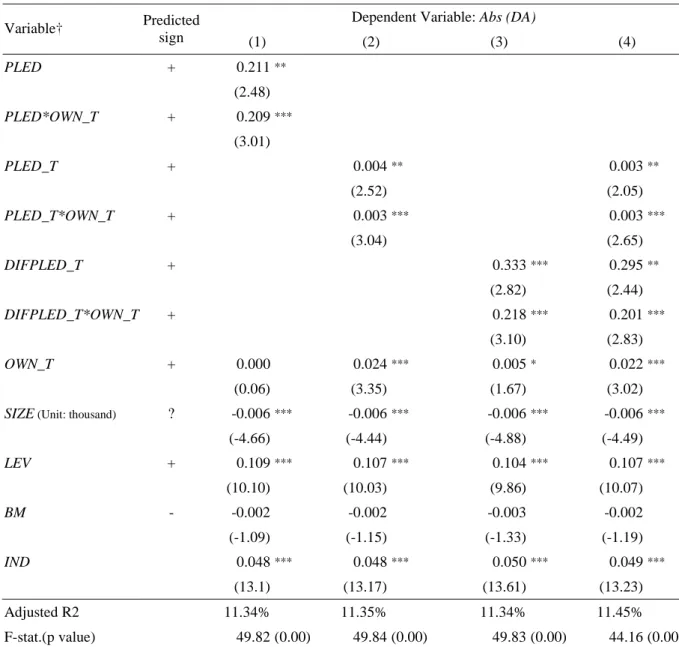
Table 2 reports the OLS regression estimates of 3 alternative measures of share
collateralization ratio (level of share collateralization ratio PLED, logarithm
transformation of share collateralization ratio PLED_T and logarithm transformation
of change of share collateralization ratio DIFPLED_T) on absolute values of
discretionary accruals for equation (1). Columns (1), (2) and (3) of table 2 shows
that 3 alternative measures of share collateralization ratio are significantly positively
related to accounting discretions. The coefficients on Table 2 for PLED, PLED_T
and DIFPLED_T are 0.211, 0.004 and 0.333 with t-values are 2.48, 2.52, and 2.82,
respectively. The results support the argument that share collateralization increases
the motivation of board member to influence the reported earnings (hypothesis 1).
In column 4, PLED_T and DIFPLED_T are included and the results show that both
measures of earnings manipulation (coefficients for PLED_T and DIFPLED_T are
0.003 and 0.295, and t-values are 2.05 and 2.44, respectively).
While regression coefficient in equation (1) is used to examine the impact of1 collateralized shares on earnings management, the magnitude of 1 2(OWN_T) in equation (1) measures the impact of collateralized shares on earnings management
conditional on different levels of board ownership. The sign of coefficient is2 expected to positive implying that the increase of ownership of directors makes the
positive association between earnings manipulation and share collateralization more
severe. Table 2 shows the coefficients for the interaction terms PLED*OWN_T (in
column #1), PLED_T*OWN_T (in column #2), and DIFPLED_T*OWN_T (in column
#3) are 0.209, 0.003, and 0.218, respectively (t-values are 3.01, 3.04, and 3.10,
respectively). Those coefficients are all significantly positive which is consistent
with the argument that more ownership held by board member can increase the board
members’ability to manipulate the earnings, and thus exaggerate the impact of share
collateralization on earnings manipulation. Results of Table 2 support the
hypotheses 2.
[Table 2 about here]
The association between the firm’s performance and the extent of accounting
discretion attributable to share collateralization by board member is examined using a
cross-sectional multiple regression (equation (2)). The regression equation includes
one of the four measures of firm’s performance (cash flows from operations deflated
by lagged total assets, return on assets, return on equity, and income before
extraordinary items deflated by total equity) as a dependent variable and includes two
predicted measures of discretionary accruals (PredictedEM1 and PredictedEM2)
management attributable to share collateralization. PredictedEM1 is the predicted
value of accounting discretion due to the level of share collateralization by board
member impact of conditional on different levels of board ownership, while
PredictedEM2 is the predicted value of accounting discretion due to the change of
share collateralization ratio conditional on different levels of board ownership. The
regression model also includes standard deviation of firm performance, logarithm of
sales, and debt-to-asset ratio as control variables to control for the possible effects of
firm risk, size and leverage on performance. In addition, lagged values of firm’s
performance, one industry dummy, and seven year dummy variable are contained in
the regression to control for the unobserved variation.
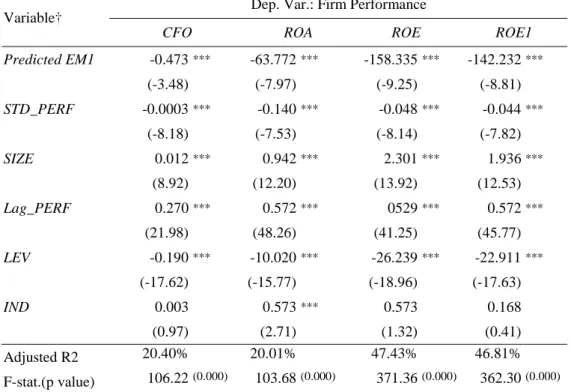
The regression result of performance on earnings management due to share
collateralization and other control variables are presented in Table 3. The results in
panel A show that the predicted component of accounting discretion due to level of
share collateralization (PredictedEM1) is significantly negatively correlated with four
measures of accounting performance (significant at 1% level), implying the earnings
manipulation due to higher level of share collateralization indeed hurts the
performance. The effect of change of share collateralization on firm performance
has similar results to the effect of level. Panel B shows that the predicted component
of accounting discretion due to change of share collateralization (PredictedEM2) is
significantly negatively correlated with ROE and ROE1 (t-values are -2.83 and -2.27,
respectively), while the effects of PredictedEM2 on CFO and ROA are not supported
(t-values are 1.55 and -1.01, respectively). The results indicate that the earnings
manipulation due to increase of share collateralization ratio has negative impact on
firm performance. Table 3 implies that agency problems associated with the
As to other control variables, the effect of standard deviation of each accounting
performance (STD_PERF) and the effect of leverage (LEV) on all measures of firm
performance are significantly negative, indicating that high risk and leverage firms
have worse performance during the sample period. Size and prior period
performance (Lag_PERF) have significantly positive impact on firm performance.
[Table 3 about here]
6. Conclusion
The paper finds that the personal financial loan of board members using firm
shares as collateral to borrow money from banks increases the managers’motivation
to manage earnings. Moreover, the influence of collateralized shares on earnings
management increases directly with the ownership of board members, implying that
board members with more ownership have higher ability to influence the accounting
manipulation due to share collateralization. The paper also finds that the predicted
component of earnings management arising from personal financing behavior of
board members has a statistically significant negative relation with firm operating
performance. Overall, the results indicate that share collateralization by board
members could induce the agency problems. The share collateralization by board
member increases the motivation of management to manipulate earnings
opportunistically and the management opportunism finally hurts the firm
Reference
Anderson R., S. Mansi, and D. Reeb, 2004. Board characteristics, accounting report integrity, and the cost of debt. Journal of Accounting and Economics 37, 315-342.
Bartov, E., F. Gul and J. Tsui, 2000. Discretionary-accruals models and audit qualifications. Journal of Accounting and Economics 30, 421-452.
Beasley, M.S., 1996. An empirical analysis of the relation between the board of director composition and financial statement fraud. The Accounting Review 71, 443-465.
Carcello, J. and T. Neal, 2000. Audit committee composition and auditor reporting. Accounting Review 75, 453-467.
Chen, D. H., Joseph Fan, and T. J. Wong, 2002. Do politicians jeopardize
professionalism? Decentralization and the structure of Chinese corporate board. Working paper, School of Business and Management, Hong Kong University of Science and Technology Clear Water Bay, Hong Kong.
Chen, Y. and S.Y. Hu, 2003. The controlling shareholders’personal leverage and firm performance. Working paper, National Taiwan University, Taiwan.
Chiou, Jeng-Ren, Ta-Chung Hsiung, and Lanfeng Kao, 2002. A study of the relationship between financial distress and collateralized shares. Taiwan Accounting Review 3(1): 79-111.
Claessens, S., S. Djankov and L. Lang, 1999. Expropriation of minority shareholders in East Asia. Working paper, World Bank, Washington, DC.
Claessens, S., S. Djankov and L. Lang, 2000. The separation of ownership and control in East Asia corporations. Journal of Financial Economics 58: 81-112.
Claessens, S., S. Djankov, J. Fan and L. Lang, 2002. Disentangling the incentive and entrenchment effects of large shareholders. Journal of Finance 57(6), 2741-2771.
Core, J., R. Holthausen and D. Larcker. 1999. Corporate governance, chief executive officer compensation, and firm performance. Journal of Financial Economics 51: 371-406.
Cox, D.R., 1970. The Analysis of Binomial Data, Methuen & Co., London.
Dechow, P., R. Sloan and A. Sweeney, 1996. Causes and consequences of earnings manipulation: An analysis of firms subject to enforcement actions by the SEC. Contemporary Accounting Research 13, 1-36.
Demsetz, H. and B. Villalonga, 2000. Ownership structure and corporate performance. working paper, University of California, Los Angeles.
Fan, J. and T.J. Wong., 2002. Corporate ownership structure and informativeness of Accounting Earnings in East Asia. Journal of Accounting and Economics 33, 401-425.
Jones, J., 1991. Earnings management during import relief investigations. Journal of Accounting Research 29, 193-228.
Kao Lanfeng and J. R. Chiou, 2002. The effect of collateralized shares on informativeness of accounting earnings. NTU Management Review 13(1), 1-36. (in Chinese)
Kao Lanfeng, J. R. Chiou and Anlin Chen, 2004. The agency problems, firm performance and monitoring mechanisms: The evidence from collateralized shares in Taiwan. Corporate Governance: An International Review 12(3),
389-402
Klein, A., 2002. Audit committee, board of director characteristics, and earnings management. Journal of Accounting and Economics 33: 375-400.
Loebbecke, J., Martha M. and John J. Willingham, 1989. Auditors' experience with material irregularities: Frequency, nature, and detectability. Auditing: A Journal of Practice and Theory 9 (1), 1-28.
McMullen, D. A., 1996. Audit committee performance: An investigation of the consequences associated with audit committees. Auditing: A Journal of Practice and Theory (Fall), 1-28.
Peasnell, K., P. Pope, and S. Young, 2000. Board monitoring and earnings management: Do outside directors influence abnormal accruals? Working paper, Lancaster University.
Warfield, T.D., Wild, J.J., Wild, K.L., 1995. Managerial ownership, accounting choices, and informativeness of earnings. Journal of Accounting and Economics 20(1), 61-91.
Yeh, Y. H. and T. S. Lee, Corporate governance and performance: The case of Taiwan, The Seventh Asia Pacific Finance Association Annual Conference, Shanghai, 2001.
Table 1 Descriptive Statistics for the sample firms, 1997-2004
Variable N Mean Std Dev Minimum Maximum
ACC 5344 -0.003 0.133 -0.675 1.399 NDA 5344 -0.003 0.125 -1.081 1.147 DA 5344 0.000 0.165 -1.078 1.083 Abs(DA) 5344 0.102 0.130 0.000 1.083 OWNERSHIP 5344 0.262 0.140 0.001* 0.978 PLED 5344 0.029 0.052 0.000 0.510 DIFPLED 5344 0.000 0.031 -0.442 0.510 Sales 5344 7270081 19854050 6615 421669678 LEV 5344 0.411 0.165 0.021 0.977 BM 5344 1.039 0.989 0.044 24.935 CFO 5344 0.052 0.135 -1.079 2.947 ROA 5344 4.642 9.564 -101.260 82.640 ROE 5344 4.831 20.073 -212.670 116.750 ROE1 5344 4.086 19.260 -183.340 116.750
Sample description and variable definition:
The sample contains 5344 firm-year observations over 1997-2004.
* Ownership of directors of KPT INDUSTRIES LTD. (凱聚, Code1805) from May, 2002 to December, 2004 is only 0.13%.
ACC is total accruals which are the difference between net income before extraordinary items and cash flows from operations, deflated by lagged total assets.
NDA is nondiscretionary accruals that are estimated for each firm-year as the expected value of accruals based on the cross-sectional modified Jones (1991) model.
DA is abnormal accruals that are the difference between total accruals and estimated expected accruals using the cross-sectional modified Jones (1991) model.
Abs(DA) is the absolute values of discretionary accruals.
OWNERSHIP is ownership of directors which is measured as the total shares held by the board members divided by the total shares outstanding.
PLED is share collateralization ratio of directors which is defined as the total shares owned by board members and pledged to financial institutions as collaterals divided by the total shares outstanding.
DIFPLED is the difference of share collateralization ratio of board members between a year and its preceding year.
SALES is the sales of the firm. LEV is debt deflated by total asset.
BM is the book value of total common equity divided by the market value of common equity. CFO is cash flow from operations deflated by lagged total assets.
ROA is return on total assets. ROE is return on common equity.
Table 2 Multivariate models of absolute values of abnormal accruals on three measures of pledged share ratio
Dependent Variable: Abs (DA) Variable† Predicted sign (1) (2) (3) (4) PLED + 0.211** (2.48) PLED*OWN_T + 0.209*** (3.01) PLED_T + 0.004** 0.003** (2.52) (2.05) PLED_T*OWN_T + 0.003*** 0.003*** (3.04) (2.65) DIFPLED_T + 0.333*** 0.295** (2.82) (2.44) DIFPLED_T*OWN_T + 0.218*** 0.201*** (3.10) (2.83) OWN_T + 0.000 0.024*** 0.005* 0.022*** (0.06) (3.35) (1.67) (3.02)
SIZE(Unit: thousand) ? -0.006*** -0.006*** -0.006*** -0.006***
(-4.66) (-4.44) (-4.88) (-4.49) LEV + 0.109*** 0.107*** 0.104*** 0.107*** (10.10) (10.03) (9.86) (10.07) BM - -0.002 -0.002 -0.003 -0.002 (-1.09) (-1.15) (-1.33) (-1.19) IND 0.048*** 0.048*** 0.050*** 0.049*** (13.1) (13.17) (13.61) (13.23) Adjusted R2 11.34% 11.35% 11.34% 11.45% F-stat.(p value) 49.82 (0.00) 49.84 (0.00) 49.83 (0.00) 44.16 (0.00)
Sample is for 5344 Taiwan firm-years observations from 1997 to 2004.
*/**/*** represents statistical significance at the 10%, 5% and 1% levels, respectively. Sample description and variable definition:
Abs(DA) is the absolute values of discretionary accruals.
PLED is share collateralization ratio of directors which is defined as the total shares owned by board members and pledged to financial institutions as collaterals divided by the total shares outstanding.
PLED_T is defined as Ln(PLER+0.5/N), the logarithm transformation of PLED (share collateralization ratio by board members) which takes values from 0 to 1 and is highly skewed to the right. Here, 0.5/N is added to accommodate the cases where PLED is zero.
DIFPLED_T is defined as Ln(1+DIFPLED), the logarithm transformation of DIFPLED which is the difference of share collateralization ratio of board members between a year and its preceding year and takes value from -1 to 1 . One is added to DIFPLED to accommodate the case where DIFPLED is equal to -1.
OWN_T is defined as Ln(OWNERSHIP), the logarithm transformation of OWNERSHIP, where OWNERSHIP is ownership of directors which is measured as the total shares held by the board members divided by the total shares outstanding.
Size is the logarithm of sales. LEV is debt deflated by total asset.
BM is the book value of total common equity divided by the market value of common equity. IND = industry dummy. The value is 1 for electronic firms; 0 otherwise.
Table 3 Firm performance on predicted earnings management due to share collateralization
Panel A: Multivariate models of firm performance on predicted earnings management due to level of share collateralization ratio (Predicted EM1)
Dep. Var.: Firm Performance Variable†
CFO ROA ROE ROE1 Predicted EM1 -0.473*** -63.772*** -158.335*** -142.232*** (-3.48) (-7.97) (-9.25) (-8.81) STD_PERF -0.0003*** -0.140*** -0.048*** -0.044*** (-8.18) (-7.53) (-8.14) (-7.82) SIZE 0.012*** 0.942*** 2.301*** 1.936*** (8.92) (12.20) (13.92) (12.53) Lag_PERF 0.270*** 0.572*** 0529*** 0.572*** (21.98) (48.26) (41.25) (45.77) LEV -0.190*** -10.020*** -26.239*** -22.911*** (-17.62) (-15.77) (-18.96) (-17.63) IND 0.003 0.573*** 0.573 0.168 (0.97) (2.71) (1.32) (0.41) Adjusted R2 20.40% 20.01% 47.43% 46.81% F-stat.(p value) 106.22(0.000) 103.68(0.000) 371.36(0.000) 362.30(0.000) Panel B: Multivariate models of firm performance on predicted earnings management due to change of share collateralization ratio (Predicted EM2)
Dep. Var.: Firm Performance Variable
CFO ROA ROE ROE1
Predicted EM2 0.493 -18.528 -111.854*** -84.157** (1.55) (-1.01) (-2.83) (-2.27) STD_PERF -0.0003*** -0.155*** -0.048*** -0.044*** (-8.13) (-8.37) (-8.12) (-7.76) SIZE 0.0102*** 0.880*** 2.172*** 1.818*** (7.65) (11.38) (13.10) (11.73) Lag_PERF) 0.272*** 0.589*** 0551*** 0.595*** (22.13) (50.31) (43.49) (48.31) LEV -0.189*** -9.910*** -26.011*** -22.641*** (-17.50) (-15.51) (-18.66) (-17.31) IND 0.006 0.628*** 0.559 0.144 (1.62) (2.95) (1.28) (0.35) Adjusted R2 44.92% 44.12% 47.16% 46.44% F-stat.(p value) 335.80(0.000) 325.12(0.000) 367.35(0.000) 356.92(0.000)
Sample is for 5344 Taiwan firm-years observations from 1997 to 2004.
**/**/*** represents statistical significance at the 10%, 5% and 1% levels, respectively.
PredictedEM1 is the predicted value of accounting discretion due to the level of share collateralization by board member impact of conditional on different levels of board ownership. PredictedEM2 is the predicted value of accounting discretion due to the change of share collateralization ratio conditional on different levels of board ownership. STD_PERF is the standard deviations of CFO, ROA, ROE or ROE1 over the sample period. LAG_PERF is firm performance of the prior year. The definitions of the remaining variables please refer to note of Table 1.