DOI: 10.6662/TESFE.2016005 台灣昆蟲Formosan Entomol. 36: 33-43 (2016) 研究報告
Formosan Entomologist
Journal Homepage: entsocjournal.yabee.com.tw
小紅鰹節蟲
(鞘翅目:鰹節蟲科) 於台灣之發生調查
姚美吉1、張淑貞1、曾瑞昌2、李啟陽1* 1 行政院農業委員會農業試驗所應用動物組 41362 台中市霧峰區中正路 189 號 2 朝陽科技大學應用化學系 41349 台中市霧峰區吉峰東路 168 號 * 通訊作者 email: [email protected] 收件日期:2016 年 2 月 5 日 接受日期:2016 年 6 月 10 日 線上刊登日期:2016 年 8 月 31 日摘 要
小紅鰹節蟲 (穀斑皮蠹;Trogoderma granarium (Everts)) (鞘翅目:鰹節蟲科) 屬於檢疫類 積穀害蟲,曾於台灣發生並記錄,導致台灣被視為此蟲之疫區。但自1990 年起,多次全國性穀倉 害蟲調查均未發現此害蟲。本研究自2012 年起,先自三種小紅鰹節蟲性費洛蒙誘引資材中,篩選 出Fuji 之 Torios 為最適資材,並確認其成分為 (Z)-14-甲基十六烷-8-烯醛 [(Z)-14-methylhexadeca- 8-enal],然後利用此蟲性費洛蒙資材,在台灣的穀倉進行長期害蟲誘引監測,以確認此蟲在台灣 是否存在。針對進口穀物部分,調查處所包含台中及高雄港兩處進口穀倉、農糧署從澳洲及東南亞 輸入之進口米倉約30 處及 2 處民營進口雜糧倉;而針對本土穀倉部分,則包含稻穀倉 48 處及碾 米廠區58 處,調查範圍均勻分布於全台灣各處之主要穀物貯藏倉庫。監測點每 6 週更換一次性費 洛蒙餌劑,經持續 3 年以上之調查結果顯示,不論進口穀物倉、本土稻穀倉及碾米廠區之監測樣 品,均未發現此檢疫害蟲,推測可能因檢疫專職機構之建立、積穀害蟲防治推薦藥劑之更替及穀物 貯藏方式之改變等,導致此蟲並未能在台灣穀倉立足。小紅鰹節蟲在台灣應屬曾發生,但現已不存 在,故台灣現應屬小紅鰹節蟲之非疫區。 關鍵詞:積穀害蟲、小紅鰹節蟲、性費洛蒙、監測。
前 言
小 紅 鰹 節 蟲 ( 穀 斑 皮 蠹 ; Trogoderma granarium (Everts)) (鞘翅目:鰹節蟲科) 為印度、 非洲、中東等地榖物貯藏期之重要害蟲,常造成嚴 重危害 (Rupesh et al., 2013; Anonymous, 2015)。 此蟲食性甚雜,能危害多種貯藏穀物及其加工品, 如稻穀、玉米、小麥、大麥、乾果、堅果、花生仁、 葡萄乾和油料等等;另外對動物性食品如牛奶、魚 粉 等 , 甚 至 昆 蟲 標 本 亦 可 取 食 (Hinton, 1945;Strong et al., 1959; Barak, 1989; Pasek, 1998)。 此蟲原產於印度,1908 年隨釀酒用大麥由印度輸入 到英國並逐步造成嚴重危害 (Durrant, 1921),並擴 展 到 歐 洲 其 他 國 家 及 非 洲 南 部 (Zacher, 1939; Banks, 1977)。1953 年隨穀物貿易傳入美國加州, 導致該蟲在當地大發生,所造成的損失約達該州農 產品總收入之 10%,若要從已被其入侵之數州及墨 西 哥 完 全 根 除 , 預 估 所 需 經 費 將 達 數 千 萬 美 元 (Armitage, 1958; Okumura, 1972)。該蟲對多種藥 劑及燻蒸劑已有抗藥性 (Lindgren et al., 1955;
Bell and Wilson, 1995),且對環境適應性强,能耐 高溫、低溫及耐旱,甚至幼蟲休眠可耐飢存活達 6 年 (Burges, 1962)。由於極易隨穀物貿易而入侵, 因此被提名為全世界最嚴重之前百大入侵種 (Lowe et al., 2000),包含我國、美國、澳大利亞等各國均 將此蟲列為檢疫害蟲,在各檢疫港口及檢疫站進行 攔截,以避免此蟲之入侵。 台 灣 在 1968 年 前 , 有 三 次 積 穀 害 蟲 普 查 (Okuni, 1924; Liang et al., 1954; Lin, 1968),害 蟲種類均未包含此蟲。但在1970 年之後,則陸續在 埔里進口小麥倉中發現,亦曾在台北麵粉廠之進口 小麥中採集到。為了解此蟲在台灣生長之狀況,Lin (1971, 1973) 特別針對生物學進行研究,發現此蟲 適宜發育的溫度為 25~33℃,能適應台灣之環境。 第四齡幼蟲起食量大增,行動活潑,能將糙米囓食 成碎米,使穀物品質變壞,發生臭味,失去其經濟 價值。成蟲為絕食性,夜間活動,缺乏飛翔能力, 在33℃時產卵量多,生長快且能迅速繁殖。在 1980 年間,曾逐漸在中部地區稻穀倉蔓延危害 (Lin and Li, 1983)。此蟲並非靠害蟲之飛翔而蔓延,主要是 透過幼蟲或成蟲附著於穀物,再藉由人為穀物買賣 而轉移。但在1991 至 2012 年間,多次稻穀倉、糙 米、蒜球或進口糙米或雜糧倉進行全國性穀倉害蟲 調查中,均未曾再發現此蟲 (Hung and Hwang, 1992; Yao and Lo, 1992; Yao et al., 2003, 2007, 2009; Yao and Lee, 2014)。
因台灣曾有小紅鰹節蟲入侵及發生之紀錄,導 致台灣穀物要輸出到中國大陸地區或其他國家時, 均被要求需先經過磷化氫之燻蒸處理。為確實了解 此蟲是否仍存在於台灣,本研究自2012 年起,開始 利用此蟲之性費洛蒙誘引劑 (Burkholder and Ma, 1985; Barak 1989; Phillips and Throne, 2010) 在全國主要稻穀倉、進口米倉及碾米廠進行此蟲之 監測,持續3 年 3 個月,以確認此蟲是否仍存在臺 灣。若經長久監測,均未發現此蟲,則可據以推測 此蟲已不存在,將相關調查結果提供動植物防疫檢 疫局,做為與外國貿易談判之依據,並宣告臺灣已 成為小紅鰹節蟲之非疫區。
材料與方法
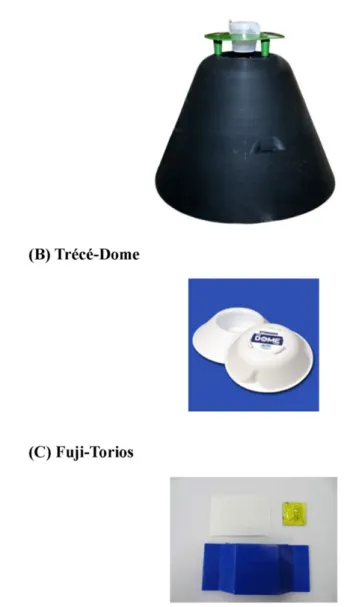
一、小紅鰹節蟲性費洛蒙誘引資材評估 從網路搜尋共有六家生產小紅鰹節蟲性費洛蒙 誘引資材之廠商,經篩選分別購買美國 ISCA 公司 (Riverside, CA) 之 Pitfall 誘引器、美國 Trécé 公司 (Adair, OK) 之 Dome 誘引器及日本 Fuji 公司 之Torios 誘引器等三款產品 (圖一),分別各選購 12 組進行先期測試。 因小紅鰹節蟲成蟲缺乏飛翔能力僅能爬行,故 性費洛蒙誘引資材之評估是將已選購 3 家廠牌之資 材,於中部分別選 3 處碾米倉進行測試,在礱穀機 或斗升機出口放置誘引器,以利有效誘捕,約每100 m2放置1 個,每處共放置 4 個。6 週後,將誘引器 所收集蟲種或黏板封裝,寄回農試所檢查誘引結果, 並評估誘引處理過程之特點,以作為本試驗長久監 測之資材。 二、小紅鰹節蟲性費洛蒙成分分析 1. 誘引資材之分析:將推薦長期監測資材所附之性 費洛蒙餌劑,利用朝陽科技大學應用化學系之 「頂空進樣氣相層析質譜儀」(head space gas chromatography-mass spectrometry, HSGC- MS) 進行成分組成分析,以獲得該資材成分 HSGC-MS 之 GC 全圖譜。 2. 誘引資材之比對:將資材所得之 HSGC-MS 分 析圖譜與性費洛蒙主要成分 (Z)-14-甲基十六烷 -8-烯醛 [(Z)-14-methylhexadeca-8-enal] 之標 準質譜進行分子離子峰 (molecular ion peak) 及斷片離子峰 (fragment ion peaks) 之比對, 以確認兩者是否一致。 三、小紅鰹節蟲之監測穀倉及方式 監測時間自2012 年 10 月起到 2015 年 12 月止, 共3 年 3 個月。 1. 進口穀物之小紅鰹節蟲監測 (1) 檢疫港口進口穀物倉庫之監測:在臺中港 及高雄港檢疫站之進口暫存穀倉,於其內 部周圍,約每100 m2放置1 個,每處共 放置4 個。監測方式為每一監測點每 6 週 更換一次性費洛蒙餌劑,並將監測黏板寄 回農業試驗所進行檢驗。 (2) 進口穀物貯藏倉庫之監測:選擇進口糙米 及其他穀物 (玉米、小麥) 之廠商,於其 倉庫內選擇1 處穀倉,監測方式如 1 (1)。 2. 本土各類穀倉之小紅鰹節蟲監測 (1) 輸中國大陸米之碾米廠之監測:將輸到中 國大陸糙米之碾米廠,需經動植物防疫檢 疫局 (防檢局) 之審查合格方可輸出,在 廠區之礱穀機或斗升機出口放置誘引器, 監測方式如1 (1)。
(2) 本土稻穀倉庫之監測:原則為每縣市選擇 3 處以上稻穀倉庫,在稻穀倉內約每 100 m2放置1 個,每處共放置 4 個。監測方 式如1 (1)。
結 果
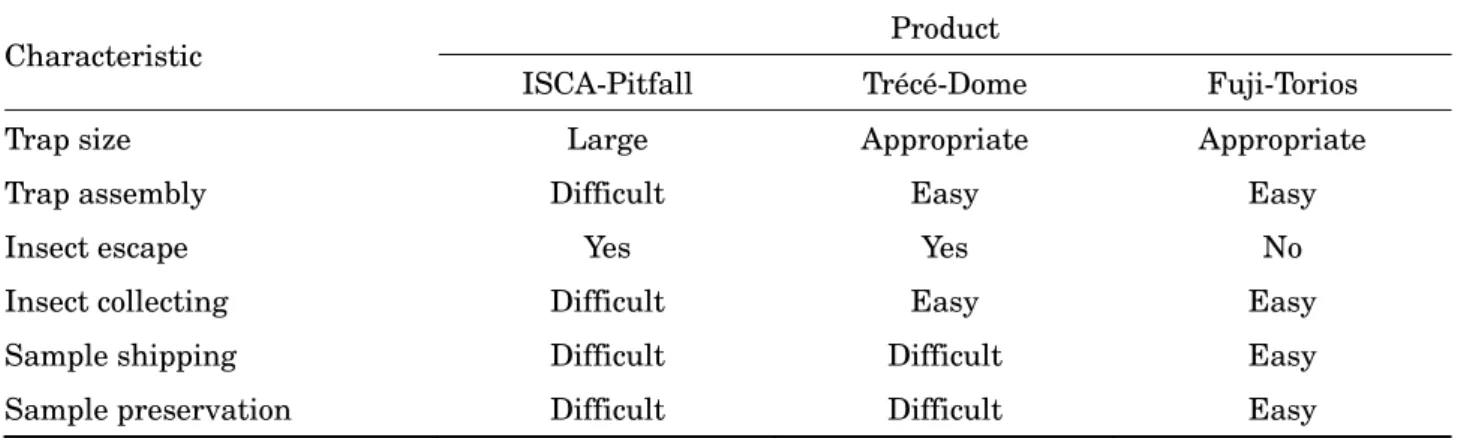
一、小紅鰹節蟲性費洛蒙誘引資材評估 三品牌之誘引器經 3 處碾米倉進行測試,其適 用性評估主要從其性費洛蒙誘引成分、誘引器大小、 誘引器組裝便利性、蟲體逃脫、害蟲收集、樣品寄 送及樣品保存等方向進行分析,其結果與特點詳列 如表一。ISCA 之 Pitfall 優點是所收集蟲體不被黏 住,鑑定無困擾;缺點為資材過大、組裝困難,蟲 體易逃脫,在收集蟲體、樣品寄送及樣品保存均較 不便利等。Trécé 之 Dome 優點是資材大小適中、 組裝容易且蟲體收集蟲體不被黏住,鑑定上不受限 制;缺點為蟲體易逃脫,在收集蟲體、樣品寄送及 樣品保存均較不便利等。Fuji 之 Torios 具有資材大 小適中、組裝容易、害蟲黏附後固定不易逃脫,且 樣品在寄送及保存上均較便利等優點;缺點為害蟲 黏附後固定於黏板上較不易鑑定。綜合比較三種之 利弊後,評估以Fuji 之 Torios 較適合長期監測,因 此選擇此資材為後續監測之用。圖一 三種小紅鰹節蟲性費洛蒙誘引資材外形圖。(A) ISCA- Pitfall;(B) Trécé-Dome;(C) Fuji-Torios。
Fig. 1. Structures of three commercial Trogoderma granarium pheromone traps. (A) ISCA- Pitfall; (B) Trécé-Dome; (C) Fuji-Torios.
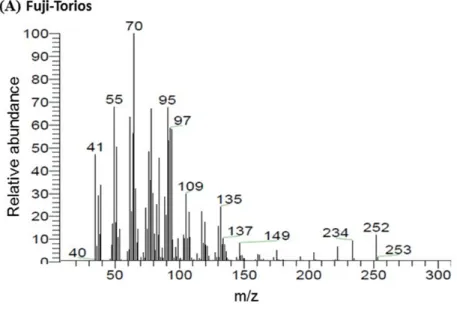
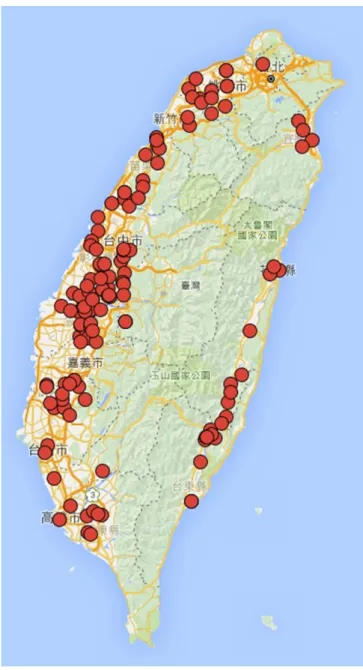
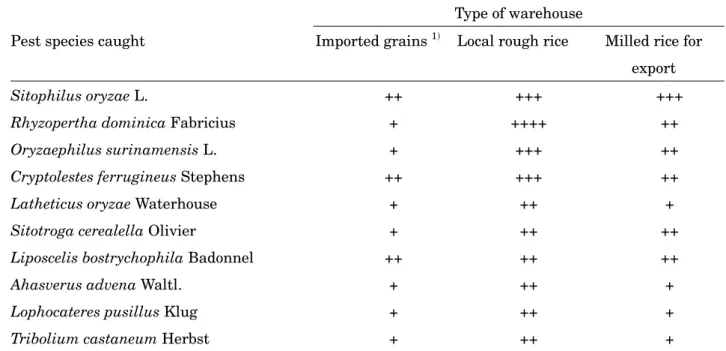
二、小紅鰹節蟲性費洛蒙成分分析 為確認Fuji 產品之性費洛蒙,是否如其標示之 成分 (Z)-14-methylhexadeca-8-enal,因此進行「頂 空進樣氣相層析質譜儀」(HSGC-MS)分析其成分組 成,所得全圖譜比對如圖二,圖二A 為 Fuji 之 Torios 所得圖譜,而圖二B 為標準之性費洛蒙「(Z)-14-甲 基十六烷-8-烯醛」[(Z)-14-methylhexadeca-8-enal] 之圖譜。從圖譜結構分析,可確認Torios 之性費洛 蒙確實為「(Z)-14-甲基十六烷-8-烯醛」,其分子量為 252 amu,未來長期使用應無虞慮。 三、小紅鰹節蟲發生之監測 長期監測小紅鰹節蟲發生狀況之穀倉,包含輸 往大陸白米之碾米廠有58 處、本土稻穀倉庫 48 處、 進口米倉30 處、進口穀物倉 2 處及港口穀倉 2 處、 合計140 處,分佈狀況如圖三;其中以輸往中國大 陸之碾米倉監測點數量最多,主要分布在中南部地 區。監測時間自2012 年 10 月起到 2015 年 12 月止, 持續3 年 3 個月,均未發現小紅鰹節蟲。在不同類 型穀倉,利用小紅鰹節蟲性費洛蒙誘引資材,所誘 得之昆蟲種類共60 種。針對上述監測倉庫再簡化為 三種不同類型穀倉之蟲相依其誘得頻度整理如表二, 在進口米倉部分主要以米象 (Sitophilus oryzae L.)、 角胸粉扁蟲 (Cryptolestes ferrugineus Stephens)、 茶蛀蟲 (Liposcelis bostrychophila Badonnel) 頻 度 較 高 ; 本 土 稻 穀 倉 以 穀 蠹 (Rhyzopertha dominica Fabricius) 最高,米象、鋸胸粉扁蟲 (Oryzaephilus surinamensis L.)、角胸粉扁蟲次之; 輸往中國大陸之碾米倉則以米象最高,穀蠹、鋸胸 粉扁蟲、角胸粉扁蟲,麥蛾 (Sitotroga cerealella Olivier)、茶蛀蟲次之。在所誘得的種類中,有兩種 為 小 紅 鰹 節 蟲 相 似 種 , 分 別 為 擬 腎 斑 皮 蠹
(Trogoderma versicolor (Creutzer)) 及球棒皮蠹 (Orphinus fulvipes (Guérin-Méneville))。
討 論
針對小紅鰹節蟲之調查,最常利用性費洛蒙餌 劑進行監測,最著名之成分為92:8 組成之 Z:E 混合 鏡像異構物14-甲基-8-十六烷烯醛 (92:8 (Z:E)-14- methyl-8-hexadecenal) (Cross et al., 1976),而 Fuji 之 Torios 主要成分為 (Z)-14-methylhexadeca- 8-enal 即為 92:8 (Z:E)-14-methyl-8-hexadecenal。 此成分對數種鰹節蟲科 (Dermestidae) 昆蟲均具 有誘引效果 (Barak and Burkholder, 1976, 1985; Cross et al., 1976; Burkholder and Ma, 1985; Barak, 1989)。以往利用此成分,對小紅鰹節蟲有 極佳誘引效果;中國大陸亦使用此成分之誘引劑, 作為邊境海關監測及攔截此蟲之重要利器 (Jiang and Wang, 1996)。 此次針對小紅鰹節蟲發生之調查地點,主要選 擇最容易透過穀物貿易侵入台灣之港口貯藏倉庫及 從國外高風險地區所進口之穀物貯藏倉庫;而本土 稻穀倉之選擇重點,則以以往30 年前曾發生小紅鰹 節蟲危害之稻穀倉,及貯藏或銷售量高之稻穀倉; 至於碾米工廠主要以外銷到國外 (包含中國大陸) 之白米廠為監測目標。在害蟲監測上,雖然無法涵 蓋每一個地方,但透過從進口、本土及出口這三方 面主要穀倉之監測,將能代表小紅鰹節蟲實際發生 之現況。 本次調查所使用之Fuji-Torios 資材,不只費洛 蒙成分相同,且具有資材大小適中、組裝容易、害 蟲黏附後固定不易逃脫,以及樣品在寄送及保存上 均較便利等優點,確實適合作為長期監測之資材。 表一 三種小紅鰹節蟲性費洛蒙誘引資材之特點分析
Table 1. Characteristic analysis of three commercial Trogoderma granarium pheromone traps
Characteristic Product
ISCA-Pitfall Trécé-Dome Fuji-Torios Trap size Large Appropriate Appropriate
Trap assembly Difficult Easy Easy
Insect escape Yes Yes No
Insect collecting Difficult Easy Easy
Sample shipping Difficult Difficult Easy Sample preservation Difficult Difficult Easy
由持續三年在不同地區之監測結果,顯示此誘引器 會對小紅鰹節蟲相似種具有誘引效果;另外在監測 上,誘蟲盒主要放置於碾米廠最容易孳生害蟲之汙 染源出口,不只提升誘得的機率,更配合小紅鰹節 蟲無法飛翔,主要以爬行轉移到其他危害點之特色, 原則上此專一性之性費洛蒙應僅能誘引得此一蟲種; 但結果顯示不同害蟲因隨機爬行而被黏附於黏板上 數量甚多。由此推測誘蟲點的設置,確實為碾米廠 最主要害蟲孳生源,導致有此誘引效果。在害蟲種 類上主要以鞘翅目昆蟲最多 (Okuni, 1924; Liang et al., 1954; Lin, 1968)。由長期監測結果,均未發 現小紅鰹節蟲,應不是此蟲較易躲藏,而是此蟲確 實未發生在台灣倉庫。 從小紅鰹節蟲入侵各國之歷史,可知其主要是 透過穀物貿易,從原生地印度轉移侵入各國再逐步 立足,若能在這過程,迅速進行撲滅,就不容易使 此害蟲立足。從台灣此蟲之發生歷史來看,此蟲確 實在1970 年至 1983 年間藉著穀物貿易進口方式, 從疫區被帶到台灣。當時港口主要負責品質檢驗之 單位為商品檢驗局,在檢驗時已發現此蟲,但並未 建立完善之檢疫制度,且此蟲尚未被定義為檢疫害 蟲,未能及時進行撲滅動作,以至逐漸在中部地區 稻穀倉蔓延危害 (Lin and Li, 1983)。然而 1990 年 之後,有多位學者針對台灣稻穀倉、糙米倉等進行 圖二 小紅鰹節蟲性費洛蒙以頂空進樣氣相層析質譜儀分析之圖譜。(A) Fuji-Torios;(B) 費洛蒙標準品。
Fig. 2. The HSGCMS spectra of Trogoderma granarium pheromones. (A) Fuji-Torios; (B) pheromone standard sample.
積穀害蟲普查,均未曾再發現此蟲 (Hung and Hwang, 1992; Yao and Lo, 1992; Yao et al., 2003, 2007)。
台灣自 2002 年起加入世界貿易組織 (World Trade Organization, WTO) 後,除原有進口玉米、 小麥、黃豆外,更增加糙米之進口,為了解是否有 檢疫害蟲隨貿易進口再度入侵台灣,因此每批進口 糙米均進行取樣,並檢驗其害蟲狀況。其輸入國包 含有美國、澳大利亞、埃及、泰國及越南等地;監 測持續至今,均未曾發現有小紅鰹節蟲之存在 (Yao et al., 2009)。另針對每年約達 900 萬噸的大宗穀物, 自2003 年起在台中港、高雄港進行長期穀物之害蟲 發生調查,自2003~2012 年共調查 1,086 件樣品, 雖樣品之含害蟲率高達 22.6%,亦均未發現小紅鰹 節蟲。此結果亦顯示此害蟲透過貿易交易傳入之可 能性極高 (Yao and Lee, 2014),因此在穀物進口時, 透過完善檢疫監測,確實能防止穀物內檢疫害蟲之 入侵。 此次小紅鰹節蟲之監測,主要利用性費洛蒙誘 引資材,可使誘引效果更加提升;加上監測倉庫涵 蓋更為全面,如港口之暫存倉,其貯藏量達 1 萬公 噸以上,是進口穀物主要暫存處所。另亦針對北中 南在台灣主要進口小麥廠商,進行長期監測。本土 稻穀倉,主要以長期且有交易買賣的農糧署委託農 會或碾米廠為主。而輸往中國大陸之碾米廠,亦遍 佈全台灣各處,其糙米生產及貯藏量,均有相當數 圖三 長期進行小紅鰹節蟲監測倉庫在台灣之分佈圖。
Fig. 3. Distribution of the Trogoderma granarium survey sites in Taiwan.
量,若有檢疫害蟲發生時,亦是高風險之代表倉庫。 但透過2012 年起,為期三年多之監測,在 140 處 之倉庫區,均未發現小紅鰹節蟲。何以小紅鰹節蟲 自1990 年後在台灣消失呢?綜合可能原因有三: (一)檢疫專職機構之成立 1998 年在農委會下增設防檢局,主管動植物之 防疫及檢疫相關業務,並針對關口之檢疫,有系統 對植物或植物產品輸入之病蟲害有詳盡規範。其中 小紅鰹節蟲亦是表列之檢疫害蟲,透過此完善之檢 疫制度建立,不只對小紅鰹節蟲,更是對所有表列 所有檢疫有害生物,達到極有效之阻隔及防範效果。 就如德國或美國等地,同樣曾因穀物輸入,導致此 蟲曾短暫入侵 (Zacher, 1939; Armitage, 1958),但 同樣透過檢疫及監測,現今已完全根除此蟲。因此 台灣設立防檢局,且建立完善之檢疫制度,隔絕此 蟲從國外再次入侵台灣的機會,並進行長期之監測, 應是導致小紅鰹節蟲從台灣消失之主要關鍵因素。 (二)積穀害蟲防治推薦藥劑之更替 稻穀倉在稻穀貯藏期間以往偏重化學防治,因 其處理方便且價格便宜,但長久使用卻容易導致害 蟲對藥劑產生抗藥性。從1970 年至今,確實因害蟲 對藥劑產生抗藥性,而必須更換推薦藥劑共 3 次, 在1970 年推薦藥劑為靈丹 (lindane),1971~1978 年為馬拉松 (malathion),1979~2001 年為巴賽松 (phoxim) , 2002 年 迄 今 則 使 用 第 滅 寧 (daltamethrin) (Yao and Lo, 1994, 1995, 2000)。 其中靈丹屬於有機氯劑,馬拉松及巴賽松則屬有機 磷劑,而第滅寧則屬除蟲菊類藥劑,其殺蟲機制各 異,因此可避免交互抗性所產生之困擾。另Hasan et al. (2006) 在小紅鰹節蟲嚴重危害之巴基斯坦,發 現第滅寧對小紅鰹節蟲有極佳之毒效。在台灣可能 在此40 多年間經歷使用藥劑之更替,導致原已立足 在本土稻穀倉之小紅鰹節蟲族群,因對推薦藥劑之 感受性變化,在稻穀倉無法適應而逐漸被撲滅,亦 可能是小紅鰹節蟲從台灣消失之因素之一。 (三)穀物貯藏方式之改變 稻穀倉之貯藏方式,在1980 年以前主要以散裝 貯存,而後推廣則為以60 kg 袋裝再堆疊貯藏,除 可避免散裝貯存之缺點外,在貯穀及搬運上均較便 利,在 1993 年袋裝穀倉約佔台灣各地所有穀倉之 96.3%。在加入 WTO 後,針對進口糙米及部分本土 稻穀之貯存更推行 1,000 kg 大型噸袋貯存方式 (Yao et al., 1998)。利用袋裝或噸袋裝方式貯存後, 倉內或倉間之期別較能區隔,且當時管理單位糧食 局,要求稻穀在每一期別進倉前都要進行空倉之藥 劑處理,對殘存之小紅鰹節蟲將直接影響其立足及 繁殖,且此蟲之成蟲缺乏飛翔能力,且對光有負趨 表二 小紅鰹節蟲性費洛蒙誘引資材誘得主要害蟲名錄及頻率
Table 2. List of the major insect pest species and their frequency of being caught by the Trogoderma
granarium pheromone traps during the monitoring period
Type of warehouse
Pest species caught Imported grains 1) Local rough rice Milled rice for
export
Sitophilus oryzae L. ++ +++ +++
Rhyzopertha dominica Fabricius + ++++ ++
Oryzaephilus surinamensis L. + +++ ++
Cryptolestes ferrugineus Stephens ++ +++ ++
Latheticus oryzae Waterhouse + ++ +
Sitotroga cerealella Olivier + ++ ++
Liposcelis bostrychophila Badonnel ++ ++ ++
Ahasverus advena Waltl. + ++ +
Lophocateres pusillus Klug + ++ +
Tribolium castaneum Herbst + ++ +
1) ++++: catch frequencies over 50; +++: 50 > catch frequencies >10; ++: 10 > catch frequencies > 1;
+: 1 > catch frequencies.
光性,其本身自主擴散之可能性就相對降低。因此 稻穀之貯藏方式改變,亦可能影響小紅鰹節蟲之立 足,導致其最後從台灣消失之因素之一。
聯合國糧農組織下的國際植物保護公約秘書處 自 1990 年之後,逐步完成制定植物防疫檢疫措施 (International Standards for Phytosanitary Measures, ISPM),其中 ISPB 8 主要規範地區疫情 之確定。台灣在1980 年之前,雖曾發生小紅鰹節蟲, 但透過檢疫專職機構防檢局之設立,並建構完善檢 防疫制度、積穀害蟲防治推薦藥劑之更替、穀物貯 藏方式改變等有害生物之根除計畫,且經由上述多 次長期之監測及此次性費洛蒙誘引資材之監測結果, 證實此蟲已不在台灣存在。但以台灣每年均有高達 900 萬噸之穀物輸入,未來仍需持續進行害蟲檢疫, 以透過第一關之嚴格把關,方能降低此蟲之入侵機 會。另台灣本土之害蟲監測,亦須持續進行以全面 性控管。總之,現今小紅鰹節蟲在台灣應已被根除, 應可宣告台灣為小紅鰹節蟲之非疫區。
誌 謝
本研究進行期間承蒙動植物防疫檢疫局各分局 防檢人員、農糧署各分署檢驗人員、各地區農會及 碾米場管倉人員協助更替費洛蒙誘餌並後送黏板, 以及本所李錦霞小姐協助調查;文成後,復承本所 應用動物組陳健忠博士不吝撥冗斧正,謹此一併致 謝。本研究受農業科技計畫持續四年之經費補助 {101 農科-10.4.3-檢-B2(3)、102 農科-10.3.2-檢 -B2(1)、103 農科-10.2.2-檢-B6(4)、104 農科-10.7.4-檢-B2(2)}。引用文獻
Anonymous. 2015. Crop protection compendium.
CAB International. Available on-line at http://sites.cabi.org/cpc/
Armitage HM. 1958. The khapra beetle
suppression program in the United States and Mexico. Proc Tenth Int Cong Entomol 4: 89-98.
Banks HJ. 1977. Distribution and establishment of Trogoderma granarium Everts (Coleoptera: Dermestidae): climatic and other influences. J Stored Prod Res 13: 183-202.
Barak AV. 1989. Development of a new trap to
detect and monitor khapra beetle (Coleoptera:
Dermestidae). J Econ Entomol 82: 1470- 1477.
Barak AV, Burkholder WE. 1976. Trapping
studies with dermestid sex pheromones. Environ Entomol 5: 111-114.
Barak AV, Burkholder WE. 1985. A versatile
and effective trap for detecting and monitoring stored product Coleoptera. Agric Ecosyst Environ 12: 207-218.
Bell CH, Wilson SM. 1995. Phosphine tolerance
and resistance in Trogoderma granarium Everts (Coleoptera: Dermestidae). J Stored Prod Res 31: 199-205.
Burges DH. 1962. Diapause, pest status and
control of the khapra beetle, Trogoderma
granarium Everts. Ann Appl Biol 50: 614-
617.
Burkholder WE, Ma M. 1985. Pheromones for
monitoring and control of stored-product insects. Annu Rev Entomol 30: 257-272.
Cross JH, Byler RC, Cassidy RF, Silverstein RM, Greenblatt RE. 1976. Porapak-Q
collection of pheromone components and isolation of (Z)-and (E)-14-methyl-8- hexadeeanal, potent sex attracting components, from females of four species of
Trogoderma. J Chem Ecol 2: 457-468.
Durrant JH. 1921. Insects associated with grain.
Grain Pests 9: 33-52.
Hasan M, Sagheer M, Ullah A, Wakil W, Javed A.
2006. Response of Trogoderma granarium (Everts) to different doses of Haloxylon
recurvum extract and deltamethrin. Pak
Entomol 28: 25-29.
Hinton HE. 1945. A monograph of the beetles
associated with stored products. Volume I. London, UK: British Museum (Natural History). 443 pp.
Hung CC, Hwang JS. 1992. Insect pests in rough rice, brown rice and chaff stored in different kinds of bin in Taiwan. Chinese J Entomol 12: 269-276. (in Chinese)
Jiang X, Wang L. 1996. An investigation of the
application of the pheromone of
Southwest Agric Univ 18: 202-205. (in Chinese)
Liang CJ, Chen TN, Lin C. 1954. Current status of rice storages and damage by stored product insects in Taiwan. Sci Agric 2: 34-41. (in Chinese)
Lin CK. 1971. Pest of stored grain and grain products in Taiwan (I): studies on the biology of the khapra beetle, Trogoderma
granarium Everts. (Coleoptera: Dermestidae).
Plant Prot Bull 13: 18-24. (in Chinese)
Lin CK. 1973. Biological studies on the khapra
beetle Trogoderma granarium Everts (Coleoptera: Dermestidae) II. studies on the effect of temperature in relation to its larval stadium. Plant Prot Bull 15: 86-92. (in Chinese)
Lin T. 1968. A survey on the granary insects and their natural enemies in Taiwan. J Agric Res China 17: 39-45. (in Chinese)
Lin T, Li CH. 1983. Studies on ecology of khapra beetle, Trogoderma granarium E. J Agric Res China 32: 383-389. (in Chinese)
Lindgren DL, Vincent LE, Krohne HE. 1955. The
khapra beetle, Trogoderma granarium Everts. Hilgardia 24: 1-36.
Lowe S, Browne M, Boudjelas S, DePoorter M.
2000. 100 of the world’s worst invasive alien species: A selection from the global invasive species database. Invasive Species Specialist Group, World Conservation Union (IUCN). Available on-line at http://www.issg.org/ booklet.pdf.
Okumura GT. 1972. Warehouse beetle a major
pest of stored food. Natl Pest Control Operator News 32: 4-5.
Okuni T. 1924. On the grain-pest in Formosa
part I. In: Formosa, Japan, Department of Agriculture Government Research Institute, Report 9: 1-166. (in Japanese)
Pasek JE. 1998. Khapra beetle (Trogoderma
granarium Everts): pest-initiated pest risk
assessment. Raleigh, NC: USDA, APHIS. pp. 32.
Phillips TW, Throne JE. 2010. Biorational
approaches to managing stored-product insects. Annu Rev Entomol 55: 375-397.
Rupesh S, Renu D, Sharma RK, Maan S. 2013.
Incidence and extent of damage due to insect pests of stored chickpea Cicer
arietinum (L.) in Haryana State, India.
Legu Res 36: 142-146.
Strong RG, Okumura GT, Sbur DE. 1959.
Distribution and host range of eight species of Trogoderma in California. J Econ Entomol 52: 830-836.
Yao MC, Lee CY. 2014. Survey of insect pests of imported bulk grain in Taiwan. Formosan Entomol 33: 271-280. (in Chinese)
Yao MC, Lo KC. 1992. Insect species and population densities in stored japonica rice in Taiwan. Chinese J Entomol 12: 161-169. (in Chinese)
Yao MC, Lo KC. 1994. Phoxim resistance in
Rhyzopertha dominica Fabricius in Taiwan.
Chinese J Entomol 14: 331-341. (in Chinese)
Yao MC, Lo KC. 1995. Phoxim resistance in
Sititroga cerealella Olivier in Taiwan. J
Agric Res China 44: 166-173. (in Chinese)
Yao MC, Lo KC. 2000. Evaluation of deltamethrin and phoxim dust mixed with bagged rough rice for control of storage insects. Chinese J Entomol 20: 255-266. (in Chinese)
Yao MC, Lee CY, Lu KH. 2009. Survey and monitoring of insect and mite pests in imported rice. J Taiwan Agric Res 58: 17-30. (in Chinese)
Yao MC, Lo KC, Wan YN. 2003. Effects of the milling process and grocery environments on the occurrence of stored-product insects. Plant Prot Bull 45: 101-116. (in Chinese)
Yao MC, Yang MT, Lo KC. 1998. Insect
populations in stored rice with different packing and storing methods in Taiwan. J Agric Res China 47: 419-429.
Yao MC, Lu KH, Wang YT, Lee CY. 2007. Population fluctuations of insect pests of garlic bulbs (Allium sativum L.) in
storehouses monitored with light traps and yellow sticky cards. Plant Prot Bull 49: 171-185. (in Chinese)
Zacher F. 1939. Verschleppung und Einburgerung von Vorratsschladingen. Verb. VII. Int. KongrEntomol Berlin. p. 2919-2926.
~43~
Investigating the Current Occurrence Status of Trogoderma
granarium
(Coleoptera: Dermestidae) in Taiwan
Me-Chi Yao1, Shu-Chen Chang1, Jui-Chang Tseng2, and Chi-Yang Lee1*
1 Applied Zoology Division, Agricultural Research Institute, Council of Agriculture, Taichung City, Taiwan 2 Department of Applied Chemistry, Chaoyang University of Technology, Taichung City, Taiwan
* Corresponding email: [email protected]
Received: 5 February 2016 Accepted: 10 June 2016 Available online: 31 August 2016
ABSTRACT
Trogoderma granarium (Everts) is a quarantine pest of stored grains. This pest was
recorded once in Taiwan, and as a result Taiwan remains being listed among the infested countries. However, since 1990 this pest has never again been found in any of the nationwide investigations. In order to determine if Trogoderma granarium still occurrs at the present time in Taiwan, a 3-year surveillance program was conducted starting in 2012. During this investigation period, the pheromone trap, Torios (Fuji) was selected from three commercial models as being the best- fitting trap for use in this surveillance. The active ingredient of this pheromone trap is (Z)-14-methylhexadeca-8-enal. Two sources of the stored grains, imported and local, were used in the survey. For the imported grains, two warehouses in Taichung and Kaohsiung Harbor, and 30 warehouses storing rice imported from Australia and Southeast Asia by the Agriculture and Food Agency of Taiwan, as well as the grain bins of two private enterprises were surveyed. For the local grains, 48 rice barns and 58 rice mills were surveyed. All of the above surveyed warehouses were evenly distributed across Taiwan. The pheromone traps were hung in each survey site and were renewed every six weeks. The traps that were removed and replaced were mailed to the Taiwan Agricultural Research Institute to be examined for the insects they caught. The results showed that no T. granarium were ever detected from any of these survey sites during the 3-yr monitoring period. Certain strategies, including the establishment of a dedicated quarantine organization, the use of new pesticides, and a change of storage methods, might be responsible for the elimination of T. granarium from Taiwan. With this investigation, we suggest that Taiwan should be listed as an area that is free of the pest T.
granarium.
Key words: stored product pests, Trogoderma granarium, sex pheromone, monitoring