N N N N Mn OH OH Me 1 C(1) C(2) C(3) C(4) C(5) C(6) C(7) C(8) C(9) C(10) C(11) C(12) C(13) C(14) C(15) C(16) C(17) C(18) C(19) C(20) C(21) N(1) N(2) N(3) N(4) C(37) O(1) O(2) C(85) C(69) C(53) Mn X X NTs I + N Mn Ts PhI OH * Mn OH * l = 433 nm l = 480 nm PhINTs *
Catalytic and asymmetric aziridination of alkenes catalysed by a chiral
manganese porphyrin complex
Tat-Shing Lai,aHoi-Lun Kwong,bChi-Ming Che*aand Shie-Ming Pengc
aDepartment of Chemistry, The University of Hong Kong, Pokfulam Road, Hong Kong, PR China
bDepartment of Biology and Chemistry, City University of Hong Kong, Tat Chee Avenue, Kowloon Tong, Hong Kong, PR China cDepartment of Chemistry, National Taiwan University, Taipei, Taiwan
A D4-manganese(III) porphyrin is utilized to catalyze
aziridi-nation of styrene-type substrates with enantiomeric excess ranging from 43 to 68%; evidence for a MnIV reactive
intermediate in the catalysis was obtained from spectro-scopic studies and organic product analysis.
Metalloporphyrins have potential applications in asymmetric organic syntheses.1 When compared to metal Schiff-base
complexes, they can offer more robust catalysts2that can lead to
high product turnover numbers and facilitate the detection and/ or isolation of highly reactive intermediates in the catalyses.3,4
Here, we report the evidence of a MnIVreactive intermediate in
a chiral manganese D4-porphyrin-catalyzed nitrene transfer
reaction. This reaction also features the first example of chiral porphyrin catalysts for asymmetric alkene aziridination with moderate enantioselectivities.
The chiral manganese(iii)porphyrin catalyst Mn(P*)(MeO-H)(OH) [H2P* =
5,10,15,20-tetrakis(1,2,3,4,5,6,7,8-octahy-dro-1,4 : 5,8-dimethanoanthracen-9-yl)porphyrin] 1 used in this work was prepared by the method of Halterman and Jan.5Upon
recrystallization of 1 from MeCN–MeOH–CH2Cl2 (1 : 10 : 2
v/v) red crystals of [Mn(P*)(MeOH)(OH)]·MeCN· MeOH·3H2O were obtained. Its structure was determined by
X-ray crystal analysis† and a perspective view of the molecule is shown in Fig. 1.
With this bulky porphyrin ligand, a new manganese species which is capable of catalyzing nitrene transfer to alkenes is detected immediately after mixing stoichiometric amount of 1 and PhINTs in CH2Cl2 at room temp. This species has an
apparent room temp. half-life of ca. 30 min in CH2Cl2and is
proposed to be a MnIV–PhINTs adduct (Scheme 1). The MnIV
formulation is based on the following reasons: its UV–VIS absorption spectrum (Fig. 2) with a Soret band at 433 nm, is similar to MnIVporphyrin complexes reported previously;6its
EPR spectrum shown in Fig. 3 is consistent with a high-spin octahedral d3ion.6It reacts rapidly with alkenes such as styrene
to regenerate the starting complex 1 with the concomitant formation of aziridine in good yield and in moderate
enantiose-lectivity ( > 70% yield and 50% ee for styrene) (Scheme 1). The UV–VIS spectral changes of its reaction with styrene are shown in Fig. 2. With excess styrene, the reaction follows pseudo-first-order kinetics (monitored at 480 nm) and the observed rate law is: rate = k2[MnIV][styrene] with the second order rate constant
being 2.0 3 1023 dm3 mol21 s21. Attempts were made to isolate this MnIV–PhINTs species in solid form by removal of
the solvent at low temperature. A brown solid was obtained and its IR spectrum showed bands at 1340 and 1159 cm21assigned to the tosyl moiety. However, this species slowly converted to
Fig. 1 Perspective view of [Mn(P*)(MeOH)(OH)]. Selected bond lengths
(Å) and angles (°): Mn–N(1) 2.004(7), Mn–N(2) 1.992(6), Mn–N(3) 2.019(7), Mn–N(4) 1.995(7), Mn–O(1) 2.268(7), Mn–O(2) 2.251(7); O(1)–Mn–O(2) 178.9(3), O(1)–Mn–N(1), 90.4(3), O(1)–Mn–N(2) 89.5(3), O(2)–Mn–N(1) 88.8(3), O(2)–Mn–N(2) 89.7(3), N(1)–Mn–N(2) 89.8(3), N(1)–Mn–N(4) 90.1(3)
Scheme 1 Proposed catalytic cycle for enantioselective aziridination
involving a MnIV–PhINTs adduct
350 400 450 500 550 600 650 700 l / nm 0.00 0.16 0.32 0.48 0.64 0.80 Absorbance MnIV MnIII 1000 2000 3000 4000 B / G NTs Me NTs Me Cl NTs Cl NTs Cl Cl NTs Br NHTs NHTs Br 1 2 3 4 5 6 7 8 9 10 11 12 13
Entry Substrate Product Yieldb (%) % ee Turnover
71 73d 72e 60f 66 43 47d 49 53d 44 56d 73 76 — n.d.g 68 62 52 49 51 45 44 43 51 55 49 130 142 292 480 132 86 94 98 106 88 112 146 152
1 and some unidentifiable substance in solution at room temperature.
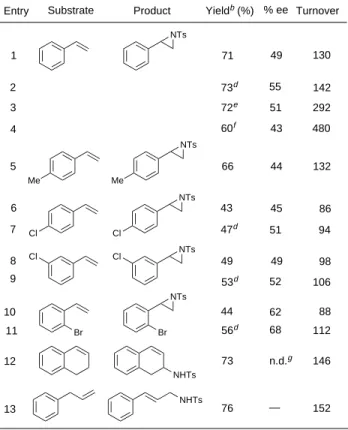
The aziridination and amination of alkenes can be rendered catalytic and enantioselective by addition of PhINTs. The results are listed in Table 1. Enantioselectivity was moderate, ranging from 40 to 68% depending on both the position and the electronic demand of the substituents, with the best result obtained with o-bromostyrene. At a catalyst : PhINTs : alkene ratio of 1 : 200 : 4000, the chemical yields based on the amount of PhINTs used were moderate and note that the turnover numbers were good, usually around 100. With another portion of PhINTs added, the turnover number increased from 130 to ca. 292 in the case of styrene (Entries 2 and 3). At a catalyst : PhINTs : alkene ratio of 1 : 600 : 4000, a turnover number of 480 and aziridine at comparable ee were obtained (Entry 4). These turnover numbers are relatively high when compared with that of the reported chiral Mn–salen catalysts.7
For alkenes that did not possess allylic hydrogen atom (Entries 1–11), aziridine was the only product. However, for alkenes that have allylic hydrogen (Entries 12 and 13), allylic amination became the major product with only minimal aziridination occurred. This result is intriguing since only a few methods for allylic amination are known.8 From the yields and turnover
numbers, the present findings feature one of the best results for catalytic allylic amination of alkenes. The absolute configura-tion of the aziridine obtained was R.
We acknowledge support from the Hong Kong Research Grants Council and The University of Hong Kong.
Footnotes and References
* E-mail: [email protected]
† Crystallographic data: C88H94MnN5O6, M = 1372.73, crystal size 0.30 3 0.50 3 0.60 mm, orthorhombic, space group P212121, a = 14.029(2), b = 20.283(3), c = 27.596(3) Å, U = 7852.2(17) Å3, Z = 4, Dc = 1.161
g cm23, m(Cu-Ka) = 17.83 cm21, F(000) = 2920, 2qmax= 140.0°,
l(Cu-Ka) = 1.5418 Å, scan type q–2q, T = 298 K, no. of unique reflections = 8118, no. of observed reflections [I > 2.0s(I)] = 4713, unit
weights were used. No. of refined parameters = 902, refinement program
NRCVAX, Rf = 0.063, Rw = 0.072, GOF = 1.87. The final Fourier
difference map showed residual extrema in the range of 0.56 to 20.43 e
Å23. CCDC 182/651.
1 (a) Y. Naruta, F. Tani, N. Ishihara and K. Maruyama, J. Am. Chem. Soc., 1991, 113, 6865; (b) J. P. Collman, L. J. Lee, C. J. Kellen-Yuen, X. Zhang, J. A. Ibers and J. I. Brauman, J. Am. Chem. Soc., 1995, 117, 692; (c) W. C. Lo, C. M. Che, K. F. Cheng and T. C. W. Mak, Chem. Commun., 1997, 1205.
2 D. Dolphin, T. Traylor and L. Y. Xie, Acc. Chem. Res., 1997, 30, 251. 3 J. T. Groves and T. Takahashi, J. Am. Chem. Soc., 1983, 105, 2073;
J. T. Groves and Y. Watanabe, J. Am. Chem. Soc., 1988, 110, 8443; W. H. Leung and C. M. Che, J. Am. Chem. Soc., 1989, 111, 8812; J. P. Collman, E. Rose and G. D. Venburg, J. Chem. Soc., Chem. Commun., 1993, 935; S. M. Au, W. H. Fung, M.-C. Cheng, C. M. Che and S. M. Peng, Chem. Commun., 1997, 1655.
4 R. Breslow and S. H. Gellman, J. Chem. Soc., Chem. Commun., 1982, 1400; E. Svastit, J. H. Dawson, R. Breslow and S. H. Gellman, J. Am. Chem. Soc., 1985, 107, 6427; D. Mansuy, J.-P. Maby, A. Dureault, G. Bedi and P. Battioni, J. Chem. Soc., Chem. Commun., 1984, 1161; J.-P. Mahy, G. Bedi, P. Battioni and D. Mansuy, Tetrahedron Lett., 1988,
29, 1927; J.-P. Mahy, G. Bedi, P. Battioni and D. Mansuy, J. Chem. Soc.,
Perkin Trans. 2, 1988, 1517.
5 R. L.Halterman and S.-T. Jan, J. Org. Chem., 1991, 30, 5253. 6 J. A. Smegal and C. L. Hill, J. Am. Chem. Soc., 1983, 105, 2920;
J. A. Smegal, B. C. Schardt and C. L. Hill, J. Am. Chem. Soc., 1983, 105, 3510.
7 K. Noda, N. Hosoya, R. Irie, Y. Ito and T. Katsuki, Synlett, 1993, 469; H. Nishikori and T. Katsuki, Tetrahedron Lett., 1996, 37, 9245. 8 M. Johannsen and K. A. Jørgensen, J. Org. Chem., 1994, 59, 214;
I. N¨ageli, C. Baud, G. Bernardinelli, Y. Jacquier, M. Moran and P. M¨uller, Helv. Chim. Acta, 1997, 80, 1087.
Received in Cambridge, 2nd September 1997; 7/06395D
Fig. 2 UV–VIS monitoring of the reaction between the MnIV–PhINTs
adduct and styrene (0.48 mol dm23); scan interval, 1 min
Fig. 3 EPR spectrum of the reactive intermediate generated by mixing 1 and
PhINTs in CH2Cl2at room temp. and then cooled to 119 K
Table 1 Catalytic asymmetric aziridination and amination of alkenes using
PhINTs with complex 1 as the catalysta
aReaction conditions: 0.50 mol% catalyst, 20-fold excess of substrate, 200
mg PhINTs and 2 ml CH2Cl2. bIsolated yield were based on the amount of
PhINTs used. cEe values are determined by HPLC analysis (Whelk-O1).
dWith 4-phenylpyridine N-oxide (5 mg) as additive. eAddition of another
portion of 200 mg of PhINTs to the reaction after the first portion of PhINTs
was consumed. f Catalyst : PhINTs : alkene = 1 : 600 : 4000. gNot
deter-mined.
![Fig. 1 Perspective view of [Mn(P*)(MeOH)(OH)]. Selected bond lengths (Å) and angles (°): Mn–N(1) 2.004(7), Mn–N(2) 1.992(6), Mn–N(3) 2.019(7), Mn–N(4) 1.995(7), Mn–O(1) 2.268(7), Mn–O(2) 2.251(7);](https://thumb-ap.123doks.com/thumbv2/9libinfo/8819642.231761/1.885.483.793.468.793/fig-perspective-view-meoh-selected-bond-lengths-angles.webp)