Self-Steepening of Prechirped Amplified and
Compressed 29-fs Fiber Laser Pulse in
Large-Mode-Area Erbium-Doped Fiber Amplifier
Gong-Ru Lin, Senior Member, IEEE, Ci-Ling Pan, Senior Member, IEEE, and Ying-Tsung Lin
Abstract—Prechirped amplification, soliton compression, and self-pulse-steepening of a 300-fs stretch-pulse mode-locked erbium-doped fiber laser (EDFL) pulse in an ultrashort length large-mode-area erbium-doped fiber amplifier (LMA-EDFA) and large-effect-area fiber (LEAF) link are investigated. In situ ampli-fied compression of the single-mode-fiber prechirped EDFL pulse (broadened to 1.2 ps) is initiated in the LMA-EDFA at a pump-ing power of > 160 mW, which provides a 20-fold pulsewidth-compressing ratio for the incoming EDFL pulse and supports a maximum output power of > 20 dBm. With an extremely short LEAF-based fifth-order soliton stage, the amplified EDFL pulse can further be compressed down to a pulsewidth of 29 fs, which gives rise to a total pulsewidth-compressing ratio of as high as 40. The LMA-EDFA-based prechirped and amplified soliton compression leaves a small pedestal on the EDFL pulse with an energy confinement ratio of 74%, providing a 20-dB magnified pulse energy of 2.3 nJ and a 10-dB spectral linewidth of 150 nm. The self-steepening-induced blue-side spectral stretch by 1.3 THz is elucidated.
Index Terms—Additive pulse mode-locked (APM), erbium-doped fiber (EDF), femtosecond fiber laser, prechirped amplifica-tion, self-steepening effect, soliton compression.
F
EMTOSECOND passively mode-locked erbium-doped fiber lasers (EDFLs) have emerged as a powerful tool for ultrafast diagnosis since the last decade [1], [2]. EDFLs usually generate low-energy pulses themselves due to the long fiber cavity with a highly inherent nonlinearity, as compared to solid-state lasers. Amplification and compression thus become mandatory procedures for generating high-power and ultrashort pulses from mode-locked EDFLs covering the C- and L-bands [3]–[6]. However, the use of the commercially available high-power erbium-doped fiber amplifier (EDFA) in connection with a typical fiber soliton compressor fails to shorten the EDFL pulsewidth since the femtosecond pulse usually experiences serious broadening in both the temporal and spectral domains by nonlinear effects during the amplification process [7]. Previ-ously, a specially designed four-stage fiber soliton pulse com-Manuscript received April 23, 2007; revised July 16, 2007. This work was supported in part by the National Science Council under Grant NSC95-2221-E-002-448.G.-R. Lin and Y.-T. Lin are with the Graduate Institute of Photonics and Optoelectronics, and Department of Electrical Engineering, National Taiwan University, Taipei 106, Taiwan, R.O.C. (e-mail: [email protected]).
C.-L. Pan is with the Department of Photonics, National Chiao Tung Univer-sity, Hsinchu 300, Taiwan, R.O.C.
Color versions of one or more of the figures in this paper are available online at http://ieeexplore.ieee.org.
Digital Object Identifier 10.1109/JLT.2007.907793
pressor consisting of standard single-mode-transmission, rare-earth-doped, dispersion-decreasing, and dispersion-flattened fibers was employed to achieve the compression of gain-switched laser diode pulsewidth from 7.5 ps to 20 fs [8]. Later on, a series of higher order soliton pulse compression to 20-fs pulsewidth was also reported by using a single and ordinary EDFA in conjunction with the dispersion-flattened fibers [9]. Versatile dispersion-managed fibers or highly nonlinear fiber-based fiber-optic loop mirrors have been introduced to reduce the pulsewidth down to < 30 fs [10], [11]. On the other hand, optical nonlinear effects such as stimulated Raman scattering (SRS) and stimulated four-photon mixing in fiber also play important roles in the pulse amplification process [8], [12]. In particular, SRS is preferable for pulse compression since it is free from phase matching, hence enabling the utilization of the long and low-loss fibers to reduce the requisite pumping power. However, the SRS still induces a nonlinearly soliton self-frequency-shift effect that is associated with the femtosec-ond pulse amplification process, which inevitably leads to the deformation of self-phase-modulated EDFL pulse spectrum under the occurrence of a self-pumping-induced red shift [8]. The combining effects result in a nonlinear chirp of the additive wavelength components and the degradation on pulse shape by a largely uncompressed pedestal. Such drawbacks limit the compressed pulsewidth and amplified peak power of the EDFL pulses at only about 1 ps and a few kilowatts, respectively. This problem remains unsolved until a highly doped EDFA with reduced erbium-doped fiber (EDF) length [12], [13] is used, in which the higher order nonlinear effect can be greatly suppressed during pulse amplification. An ultrashort pulsewidth of 24 fs [10], an extremely high pulsewidth-compressing ratio of 60 [11], a peak power of 140 kW [12], and a pulse energy of as high as 3 nJ [6] can be obtained from ver-satile amplifier and compressor links, while the problem of the dissipation of the central pulse energy spreading into the uncompressed pulse pedestal during high-order soliton com-pression still remains [12]. Recently, an investigation of the amplification or compression of femtosecond fiber laser pulses in large-mode-area (LMA) fibers [14], [15] and all-in-one simplified femtosecond EDFLs [16] have emerged as alter-native approaches for high-power amplified compression. In this paper, based on a soliton compressor with extremely short length, we investigate the prechirped high-power amplification,
in situ compression, and self-pulse-steepening phenomena of
femtosecond EDFL pulses in a highly doped LMA EDF and a 0733-8724/$25.00 © 2007 IEEE
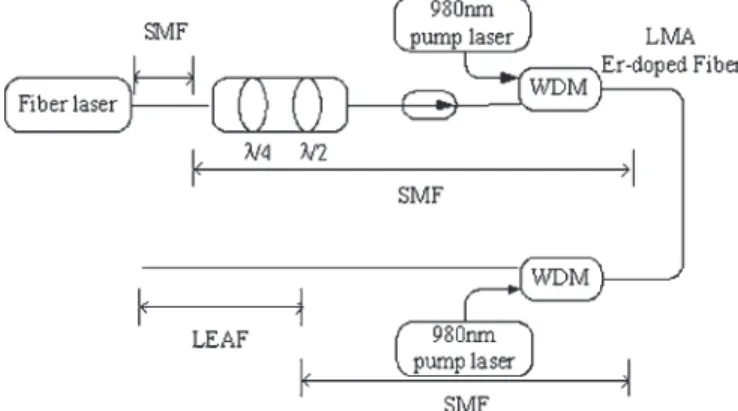
Fig. 1. Experimental setup of an LMA-EDFA + LEAF amplified com-pressor link.
Corning large-effective-area-fiber (LEAF) link. The prechirped and amplified compressing results are demonstrated toward obtaining nanojoule pulse energy and < 30-fs pulsewidth from the ultralow pedestal EDFL pulse with an improved pulse quality and acceptable energy confinement ratio. The advantage of using LMA-EDFA and the self-steepening-effect-induced blue-side spectral stretch is elucidated.
In the experiment, a self-started additive-pulse-mode-locked EDFL (APM-EDFL) oscillator with a nonlinear polariza-tion modulapolariza-tion configurapolariza-tion is constructed, which yields a Gaussian-like pulse with a pulsewidth and linewidth of 300 fs and 16.6 nm, respectively, at a central wavelength of 1560 nm and a repetition frequency of 40 MHz [17]. The average power is 0.96 mW, corresponding to a pulse energy and peak power of 24 pJ and 80 kW, respectively. Afterward, the APM-EDFL was launched into a 1.32-m-long LMA-EDF via a polarization controller (PC) based on Corning SMF-28, including a quarter-wave plate and a half-quarter-wave plate with a total length of 2.78 m. In contrast to previous works, the EDFL pulse amplified com-pressor employs a highly doped LMA-EDF (Thorlabs, Er80-8/ 125) with a mode-field diameter of 9.5± 0.5 µm, a numerical aperture of 0.13 ± 0.02, a peak absorption of 80 ± 8 dB/m at 1530 nm, and cutoff wavelengths ranging from 1100 to 1400 nm. The mode area of the LMA-EDF is five times larger than that of typical EDFs, which effectively excludes the higher nonlinear effects that occurred during the pulse amplification process. Two laser diodes at a wavelength of 980 nm were employed to bidirectionally pump the LMA-EDF with a total power of 260 mW, which was injected into the LMA-EDFA through two single-mode fiber (SMF, Corning SMF-28)-based wavelength-division-multiplexing (WDM) couplers spliced at the front and rare facets of the LMA-EDF. Such an LMA-EDFA offers a small-signal gain of 22 dB and a maximum average power of 104 mW (Fig. 1). The characteristic parameters of Corning SMF-28 and LEAF fibers that were used at the prechirping and soliton-compressing stages are listed in Table I. By prechirping the APM-EDFL pulse within the PC based on Corning SMF-28 to broaden its pulsewidth and decrease its peak power sufficiently low during the LMA-EDFA am-plification, the inherent drawback of decreasing pulse qual-ity (defined as the energy ratio of the central pulse to the total pulse) with increasing soliton-effect compression or-der N can essentially be solved. In the experiment, the
CHARACTERISTICPARAMETERS OF THESMFANDLEAFAT1560 nm
Fig. 2. Autocorrelation traces of the in situ amplified and compressed APM-EDFL pulses measured at different LMA-EDFA output powers.
APM-EDFL pulsewidth is broadened from 300 to 840 fs after prechirping, which facilitates low-order soliton-effect com-pression with large pulsewidth-comcom-pression ratio and high pulse quality initiated within the LMA-EDFA. Nonetheless, the APM-EDFL pulsewidth further broadens to 1.2 ps after passing through the LMA-EDFA with a pumping power of lower than 160 mW since such a pumping power is too small to initiate the in situ soliton compression within the LMA-EDFA. As the output power of the LMA-EDFA increases from 60 to 104 mW, we observe the amplified APM-EDFL pulse to be gradually reduced from 1.2 ps to < 60 fs with a 20-fold pulsewidth-compression ratio (see Fig. 2). Both the LMA-EDFA and the successive WDM coupler based on Corning SMF-28 serve as the extremely low-order soliton com-pressor. The maximum energy of the compressed APM-EDFL pulses is up to 2.6 nJ at an optimized SMF-28 length of 1.28 m, corresponding to an energy magnification of up to two orders of magnitude. After the LMA-EDFA, the 10-dB spectral linewidth significantly broadened to 73 nm by self-phase modulation (SPM). Fine adjustment on the input polarization benefits from the advantage of the coincidence between incident and required peak powers for soliton compression.
Fig. 3. Autocorrelation traces of the original, prechirped, LMA-EDFA ampli-fied, and LEAF compressed APM-EDFL pulses.
Later on, we have further introduced a LEAF-based soliton stage behind the LMA-EDFA, in which the order of the soliton to be compressed is determined as N = 5. To minimize the uncompressed trailing edges left as a pulse pedestal during high-order soliton compression, the multistage compressing scenario with low soliton order, short input pulsewidth, and small peak power is considered in the design of our all-in-one LMA-EDFA compressor. The fifth-order soliton period of 38.2 cm and the optimum LEAF length of 4.1 cm are estimated from theory. Experimentally, we choose another conjugated length of about 35 cm (at∼0.9z0) as it is unable to fusion-splice
the extremely short LEAF segment (4 cm long) and to further detune its length for optimizing the soliton compression [18]. The autocorrelated shape and corresponding spectra of the original APM-EDFL, the SMF-28 prechirped, the LMA-EDFA amplified, and the LEAF compressed pulsewidth are shown in Fig. 3. Such a second-stage soliton compression leads to the shortest pulsewidth of 29 fs with a maximum average power remaining at 93 mW, corresponding to a pulse energy of 2.33 nJ and a peak power of up to 80 kW. However, the pedestal inevitably occurs and degrades the pulse shape. The pulse quality degraded from 100% to 74% due to the inevitable energy spreading from the central pulse to the pedestal under high-order soliton compression procedure. In comparison, such a compressed pulsewidth is relatively comparable with the soliton-compressed gain-switched laser diode systems that were earlier demonstrated with 20-fs pulsewidth and a 55% energy confinement ratio [8], [9] or the dispersion-shifted and highly nonlinear fiber-compressed EDFL system with 24-fs pulsewidth [10]. Nevertheless, the pulse spectrum greatly extends to cover the wavelength from 1500 to 1650 nm with a linewidth of up to 150 nm in 10-dB decay (Fig. 4). The perturbation periods in the compressed EDFL pulse spectrum of about 11.5 under a soliton order of 5 is in good agreement with the theoretically calculated maximum phase shift of 36.3 rad that is induced by SPM [18]. Under an incident pulsewidth (after prechirping) of 1.2 ps, the overall pulsewidth-com-pressing ratio for such an LMA-EDFA + LEAF prechirped and amplified soliton compressor is as high as 40, which is also a
Fig. 4. Spectra of the original, prechirped, LMA-EDFA amplified, and LEAF compressed APM-EDFL pulses.
Fig. 5. Autocorrelation traces of self-steepened APM-EDFL pulses obtained by changing the length of SMF-28 before LEAF.
new record among the similar systems to date. The pulsewidth-compressing ratio obtained in our architecture is also compa-rable with those that were previously demonstrated by using a steplike dispersion-profiled fiber, which generates soliton-compressed pulsewidths of 20 fs and 44 fs with corresponding compressing ratios of 25 and 60, respectively [9], [10].
If we also prechirp the amplified and compressed APM-EDFL pulse prior to the second LEAF stage by detuning the SMF-28 length within the backward pumping WDM coupler, the pulse pedestal can reach its minimum at an SMF-28 length in the range of 128–129 cm, whereas the pulse broadens, and the pedestal grows up after propagating through the SMF-28 fiber of shorter or longer lengths (see Fig. 5). Nonetheless, we also observed that the S-band spectral components (at wavelength of < 1525 nm) of the APM-EDFL pulse after propagating through the LMA-EDFA + LEAF setup gradually decay with the increasing SMF-28 length, as shown in Fig. 6. Such a red shift of nearly 1.3 THz in soliton spectral peak is mainly due to the decreasing group velocity that occurred in the SMF-28. Typically, the soliton self-frequency shift with
Fig. 6. Spectra of the self-steepened APM-EDFL pulses obtained by changing the length of SMF-28 before LEAF.
the variation of the propagation length is attributed to the SRS effect at the Stokes’ side. However, both the amplitude and the wavelengths of the L-band spectral components at
> 1600 nm remain unchanged in the obtained spectra, even
with a variation on the prechirping SMF-28 length. The ob-served asymmetric SPM-induced spectral feature with a much more stretched blue-side spectrum shows that a self-steepening effect has likely occurred on the 56-fs APM-EDFL pulses when propagating in the SMF-28 fiber segment. The critical propagating distance corresponding to the initiation of the self-steepening effect is described as zs∼= 1.2τ0/γP0Topt[4],
where τ0is the pulsewidth, γ is the nonlinear coefficient of the
SMF-28 fiber (γ = 1.063/W· km), P0is the peak power, and
Topt is the optical period given by 2p/ω0. In the time domain,
the self-steepening effect causes an optical shock front phenom-enon with a steepened shape on the trailing edge of the soliton-compressed APM-EDFL pulse. The evaluated zsis only 160 cm
at a pulsewidth of 56 fs and a peak power of 75 kW, which indicates that the evolution on the self-steepening-induced optical shock front phenomenon of the APM-EDFL pulse can significantly be observed within a change on the SMF-28 length of even a few centimeters.
Three different parts of this paper, as compared to our previous demonstration [17], include the use of an SMF-based prechirping segment, an LMA-EDF as new gain medium, and a shorter LEAF-based compressing stage. Even though the pulse pedestal is inevitably obtained during high-order soliton compression, the novelty of the proposed architecture is the integration of three functions in one EDFA module to achieve all-in-one prechirped amplified soliton compression. In particular, the use of highly doped LMA-EDF helps reduce the required amplifier length and decrease the nonlinearity coefficient γ = n2ω0/cAeff. The LMA-EDF not only decreases
the peak intensity of the input EDFL pulse by a factor of 5 but also provides fewer nonlinear effects on the EDFL pulse during the propagation in such an EDFA with a shortened length. The benefit of using LMA-EDF can be interpreted by introducing two length scales as the dispersion length (LD= T02/|β2|) and
the nonlinear length (LNL = 1/γP0), where T0is the incident
pulsewidth, β2 is the group-velocity dispersion parameter,
γ is the nonlinearity coefficient, and P0is the peak power. LD
and LNL provide two critical length scales, over which the
dispersive or nonlinear effects become more pronounced than the linear transport of an optical pulse through a fiber with a length of L [18]. With these factors, the achievable soliton order N depends on the peak power of the input pulse, which can be described by N2= LD/LNL= γP0T02/|β2|. Thus,
the increasing mode area of LMA-EDF effectively reduces
γ and lengthens LNL, providing relaxation from suffering
from the nonlinear effects during the amplification process. In addition, the capable soliton order can also be enlarged, owing to the prechirped design of the all-in-one SMA + LMA-EDFA + LEAF amplified soliton compressor. To further improve the pulse energy confinement ratio and the possibility of shorter pulses, we strongly believe that a higher order soliton compression behind the LMA-EDFA with a larger prechirped function and a larger power gain is straightforward. The pedestal problem can be essentially solved by introducing a birefringent filter after the LMA-EDF prechirped and amplified soliton compressor.
In conclusion, we have preliminarily investigated the prechirped femtosecond APM-EDFL pulse amplification, com-pression, and self-steepening processes in a homemade LMA-EDFA with ultrashort cavity length. The SMF prechirping stage broadens the APM-EDFL pulsewidth from 300 fs to 1.2 ps and retains its peak power to sufficiently low before entering the LMA-EDFA. In situ amplification and compression are concurrently initiated at a pumping power of greater than 160 mW, providing a shortened pulsewidth of < 60 fs that is associated with the 20-fold compressing ratio. An additional LEAF-based fifth-order soliton stage further compresses the pulsewidth to 29 fs, leaving a relatively small pedestal with 74% energy confinement ratio. The compressed pulse exhibits energy and linewidth of 2.3 nJ and 150 nm, respectively, at 10-dB decay. A total pulsewidth compression ratio of up to 40 and a maximum peak-power amplification ratio of > 20 dB can be simultaneously achieved. A self-steepening-effect-induced blue-side spectral stretch by 1.3 THz is also observed and elucidated.
REFERENCES
[1] G. Lenz, K. Tamura, H. A. Haus, and E. P. Ippen, “All-solid-state fem-tosecond source at 1.55 µm,” Opt. Lett., vol. 20, no. 11, pp. 1289–1291, Jun. 1995.
[2] K. Tamura, Y. Kimura, and M. Nakazawa, “Femtosecond pulse gene-ration over 82 nm wavelength span from passively mode locked erbium-doped fibre laser,” Electron. Lett., vol. 31, no. 13, pp. 1062–1063, Jun. 1995.
[3] J. B. Schlager, P. D. Hale, and D. L. Franzen, “Subpicosecond pulse compression and Raman generation using a mode-locked erbium-doped fiber laser-amplifier,” IEEE Photon. Technol. Lett., vol. 2, no. 8, pp. 562– 564, Aug. 1990.
[4] K. Tamura, E. P. Ippen, H. A. Haus, and L. E. Nelson, “77-fs pulse generation from a stretched-pulse mode-locked all-fiber ring laser,” Opt.
Lett., vol. 18, no. 13, pp. 1080–1082, Jul. 1993.
[5] M. L. Stock and G. Mourou, “Chirped pulse amplification in an erbium-doped fiber oscillator erbium-doped fiber amplifier system,” Opt.
Commun., vol. 106, no. 4–6, pp. 249–252, Mar. 1994.
[6] A. Galvanauskas, M. E. Fermann, and D. Harter, “High-power amplifica-tion of femtosecond optical pulses in a diode-pumped fiber system,” Opt.
[7] J. T. Ong, R. Takahashi, M. Tsuchiya, S. H. Wong, R. T. Sahara, Y. Ogawa, and T. Kamiya, “Subpicosecond soliton compression of gain-switched diode-laser pulses using an erbium-doped fiber amplifier,” IEEE
J. Quantum Electron., vol. 29, no. 6, pp. 1701–1707, Jun. 1993.
[8] Y. Matsui, M. D. Pelusi, and A. Suzuki, “Generation of 20-fs optical pulses from a gain-switched laser diode by a four-stage soliton compres-sion technique,” IEEE Photon. Technol. Lett., vol. 11, no. 10, pp. 1217– 1219, Oct. 1999.
[9] K. Igarashi, M. Kishi, and M. Tsuchiya, “Higher-order soliton compres-sion of optical pulses from 5 ps to 20 fs by a 15.1-m-long single-stage step-like dispersion profiled fiber,” Jpn. J. Appl. Phys., vol. 40, no. 11, pp. 6426–6429, Nov. 2001.
[10] F. Tauser, F. Adler, and A. Leitenstorfer, “Widely tunable sub-30-fs pulses from a compact erbium-doped fiber source,” Opt. Lett., vol. 29, no. 5, pp. 516–518, Mar. 2004.
[11] R. Yatsu, K. Taira, and M. Tsuchiya, “High-quality sub-100-fs opti-cal pulse generation by fiber-optic soliton compression of gain-switched distributed-feedback laser-diode pulses in conjunction with nonlinear op-tical fiber loops,” Opt. Lett., vol. 24, no. 16, pp. 1172–1174, Aug. 1999. [12] J. W. Nicholson, A. D. Yablon, P. S. Westbrook, K. S. Feder, and
M. F. Yan, “High power, single mode, all-fiber source of femtosecond pulses at 1550 nm and its use in supercontinuum generation,” Opt.
Express, vol. 12, no. 13, pp. 3025–3034, Jun. 2004.
[13] J. Takayanagi, N. Nishizawa, H. Nagai, M. Yoshida, and T. Goto, “Gener-ation of high-power femtosecond pulse and octave-spanning ultrabroad supercontinuum using all-fiber system,” IEEE Photon. Technol. Lett., vol. 17, no. 1, pp. 37–39, Jan. 2005.
[14] M. E. Fermann, A. Galvanauskas, and M. Hofer, “Ultrafast pulse sources based on multi-mode optical fibers,” Appl. Phys. B, Photophys. Laser
Chem., vol. 70, no. 7, pp. S13–S23, Jun. 2000.
[15] A. Shirakawa, J. Ota, M. Musha, K. Nakagawa, K. Ueda, J. R. Folkenberg, and J. Broeng, “Large-mode-area erbium-ytterbium-doped photonic-crystal fiber amplifier for high-energy femtosecond pulses at 1.55 µm,”
Opt. Express, vol. 13, no. 4, pp. 1221–1227, Feb. 2005.
[16] D. Y. Tang and L. M. Zhao, “Generation of 47-fs pulses directly from an erbium-doped fiber laser,” Opt. Lett., vol. 32, no. 1, pp. 41–43, Jan. 2007. [17] Y. T. Lin and G.-R. Lin, “Dual-stage soliton compression of a self-started additive pulse mode-locked erbium-doped fiber laser for 48 fs pulse generation,” Opt. Lett., vol. 31, no. 10, pp. 1382–1384, May 2006. [18] G. P. Agrawal, Nonlinear Fiber Optics. San Diego, CA: Academic,
2001, ch. 4/5, pp. 89–192.
Gong-Ru Lin (M’96–SM’04) received the M.S.
and Ph.D. degrees from the Institute of Electro-Optical Engineering, National Chiao Tung Univer-sity, Hsinchu, Taiwan, R.O.C., in 1990 and 1996, respectively.
He is currently the Vice Chairman with the Grad-uate Institute of Photonics and Optoelectronics, and Department of Electrical Engineering, National Tai-wan University, Taipei, TaiTai-wan. He is the author and coauthor of more than 100 papers in SCI-cited international journals and more than 150 papers in international conferences. His research interests are ultrafast fiber lasers and communications, nanocrystallite elementary and compound semiconductors, and microwave and millimeterwave photonics.
Prof. Lin is currently a Senior Member and Vice Chair of the IEEE Laser and Electro-Optics Society Taipei Chapter. He also serves as the Vice Chair of the International Society for Optical Engineers Taiwan Chapter. He received the Excellent Young Engineers Award from the Chinese Institute of Electrical Engineering in 2005 and the Tien Jea Bien Young Scholar Prize from the Optical Engineering Society, R.O.C. He also received the Young Scholar and Outstanding Research Awards from the National Chiao Tung University in 2005 and the National Taipei University of Technology in 2002.
Ci-Ling Pan (M’88–SM’03) received the Ph.D.
degree in physics from Colorado State University, Fort Collins, in 1979.
He is a University Chair Professor with the Department of Photonics (DOP) and Institute of Electro-Optical Engineering (IEO), National Chiao Tung University (NCTU), Hsinchu, Taiwan, R.O.C. He was the Director of IEO, NCTU, during 1992–1995 and founding Chair of the DOP during 2004–2006. His research interests are lasers and their applications in broadband optical communication, precision metrology, and ultrafast and terahertz photonics.
Prof. Pan is a member of the Phi Tau Phi Honor Society (1991) and a Fellow of the Photonic Society of Chinese Americans (1998), the Optical Society of America (2004), the Society of Photographic and Instrumentation Engineers (2004), and the Physical Society of Republic of China (2005). He was the recipient of the Engineering Medal by the Optical Engineering Society, Taiwan (2004), Outstanding Engineering Professor Award of the Chinese Institute of Engineers (2006), and the Pan Wen Yuan Foundation Research Excellence Award (2007).
Ying-Tsung Lin, photograph and biography not available at the time of