國
立
交
通
大
學
電信工程學系
碩 士 論 文
感知網路之部份集中式動態頻譜擷取
Partial-Centralized Dynamic Spectrum Access
for Cognitive Radio Networks
研 究 生:鄭欣毅
指導教授:張仲儒 博士
感知網路之部份集中式動態頻譜擷取
Partial-Centralized Dynamic Spectrum Access for Cognitive
Radio Networks
研 究 生:鄭欣毅 Student:Shin-Yi Cheng
指導教授:張仲儒 博士 Advisor:Dr. Chung-Ju Chang
國 立 交 通 大 學
電信工程學系
碩 士 論 文
A Thesis
Submitted to Department of Communication Engineering
College of Electrical and Computer Engineering
National Chiao Tung University
in Partial Fulfillment of the Requirements
for the Degree of Master of Science
in
Communication Engineering
July 2009
Hsinchu, Taiwan
i
感知網路之部份集中式動態頻譜擷取
研究生:鄭欣毅 指導教授:張仲儒 博士
國立交通大學電信工程學系碩士班
Mandarin Abstract
摘 要 隨著既有與新興無線通訊服務的增加,對於頻寬的需求量也日漸提高,然而 頻寬資源卻是有限的,對此問題大家已經開始尋求更有效的利用頻寬之方法。而 感知無線電(Cognitive Radio)被視為一個可以有效的使用頻寬的重要技術 在本篇論文中,我們提出了一個部份集中式的感知無線電動態頻譜擷取 (Partial- Centralized Cognitive Radio-Based Dynamic Spectrum Access) 機制來提供感知無線電系統之上鏈路資料傳送。此機制控制了包含主動式頻譜資 源偵測與上鏈路無線通訊資源分配。其主要目的是在固定頻段中提升傳輸量與頻 譜的效益。在提出的機制中,我們針對 WCDMA 頻譜來做空閒頻譜偵測,根據這個 系統的特性,我們設計了主動式空閒頻譜偵測程序。此外,我們提供了一個上鏈 路無線通訊資源分配方法來有效的提升感知無線電系統的傳輸量。從模擬的結果 可以顯示出來我們所提出的方法,可以提升傳輸量,並增進頻譜使用效率。ii
Partial-Centralized Dynamic Spectrum Access for
Cognitive Radio Networks
Student: Shin-Yi Cheng Advisor: Dr. Chung-Ju Chang
Department of Communication Engineering
National Chiao Tung University
English Abstract
Abstract
With the demand for additional bandwidth increasing due to existing and new services, both spectrum policy and communication technologists are seeking solutions for this apparent spectrum scarcity. The use of “cognitive radio” (CR) technology is viewed as the key technology to fully utilize the bandwidth. In this thesis, a partial centralized CR-based dynamic spectrum access (DSA) mechanism is proposed for CR networks uplink transmission. The goals of PCCR-based DSA algorithm are throughput maximization but without much more influence on WCDMA network. In the proposed PCCR-based DSA mechanism, the proactive white space detection provides the ability of CR users to execute the bandwidth request and adjust the access power adaptively. The white space could be verified by this process with a proactive manner. Then, the uplink resource management process provides the ability of CR BS to manage the available resource and to perform the resource allocation more efficiently.
iii
Acknowledgement
誌 謝
這篇論文的誕生,得感謝許多人所給予我的力量與幫助。首先我得感謝我的 指導教授張仲儒博士,在我撰寫此篇論文的過程中給予我不少的提點與指引;再 來則是得感謝早已自學校畢業的芳慶學長,犧牲自己的時間解答我所有的疑惑; 感謝文敬、志明、文祥、耀興、振宇學長不定時的幫助和建議,讓我能更快地進 入學術領域;感謝尚樺、宗利、英奇、巧瑩、維謙、邱胤、浩翔學長姐們,親切 的帶領我熟悉並融入這整個實驗室的大家庭;感謝一起走來的和儁、志遠、以及 盈伃,和我一起相互扶持走過這兩年,在我低潮的時候給予我繼續前進的勇氣; 感謝正忠、耀庭、蕊綺、心瀅以及玉棋,是你們讓實驗室變得更熱鬧,讓苦悶的 生活增添不少色彩。 最後,還得感謝我的父母、家人以及朋友,沒有你們的支持、關心和鼓勵, 我也無法順利而無憂的走過這兩年。 欣毅 謹誌 民國 九十八年八月iv
Contents
UMandarin AbstractU ... i UEnglish AbstractU ... ii UAcknowledgementU ... iii UContentsU ... iv UList of FiguresU ... viUList of TablesU ... vii
UChapter 1 IntroductionU ... 1
UChapter 2 System ModelU ... 7
UChapter 3 Partial-Centralized Cognitive Radio-Based Dynamic Spectrum Access MechanismU ... 10
U3.1U UProactive White Space DetectionU ... 12
U3.2U UUplink Resource Management ProcessU ... 16
UChapter 4 Simulation Results and DiscussionU ... 21
U4.1U USimulation EnvironmentU ... 21
U4.2U UPerformance EvaluationU ... 24
U4.2.1U UThroughput of CR NetworkU ... 24
v
U4.2.3U UAverage TX Power of WCDMA UsersU ... 29
UChapter 5 ConclusionU ... 32
UAppendixU ... 34
USpecification Adopted in the CR NetworkU ... 34
UList of SymbolsU ... 36
UBibliographyU ... 38
vi
List of Figures
UFig. 1.1: White Space conceptU ... 3
UFig. 2.1: The topology of system modelU ... 8
UFig. 3.1: The Proactive White Space DetectionU ... 16
UFig. 4.1(a): The throughput of CR network (UρU=0.2)U ... 25
UFig. 4.1(b): The throughput of CR network (UρU=0.5)U ... 25
UFig. 4.1(c): The throughput of CR network (UρU=0.8)U ... 26
UFig. 4.2(a): The Blocking Probability of WCDMA network (5 CR users)U ... 27
UFig. 4.2(b): The Blocking Probability of WCDMA network (20 CR users)U ... 28
UFig. 4.3(a): The Average TX power of WCDMA users (5 CR users)U ... 30
UFig. 4.3(b): The Average TX power of WCDMA network (20 CR users)U ... 30
UFig. A.1: Description of a tile structureU ... 34
vii
List of Tables
UTable 1.1: Possible Dimensions of the Spectrum SpaceU ... 4
UTable 4.1: Simulation Parameters for WCDMA networkU ... 22
UTable 4.2: Simulation Parameters for CR networkU ... 23
1
Chapter 1
Introduction
Recently, because of the increase in spectrum demand, the static spectrum allocation policy that governmental agencies assign wireless spectrum to license holders on a long-term basis for large geographical regions faces spectrum scarcity in some particular spectrum bands. In contrast, a large portion of the assigned spectrum is used sporadically. According to Federal Communication Commission (FCC) [1], temporal and geographical variations in the utilization of the assigned spectrum range from 15% to 85%. The inefficiency in the spectrum usage necessitates a new communication paradigm to exploit the existing wireless spectrum opportunistically. Dynamic spectrum access (DSA) is viewed as a novel approach to solve these current spectrum inefficiency problems. The key enabling mechanism of dynamic spectrum
access technique is cognitive radio (CR). The term, cognitive radio, can formally be defined as follow [2]: A “Cognitive
Radio” is a radio that can change its transmitter parameters based on interaction with the environment which it operates. From this definition, we can define two main characteristics of the cognitive radio [2]: cognitive capability and reconfigurability. Cognitive capability refers to the ability of the radio technology to capture or sense the information from its radio environment. This capability cannot simply be realized by monitoring the power in some frequency band of interest but more sophisticated
2
techniques are required in order to capture the temporal and spatial variations in the radio environment and avoid interference to other users. Through this capability, the portions of the spectrum that are unused at a specific time or location can be identified. Consequently, the best spectrum and appropriate operating parameters can be selected. Reconfigurability refer to the ability of radio can be dynamically programmed according to the radio environment. More specifically, the cognitive radio can be programmed to transmit and receive on a variety of frequencies and to use different transmission access technologies supported by its hardware design [3]. These two characteristics of the CR enable the CR users to (I) determine which portions of the spectrum is available and detect the presence of incumbents (primary users) (spectrum
sensing), (II) coordinate access to the channel with other CR users (secondary users)
(spectrum sharing), and (III) vacate the channel when incumbents are detected (spectrum handoff).
The ultimate objective of the CR is to maximize the spectrum utilization through exploiting the available resource efficiently but minimize the degradation of existing systems. In earlier cognitive protocols, the CR network enables the usage of the spectrum called “white space (spectrum hole)” that is temporally unoccupied by the incumbents (primary user). A definition for spectrum hole: “A spectrum hole is a band of frequencies assigned to a primary user, but, at a particular time and specific geographic location, the band is not being utilized by that user,” is offered in [3]. In Fig. 1.1, it shows that in time domain and frequency domain, there will be some white space unused by the primary network. Since the primary network has an exclusive right to the spectrum band, the CR network should minimize the interference to the primary network. If the frequency band is further used by primary network, the CR network should switch to another white space. Thus, how to dynamically and
3
opportunistically use the white space is an important topic for study [4].
Time Frequenc
y
Spectrum in Use
White Space
Fig. 1.1: White Space concept
Furthermore, by adaptively adjusting the transmit power and modulation scheme, the CR network also can start transmit simultaneously in the same frequency band with the primary network on the condition that their transmissions do not interfere with the communication of primary network.
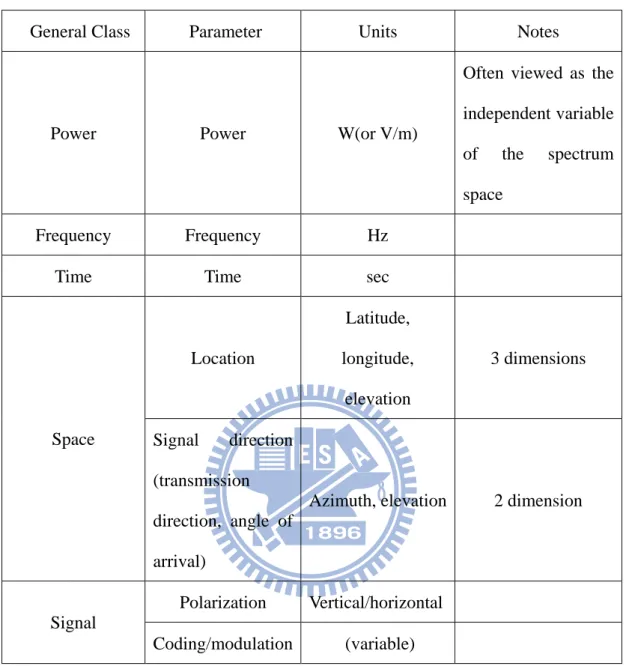
Thus, it could include various scenarios of secondary use in CR networks. Table 1.1 lists the possible dimensions of the spectrum space which was proposed in [5].
4
Table 1.1: Possible Dimensions of the Spectrum Space
Under these possible dimensions of the spectrum space, the spectrum sharing between the primary network and the CR network can be classified into two types, overlay and underlay spectrum sharing. The overlay spectrum sharing means the CR network only use the portion of spectrum has not been used by the primary network. As a result, interference to the primary systems is minimized. Some sophisticated methods are proposed in the underlay spectrum sharing scheme, such as the POMDP framework [6] or the randomized multi-user strategy [7]. However, these methods have assumed that the prior information of the primary network is known to the CR network, such as the
General Class Parameter Units Notes
Power Power W(or V/m)
Often viewed as the independent variable of the spectrum space
Frequency Frequency Hz
Time Time sec
Space Location Latitude, longitude, elevation 3 dimensions Signal direction (transmission direction, angle of arrival)
Azimuth, elevation 2 dimension
Signal
Polarization Vertical/horizontal
5
state transition probability of the primary users, which is impractical.
The underlay spectrum sharing scheme is that the CR network begins transmission such that the transmit power is regarded as noise by the primary network. For the underlay spectrum sharing, the interference temperature is to quantify and to manage the interference, which is proposed by FCC Spectrum Policy Task Force [8]. It is defined as the RF power measured at a receiving antenna per unit bandwidth and indicates the tolerable interference level in the licensed user’s receiver. To formulate the interference temperature model, it needs take some information about the RF environment, the primary network, and the CR network architecture into consideration. In [9], two interference temperature models are proposed, one is ideal interference temperature model which is receiver-based and different receivers have their own interference threshold. The other one is generalized interference model which is measured in some measure point but with less prior information. And, in [10], the author both considers these two interference models to design an OFDMA-based spectrum sharing scheme.
In this thesis, we assume that in order to increase the utilization of WCDMA spectrum band, we let WiMAX-OFDMA network to dynamically access this band. Thus, the WiMAX-OFDMA network is CR network and the infrastructure-based WCDMA network is primary network in our scenario. In this band the secondary access of CR network appears as wideband noise due to the nature of spread spectrum technique of WCDMA network. Our challenge is how to protect the WCDMA user’s right under bit error rate constraints which is tolerable for some kind of application or service and we can open some spectrum opportunities for the CR network to use. Thus, we design a partial-centralized CR-based DSA mechanism for CR network to execute uplink transmission in the WCDMA spectrum band. This thesis discusses the
6
system’s model, proposed mechanism, the performance of total throughput, and the degradation of WCDMA network.
The remaining part of the thesis is as follows. Chapter 2 describes the system environment and the network topology, including primary network and CR network. Then, chapter 3 describes the partial-centralized CR-based DSA mechanism. In chapter 4, simulation results are presented and discussed. Then, concluding remarks is given in chapter 5. Moreover, the final section is the Appendix.
7
Chapter 2
System Model
The components of the whole network architecture can be classified in two groups as the primary network and the CR network.
Primary network is an existing network infrastructure has an exclusive right to a certain spectrum band. In this thesis, we consider the infrastructure-based WCDMA cellular network as the primary network which is operated in licensed band. The WCDMA cellular network is operating around 2.0 GHz with a pair of 5 MHz spectrum bands to execute its uplink and downlink transmission. The basic idea of WCDMA network is using the code division multiple access (CDMA) technique to against the interference and allow signals of multiple users in same spectrum. Due to the nature of the CDMA technique, the WCDMA cell capacity depends on the maximal tolerable interference level of each WCDMA user. To protect the WCDMA users’ link qualities, the WCDMA BS needs control the number of the interference WCDMA users in the cell and execute the power control mechanisms.
CR network, also named secondary network, is allowed to access a desired spectrum only in an opportunistic manner. In this thesis, we consider the infrastructure-based WiMAX-OFDMA [12] as CR network. Therefore, the components of a CR network are CR user and CR base station. Orthogonal frequency division multiplexing access (OFDMA) has been adopted for WiMAX network which
8
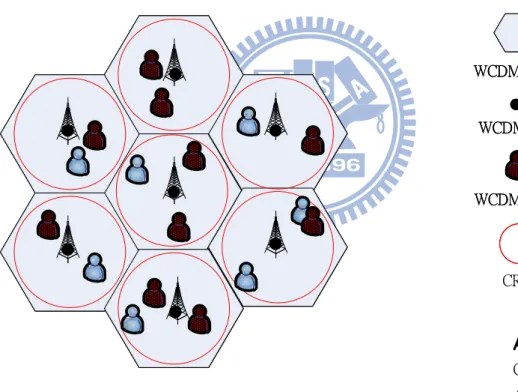
is proposed as a promising technique for future multimedia wireless communication systems due to its ability to mitigate frequency selective fading, intersymbol interference (ISI), and its flexibility for adaptive modulation on each subcarrier. Thus, WiMAX-OFDMA network can support data rate in the range of 32-130 Mbps depending on the bandwidth of operation as well as the modulation and the coding scheme. The basic allocation unit in frequency domain for the WiMAX-OFDMA network is a subchannel which is composed of a set of subcarriers. According to the channel quality, different modulation schemes such as QPSK, 16-QAM, and 64-QAM can be used. WCDMA cell WCDMA BS WCDMA user WCDMA cell WCDMA BS WCDMA user CR user WCDMA cell WCDMA BS WCDMA user CR cell CR BS
9
Fig. 2.1 shows the topology of system model, which consists of two types of networks: a primary network and a CR network. Here, we assume that the CR BSs are collocated with WCDMA BSs to measure the same uplink interference level, and therefore they have the same service coverage. We select the uplink spectrum band of WCDMA network as the CR operating spectrum. Thus, we only consider the uplink transmission of CR users to share the same spectrum with WCDMA users, while the downlink transmission of CR BS still adopts a licensed band. Because it’s difficult for CR network to guarantee available resource, we assume that only BE traffics [14] are supported for CR users to access the uplink WCDMA spectrum band by adopting partial-centralized CR-based DSA mechanism. Otherwise, we also assumed that WCDMA network and CR network use single omni-directional antennas. The other detailed specification adopted in the CR network will be described in the Appendix.
10
Chapter 3
Partial-Centralized Cognitive
Radio-Based Dynamic Spectrum
Access Mechanism
To efficiently use of the available resource in WCDMA frequency band and to guarantee the received signal quality of WCDMA users, we propose a partial-centralized cognitive radio-based dynamic access (PCCR-based DSA) mechanism for the CR network to temporarily use the frequency spectrum.
In WCDMA network, WCDMA user needs control the received power strength over the interference from others is larger than the target SINR value, denoted by
o
SINR , to maintain the received signal quality. If the current interference level is too
high to maintain the target SINR value, the WCDMA BS need to start blocking the new coming user to decrease the overall interference level in WCDMA network and maintain performance. According to this concept, the maximum tolerable interference level, denoted by Imax, can be calculated. The Imax is that a WCDMA user can endure for a target SINR requirement when transmitting with maximum transmission power Pmax at cell edge [11]. It can be precisely expressed by,
11 max max max o G L P I SINR ⋅ ⋅ = , (3.1)
where G is the processing gain, SINR is the SINR requirement of a specific o
service type, and Lmax is the maximum path loss from cell edge to BS. According to
max
I , a PCCR-based DSA mechanism is designed to model the behavior of CR
network to interact with the WCDMA network without much influence.
In the design of PCCR-based DSA mechanism, the CR BS measures the power spectrum density of average interference and noise level, denoted by NI , from the WCDMA users over the past U CR frame time. Then, the CR BS calculates the admissible received power, denoted as P , as the upper bound of total received CR
power from CR users at the CR BS. To protect the access right of WCDMA users,
CR
P is given by,
PCR =max 1
{
(
−α)
⋅Imax−(
NI B⋅ w)
, 0 ;}
α∈[0,1], (3.2) where α is a safety factor to protect WCDMA network and B is the overall wsystem bandwidth. The larger the value α is, the more protection the CR network provides. These information about NI , and α will be broadcasted through the licensed band of CR network. Moreover, CR users can also calculate P according CR
to the downlink broadcast signal.
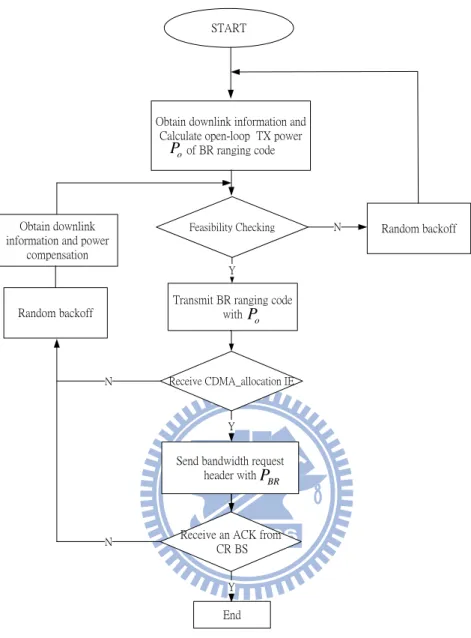
The partial-centralized CR-based DSA mechanism contains two parts, the proactive white space detection and the uplink resource management process. These two processes are individually executed in CR user side and CR BS side. When a CR user has data to be transmitted, it has to perform the proactive white space detection. The proactive white space detection provides the ability of CR users to execute the bandwidth request, to adjust the access power adaptively, and to detect the white
12
space. After receiving the request from CR users, the CR BS performs the uplink resource management process. The uplink resource management process provides the ability of CR BS to manage the available resource and to perform the resource allocation more efficiently.
3.1
Proactive White Space Detection
Based on WiMAX-OFDMA protocol, CR user transmits a randomly chosen bandwidth request ranging code to the CR BS to notify its bandwidth request try when a packet arrivals. Then, the CR BS detects a bandwidth ranging code, and replies a CDMA allocation information element which indicates the uplink resources for the CR user who transmits the detected bandwidth ranging code to transmit bandwidth request header. To let the received SINR at CR BS remains at a target values, the transmission of CR users are power-controlled to compensate the interference from WCDMA users. Therefore, CR users can detect accessible white space in the WCDMA frequency band. The white space is identified by both CR BS and CR user in a proactive manner through bandwidth request process. The detailed procedure of proactive white space detection is described as the following phases.
Phase 1: Calculate the initial access power
A CR user first acquires NI , α , and estimates the signal loss, denoted by Ll, through downlink broadcast signal from CR BS. Then, the CR user calculates the open-loop TX power of bandwidth request ranging code, denoted as P . The o P is a o
initial power value to compensate the effects of NI and signal loss, it can be precisely expressed by,
BRrc r o l SINR NI B P L ⋅ ⋅ = , (3.3) where SINRBRrc is the required SINR value [13] of bandwidth request ranging code
13
to achieve target detection probability, B is the bandwidth of ranging subchannels. r
Phase 2: Feasibility checking
Then, the CR user checks whether the current transmission of ranging code is feasible or not, denoted as the following condition,
P
o≤
(
P
max−
P
TX_r)
and P L
o⋅ ≤
l(
P
CR−
P
MAP r_)
, (3.4) where PTX_r is the transmit power of the CR user in the ranging slot time, and_
MAP r
P is the total allocated received power in the ranging slot time, they can be
derived from the allocation results in UL-MAP. Moreover, the left hand of eq. (3.4) is the transmit power constraint of CR user, and the right hand is the received power constraint at the CR BS.
If the condition is satisfied, it means the CR user identifies the current RF environment as an opportunity and starts to transmit bandwidth request ranging code. If the condition is not satisfied, the CR user should execute the back-off procedure. The back-off procedure here means the CR user selects a back-off number w randomly between zero and W , and the number w means the number of frames the CR user shall defer. Then, return to phase 1.
Phase 3: Transmit BR header
After transmitting the bandwidth request ranging code, the CR user should wait for Np frame time, where Np is the response delay, we assumed it is fixed for
simplicity. Once the CR BS receives the ranging code successfully, it will allocate an uplink transmission slot for bandwidth request header to this CR user and informs the CR user through the CDMA_allocation_IE [12]. However, if the detected requests are too many to allocate, the CR BS should reject some of these requests.
14
the bandwidth request ranging code is detected. Then, the CR user transmits a bandwidth request header with power P . The BR P is calculated according to BR P , it o
is expressed by, d BR BR o r BRrc B SINR P P B SINR = ⋅ ⋅ , (3.5)
where SINR is the required SINR value of bandwidth request header to achieve BR
target detection probability, B is the bandwidth of a data subchannel. In the d
bandwidth request header, the CR user will record not only the increment buffered bits but also P . Thus, the CR BS can decide the transmission capability of this CR BR
user through P and BR Pmax.
If the allocation information is not received, it has two possible situations. One is the bandwidth request ranging code sent by the CR user is not detected due to the interference. The other one is that although the bandwidth request ranging code is detected, the current interference and noise level is too high to allocate for the bandwidth request header under the received power constraint. Thus, the CR user should execute the back-off procedure and ramps up the transmission power of ranging code to increase the detection probability. The back-off procedure is the same as that we have mentioned before. After the back-off procedure, the CR user acquires new downlink information. Then, CR user ramps up Po with the offset value Poffset,
and adjusts it according to NI and the interference and noise level of previous cycle, denoted as NI , it is expressed by, '
' o o offset NI P P P NI = ⋅ ⋅ , (3.6) Then, go to phase 2 to check its feasibility.
Phase 4: Last acknowledgement
15 p
N frame time. Then, the CR user checks whether receiving the acknowledge from
the CR BS. Besides, a fine-tuning value of P is recorded in acknowledge to let the BR
CR user can synchronize transmit power with the CR BS.
If the acknowledge is received, it means the CR user is successful to inform the CR BS of its resource demand. In addition, it also means the current radio environment can be considered as a “white space” for the CR user. If this acknowledge is not received, it means the bandwidth request header transmitting by the CR user is not detected. Thus, the CR user executes the same back-off procedure and power compensation as in phase 3. Then, return to phase 2.
16
START
Obtain downlink information and Calculate open-loop TX power
of BR ranging code
Feasibility Checking N
Y
Receive CDMA_allocation IE
Y
Send bandwidth request header with
Receive an ACK from CR BS
Y End
Random backoff
Transmit BR ranging code with
N N
Obtain downlink information and power
compensation Po Po BR P Random backoff
Fig. 3.1: The Proactive White Space Detection
3.2
Uplink Resource Management Process
After receiving BR header, the CR BS needs to perform uplink resource management process by considering the total received power. The detailed constraints for the uplink resource management process are stated as below:
(i.) CR user’s transmit power constraint:
17
maximum transmission power. Here, we assume that all CR users have same maximal transmission power as WCDMA users.
(ii.) Received power constraint
The total UL received power from CR users shall be smaller than P . CR
(iii.) Slot allocation constraint:
Each slot of every subchannel can only be allocated to one CR user, which is a basic constraint for the single-antenna system of one cell.
Under these constraints, the uplink resource management process is designed to maximize the profits of CR network. The profits here means maximal throughput under the received power constraint. Furthermore, the CR users’ traffic we consider in this thesis is BE. The BE is designed to support data streams which have no QoS requirement. In this process, the CR BS will allocate the UL resource for BR headers first, then the resource left will be allocated for BE. In chapter II, we have made an assumption that the channel response is flat and only concerns about the effect of long-term fading. Therefore, we only need to consider the multi-user diversity according to their transmission capability when we design this process.
The uplink resource management process will be implemented as the following phases:
Phase 1:
The number of slots for bandwidth request headers, denoted by H, can be
derived according to the number of detected requests, denoted by Nreq, and the
limitation of received power, it is expressed by,
(
)
min CR , , req d h P H M N N M δ = ⋅ ⋅ , (3.7) h18
detection probability, which can be precisely expressed by,
h SINRBR NI Bd
δ = ⋅ ⋅ , (3.8)
where M is the number of slots per frame, and N is the number of data d
subchannels. If the available slots for bandwidth request headers H is smaller than
req
N , it means the current available resource is not enough to allocate all requests.
Thus, the CR BS should randomly select H requests from Nreq requests to allocate resource for them.
Phase 2: Pre-allocation
In order to maximize the throughput of CR network, we first find a combination of residual data subchannels, denoted as *
y , to achieve the target. The y is *
composed of three items y , 1* y and 2* y , where 3* y means the number of data j
subchannels allocated for modulation order j . Such combination can be found as optimization equation given by,
Objective: 1 2 3 3 * [ , , ] 1
arg max
2
j y y y jj y
= ==
∑
⋅ ⋅
yy
(3.9)Subject to the system constraints:
(i) Subchannel constraint: 3 1 j d j H y N M = ≤ −
∑
(ii) Received power constraint: 3 1 , 0 CR j j CR h j j j P H y P y M δ δ δ = ⋅ ≤ − ⋅ ≤ ≤
∑
, where δj is the minimum received power on a subchannel under the required BER with modulation order j , it is given by [15]:
19 2 1, QPSK (2 1) ln(5 ) 2, 16-QAM 1.5 3, 64-QAM j d j BER NI B j δ ⋅ − − ⋅ ⋅ ⋅ ⋅ = = . (3.10)
If the optimization equation finds more than one combinations, the CR BS will select the combination with the minimum total received power. And, in the design of the resource allocation, the allocation of each modulation order cannot beyond the number of subchannels we have obtained. Note that the subchhanels of a high modulation order can also be allocated to a low order modulation because it doesn't violate the received power constraint.
Phase 3: Allocate for BE traffics
We start to allocate the resource for BE traffics. We select the CR users according to their link quality, so the CR user with the better link quality will be selected first and allocated resource prior to the others. The allocation for BE traffic is described as below.
First, select a CR user with the best link quality, and check its transmission capability. The transmission capability could be verify by P , i.e. find the highest BR
modulation order j to let max BR j '
BR
SINR NI
P P
SINR NI
≥ ⋅ ⋅ . Then, allocate its data with the
modulation order j . However, if the resource belongs to modulation order j is exhausted, the CR BS decreases one modulation order of the CR user until the resource is available. After allocated the data for BE of the CR user under the transmit power constraint, the resource belong to each modulation order will be updated. This phase is repeated until all BE traffics have been allocated or all resource are exhaust.
Phase 4: End
The uplink resource allocation is done, and the CR BS broadcasts the allocation results in UL-MAP. According to UL-MAP, the CR user can decide the transmit
20
power under the current NI and L .The transmit power on a subchannel is offset by l
BR
P , NI , and L of the previous successful cycle of proactive white space detection 'l
and the required SINR value for modulation j ,denoted by SINR , i.e. j
' ' j l BR BR l SINR NI L P SINR NI L
21
Chapter 4
Simulation Results and Discussion
4.1 Simulation Environment
In the simulation, we only consider the large scale fading for the wireless fading channels. The large scale fading comes from the signal strength degradation over distance and shadowing effect. The path loss is modeled as 128.1 + 37.6log R (dB) [16], where R is the distance between the BS and SS in unit of kilometers. Besides, the shadowing model is assumed log-normal distributed with zero mean and standard deviation of 8 dB.
For the WCDMA network, we only consider the voice call users in the cells and the FDD mode is adopted. Fast Closed loop power control in frequency of 1500 Hz with step size 1, 2, or 3 dB. Furthermore, the conditions that WCDMA BS blocks a new arrival WCDMA user is that if a WCDMA user in cell cannot ramp up its transmission power anymore to against the interference or the new arrival WCDMA user cannot overcome the interference. The values of simulation parameters for WCDMA network list in Table 4.1.
22
Table 4.1: Simulation Parameters for WCDMA network
Parameters Val ues
Frame time 10 ms
System bandwidth (UL) 5 MHz
Number of slots per frame 15
Processing gain 21 dB
Voice call minimum SIR (BER=10-3) 7 dB
Maximum transmission power per user 23 dBm
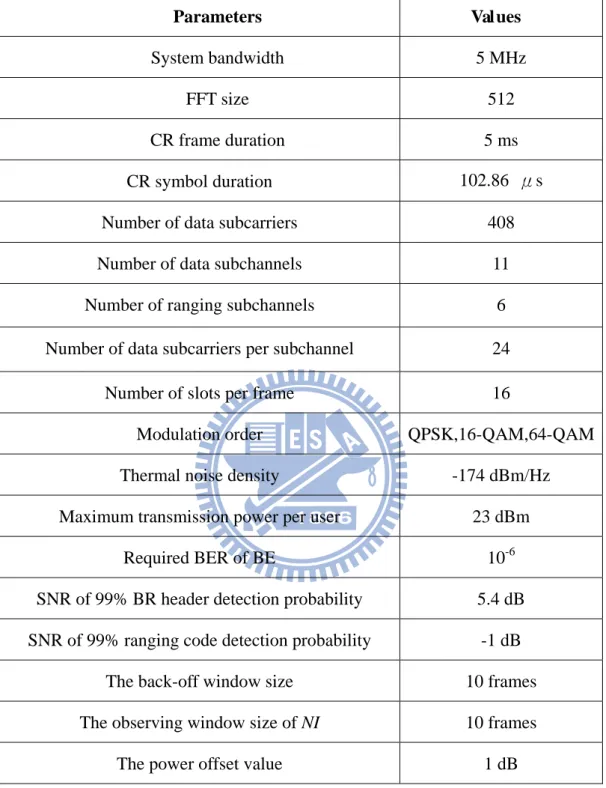
For CR network, we only consider uplink transmissions and the system parameters are compatible with IEEE 802.16 standard [12]. Table 4.2 lists the simulation parameters of the considered CR network. In this thesis, we assume the CR network adopts 5 MHz spectrum when operating in WCDMA spectrum and the frame duration is 5 ms. The number of subcarriers is equal to the FFT size, 512, but only 408 subcarriers are used for transmission, while the others are used for pilot channel or guard channel. Modulation orders are QPSK, 16-QAM, and 64-QAM. The BE traffic is evaluated in our simulation for CR users. It is modeled as a sequence of file downloads. The size of each file is truncated lognormal distributed with mean 2Mbytes, standard deviation 0.722 Mbytes, and a maximum value of 5Mbytes. The inter-arrival time between each file is exponential distributed with mean 180 seconds, and the required BER of BE is 10-6. Moreover, in the proactive white space detection, we set two required SINR value for BR header and ranging code.
23
Table 4.2: Simulation Parameters for CR network
Parameters Val ues
System bandwidth 5 MHz
FFT size 512
CR frame duration 5 ms
CR symbol duration 102.86 μs
Number of data subcarriers 408
Number of data subchannels 11
Number of ranging subchannels 6
Number of data subcarriers per subchannel 24
Number of slots per frame 16
Modulation order QPSK,16-QAM,64-QAM
Thermal noise density -174 dBm/Hz
Maximum transmission power per user 23 dBm
Required BER of BE 10-6
SNR of 99% BR header detection probability 5.4 dB
SNR of 99% ranging code detection probability -1 dB
The back-off window size 10 frames
The observing window size of NI 10 frames
24
4.2 Performance Evaluation
We simulate seven WCDMA cells case where one CR BS is collocated with the central WCDMA cell BS. CR users can access WCDMA UL spectrum by adopting the PCCR-based DSA mechanism. We define the load intensity of WCDMA network as the ratio of the traffic intensity, denoted by ρ , to achieve the 5% blocking probability. In the simulation, the number of CR users varies from 5 to 20, and each of them contains BE traffic with the arrival rate 88.9 Kbps. Moreover, the safety factor α varies from 0.9 to 0.6. Besides, we show the result with or without the pre-allocation (PA) procedure in the uplink resource management process. The uplink resource management process without PA procedure could be implemented as that. The allocation for each BE traffic will check all allocation constraint we have mentioned before, and then allocate with the highest achievable modulation order.
The following performance metric will be measured: (i) throughput of CR network, (ii) blocking probability of WCDMA network, and (iii) average transmission power of WCDMA user.
4.2.1. Throughput of CR Network
Figure 4.1(a)-(c) shows the throughput of CR network versus the number of CR users and the load intensity of WCDMA network. These figures also show the simulation results with different safety factor and the improvement of PA procedure..
25
Fig. 4.1(a): The throughput of CR network (ρ =0.2)
26
Fig. 4.1(c): The throughput of CR network (ρ =0.8)
First, we can observe the throughput of CR network increases and finally becomes saturation when the number of CR users increase. Then, under the saturated situation, the throughput of CR network will vary with the safety factor α . The smaller the safety factor is, the higher the throughput could be achieved. The reason is that the safety factor α limits the admissible received power, so as to restrict the allocation of CR network.
As the WCDMA load intensity increases, it can be found that the throughout decreases. In our design of PCCR-based DSA mechanism, the power resource CR network can use is only the residual portion of
(
1−α)
⋅Imax and Bw⋅NI. The NI will increase with the WCDMA load intensity, so that the opportunity that CR user can transmit will be compressed. The throughput of CR network even goes down to zero when α =0.9 and ρ =0.8.27
In addition, the throughput of CR network with PA procedure is higher than that without PA procedure when the safety factor or the load intensity of WCDMA network is small enough. The reason is that when the safety factor α or the load intensity of WCDMA network is small enough, the higher modulation orders could be supported under the received power constraint. Thus, to user the PA procedure, it could find a best combination to efficiently use the power resource.
4.2.2. Blocking Probability of WCDMA Network
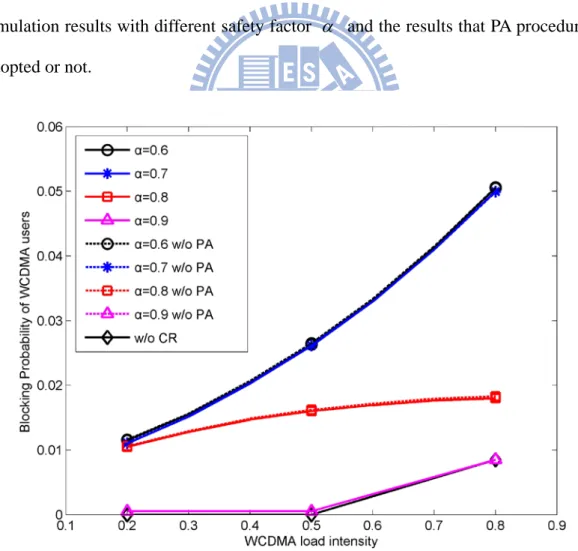
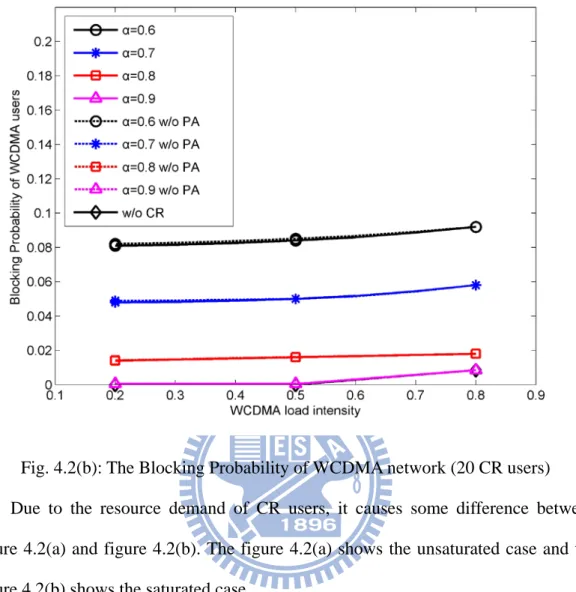
Figure 4.2(a)-(b) shows the blocking probability of the WCDMA network versus its load intensity when the number of CR users is 5 and 20. We also compare the simulation results with different safety factor α and the results that PA procedure is adopted or not.
28
Fig. 4.2(b): The Blocking Probability of WCDMA network (20 CR users) Due to the resource demand of CR users, it causes some difference between figure 4.2(a) and figure 4.2(b). The figure 4.2(a) shows the unsaturated case and the figure 4.2(b) shows the saturated case.
In figure 4.2(a), it can be found that the blocking probability of WCDMA network rises with the increasing of WCDMA load intensity. The reason is that the interference caused by WCDMA users increase with its load intensity, and the CR users should ramp up TX power to against the effect. Therefore, the total interference of whole network will increase when the limitation of
(
1−α)
⋅Imax is not reached. Thus, the new arrival WCDMA will be blocked more often with the increasing of interference level.In figure 4.2(b), the blocking probability of WCDMA network almost stays as a constant no matter what the load intensity of WCDMA is. It can be explained by eq.
29
(3.2), the admissible received power P is the residual portion of CR Bw⋅NI and
(
1−α)
⋅Imax. In the long-term basis, the total interference is fixed around(
1−α)
⋅Imax, so as to let the blocking probability stay as a constant. Besides, when α =0.9 and0.8
ρ = , the blocking probability only reflects the situation of that without CR
network scenario.
Finally, we can find that whether the PA procedure is adopted or not, it almost makes no difference to the blocking probability. It is because the PA procedure only makes use of the power resource more efficiently under the received power constraint.
4.2.3. Average TX Power of WCDMA Users
Next, figure 4.3(a)-(b) shows the average TX power of the WCDMA users versus the load intensity when the number of CR users is 5 and 20. We also compare the simulation results with different safety factor α and the results that PA procedure is adopted or not. Again, the figure 4.3(a) shows the unsaturated case and the figure 4.3(b) shows the saturated case.
30
Fig. 4.3(a): The Average TX power of WCDMA users (5 CR users)
31
First, we could be found the trend of figure 4.3(a)-(b) are similar to figure 4.2(a)-(b). In figure 4.3(a), due to the increasing of the total interference from WCDMA users and CR users. In order to compensate the increasing of interference, each WCDMA user should ramp up its TX power, so that the average TX power will also increase with the load intensity of WCDMA network. In figure 4.3(b), due to the fixed total interference level by eq. (3.2), each WCDMA user needs against that with the fixed TX power. Otherwise, the average TX power varies with the safety factor α . The average TX power is inverse proportional to the safety factor. Finally, the
curves with α =0.9 shows the phenomenon that current WCDMA spectrum is only
used by WCDMA users when load intensity is 0.8 because the current interference from WCDMA users is too high to start the transmission of CR network. Finally, we can find that the PA procedure also doesn’t affect the average TX power. The reason we have mentioned before.
32
Chapter 5
Conclusion
The limited available spectrum and the inefficiency in the spectrum usage necessitate a new communication paradigm to exploit the existing wireless spectrum opportunistically. In addition, with the demand for additional bandwidth increasing due to existing and new services, both spectrum policy and communication technologists are seeking solutions for this apparent spectrum scarcity. In this thesis, a PCCR-based dynamic spectrum access mechanism is proposed for CR network uplink transmission. The goals of PCCR-based DSA mechanism are throughput maximization without much more influence on WCDMA network. In the proposed PCCR-based DSA mechanism, the proactive white space detection provides the ability of CR users to execute the bandwidth request, and adjust the access power adaptively. And, the white space could be verified by this process with a proactive manner. Then, the uplink resource management process provides is to let the CR BS to manage the available resource and to perform the resource allocation more efficiently.
In the simulation results and discussion, the PCCR-based DSA mechanism is presented for CR network to operate in WCDMA spectrum. From the simulation results, we can conclude that the PCCR-based DSA mechanism can obtain additional throughput from the power resource of WCDMA network while the degradation is in
33
a reasonable range, such as α is 0.7. Besides, the pre-allocation in uplink
management process can achieve higher system throughput under the received power constraint. Thus, the goal to improve the spectrum efficiency could be realized.
34
Appendix
Specification Adopted in the CR Network
In [3], OFDM was proposed as a better modulation strategy for cognitive radio by virtue of its flexibility and computational efficiency. For its operation, OFDM uses a set of carrier frequencies centered on a corresponding set of narrow channel bandwidths. Most important, the availability of rate feedback through a feedback channel permits the use of bit-loading, whereby the number of bits/symbol for each channel is optimized for the SNR characterizing that channel. Therefore, many existing CR network architectures are OFDM-based [4].
In this thesis, a set of subcarriers within WCDMA frequency band is grouped into an OFDM subchannel. There are several ways for grouping subcarriers into a subchannel, and we assume the partial usage of subchannels (PUSC) permutation is adopted [12] in this thesis. The subchannel is constructed from six uplink tiles, each tile has four subcarriers. Figure A.1 shows the uplink tile structure.
Pilot carrier Data
carrier
35
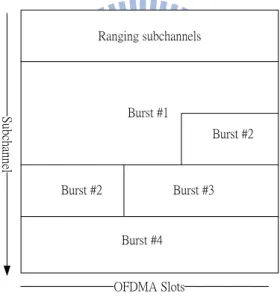
After the permutation, the subchannels are categorized into ranging subchannels and data subchannels. The ranging subchannels are used for ranging process and bandwidth request process [13], and a portion of resource will be used for allocating ranging codes. The data subchannels are used for data transmission. In the uplink, the allocation unit is one slot by one subchannel, and one slot is composed of three symbols. Furthermore, in order to meet the uplink frame structure (UL-MAP) defined in IEEE 802.16 specification as shown in figure A.2 and reduce transmission overhead and complexity, a consistent allocation scheme is developed in the proposed mechanism where the allocation results for each user will not need to be searched slot by slot in each frame.
Ranging subchannels Burst #1 Burst #2 Burst #2 Burst #3 Burst #4 Subchannel OFDMA Slots
Fig. A.2: Uplink frame structure
In the 802.16 WiMAX standard, it provides four service classes [14]: UGS (Unsolicited Grant Service), rtPS (real-time Polling Service), nrtPS (non-real-time Polling Service), BE (Best Effort). The UGS supports constant bit rate or throughput, such as E1/T1 lines and voice over IP (VoIP). The rtPS is designed to support real-time data streams with guaranteeing on throughput and latency, such as MPEG video. The nrtPS only guarantees throughput and is designed to support delay-tolerant
36
streams, such as Hypertext Transport Protocol (HTTP) service. The BE provides no guarantees on throughput or delay, such as File Transfer Protocol (FTP). Generally speaking, UGS, rtPS, nrtPS guarantee QoS , but BE doesn’t support QoS.
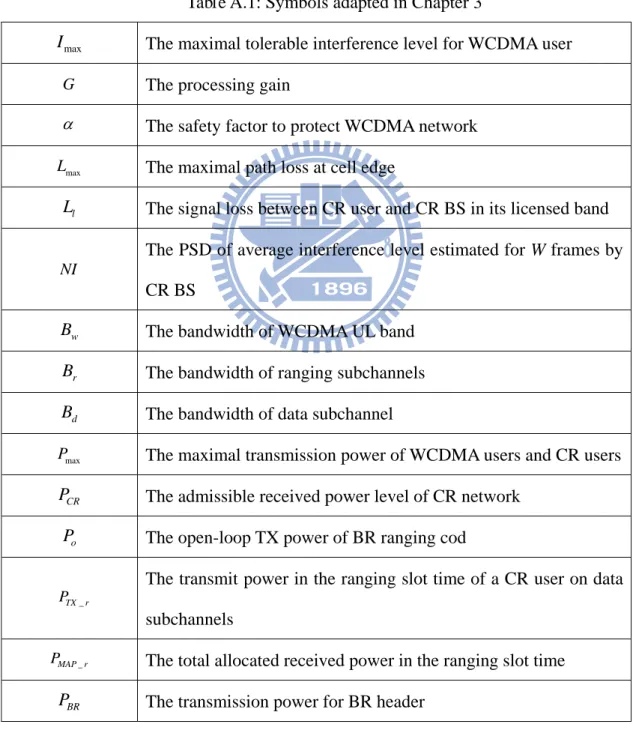
List of Symbols
Table A.1: Symbols adapted in Chapter 3 max
I The maximal tolerable interference level for WCDMA user
G The processing gain
α The safety factor to protect WCDMA network
max
L The maximal path loss at cell edge
l
L The signal loss between CR user and CR BS in its licensed band
NI
The PSD of average interference level estimated for W frames by CR BS
w
B The bandwidth of WCDMA UL band
r
B The bandwidth of ranging subchannels
d
B The bandwidth of data subchannel
max
P The maximal transmission power of WCDMA users and CR users
CR
P The admissible received power level of CR network
o
P The open-loop TX power of BR ranging cod
_
TX r
P
The transmit power in the ranging slot time of a CR user on data subchannels
_
MAP r
P The total allocated received power in the ranging slot time
BR
37 h
δ The minimum required received power for BE header to achieve
target detection probability
j
δ The minimum required received power for modulation order j
o
SIR The SIR requirement of WCDMA users
BRrc
SINR The required SNR for target detection probability of ranging code
BR
SINR The required SNR for target detection probability of BR header
offset
P The power offset vale
M The number of slots per CR frame
h
N The number of requesting CR users
d
N The number of data subchannels
H The number of slots allocated for BR header
* * * *
1, 2, 3
y y y
=
y The optimal assignment vector of data subchannels
j
38
Bibliography
[1] Federal Communications Commission, “Notice of proposed rule making and order,” ET Docket No 03-222, Dec. 2003.
[2] S. Haykin, “Cognitive radio: brain-empowered wireless communications,” IEEE
Selected Areas in Communications, Vol . 23, Issue 2, pp. 201-220, Feb. 2005.
[3] P. Sutton, L.E. Doyle, and K.E. Nolan, “A reconfigurable platform for cognitive networks,” International Conference on Cognitive Radio Oriented
Wireless Networks and Communications, pp. 1-5, Jun. 2006.
[4] I.F. Akyildiz, W.Y. Lee, M.C. Vuran, and S. Mohanty, “Next generation/dynamic spectrum access/cognitive radio wireless networks: A survey,” Comput. Networks,
pp. 2127–2159, Sep. 2006.
[5] W. D. Horne, “Adaptive spectrum access: using the full spectrum space,” 31st
Annual Telecommunications Policy Research Conference (TPRC’03), Oct. 2003.
[6] Q. Zhao, L. Tong, A. Swami, and Y. Chen, “decentralized cognitive MAC for opportunistic spectrum access in Ad Hoc networks: A POMDP Framework,” IEEE
Journal on Selected Areas in Communication: Special Issue on Adaptive, Spectrum Agile and Cognitive Wireless Networks, Vol325, no. 3, April 2007.
[7] Z. Liang, W. Liu, P. Zhou, and F. Gao, “Randomized multi-user strategy for spectrum sharing in opportunistic spectrum access network,” ICC’08, pp. 477 – 481, May 2008.
39
[8] Federal Communications Commission: “Spectrum policy task force”, Report ET Docket, Nov. 2002.
[9] T. Clancy, “Formalizing the interference temperature model,” Wiley Wireless
Communication and Mobile Computing, PP. 1077 – 1086, May 2007
[10] P. Cheng, Z. Zhang, H. Chen, and P. Qiu, “Optimal distributed joint frequency, rate and, power allocation in cognitive OFDMA systems,” Communications,
IET’08, pp. 815-826, July 2008.
[11] C. H. Lee, C. J. Chang, “Performance analysis of a truncated closed-loop power-control scheme for DS/CDMA cellular systems,” IEEE Transactions on
Vehicular Technology, Vol. 53, No. 4, pp. 1149-1159, July 2004.
[12] IEEE Std. 802.16- 2004, “IEEE Standard for Local and Metropolitan Area Networks Part 16: Air Interface for Fixed Broadband Wireless Access Systems,” Oct. 2004.
[13] D. H. Lee and H. Morikawa, “Analysis of ranging process in IEEE 802.16e wireless access systems,” MobiWAC’06, pp. 172-179, Oct. 2006.
[14] Q. Liu, X. Wang, and G.B. Giannakis, “A cross-layer scheduling algorithm with QoS support in wireless networks,” IEEE Transactions on Vehicular
Technology, Vol. 55, No. 3, pp. 839-847, May 2006.
[15] A. J. Goldsmith and S. G. Chua, “Variable-rate variable-power MQAM for fading channels,” IEEE Transactions on Communications, Vol. 45, pp.1218-1230, Oct. 1997.
[16] 3GPP TR 25.892, “Feasibility study for OFDM for UTRAN enhancement,” 3rd
40
Vita
Shin-Yi Cheng was born on 1985 in Kaohsiung, Taiwan. He received the B.E. and M.E. degree in department of communication engineering from National Chiao-Tung University, Hsinchu, Taiwan, in 2007 and 2009, respectively. His research interests include radio resource management and wireless communication systems.