The Effect of Comprehension Strategy Instruction on
EFL Learners’ Reading Comprehension
Yen-Chi Fan
Center for General Education, I-Shou University
No. 1, Sec. 1, Syuecheng Rd., Dashu Township, Kaohsiung County 840, Taiwan Tel: 886-7-657-7711 E-mail: [email protected]
Abstract
The purpose of this study is to investigate the effect of Collaborative Strategic Reading (CSR) on Taiwanese university students’ reading comprehension with reference to specific types of reading comprehension questions. The participants were 110 students from two intact classes who had low-intermediate to intermediate level of English. This study adopted a pre-test and post-test design with a control group. The data mainly came from statistical results of One-Way ANOVA, but would be triangulated by multiple data sets including the questionnaire responses and transcripts of group discussions during CSR. The findings indicated that CSR had a positive effect on the Taiwanese university learners’ reading comprehension particularly in relation to the comprehension questions on getting the main idea and finding the supporting details. However, the statistical analysis did not show that CSR significantly promoted the EFL learners’ strategic reading competence in regard to predicting, making inferences and dealing with vocabulary problems. The findings of the study suggest that implementing comprehension strategy instruction for one semester may help learners adopt some degree of strategic reading behaviours, but it takes long-term efforts and practices for EFL learners to fully develop their strategic reading abilities.
Keywords: Comprehensions strategy instruction, Collaborative Strategic Reading (CSR), Reading comprehension
1. Introduction
First and second language researchers have stressed the importance of training language learners to be strategic readers. For example, Paris et al. (1983) highlight that learning to be a strategic reader can promote reading comprehension and “failure to be strategic in reading may result from either developmental inability or poor learning” (p.293). Palincsar & Brown (1984) suggest that strategic reading helps students, especially low-achieving learners, avoid comprehension failure and enhance their retention of the text. Similarly, Koda (2004) points out that strategic reading can not only compensate for learners’ comprehension deficiency but also develop their critical thinking. Pressley (2006) contends that language learners should be taught strategic reading through explicit instruction. Janzen & Stoller (1998) maintain that strategic reading instruction is rewarding to both second language learners and their teachers. They argue that it cultivates learners’ autonomy and self-awareness of the meaning constructing process and it also prepares pre-university students for academic reading performance. They also indicate that reading strategy instruction provides an efficient method for teachers to motivate students’ participation in their learning and teach them how to read effectively.
In a large number of research studies conducted in the past three decades, comprehension strategy instruction including multiple reading strategies has been justified to be beneficial to helping students become strategic readers and improve their reading comprehension (Klingner et al., 1998; Koda, 2004; Lee, 2003; Lenski & Nierstheimer, 2002; Palincsar & Brown, 1984; Pressley, 2006; Rosenshine & Meister, 1994; Song, 1998). Therefore, comprehension strategy instruction which focuses on teaching reading strategies to students to help them become strategic readers and more self-regulated learners seems not only promising but also necessary. Among various reading approaches, Collaborative Strategic Reading (CSR) proposed by Klingner et al. (1998) is one type of comprehension strategy instruction designed to improve learners’ strategic reading abilities through small group discussion. In CSR, four reading strategies are taught including “preview”, “click and clunk”, “get the gist” and “wrap-up”. Empirical studies have supported the positive impact of CSR on primary and secondary ESL and EFL learners’ reading comprehension, learning motivation and English acquisition (Huang, 2004; Klingner et al., 1998; Standish, 2005; Wang, 2008).
As none of the existing research related to CSR has been conducted in any EFL university settings, this raises several questions which need to be answered. For example, does CSR favour younger learners rather than adult learners such as university students? Is CSR a viable approach to tertiary reading instruction? To understand the feasibility of CSR with adult EFL learners, research is needed to bridge the gap. Thus, the purpose of this present study is to examine the effect of CSR on Taiwanese university learners’ reading comprehension with reference to specific types of reading comprehension questions. It is hoped that this study can contribute to the understanding of CSR for university English teachers who are interested in increasing their repertoire of reading instruction models in their own contexts.
2. Literature Review on Comprehension Strategy Instruction
In the past three decades, a great deal of research has been done in the field of comprehension strategy instruction and there has been a consensus that it should be multi-componential and developmental (Almasi, 2003; Anderson, 1992; Brown et al., 1996; Carrell, 1988b; Dole et al., 1991; Koda, 2004; Pressley, 2000, 2002). Supported by consistent empirical results, some sophisticated instructional models composed of specific reading strategies provide solid frameworks of effective comprehension strategy instruction. Reciprocal teaching (RT) advocated by Palincsar & Brown (1984) is one of the most influential approaches. Reciprocal teaching is designed for students who have basic decoding skills but have difficulties in meaning construction and according to Pressley (2002), it is the first “empirically validated approach to the teaching of a package of comprehension strategies” (p. 12). This instructional model involves teachers’ and students’ collaborative work to construct text meaning. In practice, teachers model four cognitive reading strategies by using the thinking aloud technique to help students improve their reading comprehension: summarising, generating questions, clarifying, and making predictions. In classroom settings using reciprocal teaching, students gradually assume the role of being “the teacher” when they become more proficient. This aims to make them more independent in their learning. Reciprocal teaching has been extended to various age groups and reading proficiencies in laboratories or in first and second language classrooms. Sixteen studies on reciprocal teaching were reviewed by Rosenshine & Meister (1994) in an attempt to investigate its effectiveness. The students in their review range from grade one to eight. Three different types of classes are identified: mixed abilities, good-poor (good in decoding or but poor in comprehension), and below average (in decoding and comprehension). All of the studies were quantitative in nature and involved control and experimental groups. The results of the meta-analysis showed that the studies using researcher-developed comprehension measures had a greater impact than the ones with standardised reading tests. The findings suggested that students who are good at decoding but poor at comprehension benefit the most from this comprehension intervention.
Moreover, many studies have been conducted in ESL/EFL classrooms for the purpose of examining the effects of reciprocal teaching on adult learners’ English learning. Song (1998) found that reciprocal teaching helps Korean university students improve their reading comprehension particularly in the understanding of main ideas and making inferences of the given passages. Conducting a study in a pre-university ESL class, Cotterall (1990) found that learners in reciprocal teaching became better at looking for the main ideas from the texts and activating their background knowledge. Chen (2005) examined the effects of a modified model of comprehension strategy instruction similar to RT on 89 Taiwanese senior school students’ reading comprehension. The study concluded that comprehension strategy instruction helped the subjects increase their ability in getting main ideas, making inferences and finding answers for detailed questions, but the students’ vocabulary ability did not improve after the intervention.
Although these replications of RT research provide strong empirical support for this instructional approach, there are some methodological limitations. First of all, some of the studies, for example, Chen (2005), Cotterall (1990) and Song (1998) did not include a control group. In spite of the fact that their findings may be seen as indicative of the effectiveness of reciprocal teaching, no comparison can be made between those who do and those who do not receive this reading approach. Another limitation is that most studies with regard to RT are based on a quantitative design with a short experimental period from 2 weeks to 3 months. How students actually construct meaning is still not clear. More qualitative research would be helpful to provide a holistic evaluation.
In another comprehension intervention called direct explanation of comprehension strategies, Roehler & Duffy (1984) stressed the crucial role of teacher modelling in facilitating learners’ reading comprehension. In this approach, teachers explicitly provide declarative knowledge (what the strategies are), conditional knowledge (when to use them) and procedural knowledge (how to use them). Scaffolding in instruction and teachers’ feedback is reduced when students become more independent in the application of reading strategies. A series of Duffy and his colleagues’ experimental studies suggest that less able students who receive direct explanation of
comprehension strategies which characterises direct explanation, teacher modelling and guided practice of reading strategies show positive improvement in conceptual understanding and reading achievement (Duffy et al., 1988; Pearson & Dole, 1987; Roehler & Duffy,1984).
Influenced by Roehler & Duffy’s (1984) approach, Pressley et al. (1992) proposed transactional strategies instruction (TSI). This strategic reading intervention shares the same features of teacher modelling, direct explanation of reading strategies and guided practice with direct explanation of comprehension strategies, but differs in (1) its emphasis on the interpretative transaction between readers and text and (2) transactions among group members to construct meaning together (Pressley, 2006). Moreover, a major difference between TSI and other comprehension strategy approaches is that TSI not only emphasises cognitive reading strategies but also interpretative strategies. In TSI, a small repertoire of comprehension strategies are instructed and practised over a long period of time including predicting, generating images, seeking clarification and summarising (Pressley, 2002). The long-term goal of TSI is to help students internalise strategic processing through the interaction of group discussion and teacher scaffolding.
Unlike most of the studies in reciprocal teaching, TSI research often adopts a long-term experimental design lasting from one semester to over a year, for example, the studies of Anderson (1992) and Brown et al. (1996). These two studies provide strong empirical evidence to validate the application of TSI to improve elementary graders’ and secondary adolescents’ interpretative reading competence. In another TSI study, Loranger (1997) adopted a mixed-method approach to examine the effects of TSI on fourth graders’ reading comprehension and engagement during group discussions. Quantitative and qualitative data were gathered including pre/post-test on a standardised reading test, pre/post interviews, videotaped reading discussions and response journals. The findings of this study supported the positive impact of TSI on fourth graders’ reading achievement. Students in the experimental group were more interested and engaged in reading task and discussion than participants in the control group.
Additionally, to investigate the effect of CSR, another strategies-based instruction, Klingner et al. (1998) conducted a quasi-experiment with 141 American fourth graders who tried to comprehend social studies texts in 5 heterogeneous classrooms. The experiment lasted for 11 days. Three classes consisting of 85 students in total were assigned to the experimental groups where four reading strategies mentioned above were introduced and students were engaged in peer-led discussions to help them improve their reading comprehension. The control groups, 56 pupils in total, received teacher-led reading instruction without the introduction of the four reading comprehension strategies and group work. The findings of this study suggest that students in the experimental groups outperformed the control groups in terms of reading comprehension but did not show any significant difference in content learning.
Researchers have also been interested in the impact on learners’ achievement of integrating CSR with other approaches. Standish (2005) examined how CSR in combination with direct instruction in persuasion affected her six-graders’ persuasive writing. Three intact classes were respectively assigned to (1) CSR and direct instruction in persuasion, (2) direct instruction in persuasion only and (3) a control group. The treatment lasted for 6 weeks. The intervention effects were evaluated in terms of six measures including argument, back-up, coherence and organization, five-paragraph structure and essay length. This study found that the students in the group of CSR and direct instruction in persuasion performed significantly better than the other two groups and they were found to engage more actively in the writing tasks.
Implementing CSR in a Taiwanese fifth-grade classroom, Lee (2003) compared the effect of CSR and the traditional teacher-dominated approach on her students’ reading comprehension and vocabulary learning. The statistical results showed that CSR helped her students improve their reading comprehension more than traditional instruction, but it did not increase their abilities in terms of grapheme-phoneme correspondences and automatic word recognition. In addition, the analysis of group discussions revealed that the strategy of translation, followed by elaboration and prompting, was the most frequently used when learners in CSR group tried to work out the meaning of challenging words.
Wang (2008) examined the effect of CSR on sixth-graders’ reading comprehension and learning attitudes. Sixty-two pupils from two intact classes were divided into a control group receiving the traditional teacher-directed reading instruction and an experimental group of CSR instruction in combination with story retelling strategy training for fifteen weeks. Multiple measures were used in this study. They consisted of a questionnaire of English learning background, pre-tests and post-tests of reading comprehension, five post-tests administered after reading stories, a story reading post-test which students had not ever read in the class and a questionnaire of students’ attitudes towards the intervention. Based on the results, the author claimed that the
modified CSR approach was effective in fostering her six-graders’ overall reading comprehension and understanding of the meaning of the stories, and that it increased their English learning motivation.
In another study, Huang (2004) investigated the feasibility and efficacy of CSR in inquiry-based pedagogy to improve high school students’ strategic reading and develop their critical thinking ability. This study involved 2 classes of 42 EFL learners. The quantitative findings derived from researcher-made periodic achievement tests showed that the CSR group did not significantly outperform the control group. However, qualitative data analysis of the post-reading writing samples indicated that CSR was facilitative in developing students’ critical thinking and writing ability in terms of content and idea exploration. In addition, a majority of the participants’ self-reports from the post-intervention questionnaire considered that CSR was an effective method to promote their autonomous learning and social skills.
3. Methodology
3.1 Participants
This study was carried out at a university in the southern part of Taiwan. In the university, it is mandatory that all of the first year students take “Practical English” for three hours a week. They are all required to take an English placement test soon after entering the university. The placement test was composed of the sections to test students’ vocabulary, syntactic knowledge, reading and listening comprehension. Based on the results of the placement test, all of the first-year students are grouped into advanced, intermediate and elementary levels of English. All of the first year students were allocated into classes according to their levels and each class consisted of 50 to 60 students.
Due to the fact that it would have been difficult and impractical to recruit students to participate out of their school timetable, two intact classes, originally 117 intermediate students taught by the researcher participated in this study. The participants had at least 6 years of English learning experience. All of the students majored in subjects related to engineering such as Mechanical Engineering, Chemical Engineering, Civil Engineering, Electrical Engineering, and Computer Information Engineering. One of the classes was assigned as the control group with the traditional teacher-led reading approach, while the other was the experimental group receiving CSR instruction.
The intervention lasted for 14 weeks, which excluded the time for data collection. During the experiment, 1 student from the experimental group did not show up to take the pre-test; 3 students from the control group and 3 from the experimental group dropped out of the course due to personal reasons. Those who did not complete both the pre-test and post-test were not included in the data analysis. Consequently, 110 students were included in this study – 56 in the control group and 54 in the experimental group.
3.2 The Reading Materials
The reading materials used in the present study consisted of selected texts from three textbooks called Reading
for the Real World 2 (Zwier & Stafford-Yilmaz, 2004 ), Issues for Today: An Intermediate Reading Skills Text
(Smith & Mare, 1995) and Reading Challenge 3 (Malarcher & Janzen, 2005). These reading materials are expository texts suitable for the low-intermediate and intermediate EFL readers. The selection of the reading materials was based on the following criteria: (1) level of difficulty, (2) level of interest, and (3) variety of topics related to the real world.
3.3 Instructional Procedures
3.3.1 The Experimental Group
At the beginning of the instruction, the researcher demonstrated how to apply reading strategies taught in CSR on the whole class basis for two weeks. She applied the thinking aloud technique to explain explicitly how to use reading strategies to facilitate reading comprehension. After students gradually increased their competence of applying the reading strategies, learners were divided into 10 small collaborative peer-led groups consisting of 5 or 6 people. There were four roles assigned to the group members, namely leader, clunk expert, gist expert and reporter to scaffold their content learning and reading comprehension (Cohen, 1994; Klingner et al., 1998). Students decided how the roles could be allocated. They stayed in their original group during the CSR lessons but rotated the roles on a regular basis to foster their participation and experience different responsibilities of the tasks.
3.3.2 The Control Group
For both the experimental and control groups, the instructional materials and learning content were the same except that the control group was not exposed to reading strategies and any group work. The control group
adopted a traditional teacher-centred reading approach in which the teacher directed the instruction, initiated the questions and students generated responses. This teaching approach focused on vocabulary teaching, analysis of grammatical structures of the texts and translation from the English text.
3.4 Data Collection and Analysis
3.4.1 The Reading Measure
The reading measure given in the pre-test and post-test was in the format of multiple choice. It was made up of 9 passages, totally 50 questions which can be classified into five types of reading questions – (1) predicting the content of the passages, (2) getting the main idea, (3) finding the supporting details, (4) dealing with vocabulary, and (5) making inferences. Among 50 questions, there were 5 predicting questions, 9 main idea questions, 11 factual or detailed questions, 17 vocabulary questions and 8 about making inferences. Each question was worth 2 points and the sum total of the test was 100 points. To obtain test reliability, the same reading measure was given at pre-test and post-test 14 weeks apart. To analyse the data, the SPSS 11.0 version software was used.
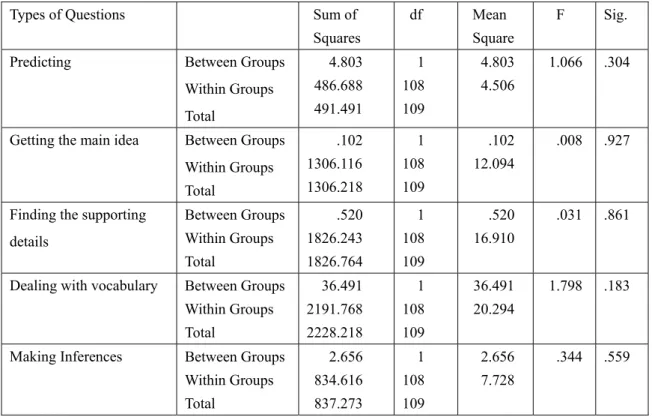
Before the treatment, it was important for the researcher to examine whether there was any significant difference in terms of reading proficiency between the control and experimental groups. In the first week of the experiment, a pre-test was given to all the participants in the two groups. Levene’s test of homogeneity of variance was not significant (Sig. value = .835, which is larger than .05). In other words, the results indicated that the two groups had similar levels of reading comprehension prior to the experiment. In addition, as shown in Table 1, there is no significant difference on the pre-test with regard to five types of comprehension questions between the control and experimental groups. The finding was important in that it provided a baseline for a more reliable comparison of the post-test after the treatment between the two groups. For data analysis, the statistical test of One-Way ANOVA was applied to investigate the effect of CSR on the specific types of reading comprehension questions. 3.4.2 The Questionnaire
To gather data regarding the EFL learners’ perspectives on CSR, after the intervention, a questionnaire was administered to the experimental group. It was composed of 32 Likert scale statements and one multiple choice question. The participants were requested to indicate the extent to which they agreed with each statement using (1) strongly disagree, (2) disagree, (3) no opinion, (4) agree, and (5) strongly agree.
3.4.3 Audio-Recordings of Group Discussions
Group discussions during CSR instruction were audio-taped at the beginning, middle and end of the intervention to examine the nature of group talk in CSR. Three groups (Group 2, 5 and 6) which consisted of 6 students were selected for data analysis. Small unobtrusive microphones and recorders were used and before audio-taping, they were tested to ensure the quality of the recordings. The titles of the texts discussed in the recorded sessions were “Bill Gates: Good Businessman or Bad?” (1st transcript), “Loneliness: How Can We Overcome It?” (2nd
transcript) and “The Best Medicine” (3rd transcript). For the purpose of fully understanding each other, the
language the students used in group discussions was Mandarin. The recordings were transcribed verbatim first, and the Mandarin was then translated into English for the ease of presentation of the data analysis
4. Results
This study discusses the effect of CSR on the EFL learners’ answers related to types of comprehension questions. An analysis of variance (One-Way ANOVA) was performed to evaluate the impact of the two instructional approaches – CSR and the traditional whole class teacher-fronted method - on all participants’ answers to five types of comprehension questions.
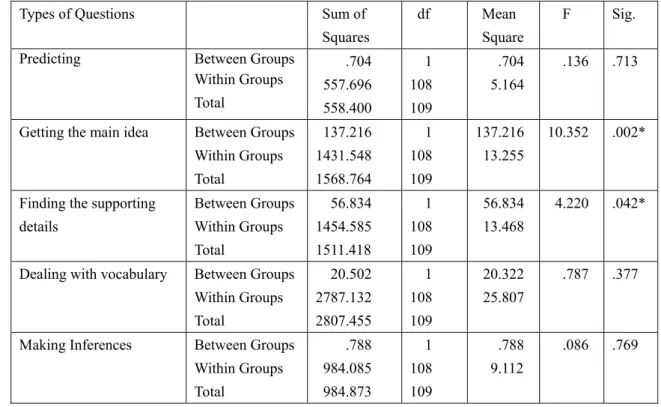
Table 2 illustrates the results of post-test for One-Way ANOVA on types of comprehension questions between the two groups after the 14 weeks’ treatment. As shown in Table 2, there was no significant difference on the prediction questions between the control and experimental groups (F=.136, p=.713 >.05). In other words, the experimental group did not perform better than the control group in answering the comprehension question on predicting. In relation to questions on getting the main idea, the statistical results showed that the F ratio was 10.352, p=.002, which means that the difference reached a statistically significant level. Therefore, this finding suggests that after receiving CSR instruction, the students performed better on getting the main idea in comparison with the students in the teacher-dominated reading approach.
As to finding the supporting details, the analysis of variance (One-Way ANOVA) showed that the gained F ratio was 4.220 and p-value was .042. This indicated that there was a significant difference between the control and experimental groups. Consequently, the finding suggests that CSR had a significantly greater impact on the students’ ability to find the supporting ideas than the traditional teacher-centred teaching method.
The numerical analysis in Table 2 showed that, for dealing with unknown words, the F ratio was .787 and p-value was .377. This finding seems to show that CSR did not have more positive effect than the traditional whole class teaching on the students’ replies in relation to dealing with unknown vocabulary words. In addition, the statistical results of a One-Way ANOVA reveal that nor did the last type of comprehension question, making inferences, display a significant difference between the two groups (F=.086, p=.769>.05). Consequently, the experimental group did not perform significantly better than the control group in terms of answering the comprehension questions on making inferences.
In summary, based on the statistical analysis discussed above, it was found that CSR had a more positive impact than the teacher-dominated whole class reading approach on the EFL learners’ ability to get the main idea, and find the supporting details, but it did not positively influence the students’ ability to predict, make inferences and deal with unknown vocabulary items.
5. Discussion
To investigate the effect of CSR on Taiwanese university students’ reading comprehension with reference to specific types of reading comprehension questions, the statistical results discussed above will be triangulated with multiple data sets including the questionnaire responses and transcripts of group discussions.
The statistical analysis of this study found that the experimental group did not perform better than the control group when answering the comprehension questions concerning predicting, making inferences and dealing with vocabulary, but they did outperform their counterparts in getting the main idea and finding the supporting details. This result was in agreement with the previous studies of Song (1998) that comprehension strategy instruction had a positive effect on EFL college learners’ answers to main idea questions and Chen’s (2005) study that reading strategy instruction improved students’ ability to identify the main idea and supporting details of reading passages.
In this study, the students in CSR were taught to read for gist. They were trained to look for the topic sentence of each paragraph and distinguish them from the supporting details. It was encouraging to find that the students in the experimental group were significantly better at finding the gist and answering the detailed questions in comparison with those in the control group. This finding was validated by the results of the questionnaire survey; 98.2% of the students in the experimental group considered that the CSR intervention helped them distinguish between the main ideas and supporting information of the reading texts. As Lin (1991) asserts, “an ideal English instructional program should include extracting the main idea for it leads to comprehending the details in a text” (p. 81). It was learning and practising the skill of extracting the most important information and understanding how the details in the text are connected with each other, which I believe, resulted in the improvement of text comprehension.
In contrast, this study did not find a significant improvement in prediction questions and making inferences. Predicting is a previewing strategy students learned in CSR. The goal of this strategy is to activate learners’ existing knowledge and set up a purpose for reading. Much evidence has supported the important role that the predicting strategy plays in reading comprehension (for example, Carrell & Eisterhold, 1988; Cotterall, 1990; Eskey & Grabe, 1988; Sweet & Snow, 2003). This strategy involves students’ confirming or rejecting the hypotheses they formulate about what the author intends to discuss.
From Palincsar and Brown’s (1984) point of view, predicting is a comprehension monitoring activity which facilitates making and testing inferences. Pressley (2006) contends that “prior knowledge plays an important role, permitting the generation of inferences required to understand the text” (p. 54). Similarly, Nuttall (1996) stresses that implicit inferential comprehension can be enhanced by the activation of prior knowledge. Hence, these two reading strategies are interrelated. In other words, the ability to make inferences is related to the understanding of schemata assumed by the author and is developed by activating a reader’s background knowledge and knowledge of the world.
The transcription data of group discussions allowed more precise insights into how students applied the predicting strategy in CSR instruction. It was found that all of the groups discussed the pre-reading questions provided in the reading materials. On some occasions, students used their knowledge of the world to construct meaning. Nevertheless, it was surprising to note that the students rarely activated their existing knowledge to predict the content to be read. Neither did they try to make inferences from the texts. Although the students took turns to answer the pre-reading questions, it seemed that they only went through the pre-reading activity to fulfil one of the CSR procedures. This confirmed the findings of Klingner et al. (1998) and Rosenshine & Meister (1994) that ESL/EFL readers have difficulty applying the predicting strategy in comprehension strategy instruction. The following excerpt is an example from Group 6 when they are engaged in a pre-reading activity.
Group 6 – The Best Medicine 1. Bin: Pre-reading 啊!
2. Chuan: 對啊! <Ya!> What makes you laugh? 3. Ss: {什麼讓我笑? <What makes me laugh?>
4. Chuan: 大家提供意見,快點! <Talk about your opinions; hurry up!> 5. Jack: 搔癢就會讓你笑啊! <Tickling makes you laugh!>
6. Chuan: 還有什麼? <What else?>還有什麼? <What else?>
7. Bin: 看到 Zao 就會笑了啊! <I laugh when I see Zao.> 看到他的臉就會很 想笑。<His face makes me laugh.>
8. Chuan: 還有什麼? <What else?>快點啦! <Hurry up!> {A bit noisy}
9. Jack: ㄟ…ㄟ..不要亂啦! <Heh…heh..don’t mess about!> 10. Chuan: 我們進入課文吧! <Let’s move on to the text!>
In the above episode, it seems that the students were perfunctory in this pre-reading event and Chuan, as a leader, did not attempt to redirect the group to relate what they knew about the topic to what they would read or provide any feedback to his members. Instead, he decided to move on to the text. Several possible factors may have contributed to the ineffective application of the predicting strategy in this study. First, perhaps students did not think that predicting was important for the facilitation of their reading comprehension. They may have had a misconception which Carrell (1988a) describes as the “meaning is in the text” (p. 109). For them, reading may still be regarded as an activity involving bottom-up processing only to decode messages from the printed materials. This tendency to over-rely on linguistic knowledge for text comprehension may have led to underestimating the crucial role of their background knowledge and the development of making inferences. Second, it is possible that the EFL students lack the prior knowledge of topics such as health or medicine. In this case, the expectation that students in peer discussions can execute effective predictions and understand the writers’ underlying presuppositions may be unwarranted. Third, several researchers have noted the challenging nature of the predicting strategy when reading expository texts (Carrell, 1988b; Klingner et al., 1998; Nuttall, 1996). As Shih (1991) points out, lacking the knowledge related to rhetorical structures is a common problem for EFL readers. In this study, students’ lack of awareness of expository text structure may account for their failure to utilise existing knowledge.
As suggested by Mikulecky (1990), for the purpose of familiarising students with the process of predicting, they need to be given some specific and intensive training conducted as a whole-class. Carrell (1988b) proposes that several techniques should be used for the activation of readers’ prior knowledge such as teaching various rhetorical structures of texts and cloze test for the development of students’ ability of contextual guessing. Anderson (1999) recommends the introduction of semantic maps to help ESL readers establish background knowledge. By introducing the important concepts and key words students need to know, teachers can help them build up background knowledge they may not possess and link it with the reading passage they are going to read. As a result of establishing and activating proper schemata, they may develop a better ability to construct meaning by inferring implicit arguments.
With regard to dealing with unknown vocabulary words, the results of a One-Way ANOVA showed that there was no significant difference between the control and experimental groups. This was congruent with previous research by Lee (2003) and Chen (2005) that EFL students did not show significant improvement in answering lexical questions after a short term of vocabulary strategy treatment. This may be due to the fact that it is difficult to investigate the effect of vocabulary strategy training by a quantitative measure. As Huckin & Bloch (1993) suggest, gains in vocabulary learning from contextual clues or other vocabulary strategies “tend to be gradual and are therefore often difficult to measure empirically in a controlled experiment” (p. 156).
6. Implications and Conclusion
This paper has shed some light on the impact of CSR on Taiwanese university learners’ answers on five different types of comprehension questions categorised in the reading measure. The findings of the study offer some pedagogical implications for university reading instruction in EFL contexts. First, CSR significantly promoted the EFL learners’ strategic reading competence in regard to reading for the gist and distinguishing the most
salient ideas from the less important supporting information, suggesting that foreign language reading instruction, especially for learners in university settings might benefit from the collaborative comprehension strategy instruction with the help from both their peers and teachers. Second, in comparison with the traditional teacher-dominated approach, CSR offers more chances for university learners to participate more actively in constructing the meaning and self-monitor their comprehension about when, where, and how to use the reading strategies while reading the text. Through discussing with others, learners have more opportunities to confirm their hypotheses, clarify their confusion and advance their reading abilities.
Moreover, this result was in accord with the observations by Huckin & Bloch (1993) and Farrell (2001) that learning of reading strategies tends to be gradual and developmental. Thus, it is important for EFL English teachers to recognise the longitudinal nature of comprehension strategy instruction (Farrell, 2001; Grabe, 1991; Janzen & Stoller, 1998; Koda, 2004; Pressley, 2006; Roehler & Duffy, 1984). Training students to become strategic is a long term process. Learners’ effective use of reading strategies, particularly some of the top-down strategies such as predicting and making inferences requires teachers’ thoughtful planning to help them reconceptualise the nature of the reading process and raise their awareness of the necessity for a shift in reading behaviours. Developing students’ strategic reading is not simply a matter of introducing them to a number of reading strategies. Promoting mastery of the comprehension strategies involves teachers’ constant modelling and instant feedback for mastery of the comprehension strategies not only at the beginning but through the whole implementation of comprehension strategy instruction.
7. Limitations
The findings of this study should be interpreted in light of its limitations. One drawback of this present study was related to the measure of reading comprehension. The reliance on a single measure of reading comprehension to determine the effect or gains of a reading intervention seems not to be sufficient. As Bernhardt (1991) points out, every type of reading measure has its own strengths and weaknesses. The adoption of multiple reading measures in investigating the effects of reading models is necessary to provide a multidimensional picture. Therefore, a wider range of assessment methods would be valuable to investigate the effects of CSR instruction on EFL learners’ reading comprehension. In addition, this study was bound to a particular context and the research sample was not representative; however, it was believed that this study could provide valuable insights to those who are interested in adopting CSR in other similar classroom settings.
References
Almasi, J. (2003). Teaching strategic processes in reading. New York: Guilford Press.
Anderson, N. (1999). Exploring second language reading: Issues and strategies. Toronto: Heinle & Heinle Publishers.
Anderson, V. (1992). A teacher development project in transactional strategy instruction for teachers of severely reading-disabled adolescents. Teaching & Teacher Education, 8, 391-403.
Bernhardt, E. B. (1991). Reading development in a second language theoretical, empirical and classroom
perspectives. Norwood: Ablex Publishing Corporation.
Brown, R., Meter, P. V., Pressley, M., & Schuder, T. (1996). A quasi-experimental validation of transactional strategies instruction with low-achieving second-grade readers. Journal of Educational Psychology, 88(1), 18-37. Carrell, P. L. (1988a). Some causes of text-boundedness and schema interference in ESL reading. In P. L. Carrell, J. Devine & D. E. Eskey (Eds.), Interactive approaches to second language reading (pp. 101-113). Cambridge: Cambridge University Press.
Carrell, P. L. (1988b). Interactive text processing: Implications for ESL/second language reading classrooms. In P. L. Carrell, J. Devine & D. E. Eskey (Eds.), Interactive approaches to second language reading (pp. 239-259). Cambridge: Cambridge University Press.
Carrell, P. L., & Eisterhold, J. C. (1988). Schema theory and ESL reading pedagogy. In P. L. Carrell, J. Devine & D. E. Eskey (Eds.), Interactive approaches to second reading (pp. 73-92). Cambridge: Cambridge University Press.
Chen, J. C. (2005). Explicit instruction of reading strategies at senior high school in Taiwan. Unpublished MA dissertation, National Kaohsiung Normal University. Kaohsiung, Taiwan.
Cohen, E. (1994). Designing group work: Strategies for the heterogeneous classroom (2nd ed.). New York:
Cotterall, S. (1990). Developing reading strategies through small-group interaction. RELC Journal, 21(2), 55-69. Dole, J. A., Duffy, G. G., Roehler, L. R., & Pearson, P. D. (1991). Moving from the old to the new: Research on reading comprehension instruction. Review of Educational Research, 61(2), 239-264.
Duffy, G. G., Roehler, L. R. & Herrmann, G. (1988). Modelling mental processes helps poor readers become strategic readers. Reading Teacher, 41, 762-767.
Eskey, D. E., & Grabe, W. (1988). Interactive models for second language reading: Perspectives on instruction. In P. L. Carrell, J. Devine & D. E. Eskey (Eds.), Interactive approaches to second language reading (pp. 223-238). Cambridge: Cambridge University Press.
Farrell, T. S. C. (2001). Teaching reading strategies: ‘It takes time!’. Reading in a Foreign Language, 13(2), 631-646.
Grabe, W. (1991). Current developments in second language reading research. TESOL Quarterly, 25(3), 375-406. Huang, C. Y. (2004). Think to win: An inquiry-based approach via Collaborative Strategic Reading technique to
teach English reading in a senior high EFL classroom. Unpublished MA dissertation, National Taiwan Normal
University, Taipei, Taiwan.
Huckin, T. & Bloch, J. (1993). Strategies for inferring word-meanings in context: A cognitive model. In T. Huckin, M. Haynes & J. Coady (Eds.), Second language reading and vocabulary learning (pp. 153-178). Norwood: Ablex Publishing Corporation.
Janzen, J., & Stoller, F. L. (1998). Integrating strategic reading in L2 instruction. Reading in a Foreign Language,
12(1), 251-268.
Klingner, J. K., Vaughn, S., & Schumm, J. S. (1998). Collaborative strategic reading during social studies in heterogeneous fourth-grade classrooms. The Elementary School Journal, 99(1), 3-22.
Koda, K. (2004). Insights into second language reading: A cross-linguistic approach. Cambridge: Cambridge University Press.
Lee, C. I. (2003). Promoting reading comprehension ability and vocabulary learning through Collaborative
Strategic Reading. Unpublished MA dissertation, National Taipei Teachers College, Taipei, Taiwan.
Lenski, S. D., & Nierstheimer, S. L. (2002). Strategy instruction from a sociocognitive perspective. Reading
Psychology, 23, 127-143.
Lin, S. C. (1991). Strategies for developing English reading comprehension skills at college level. Taipei: The Crane Publishing Co., Ltd.
Loranger, A. L. (1997). Comprehension strategies instruction: Does it make a difference? Reading Psychology,
18(1), 31-68.
Malarcher, C., & Janzen, A. (2005). Reading challenge 3. New York: Compass Publishing Inc.
Mikulecky, B. S. (1990). A short course in teaching reading skills. New York: Addison-Wesley Publishing Company.
Nuttall, C. (1996). Teaching reading skills in a foreign language. London: Heineman.
Palincsar, A. S., & Brown, A. L. (1984). Reciprocal teaching of comprehension-fostering and comprehension-monitoring activities. Cognition and Instruction, 1(2), 117-175.
Paris, S. G., Lipson, M. Y., & Wixson, K. K. (1983). Becoming a strategic reader. Contemporary Educational
Psychology, 8, 293-316.
Pearson, P. D., & Dole, J. A. (1987). Explicit comprehension instruction: A review of research and a new conceptualization of instruction. The Elementary School Journal, 88(2), 151-165.
Pressley, M. (2000). What should comprehension instruction be the instruction of? In M. L. Kamil, P. B. Mosenthal, P. D. Pearson & R. Barr (Eds.), Handbook of reading research (Vol. III, pp. 545-561). Mahwah: Lawrence Erlbaum Associates, Publishers.
Pressley, M. (2002). Comprehension strategies instruction: A turn-of-the-century status report. In C. C. Block & M. Pressley (Eds.), Comprehension instruction: Research-based best practices (pp. 11-27). New York: The Guilford Press.
Pressley, M. (2006). Reading instruction that works: The case for balanced teaching (3rd ed.). New York: The
Pressley, M., El-Dinary, P. B., Gaskins, I., Schuder, T., Bergman, J., Almasi, J., et al. (1992). Beyond direct explanation: Transactional instruction of reading comprehension strategies. Elementary School Journal, 92, 511-554.
Roehler, L.R, & Duffy, G. G. (1984). Direct explanation of comprehension process. In G. G. Duffy, L. R. Roehler & J. Mason (Eds.), Comprehension instruction: Perspectives and suggestions (pp. 265-280). New York: Longman.
Rosenshine, B., & Meister, C. (1994). Reciprocal teaching: A review of the research. Review of Educational
Research, 64(4), 479-530.
Shih, S.C. (1991). A causal model on factors affecting EFL reading comprehension of two-year college students in Taiwan. Journal of National Taipei Teachers College, 4, 25-110.
Smith, L. C., & Mare, N. N. (1995). Issues for today: Book 3 (3rd ed.). Boston: Thomson Heinle.
Song, M. J. (1998). Teaching reading strategies in an ongoing EFL university reading classroom. Asian Journal
of English Language Teaching, 8, 41-54.
Standish, L. G. (2005). The effects of Collaborative Strategic Reading and direct instruction in persuasion on
sixth-grade students' persuasive writing and attitudes. Unpublished doctoral thesis, University of Maryland,
College Park.
Sweet, A. P. & Snow, C. (2002). Reconceptualizing reading comprehension. In C. C. Block,. L. B. Gambrell, & M. Pressley (Eds.), Comprehension instruction: Research-based best practices (pp. 17-53). New York: The Guilford Press.
Wang, T. H. (2008). The effects of modified Collaborative Strategic Reading on EFL learners’ reading
comprehension. Unpublished MA dissertation, National Changhua University of Education, Changhua, Taiwan.
Zwier, L. J., & Stafford-Yilmaz, L. (2004). Reading for the real world 2. New York: Compass Publishing.
Table 1. Statistical Results of Pre-Test for One-Way ANOVA on Types of Comprehension Questions
Types of Questions Sum of
Squares
df Mean
Square
F Sig.
Predicting Between Groups
Within Groups Total 4.803 486.688 491.491 1 108 109 4.803 4.506 1.066 .304
Getting the main idea Between Groups Within Groups Total .102 1306.116 1306.218 1 108 109 .102 12.094 .008 .927
Finding the supporting details Between Groups Within Groups Total .520 1826.243 1826.764 1 108 109 .520 16.910 .031 .861
Dealing with vocabulary Between Groups Within Groups Total 36.491 2191.768 2228.218 1 108 109 36.491 20.294 1.798 .183
Making Inferences Between Groups Within Groups Total 2.656 834.616 837.273 1 108 109 2.656 7.728 .344 .559
Table 2. Statistical Results of Post-Test for One-Way ANOVA on Types of Comprehension Questions
Types of Questions Sum of
Squares
df Mean
Square
F Sig.
Predicting Between Groups
Within Groups Total .704 557.696 558.400 1 108 109 .704 5.164 .136 .713
Getting the main idea Between Groups Within Groups Total 137.216 1431.548 1568.764 1 108 109 137.216 13.255 10.352 .002*
Finding the supporting details Between Groups Within Groups Total 56.834 1454.585 1511.418 1 108 109 56.834 13.468 4.220 .042*
Dealing with vocabulary Between Groups Within Groups Total 20.502 2787.132 2807.455 1 108 109 20.322 25.807 .787 .377
Making Inferences Between Groups Within Groups Total .788 984.085 984.873 1 108 109 .788 9.112 .086 .769 * p<0.05