國立交通大學
網路工程研究所
碩
士
論
文
基於DHT應用層群播之可信賴
同儕式多串流機制
Dependable Peer-to-Peer Multi-Streaming Using
DHT-based Application Level Multicast
研 究 生:何韋呈
指導教授:王國禎 教授
基於 DHT 應用層群播之可信賴同儕式多串流機制
Dependable Peer-to-Peer Multi-Streaming Using
DHT-based Application Level Multicast
研 究 生:何韋呈 Student:Wei-Cheng He
指導教授:王國禎 Advisor:Kuochen Wang
國 立 交 通 大 學
資 訊 學 院
網 路 工 程 研 究 所
碩 士 論 文
A ThesisSubmitted to Institute of Network Engineering College of Computer Science
National Chiao Tung University in Partial Fulfillment of the Requirements
for the Degree of Master
in
Computer Science
June 2007
Hsinchu, Taiwan, Republic of China
基於DHT應用層群播之可信賴
同儕式多串流機制
學生:何韋呈 指導教授:王國禎 博士
國立交通大學 資訊學院 網路工程研究所
摘 要
近年來,同儕網路上的影音串流應用已愈來愈普及。然而,此類網路高
度不穩定的節點狀況仍舊存在,此乃是導至傳輸率下降與接收端影音串流
品質不穩定的重要因素。本論文中,我們提出一個在同儕網路上以多串流
來傳送封包的機制,稱為 ConStream,以改善這個問題。在這個機制中,整
個 待 傳 的 內 容 將 被 看 成 由 多 個 multi-stripe 所 組 成 , 並 且 每 個
multi-stripe 將被配給多棵群播樹來同時傳送串流封包。在這些串流中,
我們會加入校驗封包(parity packets)
,以使得接收端能夠回復傳送過程
所遺失的封包。除此之外,在我們所提出的 ConStream 方法,每個串流的
傳輸速度(delivery rate)相對於其它方法的單一串流將能有效的減半,每
i個節點對於串流傳送的負擔也將因此降低。模擬結果顯示,我們的方法相
較於 Scribe-PRM 與 SplitStream,在不同程度的節點斷線率(MTTFs, mean
time to failures)下,皆具有較高的傳輸率(delivery ratio)。
Dependable Peer-to-Peer Multi-Streaming
Using DHT-based Application Level Multicast
Student: Wei-Cheng He Advisor: Dr. Kuochen Wang
Institute of Computer Science and Engineering National Chiao Tung University
Abstract
Streaming applications in P2P networks are more and more popular recently. However,
high degree of churning in peer populations is a common problem, and it would result in a
low delivery ratio and instable quality of received multimedia. In this thesis, we propose a
P2P multi-streaming scheme, called ConStream, to improve this problem. In our scheme, the
whole content is composed of multi-stripes, and each of the multi-stripes will be distributed to
multiple multicast trees and be forwarded concurrently. Also, we insert parity packets into
streams so that clients can recover lost data. Furthermore, the delivery rate of each stream in
our ConStream is only half of the original single streaming. That is, the burden of each node
is lower than those nodes using single streaming to forward. Simulation results show that the
proposed ConStream has a higher delivery ratio than Scribe-PRM and SplitStream under
various MTTFs (mean time to failures).
iv
Acknowledgements
Many people have helped me with this thesis. I deeply appreciate my thesis advisor, Dr.
Kuochen Wang, for his intensive advice and instruction. I would like to thank all the
classmates in Mobile Computing and Broadband Networking Laboratory (MBL) for their
invaluable assistance and suggestions. The support by the National Science Council under
Grants NSC96-2628-E-009-140-MY3 and NSC96-2628-E-002-138-MY3 is also grateful
acknowledged.
Contents
Abstract (in Chinese) Abstract (in English)
Acknowledgements ... iv
List of Figures ... vii
List of Tables ... viii
Chapter 1 Introduction ... 1
Chapter 2 Background & Related Work ... 3
2.1 Distributed Hash Tables (DHTs) ... 3
2.2 IP Multicast and Application Level Multicast ... 5
2.3 Streaming Algorithms ... 6
Chapter 3 Design Approach ... 11
Chapter 4 Simulation Results and Discussion ... 18
4.1 Simulation Scenarios ... 18
4.2 Simulation Results ... 19
vi
Chapter 5 Conclusion ... 24
5.1 Concluding Remarks ... 24
5.2 Future Work ... 24
List of Figures
Figure 1. Architecture of P2P multimedia streaming based on DHT. ... 10
Figure 2. Concept of stripe and multi-stripe. ... 12
Figure 3. Deliver the content via stripes. ... 13
Figure 4. Deliver the content via multi-stripe. ... 13
Figure 5. Concurrent streams during the time interval of multi-stripe. ... 14
Figure 6. Conception of indegree and forwarding capacity. ... 16
Figure 7. Delivery ratios with various node failure rates ... 21
Figure 8. Distribution of delivery ratios. ... 21
Figure 9. Delivery ratios under different MTTFs. ... 22
Figure 10. Variation of absolute delays among received packets. ... 23
Figure 11. Absolute delays by each streaming. ... 23
viii
List of Tables
1
Chapter 1
Introduction
File sharing in peer-to-peer (P2P) today is well known, and several applications
such as eMule, BT, etc., are using P2P technology. Multimedia streaming using P2P
software like PPStream is targeted for P2P applications where contents must be
delivered in a real-time manner. Real-time P2P applications, such as P2P live-media,
have higher constraints than P2P file sharing applications, because the content
requested by clients must be delivered and played simultaneously. There are several
typical algorithms used in multimedia streaming for real time delivering, and we will
introduce them in Chapter 2.
Multicast is an efficient mechanism to support group communication
applications. It decouples the size of the receiver set from the amount of states kept at
any single node and potentially avoids redundant communications in the network.
Multicast mechanisms can be classified into network-layer multicast and
application-layer multicast. One of the most important challenges of application layer
multicast is its ability to handle high degree of transiency inherent to their
environments. A good indication of transiency is the peers’ median session time,
2
network [23].
In this thesis we will propose a multi-streaming scheme based on the structure of
SplitStream [13], a typical DHT-based cooperative multicast system. In the
DHT-based system, we can distribute the forwarding load among all participants and
have low system dependency on any particular node.
The rest of this thesis is structured as follows. In Chapter 2, we will introduce the
background infrastructure and some related work. In Chapter 3, the design approach
3
Chapter 2
Background & Related Work
In order to set the stage for the following discussion, this section provides an
overview of the underlying protocols upon which our approach builds and some
streaming algorithms that have addressed related topics on application level multicast.
2.1 Distributed Hash Tables (DHTs)
DHT-based decentralized distributed systems provide lookup service that the
idea is similar to a hash table: pairs in the form of (name, value) are stored in a DHT,
and any participating node can efficiently retrieve the value associated with a given
name. The workload of maintaining these tables is distributed among the nodes, so
that a change in the set of participants causes a minimal amount of disruption. Now
some known P2P tools, like BT and eMule, have successfully added DHTs as one of
their connect modes. The basic idea of using DHTs is to equally share indexes stored
in the server originally among peers, and each peer has a unique ID associated to a
local address to its managing data. When a query arrives, the local peer will check its
index to find out the mapped data or the address closest to data to forward. Although
4
troubles for a user to query the data he/she needs. Frequently, a user sends a query
only with partial information but the hash key is unique mapped to the original data;
thus it is hard to find out what he/she needs. Therefore, in [2],[3],[4], the authors
introduced some methods to improve the DHT and have some saving grace for us.
Pastry:
Every peer in Pastry [10], a sample of DHT, is assigned a random unique 128-bit node identifier (nodeId). NodeIds are uniformly distributed in the circularidentifier space formed by all possible identifiers. Pastry routes messages to the node
with the numerically closest nodeId. In order to route messages, each node maintains
a routing table including entries that some nodeIds associate with. A message is routed
to a node whose nodeId matches at least one digit longer than the current node’s
nodeId with the message key in the prefix. If no such node exists, the message is
routed to a node whose nodeId matches as long as the current node’s nodeId with the
message key in the prefix, but the node is numerically closer to the key. Therefore,
each node maintains a leaf set and a neighborhood set. The leaf set contains n nodes
which are numerically closest to the local node’s nodeId, and the neighborhood set
consists of nodes which are closest to the local node’s nodeId based on a proximity
metric. During routing, Pastry takes a consistent mapping from keys to overlay nodes
5
2.2 IP Multicast and Application Level Multicast
IP multicast is implemented in the IP layer and it’s not so far widely deployed
because of its drawbacks. Firstly, it needs routers to maintain the members of each
multicast group. Secondly, its reliability and security cannot be guaranteed. Thirdly,
IP multicast calls for changes at the infrastructural level instead of pure software,
which slows down the pace of deployment, and it is extremely difficult to work
efficiently by a large scale [6].
In contract to IP multicast, application level multicast uses only end hosts to
construct an overlay network that offers multicast functionalities. Thus, two of the
main disadvantages in IP multicast can be improved in application level multicast.
Firstly, it does not need to maintain routers. Secondly, it is flexible for all interfaces of
the network to be used in the application layer. Although application level multicast
seems better than IP multicast, it still has some drawbacks. For example, the mapping
of the overlay to the network topology may be suboptimal. Some ideas of application
level multicast were proposed in [5], [6], [7], in which each efficient multicast method
suitable to general internet has its own feature.
6
data forwarding and builds upon Pastry to support applications that demand a large
number of multicast groups. Any multicast group may consist of a subset of all nodes
in the Pastry network and is assigned a random ID (topicId). The multicast tree for a
group is formed by those forwarding nodes that Pastry routes from each group
member to the root, identified by the topicId. Messages are then multicast from the
root using reverse path forwarding [16]. Additionally, Scribe also enables higher level
protocols to specify policies, for example, to assign the outdegree (forwarding
capacity) parameter value [13], [17].
2.3 Streaming Algorithms
Existing streaming work on P2P networks can be classified into categories
according to how the content is disseminated: tree-based, mesh-based, and
forest-based [1]. Firstly, the tree-based algorithm is that the source and interior nodes
will offer extensive bandwidth for leaves, but the leaves just receiving data. Due to
this character, such an infrastructure may be not suitable for P2P streaming because
only partial interior nodes carry large load of forwarding multicast messages.
Secondly, the mesh-based algorithm is that each client maintains the partnership and
7
CoolStream [14], a representation of mesh-based streaming, provides a buffer map to
check what a peer is lack and then request from other peers. Finally, the forest-based
algorithm strips the content across a forest of interior-node-disjoint multicast trees on
its overlay network. SplitStream, a representation of forest-based streaming, is
introduced as follows.
SplitStream:
Considering tree-based protocols are unsuitable to cooperative environments, in [13], the authors proposed to split the multicast content into k stripesand each stripe is multicast by a separate multicast tree, where an interior node in one
tree is a leaf node in all others. By those disjoint trees, the forwarding load will be
distributed among participating peers, and the system will be more robust to node
failures by reducing the dependency on any node. In order to ensure the system being
feasible, inbound bandwidth consumption is controlled; a peer joins at most as many
stripes as its bandwidth capacity permits. The SplitStream implemented relies on
Scribe [11], an application level group communication protocol built on Pastry [10], a
DHT based, structured peer-to-peer routing protocol.
CoopNet:
Like SplitStream, CoopNet [20] splits the multicast content acrossdifferent trees for improving load sharing and resilience. In addition, CoopNet relies
8
to provide redundancy in data.
AMSS:
In [18], the authors proposed a model named asynchronous multi-source streaming (AMSS). In AMSS, each of the source peers is responsible to transmitdifferent packets to each of the requesting leaf peers. Also, it attaches some parity
packets in each stream, so as to improve tolerance of faulty source peers and packets
lost. Additionally, contents peers must exchange control packets to each other to
detect whether every other contents peer is active or dormant.
PRM:
Probabilistic Resilient Multicast (PRM) [22] is a data recovery scheme which can be applied to any application layer multicast for improving data deliveryratios. It used two techniques to recover data. Firstly, it utilizes randomized
forwarding; each overlay node chooses a certain amount of other overlay nodes at
random, and forwards data to each of them with a low probability. Secondly, it adopts
a reactive mechanism called triggered NAKs to handle data losses due to link errors
and network congestion. In order to compare it with our approach, we apply PRM to
the Scribe application layer multicast protocol and name it as Scribe-PRM.
Additionally, in the research of overlay multicast, some protocols have also been
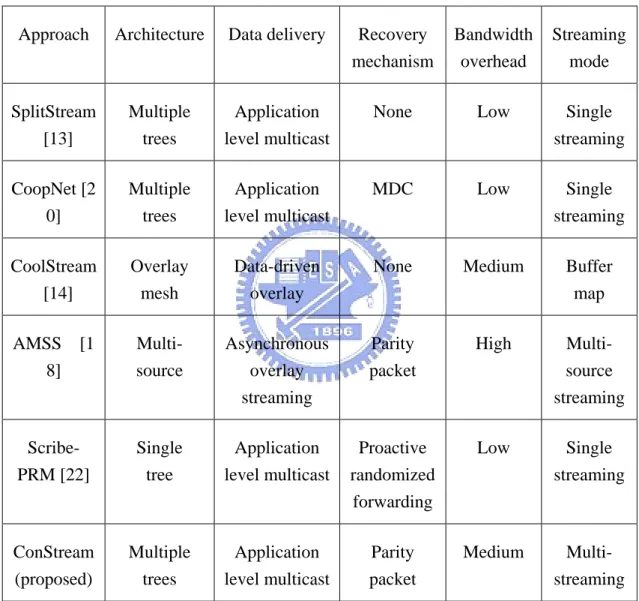
proposed aiming at reliability and resilience [8], [9], [12]. Table 1 shows the
Table 1. Comparison of related P2P streaming algorithms
Approach Architecture Data delivery Recovery mechanism Bandwidth overhead Streaming mode SplitStream [13] Multiple trees Application level multicast
None Low Single streaming CoopNet [2 0] Multiple trees Application level multicast MDC Low Single streaming CoolStream [14] Overlay mesh Data-driven overlay
None Medium Buffer map AMSS [1 8] Multi- source Asynchronous overlay streaming Parity packet High Multi- source streaming Scribe- PRM [22] Single tree Application level multicast Proactive randomized forwarding Low Single streaming ConStream (proposed) Multiple trees Application level multicast Parity packet Medium Multi- streaming 9
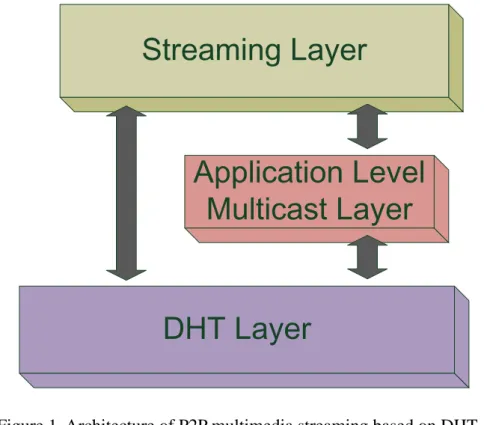
Figure 1. Architecture of P2P multimedia streaming based on DHT.
Figure 1 shows the architecture of P2P multimedia streaming based on DHTs. The
steaming layer is the focus of our approach. In general, a stream is composed of
segments. And the streaming layer is responsible to make the peers able to set some
sorts of priority to the segments and to their partners. The application level multicast
acting on the DHT layer is responsible to construct a multicast overlay network, like
Scribe [11]. Finally, we used Pasty [10] as our DHT layer to implement our basic
structure.
11
Chapter 3
Design Approach
In [15], it shows that the delivery ratio decreases when the transient condition
becomes serious in P2P networks. We propose a multi-streaming scheme on the
streaming layer, called ConStream, to resist this condition. The basic architecture of
our proposed approach is like SplitStream, striping the content across a forest of
interior-node-disjoint multicast trees that distributes the forwarding load among all
participating peers. In SplitStream, a content source forwards the content via different
stripes in a proper sequence, and the content length to forward a stripe each time is
fixed. However, in our ConStream, we merge three stripes as a unit named
multi-stripe and the total stripes in SplitStream can be viewed as several multi-stripes.
The content in a multi-stripe will be divided into small pieces, and they will be
forwarded by three multicast trees concurrently. Also we insert parity packets [18]
into streams for error recovery.
There are some problems when several streams work concurrently. Firstly, if
streams deliver contents via the same tree architecture, the forwarding capacity that
senders (interior nodes) can offer will be shared by those streams. In addition, several
ancestors lefts. Secondly, if streams are delivered via different tree architectures, how
we can do to prevent generating more load to the source or bigger delay jitter to
clients.
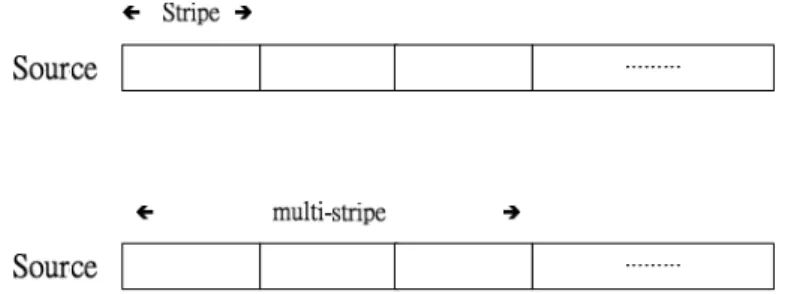
Figure 2. Concept of stripe and multi-stripe.
In Figure 2, it shows the difference between the traditional stripe and multi-stripe.
We view the total contents as many fixed time segments, and stripes are used to
deliver these segments in turn. Traditionally, the source delivers contents via one
single tree during each stripe delivering, as illustrated in Figure 3. In multi-stripe,
three stripes are grouped into a unit and contents are delivered by three stripes
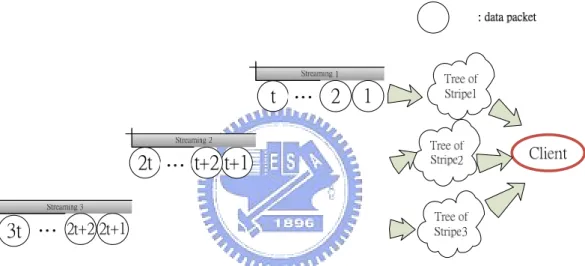
concurrently, as illustrated in Figure 4. During packets delivering in sequence via
different streams, we insert parity packets into them. A parity packet is generated from
the two latest transmitted packets. Once any interior node fails in one stream, the
descendants of this streaming tree can recover the lost data by parity packets from the
other two living streams during the time of repairing the failed tree. In Figure 4, the
parity packet (5 6) is generated and inserted into streaming 1 after packet (5) and
packet (6) are delivered via streaming 2 and streaming 3, respectively. For a certain
client, if data packet (5) is lost, this packet can be recovered by packet (6) and parity
packet (5 6). Additionally, due to the characteristic of the forest of
interior-node-disjoint [13], one faulty interior client just causes bad effect on one tree.
Thus, our approach can work robustly unless one client loses more than one stream
simultaneously, which is a situation that seldom happens.
Figure 3. Deliver the content via stripes.
Figure 4. Deliver the content via multi-stripe.
Based on the characteristic of the forest of interior-node-disjoint, these
concurrent streams will work on different tree structures and the forwarding capacity
of each client won’t be shared by more than one stream. In the view point of any node
itself, among the trees, a node is an interior node in only one tree, and it is a leaf node
in each of the other trees. In this way, one client receives the content via three
different streams, but it plays as an interior node which is responsible to forward
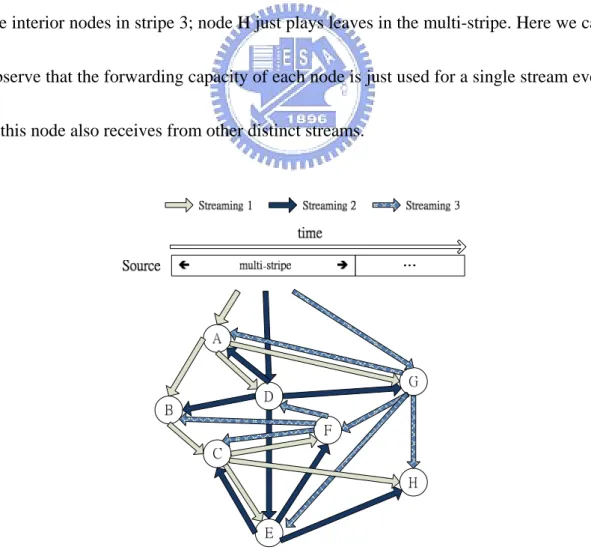
contents to no more than one stream. Figure 5 shows that nodes A, B, and C are
interior nodes in stripe 1; nodes D and E are interior nodes in stripe 2; nodes F and G
are interior nodes in stripe 3; node H just plays leaves in the multi-stripe. Here we can
observe that the forwarding capacity of each node is just used for a single stream even
if this node also receives from other distinct streams.
Figure 5. Concurrent streams during the time interval of multi-stripe.
15
The server load and bandwidth needed in our approach will increase due to
adding parity packets, but the required delivery rate in each stream will be moderated.
The forwarding load of each interior node in a multi-stripe will be 1.5 times the
forwarding load in a traditional stripe, because each parity packet generated is
accompanying with two data packets. However, considering the time interval of
multi-stripe that increases 3 times, the delivery rate of each stream in multi-stripe is
only half of the delivery rate of the stripe. The results are that packets in Figure 4 are
sparser than packets in Figure 3. The delivery rate is defined as the amount of packets
delivered over a time unit. In this way, the burden on peers will be efficiently reduced
during delivery time although the total forwarding load increases. Therefore, it’s a
feasible solution to ease up the burden on those peers with not enough outgoing
bandwidth.
According to [13], a node in the overlay network will contribute its bandwidth
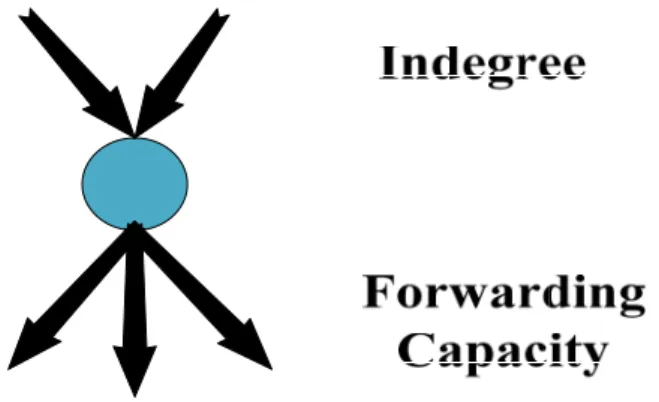
for data forwarding. As shown in Figure 6, the forwarding capacity of a node is
defined as the number of its receivers, and indegree is defined as the number of
distinct stripes that a node requests. For the feasibility of forest construction in
SplitStream, it needs to satisfy the following two conditions. (1) Feasible condition: if
forest construction is feasible, the sum of the desired indegrees of all nodes cannot
the above feasible condition to hold, each node’s forwarding capacity must exceed its
desired indegree [13].
Figure 6. Conception of indegree and forwarding capacity.
Following the above conditions, the more forwarding capacity a client
contributes the more indegree a client can receive. These two conditions emphasize
fairness and are used to improve performance. And since our proposed architecture is
based on SplitStream, we can also make our model ideal by satisfying the feasible
condition and sufficient condition. According to our improved architecture, clients can
contribute more capacity to promote efficiency in a system and to easily satisfy the
need of indegree, because their original load is lowered by decreasing the delivery
rate.
In our ConStream, we merge three stripes as a multi-stripe and take it as a unit to
forward the content. But why not merge four, five, or six as a multi-stripe? When
17
streams are delivered concurrently, a client will receive contents from different paths,
and the delay time of these data will be more variant than that of just from one path.
For example, in Figure 5, node F receives contents form streaming 1, streaming 2, and
streaming 3 concurrently, but the hops of stream paths from the source to node F are 4,
3, and 2, respectively. This situation will result in unsteady quality of media contents
played in real time. To reduce such a jitter problem, we merge only three stripes and
we also base on the slowest stream to start the real time multimedia playing during
multi-stripe delivering. However, in this way, it will cause the client buffer being
occupied by the data from the other two streams during waiting for the slowest stream.
18
Chapter 4
Simulation Results and Discussion
Based on the architecture in Figure 1, we used FreePastry (version 2.0_03) [19]
to implement the DHT layer (Pastry), application layer multicast (Scribe), and
streaming layer (SplitStream). And then we implement our proposed ConStream
scheme on this structure. In addition, we implemented Scribe-PRM, which we are
going to compare with, by applying PRM to Scribe to significantly augment the data
delivery ratio of Scribe.
4.1 Simulation Scenarios
Our environment was built on a Pastry overlay with 1000 nodes and built a forest
structure with all overlay nodes. The delivery ratio is defined as the ratio of packets a
client received to total delivered packets by the source. Repair time is determined
primarily by SplitStream’s failure detection period, which triggers a tree repair when
no heartbeats or data packets have been received for 30 seconds [13]. Besides, the
randomized forwarding probability p in Scribe-PRM is chosen to be 0.05 [22]. We
will measure the delivery ratio under transient conditions, and the parameters for the
19
[22]. We assume that the delivery ratio of each peer is 100% under non-transient
environments. On the other hand, we measure the absolute delay of sequential packets
on a certain client to examine delay jitter. The absolute delay is defined as the elapsed
time of a packet from source to destination. In addition, the environment we used to
measure the absolute delay is established with non-transient condition because the
transient condition may cause more unstable factors in the measurement.
4.2 Simulation Results
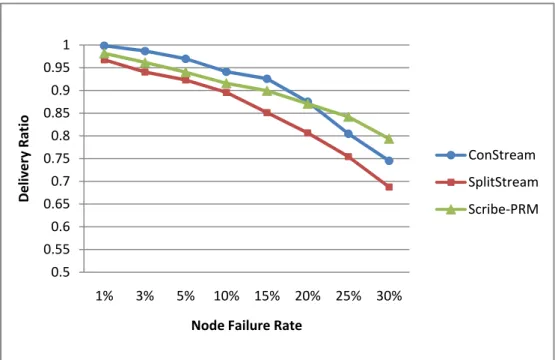
In Figure 7, we examine the variation of delivery radios under the node failure
rate between 1% and 30% (which implies 10 to 300 simultaneous failures in the
overlay with 1000 nodes) with a fixed MTTF of 120 seconds. The result shows that
the descending rates of the delivery ratio with the increase of the node failure rate for
ConStream and SplitStream are similar, but Scribe-PRM has a lower descending rate.
Our ConStream performs better than Scribe-PRM under the node failure rate less than
20%. And in reality, 20% of the node failure rate is too high in usual Internet
standards.
In addition, we examine the distribution of delivery ratios in each algorithm
20
simultaneous failures in the overlay with 1000 nodes). And we randomly chose 100
nodes from this overlay and the result is shown in Figure 8. The delivery ratio in
SplitStream or Scribe-PRM is about 60% ~ 100%. The delivery ratio in ConStream is
about 80% ~ 100%, which is denser than the other two. As a result, we observed that
nodes in ConStream will receive stable contents even under transient condition.
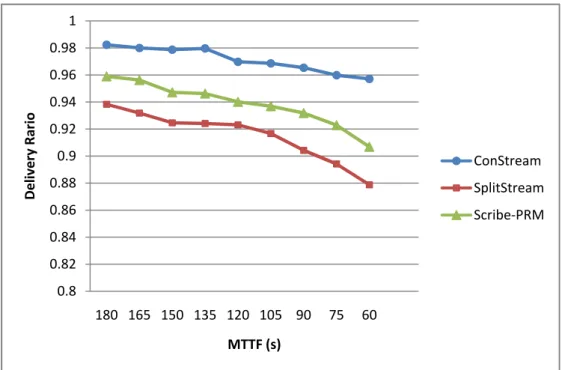
Assuming that the actual internet environment of node failure rate is 5% (which
is still high in usual Internet standards) [22], we examined the delivery ratio under
different MTTFs. From simulation results in Figure 9, ConStream has higher delivery
ratio than SplitStream and Scribe-PRM under different MTTFs. Additonally, we
found that the curve of ConStream demostrates more steady trend than the other two
with respect to different MTTFs. Note that the difference of delivery ratios between
ConStream and Scribe-PRM (or SplitStream) increases as MTTF decreases. For
example, when MTTF is between 180 and 60 seconds, the variances of delivery ratios
for ConStream is about 0.02, while the variances for Scribe-PRM and SplitStream are
0.5 0.55 0.6 0.65 0.7 0.75 0.8 0.85 0.9 0.95 1 1% 3% 5% 10% 15% 20% 25% 30% Delivery Ratio Node Failure Rate ConStream SplitStream Scribe‐PRM
Figure 7. Delivery ratios with various node failure rates
under a fixed MTTF (120 seconds).
0.4 0.5 0.6 0.7 0.8 0.9 1 Delivery Ratio Node Distribution (100 nodes)
ConStream SplitStream Scribe‐PRM
Figure 8. Distribution of delivery ratios.
0.8 0.82 0.84 0.86 0.88 0.9 0.92 0.94 0.96 0.98 1 180 165 150 135 120 105 90 75 60 Delivery Rario MTTF (s) ConStream SplitStream Scribe‐PRM
Figure 9. Delivery ratios under different MTTFs.
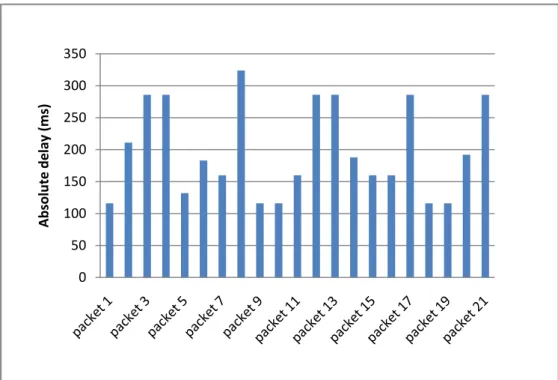
In ConStream, the absolute delays of packets that a client receives from the same
sequence may be unstable because these packets are delivered via different paths.
In Figure 10, it shows packets with wide delay variation received by one client in a
certain time interval. In addition, we classified these packets according to the streams
they originally belong to, as shown in Figure 11. The absolute delays in multi-stripe of
our ConStream is less stable, and we have proposed an improved solution, introduced
in Chapter 3, for each client, in order to handle this unfavorable condition.
0 50 100 150 200 250 300 350 Absolute delay (ms)
Figure 10. Variation of absolute delays among received packets.
0 50 100 150 200 250 300 350 1 2 3 4 5 6 7 Absolute delay (ms) Stream 1 Stream 2 Stream 3
Figure 11. Absolute delays by each streaming.
24
Chapter 5
Conclusion
5.1 Concluding Remarks
We have presented a P2P multi-streaming scheme, ConStream, which have a
feature of a high delivery ratio. And in this scheme, with the parity packet and the
multi-stripe techniques, the lost data caused by transient peers in P2P networks can be
reduced, and the tree recovery time can be tolerated as well. However, clients’ buffers
that are used to cache contents temporarily need to be increased to resolve variable
delay times between streams. Although the bandwidth consumed by each stream will
increase for parity packets, the load on peers will be efficiently reduced during
delivery time because of the reduced delivery rate of streams.
5.2 Future Work
We will implement the proposed ConStream in an actual internet environment,
25
Bibliography
[1] http://mmdays.wordpress.com/2007/04/19/p2p-tv/
[2] M. Balazinska, H. Balakrishnan, and D. Karger, “INS/Twine: A scalable peer-to-peer architecture for intentional resource discovery,” in Proc. ICPC, pp. 195–210, August 2002.
[3] M. Harren, J. Hellerstein, R. Huebsch, B. Loo, S. Shenker, and I. Stoica, “Complex queries in dht-based peer-to-peer networks,” in Proc. IPTPS, pp. 242-250, March 2002.
[4] L. Garces-Erice, P.A. Felber, E.W. Biersack, G. Urvoy-Keller, K.W. Ross, “Data indexing in peer-to-peer DHT networks,” in Proc. ICDCS, pp. 200-208, 2004. [5] C. Luo, J. Li, and S. Li, "DigiMetro – An Application-Level Multicast System
for Multi-party Video Conferencing," in Proc. IEEE Globecom, Vol. 2, pp. 982-987, November 2004.
[6] Z. Liu, G. He, Zhi Liu, “Metrino - an application-level multicast system for real-time video communication,” in Proc. WiCOM, Vol 2, pp. 1311–1316, Sept. 2005.
[7] C.L. Chan, S.Y. Huang, H.H. Chen, W.H. Tung, J.S. Wang, “An Application-Level Multicast Framework for Large Scale VOD Services,” in Proc.
ICPADS, pp. 98–104, 2005.
[8] V.N. Padmanabhan, H.J. Wang, P.A. Chou, “Resilient peer-to-peer streaming,” in
Proc. IEEE ICNP, pp. 16–27, Nov 2003.
[9] D.A. Tran, K.A. Hua, and T. Do, “ZIGZAG: An efficient peer-to-peer scheme for media streaming,” in Proc. IEEE INFOCOM, pp. 1283–1292, April 2003.
[10] A. Rowstron, P. Druschel, “Pastry: Scalable, distributed object location and routing for large-scale peer-to-peer systems,” in Proc. IFIP/ACM International
Conference on Distributed Systems Platforms (Middleware), pp. 329–350,
November 2001.
[11] M. Castro, P. Druschel, A.M. Kermarrec, and A. Rowstron., “Scribe: A large-scale and decentralized application level multicast infrastructure,” IEEE
Journal on Selected Areas in Communication, Vol. 20, pp. 1489-1499, October
2002.
[12] M. Yang and Z. Fei, “A proactive approach to reconstructing overlay multicast trees,” in Proc. IEEE INFOCOM, Vol. 4, pp. 2743-2753, march 2004.
[13] M. Castro, P. Druschel, A.M. Kermarrec, A. Nandi, A. Rowstron, A. Singh, “Splitstream: High-bandwidth content distribution in a cooperative environment,” in Proc. IPTPS’03, pp. 292-303, February 2003.
26
[14] X. Zhang, J. Liu, B. Li, Y.-S.P. Yum,” CoolStreaming/DONet: a data-driven overlay network for peer-to-peer live media streaming,” in Proc. IEEE
INFOCOM, Vol. 3, pp. 2102-2111, Mach 2005.
[15] S. Birrer, F.E. Bustamante, “The feasibility of DHT-based streaming multicast,” in Proc. MASCOTS, pp. 288-298, Sept. 2005.
[16] Y.K. Dalal and R.M. Metcalfe, “Reverse path forwarding of broadcast packets,”
Communication of the ACM, Vol. 21, pp. 1040–1048, December 1978.
[17] A.R. Bharambe, S.G. Rao, V.N. Padmanabhan, S. Seshan, and H. Zhang, “The impact of heterogeneous bandwidth constraints on DHT-based multicast protocols,” in Proc. IPTPS, pp. 115-126, February 2005.
[18] S. Itaya, T. Enokido, M. Takizawa, A. Yamada, “A scalable multimedia streaming model based-on multi-source streaming concept,” in Proc.
International Conference on Parallel and Distributed systems, Vol. 1, pp. 15-21,
July 2005.
[19] http://freepastry.rice.edu/FreePastry/README-2.0_03.html
[20] P.A. Chou, V.N. Padmanabhan, and H.J. Wang, “Resilient peer-to-peer streaming,” in Proc. IEEE International Conference on Network Protocols, pp. 16-27, March 2003.
[21] T. Xiangroug, S. Datta, “Building multicast trees for multimedia streaming in heterogeneous P2P networks,” in Proc. Systems Communications, pp. 141-146, July 2005.
[22] S. Banerjee, S. Lee, B. Bhattacharjee, A. Srinivassan, “Resilient multicast using overlays,” IEEE/ACM Transactions on Networking, pp. 237-248, April 2006. [23] S. Birrer, F.E. Bustamante, “Resilient peer-to-peer multicast without the cost,” in