國
立 交 通 大 學
資訊工程學系
博士論文
安全數位盲簽章機制之設計與應用
The Design of Secure Digital Blind
Signature Schemes and Their Applications
研
究 生:吳林全
Student: Lin-Chuan Wu
指導教授:葉義雄
Advisor:
Yi-Shiung
Yeh
安全數位盲簽章機制之設計與應用
學 生
: 吳林全 指導教授: 葉義雄
國 立 交 通 大 學 資 訊 工 程 學 系 博 士 班
摘要
近 年 來 由 於 網 際 網 路 應 用 快 速 地 發 展 , 使 得 網 路 購 物 和 網 路 競 標 等 電 子 交 易 服 務 日 漸 普 及 。 目 前 這 些 服 務 所 採 用 的 認 證 方 式 大 多 為 身 份 -密 碼 (ID-Password) 機 制 , 因 其 不 具 備 不 可 否 認 ( non-repudiation) 的 性 質 。 因 此 , 植 基 於 公 開 金 鑰 基 礎 建 設 (PKI) 之 數 位 簽 章 機 制 能 夠 達 到 交 易 上 之 不 可 否 認 性 , 建 立 電 子 商 務 應 用 和 服 務 之 穩 定 基 礎 。 然 而 , 在 電 子 現 金 或 電 子 投 票 等 應 用 中 , 須 額 外 滿 足 使 用 者 對 匿 名 性(anonymity)的 要 求,以 保 障 使 用 者 的 隱 私 權。因 此,數 位 盲 簽 章 機 制 的 設 計 即 是 要 解 決 此 一 問 題 , 以 提 供 使 用 者 達 到 不 可 追 蹤 性 (untraceability)目 的,使 得 在 計 算 上 簽 章 之 簽 署 者 事 後 無 法 識 別 所 簽 署 之 簽 章 是 由 何 人 所 持 有 ; 換 句 話 說 就 是 要 追 蹤 出 該 簽 章 的 持 有 人 在 計 算 上 是 不 可 行 的 。本 論 文 主 要 是 提 出 偽 造 即 停 盲 簽 章 機 制 (fail-stop blind signature scheme) 來 解 決 傳 統 盲 簽 章 機 制 在 面 對 擁 有 無 限 計 算 能 力 的 偽 造 者 總 是 能 夠 成 功 地 偽 造 簽 章 , 且 對 偽 造 即 停 盲 簽 章 機 制 所 須 具 備 的 安 全 性 質 加 以 定 義 , 並 證 明 所 提 出 之 簽 章 機 制 是 安 全 的 。 本 論 文 亦 針 對 現 有 各 種 植 基 於 整 數 分 解 、 二 次 剩 餘 以 及 離 散 對 數 之 盲 簽 章 機 制 , 提 出 一 些 在 安 全 上 和 效 率 上 的 改 善 方 法 。 同 時 也 探 討 代 理 盲 簽 章 機 制 之 不 可 偽 造 性(unforgeability)和 不 可 追 蹤 性( untraceability) 等 安 全 議 題 。 最 後 , 提 出 具 備 偽 造 即 停 盲 簽 章 機 制 之 電 子 現 金 系 統 和 具 備 資 訊 隱 藏 和 不 可 追 蹤 性 之 電 子 票 卷 協 定 , 期 能 建 構 更 安 全 的 電 子 交 易 系 統 之 理 論 基 礎 和 應 用 服 務 。 關 鍵 字: 不 可 追 蹤 性, 偽 造 即 停 盲 簽 章 機 制, 盲 簽 章 機 制, 密 碼 學, 資 訊 安 全
The Design of Secure Digital Blind
Signature Schemes and Their Applications
Student: Lin-Chuan Wu Advisor: Yi-Shiung Yeh
Institute of Computer Science and Information Engineering
National Chiao Tung University
Abstract
Recently, Internet applications are developed rapidly, such that
electronic transaction services like purchasing and bidding on Internet are
more popular. The ID-Password mechanism is mainly used for
authentication, but it cannot achieve the non-repudiation property.
Therefore, the digital signature scheme based on PKI can achieve the
non-repudiation property in electronic transactions. It can be the
well-constructed basis for electronic commerce services and applications.
However, in electronic cash or electronic ticket applications, the
privacy. Thus, the digital blind signature scheme is proposed for this
purpose. The untraceability property is an important property in digital
blind signature scheme, it makes the signer computationally cannot identify
the signature which is owned by someone. In the other words, the signer
is computationally infeasible to trace the signature.
In this dissertation, a fail-stop blind signature scheme is proposed to
solve the problem that a forger with more powerful computational
capability can always forge a signature successfully. A secure fail-stop
blind signature scheme is also defined. Moreover, our proposed signature
scheme is proved secure.
Some improved digital blind signature schemes, in security and
efficiency, based on integer factorization, quadratic residue, and discrete
logarithm cryptosystems are also be presented in this dissertation.
Furthermore, the unforgeability and untraceability properties of proxy blind
signature schemes are discussed. Finally, an electronic cash system based
on fail-stop blind signature scheme and an electronic ticket protocol with
information hiding are proposed. They can be established for more secure
關 鍵 字: Untraceability, Fail-stop Blind Signature Scheme, Blind Signature
Contents
CHAPTER 1 INTRODUCTION ... 1
1.1 MOTIVATIONS... 1
1.2 RESEARCH OBJECTIVES AND CONTRIBUTIONS... 2
CHAPTER 2 DIGITAL SIGNATURE SCHEMES ... 4
2.1 RIVEST-SHAMIR-ADLEMAN SIGNATURE SCHEME... 4
2.2 ELGAMAL SIGNATURE SCHEME... 7
2.3 RABIN SIGNATURE SCHEME... 9
2.4 CHAUM BLIND SIGNATURE SCHEME... 11
2.5 SUSILO-SAFAVI-PIEPRZYK FAIL-STOP SIGNATURE SCHEME... 13
2.6 MAMBO-USUDA-OKAMOTO PROXY SIGNATURE SCHEME... 16
CHAPTER 3 ANALYSIS OF SOME BLIND SIGNATURE SCHEMES ... 20
3.1 CRYPTANALYSIS ON A NEW RABIN-LIKE BLIND SIGNATURE SCHEME... 20
3.1.1 Chen et al.’s Blind Signature Scheme ... 23
3.1.2 Cryptanalysis on Chen et al.’s Scheme ... 25
3.2 RSA-BASED PARTIALLY BLIND SIGNATURE SCHEME... 27
3.2.1 Chien et al.’s scheme ... 28
3.2.2 Hwang et al.’s Traceability Attack ... 30
3.2.3 Analysis of Hwang et al.’s Attack ... 32
3.3 UNTRACEABLE ELGAMAL BLIND SIGNATURE SCHEME... 34
3.3.1 Camenisch et al.’s scheme ... 35
3.3.2 Lee et al.’s Traceability Attack ... 36
3.3.3 Analysis of Lee et al.’s Attack ... 37
3.4.1 The Proxy Blind Signature Schemes ... 42
3.4.1.1 Tan et al.’s proxy blind signature schemes ... 42
3.4.1.2 Lal and Awasthi’s proxy blind signature scheme ... 44
3.4.2 Sun et al.’s Traceability Attack... 46
3.4.2.1 Sun et al.’s attack on Tan et al.’s schemes ... 46
3.4.2.2 Sun et al.’s attack on Lal-Awasthi’s scheme... 47
3.4.3 Analysis of Sun et al.’s Attack ... 48
3.4.3.1 Analysis of Sun et al.’s attack on Tan et al.’s schemes... 48
3.4.3.2 Analysis of Sun et al.’s attack on Lal-Awasthi’s scheme ... 50
CHAPTER 4 THE PROPOSED DIGITAL BLIND SIGNATURE SCHEMES ... 52
4.1 AFAIL-STOP BLIND SIGNATURE SCHEME ... 52
4.1.1 The Proposed Blind Signature Scheme ... 53
4.1.2 Security Analysis ... 55
4.2 THE ENHANCED GENERIC BLIND SIGNATURE SCHEME ... 61
4.3 THE ENHANCED BLIND SIGNATURE SCHEME BASED ON THE ELLIPTIC CURVE CRYPTOSYSTEM... 63
4.3.1 Yeh-Chang’s Blind Signature Scheme... 64
4.3.2 The Enhanced Signature Scheme ... 66
4.3.3 Security Analysis ... 68
4.3.4 Performance Comparison ... 71
CHAPTER 5 APPLICATIONS OF SOME BLIND SIGNATURE SCHEMES ... 73
5.1 THE UNTRACEABLE FAIL-STOP ELECTRONIC CASH SCHEME ... 74
5.1.1 Chaum’s Untraceable Electronic Cash Scheme ... 75
5.1.2 The Proposed Electronic Cash Scheme ... 77
5.2 AN UNTRACEABLE ELECTRONIC TICKET SCHEME FOR INFORMATION HIDING... 82
5.2.1 The Proposed Electronic Ticket Scheme ... 83
5.2.2 Security Analysis ... 85
CHAPTER 6 CONCLUSIONS ... 87
List of Figures
FIGURE 2.1 BLOCK DIAGRAM OF RSA SIGNATURE SCHEME... 5
FIGURE 2.2 PROTOCOL DIAGRAM OF RSA SIGNATURE SCHEME... 7
FIGURE 2.3 BLOCK DIAGRAM OF ELGAMAL SIGNATURE SCHEME... 8
FIGURE 2.4 PROTOCOL DIAGRAM OF ELGAMAL SIGNATURE SCHEME... 9
FIGURE 2.5 BLOCK DIAGRAM OF RABIN SCHEME...10
FIGURE 2.6 PROTOCOL DIAGRAM OF RABIN SCHEME...11
FIGURE 2.7 PROTOCOL DIAGRAM OF CHAUM SIGNATURE SCHEME...13
FIGURE 2.8 PROTOCOL DIAGRAM OF PARTIAL DELEGATION PROXY SIGNATURE SCHEME ...19
List of Tables
TABLE 4.1 THE COMPARISON OF REQUIRED STORAGE REQUIREMENTS...72
Chapter 1 Introduction
1.1 Motivations
Due to Internet applications are developed rapidly, such that electronic
transaction services like that purchasing and bidding on Internet are more
popular. These applications are mainly using the ID-Password mechanism
for authentication, but this mechanism cannot achieve the non-repudiation
property. For protect the users against malicious parties, some advanced
techniques to enhance the security of the electronic transaction services are
required. Therefore, the digital signature scheme based on Public Key
Infrastructure (PKI) can achieve the non-repudiation property. It is also
the key component for electronic commerce services and applications.
Although the digital signature scheme can achieve the non-repudiation
property, it cannot provide the privacy for the users. In some applications
like electronic cash or electronic ticket systems, the anonymity property is
very important and should be satisfied. Thus, the digital blind signature
scheme is proposed to ensure the unforgeability for the signer and achieve
signer computationally cannot identify the signature which is owned by
someone. Hence, the signer is computationally infeasible to trace the
signature.
However, the traditional digital blind signature schemes cannot protect
the signer against a forger with more powerful computational capability to
forge a signature. This means that there is no mechanism to protect the
signer against a forged signature which has succeeded in signature
verification. Namely, if a signed message succeeds in signature
verification it is assumed to be generated by the owner of the private key.
Thus, a fail-stop blind signature scheme is proposed to solve this problem
in this dissertation.
Recently, a lot of misunderstandings on digital blind signature
schemes and proxy blind signature schemes are submitted. They claim
that some blind signature schemes cannot satisfy the untraceability property.
However, these claims are incorrect and they will be analyzed and
corrected.
In this dissertation, a secure fail-stop blind signature scheme based on
the integer factorization is defined, proposed and proved. It can be
applied in more critical system like electronic payment systems which need
higher security against more powerful forger and can preserve the users’
privacy. Furthermore, some misunderstanding claims on digital blind
signature schemes are discussed and corrected in detail. The
untraceability property of the proxy blind signature schemes is also
analyzed in this dissertation. Finally, some more secure electronic
Chapter 2 Digital Signature Schemes
The ordinary handwritten signature is used to specify the responsibility
of the person and can achieve the non-repudiation property. A digital
signature scheme is a method to sign the message in electronic form and can
provide analogous to the ordinary handwritten signature. Any digital
information including digital signatures can be copied easily, so digital
signatures cannot be the digitalized version of handwritten signatures. To
overcome this problem, digital signature schemes are designed by using
mathematical functions and interactive protocols. The following sections
describe the various digital signature schemes in detail.
2.1 Rivest-Shamir-Adleman Signature Scheme
The concept of digital signature scheme was introduced by Diffie and
Hellman [12] in 1976. Generally, a digital signature scheme has the
signing algorithm and the verification algorithm. The fundamental idea is
that everyone has pair of keys: a signing/private key and a
the signing algorithm and the verification key is to verify the correctness of
the signature by using the public verification algorithm. Especially, the
verification key can be published and the signing key must be kept secretly.
In 1978, Rivest, Shamir, and Adleman [43] proposed the first digital
signature scheme based on the integer factorization problem. The signer
and the requester are two kinds of participants in RSA signature scheme.
The four phases in RSA signature scheme are: (1) Initialization, (2)
Requesting, (3) Signing, (4) Verification. Initially, the signer publishes
the necessary information for the participants. In the requesting phase,
the requester sends the message to the signer. The signer signs on that
message in the signing phase. Finally, anyone can verify the correctness
of the signature using the message-signature pair in the verification phase.
Figure 2.1
shows the block diagram of RSA signature scheme for signingand verification. The detailed signature scheme is described as follows.
(1) Initialization: The signer randomly selects two large primes p
and q , and calculates n= p⋅q and φ(n)=(p−1)⋅(q−1) . Next, the
signer selects a large random number 1<d <φ(n) such that )
( mod
1 n
d
e⋅ ≡ φ . Thus, d is the private key of the signer and e is the
public key.
(2) Requesting: The requester prepares the message m and sends it to
the signer.
(3) Signing: The signer calculates the signature s=md modn on the
message m and sends s to the requester.
(4) Verification: Anyone can verify the correctness of the signature s
received from the requester by checking whether se =mmodn because e
is public.
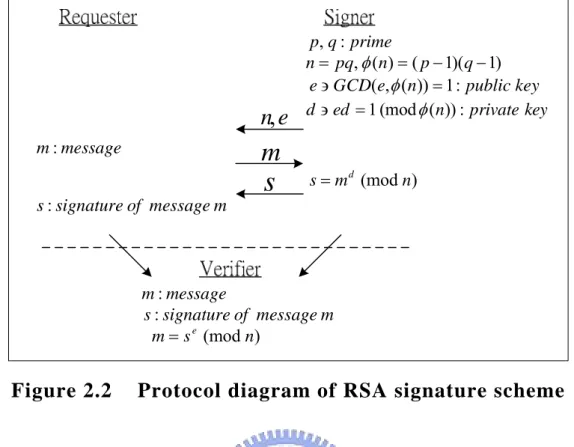
The protocol diagram of RSA signature scheme is illustrated in
Figure
prime q p, : ) 1 )( 1 ( ) ( , = − − = pq n p q n φ key public n e GCD e∋ ( ,φ( ))=1: key private n ed d ∋ =1(modφ( )): message m :
m
) (mod n m s= de
n,
message m : m message of signature s : ) (mod n s m= es
m message of signature s :Figure 2.2 Protocol diagram of RSA signature scheme
Anyone can forge a signature by using multiplication attack in RSA
signature scheme. To prevent this attack, hash function can be used
within the signature scheme to reduce the problem.
2.2 ElGamal Signature Scheme
ElGamal [13] presented another digital signature scheme in 1985.
The security of ElGamal scheme is based on the difficulty of computing
discrete logarithm. There are many valid signatures for any given
message in ElGamal scheme, and any of these valid signatures are authentic
non-deterministic signature scheme. The major shortcoming in ElGamal
scheme is the double length of any message. The block diagram of ElGamal
signature scheme for signing and verification is shown by
Figure 2.3
.
Figure 2.3 Block diagram of ElGamal signature scheme
The four phases of ElGamal scheme are described in the following.
(1) Initialization: The signer randomly chooses a prime number p
such that discrete logarithm problem in Z is intractable. Let p g∈Zp*
be a primitive root and x be the private key of the signer. The public
key of the signer is defined by y= gx modp.
(2) Requesting: The requester sends the message m to the signer.
(3) Signing: The signer selects a random number k. Then s/he can
compute r= gk modp and s=k−1(m−xr)mod(p−1). The ( sr, ) is the
signature on the message m.
(4) Verification: Anyone can verify the correctness of the signature
) ,
Figure 2.4
illustrates the protocol diagram of ElGamal signature scheme. prime p : p of generator Z g∈ p* : key private Z x∈ p : key public p g y= x (mod ): message Z m∈ p :m
number random Z k∈ p : ) (mod p g r = k ) 1 (mod ) ( 1 − − = − p rx m k s)
,
( s
r
m message of signature s r, ): ( q to prime relatively message m : m message of signature s r, ): ( ) (mod p r y gm = r sFigure 2.4 Protocol diagram of ElGamal signature scheme
2.3 Rabin Signature Scheme
In 1979, Rabin [40] proposed a signature scheme based on the
quadratic residue problem. The security of Rabin scheme is based on the
difficulty of computing square root modulo a composite number. Rabin
scheme is computationally secure against chosen-plaintext attack.
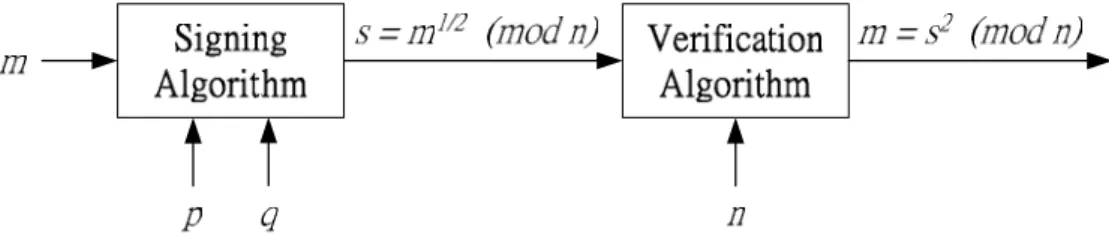
Figure
2.5
shows the block diagram of Rabin signature scheme for signing andFigure 2.5 Block diagram of Rabin scheme
(1) Initialization: The signer can selects two random prime numbers
p and q , where p=3mod4 and q=3mod4. Then s/he calculates q
p
n= ⋅ and φ(n)=(p−1)⋅(q−1). Thus, p and q are the private key
and n is the public key.
(2) Requesting: The requester prepares the message m and sends it to
the signer.
(3) Signing: The signature is the square root of the message m.
Thus, the signer can calculate the signature s=m1/2 modn and sends s to
the requester.
(4) Verification: Anyone can verify the signature s by checking
whether s2 =mmodn is true.
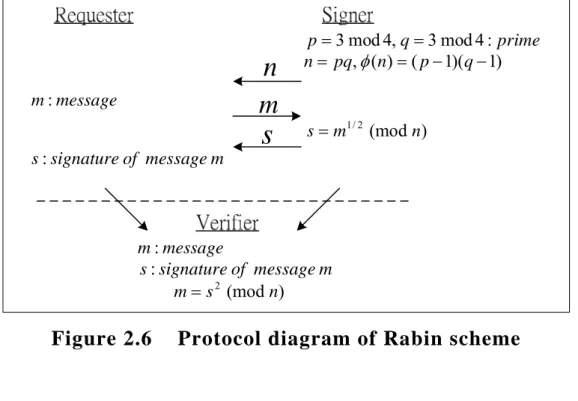
The protocol diagram of Rabin signature scheme is illustrated detailed
prime q p=3mod4, =3mod4: ) 1 )( 1 ( ) ( , = − − = pq n p q n φ message m :
m
) (mod 2 / 1 n m s=n
message m : m message of signature s : ) (mod 2 n s m=s
m message of signature s :Figure 2.6 Protocol diagram of Rabin scheme
2.4 Chaum Blind Signature Scheme
Chaum [8] presented the first blind signature scheme based on RSA
digital signature scheme in 1982. The blind signature scheme allows a
requester to obtain a message signed by the signer without revealing
message. Therefore, the signer cannot link/trace any message-signature
pair practically later. The blind signature scheme can be used in
electronic payment systems or electronic voting systems to preserve the
participants’ anonymity. The detailed scheme is described in the
following.
randomly, and computes n= pq and φ(n)=(p−1)(q−1) . Then, the
signer selects two random numbers e and d such that ed ≡1modφ(n),
where )1<e<φ(n and 1<d <φ(n). Finally, the signer publishes ( en, )
as his public key and a one-way hash function H like SHA-1.
(2) Blinding and requesting: The requester selects a random number
r as the blinding factor, where r∈Zn*. Then, the requester sends the
blinded message m~ =reH(m)modn to the signer.
(3) Signing: After the signer receives the blind message m~, s/he
calculates d
m s ~
~ = and sends it to the requester.
(4) Unblinding: The requester can compute the signature
n s
r
s= −1~mod from the blinded signature s~.
(5) Verification: Anyone can easily verify the message-signature pair
) ,
(m s by checking that se =H(m)modn is true.
The signer cannot recognize which messages was actually signed and
know which blind signatures was actually generated due to the blinding
factor r . Therefore, Chaum blind signature scheme can achieve the
unlinkability/untraceability property.
scheme.
Signer
Requester
prime q p, : ) 1 )( 1 ( ) ( , = − − = pq n p q n φ key private n e GCD e∋ ( ,φ( ))=1: key public n ed d ∋ =1(modφ( )): message m :m
~
) (mod ~ ~s =md ne
n,
Verifier
message m : m message of signature s : ) (mod n s m= ds~
m message of signature m s r s = −1~ = d : number random r : ) (mod ~ r m n m= e ) (mod ~ rm n s = dFigure 2.7 Protocol diagram of Chaum signature scheme
2.5 Susilo-Safavi-Pieprzyk Fail-stop Signature
Scheme
The traditional digital signature schemes cannot protect the signer
against a forger with more powerful computational capability to forge a
signature. This means that there is no mechanism to protect the signer
against a forged signature which has succeeded in signature verification.
to be generated by the owner of the private key.
To overcome this kind of attack, Waidner and Pfitzmann [50, 38]
proposed the first fail-stop signature scheme. Fail-stop signature can
protect a signer against a forger even with more powerful computational
capability because the possibility of finding the signer’s right private key in
the fail-stop signature is negligible. The signer can use “proof of forgery”
algorithm to prove the signature is forgery. It achieves “proof of forgery”
by showing that the underlying computational assumption has been broken.
The signer can stop the system if a forgery occurs – hence named fail-stop
signature scheme. The signer is unconditionally secure and the requester
is cryptographically secure in the fail-stop signature scheme.
In 1992, van Heyst and Pedersen constructed a fail-stop signature
scheme based on the discrete logarithm problem [46] and their scheme is a
Lamport-like one-time signature [26]. Susilo, Safavi-Naini and Pieprzyk
[48] presented two RSA-based fail-stop signature schemes with and without
a trusted dealer in 1999. We only consider the scheme with trusted dealer
here for simplicity. Actually, the signer and the receiver can instead of
trusted dealer to perform the initialization phase by using Boneh-Franklin’s
dealer, the sender and the receiver in the Susilo et al.’s scheme with trusted
dealer. A forged signature can be proved by using Miller’s [33] and
Bach’s [2] methods to reveal non-trivial factors for the signer. The
detailed scheme is described as follows.
(1) Initialization: The two large prime numbers p and q are
chosen by the trusted dealer D , such that p = p2 '+1 and q = q2 '+1, where
'
p and q are also prime. Then, D computes ' n= pq and
) 1 )( 1 ( ) (n = p− q−
φ . Next, D chooses dD as her/his private key and
computes eD =dD−1 modφ(n), where GCD(dD,φ(n))=1. Then, D selects a
random number α∈Zn* and computes n
D
d mod
α
β = . Finally, D
publishes her/his public key ( nα, ) and sends (eD,β) to the signer S
securely.
(2) Key generation: The signer S selects four random numbers,
which are k1,k2,k and 3 k4 as the private key, where ki∈Zn*, 1≤ i≤4.
Next, S computes k4 k3 modn
1 α β β = , k3 k1 modn 1 1 α β α = and n k k mod 2 4 1 2 α β
α = . Finally, s/he publishes her/his public key (β1,α1,α2).
(3) Signature generation: The signer S computes y1 =k1x+k2 and
4 3 2 k x k
y = + , where x∈Zn* is a message. Then, s/he publishes the
(4) Signature verification: The receiver R can verify the signature
by checking the formula αy2β1y1 =α1xα2 modn. If it is true, this signature
is a valid one.
(5) Proof of forgery: If a forged signature (y1 ,'y2') on message x
succeeds in signature verification phase, S can prove that a forgery has
occurred by executing the following steps.
1. To construct the right signature (y1,y2) on message x.
2. To compute Z1 =(y1'−y1) and Z2 =(y2 − y2').
3. To compute γ =eD(Z2 −k4Z1)−k3Z1 =cφ(n)
4. To find non-trivial factors of n by using Miller’s [33] and Bach’s
[2] methods.
5. The non-trivial factors of n is the proof of forgery.
2.6 Mambo-Usuda-Okamoto Proxy Signature Scheme
The proxy signature scheme based on the discrete logarithm problem
was presented by Mambo et al. [30] in 1996. It can allow the designated
example, when a manager is going on a vacation, s/he can delegate her/his
secretary to sign the messages on behalf of her/him. There are three types
of delegation: full delegation, delegation by warrant and partial delegation
in the proxy signature scheme.
In full delegation, the original signer gives her/his private key to the
designated proxy signer and then the original signer and the proxy signer
can both generate the same signatures. However, the signatures generated
by the original signer and the proxy signer are not distinguishable. Thus,
the dispute between the original signer and the proxy signer on the
signature cannot be settled.
The warrant is used to show that the proxy signer is legal and to
describe the needed information between the original signer and the proxy
signer in delegation by warrant. It can be implemented by using ordinary
signature scheme. However, it needs to execute the proxy signature
verification process and then the ordinary signature verification process.
In partial delegation, the original signer uses her/his private key to
generate the proxy secret key and sends it to the proxy signer securely.
The signatures can be distinguished from the original signer and the proxy
delegation scheme and more efficient than delegation by warrant scheme.
We describe Mambo et al.’s partial delegation proxy signature scheme in
detail as follows.
(1) Initialization: The original signer randomly chooses a large prime
number p and a generator *
p
Z
g∈ . Let x be the private key of the
original signer and y be the corresponding public key such that
p g
y = x mod .
(2) Proxy delegation: The original signer randomly selects a number
o
k , and calculates r gko p
o = mod and so = x+koro mod(p−1). Next, the
original signer sends (ro,so) to the proxy signer in a secure manner. After the proxy signer receives (ro,so), s/he can verify it by checking the correctness of the equation g o yr ro p
o s
mod
= . If (ro,so) satisfies that equation, s/he can accept it as a valid proxy. Finally, the proxy signer
computes her/his proxy secret key spr =so +xp modq.
(3) Requesting: The requester sends the prepared message m to the
signer.
(4) Signing: The proxy signer chooses k randomly, and computes
p g
r= k mod and s=k−1(m−xr)mod(p−1), where m is the message to be
(5) Verification: Anyone can verify the correctness of the signature
) ,
( sr by checking that the equation yrrs =gm modp holds.
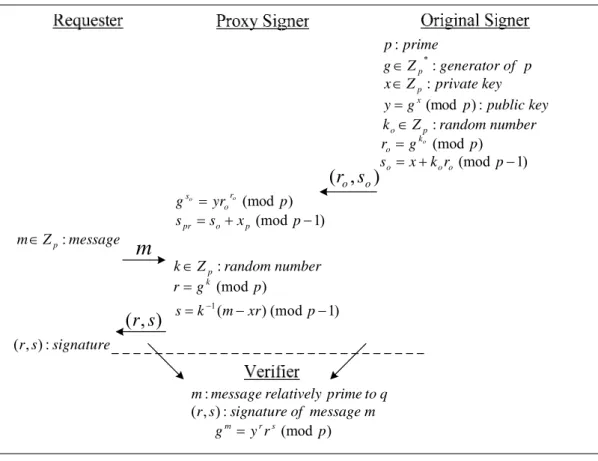
Figure 2.8
illustrates the protocol diagram of Mambo et al.’s proxysignature scheme. prime p : p of generator Z g p : * ∈ key private Z x∈ p: key public p g y= x(mod ): message Z m∈ p:
m
number random Z ko∈ p: ) (mod p g r ko o = ) 1 (mod − + =x k r p so o o ) , (ro so q to prime relatively message m : m message of signature s r, ): ( ) (mod p r y gm = r s ) (mod p yr g o ro o s = ) 1 (mod − + =s x p spr o p number random Z k∈ p : ) (mod p g r= k ) 1 (mod ) ( 1 − − = − p xr m k s ) , ( sr signature s r, ): (Figure 2.8 Protocol diagram of Partial delegation proxy
signature scheme
Chapter 3 Analysis of Some Blind Signature
Schemes
In Section 3.1, we introduce the cryptanalysis on a new Rabin-like
blind signature scheme based on the quadratic residue problem. A
traceability attack on RSA-Based partially signature with low computation
is analyzed and corrected in detail In Section 3.2. Lee et al. claimed that
ElGamal blind signature scheme is traceable but we show that their claims
are incorrect in Section 3.3. Finally, we analyze Sun et al.’s traceability
attack on proxy blind signature scheme in Section 3.4.
3.1 Cryptanalysis on a New Rabin-like Blind
Signature Scheme
The Rabin digital signature scheme [40] is based on the square-root
problem. Its security is relying on the difficulty of finding the square
roots of a quadratic residue under a modulus n and it has been proved to be
as hard as factoring n [40]. Compared to the RSA cryptosystem [43], the
The blind signature scheme was proposed by Chaum [7] and it is based
on the RSA cryptosystem [43]. In addition to the unforgeability of the
signatures, it must satisfy two requirements: (1) the contents of messages
are unknown to the signer when signing and (2) the signer cannot trace the
signed messages after the senders have revealed the signatures publicly.
Because of the unlinkability property, blind signature can protect the
senders’ privacy in digital transactions and it can be applied in electronic
voting systems and electronic cash systems.
Recently, Chen et al. [10] proposed a new Rabin-like blind signature
scheme, which is based on the square-root problem. Although their
scheme is simple and efficient, it can be compromised when choosing some
particular blinding factors. In this section, we propose an attack on Chen
et al.’s scheme and demonstrate that their scheme is not secure.
Let Zn* ={k∈Zn |GCD(k,n)=1} be the multiplicative group under
modulus n, where n is a positive integer. An integer a is called a
quadratic residue (QR) in Zn*, if there exists an integer
*
Zn
x∈ such that
a
x2 ≡n . If no such x exists, a is called a quadratic non-residue (QNR)
in Zn*. The set of all quadratic residues under modulus n is denoted by n
by Qn . That is, Qn =
{
a∈Zn ∃x∈Zn x ≡n a}
2 * * , | and Qn =Zn −Qn * [32, 44, 46].Let p be an odd prime and let α be a generator in Z *
p . An
integer *
p
Z
a∈ is a quadratic residue modulo p if and only if a≡pαi
where i is an even integer. It follows that |Qp |=|Qp |=(p−1)/2, i.e. half of the elements in Z *
p are QR’s and the other half are QNR’s.
Let p be an odd prime and a be an integer. The Legendre symbol
⎟⎟ ⎠ ⎞ ⎜⎜ ⎝ ⎛ p a is defined below. P P Q a if Q a if a p if p a ∈ ∈ ⎪ ⎩ ⎪ ⎨ ⎧ − = ⎟⎟ ⎠ ⎞ ⎜⎜ ⎝ ⎛ , , | , 1 1 0
Let n be a product of two distinct odd primes p and q , i.e.,
q p
n= ⋅ . An integer a∈Zn* is a quadratic residue under modulo n if
and only if * p Z a∈ and a∈Zq* . Therefore, 4 / ) 1 )( 1 ( | || | | |Qn = Qp Qq = p− q− and |Qn |=3(p−1)(q−1)/4.
Let n≥3 be an odd integer with prime factorization
k e k e e p p p n= 1 2 ⋅⋅⋅ 2
1 and let a be an integer. The Jacobi symbol [32] is
k e k e e p a p a p a n a ⎟⎟ ⎠ ⎞ ⎜⎜ ⎝ ⎛ ⋅ ⋅ ⋅ ⎟⎟ ⎠ ⎞ ⎜⎜ ⎝ ⎛ ⎟⎟ ⎠ ⎞ ⎜⎜ ⎝ ⎛ = ⎟ ⎠ ⎞ ⎜ ⎝ ⎛ 1 2 2 1
Let n≥3 be an odd integer and
⎭ ⎬ ⎫ ⎩ ⎨ ⎧ = ⎟ ⎠ ⎞ ⎜ ⎝ ⎛ ∈ = *| 1 n a Z a Jn n . n n n J Q
Q~ = − is defined to be the set of pseudo-squares under modulus n.
Thus the Jacobi symbol is a generalization of the Legendre symbol [32]
where n is not necessarily to be prime.
Let n= p⋅q be a Blum integer, i.e., p and q are distinct primes
and p≡ q4 ≡4 3. If x∈Qn, then x(n−p−q+5)/8 mod n is a square root of
x. If x∈ , then Jn ⎩ ⎨ ⎧ ∈ − ∈ = n n d Q x if x n Q x if x x ~ , , 2 where 8d =(n−p−q+5)/ .
Let n= p⋅q be a Williams integer [32], i.e., p and q are distinct
primes and p≡8 3 and q≡8 7. Thus, 2 is a quadratic non-residue under
modulus n with Jacobi symbol 2⎟=−1
⎠ ⎞ ⎜ ⎝ ⎛
n . Hence, multiplication of any
integer x by 2 or 2-1 mod n reverses the Jacobi symbol of x.
3.1.1 Chen et al.’s Blind Signature Scheme
based on Rabin’s signature scheme. There are two kinds of participants,
senders and the signer in the blind signature scheme. The sender requests
signatures from the signer, and the signer issues signatures on the blinded
messages to the sender. The protocol consists of three phases: (1)
requesting, (2) signing and (3) extraction. A sender submits a blinded
message to the signer in the requesting phase to obtain a signature. In the
signing phase, the signer computes the signature on the blinded message
and returns the result to the sender. Finally, the sender extracts the
signature from the result that he received in the extraction phase.
Let n= p⋅q be a Williams integer and (p,q) be kept secret by the
signer. Let H be a one-way hash function. The details of the scheme
are described as follows.
(1) Requesting: To request the signature of the message m, the sender
computes )H(m . Then s/he randomly chooses the blinding factor r∈Zn*.
The sender chooses appropriate bits a and b.
⎪ ⎪ ⎩ ⎪⎪ ⎨ ⎧ − = ⎟ ⎠ ⎞ ⎜ ⎝ ⎛ = ⎟ ⎠ ⎞ ⎜ ⎝ ⎛ = 1 ) ( , 1 1 ) ( , 0 n m H if n m H if a such that a n J n m H ∈ − ( )mod
n m
H r
m~=2−a 4 ( )mod to the signer.
(2) Signing: After the signer receives m~ , s/he computes
n m H r s (2 a ( ))d mod ~= − 4 where =( − − +5)/8 q p n
d is the private key of
the signer, and sends s~ back to the sender.
(3) Extraction: The sender computes s=(~sr−2)mod n and forms
) , ,
(s a b such that s2(−1)b2a ≡n H(m). One can verify the correctness of
the signature (s,a,b) on the message m by checking the formula
) ( 2 ) 1 ( 2 m H s − b a ≡n .
3.1.2 Cryptanalysis on Chen et al.’s Scheme
In this section, we demonstrate that Chen-Qiu-Zheng scheme [10] is
not secure against the chosen-ciphertext attack.
Theorem 3.1: Given two integers x and y in Zn* , where
q p
n= ⋅ is a Blum integer. If x2 ≡n y2 and x≠±ymod n , then
=
+ mod , )
(x y n n
GCD p or q .
Proof: By the Chinese remainder theorem, an integer w in Zn* can
be represented by <w1, w2 >, where w1 =(wmod p) and w2 =(wmodq).
> +
+ >=< +
<k wmodn k1 w1 mod p, k2 w2 modq
> ⋅
⋅ >=< ⋅
<k wmodn k1 w1 mod p, k2 w2 modq
> >=< < − q k p k n
k 1 mod 1 mod , 2 mod
> −
− >=< −
< k modn k1 mod p, k2 modq
Besides, for every <k1, k2 > and <w1, w2 > in Zn* ,
> >=<
<k1,k2 w1,w2 if and only if k1 =w1 mod p and k2 =w2 modq.
Let x=<x1, x2 > in Zn*, where x1 =(xmod p) and x2 =(xmodq),
and let ( 2 mod )
n x
t = . The integer t has four square roots
} , , , , , , , {<x1 x2 > < x1 −x2 > <−x1 x2 > <−x1 −x2 > , where y=<−x1, x2 > or > − =<x1, x2
y since x≠(±ymodn) . If y=<−x1, x2 > , then
> =<
+y n x q
x mod ) 0,2 mod
( 2 . Hence, (x+ymodn) can be divided by
p and GCD(x+y modn,n)= p . If y=<x1, x− 2 > , then
> =<
+ mod ) 2 mod ,0
(x y n x1 p = <2x1 mod p, 0>. Thus, (x+ymodn) can be divided by q and GCD(x+ymodn,n)=q.
In Chen-Qiu-Zheng scheme, someone tries to compromise this
scheme, s/he can send (2 2 ( )mod )
n m h r a − , instead of (2−ar4h(m )mod n) to
the signer without being detected by the signer since it is blinded, and then
obtains )~ ((2 2 ( )) mod
n m
h r
) mod ) ( 2 ( 2 n m h r a
− with probability 1/2, and (~ 1mod )
n r
s − is a square root
of )(2−ah(m )mod n with probability 1/2, too. Then, the sender randomly
selects another rˆ , and sends (2 ˆ2 ( )mod )
n m
h r
a
− to the signer, so that he
can receive ˆ ((2 ˆ2 ( )) mod )
n m
h r
s= −a d . If the integer (sˆrˆ−1mod n) is a
square root of (2−ah(m )mod n) and different from (±~sr−1 mod n) where
the probability is 4 1 2 1 2 1⋅ = , then (~ 1 ˆˆ 1 mod , ) n n r s r s GCD − + − is one of the
prime factors of n by Theorem 3.1. This kind of chosen-ciphertext
attack can compromise Chen-Qiu-Zheng scheme.
3.2 RSA-Based Partially Blind Signature Scheme
In AsiaCrypt’96, Abe and Fujisaki [1] submitted the first partially
blind signature scheme to inject the common information, like the date, on
the signature. Chien et al. [11] proposed more efficient RSA-based
partially blind signature scheme than Abe-Fujisaki’s scheme later.
Recently, Hwang et al. [21] claimed Chien et al.’s scheme cannot meet the
untraceability property of the blind signature. In this section, we show
that Hwang et al.’s claim is incorrect and Chien et al.’s scheme is still the
Recently, Chien et al. proposed RSA-based partially blind signature
with low computation for mobile and smart-card applications. Hwang et
al. claimed that Chien et al.’s scheme cannot meet the untraceability
property of the blind signature later. In this section, we show that Hwang
et al.’s claim is incorrect and Chien et al.’s scheme is still satisfy the
untraceability property.
3.2.1
Chien et al.’s scheme
In 2001, Chien et al. proposed an efficient partially blind signature
based on RSA cryptosystem. To compare with Abe-Fujisaki’s scheme,
Chien et al.’s scheme can reduce the amount of computations by almost
98% for the requester. Therefore, Chien et al.’s scheme is suitable for
mobile client and smart-card applications.
The signer and the requester are two kinds of participants in the
Chien’s partially blind signature. The requester obtains a partially blind
signature from the signer and the signer cannot link any message-signature
pair later. The four phases in Chien et al.’s scheme are (1) Initialization,
(2) Requesting, (3) Signing, (4) Extraction and verification. Initially, the
the requesting phase, the requester sends a blinded message and the agreed
common information to the signer. The signer signs on the blinded
message with the common information in the signing phase. Finally, the
requester obtains the signature from the blinded signature without removing
the injected common information in the extraction and verification phase.
Anyone can verify the correctness of the signature using the
message-signature pair and the agreed common information. The detailed
scheme is describe as follows.
(1) Initialization: The signer randomly selects two large primes p
and q , and calculates n= p⋅q and φ(n)=(p−1)⋅(q−1) . Then, the
signer selects large integers d such that e⋅d ≡1modφ(n), where e=3.
Thus, d is the private key of the signer and the signer publishes his public
key )( ne, and a secure one-way hash function h(⋅) like SHA-1.
(2) Requesting: The requester prepares the common information a
according to the predefined format. Then, s/he randomly selects two
integers r∈Zn and u∈Zn . The requester calculates n u m h re ( )( 2 +1)mod =
α and sends (a,α) to the signer. After the signer verifying the agreed common information a, s/he randomly chooses a
requester receives x, s/he selects a random number k and computes
rk
b= . Finally, the requester computes β =be(u−x)modn and sends β
to the signer.
(3) Signing: The signer calculates β−1 modn and n
x a
h
t = ( )d(α( 2 +1)β−2)2d mod then s/he sends (β−1,t) to the requester.
(4) Extraction and verification: After the requester receives (β−1,t),
s/he obtains the signature by calculating c=(ux+1)β−1be modn and n
k tr
s= 2 4 mod . The 3-tuple (a,c,s) is a signature on the message m,
and anyone can verify the correctness of (a,c,s) by checking whether
n c m h a h se = ( ) ( )( 2 +1)2 mod .
If )(a,c,s is a signature of the message m generated by Chien et
al.’s partially blind signature scheme, then se =h(a)h(m)(c2 +1)2 modn
must be held. The detailed proof can be found in [11].
3.2.2
Hwang et al.’s Traceability Attack
In Hwang et al.’s claim [21], the signer can keep a set of record for all
blinded messages and use them to trace back the blind signature. Thus,
untraceability of the blind signature. The detailed procedures of Hwang et
al.’s cryptanalysis are described as follows.
1. The signer can keep a set of records (αi, xi,βi,ti, βi−1) for each
instance i in Chien et al.’s scheme.
2. When the requester reveals (a,c,s,m) to the public, the signer can compute u~i =(1+cxi)(c−xi)−1 modn for each instance i since
n x u x u b x u c i i i i e i i i i 1) ( 1)( ) mod ( + −1 = + − −1 = β .
3. The signer can obtain b ui xi d n
d i
i (~ ) mod
~ = β − − for each instance i
since β =be(u−x)modn. Note: b ui xi e n d i i (~ ) mod ~ =β −
is wrong in Hwang et al. [21].
4. The signer can then compute r h m ui d n
d d i i ( ) (~ 1) mod ~ =α − 2 + − for each instance i since r h m ui n e i i ( )( 1)mod 2 + = α .
Note: r~i =αidh(m)e(u~i2 +1)d modn is also wrong in Hwang et al. [21].
5. The signer can obtain ki bir~i modn
~ ~ = −1
for each instance i since
n k
r
bi = i i mod .
6. Finally, the signer can check if s ti ri ki modn
~ ~2⋅ 4
⋅
= . If it is true,
the signer can trace back the blind signature.
the untraceability property of the blind signature.
3.2.3
Analysis of Hwang et al.’s Attack
In 1995, Harn [19] claimed that Camenisch et. al.’s blind signature
scheme [5] is traceable. Horster et al. [20] proved that Harn’s
cryptanalysis is incorrect later. However, Theorem 3.2 shows that Hwang
et al.’s claim on Chien et al.’s scheme is incorrect.
Theorem 3.2: For given a message-signature pair (a,c,s,m), the
signer can derive 4-tuple (u~i,b~i,~ri,k~i) such that s=ti⋅r~i2⋅k~i4 modn is
always satisfied for each ( , , , , −1)
i i i i i x β t β α .
Proof: According to Hwang et al.’s claim, the signer can keep
) , , , , ( −1 i i i i i x β t β
α for each instance i in Chien et al.’s scheme. When
the requester reveals (a,c,s,m) to the public, the signer can compute
n x
c cx
u~i =(1+ i)( − i)−1 mod for each instance i . Then s/he can obtain
n x
u
b~i =βid(~i − i)−d mod . The signer can compute n u m h ri id ( ) d(~i 1) d mod ~ =α − 2 + − and n r b
k~i = ~i~i−1 mod . Finally, the signer
can check whether the formula s=ti⋅r~i2 ⋅k~i4 modn is true or not.
i in the following derivations. ) ~ ~ (ti ⋅ri2⋅ki4 n r b r x a h i i i d i i i d ( ( 1) ) ~ (~ ~ ) mod ) ( ⋅ 2 + −2 2 ⋅ 2 ⋅ −1 4 ≡ α β n r b x a h i i d i i i d ( ( 1) ) ~ ~ mod ) ( ⋅ 2 + −2 2 ⋅ 4⋅ −2 ≡ α β n u m h x u x a h i d d d i d i i d i d i i i d ( ( 1) ) ( (~ ) ) ( ( ) (~ 1) ) mod ) ( ⋅ 2 + −2 2 ⋅ − − 4 ⋅ − 2 + − −2 ≡ α β β α n u m h x u x a h( )d ⋅( i2d( i2+1)2d i 4d)⋅( i4d(~i− i) 4d)⋅( i 2d ( )2d(~i2 +1)2d)mod ≡ α β − β − α − n u m h x u x a h i d d d i i d i d ( 1) (~ ) ( ( ) (~ 1) )mod ) ( ⋅ 2 + 2 ⋅ − 4 ⋅ 2 2 + 2 ≡ − n u x u x m h a h i i i i d d d ( ) [( 1) (~ ) (~ 1)] mod ) ( ⋅ 2 ⋅ 2 + ⋅ − 2 ⋅ 2 + 2 ≡ − n u x u x m h a h( ) ( ) [( i 1) (~i i) (~i 1)] ]d mod [ ⋅ 2 ⋅ 2 + ⋅ − 2⋅ 2 + 2 ≡ − n u x u x m h a h( ) ( ) [( i 1) (~i i) (~i 1)] ]d mod [ ⋅ 2 ⋅ 2 + ⋅ − 2⋅ 2 + 2 ≡ − n u x u x x u m h a h( ) ( ) [(~i i) ( i ~i i ~i 1)] ]d mod [ ⋅ 2 ⋅ − 2 ⋅ 2 2 + 2 + 2 + 2 ≡ − n x u x u u x u x x u m h a h( ) ( ) [(~i i) ( i ~i i ~i 1 2~i i 2~i i)] ]d mod [ ⋅ 2 ⋅ − 2⋅ 2 2 + 2 + 2 + + − 2 ≡ − n x u u x x u m h a h( ) ( ) [(~i i) (( i~i 1) (~i i) )] ]d mod [ ⋅ 2 ⋅ − 2⋅ + 2 + − 2 2 ≡ − n c m h a h( ) ( ) [ 1] ]d mod [ ⋅ 2 ⋅ 2 + 2 ≡ n s mod ≡
Thus, Hwang et al.’s cryptanalysis on Chien et al.’s scheme is incorrect.
untraceability property and it is an untraceable scheme.
3.3 Untraceable ElGamal Blind Signature Scheme
In Eurocrypt’94, Camenisch et al. presented the blind signature
schemes based on the discrete logarithm problem. Recently, Lee et al.
asserted that Camenisch et al.’s schemes cannot satisfy the untraceability
property of the blind signature scheme. We will analyze that Lee et al.’s
traceability attack is failed and Camenisch et al.’s schemes are still
untraceable here. Although Lee et al. presented an untraceable scheme, it
needs more computations and storages than Camenisch et al.’s schemes.
Hence, Lee et al.’s scheme is unnecessary.
A blind signature scheme is a protocol to allow the requester to obtain
a signature without revealing message and the signer cannot trace any
message-signature pair later. It can achieve the unforgeability property
for the signer and the untraceability for the requester. The first blind
signature scheme was presented by Chaum [8] and it is based on the integer
factoring problem. Camenisch et al. [5] proposed DSA [34] and
logarithm problem in Eurocrupt’94. Harn [19] pointed out that Camenisch
et al.’s schemes are traceable in 1995. Horster et al. [20] showed that
Harn’s cryptanalysis is incorrect later. Recently, Lee et al. [27] claimed
Horster et al.’s comment is improper and asserted Camenisch et al.’s
schemes cannot satisfy the untraceability property of the blind signature
scheme. However, we show that Lee et al.’s traceability attack on
Camenisch et al.’s schemes is failed in this section.
3.3.1
Camenisch et al.’s scheme
There are two kinds of participant: the signer and the requester in
Camenisch et al.’s blind signature scheme. Initialization, requesting,
signing, and verification are four phases in their schemes and the details of
DSA blind signature scheme are described in the following. (The concept of
Nyberg-Rueppel blind signature scheme is similar to DSA blind signature
scheme and its details are omitted here.)
(1) Initialization: Two large primes p and q are randomly chosen
by the signer such that q|(p−1). Next, s/he selects g∈Zp* of order q
and a random number x∈Zq, and computes y g (mod p) x
= . Thus, the
the signer randomly selects kˆ∈Zq and calculates ˆ (mod )
ˆ
p g
r= k , and
sends rˆ to the requester.
(2) Requesting: To sign a message m which is relatively prime to q ,
the requester selects two random numbers a,b∈Zq and computes
) (mod
ˆ g p
r
r= a b . Then, s/he calculates the blinded message
) (mod ˆ ˆ 1 q r r am
m= − and sends mˆ to the signer.
(3) Signing: After the signer receives mˆ , s/he computes
) (mod ˆ ˆ ˆ ˆ xr km q
s= + and sends sˆ back to the requester.
(4) Verification: The requester can calculate the signature s by the
equation )ˆ ˆ 1 (mod q bm r r s
s= − + . Thus, ( sr, ) is the signature on the
message m . Anyone can verify the signature by checking whether
) (mod p
r y
gs = r m holds.
3.3.2
Lee et al.’s Traceability Attack
Recently, Lee et al. [27] asserted that Camenisch et al.’s schemes [5]
cannot satisfy the untraceability property of the blind signature scheme.
The detailed procedures of Lee et al.’s traceability attack on Camenisch et
traceability attack on Nyberg-Rueppel blind signature scheme is similar to
DSA blind signature scheme and its description is omitted for concise.)
1. The signer can record all instances (kˆi,rˆi,mˆi,sˆi) in Camenisch et
al.’s scheme.
2. After the requester publishes (r,s,m), the signer can calculate
) (mod ) ˆ ˆ ( 1 1 q r r s s m bi i i − − −
= for all instances because of
) (mod ˆ ˆ 1 q bm r r s s= − + .
3. Next, the signer can compute ˆ 1ˆ 1 (mod )
q r r m m ai i i − − = for all
instances because of ˆ ˆ 1 (mod )
q r
r am
m= − .
4. Finally, the signer can check whether r rˆaigbi (mod p)
i
= holds. If
it is true, the signer can trace the blind signature.
Thus, Lee et al. asserted that Camenisch et al.’s schemes cannot satisfy
the untraceability property of the blind signature.
3.3.3
Analysis of Lee et al.’s Attack
Recently, Hwang et al. [22] asserted that Chaum’s blind signature
scheme [8] is traceable and presented an untraceable blind signature scheme
et al’s claim is invalid later. There are several papers [23, 24] claimed
that many blind signature schemes incurred the traceability attack.
However, many cryptanalysts [28, 14] have showed the traceability attack
is failed later. We analyze that Lee et al.’s traceability attack is failed in
the following.
Based on Lee et al.’s traceability attack, the signer can keep
) ˆ , ˆ , ˆ , ˆ
(ki ri mi si for all instances in Camenisch et al.’s schemes. After the
requester publishes (r,s,m) , the signer can calculate
) (mod ) ˆ ˆ ( 1 1 q r r s s m bi i i − − − = and ˆ 1ˆ 1 (mod ) q r r m m ai i i − −
= for all instances.
Then, the signer can check whether r rˆaigbi (mod p)
i
= holds. If the result
is true, Lee et al. asserted that the signer can trace the blind signature in
Camenisch et al.’s schemes. Indeed, we analyze that r rˆaigbi (mod p)
i
=
is always true for all instances in the following.
) (mod ˆ g p rai bi i ) (mod ) ˆ ˆ ( ˆ 1 1 p g gkiai m s sirri − − − = ) (mod ) ˆ ˆ ( ) ˆ ˆ ( ˆ 1 1 1 1 p g gki mim ri r m s sirri − − − − − = ) (mod ) ˆ ˆ ( ) ˆ ˆ ( ˆ 1 1 1 1 p gki mim ri r m s sirri − − − − + − = ) (mod ) ˆ ˆ ˆ ˆ ˆ ( 1 1 1 p gm kimiri r s sirri − − − + − =
) (mod ) ˆ ) ˆ ˆ ˆ ( ˆ ˆ ˆ ( 1 1 1 p gm kimiri r s xri kimi rri − − − + − + = ) (mod )) ˆ ˆ ˆ ( ˆ ˆ ˆ ( 1 1 1 p gm kimiri r s xr kimirri − − − + − + = ) (mod ) ˆ ˆ ˆ ˆ ˆ ˆ ( 1 1 1 p gm kimiri r s xr kimirri − − − + − − = ) (mod ) ( 1 p gm− s−xr = ) (mod 1 1 p g gm−s −m−xr = ) (mod ) (yrrm m−1g−m−1xr p = ) (mod ) (yrm−1r g−m−1xr p = ) (mod ) (gxrm−1r g−m−1xr p = ) (mod p r =
For a given message-signature pair (r,s,m), the signer can derive )
,
(ai bi such that r rˆ g (mod p)
i i b
a i
= is always held for all instances
) ˆ , ˆ , ˆ , ˆ
(ki ri mi si . Hence, Lee et al.’s traceability attack on Camenisch et
al.’s schemes is failed. Although Lee et al.’s scheme satisfies the
untraceability property, it needs more computations and storages than
Camenisch et al.’s schemes. Thus, Lee et al.’s scheme is unnecessary.
The proxy blind signature scheme allows the designated proxy signer
using the proxy secret key to generate a blind signature on behalf of the
original signer. Tan et al. presented the DLP-based and ECDLP based
blind signature schemes. Lal and Awasthi proposed a improved
DLP-based scheme later. Recently, Sun et al. presented linkability attack
on Tan et al.’s and Lal-Awasthi’s proxy blind signature schemes
respectively. In this section, we show that Sun et al.’s attack is invalid
and these schemes are still satisfy the unlinkability property.
Mambo et al. [30] presented the proxy signature scheme to allow the
designated proxy signer to sign messages on behalf of the original signer.
For example, when a manager is going on a vocation, s/he can delegate
her/his secretary to sign messages on behalf of her/him. The defined three
types of delegation in the proxy signature scheme are full delegation,
partial delegation and delegation by warrant. In full delegation, the
original signer gives her/his private key to the designated proxy signer and
then the original signer and the proxy signer can both generate the same
signatures. The original signer uses her/his private key to generate the
proxy secret key and sends it to the proxy signer securely in partial