
科技化服務議題探討 - 以利豐個案為例 - 政大學術集成
82
0
0
全文
(2) Abstract In recent years, International Monetary Fund (IMF) statistics show that the service sector’s importance in economic growth is more and more apparent. To cope with the trend, Taiwan government has been planning to elaborate Taiwan’s advantage in Information & Communication Technology (ICT) industry to promote ITeS since 2006, with the promotion and ITeS developing, the stakeholders are looking forward to create long-term revenue and expand this new information service market.. 政 治 大. IT-enabled Services (ITeS) can be defined as the combination of knowledge. 立. regarding certain specific areas and information technologies (IT), or the generation. ‧ 國. 學. of new application ideas based on IT itself, to create innovative technology-based services, new business model and value added. There are two main groups of ITeS as. ‧. follows: (1) Mode I: business process services delivered via IT, for example on-line. y. Nat. sit. banking, remote healthcare, and so on; and (2) Mode II: technology itself as a service,. n. al. er. io. for example Software as a Service (SaaS).. i n U. v. This research adopts case study as research method to discuss ITeS. Ch. engchi. implementation and the potential challenges behind the scenes. By taking Li & Fung’s beta launch of the new business-to-business (B2B) e-commerce portal in August 2000 event as the single case, the study based on the proposed ITeS implementation process framework to review the case, the analysis result shows the IT assets, managerial assets and market assets through the proposal, the planning, the development and the operation phases, and generalizes the managerial issues about ITeS implementation, and the related IT and strategy, IT-enabled opportunities and risks topics. From the research findings, this research aims to provide a reference about the implementation and promotion of ITeS to those enterprises that are service firms or have interest in i.
(3) ITeS, as well as the ICT industry and the authority.. Keywords: IT-enabled Service (ITeS), IT strategies, Case study. 根據國際貨幣基金會(International Monetary Fund, IMF)之資料顯示,服務 業對一個國家在經濟發展上的貢獻比,已扮演愈來愈吃重的角色。為了因應此發. 政 治 大 有優勢,推動特定產業的科技化服務,以帶動服務產業及資訊科技產業升級。 立. 展趨勢,從 2006 年起,政府部門便計畫能運用臺灣在「ICT 科技平台」上的既. 科技化服務(IT-enabled Service, ITeS)一詞泛指善用資通訊尖端科技,提供. ‧ 國. 學. 客戶創新應用或服務,以滿足客戶需求,創造更大效益之模式。全球科技化服務. ‧. 業的運作,可概分為 2 種模式,分別為透過 IT 科技傳遞由人提供的服務(Services. y. Nat. via IT, SvIT),以及科技本身就是一種服務(IT as a Services, ITaaS)。. er. io. sit. 本研究採用個案研究法,探討企業推動科技化服務的執行過程以及可能面臨 的問題。以利豐集團於 2000 年投資電子商務的個案為例,應用所建議的科技化. al. n. v i n 服務發展模型去分析個案公司從規劃、建置到營運等階段中所投入的資源及所配 Ch engchi U 置的資產,並歸納出導入過程中的管理性議題,以及所衍生的資訊科技與企業競. 爭策略、科技化的機會與風險等相關議題。希望透過本研究結果,提供管理部門、 服務產業以及資訊科技產業業者在推動以及導入科技化服務之參考。. 關鍵字:科技化服務. 資訊科技策略. 個案研究. ii.
(4) Contents ABSTRACT .................................................................................................................. I CONTENTS............................................................................................................... III TABLES ..................................................................................................................... IV FIGURES ..................................................................................................................... V CHAPTER 1 INTRODUCTION................................................................................ 1 1. 2. 3.. BACKGROUND AND MOTIVE ............................................................................... 1 RESEARCH OBJECTIVE ........................................................................................ 2 STRUCTURE......................................................................................................... 4. 立. 政 治 大. CHAPTER 2 DEFINITION AND LITERATURE REVIEW ................................. 5. ‧ 國. 學. ‧. SERVICE DEFINITION AND LITERATURE REVIEW ................................................. 5 IT-ENABLED SERVICE (ITES) DEFINITION AND LITERATURE REVIEW ................. 8 NEW SERVICE DEVELOPMENT AND ITES DEVELOPMENT LITERATURE ............. 11 THE PROPOSED ITES IMPLEMENTATION PROCESS FRAMEWORK ....................... 16 IT AND STRATEGY ............................................................................................. 19. sit. y. Nat. 1. 2. 3. 4. 5.. er. al. LIBRARY CASE STUDY ...................................................................................... 21 CASE STUDY DESIGN ........................................................................................ 21 DATA COLLECTION AND ANALYSIS .................................................................... 23. n. 1. 2. 3.. io. CHAPTER 3 RESEARCH METHOD .................................................................... 21. Ch. engchi. i n U. v. CHAPTER 4 CASE DESCRIPTION AND ANALYSIS ........................................ 24 1. 2. 3.. CASE COMPANY ................................................................................................ 24 CASE ANALYSIS ................................................................................................ 28 CASE CONCLUSION ........................................................................................... 50. CHAPTER 5 RESEARCH FINDINGS ................................................................... 65 1. 2.. ITES IMPLEMENTATION PROCESS FRAMEWORK ................................................ 65 MANAGERIAL IMPLICATIONS............................................................................. 68. CHAPTER 6 CONCLUSIONS AND SUGGESTIONS ......................................... 72 REFERENCES ........................................................................................................... 74. iii.
(5) Tables TABLE 1 DIFFERENCES IN THE USER INTERACTIONS IN THE DEVELOPMENT PROCESSES FOR PRODUCTS AND SERVICES ........................................................ 15 TABLE 2 SHORT HISTORY OF LI & FUNG .................................................................... 24 TABLE 3 IT ASSETS OF LIFUNG.COM/STUDIODIRECT................................................. 53 TABLE 4 MANAGERIAL ASSETS OF LIFUNG.COM/STUDIODIRECT .............................. 53 TABLE 5 MARKET ASSETS OF LIFUNG.COM/STUDIODIRECT ...................................... 55 TABLE 6 ISSUES OF LIFUNG.COM/STUDIODIRECT....................................................... 58 TABLE 7 PROS AND CONS OF LIFUNG.COM/STUDIODIRECT TO THE LONG-TERM BUSINESS OUTLOOK ............................................................................................ 62. 立. 政 治 大. ‧. ‧ 國. 學. n. er. io. sit. y. Nat. al. Ch. engchi. iv. i n U. v.
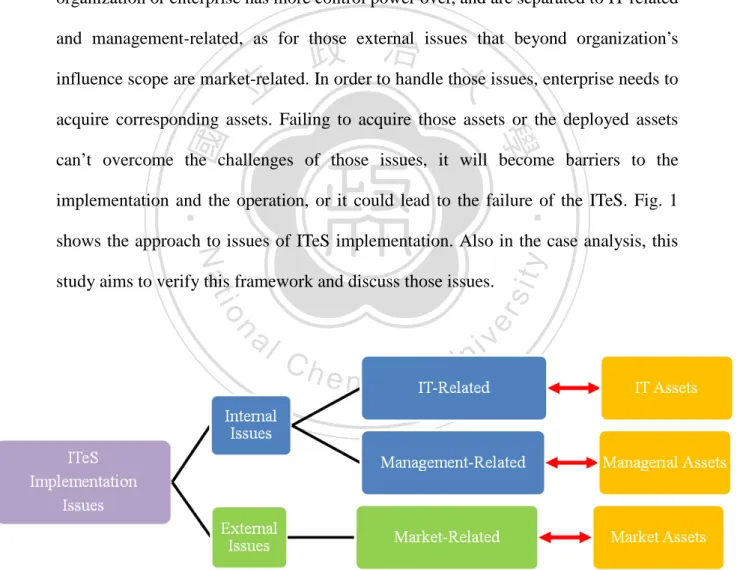
(6) Figures FIG. 1 APPROACH TO ISSUES OF ITES IMPLEMENTATION ............................................ 3 FIG. 2 ROLE OF TECHNOLOGY IN THE SERVICE ENCOUNTER ...................................... 9 FIG. 3 SERVICE DEVELOPMENT PROCESS MODELS FROM THE LITERATURE ........... 11 FIG. 4 THE NSD PROCESS CYCLE ............................................................................... 12 FIG. 5 APPROACH TO NEW IT-ENABLED SERVICE DESIGN .......................................... 14 FIG. 6 PROPOSED ITES IMPLEMENTATION PROCESS ................................................. 18 FIG. 7 CASE STUDY METHOD ...................................................................................... 23 FIG. 8 LI & FUNG’S TOTAL VALUE ADDED PACKAGE ................................................. 26 FIG. 9 LIFUNG.COM MARKET POSITIONING ............................................................... 29 FIG. 10 LIFUNG.COM’S LIMITED MASS CUSTOMIZATION WEB PAGE SAMPLE ......... 42. 立. 政 治 大. ‧. ‧ 國. 學. n. er. io. sit. y. Nat. al. Ch. engchi. v. i n U. v.
(7) Chapter 1. Introduction. 1. Background and Motive “The Executive Yuan decided that 12 categories of emerging services, namely Financial, Distribution, Telecommunication and Media, Medical, Health care and Care-giving, Manpower Training, Property Management, Tourism, Sporting and Recreational, Cultural and Creative, Design, Information, and Environmental. 政 治 大. Protection, should be included in the ITeS Flagship Plans.” ([3], Part III, Chapter 3,. 立. Section 20, p. 2) Information Technology Enabled Services (ITeS) was mentioned for. ‧ 國. 學. the first time in 2006 White Paper on Taiwan Industrial Technology. “If the Taiwan government can utilize its strength in IT manufacturing. ‧. capabilities, together with its world leading broadband wireless communications. y. Nat. sit. infrastructure, and guide domestic service industry and high-technology industry. n. al. er. io. towards the development of ITeS, then Taiwan will be in an excellent position to. i n U. v. upgrade itself from a key IT manufacturing country to become an important ITeS. Ch. engchi. supplier nation despite most local enterprises being medium and small scale.” ([3], Part III, Chapter 3, Section 20, p. 1) This policy proclamation about the opportunities of ITeS at that time showed Taiwan government’s vision, viewing to elaborate Taiwan’s advantage in Information & Communication Technology (ICT) industry from a innovation way. Year after year, ITeS kept showing in 2007, 2008 and 2009 White Paper on Taiwan Industrial Technology, and from a planner or promoter’s viewpoint, Taiwan government drew the roadmap for technology development, focused ITeS in some specific areas, like financial, healthcare and Next Emerging Web services, which still 1.
(8) were all implicated to an advantageous ICT industry. ([4], Part II, Chapter 1 Section 4, pp. 1-4) ([5], Part II, Chapter 1, Section 3 pp. 1-3) ([6], Part II, Chapter 1, Section 3, pp. 1-4) Knowing the policies and perspectives about ITeS in recent years, we can understand the government has been taken actions to cope with the changing economic trend, that the service sector’s importance in economic growth is more and more apparent. We also can perceive that the goal and the direction is right, not only this is the world trend, but also this is a chance for Taiwan’s companies and related. 政 治 大 Taiwan government’s ITeS Flagship Plans is one example of the emerging focus 立. industries to gain more advantages or create new sources of profit.. on ITeS, Rai and Sambamurthy (2006) introduced the growth interest of IT in service. ‧ 國. 學. management and the opportunities for information system scholars, Fitzsimmons and. ‧. Fitzsimmons (2006) also mentioned about the trend of technologies in services. With. sit. y. Nat. the trend that the world’s economies have become dominated by service-focused. io. er. businesses, more emphases about ITeS can be expected.. Interested in ITeS, this study aims to have a better understanding about ITeS. al. n. v i n C hto find the unnoticed implementation, via the research or missing pieces that are engchi U. needed to implement ITeS other than information technology capability. With the addressed issues about ITeS, the result of this research is to provide a clearer picture about ITeS implementation to those ITeS involving parties.. 2. Research Objective To have a better understanding about ITeS implementation, this study attempts to first generalize and propose a high-level process for ITeS implementation, then takes Li & Fung’s beta launch of the new business-to-business (B2B) e-commerce portal in 2.
(9) August 2000 as the object of case study to review what happened during that span applying to the process. Through the research, this study tries to address findings and suggestions for those enterprises that are service firms or have interest in ITeS, as well as the ICT industry and the authority. With regard to the interest in finding factors that affect ITeS implementation other than IT, this study hypothesizes that those issues can be classified according to the control power of the enterprise. Internal issues refer to those are within the organization or enterprise has more control power over, and are separated to IT-related. 政 治 大 influence scope are market-related. In order to handle those issues, enterprise needs to 立. and management-related, as for those external issues that beyond organization’s. acquire corresponding assets. Failing to acquire those assets or the deployed assets. ‧ 國. 學. can’t overcome the challenges of those issues, it will become barriers to the. ‧. implementation and the operation, or it could lead to the failure of the ITeS. Fig. 1. io. n. al. er. study aims to verify this framework and discuss those issues.. sit. y. Nat. shows the approach to issues of ITeS implementation. Also in the case analysis, this. Ch. engchi. i n U. v. Fig. 1 Approach to Issues of ITeS Implementation (Source: Organized by this Research). 3.
(10) 3. Structure Chapter 2 reviews recent research in service, ITeS, and new service development to highlight a process and framework for ITeS implementation. Chapter 3 illustrates the research method. In chapter 4, this study first gives a brief introduction about the case company and then adopts the proposed framework to examine case company’s ITeS implementation process, and at the end concludes the IT, managerial and market assets, the issues and the implementation process in the third part. Chapter 5 explains. 政 治 大 issues. The final chapter summarizes the conclusions and discusses direction for 立 the findings about the process framework of ITeS implementation and the managerial. future study.. ‧. ‧ 國. 學. n. er. io. sit. y. Nat. al. Ch. engchi. 4. i n U. v.
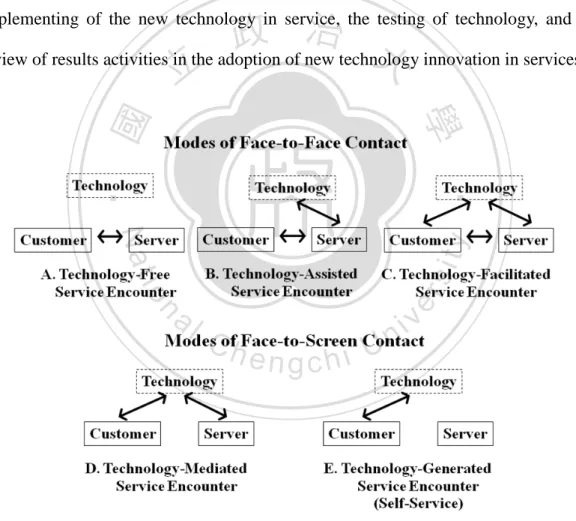
(11) Chapter 2. Definition and Literature Review. 1. Service Definition and Literature Review For decades, we can find many definitions of service in different fields, some definitions are: A service is a change in the condition of a person, or a good belonging to some economic entity, brought about as a result of some other economic. 政 治 大. entity, with the approval of the first person or economic entity. (Hill, 1977). 立. A precise definition of goods and services should distinguish them on the. ‧ 國. 學. basis of their attributes. A good is a tangible physical object or product that can be created and transferred; it has an existence over time and thus can. ‧. be created and used later. A service is intangible and perishable, it is an. y. Nat. sit. occurrence or process that is created and used simultaneously or nearly. n. al. er. io. simultaneously. While the consumer cannot retain the actual service after it. i n U. v. is produced, the effect of the service can be retained. (Sasser, Olsen and Wyckoff, 1978, p. 8). Ch. engchi. Most authorizes consider the services sector to include all economic activities whose output is not a physical product or construction, is generally consumed at the time it is produced, and provides added value in forms (such as convenience, amusement, timeliness, comfort, or health) that are essentially intangible concerns of its first purchaser. (Quinn, Baruch and Paquette, 1987, p. 50) A service is an activity or series of activities of more or less intangible nature that normally, but not necessarily, take place in interactions between 5.
(12) customer and service employees and/or physical resources or goods and/or systems of the service provider, which are provided as solutions to customer problems. (Gronroos, 1990, p. 27) Services are capabilities or competencies that one person, organization, enterprise, or system provides for another. (Vargo and Lusch, 2004) A service is a provider-client interaction that creates and captures value. (IBM Research, 2004) A service is a time-perishable, intangible experience performed for a. 政 治 大. customer acting in the role of a co-producer. (Fitzsimmons and Fitzsimmons, 2006, p. 4). 立. From these definitions, while not all the same, we can understand some. ‧ 國. 學. characteristics of service, such as intangibility, simultaneity and perishability. Besides,. ‧. there are some behaviors or concepts like interaction, exchange, experience and value. sit. y. Nat. in the service process or accompanying service. Chen, Chang, Tsaih and Chou (2010). io. er. stated the study of the essence of services has undergone evolutionary change. From the early study of the characteristics of service to the service itself, that service are. al. n. v i n C hcan provide added U processes and performance which value and solutions to customer engchi. problems, then to the latest research, researchers deliberated the hybrid form of service, that service involves various elements (e.g. tangible or intangible) and roles (e.g. technology and organization). Furthermore, services are capabilities or competencies that enterprises provide for customers, and we can see more and more about the process of co-producing, the participation, and the value creation are emphasized. Talking about the co-producing and customer participation, Fitzsimmons and Fitzsimmons (2006) mentioned about a difference in the service process and the traditional manufacturing operations: the presence of the customer as a participant, 6.
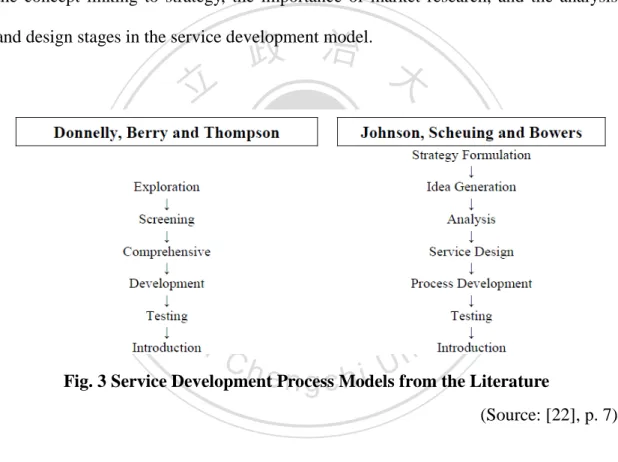
(13) and this would affect the facility design. In addition, when providing a service, the realization of customer can play an active part in the process is an important consideration. Sampson and Froehle (2006) also noted about the customer-self inputs in the service process. Customer-self inputs are common in the process, and not only as a labor input, customers can also participate in production by providing property and/or information. An important point in the service providing process is that the service providers can prepare for production, but they won’t be able to execute the actual service process until necessary customer-self inputs are present. These. 政 治 大 service design. On top of. comments give us a primary knowledge about considering customer in the service providing process and the. 立. that, Fitzsimmons and. Fitzsimmons (2006) further commented: “taking the customer out of the process,. ‧ 國. 學. however, is becoming a common practice.” ([8], p. 23) Contemplating the role of. ‧. customer in the service providing process and the information technology, this study. sit. y. Nat. thinks with the help of the technology, the presence of customers - the labor. io. er. intensiveness or manual activities done by the customer in the process could be reduced or replaced by automation, by information system, or by service providers.. al. n. v i n Ch Even though, the necessary customer-self inputs are still required to complete the engchi U service process. The Customer-self inputs are provided in various forms and are. delivered through multiple ways, and taking the customer out of the process on the premise that the required inputs were fulfilled would simplify the process and increase the efficiency. Furthermore, we can assume that in order to obtain the required inputs, or to facilitate the service providing, service provider could ask customers for more activities, or even add new processes to an existing one in order to provide a better service. Therefore, the service process requires more emphasis about the service design, the process reengineering, and the use of technology.. 7.
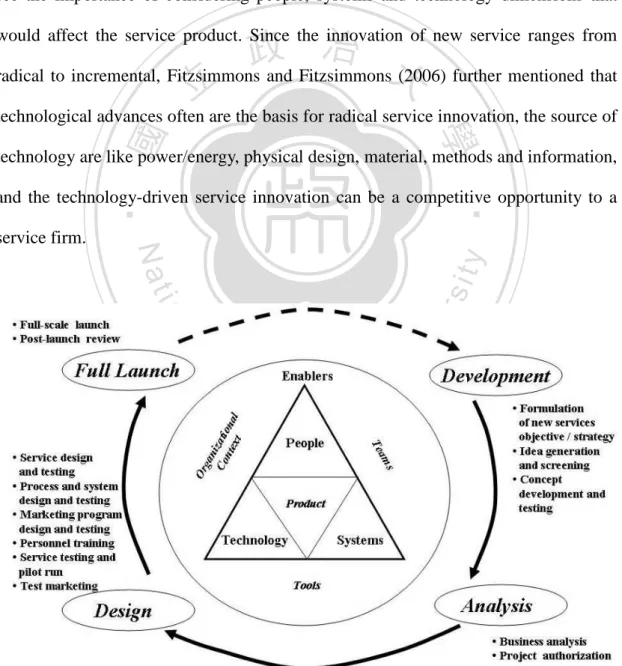
(14) 2. IT-enabled Service (ITeS) Definition and Literature Review According to 2006 White Paper on Taiwan Industrial Technology, The scope of Information Technologies-enabled Services (ITeS) can be defined as: "the combination of knowledge regarding certain specific areas and information technologies (IT), or the generation of new application ideas based on IT itself, to create innovative technology-based services, new business model and value added." ([3], Part III, Chapter 3, Section 20, p. 1) Then in 2007 White Paper on Taiwan. 政 治 大 “There are two main groups of ITeS as follows: (1) Mode I: business process services 立 Industrial Technology, it further introduced some real cases and applications of ITeS:. delivered via IT, for example on-line banking, remote healthcare, and so on; and (2). ‧ 國. 學. Mode II: technology itself as a service, for example Software as a Service (SaaS). ‧. provided by Google, Yahoo!, Skype, and Salesforces.com, etc. Generally, mainstream. sit. y. Nat. web-based ITeS can be classified into ten parts: search engine; information filtering. io. er. and aggregation; online shopping, auction and trading; social networking; multimedia sharing and broadcasting; online communication; personalized service;. al. n. v i n platform service; location-basedCservice; and other innovative services.” ([4], Part II, hengchi U. Chapter 1, Section 4, p. 1) From the definition and the examples, we get an essential cognition of ITeS as an innovative improvement or creation, and it uses IT or related new technologies to reform an existing service or to form a new service. When talking about service management, Fitzsimmons and Fitzsimmons (2006) introduced technologies in services. In the service encounter scenario, based on the face-to-face or the face-to-screen contact situation, there are five modes of technology’s contribution to the service encounter. Fig. 2 illustrates the five roles of technology in the service encounter. With the introduction of technology, there are more and more technology-enabled self-service and the automation of services in the 8.
(15) back office. Besides, Fitzsimmons and Fitzsimmons (2006) also mentioned the recently web-based Internet services and the scalability between e-commerce and e-service, and most important of all, the challenges along with the technological innovation in the adoption of new services, and how to manage the new technology adoption process. Concerning employees and customers, Fitzsimmons and Fitzsimmons (2006) advised a 10-step planning guide to manage the implementation process. These steps highlighted the education, the analysis of technology and application requirements, the specification confirmation and design, the planning and. 政 治 大 review of results activities in the adoption of new technology innovation in services. 立. implementing of the new technology in service, the testing of technology, and the. ‧. ‧ 國. 學. n. er. io. sit. y. Nat. al. Ch. engchi. i n U. v. Fig. 2 Role of Technology in the Service Encounter (Source: [8], p. 106). “An interdisciplinary approach is required to understand how services should be conceived, designed, delivered, and supported. The potential of information 9.
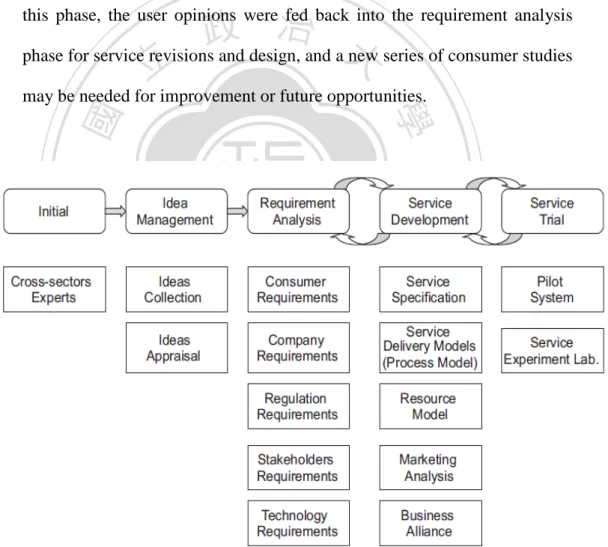
(16) technology for services management is touted as significant…. we conceptualize digitally enabled services management as the capabilities, structures, and processes with which digitized services are conceived and architected, how these services are offered and orchestrated, and how interactions for innovation and production of services are managed.” ([19], p. 329) In the term of “digital enablement of services”, Rai and Sambamurthy (2006) stated an interdisciplinary approach about providing services and emphasized the future of IT innovations for services management, that we can see the trend and the importance of applying IT system to service management.. 政 治 大 ITeS system. The service system design adopts the IT empowerment approach, and 立. In addition, Chen, Chang, Tsaih and Chou (2010) described a generic design of an. includes the front-office service subsystem and the middle/back-office subsystem. IT. ‧ 國. 學. empowerment means customers can play an active role in the service process and. ‧. employees could interact with each other across functional boundaries. The. sit. y. Nat. front-office IT performs a “customer as co-producer” design, it encourages active. io. er. customer participation in the process. The middle/back office IT provides a “production-line” environment to ensure consistent quality and efficiency of. n. al. operation.. Ch. engchi. i n U. v. In brief, we view ITeS as based on the mindset of providing a service and using IT to realize it. With the help of IT, service provider can modify the existing process or create a new process, and both would add more value to service stakeholders. The innovation degree or technology complexity in ITeS could be high or low, and the business process reengineering or process redesign might be needed. ITeS would include different components with regard to the participants and the process needs, it aims to provide services. The implementation process of an ITeS is critical, and in next section, this study reviews the new service and the ITeS development process.. 10.
(17) 3. New Service Development and ITeS Development Literature In service literature, scholars had studied many new service development models. Shekar (2007) summarized two models of service development (see Fig. 3). Both models have some common activities in the later half part, including the development, the testing and the introduction stage, and differ in the beginning stages. One model describes the process as search and select then form the service, the other one stresses the concept linking to strategy, the importance of market research, and the analysis. 政 治 大. and design stages in the service development model.. 立. ‧. ‧ 國. 學. n. er. io. sit. y. Nat. al. Ch. engchi. i n U. v. Fig. 3 Service Development Process Models from the Literature (Source: [22], p. 7). Referring to the new service development (NSD) cycle (see Fig. 4), Fitzsimmons and Fitzsimmons (2006) detailed the process of new service development, it’s a development, analysis, design and full launch cycle. The ideas for new service innovations can originate from many sources, and the innovations can be a new service product or some degree of modification to an existing service. Once the ideas were generated, these ideas then form the input to development stage, and the new. 11.
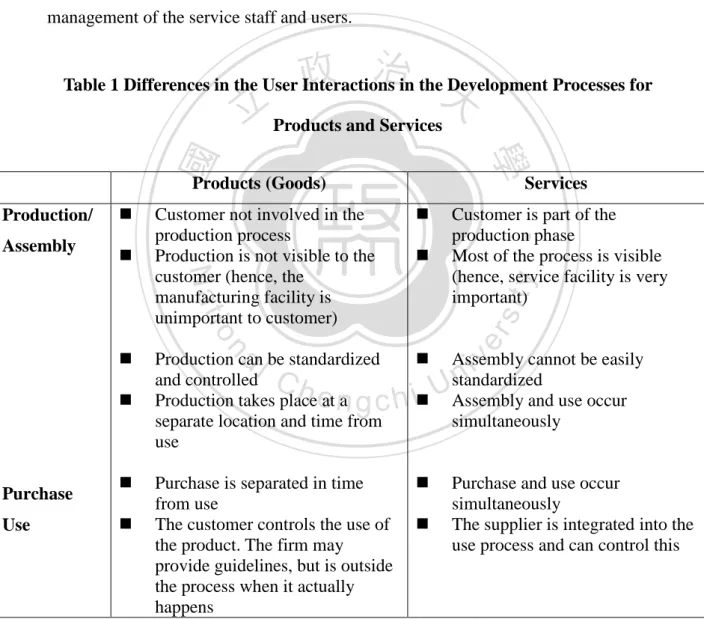
(18) service development cycle begins. The cycle includes planning and execution phase. Planning phase consists of the development and the analysis stages where market viability and capability are assessed. After the ideas passed the assessment, the design and launch stages represent the execution phase. In the development process, the service delivery design and cross-functional development efforts become critical to success. In the proceeding of the cycle, there are some enablers to facilitate the NSD process, such as teams, tools, and organization context. From the model, we can also see the importance of considering people, systems and technology dimensions that. 政 治 大 radical to incremental, Fitzsimmons and Fitzsimmons (2006) further mentioned that 立 would affect the service product. Since the innovation of new service ranges from. technological advances often are the basis for radical service innovation, the source of. ‧ 國. 學. technology are like power/energy, physical design, material, methods and information,. n. al. er. io. sit. y. Nat. service firm.. ‧. and the technology-driven service innovation can be a competitive opportunity to a. Ch. engchi. i n U. v. Fig. 4 The NSD Process Cycle (Source: [8], p. 80) 12.
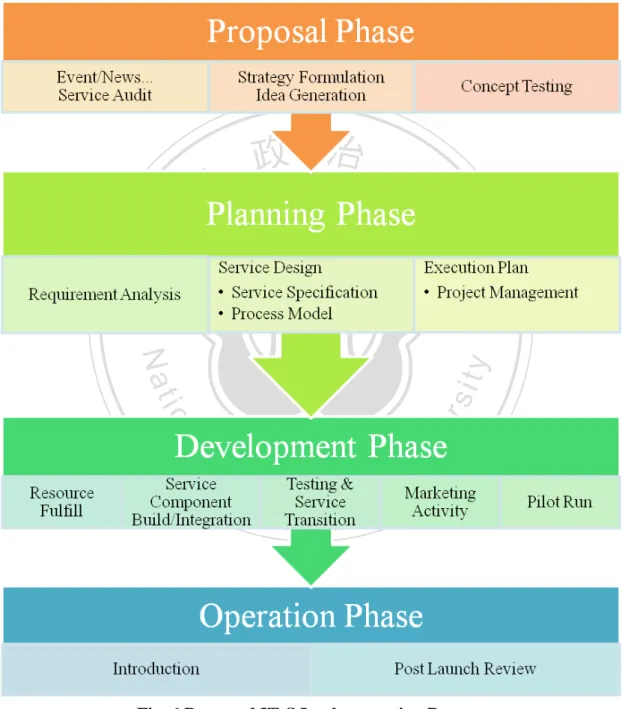
(19) In a case of study Taiwanese healthcare service, Yang and Hsiao (2009) introduced an IT-enabled service model (see Fig. 5). The model comprises initial, idea management, requirement analysis, service development, and the service trial phases: 1. Initial phase: in the beginning of the project, experts from multiple domains and disciplines are teamed up to plan and examine complex development processes involving consumer research, service design and construction of service trials. 2. Idea management phase: this phase includes idea collection and idea. 政 治 大 collection, such as service features, business models, marketing types, 立 appraisal. For idea collection, it requires a comprehensive information. innovative case survey results, market owners, related industries and. ‧ 國. 學. companies. Then those ideas will be evaluated regarding real-world. ‧. environments, competitive advantages, organizational strategies, resource. sit. y. Nat. allocation and technology, and which received low appraisals would be. io. er. eliminated from consideration.. 3. Requirement analysis phase: this phase acquires the requirements for new. al. n. v i n C h perspectives, including services based on multiple consumers, companies, engchi U stakeholders, technology and appropriate regulations.. 4. Service development phase: this phase begins after completing requirement analysis. The iterative interaction between these two phases must be understood when modifying service design. Plans for new services are based on analytical results from the requirements analysis phase, and include service specifications, a service-delivery model, resource model, marketing analysis and proposed business alliance. In this stage, service specification and process modeling can be applied to describe a service; the resource model is designed for planning for all resources needed to offer 13.
(20) services. Marketing analysis examines market feasibility of a service by evaluating target consumer profiles, market scale, market share, marketing strategy, policy and competitors. Via business alliances, organizations can reduce service cost and increase the value of core services, and the boom in outsourcing services can assist in establishing effective business alliances. 5. Service trial phase: the final phase includes a pilot system and service experiment laboratory. The service development phase analyzes feedback from outcomes of the service trial phase to enhance service design. During. 政 治 大 phase for service revisions and design, and a new series of consumer studies 立. this phase, the user opinions were fed back into the requirement analysis. may be needed for improvement or future opportunities.. ‧. ‧ 國. 學. n. er. io. sit. y. Nat. al. Ch. engchi. i n U. v. Fig. 5 Approach to new IT-enabled service design (Source: [25], p. 333). 14.
(21) In addition to the new service and the ITeS development process model, Shekar (2007) compared the development of services to manufactured products and pointed out the difference of the user’s interaction in production/assembly, purchase and use stages (see Table 1). The comparison shows the distinctiveness or separability of the steps and the degree of involvement between the user and service staff in each step, and emphasizes the development should not only look at the service product but also the nature of interaction of with users, this leads to an important issue of process management of the service staff and users.. 政 治 大. Table 1 Differences in the User Interactions in the Development Processes for. 立 Products and Services. ‧ 國. 學. Products (Goods). Assembly. . . Purchase Use. . n. . al. sit. io. . Production can be standardized and controlled Production takes place at a separate location and time from use. . Purchase is separated in time from use The customer controls the use of the product. The firm may provide guidelines, but is outside the process when it actually happens. . Ch. Customer is part of the production phase Most of the process is visible (hence, service facility is very important). y. Nat. Customer not involved in the production process Production is not visible to the customer (hence, the manufacturing facility is unimportant to customer). e n g c h i. . er. . ‧. Production/. Services. i n U. v. Assembly cannot be easily standardized Assembly and use occur simultaneously. Purchase and use occur simultaneously The supplier is integrated into the use process and can control this. (Source: [22], p. 6). 15.
(22) 4. The Proposed ITeS Implementation Process Framework From the definitions and development process models review, this research generalizes a framework for ITeS implementation processes study (see Fig. 6), the framework consists of proposal, planning, development and operation phases: 1. Proposal phase: the proposal phase includes event/news/…/service audit, strategy formulation/idea generation and concept testing activities. The ideas or opportunities for an ITeS would be triggered by many external. 政 治 大 breakthrough, etc. And by auditing or comparing to competitors’ service 立. sources, such as trend, social news, economical events, technology. operation would stimulate an idea to build an ITeS. Once the idea is. ‧ 國. 學. generated or the strategy is formed, the concept of the ITeS proposal for. ‧. service innovation is required to be tested. The concept testing evaluates the. sit. y. Nat. feasibility, the benefit, the impact of the ITeS regarding business and. io. er. industry environments, organizational strategies, the cost of investment and resource allocation, competitors and customers, and the know-how about. al. n. v i n the service scope and C the technology. After U h e n g c h i the concept testing, the proposal could be abandoned or revised. When the evaluation result is accepted, a. more specific goal for the ITeS will be set, and then moves into next phase to plan for the service innovation execution. 2. Planning phase: with the direction of the ITeS in mind, this phase requires a thorough requirement analysis about the service, a detail service design for the ITeS, and an execution plan for the whole ITeS project. The requirement analysis should consider all related stakeholders, from management level to employees, from the staffs to outside customers and suppliers. Not only the related stakeholders, but also takes all the affected existing processes, IT 16.
(23) systems, the applied technology, environments and regulations into consideration. Requirement analysis defines the scope and the outcome, service design describes the shape and delineates “what” and “how” to build the ITeS. As for the execution plan, it’s a guideline for the whole project, concerning ITeS implementation’s goals and objectives, schedule, resource, risk, monitor and control, etc. 3. Development phase: according to the execution plan, activities in this phase are fulfilling the required resources, developing the ITeS, preparing for. 政 治 大 production facilities and associated equipments, and are allocated from 立 operation, and the pilot run. The required resources involve people, funding,. inside or outside the organization. When developing the ITeS, some service. ‧ 國. 學. components could be existing ones, so besides building the new. ‧. components, integrating other service components is an effective but more. sit. y. Nat. complex way, and testing should be performed according to each building. io. er. and integration steps. Service transition for employees and customers is a fundamental preparation task. Not only the training for new ITeS, but. al. n. v i n C hattention to the relating organization should pay job or process adjustment. engchi U. Other than service transition, marketing is a weapon considering the operation of the ITeS; proper promotion can lower the resistance to the change and help the adoption process. Pilot run tests the whole model of ITeS, and the feedbacks and results are taken for improvement and to decide whether can move to next phase or not. 4. Operation phase: after the previous planning, building and testing stages, when ITeS is brought to introduction, the scope, the process, or the target customer could be revised to fit in with the operation. However, the main. idea of the concept, and the goal of the strategic thinking should be 17.
(24) followed, that organization can review the actual situation according to the planned. In post launch review, organization reviews the performance and result according to original plan and then situation, and decides the future of the ITeS.. 立. 政 治 大. ‧. ‧ 國. 學. n. er. io. sit. y. Nat. al. Ch. engchi. i n U. v. Fig. 6 Proposed ITeS Implementation Process (Source: Organized by this Research). 18.
(25) 5. IT and Strategy Discussing about the business models and strategy, Applegate, Austin and McFarlan (2007) emphasized the importance of assessing IT impact and alignment to the business and the strategy. “The ability to achieve alignment among the environment, strategy, and capabilities is central to creating a successful business model that delivers value to all stakeholders. Yet this is easier said than done─especially in today’s earnings-driven, turbulent economy. And, the difficulty of. 政 治 大 automate back-office activities─for 立. achieving business alignment increases significantly when IT enters the picture. Long considered a tool to. example, payroll and. accounts receivable─only recently has IT become an important tool for defining new. ‧ 國. 學. strategic opportunities and building the capabilities needed to execute them.” ([1], p.. ‧. 35). sit. y. Nat. About assessing IT impact and alignment, Applegate, Austin and McFarlan. io. er. (2007) discussed McFarlan’s Strategic Grid, and Henderson and Venkatraman’s Strategic Alignment Model. These two frameworks help decision makers and. al. n. v i n C do executives to make decisions and about aligning IT and Strategy. Take the h eactions ngchi U. strategic grid for example, McFarlan suggests that an organization’s portfolio of IT initiatives and projects be assessed along two key dimensions, the impact on business operations and the impact on strategy. For the analysis of IT projects and investments, using this model at a given point in time helps a firm or an organization to assess the alignment of individual IT projects with business operations and strategy. Besides, the model also enables the assessment of the portfolio of IT projects and initiatives and to analyze the governance method of the IT department as a core enabler in its business model. And finally, the strategic grid works as a benchmark for a company’s IT project and investment portfolio with other firms in the industry and to assess changes 19.
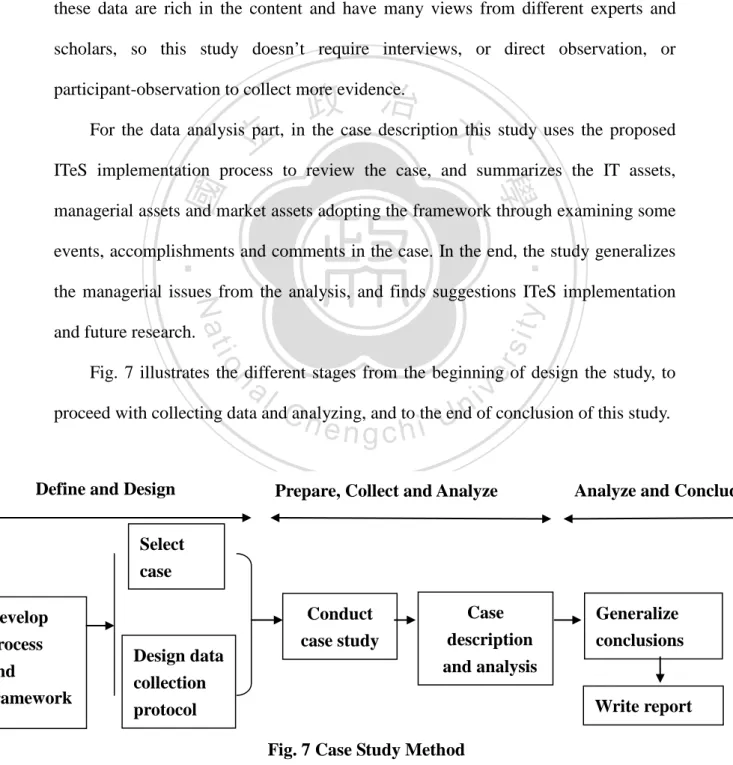
(26) over time. “Strategic opportunities are implemented through initiatives and projects that signify a company’s strategic intent” ([1], pp. 34) Mentioned as IT-enabled business, IT-enabled projects, IT-enabled initiatives, technology-enabled innovation and so on, Applegate, Austin and McFarlan (2007) analyzed few cases about how IT or new technology can make a company more competitively, or on the other way, they can break the industry rules and competition situation in an unexpected way. Indeed, IT or new technology can bring opportunities, like IT can change the basis of competition,. 政 治 大 to existing products and services or create new ones. However, opportunity usually 立 or IT can build barriers to entry, or IT can increase switching cost, or IT can add value. comes along with risk. IT or new technology may also bring strategic risk, such as. ‧ 國. 學. emerging technologies can disrupt current business models, or IT can lower entry. ‧. barriers, or IT can trigger regulatory action.. sit. y. Nat. “When an organization invests in a new technology, it is important to candidly. io. er. assess whether the investment will result in a sustainable advantage or whether it will simply maintain the current industry and competitive dynamics and market share.”. al. n. v i n Cexploit ([1], pp. 55) Considering how to and avoid risk at the same U h e nITg opportunities i h c. time, Applegate, Austin and McFarlan (2007) suggested few questions that executives. can ask themselves upon IT-enabled business opportunities and risks, these questions highlight the analysis of the strategic impact of IT, and implicate the ongoing innovation and the evolvement of IT-enabled service.. 20.
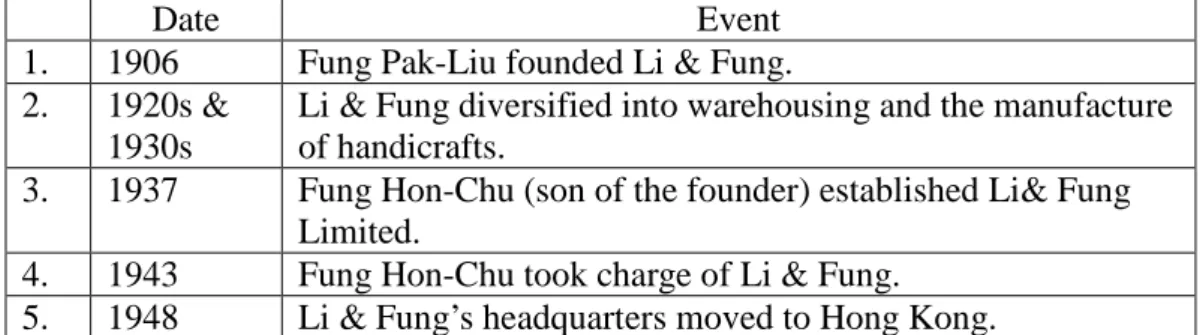
(27) Chapter 3. Research Method. 1. Library Case Study This study is a qualitative research, and adopts case study as research method. About the case study: “The essence of a case study, the central tendency among all types of case study, is that it tries to illuminate a decision or set of decisions: why they were taken, how they were implemented, and with what result. (Schramm, 1971,. 政 治 大. emphasis added)” ([26], p. 17) According to Yin (2009), the case study means a. 立. “how” or “why” question is being asked about a contemporary set of events, and the. ‧ 國. 學. investigator has little or no control over the events. This study tries to understand the process and the theme about ITeS implementation, via reviewing the event of that. ‧. time to find managerial issues and suggestions, and the exploration doesn’t require. y. Nat. n. al. er. io. is appropriate.. sit. any control of the event or behavior, theoretically and technically the research method. Ch. engchi. i n U. v. 2. Case Study Design Interested in ITeS implementation, the main questions of this study is what are those IT, managerial and market assets and the managerial issues behind the scenes. In order to find the answer, this study proposes an implementation process framework, and uses this framework to examine the unit of analysis in an exploratory way, and of course the unit of analysis would be those enterprises that implemented ITeS. Yin (2009) defined four types of designs for case studies: (1) single-case designs (holistic), (2) single-case designs (embedded), (3) multiple-case designs (holistic), and 21.
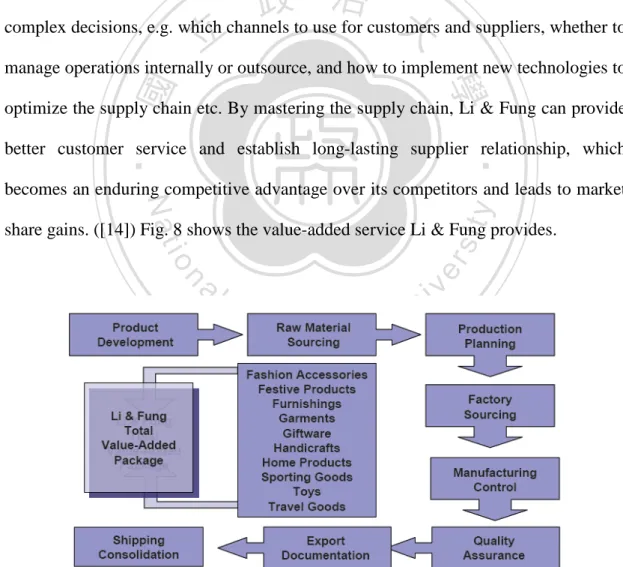
(28) (4) multiple-case designs (embedded). Considering the high level ITeS development process for different enterprises might be alike, but their industry background varies, operation processes are different, business scope differs, and the motive, the strategy and the situations came through during the development period definitely are unalike. Therefore this study chooses one enterprise’s ITeS event as the single case, that is, the Li & Fung’s beta launch of the new business-to-business(B2B) e-commerce portal in August 2000 event, and reviews this event in a holistic way, takes this as an representative case.. 政 治 大 1. Li & Fung is a globally well-known enterprise, as a SCM expert, Li & Fung 立. There are four reasons for choosing this single case as the analysis unit:. Fung confronts is representative.. 學. ‧ 國. faces from upstream producers to end customers, so the situations that Li &. ‧. 2. The information sources of Li & Fung are bounteous and trustworthy. Not. sit. y. Nat. only Li & Fung’s leaders and executive teams are willing to share their. io. er. experiences about the business and operation, also there are a lot of reliable research institutions that provide a great quantity of high quality references. al. n. v i n about Li & Fung. AndCas a public company,Umost data about Li & Fung are hengchi very transparent and dependable.. 3. The time span of the event underwent “dot-com bubble” period, considering the historical background and atmosphere of that time, this event was especially meaningful. 4. From the initiative of the event to its termination, the case provided complete information and more reference value to the research.. 22.
(29) 3. Data Collection and analysis The main research data is based on Harvard Business School Case - Li & Fung (A): Internet Issues and Li & Fung (B): Internet Issues, and refers to other secondary data about Li & Fung and the event, including Li & Fung’s official archival records, publications about Li & Fung, interview and speech records. As mentioned before, these data are rich in the content and have many views from different experts and scholars, so this study doesn’t require interviews, or direct observation, or. 政 治 大 For the data analysis part, in the case description this study uses the proposed 立. participant-observation to collect more evidence.. ITeS implementation process to review the case, and summarizes the IT assets,. ‧ 國. 學. managerial assets and market assets adopting the framework through examining some. ‧. events, accomplishments and comments in the case. In the end, the study generalizes. sit. y. Nat. the managerial issues from the analysis, and finds suggestions ITeS implementation. io. er. and future research.. Fig. 7 illustrates the different stages from the beginning of design the study, to. al. n. v i n proceed with collecting data andCanalyzing, and to theU h e n g c h i end of conclusion of this study. Define and Design. Prepare, Collect and Analyze. Analyze and Conclude. Select case Develop process and framework. Design data collection protocol. Conduct case study. Case description and analysis. Generalize conclusions. Write report Fig. 7 Case Study Method (Source: Organized by this Research) 23.
(30) Chapter 4. Case Description and Analysis. 1. Case Company Founded in Guangzhou in 1906,in the beginning was a traditional trading company dealing in Chinese products exportation, today Li & Fung Limited (“Li & Fung” or “the Group”, SEHK: 494), the global consumer goods exporter, is a Hong Kong headquartered multi-national group and recognized as the world's leader in. 政 治 大. consumer goods design, development and sourcing. Li & Fung is a group of. 立. companies driving strong growth in three distinct core businesses – export sourcing. ‧ 國. 學. through Li & Fung Limited, distribution through Integrated Distribution Services Group Limited and retailing through Convenience Retail Asia Limited, Trinity. ‧. Limited and other privately held entities. From over 240 offices and distribution. y. Nat. sit. centers in the United States, Europe, Africa and Asia, the Group manages the supply. n. al. er. io. chain for retailers and brands worldwide and sources from more than 40 economies.. i n U. v. The Li & Fung Group has a total staff of over 27,000, with a total revenue of. Ch. engchi. US$15.98 billion in 2010. Table 2 lists the short history of Li & Fung. Table 2 lists a short history of Li & Fung.. Table 2 Short History of Li & Fung. 3.. Date 1906 1920s & 1930s 1937. 4. 5.. 1943 1948. 1. 2.. Event Fung Pak-Liu founded Li & Fung. Li & Fung diversified into warehousing and the manufacture of handicrafts. Fung Hon-Chu (son of the founder) established Li& Fung Limited. Fung Hon-Chu took charge of Li & Fung. Li & Fung’s headquarters moved to Hong Kong. 24.
(31) 6. 7.. 1972 1973. 8. 9. 10. 11. 12.. 1974 1988 1991 1992/7 1995. 13.. 1998. 14.. 1999. 15. 16.. 2000 2005. 17.. 2010. William Fung (Fung Kwok-Lun) returned to Li & Fung. Li & Fung became the holding company for the Group and was listed on the Hong Kong Stock Exchange. Victor Fung (Fung Kwok-king) rejoined Li & Fung. The Group was Privatized and streamlined. Incorporated in Bermuda. Trading activities were listed on the HKSE. Acquisition of Inchcape Buying Services (formerly Dodwell). Li & Fung Distribution Group was established as a provider of supply chain services with a Pan-Asia focus. Acquired export trading firms Swire & Maclaine and Camberley. Buying agent Colby Group Holdings Limited. Li & Fung Licensing was established to bring fashion and lifestyle brands into Asia. Acquired Hong Kong-based Jackel Group, Hong Kong-based HTP, and substantially all of the assets of Cipriani Accessories Inc., and its affiliate, The Max Leather Group. Cipriani Accessories Inc.. 立. 政 治 大. ‧ 國. 學. (Source: [17], pp. 1-6 & [12], p. 89 & Li & Fung Group Web site [13]). ‧. Not only a trading company, today Li & Fung has evolved from a sourcing agent. Nat. sit. y. to a global supply chain manager by being an innovator in the development of supply. n. al. er. io. chain management. Victor (Fung Kwok-king, chairman of Li & Fung) had. i n U. v. commented about the service: “We have been changing. Now we’re orchestrating a. Ch. engchi. whole production process that starts from raw materials all the way through to finished product…. Li & Fung does not own any of the boxes in the supply chain; rather, we manage and orchestrate it from above. The creation of value is based on a holistic conception of the value chain.” ([17], p. 3) A source from "Li & Fung - The Orchestrator of Global Supply Chain Management", written by Mr. Chang Ka Mun and Li & Fung Research Centre, concluded following seven principles which constitute the pillar of Li & Fung's supply chain management: 1. Be customer-centric and market demand driven. 2. Focus on one's core competency and outsource non-core activities, in order. 25.
(32) to develop a positioning in the supply chain. 3. Develop a close, risk- and profit-sharing relationship with business partners. 4. Design, implement, evaluate and continuously improve the work flow, physical flow, information flow and cash flow in the supply chain. 5. Adopt information technology to optimize the operation of the supply chain. 6. Shorten production lead time and delivery cycles. 7. Lower costs in sourcing, warehousing and transportation.. 政 治 大 complex decisions, e.g. which channels to use for customers and suppliers, whether to 立. These seven principles serve as a guideline for Li & Fung to resolve many. manage operations internally or outsource, and how to implement new technologies to. ‧ 國. 學. optimize the supply chain etc. By mastering the supply chain, Li & Fung can provide. ‧. better customer service and establish long-lasting supplier relationship, which. sit. y. Nat. becomes an enduring competitive advantage over its competitors and leads to market. io. n. al. er. share gains. ([14]) Fig. 8 shows the value-added service Li & Fung provides.. Ch. engchi. i n U. v. Fig. 8 Li & Fung’s Total Value Added Package (Source: [17], p. 17) According to the source, the number of Li & Fung’s customers and suppliers 26.
(33) showed the complexity and its broad business scope, “Li & Fung’s core export-trading business encompassed a wide array of services that spanned the supply chain... In 2006, Li & Fung supplied its over 1,000 customers in both hard and soft goods from a coordinated network of 8,000 to 10,000 suppliers through a sourcing network of over 70 offices in over 40 countries and territories.” ([15], p. 4) Talking about the value chain, William Fung (Fung Kwok-lun, managing director of Li & Fung) had stated that: “Nobody is going to pay you more unless you do more.” ([15], p. 6) According to the source, Li & Fung provided product planning, design. 政 治 大 sourcing for its soft-goods customers. And for upstream process, Li & Fung also 立. services, and development in addition to its traditional raw material and factory. supplied quality control, testing export documentation and logistics services. A. ‧ 國. 學. statistic number about 2002, by moving up the value chain, Li & Fung had grown to. ‧. sales of almost US$5 billion. ([15], p. 6). sit. y. Nat. Since 1995, the growth strategies for Li & Fung are a combination of an organic. io. er. model, acquisitions, and use of E-Commerce technologies to integrate and simplify internal communication, and improve communication between company divisions and. n. al. customers.. Ch. engchi. i n U. v. For organic growth, Li & Fung adopted a “three-year plan” system in 1996. William described the system having been adopted directly from the economic planning system of the Chinese Communist Party, in his words: “allow[ed] the company to look ahead, but not too far ahead.” ([17], p. 5) And the results turned to be in investors favor, in 2000, Li & Fung outperformed the Hang Seng Index (HSI) by over 75%. Through buying rival sourcing companies and suppliers, Li & Fung gained new client accounts and new knowledge of the value chain, and after operation integration, they can bring up the operating margins of these acquired units to create synergy and 27.
(34) continue growing. Had been Keeping an eye on avoid being disintermediated, Li & Fung took an Internet initiative of its own, an intranet to link the Group’s offices and manufacturing sites around the world was launched in 1995. Then in 1997, Li & Fung launched secure extranet sites, each site was customized and extended the link directly to a key customer. By 2000, 10 such extranets were in place. The software development of both intranet and extranet was outsourced, and the success laid the foundation of e-commerce solution, for further online presence, a new plan for B2B e-commerce. 政 治 大. portal was gradually rising to the surface.. 立. ‧ 國. 學. 2. Case Analysis. ‧. Around 1999, after a lot of research about the Internet and the discussion about. sit. y. Nat. the impact to Li & Fung and supply chain management, Li & Fung saw the. io. er. opportunities from small-to-medium-sized enterprises (SMEs)-a segment not well served through Li & Fung’s high-service, high-cost sales channels. Historically it had. al. n. v i n not been cost effective for Li &C Fung to trade with SMEs h e n g c h i U since orders were small and. often below factory minimums. Through a proposed Internet portal, Li & Fung hoped to extend the supply chain service to new markets. By aggregating the smaller orders via its B2B portal, Li & Fung hoped to utilize the economies of scale, thus it would expand the market-base and bring in revenue that Li & Fung could not access before the Internet. On March 27, 2000, Li & Fung announced the creation of B2B portal lifung.com, as well as the start-up’s management team, lifung.com was expected to bolster earnings by an operating margin of roughly 6%, or 14% total revenue. In August 2000, Li & Fung beta launched lifung.com; this B2B portal offered a wide array of 28.
(35) customization options to its clients. Fig. 9 shows the butterfly model and lifung.com market positioning. Six months later, Li & Fung renewed lifung.com, and on February 14, 2001 launched the new website: www.studiodirect.com. This time Li & Fung targeted only the SMEs in the United States first, focused mainly on “green-grass” products-golf apparel and accessories, and planned to extend its services to European and Japanese SMEs or other product lines if the result showed signs of success.. 立. 政 治 大. n. al. er. io. sit. y. ‧. ‧ 國. 學. Nat. Fig. 9 Lifung.com Market Positioning. Ch. engchi. i n U. (Source: [17], p. 19). v. According to Li & Fung’s 2001 Annual Report, the new venture had been closed due to the fail of performance expectation: “The discontinued operations represent the Group’s investment in a new trading operation in United States, StudioDirect, which was based on using the internet to deal with small and medium-sized customers who were not normally big enough for the Group to serve profitably. As prospect of this operation as an internet business is not up to management’s expectation, the Group decided to discontinue this operation and reduce its shareholding to 15%. The discontinuance resulted in a net loss of approximately HK$168,996,000 which represented the Group’s share of loss from the operation.” ([12], p. 51) 29.
(36) Next in this section, this study adopts the proposed ITeS implementation process to examine the implementation of lifung.com/StudioDirect, reviews what Li & Fung had done or what happened during each of the proposal, planning, development and operation phase. First for the proposal phase, we talk about the idea generation, and how management formulated the strategy behind the launch of the new portal. Next for the planning phase, we review how Li & Fung drafted the requirements of the new service and chose the system develop mode, and the forecasting of the new venture. Then we examine the acquisition of resources, discussed how Li & Fung fulfilled the. 政 治 大 launch testing of lifung.com for development phase. In the last operation phase, we 立. human resource and the capital needs, the deployment of the website, and the beta. discuss the introduction and post launch review of StudioDirect.. ‧ 國. 學 ‧. Proposal Phase. sit. y. Nat. To Li & Fung, the idea of going online was not coming from nowhere, the move. io. er. has been considered for years. When Li & Fung were growing in the traditional old-economy as planned, they have been kept an eye on the Internet’s impact;. al. n. v i n “disintermediated” was like an C alarm that Li & FungU h e n g c h i had always carried in mind. In. their three-year planning system, an core element was keeping an introspective look at. themselves to check whether they are still relevant, and whether or not they are going to be disintermediated. B2B was not a new technology nor an unheard new fashion to Li & Fung at that time, the well-known amazon.com has been operating since 1995, and William had said about Internet: “About three or four years ago, Victor and I discussed the Internet and how it impacts us.” ([17], p. 1) The Fung brothers had already noticed the revolutionary technology, but didn’t view it as a big challenge in the beginning. After a closer examination of local B2B portals and online exchanges, Victor concluded the 30.
(37) threat was far less than first imagined. Basically, to Li & Fung, how they operated, and the value-added services they provided, and the relationships with customers were much different to how B2B exchanges worked. For that reason Li & Fung was still irreplaceable comparing to those online guys in some ways. Though no immediate threat, the management had been always keeping in mind about the Internet’s progress. Victor had said: “Therefore, we needed to think through e-commerce properly, to formulate a proper response.” ([17], p. 7) Later in 1999, a visit to the United States knocked another window, what William. 政 治 大 I asked my friend at Toys ’R’ Us, “Why are you concerned about eToys? 立. sensed is a different type of threat from Internet:. It does about $28-$30 million in sales whereas you do $11 billion, and it. ‧ 國. 學. loses as much as its entire turnover? How can you worry about them?” And. sit. y. Nat. fact that investors are throwing money at them. ([17], p. 7). ‧. the first lesson I learned was that it’s not their size that is the threat but the. io. er. What William discovered a much worried intimidation was the “money”, which came from investors from everywhere and was pouring to those so-called dot-com. al. n. v i n C hto do much biggerUdamage to offline competitors guys. The money was big enough engchi then on the traditional business battlefield, not the way how B2B functioned or. performed, but they could use the money to acquire offline companies or hire key people from offline companies. William said about the situation: “They can hire away all of the talent that you have. The biggest weapon is the money they have. At one point, they could have hired away my entire management.” ([17], p. 7) According to NASDAQ Composite historical data, on March 10, 2000, when the technology heavy NASDAQ Composite index, peaked at 5,048.62 (intra-day peak 5,132.52), was more than double its value just a year before. Faced such threat, and considered that other old-economy trading companies or 31.
(38) local sourcing firms might partner with a dot-com and become a new competitor overnight, the Fung brothers were ready to move on: I started off saying that the Internet is just another technology that affects the way information is transferred and people communicate with each other. It has a very dramatic impact, more dramatic than the fax. But for me, it’s yet another in a series of technological changes that affects our business that we have to be keenly aware of. It may be the most important change until now, but it is probably not the last. (William Fung) ([17], p. 7). 政 治 大 nevertheless still technology. Li & Fung always has been aggressive in 立 The Internet is a revolutionary technology, but new technology is. adopting new technologies. When the telephone came along, my. ‧ 國. 學. grandfather was shocked. When the fax came around, the technology. ‧. changed our turnaround time into just days. With Internet technology, now. io. According to William:. n. al. Our starting point. er. there will be even less lag. (Victor Fung) ([17], p. 7). sit. y. Nat. we get answers within hours. When broadband and WAP comes online,. v i n C was a defensive posture: h e n g c h i U Would. the Internet. disintermediate us? Would we get “Amazoned” by someone who will put together all of the information about buyers and factories online? After a lot of research we realized that the Internet facilitates supply-chain management and we weren’t going to be disintermediated. The key is to have the old-economy know-how and yet be open to new-economy ideas. ([17], p. 1) From a defensive posture, the Fung brothers determined that Li & Fung needed an e-commerce strategy, and this was the origin of the venture. In addition, Li & Fung knew there were some not well-served customers in their traditional service ways, like 32.
(39) the SME (small and medium-sized enterprise). So would this become an opportunity to provide new service, or what would this new strategy be and how to execute it? Those remaining questions were to be solved in the next stage, later in the planning phase Li & Fung was going to verify the requirements clearly, design the service more specifically and shape the strategy more completely to implement. For this case, we can see that the strategy was from top executives, and the decision was not made in a short time. From the service audit point, Li & Fung understood their markets well and truly, both about the already and potential. 政 治 大 the social environment aspect, the booming of the Internet was the trend, and Li & 立 customers, and Li & Fung knew what they were good at and what they lacked. From. Fung had been pondering on the new-economy technology. Once Li & Fung felt it. ‧ 國. 學. was the time to do something, from a defensive view, and noted that the relationships. ‧. with the existing big customers and the value-added service they provided were still. sit. y. Nat. relatively more advantageous to those new B2B portals, took the move and viewed. io. er. the SMEs as target to start a new service became a proper response. Li & Fung hoped that this trial could open up new customers, and looked forward the move to prevent. al. n. v i n Cappear the new-economy from suddenly horizon in those markets in advance. U h e nongthe i h c Under the consideration that the new model would not affect existing channel, Li &. Fung formulated the initial strategy, next step was turning the proposal into an executable plan.. Planning Phase To plan for the execution of the e-commerce plan, first Li & Fung had to decide how the new portal was going to be built, outsourcing or in-house. Besides, Li & Fung needed to design what services would the website provide, and how the new services would connect to its existing traditional process. Also from the planning 33.
(40) perspective, Li & Fung should set the prospect and the goal for the new venture, and one important thing, how to monitor and manage the project to proceed properly. First big decision about the new IT venture was that Li & Fung planned to do it within the company, and the instruction was from top management. Although the successful intranet and extranets were outsourced before, but this time, for the new e-commerce strategy and the new IT technology, Victor wanted to make sure that the technology would pervade the entire Li & Fung organization. Consequently the solution must be an internal one, and as Victor phrased it: “bubble in, not bubble out.”. 政 治 大 Inc., Li & Fung’s venture capital arm and a 15-year Li & Fung veteran, also favored 立 Victor was not alone with this viewpoint, Michael Hsieh, president of LF International. the “bubble in” approach. According to Hsieh, outsourcing e-commerce. ‧ 國. 學. implementation to a third-party consultant for a $10 million fee is like “putting the fox. ‧. in the chicken coop.” Outsourcing would create a risky dependency on outsiders,. sit. y. Nat. particularly if future design changes were required, and it would provide outsiders. io. er. with proprietary information, strategy, and the entire business model. Now that in-house became the mode Li & Fung planned to build the new B2B. al. n. v i n portal, Li & Fung could use theC existing IT department h e n g c h i Uor search support from outside. When talking about this choice, Victor said he didn’t care to take the advantage of the venture and start a new entity separate from Li & Fung, according to Victor: I’m not interested in starting a dot-com division, getting a high valuation with a $13 million cash flow, and then spinning it off. I want Li & Fung to be around for another 100 years, not just 5 or 15. To start a pure Internet division is as equally absurd as starting a fax division, a division that exclusively uses faxes. ([17], p. 8) There was a story behind the team organizing. Dated back to 1997, Hsieh had a chance to meet John Suh. Suh was the CEO of Castling Group. Castling Group was 34.
(41) an Internet start-up company, and specialized in using the Internet technology to bolster those offline, old-economy companies to compete against online companies. They had discussed how a focused combination of technology and supply-chain reform could transform retail few years before the venture. The meeting left Hsieh a good image about Suh and Castling Group, but it was not yet the right time for further cooperation to both. Until now, the time was ripe, thus when Li & Fung was seeking the solution, what Li & Fung was searching for created a chance for each other. The combination was like Hsieh commented: “Both the evolution of Castling from B2C to. 政 治 大 appreciation for the supply chain and a record for building successful e-commerce 立 B2B and Li & Fung’s needs complemented each other nicely; John had a real. models.” ([17], pp. 8-9) Then the co-investment from both sides, and Li & Fung. ‧ 國. 學. absorbed the people, the knowledge and the experiences from Castling Group turned. ‧. out to be how the new project team was organized.. sit. y. Nat. Notwithstanding that Li & Fung adopted a different thinking considering the. io. er. technology topic, but with regard to the real business’s business, that is, what the targeted users really want, Li & Fung kept their traditional mindset. William asked. al. n. v i n C ofh its target SME market some traditional market research at the juncture, and this engchi U. made Li & Fung different from most dot-coms and other B2B portals. According to William: We cannot assume [he said, paraphrasing Kevin Costner in Field of Dreams] that if you build it, they will come. In building lifung.com we have to have a balance of the two mentalities, both old and new; there needs to be a happy medium. So let’s do some top-down old-economy market research first to find out how big the target market is, some bottom-up focus-group research to identify retailers’ real needs, and then we’ll see whether or not they will come. ([17], p. 9) 35.
(42) The market research proved to be worthy. First, the endorsements of Li & Fung’s preliminary research of its target SME market by industry analysts fostered investor confidence, made lifung.com more attractive among all the B2B portals proliferated in early 2000, and helped the coming financing activity. Second, the market research pinpointed the target and determined the position of lifung.com. According to William: One of the beauties of ‘B2b’ is the finite number of customers. You don’t have to take out Super Bowl advertising time or plaster the New York. 政 治 大 these retailers, we know how to reach them since they all read the same 立 subway system with ads. By and large, we know the names and addresses of. trade publications and go to the same trade shows. ([17], p. 10). ‧ 國. 學. 20,000 retailers and 2,800 wholesalers in the United States with a total market. ‧. size of $54 billion were targeted based on the market research results. Those SME. sit. y. Nat. customers were served the least but had to pay much more commission or margins, so. io. er. not only the charge rate and the services, but also the fashion trends information, the flexibility of orders and the options about the products were what they wanted.. n. al. According to William:. Ch. engchi. i n U. v. Not surprisingly, the small guys want what the big guys want-a differentiated product line at good prices. However, the SMEs do not have many options and have been poorly serviced in the past. ([17], p. 10) Now that the requirements were clarified, so the new portal was designed to fulfill the needs, and to aggregate the smaller orders via lifung.com was the solution that the Fung brothers projected to provide. In that way, it could overcome the cost problem of providing service to SMEs’ small orders, and provide more limited amount of customization to their requirements, take a China-sourced item for example, one shape could have 10 different patterns and 15 different colors. Furthermore, the 36.
(43) 10%-15% commission and no minimum order restriction, offered SMEs much more cheaper cost to benefit from Li & Fung’s services. In addition to the portal’s functionality, for organization management consideration, lifung.com was an independent unit to Li & Fung’s IT department. From the business process integration perspective, lifung.com was designed to interact with Li & Fung in the same way as one of the Group’s key customers. Lifung.com would operate as a big client on behalf of thousands of SMEs and place orders through extranet like other key customers, but could enjoy a better interaction.. 政 治 大 and the return of the investment. According to the case data: 立. With all these planned ideas and arrangement, Li & Fung also drafted the goal. While its initial contribution to Group earnings were likely to be. ‧ 國. 學. minimal for the first two years, lifung.com was expected to bolster earnings. ‧. by an operation margin of roughly 6%, or 14% of total revenue. Li & Fung. sit. y. Nat. expected that by 2004 the online division would contribute as much as $2. io. er. billion in sales, or up to nearly one-third of the group’s total revenues, with 1,000 new SME clients in the U.S. targeted for sales of $2 million each. As. al. n. v i n C hover time and itsUvalue proposition became lifung.com gained credibility engchi known among SMEs, Li & Fung expected its operating margins to increase to 7%-8%. ([17], p. 12) Another move Li & Fung took was adding two experts to its board, and this can be viewed as a piece to the project planning. With two new technical directors, a technology company CEO and an academic, Li & Fung could gain more control and knowledge to carry out the project, also make sure the direction is correct. William remarked: The one thing certain about our business is that it will be constantly changing, so we need to install a mechanism for monitoring external 37.
(44) environmental changes that impact out business. We decided a long time ago that we were an information and knowledge-based services company, so anything to do with information technology is crucial to us. We keep up with what’s happening with board members who can help us scan the horizon. ([17], p. 8) In this stage, we can see how Li & Fung planned the new IT venture, and still the top management played an important role in the proceeding. Also the case showed that Li & Fung adopted some old-economy instrument or traditional experience to. 政 治 大 there was the development blueprint for lifung.com, which was like its “three-year 立 make the project an executable one, market research was a good example. Besides,. plan” system, and this helped the following monitor control and evaluation activities.. ‧ 國. 學. The original thinking of doing this within the company implied Li & Fung view. ‧. this venture as an important trial for business growth. If the website was to be. sit. y. Nat. operated successfully, then to have the knowledge of the venture would fasten future. io. er. expansion, and this would keep competitors from catching up easily because the know-how was in others’ hand and Li & Fung lacked control. As for the result that Li. al. n. v i n C h Group, one possibility Castling might engchi U. & Fung teamed up with. be the schedule. consideration, it would take longer time and efforts to do it on its own, and the sense of threat was looming ahead. Another reason might be the traditional acquisition mindset, a slight twist of buying rival companies. The integration with Castling Group brought what Li & Fung lacked, and to Castling Group, Li & Fung was also a very good choice. When asked about Li & Fung as a partner, Suh remarked: (Li & Fung is) the perfect strategic partner. They have an entrepreneurial philosophy rooted at the core of their system. They’ve got an aggressive and visionary leadership team at the forefront of supply-chain management. And they’re ready to operate according to the rules of the new 38.
(45) economy. ([17], p. 9) In planning viewpoint, the understanding of each other, and the combination of two domain experts leveraged the chance of success and the steps of the venture. According to Suh: Moving quickly… requires a fundamental trust in an organization that best arises from the experience of a team that has built things together, with members who know each other’s strengths and weaknesses. We do a lot of team building, because without trust you cannot move at the speed required.. 政 治 大 and constant communication are essential because there are so many skills 立. There are certain elements critical to the success of a dot-com… openness. and inter-functional dependencies that must be navigated for a successful. ‧ 國. 學. launch. ([17], p. 9). ‧. Suh had generalized launching an online venture into the business strategy, the. sit. y. Nat. design-build-test phase, and actual execution, in the aforementioned proposal and. io. er. planning phases we discussed the business strategy and design aspects, next step we look into the development course, to see how Li & Fung built and tested the portal.. n. al. Development Phase. Ch. engchi. i n U. v. Before really moved on to build the ITeS, in this section first we review the resource fulfillment activity done by Li & Fung, then we review the achievement of lifung.com, the development results of the ITeS, and in the last part of this phase, we review the beta launch of lifung.com. As Li & Fung announced the lifung.com’s management team and the $200 million investment to build the online business on March 27, 2000, the resource fulfillment could be separated into two parts: human resource and financial resource. For people recruitment part, followed the in-house developing decision and the 39.
數據
+7
相關文件
Briefing Session on the Initial Recommendations for the Ultimate Way Forward of the Business, Accounting and Financial Studies (BAFS) Curriculum and Assessment Event Date &
FOUR authentic cases on ethical decision making in business are adopted in the case studies available on the website of the Hong Kong Ethics Development Centre
• When providing accommodation for business travellers to stay during the MICE event, the hotel needs to provide the following services for the delegates or attendees, the.
Teacher then briefly explains the answers on Teachers’ Reference: Appendix 1 [Suggested Answers for Worksheet 1 (Understanding of Happy Life among Different Jewish Sects in
z The project, conducted by the Business Council of Australia with the Australian Chamber of Commerce and Industry, was completed in March 2002. z Employability : skills required
By using the case study and cross analysis of the results, The Purpose of this research is find out the Business implementing Supply Chain Management system project, Our study
The share of India & Taiwan in the World economy and discussed how world export-import market is increasing year by year.. The data shows us that the business between these
Based on the observations and data collection of the case project in the past three years, the critical management issues for the implementation of
