Processing Technique of Sound Absorbent/Thermal-Insulating/Flame
Retardant Composite Material
Jia-Horng Lin1,2, Chen-Hung Huang3,b*, Kuo-Cheng Tai4,c*, Chia-Chang Lin5, Yi-Ting Tsai1 and Ching-Wen Lou6,a*
1
Laboratory of Fiber Application and Manufacturing, Department of Fiber and Composite Materials, Feng Chia University, Taichung City 407, Taiwan, R.O.C.
2
School of Chinese Medicine, China Medical University, Taichung 40402, Taiwan, R.O.C.
3
Department of Aerospace and Systems Engineering Feng Chia University, Taichung City 407, Taiwan, R.O.C.
4
Department of Mechanical and Computer-Aided Engineering Feng Chia University, Taichung City 407, Taiwan, R.O.C.
5
Department of Police Administration, Taiwan Police College, Taipei 11696, Taiwan, R.O.C.
6
Institute of Biomedical Engineering and Material Science, Central Taiwan University of Science and Technology, Taichung 406, Taiwan, R.O.C.
*corresponding email: [email protected], [email protected], [email protected]
Keywords:Sound absorption, thermal insulation, flame retardant, limiting oxygen index, thermal
conductive coefficient, sound absorption coefficient
Abstract.
This research is to develop a processing technique for fabricating the three-dimensional nonwoven fabric with the sound absorption capability and flame retardant capability. Furthermore, the physical properties and functionalities of the three-dimensional nonwoven fabric are adequately evaluated and tested. Several nonwoven fabrics are fabricated by two polyester fibers with different denier numbers and the low-melting-point fibers. Then, multiple nonwoven fabrics are used to make three-dimensional nonwoven fabrics through lapping, needle-punching process. After being reinforced by heating in the hot air circulation oven, the physical properties of three-dimensional nonwoven fabrics such as tensile strength, breathability, sound-absorption coefficients, limiting oxygen index (LOI), and thermal conductive coefficients are properly evaluated. Subsequently, the influence of fiber faintness on the performance of sound-absorption and thermal insulation of three-dimensional nonwoven fabrics is carefully examined through the obtained results.
Introduction
Noise, longitudinal sound waves, usually transmits through the air [1]. While traveling through the sound-absorbing materials such as foam or fiber, the branched structures of sound-absorbing materials increase the resistance of air vibration and the friction between the air molecules and internal wall of hole [2, 3]. This contributes to sound absorption by transforming sound energy into heat dissipation. The most common sound absorbing materials used are porous. The abundant interconnected pores extending to the outer surface of sound-absorbing materials can allow air to enter freely [4-5].The advantages that polyester fiber has include universality, heat endurance, good
resiliency, reusable exploitation and easy retreatment. It is the primary reason to choose polyester fiber as the base material for the fabrication of three-dimensional nonwoven fabric. Each 2 D polyester fiber and 12 D fire retarded three-dimensional hollow crimp polyester fiber is individually mixed with low-melting point polyester fibers to fabricate the desired three-dimensional nonwoven fabric with the sound absorption, flame retardant and thermal insulation capabilities.
Experiment
Each of the 2 D polyester fiber (supplied by Far Eastern Group) and 12 D (supplied by Far Eastern Group) fire retarded three-dimensional hollow crimp polyester fibers are individually mixed with low-melting point polyester fibers at a ratio of 7:3 (i.e. low-melting point fiber: 30 wt%) to make 2 D polyester fabric and 12 D polyester fabric. Each of the fabrics obtained is then laminated for 7, 8, 9 and 10 layers in the machine direction and combined by multiple needle-punching to fabricate three-dimensional nonwoven fabrics. The three-dimensional nonwoven fabrics casted into a mold (thickness of mold: 10mm) are then reinforced by heating in the circulation oven at 130 ℃ for 10 minutes. The sound absorption property, breathability, thermal conductive coefficients, and LOI of test samples are properly evaluated in accordance with ASTM E1050- 08, ASTM D737- 04. 2008., ASTM C177, and ASTM D2863, respectively.
Results and Discussion
The influence of fiber fineness and number of layers on the breathability of three-dimensional nonwoven fabric
The breathability of 2 D three-dimensional nonwoven fabric and 12 D three-dimensional nonwoven fabric is listed in Table 1. According to Table 1, the breathability of 2 D three-dimensional nonwoven fabric is lower than that of 12 D three-dimensional nonwoven fabric. Notice that the fiber fineness of 2 D polyester fiber is lower compared to that of 12 D fiber retarded three-dimensional hollow crimp polyester fiber. The formation of 2 D three-dimensional nonwoven fabric is considered to be much denser and tighter than that of 12 D three-dimensional nonwoven fabric. Therefore, the decreasing breathability is caused by the denser and smaller pores that 2 D three-dimensional nonwoven fabric has.
Table 1. The breathability of 2 D three-dimensional nonwoven fabric and 12 D three-dimensional nonwoven fabric (heating temperature: 130 ℃, time: 10 minutes, weight of single fabric: 200±10 g/m2, thickness:10 mm)
layers 7 8 9 10
2 D 19.1 14.4 13.7 10.2
12 D 48.0 43.7 36.2 30.7
The influence of fiber fineness and number of layers on the sound absorption coefficient of three-dimensional nonwoven fabric
Figures 1 illustrate the sound absorption coefficients of 2 D and 12 D three-dimensional nonwoven fabrics respectively. For both 2 D and 12 D three-dimensional nonwoven fabrics, results show that sound absorption coefficients increase when the number of laminated layers increases from 7 to 10. Due to the fine fiber fineness of 2 D polyester fiber, the small pores formed within the 2 D three-dimensional nonwoven fabric lead to increase the detention time of sound waves causing
the increasing resistance of air vibration. On the other hand, the formation of 12 D three-dimensional nonwoven fabric which is made from 12 D fire retarded hollow crimp polyester fiber is more bulky (looser) and possesses larger pores allowing the sound waves to pass through easily. Therefore, the sound absorption coefficients of 12 D three-dimensional nonwoven fabric are smaller than those of 2 D three-dimensional nonwoven fabric.
Figure 1. The sound absorption coefficients of three-dimensional nonwoven fabric (heating temperature: 130 ℃, time: 10 minutes, weight of single fabric: 200±10 g/m2, thickness:10 mm)
The influence of fiber fineness and number of layers on the LOI of three-dimensional nonwoven fabric
Table 2 is the experimental results of 2 D and 12 D three-dimensional nonwoven fabrics. As seen from Table 2, the LOI value of 2 D and 12 D three-dimensional nonwoven fabrics increases along with the increasing number of laminated layers. The LOI value of 2 D and 12 D three-dimensional nonwoven fabrics can reach as high as 33 and 32, respectively. The fine fiber fineness of 2 D polyester fiber allows more bonding points to be formed between 2 D polyester fibers and low-melting point fibers through thermal bonding process. Therefore, the fiber structure formation of 2 D three-dimensional nonwoven fabric is denser and tighter. Accordingly, the amount of combustion-supporting gas contained within the gaps of fiber structure becomes less dense. This contributes to reduce the flammability of 2 D three-dimensional nonwoven fabric.
Table 2. The LOI of 2 D and 12 D three-dimensional nonwoven fabrics (heating temperature:130 ℃, time: 10 minutes, weight of single fabric: 200±10 g/m2
, thickness: 10 mm)
layers 7 8 9 10
2 D 31 32 33 33
12 D 30 30 31 32
The influence of fiber fineness and number of layers on the thermal conductive coefficient of three-dimensional nonwoven fabric
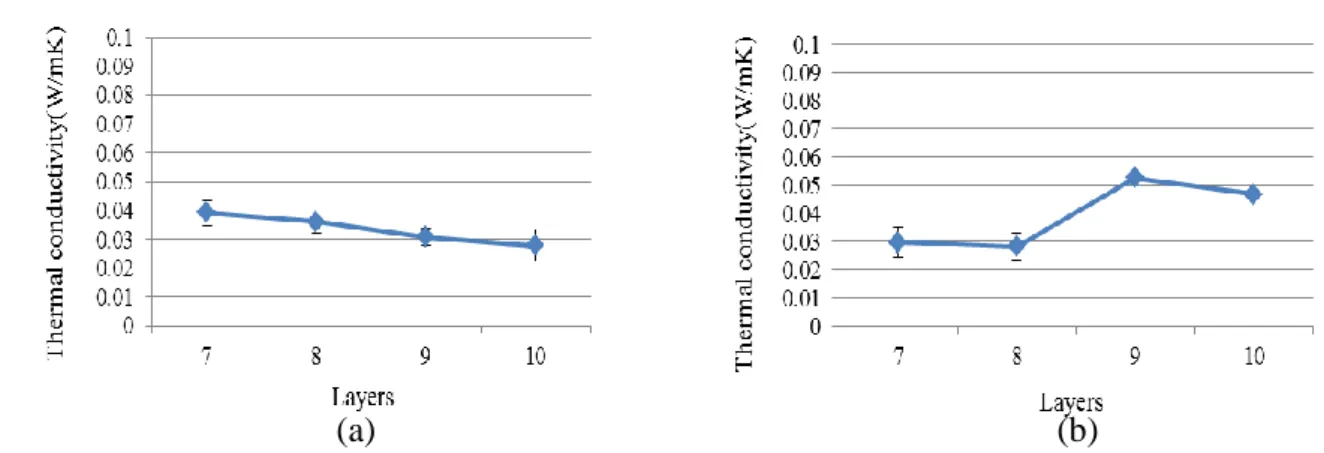
The thermal conductive coefficients of 2 D and 12 D three-dimensional nonwoven fabrics are illustrated in Figures 2. As shown in Figure 2(a), the thermal conductive coefficient values of 2 D three-dimensional nonwoven fabric decrease along with the increasing number of laminated layers. The small gaps and few pores which are formed within the fiber structure formation of 2D three-dimensional nonwoven fabric causes obstruction of air convection and conduction resulting in decreasing thermal conductive coefficient and enhancing the thermal insulation capability. From Figure 2(b), it is observed that the overall trend of thermal conductive coefficient values of 12 D three-dimensional nonwoven fabric tends to increase along with the increasing number of laminated layers. In other words, the thermal insulation efficiency of 12 D three-dimensional nonwoven fabric decrease as the number of laminated layers increases.
Figure 2. The thermal conductive coefficients of three-dimensional nonwoven fabrics (heating temperature:130 ℃, time: 10 minutes, weight of single fabric: 200±10 g/m2, thickness:10 mm) (a) Fiber fineness :2 D (b) Fiber fineness :12 D
Conclusion
In this research, the processing technique of thermal-plastic sound absorbent, thermal-insulating and flame retardant composite material has been successfully developed. The experimental results indicate that the 12 D three-dimensional nonwoven fabric has better ultimate tensile strength as compared to that of 2 D three-dimensional nonwoven fabric. Also, as the number of laminated layers reaches at 10, the optimal ultimate tensile strength of 12 D three-dimensional nonwoven fabric is 6.67 MPa in CD and 5.23 MPa in MD. In terms of sound absorption property, experimental results indicate that sound absorption coefficients of 2 D and 12 D three-dimensional nonwoven fabrics increase along with the number of laminated layers. While the number of laminated layers reaches at 10, the average sound absorption coefficients of 2 D and 12 D three-dimensional nonwoven fabrics are 0.6 and 0.605, respectively. Similarly, the LOI value of 2 D and 12 D three-dimensional nonwoven fabrics increase along with the number of laminated layers. While the number of laminated layers increases to 10, the LOI value of 2 D and 12 D three-dimensional nonwoven fabrics can reach as high as 33 and 32, respectively. According to the results of thermal conductive coefficient test, the optimal thermal conductive coefficients of the 2 D and 12 D three-dimensional nonwoven fabrics are 0.0279 W/m.k (at 10 layers) and 0.0282 W/mk (at 8 layers), respectively. This research has successfully developed three-dimensional nonwoven fabrics with the sound absorption capability, thermal insulation capability and flame retardant capability. It is expected that the three dimensional nonwoven fabrics would be broadly applied as the green building materials to provide a more safe and comfortable living environment.
Acknowledgement
This work would especially like to thank National Science Council of the Republic of China, Taiwan, for financially supporting this research under Contract NSC 99-2622-E-035-008-CC3.
References
[1] C. W. Lou, P. Chen and J. H. Lin: Advanced Materials Research Vol. 55-57 (2008), p. 393-396. [2] J. H. Lin, Y. C. Liao, C. C. Huang, C. C. Lin, C. M. Lin and C. W. Lou: Advanced Materials
Research Vol. 97-101 (2010), p. 1801-1804.
[3] K. C. Tai, P. Chen, C. W. Lin, C. W. Lou, H. M. Tan, J. H. Lin: Advanced Materials Research Vol. 123-125 (2010), p. 475-478.
[4] C. W. Lou, Y. C. Lee, I. J. Tsai, C. H. Lei, J. M. Chen and J. H. Lin: Journal of Advanced Materials Vol. 40 No. 2 (2008), p. 33-40.
[5] C. W. Lou, C. W. Lin, C. C. Lin, S. J. Li, I. J. Tsai and J. H. Lin: Advanced Materials Research Vol. 55-57 (2008), p. 405-408.