Directional light extraction enhancement from GaN-based film-transferred photonic
crystal light-emitting diodes
Chun-Feng Lai, Chia-Hsin Chao, Hao-Chung Kuo, His-Hsuan Yen, Chia-En Lee, and Wen-Yung Yeh
Citation: Applied Physics Letters 94, 123106 (2009); doi: 10.1063/1.3106109
View online: http://dx.doi.org/10.1063/1.3106109
View Table of Contents: http://scitation.aip.org/content/aip/journal/apl/94/12?ver=pdfcov Published by the AIP Publishing
Articles you may be interested in
Highly-directional emission patterns based on near single guided mode extraction from GaN-based ultrathin microcavity light-emitting diodes with photonic crystals
Appl. Phys. Lett. 97, 013108 (2010); 10.1063/1.3459970
Enhancement of light extraction from GaN-based green light-emitting diodes using selective area photonic crystal
Appl. Phys. Lett. 96, 251103 (2010); 10.1063/1.3454240
Measurement of extraction and absorption parameters in GaN-based photonic-crystal light-emitting diodes J. Appl. Phys. 107, 053114 (2010); 10.1063/1.3309837
Enhanced light extraction from GaN-based green light-emitting diode with photonic crystal Appl. Phys. Lett. 91, 181109 (2007); 10.1063/1.2804005
Enhanced light extraction from GaN-based light-emitting diodes with holographically generated two-dimensional photonic crystal patterns
Appl. Phys. Lett. 87, 203508 (2005); 10.1063/1.2132073
This article is copyrighted as indicated in the article. Reuse of AIP content is subject to the terms at: http://scitation.aip.org/termsconditions. Downloaded to IP: 140.113.38.11 On: Wed, 30 Apr 2014 15:25:21
Directional light extraction enhancement from GaN-based film-transferred
photonic crystal light-emitting diodes
Chun-Feng Lai,1Chia-Hsin Chao,2Hao-Chung Kuo,1,a兲 His-Hsuan Yen,1Chia-En Lee,1 and Wen-Yung Yeh2
1
Department of Photonics and Institute of Electro-Optical Engineering, National Chiao-Tung University, Hsinchu 300, Taiwan
2
Electronics and Opto-electronics Research Laboratories, Industrial Technology Research Institute, Hsinchu 310, Taiwan
共Received 5 February 2009; accepted 5 March 2009; published online 25 March 2009兲
Experimental investigation of the directionality in the far-field pattern and light extraction enhancement in collected cone were performed in GaN-based film-transferred photonic crystal 共PhC兲 light-emitting diodes 共FTLEDs兲. Angular-resolved measurement revealed directional profile and azimuthal anisotropy in the far-field distribution with guided modes extraction. Good agreement according to Bragg’s diffraction theory and free photon band structure were achieved. The light enhancement in PhC FTLEDs compared to non-PhC FTLEDs within the collection cone angle was obtained according to measured three-dimensional far-field patterns. In a ⫾20° collection cone, collected light was enhanced by a factor of⬃2.4 for the collimated PhC FTLED. © 2009 American
Institute of Physics.关DOI:10.1063/1.3106109兴
For next generation applications of light-emitting diodes 共LEDs兲, further improvements of the light extraction effi-ciency and the directional far-field patterns are required. Di-rectional far-field pattern of the light sources is important for many applications in projector displays, backlight displays, and automobile headlights.1Approaches based on the photo-nic crystal 共PhC兲 have attracted much attention to achieve light extraction enhancement, polarization, and directional patterns from GaN LEDs.2–4 Recently, an AlGaInP film-transferred 共FT兲 resonant cavity LED combined with PhC has been reported for enhancing directional light extraction5 in the red wavelength, as well as GaN PhC FTLEDs in the blue wavelength range for light extraction enhancement.6,7 Nevertheless, a blue GaN PhC FTLEDs with directional light extraction has not been studied in detail.
In this paper, experimental and theoretical studies on the directional light extraction through Bragg diffraction of guided modes in GaN PhC FTLEDs will be addressed. GaN FTLEDs with different PhC lattices based on free photon band structure exhibit the corresponding directionality pro-files in the far-field patterns. In addition, angular-resolved spectra have been mapped monochromatically to demon-strate the azimuthal evolution of the guided modes’ diffrac-tion behavior. Furthermore, the light enhancement of PhC FTLEDs compared to non-PhC FTLEDs within the collec-tion cone angle was also obtained according to the measured three-dimensional共3D兲 far-field patterns.
The blue GaN-based LED wafer were grown by metal-organic chemical-vapor deposition onto c-face 共0001兲 2 in. diameter sapphire substrates. The LED structure consists of a 30-nm-thick GaN nucleation layer, a 4-m-thick undoped GaN buffer layer, a 3-m-thick Si-doped n-GaN layer, a 120 nm InGaN/GaN multiple quantum well active region with eight periods 共dominant wavelength =475 nm兲, a 20-nm-thick Mg-doped p-AlGaN electron blocking layer, and a 300-nm-thick Mg-doped p-GaN contact layer. The
de-tailed wafer processing of GaN FTLEDs associated PhC is the same as in Ref. 8, using the laser lift-off technique to remove the sapphire substrate. The resulting structure was then thinned down by chemical-mechanical polishing to ob-tain the GaN cavity thickness of around 1.5 m. The square-lattice PhC with circular holes was then defined by holography lithography. PhC holes were etched into the top
n-GaN surface to a depth of around 150 nm. The lattice
constant a of PhC were 290, 350, and 400 nm and the hole diameter d fixed to ratio d/a=0.7. A scanning electron mi-croscopy共SEM兲 image of the square-lattice PhC structure is shown in Fig. 1共a兲. Finally, a patterned Pt/Cr/Au electrode was deposited on n-GaN as the n-type contact layer. After fabrication, the dies were mounted on transistor outline共TO兲 package with encapsulant-free.
After sample preparation, angular-resolved measurement under electrical current injection was performed. A
continu-a兲Electronic mail: [email protected].
FIG. 1. 共Color online兲 共a兲 The top-view SEM image of PhCs on FTLED with the lattice constant a = 400 nm and the diameter of air holes d = 280 nm fabricated with the holography lithography. Inset: the cross-section TEM image shows the PhC depth t = 150 nm.共b兲 The optical mi-crography showing the blue light distribution across the die operated at low injection current 5 mA.共c兲 Schematic diagram of the GaN FTLED structure with PhC.
APPLIED PHYSICS LETTERS 94, 123106共2009兲
0003-6951/2009/94共12兲/123106/3/$25.00 94, 123106-1 © 2009 American Institute of Physics
This article is copyrighted as indicated in the article. Reuse of AIP content is subject to the terms at: http://scitation.aip.org/termsconditions. Downloaded to IP: 140.113.38.11 On: Wed, 30 Apr 2014 15:25:21
ous current of 20 mA injected into the TO mounted device at room temperature. The angular-resolved experiment setup is the same as in Ref.9. In PhC FTLED, the far-field distribu-tion will be significantly modified by the PhC lattice diffrac-tion. The waveguided light traveling in the plane will be diffracted by the reciprocal wave vectors associated with the PhC. Figure 2shows the two-dimensional 共2D兲 free photon band structure for the TE modes with average refractive in-dex n = 2.42.10 Three different a values, 290, 350, and 400 nm, creates a range of a/=0.52–0.91 for experimental in-vestigation as enclosed in the boxes, as shown in Fig.2. The angular-resolved spectra are transformed into the guided mode dispersion curves, as shown in the inset as boxes in Fig. 2.9The image shows the normalized dispersion curves for each mode lines in the⌫X and ⌫M directions. Above the air lines, the band structure exhibits and abundance of reso-nant states that will be involved in the PhC assisted by light extraction. Using the angular-resolved spectroscopic tech-nique, most of these states can be investigated efficiently. The agreement between the experiment and calculation are good. Only the guided modes of effective refractive index
neff= 2.414– 2.15 from our samples are seen. We accurately fit the lowest order mode with the free photon band structure. The other modes are shifted higher than our red line because each mode has a different photonic crystal induced effective index.9Additionally, the extracted guided mode corresponds with the high symmetry point along the⌫ axis of ⌫1and⌫2 that shows the light collimation profile. For a more detailed analysis of angular-resolved spectra for GaN film-transferred PhC LEDs, see Ref.7.
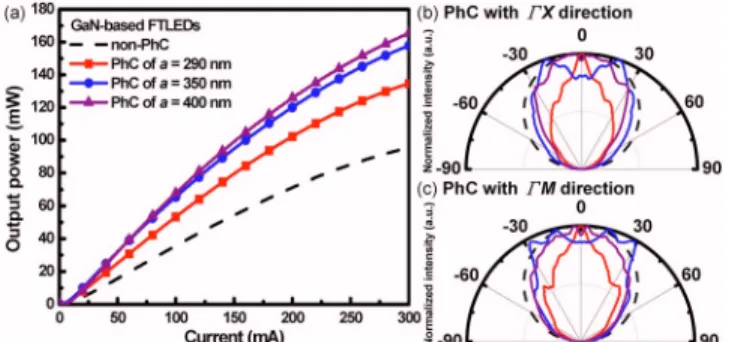
In addition, the intensity-current-voltage共L-I-V兲 charac-teristics were measured by using an integration sphere with Si photodiode. The turn on voltage is about 2.7 V. The light output power of the GaN PhC FTLEDs with various a values of 290, 350, and 400 nm at a driving current of 200 mA shown in Fig. 3共a兲 reveals output power enhancement by a percentage of 45%, 68%, and 77%, respectively, compared to the GaN FTLED without PhC 共non-PhC FTLED兲. At 200 mA driving current, the forward voltages of the GaN PhC FTLED with a of 290, 350, and 400 nm are 6.2, 6.4, and 6.5
V, respectively. The high forward voltages could attribute to high series resistance in such thin PhC device. Furthermore, due to the discrete nature of the guided modes, this diffrac-tion light will exhibit anisotropy in the far-field pattern both in the zenith directional and the azimuthal direction. The far-field patterns in the zenith direction were measured at a driving current of 50 mA, normalized with the peak intensity, as shown in Figs.3共b兲and3共c兲. The samples with a of 290 and 400 nm have collimated far-field patterns that both are peaked near normal to the FTLED surface and have small far-field angle at half intensity of ⫾31.7° 共⫾41.05°兲 and ⫾42.45° 共⫾49.7°兲 in ⌫X 共⌫M兲 orientation of PhC lattice, respectively, which are much smaller than that of a typical Lambertian cone, ⫾60°. The measured far-field pattern of the GaN non-PhC FTLED is nearly Lambertian. In addition, the a of 350 nm sample has lobes at around ⫾17° 共⫾15°, ⫾30°兲 in ⌫X 共⌫M兲 orientation. Therefore, in GaN PhC FTLED, the far-field distributions will be significantly modi-fied by the PhC structure, i.e., lattice constant a. With com-paring to the encapsulant-free PhC FTLED, the encapsulated PhC FTLED has similar far-field characteristics in our study. As a result, the GaN PhC FTLEDs can be encapsulated to increase light enhancement,6 while retaining the directional patterns.
The azimuthal anisotropy of the far-field distribution is measured as a function of the azimuthal angles by using the angular-resolved setup. Figures 4共a兲–4共c兲 plot the far-field distributions monochromatically in the azimuthal direction at a fixed wavelength of =475 nm with a of 290, 350, and 400 nm, respectively. Different guided mode with different index will trace out an arc with the radius corresponding to the respective waveguide circle, which are well fitting by Ewald’s construction of Bragg’s diffraction theory.11 The several lower guided mode extracted by PhC lattice is shown in Fig. 4. Additionally, we also measured the 3D far-field patterns of three different a values, 290, 350, and 400 nm, in top view, which revealed the PhC diffraction patterns with fourfold symmetry due to square lattice, as shown in Figs.
4共d兲–4共f兲, respectively.
The light enhancement in the PhC FTLEDs compared to non-PhC FTLEDs at a driving current of 50 mA can be charted in Fig.5in which the light enhancement is defined as the ratio of the light output of the PhC FTLED divided by non-PhC LED, and the power is collected from ⫾0° to ⫾90°. The light enhancements in collection angles strongly depending on the far-field patterns of GaN PhC FTLEDs are obtained. The collimated PhC FTLED in a ⫾20° collection
FIG. 2. 共Color online兲 Free photon band structure calculated with n=2.42 for the TE modes. The red thick lines indicate the collinear coupled modes. The red dash lines indicated the noncollinear coupled bands. The air lines are shown in gray dashed lines. The boxes indicate the experiment regions observed with a = 290, 350, and 400 nm.
FIG. 3.共Color online兲 共a兲 Light output power-current 共L-I兲 curve character-istic of GaN FTLED with PhC and without PhC. The far-field pattern shows the different direction共b兲 ⌫X and 共c兲 ⌫M with PhC at driving current of 50 mA.
123106-2 Lai et al. Appl. Phys. Lett. 94, 123106共2009兲
This article is copyrighted as indicated in the article. Reuse of AIP content is subject to the terms at: http://scitation.aip.org/termsconditions. Downloaded to IP: 140.113.38.11 On: Wed, 30 Apr 2014 15:25:21
cone achieves the light enhancement of⬃2.4. For collimated patterns, the light enhancement increases with collection angle shrinking. The divergent profile of PhC with a = 350 nm reveals little light enhancement in a small collec-tion angle. Therefore, the collimacollec-tion profile of far-field pat-tern could contribute to the stronger directional light en-hancement in many applications, especially for etendue limited applications. Additionally, the extraction enhance-ment is not only a function of the PhC parameters, but also on other variables such as the GaN thickness and QW place-ment, as shown in Ref.7.
In conclusion, the far-field directionality and light ex-traction enhancement in collected cone in GaN-based PhC FTLEDs with three different square PhC lattice have been experimentally investigated. Angular-resolved measurements
revealed directional profile and azimuthal anisotropy in the far-field distribution with guided modes extraction based on the Bragg’s diffraction. The extracted guided mode corre-sponds with the high symmetry point along the ⌫ axis of ⌫1 and ⌫2 that shows the light collimation profile. The light enhancement in PhC FTLEDs compared to non-PhC FTLEDs within the collection cone angle was also obtained according to measured 3D far-field patterns. In a ⫾20° col-lection cone, collected light was enhanced by a factor of ⬃2.4 for the collimated PhC FTLED. The collimated PhC FTLED is a promising candidate for etendue limited appli-cations, such as projecting display.
1M. R. Krames, O. B. Shchekin, R. Mueller-Mach, G. O. Mueller, L. Zhou, G. Harbers, and M. G. Craford,J. Disp. Technol. 3, 160共2007兲. 2C. F. Lai, H. C. Kuo, C. H. Chao, H. T. Hsueh, J.-F. T. Wang, W. Y. Yeh,
and J. Y. Chi,Appl. Phys. Lett. 91, 123117共2007兲.
3C. F. Lai, J. Y. Chi, H. H. Yen, H. C. Kuo, C. H. Chao, H. T. Hsueh, J.-F. T. Wang, C. Y. Huang, and W. Y. Yeh, Appl. Phys. Lett. 92, 243118 共2008兲.
4J. J. Wierer, M. R. Krames, J. E. Epler, N. F. Gardner, and M. G. Craford,
Appl. Phys. Lett. 84, 3885共2004兲.
5K. Bergenek, Ch. Wiesmann, H. Zul, R. Wirth, P. Sundgren, N. Linder, K. Streubel, and T. F. Krauss,Appl. Phys. Lett. 93, 231109共2008兲. 6H. K. Cho, S. K. Kim, D. K. Bae, B. C. Kang, J. S. Lee, and Y. H. Lee,
IEEE Photonics Technol. Lett. 20, 2096共2008兲.
7J. J. Wierer, A. David, and M. M. Megens, Nat. Photonics 3, 163共2009兲. 8C. E. Lee, C. F. Lai, Y. C. Lee, H. C. Kuo, T. C. Lu, and S. C. Wang,IEEE
Photonics Technol. Lett. 21, 331共2009兲.
9A. David, C. Meier, R. Sharma, F. S. Diana, S. P. DenBaars, E. Hu, S. Nakamura, and C. Weisbuch,Appl. Phys. Lett. 87, 101107共2005兲. 10G. Yu, G. Wang, H. Ishikawa, M. Umeno, T. Soga, T. Egawa, J. Watanabe,
and T. Jimbo,Appl. Phys. Lett. 70, 3209共1997兲.
11A. David, H. Benisty, and C. Weisbuch,J. Disp. Technol. 3, 133共2007兲. FIG. 4.共Color online兲 The map of intensity of the extracted light at a fixed wavelength =475 nm. The wavelength was kept at a constant corresponding to 共a兲 a=290 nm, 共b兲 a=350 nm, and 共c兲 a=400 nm, respectively. Inset: the tittles show Bragg’s diffraction theory fitting with effective refractive index neff = 2.414共cyan X of ⌫X direction, green O of ⌫M direction, and blue 䊐 of ⌫X⌫M direction兲. The top view of 3D far-field pattern shows three different a value 共d兲 290 nm, 共e兲 350 nm, and 共f兲 400 nm, respectively.
FIG. 5. 共Color online兲 Light enhancement recorded at various output col-lection angle for GaN PhC FTLEDs with three different a.
123106-3 Lai et al. Appl. Phys. Lett. 94, 123106共2009兲
This article is copyrighted as indicated in the article. Reuse of AIP content is subject to the terms at: http://scitation.aip.org/termsconditions. Downloaded to IP: 140.113.38.11 On: Wed, 30 Apr 2014 15:25:21