科技部補助專題研究計畫成果報告
期末報告
情緒與學習:以多元資料庫與分析方法驗證質性模式
計 畫 類 別 : 個別型計畫 計 畫 編 號 : MOST 103-2410-H-004-137-執 行 期 間 : 103年08月01日至105年03月31日 執 行 單 位 : 國立政治大學教育學系 計 畫 主 持 人 : 邱美秀 計畫參與人員: 博士班研究生-兼任助理人員:李昭鋆 博士班研究生-兼任助理人員:錫東岳 報 告 附 件 : 出席國際會議研究心得報告及發表論文 處 理 方 式 : 1.公開資訊:本計畫可公開查詢 2.「本研究」是否已有嚴重損及公共利益之發現:否 3.「本報告」是否建議提供政府單位施政參考:否中 華 民 國 105 年 04 月 01 日
中 文 摘 要 : 本研究主要目的在建立學生資訊科技使用之有效學習模式(學習成效 含成就與情意),並以社經地位為中介變項。以PISA資料庫臺灣資料 為例,進行四個結構方程模式之建立與考驗。模式一:校內外資訊 科技並行使用對學習成效影響之模式;模式二:校內外連結資訊科 技使用對學習成效影響之模式;模式三:模式一加上社經之中介 ;模式四:模式二加上社經之中介。統計考驗結果顯示:(1)實證資 料均支持此四模式,即模式均適配;(2)以模式適配值進行比較,有 社經地位中介之模式(三、四)優於無社經中介之模式(一、二)。 (3)以訊息指標值進行比較,無社經地位中介之模式(一、二)優於有 社經中介之模式(三、四)。(4)從模式一轉到模式二,似乎較能提出 具體有利於教學實務的建議。(5)加入社經變項,較能解釋資訊科技 使用仍受社經地位影響的現狀,研究結果能對家庭教育實務提出建 設性的建議。本研究之貢獻在於連結方法學與教育實務,力圖能增 益二者。 中 文 關 鍵 詞 : 成就、情意、資訊科技使用、統計評估、教育實務。
英 文 摘 要 : TThis study explored models for effective information and communication technology (ICT) use on the learning outcomes of achievement and affect, mediated by outside-school ICT use and socioeconomic status (SES), using structural equation modeling. Four models were developed based on empirical findings and validated using the 2012 Taiwanese sample of the Program for International Student Assessment to demonstrate model exploration. The four models measure the effects of ICT use on learning outcomes from (A) parallel ICT use, (B) inside-school ICT use with outside-school ICT use mediation, (C) Model A with SES mediation, and (D) Model B with SES mediation. Data analysis results indicate that the four models fit empirical data; Models C and D (with SES mediation) are superior to Models A and B based on fit indices; Models A and B are superior to Models A and B based on information criteria; and Models B–D (with mediation) provide more educational meaning than does Model A (without mediation).
英 文 關 鍵 詞 : achievement, affect, ICT use, statistical evaluation, educational practice
Introduction
Schools have gradually incorporated information and communication technology (ICT) to address traditional curricula. The effects of inside-school ICT use on traditional curricular learning outcomes (e.g., achievements and affects) and curricula, however, remain diverse and uncertain (Cristia, Czerwonko, & Garofalo, 2010; Tamim, Bernard, Borokhovski, Abrami, & Schmid, 2011). Potential reasons may be that ICT use does not directly link to traditional learning outcomes, methods for increasing the effects of inside-school ICT use are still in progress, and models for the effects of inside-school ICT use are still in development, relying on researchers’ experiences or ideas (Lim, Zhao, Tondeur, Chai, & Tsai, 2013). Experiments may help researchers prove the effectiveness of certain methods in increasing the effects of inside-school ICT use. Conducting experiments, however, is time consuming, and replicating experimental results in different contexts is necessary to validate previous experimental results.
This study used statistical methodology and structural equation modeling (SEM) to measure the effectiveness of methods for increasing the effects of inside-school ICT use on traditional learning outcomes. SEM is traditionally used to validate theory-based models but may be used for model or theory development (Schnoll, Fang, & Manne, 2004). For an emerging field such as that explored in this study, reliable theories are rare. This study aimed to demonstrate how SEM may be used to explore models for increasing the effects of inside-school ICT use on learning outcomes, based on empirical findings related to outside-school ICT use and socioeconomic status (SES).
Outside-school ICT use may mediate the effects of inside-school ICT use on learning outcomes (achievements and affects)
Inside-school ICT use is a response to the worldwide trend of daily ICT use. The difference between inside-school and outside-school ICT use may be that most inside-school ICT use focuses on educational purposes under teacher supervision (Samuelsson, 2010; Tondeur, Sinnaeve, Van Houtte, & Van Braak, 2010; Tondeur, Van Braak, & Valcke, 2007), whereas outside-school ICT use focuses more on leisure than educational purposes, with or without parental supervision (Malamud & Pop-Eleches, 2011; Mumtaz, 2001). The boundaries between inside-school and outside-school ICT use, however, appears to have gradually diminished because of recent developments and widespread use of virtual social networks (Junco, 2012; Kent & Facer, 2004), massive open online courses (Liyanagunawardena, Adams, &
Williams, 2013), and flipped classrooms (Flumerfelt & Green, 2013; Roehl, Reddy, & Shannon, 2013). This blurring of the boundary between inside-school and outside-school ICT use suggests that investing additional time in education or leisure outside school may be related to learning outcomes.
The effects of inside-school ICT use on traditional cognitive learning outcomes (i.e., achievements) may be limited without ensuring teaching quality (Luu & Freeman, 2011; Morgan, 2010; Ravizza, Hambrick, & Fenn, 2014; Wurst, Smarkola, & Gaffney, 2008). For affective learning outcomes, inside-school ICT use generally has positive relationships with attitudes toward ICT (Papastergiou, 2010) and openness to new things (Selwyn, Potter, & Cranmer, 2009) but nonsignficant relationships with attendance (Muir-Herzig, 2004) and negative relationships with concentration (Sana, Weston, & Cepeda, 2013). No studies, to date, have focused on the effects of outside-school ICT use on traditional learning outcomes.
SES may mediate effects of ICT use on learning outcomes (achievements and affects)
SES is an index of a family’s cultural and material capital. SES, therefore, is potentially related to ICT use outside school. Focusing on cultural capital, SES may help children focus on educational or advanced ICT use (Nasah, DaCosta, Kinsell, & Seok, 2010; Vekiri, 2010). Focusing on material capital, a high SES may result in access to ICT facilities without supervision or teaching, which may lead to leisure ICT use and limit learning outcomes (Selwyn & Gorard, 2003; Tondeur et al., 2010). Relationships between SES and inside-school ICT use may be not strong in an educational system where public schools are well developed and most children attend public schools, as in Taiwan.
Research has long indicated that SES has stable relationships with learning outcomes such as achievements, interest, and openness to experiences, which may relate to cultural capital or gene (Tucker‐ Drob & Harden, 2012). The stable relationships between SES and learning outcomes suggest that including SES as a predictor of achievement in a model is likely to increase model fit.
This predicted relationship between outside-school ICT use and SES combined with evidence-based relationships between SES and learning outcomes suggests that examining the relationship between ICT use and achievements without considering SES may be biased (Kubiatko & Vlckova, 2010). As previous studies have indicated, outside-school ICT use, achievement, and SES are positively related (Lee & Wu, 2012; Sánchez & Salinas, 2008). SES, therefore, may mediate the effect of ICT use, particularly outside-school ICT use, on learning outcomes.
Hypotheses
Hypothesis 1. Diverse ICT use has parallel, weak effects on learning outcomes (achievements and affects) (Model A).
Hypothesis 2. Diverse ICT use with additional mediated outside-school ICT use (i.e., the link between inside-school to outside-school ICT use) has increased effects on learning outcomes (Model B) compared with Model A.
Hypothesis 3. Diverse ICT use with additional SES mediation has increased effects on learning outcomes (Model C) compared with Model A.
Hypothesis 4. Diverse ICT use with additional mediated outside-school ICT use and SES has increased effects on learning outcomes (Model D) compared with Models A–C.
Methods
Data source and sample
This study used data of the Taiwanese sample from the main and ICT surveys of the Program for International Student Assessment (PISA) in 2012 (Organization for Economic Cooperation and Development [OECD], 2014) to examine the hypotheses. PISA is a triennial survey examining 15-year-old student achievements in mathematics, reading, and science, and collects related student, parent, and school background data since 2000. The ICT survey was optional and focused on ICT availability, use, and attitudes. The Taiwanese sample comprised data from 6,046 students.
Measures
Learning outcome 1: Achievement. Three achievement measures were used to represent diverse student cognitive learning outcomes: mathematics achievement (“pv1math” in PISA 2012), reading achievement (“pv1read”), and science achievement (“pv1scie”). The test reliabilities for the Taiwanese data were .91, .89, and .91 for mathematics, reading, and science achievements, respectively. The three measures were scaled using item response theory (IRT) to a mean of (M) = 500 and standard deviation of (SD) = 100. Higher scores represented higher achievements (OECD, 2014, pp. 159, 233, and 234).
(“openps”) and perseverance (“persev”). Openness comprised five items such as “I can handle a lot of information.” Perseverance also comprised five items such as “When confronted with a problem, I do more than what is expected of me.” The internal reliabilities for the Taiwanese sample were .86 for openness and .84 for perseverance. Both measures were rated on a 5-point Likert scale from 1 (very much like me) to 5 (not at all like me) (OECD, 2014, pp. 337 and 425).
ICT use. ICT use entailed three measures: inside-school ICT use (“usesch”), outside-school leisure ICT use (“entuse”), and outside-school educational ICT use (“homsch”). Inside-school ICT use involved nine items asking students about how often they used computers at school for activities such as using email, doing homework, and playing simulations. Leisure ICT use entailed 10 items asking students how often they used computers outside school for activities such as playing one-player games and participating in social networks. Educational ICT use involved seven items asking students how often they used computers outside school for the activities such as browsing the Internet for schoolwork and doing homework on the computer. Students rated the items on a 5-point Likert scale from 1 (never or hardly ever) to 5 (every day). The internal reliability for the Taiwanese sample was .85 for inside-school ICT use, .83 for leisure ICT use, and .86 for educational ICT use (OECD, 2014, pp. 338-340, 426, and 427).
Socioeconomic status. The measure SES (“escs”) was derived based on three items: (1) home possessions, (2) parental occupation with the highest income, and (3) the highest parental education. The internal reliabilities of the three items, each further z-standardized, was .69 for the Taiwanese data (OECD, 2014, pp. 351–353). The measurements of affects, ICT use, and SES were scaled internationally using IRT to values of M = 0 and SD = 1. Higher scores represented higher degrees of each measure (OECD, 2014, p. 312). The case numbers (N), means, SDs, and correlations among the nine measures for the Taiwanese data are presented in Table 1.
<Insert Table 1 around here.>
Statistical analysis
The data were analyzed using R software Version 3.1.3 (R Core Team, http://www.R-project.org/). Descriptive statistics and Pearson’s bivariate correlations (Table 1) were obtained for a basic understanding of the measures using the R psych and stats packages. Absolute values of correlation coefficients below or equal to .35 indicate weak relationships, those from .36 to .67 indicate moderate relationships, and those from .68 to 1.00 indicate strong relationships (Taylor, 1990). Before using
SEM to examine the hypotheses, the data were weighted using the total student weight (“W_FSTUWT”) and 80 replicate weights (“W_FSTR1-80”) with the R survey package. The weighting procedure involved accounting for the PISA sampling design and the analysis results could be used to characterize the population (Oberski, 2014; OECD, 2014).
The four hypotheses were examined using SEM with the R lavaan package (Rosseel, 2012). Some of the measures had missing data, revealed by the numbers of cases used to determine the measures (Table 1). Missing data were handled using the full information maximum likelihood (FIML) estimation, which was superior to other methods (e.g., listwise deletion, pairwise deletion, and similar response pattern imputation) when SEM was used (Enders & Bandalos, 2001). This study compared FIML with listwise deletion and found that both methods generated similar parameter estimate patterns (e.g., value direction and significance levels), but FIML generated more desirable fit index values than listwise deletion did.
The default parameters obtained using the R lavaan package included factor loadings, regressions, correlations, and intercepts (e.g., Models A–D in Figures 1–2). Regression coefficients were added to the regression formula to examine the significance levels of mediated or indirect effects (Baron & Kenny, 1986; Rosseel, 2015).
The metrics for the fit indices and information criteria were used to examine how Models A–D fitted the data and whether this corresponded with the hypotheses. The fit indices indicated the capacity of a model to reproduce the variance-covariance matrix of the data. The chi-square (χ2) value, the traditional criterion, represented the deviance between the observed and model-implied variance-covariance matrices, with a nonsignficant χ2 indicating a good fit. The χ2 value was not a suitable metric in this study because of the large sample size (Bollen & Long, 1993). The root mean square error of approximation (RMSEA) was developed based on the χ2 adjusted for sample sizes and was considered one of the major metrics for determining the power of a whole SEM model (Thoemmes, MacKinnon, & Reiser, 2010). The comparative fit index (CFI) and the Tucker–Lewis index (TLI; also named the nonnormed fit index) are based on the χ2 adjusted for degrees of freedom. The CFI penalty for model complexity was considerably lower than the TLI although the CFI and TLI normally generated similar results. As such, three fit indices were used in this study: an RMSEA lower than .100 (lower being better), and a CFI and TLI, both higher than .900 (higher being better) (Hair, Black, Babin, Anderson, & Tatham, 2006). Information criteria were applied to compare competing (nested or nonnested) models with lower values, indicating models that fitted data better (Lewis, Butler & Gilbert, 2011). Information criteria were based on maximum likelihood estimation
with the Akaike information criterion (AIC) adjusted for unbiased estimation, the Bayesian information criterion (BIC) adjusted for parameter numbers, and the sample-size adjusted BIC (aBIC) adjusted for parameter numbers and sample sizes. The BIC and aBIC favor simpler models than the AIC does (Patarapichayatham, Kamata, & Kanjanawasee, 2012). When sample sizes are large, the aBIC performs higher in selecting models than does the AIC or BIC (Kim, Yoon, Wen, Luo, & Kwok, 2015).
Results
Direct effects of ICT use on learning outcomes (achievements and affects) (Model A)
Model A highlighted that diverse ICT use had parallel but weak effects on learning outcomes (achievements and affects) without a strong basis in theory or empirical research (Figure 1 and Table 2). The results obtained by SEM generally supported Hypothesis 1 in that the three ICT measures had weak, although significant, effects on learning outcomes, except for the nonsignificant effect of inside-school ICT use on affects (Figure 1 and Table 2). Model A closely fitted the data, as indicated by the fit index values (RMSEA = .060, CFI = .989, TLI = .979). The weak or nonsignificant effects of inside-school ICT use were not expected of educators but replicated some previous findings (Ravizza et al., 2014). Previous literature (e.g., Flumerfelt & Green, 2013) and the slightly higher effects of outside-school ICT use than those of inside-school ICT use suggest that recent trends of linking inside-school and outside-school ICT use implied that an increased effect from inside-school ICT use might be obtained in conjunction with outside-school ICT use.
ICT use with inside-school to outside-school links (Model B)
Model B was similar to Model A with two additional paths from inside-school to outside-school leisure and educational ICT use (Figure 1 and Table 2). The values of the direct effects in Model B were the same as those in Model A, but Model B had two additional positive and significant paths from inside-school to outside-school leisure and educational ICT use, respectively. In addition, the two additional paths contributed to significant mediated effects by inside-school ICT use on learning outcomes through leisure and educational ICT use. The results of unchanged direct effects and additional mediated effects provided the meaningful educational message
that diverse ICT use with additional effects from inside-school to outside-school ICT use had increased effects on learning outcomes (Model B) compared with those without inside-school to outside-school ICT use (Model A), which supports the prediction of Hypothesis 2.
Model B fitted the data closely, as revealed by the fit index values (RMSEA = .060, CFI = .989, TLI = .977). Most fit index values remained unchanged from Model A to Model B, which suggested that Model B with two additional paths had a similar fit to that of Model A.
Information criteria, however, increased from Model A (AIC = 262734.856; BIC = 262882.413; aBIC = 262812.503) to Model B (AIC = 262748.855; BIC = 262943.362; aBIC = 262851.208). The results suggested that Model A fitted the data better than Model B did, possibly because Model A was simpler than Model B.
ICT use with SES mediation (Model C)
Model C was similar to Model A with additional SES mediation for the three types of ICT use (Figure 1 and Table 2). A student’s SES had a moderate effect on achievements and a weak effect on affects. It could be significantly regressed on leisure and educational, but not on inside-school ICT use.
The direct effects of achievements or affects regressed on the three types of ICT use were reduced, except for the direct effect of affects regressed on leisure ICT use. The significance levels, however, remained unchanged from Model A to Model C. The reduction in direct effects but unchanged significant levels suggests that SES partially mediated the effects of the three types of ICT use on learning outcomes (Baron & Kenny, 1986). The increased direct effect of affects regressed on leisure ICT use was a unique phenomenon, suggesting that including SES mediation increased the effect of leisure ICT use on affects.
The mediated effects from SES were significant, except for achievements and affects regressed on inside-school ICT use. The results provided direct evidence that SES mediated the effects of leisure and educational, not inside-school, ICT use on learning outcomes.
The values of the fit indices indicated that Model C fitted the data well (RMSEA = .057, CFI = .988, TLI = .976). Compared with Model A (RMSEA = .060, CFI = .989, TLI = .979), Model C had a reduced RMSEA value and slightly lower CFI and TLI values. The results suggested that Model C was better than Model A because the RMSEA was one of the major metrics for determining the power of an SEM model (Thoemmes et al., 2010).
Information criteria, however, increased from Model A (AIC = 262734.856; BIC = 262882.413; aBIC = 262812.503) to Model C (AIC = 276542.400; BIC = 276736.907; aBIC = 276644.753). The results suggested that Model A fitted the data better than Model C did.
ICT with inside-school and outside-school links and SES mediation (Model D)
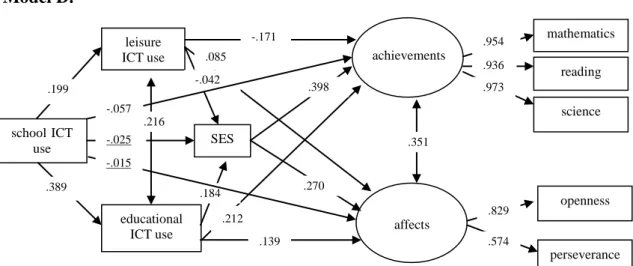
Model D was similar to Model B with additional SES mediation for the effects of the three types of ICT use on learning outcomes and similar to Model C with an additional two paths from inside-school to outside-school ICT use (Figure 1 and Table 2). The direct effect values of Model D were the same as those of Model C. Models B and D had the same values of leisure and educational ICT use regressed on inside-school ICT use. The results suggested that SES mediation and inside-school to outside-school links were independent in their effects on learning outcomes.
Models D and C have the same values of mediated effects from SES. The mediated effects from outside-school ICT use, however, was reduced from Models B to D, except for the increased mediated effects from leisure ICT use on the effect of inside-school ICT use on affects; the significance levels remained unchanged. The results suggested that SES had additional, partial mediated effects on the mediated effects from outside-school ICT use.
The fit index values revealed that Model D closely fitted the data (RMSEA = .057, CFI = .989, TLI = .975). Model D was the most complex among Models A–D. Model D, however, fitted the data no worse than Model C did (same RMSEA, slightly higher CFI, and slightly lower TLI values) and better than Models A–B did (lower RMSEA, same CFI, and slightly lower TLI values). The reasons that Model D had the lowest TLI might be that the TLI strongly penalizes model complexity. Information criteria, however, indicated that Model D was the worst among Models A–D because Model D had the highest information criteria values (AIC = 276556.399; BIC = 276797.856; aBIC = 276683.458). The reason might be that Model D was the most complex among Models A–D, and information criteria favor simpler models.
Discussion
Weak effects of ICT use on traditional learning outcomes (achievements and affects) (Model A)
Without a basis in theory, the parallel effects of diverse ICT use on traditional learning outcomes are generally weak, especially for the nonsignficant effect of inside-school ICT use on affects. The results are consistent with previous empirical research findings that ICT use has diverse effects on cognitive and affective outcomes (Cristia et al., 2010; Morgan, 2010). Despite large investments in inside-school ICT use including hardware, software, and teacher training, the effects of inside-school ICT use on traditional learning outcomes are disappointing and must be amended.
The results of parallel ICT use on learning outcomes, however, suggest likely methods for increasing the effects of inside-school ICT use. The slightly higher correlations between outside-school ICT use and learning outcomes suggest linking inside-school to outside-school ICT use may increase the effect of inside-school ICT use. In addition, the relationships between the three types of ICT use are significant and positive (Table 1).
Increased effects of inside-school ICT use by linking inside-school to outside-school ICT use (Model B)
Model B increases the effects of inside-school ICT use on learning outcomes through significant mediated effects from outside-school ICT use, which provides additional meaning for educational practices. The SEM results reveal that inside-school ICT use leading to outside-school educational ICT use results in multiple positive learning outcomes. The effect of inside-school ICT use on affects can also be activated through mediated effects from outside-school leisure ICT use. The results are consistent with previous PISA 2009 findings, in that home ICT use relates to student achievements more than inside-school ICT use does (OECD, 2010). The findings of this study suggest that student learning outcomes may be affected by educational provisions linking inside-school and outside-school educational ICT use (Kent & Facer, 2004). Teachers may need further professional development to integrate ICT into curricula, address course objectives, and link student inside-school and outside-school ICT use for educational purposes (Barrera-Osori & Linden, 2009).
Effectively linking inside-school and outside-school ICT use presents educators with several challenges, including overcoming digital inequality. Teachers must develop pedagogies to monitor student outside-school educational ICT use (Wellington, 2001). Outside-school ICT competence and availability (e.g., smart phones) may influence inside-school ICT use (Plesch, Kaendler, Rummel, Wiedmann, & Spada, 2013) and the influence increases with age (Selwyn, Boraschi,
& Ö zkula, 2009). Future research can also examine a reverse model from outside-school to inside-school ICT use.
SES mediation increases effects of ICT use on learning outcomes (achievements and affects) (Models C and D)
The second method for increasing the effect of ICT use is to add measures stably relating to learning outcomes. A student’s SES has long been a well-known factor relating to achievements (Tucker‐ Drob & Harden, 2012), which also relates to home ICT use (Tondeur et al., 2010). As predicted, the degrees of fit of the data increase by including SES (Models C and D) into the original models of parallel ICT use (Model A) or parallel with linking inside-school to outside-school ICT use (Model B). Educational ICT use with SES mediation increases additional positive effects and leisure ICT use with SES mediation increases additional negative effects.
The complete mediation model (Model D) provides meaningful lessons for both teachers and parents. Parents must monitor student outside-school ICT use and teachers may have to become nodes for distributed learning economies, connecting parents of different SESs through ICT use to optimize learning outcomes (Hohlfeld, Ritzhaupt, & Barron, 2010).
SEM as a model exploration technique
ICT use is a new field and gradually spreading in both daily and educational lives. The lack of ICT use theories in the academic world offers opportunities to develop new models by applying diverse methodologies. The use of SEM has traditionally been a model validation technique. This study used SEM as a model exploration technique, developing models—with support from empirical ICT use research findings—and validating models.
This study used two methods for assessing model goodness-of-fit to data: fit indices and information criteria. Fit indices were developed based on χ2 metrics, testing variance-covariance matrices between the observed and model-implied data. Information criteria were developed from the maximum likelihood estimation for comparing models.
Fit indices were found to provide a higher number of diverse functions than information criteria did. Fit indices can be used to determine degrees of fit to data for a single model (Hair et al., 2006) and the deviance between two models in fit index values can be used to compare the relative power of the two models, despite lacking salient statistical examination (Thoemmes et al., 2010). Previous research
suggested using differences between the χ2 values to compare two models (Cheong, MacKinnon, & Khoo, 2003), but this cannot be used when two models have the same degrees of freedom (e.g., Models A and B in this study). Future research may develop statistical methods for using other fit indices (e.g., RMSEA) to compare models.
Information criteria can be used only to compare models. Information criteria appear to be sensitive to model complexity, with models that are more complex having higher information criteria values. As revealed in this study, Model A has the lowest information criteria values among Models A–D, which indicates Model A is the best model. Models B–D, however, provide messages that are more meaningful for educational practices but still have good or even better fit to the data, as revealed by the fit index values. Future information criteria development may revise penalty methods for model complexity.
References
Barrera-Osorio, F., & Linden, L. L. (2009). The use and misuse of computers in
education: Evidence from a randomized experiment in Colombia (Policy
Research Working Paper 4836). Washington, D.C.: World Bank.
Bollen, K. A. & Long, J. S. (1993). Testing structural equation models. Newbury Park, CA: Sage.
Cheong, J., MacKinnon, D. P., & Khoo, S. T. (2003). Investigation of mediational processes using parallel process latent growth curve modeling. Structural
Equation Modeling, 10, 238-262.
Cristia, J. P., Czerwonko, A., & Garofalo, P. (2010). Does ICT increase years of
education?: Evidence from Peru (IDB working paper OVE/WP-01/10).
Washington, D.C.: Inter-American Development Bank.
Enders, C. K., & Bandalos, D. L. (2001). The relative performance of full information maximum likelihood estimation for missing data in structural equation models. Structural Equation Modeling, 8, 430-457.
Flumerfelt, S., & Green, G. (2013). Using lean in the flipped classroom for at risk Students. Educational Technology & Society, 16(1), 356–366.
Hair, J. F., Jr., Black, W. C., Babin, B. J., Anderson, R. E., & Tatham, R. L. (2006).
Multivariate data analysis (6th ed.). Upper Saddle River, NJ: Prentice-Hall.
Hohlfeld, T. N., Ritzhaupt, A. D., & Barron, A. E. (2010). Connecting schools, community, and family with ICT: Four-year trends related to school level and SES of public schools in Florida. Computers & Education, 55, 391-405.
and academic performance. Computers & Education, 59, 505-514.
Kent, N., & Facer, K. (2004). Different worlds? A comparison of young people's home and school ICT use. Journal of Computer Assisted Learning, 20, 440-455. Kim, E. S., Yoon, M., Wen, Y., Luo, W., & Kwok, O. M. (2015). Within-level group
factorial invariance with multilevel data: Multilevel factor mixture and multilevel MIMIC models. Structural Equation Modeling, (ahead-of-print), 1–14.
Kubiatko, M., & Vlckova, K. (2010). The relationship between ICT use and science knowledge for Czech students: A secondary analysis of PISA 2006. International
Journal of Science and Mathematics Education, 8, 523-543.
Lee, Y. H., & Wu, J. Y. (2012). The effect of individual differences in the inner and outer states of ICT on engagement in online reading activities and PISA 2009 reading literacy: Exploring the relationship between the old and new reading literacy. Learning and Individual Differences, 22, 336-342.
Lewis, F., Butler, A., & Gilbert, L. (2011). A unified approach to model selection using the likelihood ratio test. Methods in Ecology and Evolution, 2, 155–162. Lim, C.-P., Zhao, Y., Tondeur, J., Chai, C.-S., & Tsai, C.-C. (2013). Bridging the
gap: Technology trends and use of technology in schools. Educational
Technology & Society, 16, 59–68.
Liyanagunawardena, T. R., Adams, A. A., & Williams, S. A. (2013). MOOCs: A systematic study of the published literature 2008-2012. International Review of
Research in Open and Distributed Learning, 14, 202-227.
Luu, K., & Freeman, J. G. (2011). An analysis of the relationship between information and communication technology (ICT) and scientific literacy in Canada and Australia. Computers & Education, 56, 1072-1082.
Malamud, O., & Pop-Eleches, C. (2011). Home computer use and the development of human capital. Quarterly Journal of Economics, 126, 987-1027.
Morgan, A. (2010). Interactive whiteboards, interactivity and play in the classroom with children aged three to seven years. European Early Childhood Education
Research Journal, 18, 93-104.
Muir-Herzig, R. G. (2004). Technology and its impact in the classroom. Computers
& Education, 42, 111-131.
Mumtaz, S. (2001). Children's enjoyment and perception of computer use in the home and the school. Computers & Education, 36, 347-362.
Nasah, A., DaCosta, B., Kinsell, C., & Seok, S. (2010). The digital literacy debate: An investigation of digital propensity and information and communication technology. Educational Technology Research and Development, 58, 531-555. Oberski, D. L. (2014). Lavaan.survey: An R package for complex survey analysis of
Organization for Economic Cooperation and Development. (2014). PISA 2012
technical report. PISA: OECD Publishing.
Papastergiou, M. (2010). Enhancing physical education and sport science students’ self-efficacy and attitudes regarding information and communication technologies through a computer literacy course. Computers & Education, 54, 298-308.
Patarapichayatham, C., Kamata, A., & Kanjanawasee, S. (2012). Evaluation of model selection strategies for cross-level two-way differential item functioning analysis. Educational and Psychological Measurement, 72, 44–51.
Plesch, C., Kaendler, C., Rummel, N., Wiedmann, M., & Spada, H. (2013). Identifying Areas of Tension in the field of technology-enhanced learning: Results of an international Delphi study. Computers & Education, 65, 92-105. Ravizza, S. M., Hambrick, D. Z., & Fenn, K. M. (2014). Non-academic internet use
in the classroom is negatively related to classroom learning regardless of intellectual ability. Computers & Education, 78, 109-114.
Roehl, A., Reddy, S. L., & Shannon, G. J. (2013). The flipped classroom: An opportunity to engage millennial students through active learning strategies.
Journal of Family & Consumer Sciences, 105(2), 44-49.
Rosseel, Y. (2012). lavaan: An R Package for Structural Equation Modeling. Journal
of Statistical Software, 48(2), 1-36.
Rosseel, Y. (2015). The lavaan tutorial. Department of Data Analysis, Ghent University.
Samuelsson, U. (2010). ICT use among 13-year-old Swedish children. Learning,
Media & Technology, 35, 15-30.
Sana, F., Weston, T., & Cepeda, N. J. (2013). Laptop multitasking hinders classroom learning for both users and nearby peers. Computers & Education, 62, 24-31. Sánchez, J., & Salinas, A. (2008). ICT & learning in Chilean schools: Lessons
learned. Computers & Education, 51, 1621-1633.
Schnoll, R. A., Fang, C. Y., & Manne, S. L. (2004). The application of SEM to behavioral research in oncology: Past accomplishments and future opportunities.
Structural Equation Modeling, 11, 583-614.
Selwyn, N., & Gorard, S. (2003). Reality bytes: Examining the rhetoric of widening educational participation via ICT. British Journal of Educational Technology, 34, 169-181.
Selwyn, N., Boraschi, D., & Ö zkula, S. M. (2009). Drawing digital pictures: An investigation of primary pupils’ representations of ICT and schools. British
Educational Research Journal, 35, 909-928.
communication technologies at school and home. British Journal of Educational
Technology, 40, 919-932.
Tamim, R. M., Bernard, R. M., Borokhovski, E., Abrami, P. C., & Schmid, R. F. (2011). What forty years of research says about the impact of technology on learning a second-order meta-analysis and validation study. Review of Educational
research, 81, 4-28.
Taylor, R. (1990). Interpretation of the correlation coefficient: A basic review.
Journal of Diagnostic Medical Sonography, 6, 35-39.
Thoemmes, F., MacKinnon, D. P., & Reiser, M. R. (2010). Power analysis for complex mediational designs using Monte Carlo methods. Structural Equation
Modeling, 17, 510-534.
Tondeur, J., Sinnaeve, I., Van Houtte, M., & Van Braak, J. (2010). ICT as cultural capital: The relationship between socioeconomic status and the computer-use profile of young people. New Media & Society, 13, 151-168.
Tondeur, J., Van Braak, J., & Valcke, M. (2007). Curricula and the use of ICT in education: Two worlds apart?. British Journal of Educational Technology, 38, 962-976.
Tucker‐ Drob, E. M., & Harden, K. P. (2012). Intellectual interest mediates gene × socioeconomic status interaction on adolescent academic achievement. Child
Development, 83, 743-757.
Vekiri, I. (2010). Socioeconomic differences in elementary students’ ICT beliefs and out-of-school experiences. Computers & Education, 54, 941-950.
Wellington, J. (2001). Exploring the secret garden: The growing importance of ICT in the home. British Journal of Educational Technology, 32(2), 233-244.
Wurst, C., Smarkola, C., & Gaffney, M. A. (2008). Ubiquitous laptop usage in higher education: Effects on student achievement, student satisfaction, and constructivist measures in honors and traditional classrooms. Computers &
Table 1
Descriptive statistics and correlations between the measures.
N Mean SD Correlations 1 2 3 4 5 6 7 8 1. Mathematics achievement 6046 557.580 115.030 2. Reading achievement 6046 521.930 91.630 .892 3. Science achievement 6046 522.060 83.320 .928 .911 4. Openness 4008 -0.330 1.010 .294 .231 .274 5. Perseverance 4008 -0.080 0.880 .240 .185 .213 .475
6. School ICT use 5978 -0.240 0.970 -.008 -.016 -.013 .060 .044
7. Leisure ICT use 6000 -0.200 0.990 -.129 -.135 -.131 .125 -.009 .199
8. Educational ICT use 5985 -0.510 1.010 .160 .172 .138 .146 .186 .389 .273
9. Socioeconomic status 6023 -0.390 0.850 .417 .385 .403 .245 .149 .038 .004 .161
Table 2
Selected parameters, fit indices, and information criteria values for Models A–D. Model A Model B Model C Model D Direct effects ach ~ sict -.067 -.067 -.057 -.057 ach ~ lict -.188 -.188 -.171 -.171 ach ~ eict .236 .236 .163 .163 ach ~ SES .398 .398 aff ~ sict -.022 -.022 -.015 -.015 aff ~ lict .064 .064 .085 .085 aff ~ eict .204 .204 .139 .139 ach ~ aff .270 .270 lict ~ sict .199 .199 eict ~ sict .389 .389 SES ~ sict -.025 -.025 SES ~ lict -.042 -.042 SES ~ eict .184 .184 Mediated effects ach ~ sict via lict
(ach ~ lict * lict ~ sict) -.037 -.034
ach ~ sict via eict
(ach ~ eict * eict ~ sict) .092 .063
aff ~ sict via lict
(aff ~ lict * lict ~ sict) .013 .017
aff ~ sict via eict
(aff ~ eict * eict ~ sict) .079 .054
ach ~ sict via SES
(ach ~ SES * SES ~ sict) -.010 -.010
ach ~ lict via SES
(ach ~ SES * SES ~ lict) -.017 -.017
ach ~ eict via SES
(ach ~ SES * SES ~ eict) .073 .073
aff ~ sict via SES
(aff ~ SES * SES ~ sict) -.007 -.007
aff~ lict via SES
(aff ~ SES * SES ~ lict) -.011 -.011
aff ~ eict via SES
(aff ~ SES * SES ~ eict) .050 .050
Fit indexes χ2
(df) 296.997(13) 296.995(13) 326.988(16) 326.986(16)
RMSEA .060 .060 .057 .057
TLI .979 .977 .976 .975 Information criteria
AIC 262734.856 262748.855 276542.400 276556.399
BIC 262882.413 262943.362 276736.907 276797.856
aBIC 262812.503 262851.208 276644.753 276683.458
Note. The underlined effect (regression) statistics are not significant at p = .05. All χ2
statistics are significant at p = .05. ' ~ ' = regressed on; ach = achievements; aff = affects; sict = school ICT use; lict = leisure ICT use; eict = educational ICT use; SES = socioeconomic status; χ2 = chi-square (or minimum function test) statistic; df = degrees of freedom; RMSEA = root mean square error of approximation; CFI = comparative fit index; TLI = Tucker–Lewis index; AIC = Akaike information criterion; BIC = Bayesian information criterion; aBIC = sample-size adjusted Bayesian information criterion.
Model A. Model B. Model C. schoolICT use leisure ICT use educational ICT use use achievements affects mathematics reading science openness perseverance .954 .936 .973 .598 60 .199 .236 .064 -.188 .357 .204 .216 .389 .795 schoolICT use leisure ICT use educational ICT use use achievements affects mathematics reading science openness perseverance .954 .936 .973 .598 60 .236 -.188 .357 .204 .795 -.067 -.022 .064 schoolICT use leisure ICT use educational ICT use use achievements affects mathematics reading science openness perseverance .954 .936 .973 .574 60 .163 -.171 .273 .139 .829 -.057 -.015 -.042 SES -.025 .184 .398 .270 .085 -.022 -.067
Model D.
Fig. 1. Model A: A model for the effects of parallel ICT use on learning outcomes. Model B: A model for the effects of ICT use with additional inside- to outside-school
ICT use on learning outcomes. Model C. A model for the effects of diverse types of ICT use with additional SES mediations on learning outcomes. Model D. A model for the effects of diverse types of ICT use with additional inside- to outside-school ICT use and SES mediations on learning outcomes. The underlined standardized parameter estimates are not significant at p = .05.
schoolICT use leisure ICT use educational ICT use use achievements affects mathematics reading science openness perseverance .954 .936 .973 .574 .199 .212 -.171 .351 .139 .216 .389 .829 SES -.042 .184 .085 .398 .270 -.015 -.025 -.057
科技部補助專題研究計畫出席國際學術會議心得報告 日期: 104 年 7 月 31 日 一、 參加會議經過 7 月 1-5 日:註冊,發表論文,參加 keynote speech、其他學者的論文發表、會議安排的學術與交流活 動。 二、 與會心得
1. 此會議由 International Academic Forum (IAFOR)主辦,此組織的本部在日本,此組織除了辦 conferences,也出版 journals,會議手冊也可用 APP 或電子書的型式看,主要是增進個人與組織、 亞洲國家間、亞洲與其他國家間的了解與合作。
2. IAFOR 在世界各地(主要是日本、英國、目前也新開發其他地點)舉辦數種主題的會議。此次「The Third European Conference on Education」的會議主題是教育、教室科技、語言學習,故有來自世 界各地(包括臺灣)此三主題方面的學者、教師、執業者參與。 3. 此次的 keynote speeches 以多種型式進行,有個別學者演講,主題式的多學者演講與討論會,也 有非學者但寫出重要教育科普書籍的人士來演講,此會議地點的市長也進行一小段演講,頗為 多元。 4. 在研究主題上,除了之前重的科技,這次,似乎更多的學者回到了學習的廣度,包括教育實習、 大學教育一般社區人士、學生的國際與地區多元移動、教育宜注重師生聯結(connected)…等。也 就是,從早期對科技融入教育方法的重視,這次,更重回到教育的本質-人與人的真實交流、教 育公平性、多元性等的議題。報告的學者們,很樂意分享其教學與研究經驗,並提供相關資料, 供與會學者參考學習,覺得收穫良多。會後與各學者請益,也得到更多的了解,並開展未來合 作的可能。 5. 報告投稿的論文,參與此場次的各學者,提出很不錯的思考點,彼此互動,覺得有所收穫,可 增進論文的精緻度與完整性。 三、發表論文全文或摘要
Effects of ICT use patterns and SES on achievements and affects
Mei-Shiu Chiu, National Chengchi University, Taiwan 計畫編號 MOST 103-2410-H-004-137 計畫名稱 情緒與學習:以多元資料庫與分析方法驗證質性模式 出國人員 姓名 邱美秀 服務機構 及職稱 國立政治大學教育學系 教授 會議時間 104 年 7 月 1 至 104 年 7 月 5 日 會議地點 Brighton, UK (英國) 會議名稱 (中文) 第三屆歐洲教育會議
(英文) The Third European Conference on Education
發表題目 (中文) ICT 使用類型和社經對成就和情意的影響效果
This study aims to explore the effects of information and communication technology (ICT) use patterns, moderated by socioeconomic status (SES), on achievements and affects. Data were obtained from the main and ICT survey of the Programme for International Student Assessment (PISA) 2012 for Taiwan (N = 6,046). The results of correlation analysis reveal a digital divide by SES in the ICT use pattern of academic and school ICT use but no in that of playful ICT use. The results of regression analysis show that achievements are positively predicted by academic ICT use, negatively by playful ICT use especially for high SES students, and little by school ICT use. Affects are stably predicted by academic ICT use, slightly by school ICT use for low SES students, but diversely by playful ICT use. The findings suggest that ICT use for academic purposes tends to be the best educational practice for promoting achievements and affects of all students from diverse SES levels.
Keywords: achievement, affect, ICT, PISA, playfulness, SES
四、 建議 1. 與來自芬蘭的二位學者討論在職教師的評鑑制度,芬蘭的學者說,他們事實上「不評鑑」在職教 師,因為家長隨時可進來看教師教學,國家有課綱制訂必要的教學內容,教師在教法上有極大的 發展空間,每學年有二次和家長報告教材教法的機會,家長若有意見或隨時有意見,由學校校方 直接處理,也就是家長不直接干預教師課堂教學。而一般而言,芬蘭的家長與文化極為尊重教師, 會來看教師教學的,主要為中產階段家長,但人數不多,目前未聞有家長嚴重干預教學與校務的 狀況發生。芬蘭的職前教師教育為 5 年(相當於大學到研究所階段),其目標是:教師要能研發、 執行與評鑑教學,故教師均有很強的教學研究、研發與改進的能力,而能自發性的創造教材、改 進教學。芬蘭的二位學者也提醒我,芬蘭的文化不同於臺灣,但,知道他國的方式,也許能讓我 們思考一下臺灣的教師培育目標、教材與教法,在職教師的評鑑方式、教師專業發展推行方式等 是否有改進的空間。 2. 這是第二次參加 IAFOR 舉辦的會議,覺得程序與內容不斷在精緻、精簡、創新中。其服務人員, 常私下詢問與會人員,覺得如何?有何需要改進之處?這樣的態度與方法,應該是一個組織能進 步、永續發展的重要關鍵。 五、攜回資料名稱及內容 會議手冊(紙本),含會議簡介、會議相關資訊、keynote speaker 的簡介與演說主要內容、議程(含時間 安排、所有與會者名單、論文名稱…等)。 六、其他 論文發表之大會證明文件
科技部補助計畫衍生研發成果推廣資料表
日期:2016/03/03科技部補助計畫
計畫名稱: 情緒與學習:以多元資料庫與分析方法驗證質性模式 計畫主持人: 邱美秀 計畫編號: 103-2410-H-004-137- 學門領域: 教育學理論基礎無研發成果推廣資料
103年度專題研究計畫研究成果彙整表
計畫主持人:邱美秀 計畫編號: 103-2410-H-004-137-計畫名稱:情緒與學習:以多元資料庫與分析方法驗證質性模式 成果項目 量化 單位 備註(質化說明 :如數個計畫共 同成果、成果列 為該期刊之封面 故事...等) 實際已達成 數(被接受 或已發表) 預期總達成 數(含實際 已達成數) 本計畫實 際貢獻百 分比 國內 論文著作 期刊論文 0 0 100% 篇 研究報告/技術報告 0 0 100% 研討會論文 1 1 100% 邱美秀(2015)。 資訊科技使用之 學習成效:模式 建立與考驗。論 文發表於2015全 球華人教育資訊 與評估學術研討 會暨中國測驗學 會年會,國立臺 中教育大學,臺 中,2015年12月 19-20日。 專書 0 0 100% 章/本 專利 申請中件數 0 0 100% 件 已獲得件數 0 0 100% 技術移轉 件數 0 0 100% 件 權利金 0 0 100% 千元 參與計畫人力 (本國籍) 碩士生 0 0 100% 人次 博士生 1 1 100% 一位兼任助理。 博士後研究員 0 0 100% 專任助理 0 0 100% 國外 論文著作 期刊論文 1 1 100% 篇 Chiu, M.-S. (2015). The challenge of learning physics before mathematics: A case study of curriculum change in Taiwan. Research in Science Education1165-015-9479-5 (SSCI). (NSC 101-2511-S-004 -001; MOST 103-2410-H-004-137) 研究報告/技術報告 0 0 100% 研討會論文 1 1 100% Chiu, M.-S. (2015). Effects of ICT use patterns and SES on achievements and affects. Paper presented at The Third European Conference on Education, Brighton, UK, 1-5 July. 專書 0 0 100% 章/本 專利 申請中件數 0 0 100% 件 已獲得件數 0 0 100% 技術移轉 件數 0 0 100% 件 權利金 0 0 100% 千元 參與計畫人力 (外國籍) 碩士生 0 0 100% 人次 博士生 1 1 100% 一位兼任助理。 博士後研究員 0 0 100% 專任助理 0 0 100% 其他成果 (無法以量化表達之 成果如辦理學術活動 、獲得獎項、重要國 際合作、研究成果國 際影響力及其他協助 產業技術發展之具體 效益事項等,請以文 字敘述填列。) 無。 成果項目 量化 名稱或內容性質簡述 科 教 處 計 畫 加 測驗工具(含質性與量性) 0 課程/模組 0 電腦及網路系統或工具 0 教材 0
項
目 電子報、網站 0