National Chiao-Tung University / Institute of Applied Arts
Sport Events Effect on the Design of Social Television System
Sport Events Effect on the Design of Social Television System
Student:Chia-Lin Mao
Advisor:Ming-Chuen Chuang
Yi-Shin Deng
A Thesis
Submitted to Institute of Applied Arts College of Humanities and Social Sciences
National Chiao Tung University in Partial Fulfillment of the Requirements For the Degree of Master of Art in Design
July 2012
摘要
長久以來,運動賽事的社交特質早已被人們所認定。如同我們所見,運動賽事透過 本身善於引發人們慶祝活動的天性,不斷刺激人們的生活並產生豐富圍繞著運動賽事的 社交活動,其本身的所蘊含的巨大的社交需求及價值早已不言而喻。近來,隨著社交科 技的創新及發展,一種支持人們圍繞著電視內容進行社交互動,被稱作”社交電視”的新 興概念正在逐漸形成,將人們對於觀看電視的體驗帶入另一個新的境界。 雖然,這樣令人興奮的概念似乎正為滿足人們對於運動賽事的社交互動的渴求提供 了一個良好的機會,不少實證研究仍指出不同的電視節目類型會為人們帶來不同的社交 體驗,而針對於節目類型對於人們社交互動的影響的研究也十分罕見。因此,本研究的 目的旨在探索運動賽事節目如何在人們對於電視內容的相關互動行為中扮演關鍵的腳 色,並嘗試進一步將賽事的特質融入新生的社交電視系統中。透過深度訪談(In-depth interview),探針日誌(Probe diaries),以及配對訪談(Pair interview) 三種互補的研究方法,針對運動迷圍繞在賽事中的各式的生活面向進行深入調查,並利 用親和圖(Affinity diagram)來分析整理三個階段訪談所收集到的所有資料。根據研究結果, 我們歸納出幾個運動賽事主要不同於其他電視節目類型的關鍵社交特質,並進一步就以 下三個面向: 觀看模式、社交活動及社群建立,來探討這些特質對於人們圍繞電視內容 的相關行為所造成的影響。 最後,我們也根據結果提出七項設計建議: (1)促進賽事間的同步互動。(2)以社群資 訊為賽事選汰依據。(3)鼓勵分享重點賽事及重要時刻。(4)支持賽事流程中注意力的轉移。 (5)強化重要時刻的慶祝活動。(6)以球隊及球員為中心建立社群。(7)顯示他人對於賽事之 偏好及觀看狀態。本研究期盼其所提出之發現及建議,可以做為設計師在將新興的社交 電視系統融入運動賽事節目時的基礎,並進而創造出圍繞著運動賽事內容美好的社交經 驗。 關鍵字: 社交互動電視、電視節目類型、運動賽事,使用者經驗、探針日誌法
Abstract
The social character of sport events has long been recognized. As we could see the celebratory nature engenders massive social activities around the game, the huge social needs and value of sport events are self-evidencing. Recently, with the rapid developing of social innovation and technology, an emerging idea of “social television” which supports peoples’ social interaction around television content has been brought up, leads television viewing experience into a new field.
While this exciting concept seems a great opportunity to satisfy the enormous social needs of sport fans, many researches also show that different television genres bring out different social experiences according to the corresponding contents. However, thorough research of this phenomenon is still scarce. Therefore, the purpose of this thesis is to explore how sport genre can play a role in the peoples’ use of television contents, and integrate the sport genre into the neonate television system.
Through conducting complementary methods including the in-depth interview, group probe diaries, and pair interview, various perspectives of sport fans’ life that revolve around sport events are investigated. All data collected from the three-stage research process were analyzed and categorized into affinity diagram. According to the results, several key social characters of sport events have been identified which differentiate it from other television genres. Being discussed is how these key characters affect people’s use of television contents in following three aspects: viewing pattern, social activities and the community building around sport events.
Finally, seven design suggestions were also developed based on our findings: (1) Promoting synchronize interaction during sport events. (2) Using social information as a content filter. (3) Encouraging to share important materials. (4) Supporting attention switching with game flow. (5) Maximizing the celebration on important moments. (6) Building community around players and teams. (7) Showing the preference and viewing status. We hope that our findings would provide a sturdy foundation for designers to blend the emerging social television systems into sport genre, and therefore, creating a better social experience around sport events.
Key words
致謝
我想要先謝謝三年前的自己。因為你的努力,進來了應藝所,我才能遇到這些美麗的人。 很多的謝謝要先獻給我的指導教授 鄧怡莘老師,謝謝老師這些日子以來包容我一拖再 拖的個性,謝謝老師藉由很多機會告訴我要做回最踏實的自己,謝謝老師給了我很多空 間和機會去磨練、去嘗試、去犯錯、並從中學習。讓迷惘的時候很煎熬,所以有更深刻 的體會。老師總是能用最簡單的例子向我闡述最深刻的道理,讓我知道,學問是從生活 長出來的,而生活本身也是一門學問。和老師聊天總是忘了時間,我想這是一種奢侈, 也是一種幸福,也希望這樣的學習可以一直一直這樣延續下去。 另外也要謝謝所上的每一位老師。每一堂教過我的課,甚至每一句走廊上的交談,都餵 養著我三年來的成長;感謝氣度寬宏的莊老師,一路來對我的照顧,無論是口試中所給 的建議,或之後的鼓勵,都讓我與這篇論文更加的完整。謝謝心直口快的林老師,老師 的熱情,執著和那一段花園與園丁的故事,我會一直惦記在心裡。謝謝溫柔卻總帶有力 量的賴老師,電影課所教給我的不只是藝術,更多的是內在對於世界的反思與自省。謝 謝可愛的陳老師為我開展人生的道理,很受用,心也平靜,我會試著好好的去實踐它。 很酷的謝老師總是像我的大哥一樣,work hard, play hard 的態度,是我學習的好榜樣。也 要謝謝成大的簡老師,在口試期間能夠給我很棒的建議,讓我能看到自己的缺點,而能 夠再更向前邁進一步。 然後,是 IAA 的你們,這一群我也許永遠無法忘懷的同學、學長姐學弟妹們。你們的真 誠、善良、自由、瘋癲,你們每一個人的獨特和美好,都讓我看到這個世界各種的可能 性。謝謝 98 的丕旭、蔡爸、草莓、路西、邱哥、如薇、彥翔、方哥、冠宇、瀚云、丹 丹、瞇瞇、思思、俊全、凱婷,和你們生活在一起的日子,從你們身上學到的東西,和 那些爽朗的笑聲,太多太多,我沒有辦法一次講完,但我會一直記得,也會持續下去。 謝謝博班的螞蟻、庚錞和阿骨適時的給了我很多的建議與幫助,被照顧感覺很是窩心。 謝謝承捷和育婕,國科會的過程讓我從你們的身上學到了很多,如果沒有你們的加入, 還是真不知道該怎麼辦。謝謝致軒、欣蕙、曾晨、阿蛤、汪汪與其他學弟妹在很多大大 小小事情上的幫忙,我才如此順利的度過每一個關卡。特別要謝謝鐘張,這段日子以來 的照顧;那些苦悶喪志的時時刻刻,有妳在,很溫暖。謝謝應藝所每一個人,你們所給 予的,除了設計,還有愛與人生。 最後要感謝我的爸媽,沒有你們的支持,就沒有這本論文,和這一段美麗的旅程。 毛迦霖 謹誌 中華民國一○一年七月CONTENTS
摘要 ... I ABSTRACT ... II 致謝 ... III CONTENTS ... IV FIGURES ... VII TABLES ... VII CHAPTERS 1 INTRODUCTION ... 1 1.1 BACKGROUND ... 1 1.2 MOTIVATION ... 2 1.3 OBJECTIVES ... 3 1.4 SCOPE ... 4 1.5 OUTLINE OF THESIS ... 5CHAPTERS 2 LITERATURE REVIEW ... 6
2.1 THE SOCIAL USES OF TELEVISION ... 6
2.2 SOCIAL LEVERAGE OF SPORT EVENTS... 7
2.3 CO-EXPERIENCE ... 8
2.3.1 Defining co-experience ... 8
2.3.2 Co-experience and the migration ... 8
2.4 THE CONCEPT OF SOCIAL TELEVISION... 9
2.4.1 Defining the term of social TV ... 9
2.4.2 Social networking encourages the concept of Social TV ... 11
2.4.3 The secondary screen ... 12
2.4.4 Current Social TV developments ... 13
2.4.5 Field trials and program genres ... 14
2.5 SOCIAL TV OF SPORT EVENTS ... 16
CHAPTERS 3 METHODOLOGY ... 19
3.1 RESEARCH ISSUES ... 19
3.2 RESEARCH PROCESS ... 20
3.2.1 In-depth interview ... 22
3.2.2 Group Probe diaries ... 23
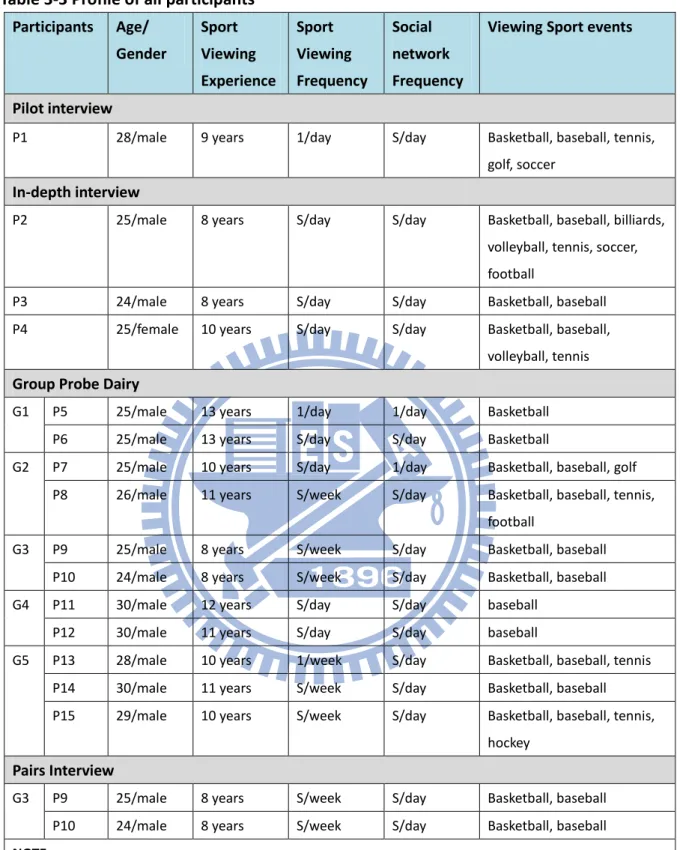
3.3 RECRUITING ... 26
CHAPTERS 4 RESULT ... 29
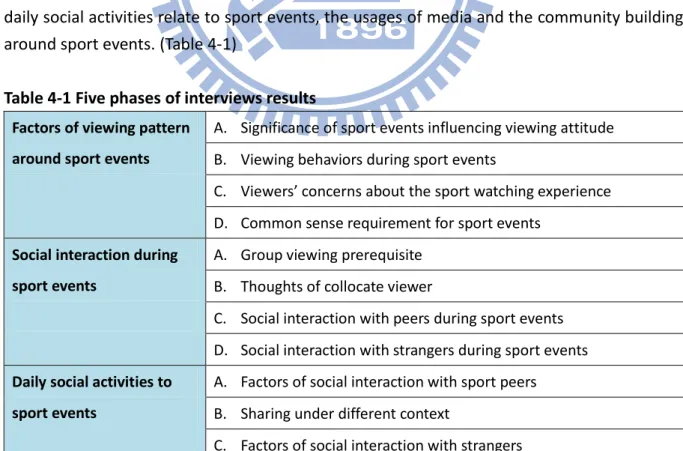
4.1 INTERVIEWS ... 29
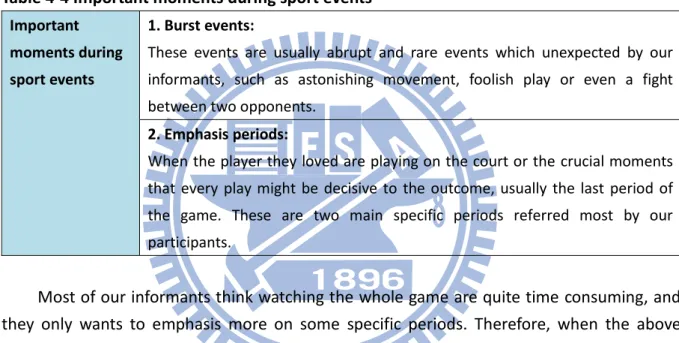
4.1.1 Factors of viewing pattern around sport events ... 30
4.1.2 Social interaction during sport events ... 34
4.1.3 Daily social activities to sport events ... 40
4.1.4 Media usage versus sport events ... 43
4.1.5 Peer groups and larger community ... 46
4.2 GROUP PROBE DIARIES ... 49
4.2.1 Daily activities on sport events ... 49
4.2.2 The interrelationship and interaction among sport peer groups ... 51
4.2.3 Activities during the game ... 52
4.2.4 Building a sport club ... 53
4.2.5 Viewing environment ... 54
CHAPTERS 5 DISCUSSION ... 55
5.1 CRITICAL CHARACTERS OF SPORT EVENTS GENRE ... 55
5.2 GENRE EFFECT ON VIEWING BEHAVIORS ... 57
5.3 GENRE EFFECT ON SOCIAL PATTERN ... 59
5.3.1 During sport events ... 59
5.3.2 After the sport events ... 64
5.3.3 Both during and after ... 65
5.4 GENRE SHAPING THE COMMUNITY ... 69
5.4.1 Peer groups ... 69
5.4.2 Larger Community ... 72
5.5 GENRE EFFECT ON THE MIGRATION OF CO-EXPERIENCE... 74
CHAPTERS 6 DESIGN IMPLICATION ... 76
6.1 CONTENT SELECTION AND SHARING ... 76
6.1.1 Promoting synchronize interaction during sport events ... 76
6.1.2 Using social information as a content filter ... 77
6.1.3 Encouraging to share important materials... 77
6.2 COMMUNICATION ... 78
6.2.1 Supporting attention switching with game flow ... 78
6.2.2 Maximizing the celebration on important moments ... 79
6.3 COMMUNITY BUILDING ... 80
6.3.1 Building community around players and teams ... 80
6.4.1 Showing the preference and viewing status ... 81
CHAPTERS 7 CONCLUSION ... 82
7.1 CONCLUSION OF FINDINGS ... 82
7.1.1 Sport genre influence social interaction ... 82
7.1.2 Sport genre shape community building ... 83
7.2 CONTRIBUTIONS ... 84
7.3 LIMITATIONS ... 84
7.4 FUTURE WORKS ... 85
REFERENCE ... 87
APPENDIX A: THE RESEARCH SCRIPT FOR IN-DEPTH INTERVIEW ... 91
APPENDIX B: THE RESEARCH SCRIPT FOR PAIRS INTERVIEW... 92
APPENDIX C: THE RESEARCH SCRIPT FOR GROUP PROBE DIARIES ... 98
APPENDIX D: SCREENER ... 102
FIGURES
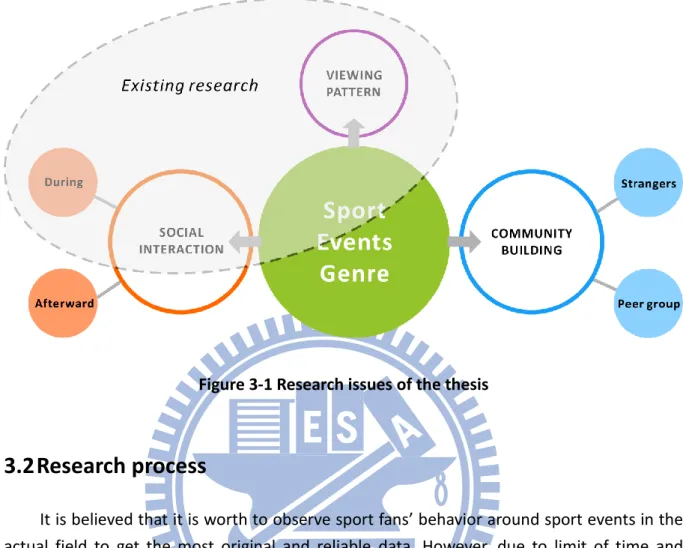
Figure 3-1 Research issues of the thesis ... 20
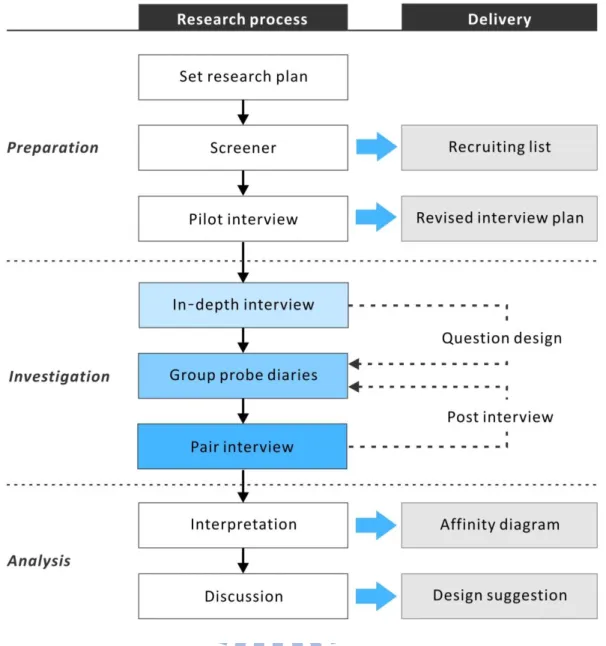
Figure 3-2 The research process of this thesis ... 21
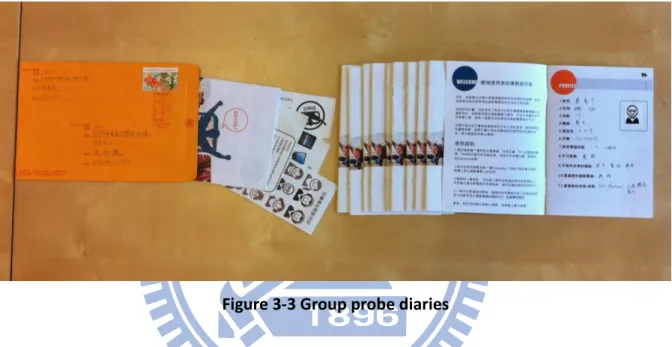
Figure 3-3 Group probe diaries ... 24
Figure 4-1 A participant recorded his abundant daily activities around sport events ... 50
Figure 4-2 Two peers’ similar media usage pattern related to sport events ... 51
Figure 4-3 Two peers’ own sport peer groups ... 52
Figure 4-4 One participant recorded how he share information to sport peers ... 53
Figure 4-5 A participant’s viewing environment ... 54
Figure 5-1 Attention switch during sport events ... 58
Figure 5-2 Using secondary screens to preserve content quality ... 59
Figure 5-3 Attention directing the communication topic ... 60
Figure 5-4 Comparing interactions timing with/without common ground ... 61
Figure 5-5 Histogram shown aggregated sentiments correspond to important moment ... 62
Figure 5-6 Small plot of sport benefits both sharing and receiving ... 65
Figure 5-7 Sharing public and privately to get the most feedback ... 67
Figure 5-8 People belongs to many small-sized sport peer group ... 69
Figure 5-9 Players and teams as a central for connecting to other unknown viewers ... 73
Figure 6-1 Using different communication modalities to support peoples’ attention switch . 79
TABLES
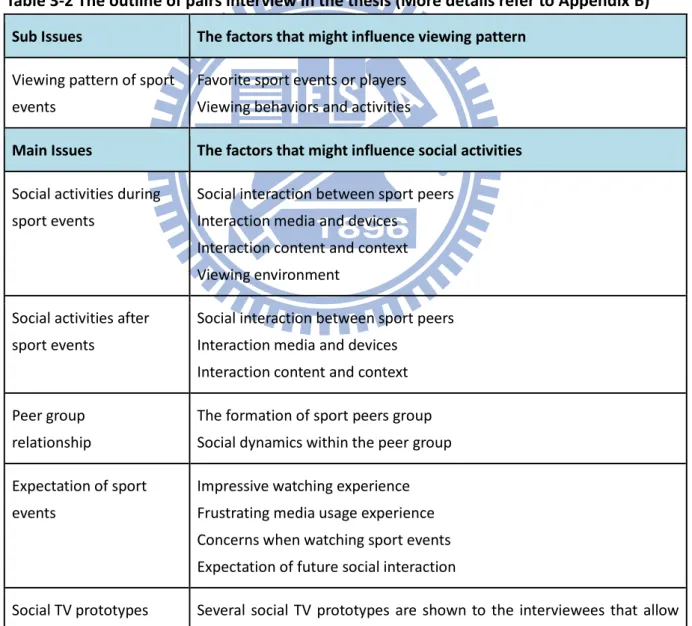
Table 3-1 The outline of in-depth interview ... 23Table 3-2 The outline of pairs interview in the thesis ... 25
Table 3-3 Profile of all participants ... 27
Table 4-1 Five phases of interviews results ... 29
Table 4-2 Criteria of significant games ... 30
Table 4-3 Unimportant moments during sport events ... 31
Table 4-4 Important moments during sport events ... 32
Chapters 1 Introduction
People do socialize around sports. From the ancient Coliseums to nowadays various professional sports games, the tremendous social character of sport events has long been recognized. Along with the rapid science and social technology, people can now comfortably watch their favorite live sport event through the high-definition television, while using variety of communication media to interact with their friends even with distant. Recently, the emerging social networking further fueled those social activities, brings an exciting concept of Social television which support peoples' social interaction around television content. As this concept seems a great opportunity to meet the social hunger of sports, valuable uncultivated lands are waiting to be explore.
1.1 Background
As Television has long been an essential household appliance in the modern house which is so popular all around the world. Today, television viewing might be a major daily recreation for most of us, vast consumption contents of the television penetrates every aspects of our life. It is not only works as a regulator that segment our daily schedule, but also influence our social relationship with others by interacting and communicating around television content. (Lull, 1980) The richness and diversification of television contents pour abundant social resource into our everyday social activities, makes it plays a central role of our social life.
Among these miscellaneous television contents, sport is one of the most social able programs. It is so obvious that the social activities around sport event are never scarce to see. Every year, when mega-sport event begin, such as Olympic Games, millions of fans gathering in front of television in their house, bars and squares, talking and cheering enthusiastically with their friends and family, or even stranger. Furthermore, these social interactions will extend from the watching period to their daily life which becomes a motivator of their social activity, such as talking with their colleagues about the game yesterday as a conversation starter. Sometimes this conversation can last for a long period even the sport event itself is over. To these avid fans, watching and talking sport event is not only a leisure activity, but a rope to tie them together with their social community and reinforce their interpersonal relationship with others.
Nowadays, with the rapid sciences and technology innovation, the viewing and social pattern of television has been fundamentally changed. People can now easily watching their favorite show whenever and wherever they want with their on-demand and mobile television. Moreover, the emerging social networking and communication tools facilitating the social interaction between television viewers, which allow them to interact and socialize around television contents in a variety modality. These innovations further drive the concept of “Social TV”, which is now a general term for technology that supports communication and social interaction in either the context of watching television, or related to television content.
It is to believed that, with the exciting newly communication and social interaction capability provide by social television, the huge social demands from sport fans are seems about to be satisfied. However, the Social television is still at its infancy, there is still a semi-chaotic situation remain to be fully understand.
1.2 Motivation
As we can see the emerging of social networking and communication media have already fundamentally changed how we interact with others in the last decade. These social innovations not only reform peoples’ social life, but also radically changed the television landscape. We shall not surprise why social television development sprung up like mushrooms in the last few years, as it is an attempt to recapture the social nature of the television experience at its origins through these emerging social technologies.
Recently, research on social television has been mainly focus on the creation of the system itself, or on specific features. Large numbers of social TV prototypes are put into lab and field test to examine peoples’ social behaviors and attitude around television content, and the results above all shared facts that television genres play a significant role on peoples’ uses of television content as different genres result in a different social experience. The distinctive impacts not only dominate peoples’ social interaction while watching, but pervasively into their social activities afterward.
Simultaneously, as another identical result has been shown, many participants in disparate researches coincidentally indicate that sport as one of those program genres that are very well suited for stimulating social interactions.(Harboe, Massey, Metcalf, Wheatley, & Romano, 2008) Moreover, we could also see how people are now eager to socialize around sport event on various social platforms. Take BBS for example, every day, huge amount of people are enthusiastically discuss and debate about sport event on the variety discussion boards related to sport events, and most of the time, these sport discussion boards are
always at the top ranking of popularity.
Nowadays, more and more sport forums are pop out every day, and all the websites related to sport events are trying to integrate social network giants into their site, such as Facebook or twitter. Even the online sport event broadcasting channel have started to provide communication tools for the viewer, such as text chat to allow user can share their thoughts during the sport games. As all the present of these evidences, the significant social requirement of sport event is apparent, and the characters of sport genre itself are believed massively social.
There is no denying that the social demands around sport events are huge, and how to supporting people social interaction to satisfy their needs, creating a better social experience seems an urgent topic to be explored. Meanwhile, although many researchers have suggested that television program genres play an important role in the social use of television, research on how a particular genre impact peoples’ social pattern remains scarce.
Therefore, the main purpose of this research is to bridge the gap by investigating how specific sport genres might influence peoples’ social life, in order to create a desirable social platform for people who love sport to facilitate their social interaction, fulfill their social demands and further strengthen the social tie with their sport community.
1.3 Objectives
Although the developing Social TV provide a great opportunity to feed sport fans’ huge social needs around sport events, how to integrate the neonate television system into particular sport genre remain to be a challenging issue to the Social TV designer. In this research, we try to devote more insights into this emerging field, investigating of how particular sports genre might influence peoples’ uses of television sports contents, and to promote a better social experience around sport events broadcasting for the developing social television system. Three objectives are focused as follows:
A. Understanding how sport genre affecting peoples’ life around sport events
In this research, via the thorough investigation into people’s interaction and connection around sport events, various aspects of how sport genre affecting peoples’ viewing pattern, social activities and interpersonal relationship building around sport events would be explored. It is believed only when having the comprehensive understanding of how sport genre influence peoples’ life, a seamless and holistic social experience
around sport events can be created.
B. Identifying what unique characters of sport genre are specifically affect peoples’ social activities
As television genres play a prominent role on peoples’ social uses of television content, it is critical to understand what specific factors the sport genre has that differentiate itself from other television genres, bring particular impacts on peoples' social activities. Through analyzing the influence sport genre brings to peoples’ life, some unique social characters could be identified, setting a corner stone for the distinctive design of social television system of sport genre.
C. Proposing design suggestion for social television system on sport events
By thoughtfully understanding the specifically influence that sport genre brings to peoples’ life, some design suggestions were proposed as the guidance for the designers to provide a satisfying and desirable social experience when designing social platforms related to sport events.
1.4 Scope
This research is intended to provide insights and suggestions through the user study of peoples’ current viewing and social activities around sport events broadcasting which could help the future social television blend into sport genre. The “sport events broadcasting” in this research were mainly referred to the current sports programs which provided and produced by the television producers.
Moreover, the word “sport events” in this research were widely defined as all kinds of sport broadcasting, such as would cup, Olympics, and various professional sports. Therefore, the findings of the study could generally referenced for the designs of social platforms relate to sport events, but the subtle divergent impacts on peoples’ life among different specific sports are not examine in this research.
Finally, the term “social television system” we use in this research were widely defined as all interactive system that support social able aspects of television viewing, allowing people to interact with each other via television set, smart phone, tablet or PC. Chapter 2.4.1 presented the complete definition of social television in this research.
1.5 Outline of thesis
This thesis consists of six chapters. Chapter one, introduction, state the research background, motivation, objectives, limitations. Chapter two, literature reviews, compares results from other relevant research in several different fields, such as the social uses of television, the social values of sport event and the development of social television. Chapters
three, methodology, describe the research plan and the method for research activity. The
analyzed results of the research phases and summarized findings are presented in Chapter
Four. The findings are discussed in Chapter Five and the design suggestions are proposed in chapter six. Chapter seven concludes the summary of this research and some
recommendation are provided for further studies on the design of social television relate to sport events.
Chapters 2 Literature review
This part on literature review started with an introduction to the social influence of television and sport events on section 2.1 and 2.2. Section 2.3 described co-experience that used to understand the social aspects of user experience, setting a theoretical foundation for us to discuss the social experience of sport events. In order to have a holistic viewpoint and further link our study into the emerging domain, we extensively reviewed the related works of social television in section 2.4, including the definition, the influence of social network, secondary screen, commercial products, research prototypes and field studies. Finally, section 2.5 presented works which related to the social television of sport events, to comprehend what have already been provided for this new territory.
2.1 The social uses of television
Although the traditional stereotype regards television watching as a solitary, personal activity, the social uses of television have long been recognized. Television serves many social purposes, such as providing topics for conversations, easing interaction, and promoting feelings of togetherness. Lull (1980) classifies the social use of television in two main aspects: structural and relational. The structural aspects are concerned with the way television has an impact on the structure of peoples’ life, and the relational aspects consider the influence television has on the relationship between people.
Lull further divide the structural uses of television into environmental and regulative aspects. First, the environmental uses, he regarded television as a background noise to create a busy atmosphere which could instantly bring live into the house, or to use as companion during the tedious household chores, and without denying service as a timeless entertainment source for the family. Secondly, the regulative aspects, he indicated that television also works as a regulator to punctuate peoples’ time and activities, such as family members may talk to each other regulative by the scheduling programs.
On the other hand, the relational aspect has divided into four categories. Communication facilitation means television can trigger off peoples’ conversation. Social affiliation or avoidance referred television can promote but also prevent physical or verbal contact. Social learning shows the possibilities offered by television to learn how to behave socially or solve problems in their daily life. Finally, Competence or dominance presents that by forbidden someone to access or to critic or predict the content of the television, people can demonstrated their authority and competence or promoting themselves (Lull, 1980)
Conversely, these sociable aspects can also be important motivations for TV viewing. For example someone might watch a television program in order to participate in a later conversation about it. Therefore, these social aspects are not only influence people during the time they watch, but more on the time after it.(Harboe et al., 2008)
2.2 Social leverage of sport events
Sports have two very predominately social characters: it frees peoples’ emotion, and then brings them together. Anthropologists, who study public performances, including sport events, call these two characters ‘Liminality’ and ‘Communitas’. These two interdepend character mutually reinforcement each other and create massive social impact on sport events.(Chalip, 2006)
As the definition form anthropologists “If there is a feeling of overtly sacred aspect to what is going on in a secular context, it is called ‘Liminality’”. (Chalip, 2006) Liminality can provide a safe place and time to elaborate openly emotional behavior despite social norms, which we can see quite extraordinary in sport events, people embracing, shouting, swearing, kissing, dancing in jubilation. Even male weeping is accepted. Moreover, people who watching sport events can create an experience of communal excitement through unavoidable and constant extensive physical contact which is unusual in our life context, even in any culture. (Kennedy, 2001) The experience of Liminality is a sense that is felt more than understood. In Chalip’s study, the interviewees find themselves felt something but have no words to describe. They feel new energy has been injected into the communal atmosphere which can be shared by all, and further heighten the sense of community among those who are present (Chalip, 2006)
Anthropologists called the sense of community are ‘communitas’ which engendered via liminality. It has flow-on consequences for community life and social relations which gives people freedom to negotiate a relationship to other fans or even strangers.(Chalip, 2006) Took world cup as example, people often look to the team as a representative of the polis and take civic or national pride in their `ownership' of it. And when the team wins, the entire country wins, and thus the supporter shares the lustre, becomes ritually distinguished from non-supported persons and especially from the losers. In the psychological sense, sports spectators seek, through a process of identification, a refuge from urban anonymity: an imagined return to an imagined small community, or the communitas. There are few entertainments like sports that have such astonishing power to foster the formation process of community to this extent. (Kennedy, 2001)
McDougall (2003) present a shared phenomenon which demonstrate the “liminality” and “communita” effect of sport events on these fans: “people like to watch football or
baseball game as live entertainment where crazy fans fill the court rather than watching TV broadcast alone at home. Even when they have no options but to watch the broadcast, they would choose to watch the game with friends or with a group of strangers accidentally met at the bar. That’s because people enjoy the atmosphere of shouting and clapping at the same time, especially the idea that everyone is caring about the same thing.” (McDougall, 2003)
2.3 Co-experience
The notion of co-experience, start from a gradually shifting focus by the user center designers who put more attention on the experience of interacting with others rather than on the product itself, such as usability. The awareness of a holistic user experience should not only consider the aspects of a single users’ experience, but to extend to a larger circle with the social aspects of interaction with others. (Battarbee, 2003a) Therefore, an empathic designer should focus more on “co-experience”, take all the elements into consideration to help user achieving a better interaction experience with others. (Forlizzi & Ford, 2000)
2.3.1 Defining co-experience
As above mention, the term “co-experience” are mainly refer to the missing social quality of user experience. Battarbee (2003b) define “co-experience” as the user experience which created in social interaction. In another study, he further explains the term itself is to describe “experiences with products in terms of how the meanings of individual experiences emerge and change as they become part of social interaction.” (Battarbee & Koskinen, 2005) Users create ways to make existing technologies and products work in for them in social interaction, and when they create together with others, the situation become much more interesting and unpredictable which brings out different emotions and satisfaction and further strengthened the social tie between them. (Sanders, 2001)
2.3.2 Co-experience and the migration
To further understand the differences between personal experience and co-experience, we apply the framework which generated by Forlizzi and Battarbee (2004) to explain the three types of user experience in the interactive system.
First, experience, is the constant stream of “self-talk” that happens while we are conscious. It referred to how we continually assess our goals relative to the people, products,
and environments that surround us at any given time. Second, an experience, this type of experience may be characterized by a number of product interactions and emotions which in a more coalesced way. An experience has a beginning and an end that makes people feel a sense of completion, and often inspires emotional and behavioral changes in the experiencer. The third and the final, Co-experience, it is about user experience in social contexts which takes place as experiences are created together, or have been lifting up and shared with others. (Forlizzi & Battarbee, 2004)
As these experiences are not stood individual, there are dynamic migration between them, from the center of attention to the periphery or into stories and acts of personalization and back again. Such migrations happen in at least three general ways below:
a. Lifting up experiences:
Through a social process, subconscious experience often migrates to become “an experience”. People constantly lift memories from their everyday life and evaluating it as if meaningful enough to communicate them to others.
b. Reciprocating experiences:
Once the experience is lifted up, recipients would usually admit and respond to that experience. For example, they may reciprocate by sharing their own similar experiences or simply offer a sympathetic response. By the feedback they give, they show that both the experience and the person are meaningful for them. Experiences can be maintained, supported and elaborated socially, and the memories related to it may be retold as well.
c. Rejecting and ignoring experiences:
Finally, experiences brought to the attention of others may also be rejected or downgraded by others. For example, something that is important for one person may be too familiar, uninteresting or even offensive to others. They may indicate this in various ways to soften the rejection, such humor or teasing, topic change, direct response or even inaction.
(Battarbee & Koskinen, 2005)
2.4 The concept of Social television
2.4.1 Defining the term of social TV
trying to define the boundary of the emerging field. According to number of studies, “Social TV,” is a label for Interactive TV systems that support the sociable aspects of TV viewing. (Coppens, Trappeniers, & Godon, 2004; Harboe et al., 2008; Oehlberg, Ducheneaut, Thornton, Moore, & Nickell, 2006) However, the broadness and complexity of the current situation are hard to understand by such a short phrase. Therefore, it is needed for a quick flash back of the historical context of the development of social television.
Since the growths in networking bandwidth and computing power available to the house in last decade, the way we watch TV are no longer reluctant to the traditional standalone box. Web applications with video content, networked televisions, set-top boxes, and online TV widgets are now transforming our television viewing experience and blur the boundary of the notion of television. Simultaneously, computer-mediated communications are becoming an indispensable part of our daily interactions and by combining with the following enormous development of social networking, lead us towards a more social-aware television experience. (Cesar & Geerts, 2011; Harboe et al., 2008)
As people start social around TV content via social networking, the widespread phenomenon elaborated commercial services’ interest to integrate the current social networking with TV content. Some examples include the integration of Twitter updates during live video streaming (Shamma, Kennedy, & Churchill, 2009) and theClipSync, combine with Facebook applications that allow commenting while watching video content. Some of these applications are recently being created for smartphone, which can act as a secondary screen, so the commenting does not take valuable space on the television set. (Cesar, Bulterman, & Jansen, 2008) In parallel to the integration of social networking into the television environment, in the last few years there have been great efforts in devoting a direct communication link between separate households to watching television together.
All the above innovation can be referred to “social TV”, allowing people to interact with each other via the television set, smartphones, tablets or the PC. In the past few years, many academic and industrial researches have already creating several prototypes to explore the field. Features include remote talking or chatting while watching television, commenting television content, content-aware buddy lists to show what others are watching, and sharing and recommending video clips. (Cesar & Geerts, 2011)
Next, we would go further to review more studies related to social TV. It would begin as the illustration about how the social network can boost social TV, and how secondary screen play its role in the television environment. Later, provide some current research prototypes and the results of field studies.
2.4.2 Social networking encourages the concept of Social TV
Facebook's more than 600 million and Twitter's almost 200 million users are a strong indication that these web tools are part of people's lives and are indeed changing the way people interact. Along with their success, the television experience has been transformed, and with the way it influences the population and it allows for social interaction. These virtual spaces are now leading people to expand their social interaction to a larger size of communities, such as countries, or even hemispheres. (Klym & Montpetit, 2008) Therefore, if television already facilitated social interaction in the past, nowadays this property has been certainly further emphasized. The use that has been done of social networks such as Twitter and Facebook in concert with TV viewing, principally as forums to discuss TV shows, and further changing or even rediscovering some of the traditional properties which associated to television, such as liveness, content narrative and watching flow. (Cusumano & Summa, 2011)
The most salient impact of the social networks is the reforming and recapturing the liveness of television experience. The “liveness” has been defined as a specific feature of television that differentiate itself from other media, and a reflection of the living, constantly changing present. (Feuer, 1983) It provides people a feeling of instantaneousness and uncertainty which very much like the actual life. Although, the on-demand system seems are decreasing this traditional character, the rise of social media however enhance and redefining the sense of the liveness. (Cusumano & Summa, 2011)
Nowadays, with many TV producers starting to integrate the various social networks into television, people can now easily share their thought about the show with others, and the results shows the strong tendency that people do lust to share their experience to as many people as possible, and the liveness program promise the goal by gathering the highest possible quantity of people to watch the same show, such as super bowl and Grammy award. Simultaneously, people who watch alone are attracted by the massively comment on the show because they want to join the conversation. The characters of social networking which facilitating the conversation and shared experience are now as an instrument to re-impose liveness back to the audience. (Cusumano & Summa, 2011)
However, these social networks was not just a platform for people to talk around television, the convergence of TV and web further create a unique entity with a more democratic television experience. As current social media allow viewers to interact with their favorite shows almost instantaneously and without having to make almost any effort, and
they could also further give feedback to the TV producers or scriptwriters to change the narrative of television in an interactive way. Meanwhile, these producers also try to facilitate people to participant the show by giving the fans invitation to image and decide what would be next. For example, two characters from the show “Lost” were killed off from the show because viewers were complaining online that the two characters were simply too annoying. (Cusumano & Summa, 2011)
As mentioned above, with television and web converging into one element, the social networks substantially becoming part of the watching flow itself. In the “old television" age, the ways we experience the flow are almost exclusively determined by the interests of TV provider and advertisers. What is happening now is that comments and conversations on social networks are increasingly becoming both elements of the flow and what actually define the flow itself. A much democratic flow defined by one's social network: whatever friends, acquaintances or the web talk about defines what we watch. “People are now
learning how to use these different social media technologies to bring a freer flow of ideas and content. Inspired by those ideals, consumers are fighting for the right to participate more fully in their culture" (Cusumano & Summa, 2011)
As more researchers clam the convergence of different domains is still in its infancy, such as IPTV, the Web, and the mobile world. (Cesar, Bulterman, & Jansen, 2008; Cesar & Geerts, 2011) The further development on social networking will work as a bridge across currently fragmented environments, providing seamless shared experiences independently of the location, the network, and the device. (Cesar & Geerts, 2011)
2.4.3 The secondary screen
The very first notion of using a secondary screen in the television environment can be trace back to 1996, Robertson, Wharton, Ashworth, and Franzke (1996) presented a system where handheld devices are used for interacting with the television. The watching experience of television can be enriched by using other devices as a secondary screen providing both rendering and interaction capabilities. Today, it is a very common phenomenon that people frequently use their laptop or mobiles for a number of activities while watching television, such as surf the web or use email or even chat to others. People have their preference for accessing different services on different display panels rather than overloading one shared display channel.(Seager, Knoche, & Sasse, 2007)
Cesar, Bulterman, and Jansen (2008) further extending the previous studies, identify four major usages of the secondary screen in an interactive television environment: control,
transfer, enrich and share television content. And they can be mainly categories into two independent aspects, rendering and interaction.
On the rendering side, control is capable of differentiating the shared and personal nature of the media content. For example, people can share media resource to the public screen with others, and when the material is private information, it can be showed on the private display, which is the secondary screen. Transfer, on the other hand, can be used for presentation continuity, such as when the user is moving out for somewhere, but still wants to bring along the presentation shown in the television set to the secondary screen.
On the other hand, the aspects of interaction, people are able to use the secondary screen to edit and share a bounded fragment form the main screen, or further enrich the fragment by adding personalized media overlays such as a voice commentary and share the “enriched fragment” to their peer group. through their studies, it is concluded that “hand-
held devices would be used in the living room, in conjunction with other consumer electronics appliances, for consuming and manipulating television content.”(Cesar, Bulterman, & Jansen,
2008)
2.4.4 Current Social TV developments
Recently, several conceptual, prototype or research systems for social television have been pronounced, and implemented to various degrees. Each of them might focus on one or more specific features, which support peoples’ different social activities around television content.
AmigoTV includes a rich set of interaction options such as animated emoticons and voice chat. (Coppens et al., 2004) Regan and Todd (2004) create a system with Buddies list that allows multiple simultaneous users to access their instant messaging while watching TV together. 2BeOn integrated interpersonal communication on a TV as a workbench system. (Abreu, Almeida, & Branco, 2002) CollaboraTV integrates asynchronous social information into recorded shows which provide a way for user to interact with each other despite watching at different times. (Harrison & Amento, 2007) Cesar, Bulterman, Geerts, et al. (2008) propose a secondary screen system for viewers to enrich broadcasting content and share the results with other users. TakeoverTV go further demonstrate a way to lets local users influence and interact with others by showing their preferences of television programs shown on public displays via smart devices. (Elliott, Carr, & Holtzman, 2011) IntoNow are a recent service which able to recognize what one is watching on TV via their proprietary "Sound Print" audio fingerprinting technology, and it also notifies the user when someone of
his own social networks is watching the same show.
As these systems mentioned above are all presented through the TV, on the other hand, Fink, Covell, and Baluja (2006) provide a TV channel chat room through a separate laptop computer, gathering presence information from the TV audio through the PC microphone. Other websites such asBuddyTV and Joost also allow users to chat while watching TV.
In order to understand and tame this semi-chaotic situation, Cesar and Geerts (2011) further investigate over thirty systems, to provide a framework of current developments in the emerging field of social TV. They first identified four major activity categories which determine the goal of the interaction around television:
a. Content selection and sharing:
The users might want to send full programs or edited versions to their peers, or be informed by other peers to decide what to watch.
b. Communication:
The user can have direct communication via chat, audio, or video with other peers.
c. Community building:
The user could comment about a television program with a large community.
d. Status update:
To making the users available to others that what they are currently watching.
In parallel, they also point out there are five aspects that determine how each activity is performed, and some of the aspects are more salient than in others. They are the usage of device and network, the communication modality, the presence of users, the synchronization of interaction and the strength tie with peer group or larger community. (Cesar & Geerts, 2011) It has believed that this framework would provide us a tool to draw an outline for the systematically investigation of the sport fans’ social activities around sport events.
2.4.5 Field trials and program genres
Although there are many social TV applications, both research and commercial, have been reported above, there are few studies have investigated the actual uses of social television system. Geerts (2006) compared text chat and audio chat while watching television, he find out most users regard voice chat are much more natural, and text chat is more
preferred by younger users. Weisz et al. (2007) investigated the influence on the social relationships of friends and strangers of text chatting while watching online videos, and found that it did create more positive feelings. But also refer the needs for more cautious when integrating strangers into the social television to engage to a wider community. Both above proposals describe ways to support the proper timing of social interaction during group television viewing and minimize the disruptions in the flow of television viewing. However, these studies still in a lab setting experiment.
On the other hand, two studies on the uses of social television were conducted in a much natural field. Harboe et al. (2008) compare the results from a field test of social TV prototype and focus groups with several social TV concepts. They find out people are showing more appreciation when they actually using it. Meanwhile, people can deal with potential conflicts between conversation and television audio without any technical support, but the video chat did not improve their experience. In another study, Geerts and De Grooff (2009) try to build up sociability guidelines for the interaction of social television. Based on several user studies with social TV prototype in a real-life context and grounding analysis, they have provided twelve sociability guidelines for designing or evaluating the social interaction these systems enable. One of the guidelines suggests that “there is more need to
consider the differences of specific program genres”, which is much related to our research
that we would further extend the review below.
Current research on social interactive television has been mainly focused on the creation of the systems itself, or on divergent specific features, such as a comparison between voice chat and text chat. (Geerts, 2006) Several user studies have showed that television program genres play an important role in the use of social TV (Cesar, Bulterman, & Jansen, 2008; Harboe et al., 2008; Weisz et al., 2007)especially concerning about attention switching and communication activity. However, researches into why and how certain genres have an impact on the uses of social TV systems remains scarce.
In the research of television genres, many researchers focus on the constitution of a genre, categorizing television programs fit into a genre and the way audiences use genre to understand and enjoy programs.(Bignell, 2004) On the other hand, the social patterns surrounding certain television genres are not explicitly studied. Recently, some scholars have dedicating to this domain. Hawkins et al. (2005) found that, contrary to what they expected, attention styles were not a steady characteristic of an individual, but differed according to genre. They further identified the importance of plot structure which causes different attention style in the viewing experience. For instance, dramas and movies require for more continuous attention than commercials and news items. Oehlberg et al. (2006) asked their
participants where they watched television over a distance, what kinds of television programs they watched in groups. Genres with bursty rhythms, redundant content or people-centered content were considered as the most sociable.
Another interesting studyoffer more insight into the impact of different genres,Geerts, Cesar, and Bulterman (2008) apply an systematically analysis of the different genres that influence peoples’ communication patterns around television content, and mainly focus on two interaction modes: synchronous and asynchronous. The usage of divergent devices on certain television program genres were also takes into their consideration. There are some stimulating findings have been revealed.
First, they have identified the importance of plot-structure on the social interaction. Genres with plot-structure call for peoples’ full attention; hence they do not talk while watching. Strong Plot-structure genres like Films, news and documentaries are genres people talk more and also like to share, might fit into asynchronous systems. Conversely, News, soap, quiz and sport are those genres during which people talk most while watching, are much suitable for synchronous systems. (Geerts et al., 2008)
Additionally, they also found that there are certain relations between device and genre preferences. Which genres with more plot structure are preferred to be watched on television, whereas genres with less plot structure can be watched on a mobile phone.(Geerts et al., 2008) As they concluded “More research needed into this interplay
between these social uses and specific genres”, we further look into one of the most social
able genre which referred by many studies - the sport genre.
2.5 Social TV of sport events
Sport is often mentioned as one of those genres that are very well suited for inspiring social interactions. Harboe et al. (2008) evaluated a social TV system via the focus groups as well as the field trials, they found most participants agreed that sport programs are especially well suited for the using of their system. In the conclusion, they claim that when designing social TV systems, the features should be optimized for the characteristics of sports viewing. Similarly, Weldon (2006) suggests creating an audio tool specifically designed for talking and shouting during sport match, arguing that the voice chat should be tailored to facilitate fan communication while watching sports events.
Here are one anecdote evidence of sport genre have been found in several studies. Sport is very a “male genre” which being preferred more by males rather than woman. As
aforementioned study, Harboe et al. (2008) state that the women in their study would use their social TV system more for programs other than sport, such as shopping. Brereton and O'Connor (2007) also follow by reporting that the three favorite genres of males in their study are comedy, sport and science fiction, while for the females this was comedy, soap opera and romance. Kennedy (2001) explains the phenomenon by stating that “Sport has
become a male preserve because it is one of the few areas of life where aggressive male behavior is sanctioned”, in other word, men can neglect the social norms to show their
macho aggressiveness via sports.
Another one revealed in the previous study, Geerts et al. (2008) shows people talk a lot while watching sport events, but also talks more about it afterwards. They further concluded the reason that “plot structure is less important in sport events as it focuses more on the
situation at hand rather than the bigger plot”. Although they regard it as odd evidence, it
seems no surprise that people in these researches show a great desire for social interaction around sport events.
However, to our knowledge, there is little user studies really specifically addressed on the uses of social TV system on sport genre. As above mentioned, an audio tool has been particularly designed for sport fans, which support the communication while watching a sports event. (Weldon, 2006) Another interesting research we found, My Second Bike is a social TV system combines with Google earth which targeting at bicycle racing. Via link with other viewers and the live bicycle game on TV, user can see other spectators, competing athletes and outdoor bikers simultaneously on the screen and physically interact with them through the sensor-fitted bikes, such as racing with them. (Chung, Xu, Colaco, Schmandt, & Li, 2010) Sofanatics is a commercial service which aimed directly at people who keep a computer in their lap while watching sport games on TV. People can log in with their Facebook account, sticking on the ‘Fan Battle’ to talking about the game via video chat, commenting or even predicting the game. Still, these prototypes are not a user study project.
In the study that is most relevant to our work, Sahami Shirazi et al. (2011) designed a mobile application which allow user to share divergent nonverbal iconic to other viewers in real time while watching sport events. To make it available to a large number of users, they upload the app to the Android Market and conducted a user study in the wild during the World Cup 2010. Some interesting results have been revealing, TV viewers who used the app had more fun and felt more connected to other viewers. By monitoring the real-time channel, collected data exemplify that the aggregated sentiments correspond to some important moments, such as the “Goal” time. A more implicit fact is that when user and the majority of fans had pressed the “Vuvuzela button” at same time, they presented an “aha” reaction and
promoted the conscious experience of connectedness between other viewers. (Sahami Shirazi et al., 2011) However, due to their difficulties of gathering the ground truth for individuals, it is believed that there need to pouring more effort on investigating the interaction between sport fans, during or after watching sport events.
Chapters 3 Methodology
The purpose of this research is to find out how sport genre might specifically influence peoples’ uses of television contents that contribute insights to promote a better user experience on social television when apply to sport events. In order to reach this goal, it has been try to investigate peoples’ current viewing and social activity around sport events and further discover and understand their fundamental needs and expectation. Therefore, we target our participants on the actual sport fans, who have rich experience and social activity around sport events. Due to the privacy difficulties, in-depth and Pair interview are used as the alternative methods to uncover these sport fans’ life, and the added group probe diaries to investigate more subtle issues and enhance the reliability of the data we found.
3.1 Research issues
We started our empirical work focusing on exploring and investigating peoples’ current viewing and social activities around sport events broadcasting. For the comprehensive exploration, various aspects and issues were set to address.
As we could see in literatures, most of the researchers studying different program genre on social television, including sport, focusing on peoples’ viewing and social activities during sport events, social activities afterward which related to the television content of sport events were less addressed. Therefore, our survey were first start with identifying what special characters of sport events might affect peoples’ viewing attitude and behavior, then extending to how these characters might influence their social interaction during or after the sport events. Furthermore, it has also been tried to understand more about the interrelationship between sport peers group, since the structure and strength of social ties might bring impact to the social interaction among sport peers. (Figure 3-1) Additionally, we also pay attention to peoples’ usages of communication media under different context, as the behaviors may further reveal their subtle needs and expectation.
Through thoughtfully look into sport fans’ life; we might expected to reveal how special characters of the sport events influence people’s viewing and social activities and their relationship from the peer-group to the larger community. Subtle needs and expectation such as the communication facilitation, emotional attachment, and the identification with their community are also expected to be unfolded.
Figure 3-1 Research issues of the thesis
3.2 Research process
It is believed that it is worth to observe sport fans’ behavior around sport events in the actual field to get the most original and reliable data. However, due to limit of time and privacy reason, we decide to set our research plan with series of alternative complementary methods. The research process was carried out through three stages: in-depth interviews, group probe diaries and pair interview. Each stage was aim to address some specific issues and also as the supplement for other approaches to systematically investigate the complex real situation of sport fans’ social activities in a variety aspects. Intact research process of this thesis is shown in figure 3-2 and explained in the following:
Since the purpose of this research is mainly to reveal peoples’ social needs around sport events based on their life context related to sport events, before we start our research process, a screener was first designed and sends out via network to recruit and filter out the real sport fans as participants to join the research process.
Considering the wide range issues around sport events might involve in different spectrum of sport fans’ life. Before the formal research process, it was first tried to explore and understand peoples’ viewing and social activities through a pilot study, then revise the research plan for the following formal researches.
Figure 3-2 The research process of this thesis
The first stage is in-depth interview. The aim of this stage is to widely explore and investigate sport fans’ current viewing and social behaviors around sport events. Impressive viewing and social experience were also covered in this phase. Data collected from this stage were interpreted and categorized into several orientations and further provide directions to guide the question design of the following probe diaries.
The next stage is group probe diaries. The aim of this stage is to discover more subtle facts about the formation, interaction and relationship between sport fans’ peer group and larger community by comparing the peers’ diaries. Additionally, it has been try to solve the recall bias problem in the in-depth interview session through the self-document process.
Interesting and ambiguity facts recorded by the participant in the diaries were noted during the interpretation process for a further investigation through the post pair interview.
The final stage is a pair interview which regards as the complementation for the previous in-depth interview and probe diaries. There are two aims in this stage: firstly is to have a deeper understanding about the thought behind some interesting facts recorded in the probe diaries and secondly is tried to reveal more subtle information about the social interaction and relationship via prompting conversation between the two peers in the same group.
All of the data gathered from the three research stages were taking noted and categorize into affinity diagram for a fully understanding of the scope of the variety aspect of sport fans’ life. Finally, after analysis and interpretation, we have discussed our findings and provide some design suggestion for the future developing of social television for sport fans.
3.2.1 In-depth interview
In in-depth interview, it mainly focuses on the context of viewing behavior and social interaction with other viewers. Facts that may impact viewing pattern and social activities during or after sport events are expect to be found in this stage, on the other hand, participants’ media usage pattern, social needs and expectation of sport events are also expect to be revealed.
As we observe in pilot study, participant recalls more when talks about their favorite sport events, especially their favorite players or teams. Therefore, in order to facilitate and raise their interests of expression, the design of the interview script would first start from questioning their favorite sport events or players, then gradually shift to how they follows and watch these favorite events and how they share their viewing experience and thought with others during or after the sport events. Additionally, we also invite participant to talk about some of their most impressive watching experience around sport events, since the memory might be easier to retrieve and recalled complete.
Through this process, participants might be more open and freely to express their self and the extending discussion may dig out more subtle and unexpected issues. The outline of the in-depth interview consisted of four parts, shown in Table 3-1.
Table 3-1 The outline of in-depth interview (more details refer to Appendix A)
Sub Issues The factors that might influence viewing pattern
Viewing pattern of sport events
Favorite sport events or players Choice of sport events
Viewing media and devices Viewing context
Viewing environment
Main Issues The factors that might influence social activities
Social activities during sport events
Social interaction behaviors and activities Interaction media and devices
Interaction content and context Viewing environment
Social activities after sport events
Social interaction behaviors and activities Interaction media and devices
Interaction content and context Expectation of sport
events
Impressive broadcasting watching experience Impressive live watching experience
Concerns when watching sport events
3.2.2 Group Probe diaries
After the interview process, some interesting issues have been found which needed for further investigation, such as the formation and interrelationship between peer-group. Meanwhile, to raise the reliability of the data we found in first stage, probe diaries were conducted as alternative method through a self-document process. There are three kinds of tasks in the probe diaries: the informative, inferential and innovative task. (Figures 3-3)
Firstly, the informative tasks, participant were ask to record their daily media usage relate to sports events, four key element have been indicated: the software and network they use, through what kind of device, the related activities they involve and if there are any notable impression during these activities. The viewing context, social activities and impressive impression during the sport events were also ask to be noted.
Secondly, the inferential tasks, participant were ask to think to indicate their three closest friends around sport events, Rank their interaction frequency, describe the relationship and understanding between them, common leisure activity them involve together, and what if these closest friends know each other.
And finally, the innovative tasks, participant were ask to design a sport club for their peer-group, what activity they want to hold in this club and what expectation and attitude toward this sport club. Participants were also asking to sketch out their current viewing environment and the future viewing environment they have dream about.
Figure 3-3 Group probe diaries
Above tasks were designed and divided into five different daily themes to guide participants to write the diary thoughtfully. Since the curiosity about interaction and relationship between peer-group has been raise up, it has tried to recruit two participants who are both in the same peer-group to participant the diary process.
By the comparing and analyzing of these self-document records, deeper information on the relationship, interaction and expectation between peer-groups around sport events were revealed. More reliable facts such as sport fans’ routine media usage, viewing and social activity during sport events were also collected and reached. For more detail of the probe diary, take a look at Appendix C.
3.2.3 Pairs interview
For the deeper interpretation, after collect and analyze the probe diaries, a following post pair-interview has been conducted. In this stage, except from inquiring participants’