
A Secure Protocol for Mobile IP Using Smartcards
4
0
0
全文
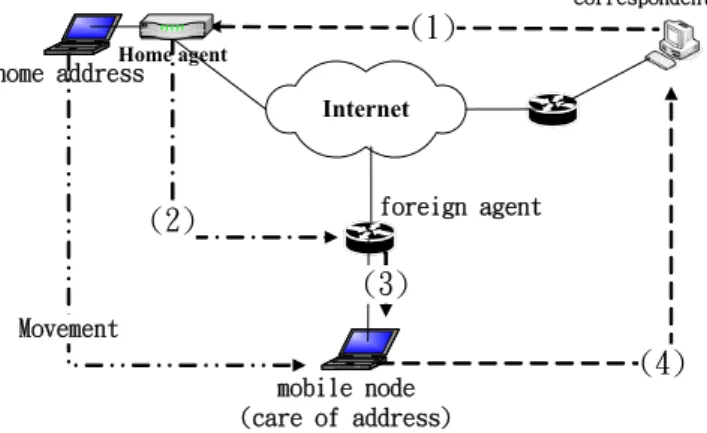
(2) Figure 1 shows the communication between the mobile node and the correspondent, described briefly as follows. Step 1: The correspondent sends the packets to the home agent. Step 2: The home agent transfers the packets to the foreign agent. Step 3: The foreign agent transfers packets to the mobile node. Step 4: The mobile node feeds back messages to the correspondent.. 2: RELATED WORKS Mobile IP is vulnerable to some attacks such as eavesdropping during the registration and data transfer. Thus, IPSec [5] is recommended to protect the mobile IP communication. In 2004, Mufti and Khanum [1] developed a method to preventing the mobile communication from “Denial of Service Attack” by using the public key technique. In 2005, Lee et al. [2] advised to use authentication method to ensure the security of mobile communication. We briefly introduce the method proposed by Mufti and Khanum and point out the weakness of their method. Some notations are defined: M mobile node F foreign agent H home agent of M key shared by M and F. K. MF. IM IH IF. IP address of mobile node IP address of home agent IP address of foreign agent ni random number message from A to B MSGAB < .. > content of message LT lifetime ( )X encrypted message with X as a key public key of A. P V SK. However, we found out some weakness in their registration phase, as described below: 1) Key management problem: the authentication of M (mobile node) and H (home agent of M) relies upon the security of KMF. 2) Malicious attacks are probable to succeed: A. M (mobile node ) sends the following message to F (foreign agent): MSG MF =< IM, IH, LT,n1 ,(K MH ,n1 ,IM)K MH >. B. A malicious foreign agent could modify and the horten the LT in MSGMF , and then transfer it to the real foreign agent for registration. The mobile node would fail on functions due to the problem of lifetime even if it registers successfully. C. A malicious attacker could intercept the message of M (mobile node) sent to F (foreign agent). However, F (foreign agent) can not identify whether IH or LT is modified or not under the message their authentication scheme. So, the Denial of Service attack could succeed. In 2005, Lee et al. [2] suggested that an authentication method with one-way hash function and smart card is used. Some notations are used.. U. user identification of user. i. ID. i. PW x h(⋅) T. i. password of user private key of server x one-way hash function SHA-512[4]. timestamp. The scheme needs the smart card registration phase for user Ui: Step 1: User Ui inputs its IDi and PWi to the server for issuing a smart card. Step 2: Server computes Ai=h(IDi||x) and Bi=h(Ai||PWi). Step 3: Server issues a smart card containing {IDi, Ai, Bi, h(.)} for user Ui under a secure channel. Lee’s login phase is described as belows: Step 1: (User side) 1) User inserts the smart card into card reader and inputs his/her IDi and PW*i. 2) Smart card computes B*i=h(Ai||h(PW*i)), C2=. B*i. A. private key of A session key of A and B Registration Phase in the Mufti and Khanum’s: Step 1: M Æ F: A. AB. MSG MF =< IM, IH, LT,n1 ,(K MH ,n1 ,IM) K MH >. Step 2: F Æ H: MSG FH =< (MSG MF , IF, n2 , (IF, n2 )VF ) PH >. Step 3: H Æ F: MSG HF =< (( SK MF ,n2 , MSG HM )VH ) PF > MSG HM =< ( K MH ,n1 , SK MF ) K MH >. Step 4: F Æ M: MSG FM =< (MSG HM )VF >. After completion of registration, SK MF is taken as the encryption key for data transfer. In their paper, public key is used to protect information exchanged between the mobile node and the foreign agent.. ⊕Ai, and C1=h(T⊕Bi). 3) User sends message {IDi, C1, C2, T} to the server. Step 2: (Server side) 1) Server verifies if the timestamp T is within the lifetime. and obtains 2) Server computes Ai=h(IDi||x) B*i=C2⊕Ai and C1=h(T⊕Bi).. - 537 -.
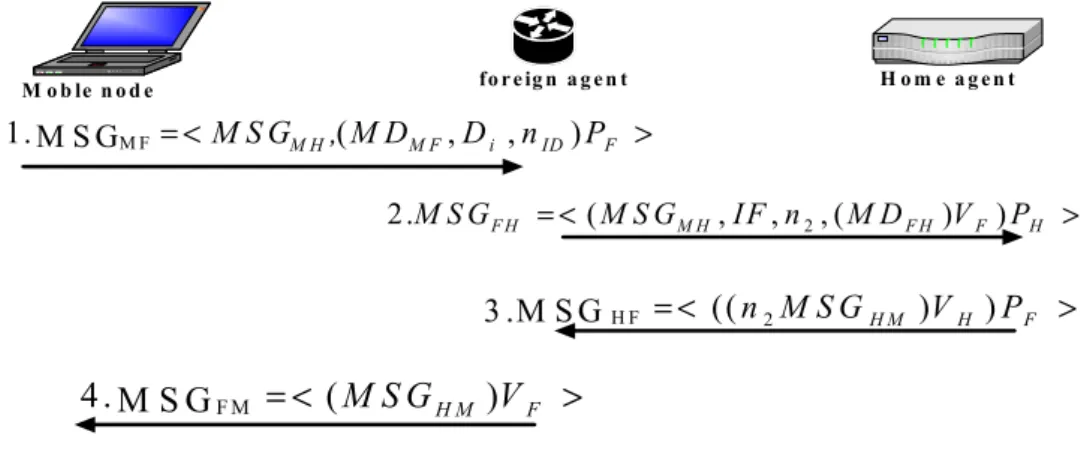
(3) Server. verifies. if. ?. Ci* = Ci .. If. equal,. the. authentication is successful; otherwise, it is rejected.. 3: PROPOSED METHOD To make the registration procedure of Mobile IP more secure, we apply Lee’s scheme with HMAC. Below, we proposed our scheme. Smart card registration phase: Step 1: User U i inputs his/her IDi and PW i to the home agent for requesting a smart card. Step 2: The home agent issues a smart card by: 1) Compute Ai=h(IDi||h(VH)), where VH is the private key of the home agent. 2) Compute Bi=h(Ai||h(PWi)). Compute Di=(IDi⊕nID)VH, where nID is a random number. The smart card for user U i contains message of {IDi, Ai, Bi, h(.), Di}. Mobile node registration phase: Step 1: Mobile node (M) Æ foreign agent (F): 1) User inserts the smart card into card reader and inputs the corresponding IDi and PWi*. 2) Smart card computes Bi*=h(Ai||h(PWi*)), C2=Bi*⊕Ai, C1=h(T⊕Bi), and SKMH=h(Bi||n1). 3) Let MSGreg=<IM, IH, n1, IDi, C1, C2, T>, and computes MDMF=h(MSGreg) and MSGHMAC = HMACSKMH(MSGreg). 3). 4) Let MSGMH = < IM, IH, n1, IDi, C1, C2, T,MSGHMAC >, MSGMF=<MSGMH, (MDMF, Di, nID)PF>. 5) Send the message MSGMF to F. Step 2: F Æ H: After receiving the request for registration, the foreign agent verifies the integrity of the message and then transfers the message to the home agent. 1) Foreign agent verifies if timestamp T is within the lifetime. 2) Retrieves MDMF, Di, nID using its private key V F. 3) Computes IDi*=(Di ⊕ nID)PH, where PH is the public key of the home agent and verifies if ?. IDi* = IDi . If not equal, the registration is rejected, indicating that the mobile node has not been accepted by the home agent. 4) Computes MDFH=h(MSGMH, IF, n2), MSGFH = <( MSGMH, IF, n2, (MDFH)VF)PH>. 5) Foreign agent sends the message MSGFH to the home agent (H).. Step 3: HÆ F: Home agent verifies the message of M (mobile node) after receiving the request for registration, and then sends back a registration replay to the foreign agent. 1) Home agent verifies if timestamp T is within the lifetime. 2) After receiving the message, H decrypts the message using VH. 3) After decrypting MDFH using PF, H verifies the integrity of MSGFH. 4) Home agent computes Ai=h(IDi||h(VH)) based on the data of user Ui, and obtain Bi*=C2⊕Ai. 5) Verifies MSGHMAC using SKMH and MSGreg. ?. 6) Computes C1*=h(T⊕Bi*) and verifies Ci* = Ci . If equal, the authentication is successful. 7) Let MSGHM = <n1, IDi, C1**, C2, T*> and MSGHF = <((n2, MSGHM)VH)PF>, where C1**=h(T*⊕Bi), T* is a new timestamp. 8) Home agent sends the message MSGHF to the foreign agent. Step 4: Foreign agent Æ mobile node: Foreign agent transfers back the message to M (mobile node). 1) After receiving the message, foreign agent decrypts MSGHF using VF and PH to retrieve MSGHM and n2. 2) Computes MSGFM = <(MSGHM)VF> and sends it to mobile node. 3) Mobile node retrieves MSGFM using PF. 4) M verifies if timestamp T* is within the lifetime. 5) Computes C1***=h(T*⊕Bi) and verifies ?. Ci*** = Ci** . If equal, the registration is successful.. 4: ALANYSIS In this section, we analyze that the proposed method can solve the problems in the Mufti and Khanum’s [1]. 1) Against the attacks from a malicious mobile node: when M (mobile node) sends a message to F (foreign agent), F firstly uses the public key PH and Di of the home agent to verify whether M (mobile node) is a right node. Further, it resists against the replay attack using random number n1 when a malicious mobile node uses the former registration messages.. - 538 -.
(4) M o b le n o d e. fo r e ig n a g e n t. H om e agent. 1 . M S GM F = < M S GM H ,( M D M F , D i , n ID ) PF > 2 .M S G F H = < ( M S G M H , I F , n 2 , ( M D F H )V F ) PH >. 3 .M S G H F = < (( n 2 M S G H M )V H ) P F >. 4 . M S G F M = < ( M S G H M )V F > Figure 2. Mobile node Registration. 2) Against the attack from a malicious foreign agent: in our scheme the registration message contains the authentication information of H (home agent) and F (foreign agent) using HMAC, a malicious foreign agent can not modify the messages to forge the home agent H. Further, since M verifies the registration response from H, so the malicious agent can not modify it, too.. 5: CONCLUSIONS With the rapid progress of the Internet and wireless technologies, there are more and more applications developed on the mobile IP environments. However, there also bring many security problems on the mobile IP. In the paper, we propose a new registration scheme for mobile IP. Based on the security property of smart card, our scheme improves the security to resist some attacks such as Denial of Service attack and malicious foreign agent attacks and offers users a convenience to use the ID and password.. Acknowledgement This research is partially supported by the National Science Council of Taiwan, by contract NSC 95-2221-E-029-020-MY3.. REFERENCES [1]. Muid Mufti ,Aasia Khanum., “Design and Implementation of a Secure Mobile IP Protocol,” Proceedings of the International Networking and Communication Conference on Network Security (INCP 2004), June 2-13 ,2004, pp. 53-57. [2]. Chia-Yin Lee ,Chu-Hsing Lin , and Chin-Chen Chang , "An Improved Low Computation Cost User Authentication Scheme for Mobile Communication , " Proceedings of International Conference on Advanced Information Networking and Applications (AINA 2005) , Vol. 2, March. 25-30, 2005 , pp. 249–252. [3]. Charles E. Perkins, “IP Mobility Support”, RFC 2002, Oct 1996. [4]. NIST, U.S. Department of Commerce, “Secure hash standard,” August 2002, U.S. Federal Information Processing Standard (FIPS) 180-2. [5]. J. Zao, M. Condell, “Use of IPSec in Mobile IP,” Internet Draft, draft-ietf-mobileip-ipsec-use-OO. txt, 1997. [6]. C. C. Chang, C. T. Wang, and Chu-Hsing Lin, “Conference Key Distributions Using Self-Certified Public Keys,” International Journal of Applied Mathematics, Volume 2, No. 3, 2000, pp.327-337. [7]. T. M. Hsieh, Y. S. Yeh, Chu-Hsing Lin, and S. H. Tuan, “One-Way Hash Functions with Changeable Parameters,” Information Sciences, Vol. 118, September 1999, pp.223-239. [8]. Chu-Hsing Lin, C. C. Chang and R. C. T. Lee, "A New Public-Key Cipher System Based on the Diophantine Equations," IEEE Transactions on Computers, Vol.44, No.1, January 1995, pp.13-19. [9]. Chu-Hsing Lin, Wei Lee, and Chien-Sheng Chen, " Dynamic Key Generations for Secret Sharing in Access Structures , " Proceedings of International Conference on Advanced Information Networking and Applications (AINA 2005), Vol. 2, March 25-30, 2005 , pp. 127-130. [10]. James D. Solomon, “Mobile IP The Internet Unplugged”, Prentice Hall International, Inc. [11]. Behrouz A. Forouzan, Sophia Chung Fegan,” TCP/IP Protocol Suite”, Second Edition, Mcgraw-Hill Company, Inc.. - 539 -.
(5)
數據
相關文件
At migration or load time, the Roam agent can compare the device requirements from the application components with the target device capabilities and decide the best
2.8 The principles for short-term change are building on the strengths of teachers and schools to develop incremental change, and enhancing interactive collaboration to
You are a property agent working for the Quality Property Company. A potential client has contacted you from Australia because he will soon be moving to Hong Kong with
3.16 Career-oriented studies provide courses alongside other school subjects and learning experiences in the senior secondary curriculum. They have been included in the
Miroslav Fiedler, Praha, Algebraic connectivity of graphs, Czechoslovak Mathematical Journal 23 (98) 1973,
The difference resulted from the co- existence of two kinds of words in Buddhist scriptures a foreign words in which di- syllabic words are dominant, and most of them are the
Binding Warning message Binding Update message AAAO: the AAA server of the old foreign network to which the OFA belongs. AAAF: the AAA server of the new foreign network to which the
• Tactics: the art of organizing an army, and using weapons or military units in combination against the enemy in military encounters.. • Operational art: a component of military
