Adjustable pretilt angle of nematic 4-n-pentyl-4
⬘
-cyanobiphenyl
on self-assembled monolayers formed from organosilanes
on square-wave grating silica surfaces
Da-Ren Chiou, Kuan-Yu Yeh, and Li-Jen Chena兲
Department of Chemical Engineering, National Taiwan University, Taipei 10617, Taiwan, Republic of China
共Received 11 October 2005; accepted 7 March 2006; published online 31 March 2006兲
The square-wave grating silica surfaces are fabricated by soft embossing silica sol-gel precursor on glass substrates with an elastomeric polydimethylsiloxane mold. The patterned silica surface could induce the planar alignment of liquid crystal 4-n-pentyl-4
⬘
-cyanobiphenyl共5CB兲 along the direction of microgrooves but with no pretilt angle. The pretilt angle of 5CBs is adjusted from 0° to 90° by the further deposition of organosilane self-assembled monolayers with different functional end-groups on the patterned silica surfaces. © 2006 American Institute of Physics.关DOI:10.1063/1.2191472兴
In the liquid crystal display industry, the unidirectional mechanical rubbing process on polymer-coated substrates with a velvet cloth is almost exclusively applied to align liquid crystals. The rubbing process induces grooves in the polymer surfaces and also realigns polymer backbone that enables liquid crystal molecules to align along the direction of the grooves. The liquid crystal alignment depends both on the surface topography and on the chemical nature of the surface 共such as the realignment of polymer backbone兲. Recent studies1–3pointed out that the realignment of polymer chains during the mechanical rubbing process is particularly responsible for the liquid crystal alignment rather than the groove effect. In particular, the modern nonrubbing photoin-duced liquid crystal alignment by polarized light exposure,4 which does not involve the production of microgrooves, also confirms that the realignment of the polymer main chains dominates the liquid crystal alignment. It remains a contro-versial problem that whether the surface topography5,6 or the chemical nature of the surface1–3 dominates the planar alignment of nematic liquid crystals. Therefore, we applied the soft embossing method to fabricate square-wave grating silica films, which do not involve any polymer main chain, to solely investigate the surface topography effect on the liquid crystal alignment in this study. On the other hand, the chemi-cal nature of the surface was manipulated by growing the self-assembled monolayers 共SAMs兲 formed from organosi-lanes on the square-wave grating silica surfaces. The pretilt angle of nematic liquid crystal 4-n-pentyl-4
⬘
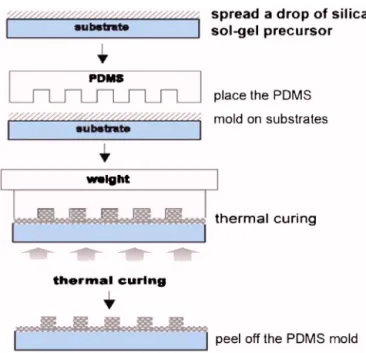
-cyanobiphenyl 共5CB兲 increases along with an increase in the hydrophobicity of the SAM surfaces.The microgrooved silica surface is fabricated by soft embossing method,7 which simply applies an elastomeric polydimethylsiloxane 共PDMS兲 mold as often used in soft lithography8to an imprinting process. Figure 1 schematically illustrates the soft embossing process. The PDMS 共Sylgar-dTM184, Dow Corning Co.兲 mold is fabricated by casting prepolymer against a silicon master of square-wave grating pattern prepared either by photolithography or by the electron-beam method. We first spread a drop of silica sol-gel precursor prepared according to the well-known procedure9onto the clean glass substrate. Then the patterned
PDMS mold is embossed on this substrate and followed by baking at 50 ° C for 1 h. After peeling off the PDMS mold, the patterned silica surface with periodical grooves is fabri-cated. The slow heat treatment of these patterned silica sur-faces is then applied up to 400 ° C and the patterned structure shrinks obviously in the direction perpendicular to the sub-strate surface.7 However, there is no cracking of the pat-terned structures after the slow heat treatment stage. This is consistent with the observation of Chou et al.10
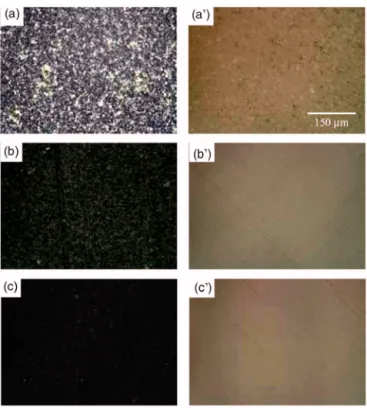
The crossed polarized optical microscopy共Zeiss兲 is used to observe alignment of the nematic liquid crystal 5CB on these patterned silica surfaces. The liquid crystal cell is com-posed of two patterned silica substrates with parallel groove direction and these two substrates are kept apart by inserting 10m Mylar films共DuPont Films兲 at the two longer edges. The filling of the 5CBs is driven by capillarity. Figure 2 shows the optical micrographs. The alignment of 5CBs on the patterned silica surface with 391 nm groove width and 350 nm groove depth is uniformly planar along the groove direction, as shown in Fig. 2共a兲 and 2共a
⬘
兲. The surface topol-ogy is determined by the atomic force microscope共Nano-a兲Author to whom correspondence should be addressed; electronic mail: [email protected]
FIG. 1. 共Color online兲 The schematic representation of the fabrication of patterned silica surfaces by soft embossing method.
APPLIED PHYSICS LETTERS 88, 133123共2006兲
0003-6951/2006/88共13兲/133123/3/$23.00 88, 133123-1 © 2006 American Institute of Physics
scope IIIa, Digital Instrument, Santa Barbara兲. It is interest-ing to note that when the groove width and the groove depth are increased to 1.98m and 918 nm, respectively, the liq-uid crystal alignment remains planar, as shown in Figs. 2共b兲 and 2共b
⬘
兲. However, when the groove width is increased to 5.31m whereas the groove depth remains 350 nm, there are microdomains, as shown in Figs. 2共c兲 and 2共c⬘
兲, indicat-ing that the liquid crystal alignment is not uniformly planar along the groove direction anymore.Previous studies5,6show that the physical topography of a surface has an effect on the orientation of liquid crystal alignment. Berreman5 rubbed the glass substrates with dia-mond powder to produce microgrooves on the surfaces. He claimed that the groove effect is the primary factor that in-duces the alignment of liquid crystal molecules toward the rubbing direction according to the minimization of the elastic energies in a nematic liquid crystal. According to the expres-sion of the anchoring energy of Berreman,5 the anchoring energy is strongly dependent on the groove geometry. That is, the greater the groove depth, the higher the anchoring energy would be. It is plausible to conjecture that a substrate with a sufficient deep groove depth could induce uniform alignment of liquid crystal molecules that are confined even in a large groove width. Our experiment results support this conjecture. Figure 3 shows the optical micrographs for the alignment of 5CBs between two patterned silica surfaces with 2.83m groove width and different groove depths. One can see in Figs. 3共a兲, 3共a
⬘
兲, 3共b兲, and 3共b⬘
兲, that the align-ment of 5CBs is not uniform for 55 nm groove depth but becomes more uniform for 600 nm groove depth. Eventually, Figs. 3共c兲 and 3共c⬘
兲 show uniformly planar alignment when the groove depth is further increased to 1200 nm.The anchoring energy is further determined to explore the quality of anchoring of 5CBs on the patterned silica sur-faces fabricated by the soft embossing process. The cell is assembled with a cell gap of 10m. The groove direction of surfaces is perpendicular to each other: one patterned silica substrate and a conventionally rubbed polyimide counter plate. The cell rotation method11is applied to determine the surface anchoring energies by detecting the twist angle of liquid crystal molecules in the liquid crystal cell. The pat-terned silica surfaces with 1055 nm groove width and 917 nm groove depth exhibit higher anchoring energies 共7.1⫻10−5J / m2兲 than those of the conventional rubbed
polyimide surfaces共1.7⫻10−5J / m2 in this work兲. It is
be-lieved that the high anchoring energy is mainly due to the large groove depth. Note that the groove width and depth of rubbed polyimide surface are 30 and 4 nm, respectively, in this work.
The square-wave grating silica surfaces have a great po-tential to serve as liquid crystal alignment layers. However, there is no pretilt angle for 5CBs on the bare silica surfaces of square-wave grating. It is well understood that a broad range of the chemical nature of the silica surface could be modified by the SAMs formed from organosilanes with the hydroxyl groups on the silica surface. In this study, the pretilt angle was measured by the crystal-rotation method12 共Autronic-Melchers, TBA 105兲. When the dodecyltriethox-ysilane 共DTS, Gelest兲 or octadecyltrichlorosilane 共OTS, Al-drich兲 SAM is formed on the square-wave grating silica sur-faces, the pretilt angle of 5CBs becomes 90°. That is, the liquid crystal 5CB exhibits homeotropic alignment on the DTS- and OTS-SAMs, which is a low energy and very
hy-FIG. 2. 共Color online兲 The optical micrographs of liquid crystal alignment on the patterned silica surfaces taken between crossed polarizers.关共a兲 and 共a⬘兲兴 391 nm groove width, 关共b兲 and 共b⬘兲兴 1.98m groove width, and关共c兲 and共c⬘兲兴 5.31m groove width. All the micrographs on the left hand side, 共a兲, 共b兲, and 共c兲, are taken with the groove direction parallel to one of the polarizer axes, and all the micrographs on the right hand side,共a⬘兲, 共b⬘兲, and 共c⬘兲, are taken with the groove direction at 45° to each polarizer axis.
FIG. 3.共Color online兲 Optical micrographs of liquid crystal alignment taken between crossed polarizers for the patterned silica surfaces with 2.83m groove width at three different groove depths: 55 nm关共a兲 and 共a⬘兲兴, 600 nm 关共b兲 and 共b⬘兲兴, and 1200 nm 关共c兲 and 共c⬘兲兴. All the micrographs on the left hand side,共a兲, 共b兲, and 共c兲, are taken with the groove direction parallel to one of the polarizer axes, and all the micrographs on the right hand side, 共a⬘兲, 共b⬘兲, and 共c⬘兲, are taken with the groove direction at 45° to each polarizer axis.
133123-2 Chiou, Yeh, and Chen Appl. Phys. Lett. 88, 133123共2006兲
drophobic surface. Note that the dimension of the square-wave grating surface used for SAM formation is of 780 nm spatial period, 390 nm groove width, and 150 nm groove depth. On the other hand, the pretilt angle of 5CBs on the SAM formed from 11-aminoundecyltriethoxysilane共AUTS, Gelest兲 on the square-wave grating silica surface switches to 1.5°. Note that the AUTS-SAM is a relatively high energy and hydrophilic surface that makes the 5CB planar anchoring along the groove direction with a small pretilt angle. Here the advancing contact angle of water is used as an index of the hydrophobicity of the surface. The larger is the advanc-ing contact angle of water, more hydrophobic is the surface. The advancing contact angles of the DTS-, OTS-, and AUTS-SAMs on flat surfaces are 110°, 110°, and 75°, re-spectively. The corresponding pretilt angles on the DTS-, OTS-, and AUTS-SAMs are 90°, 90°, and 1.5°, respectively. It is plausible to conjecture that the pretilt angle of the liquid crystal 5CB can be manipulated by tuning the hydrophobic-ity 共chemical nature兲 of the surface. Therefore, the mixed SAMs of DTS and AUTS on the patterned silica surfaces are prepared from mixtures of DTS and AUTS solutions at molar ratios 共DTS/AUTS兲 of 5 and 10. The advancing contact angles of water on the mixed SAMs at molar ratios of 5 and 10 are 87° and 92°, respectively. The hydrophobicity in-creases along with the molar ratio, as expected. Indeed, the pretilt angle of 5CBs is 3.4° on the patterned silica surfaces deposited at a molar ratio of 5 and 18.6° at the molar ratio of 10. It is obvious that the pretilt angle increases along with the advancing contact angle of water and the hydrophobicity of the surface. This observation indicates that it is possible to adjust the pretilt angle of the liquid crystals on the SAM formed from organosilanes with different surface chemical functionalities.
From the above experimental results, the liquid crystal alignment is subject to both the surface topography and the chemical nature of the surface. It is found that the shorter the wavelength of the grating is and the deeper the groove is, the better the planar alignment of nematic liquid crystal be-comes. However, the chemical nature of the surface can overwhelm the topographical effect, i.e., the pretilt angle of the liquid crystal 5CB is adjustable by changing the hydro-phobicity of the surface of the square-wave grating, as men-tioned above. It seems that the chemical nature of the surface is the main factor determining the liquid crystal alignment. In contrast, we would like to demonstrate that the topo-graphical effect can also overwhelm the chemical nature of the surface when the chemical anchoring is weak. The OTS-SAMs are prepared on the square-wave grating silica sur-faces of 5.7m spatial period, 2.85m groove width, and four different groove depths. It is found that the 5CB exhibits homeotropic alignment on these surfaces when the groove depth is 70 or 465 nm, as shown in Fig. 4共a兲. When the groove depth is further increased, there is a transition of the alignment of 5CBs from homeotropic to planar, as showed in Figs. 4共b兲 and 4共c兲. This observation indicates that when the surface topography is weak, the surface chemical interactions dominate the alignment of 5CBs. While the surface topogra-phy gets more pronounced, it becomes the primary factor for the alignment of 5CBs.13Therefore, the liquid crystal align-ment is simply the outcome of the competition of the surface topography and the chemical nature of the surface.
In summary, the square-wave grating silica surfaces are fabricated by soft embossing method. The SAMs are
pre-pared on the square-wave grating silica surfaces to manipu-late the hydrophobicity of the surface. The pretilt angle of the liquid crystal 5CB is adjustable by changing the hydro-phobicity of the surface of the square-wave grating. It is found that both the surface topography and the chemical na-ture of the surface are responsible for the liquid crystal align-ment and the uniformity of the liquid crystal alignalign-ment is strongly dependent on the groove geometry.
1J. Stöhr, M. G. Samant, J. Lüning, A. C. Callegari, P. Chaudhari, J. P. Doyle, J. A. Lacey, S. A. Lien, S. Purushothaman, and J. L. Speidell, Science 292, 2299共2001兲.
2J. M. Geary, J. W. Goodby, A. R. Kmetz, and J. S. Patel, J. Appl. Phys.
62, 4100共1987兲.
3J. A. Castellano, Mol. Cryst. Liq. Cryst. 94, 33共1983兲; A. J. Pidduck, G. P. Bryan-Brown, S. Haslam, R. Bannister, I. Kitely, T. J. McMaster, and L. Boogaard, J. Vac. Sci. Technol. A 14, 1723共1996兲.
4W. M. Gibbons, P. J. Shannon, S. T. Sun, and B. J. Swetlin, Nature 共London兲 351, 49 共1991兲.
5D. W. Berreman, Phys. Rev. Lett. 28, 1683共1972兲; Mol. Cryst. Liq. Cryst.
23, 215共1973兲.
6M. Behdani, S. H. Keshmiri, S. Soria, M. A. Bader, J. Ihlemann, G. Marowsky, and Th. Rasing, Appl. Phys. Lett. 82, 2553共2003兲. 7C. Marzolin, S. P. Smith, M. Prentiss, and G. M. Whitesides, Adv. Mater.
共Weinheim, Ger.兲 10, 571 共1998兲.
8Y. Xia and G. M. Whitesides, Angew. Chem., Int. Ed. 37, 551共1998兲. 9C.-Y. Ting, D.-F. Ouyan, and B.-Z. Wan, J. Electrochem. Soc. 150, F164
共2003兲.
10M. Li, H. Tan, L. Chen, J. Wang, and S. Y. Chou, J. Vac. Sci. Technol. B
21, 660共2003兲.
11G. P. Bryan-Brown, and I. C. Sage, Liq. Cryst. 20, 825共1996兲. 12G. Baur, V. Wittwer, and D. W. Berreman, Phys. Lett. 56A, 142共1976兲. 13D. H. Chung, T. Fukuda, Y. Takanishi, K. Ishikawa, H. Matsuda, H.
Takezoe, and M. A. Osipov, J. Appl. Phys. 92, 1841共2002兲.
FIG. 4.共Color online兲 Optical micrographs of liquid crystal alignment taken between crossed polarizers for the patterned silica surfaces deposited with octadecyltrichlorosilane for 2.83m groove width at three different groove depths: 465 nm关共a兲 and 共a⬘兲兴, 1068 nm 关共b兲 and 共b⬘兲兴, and 1785 nm 关共c兲 and 共c⬘兲兴. All the micrographs on the left hand side, 共a兲, 共b兲, and 共c兲, are taken with the groove direction parallel to one of the polarizer axes, and all the micrographs on the right hand side,共a⬘兲, 共b⬘兲, and 共c⬘兲, are taken with the groove direction at 45° to each polarizer axis.
133123-3 Chiou, Yeh, and Chen Appl. Phys. Lett. 88, 133123共2006兲