Rational Choices and Irrational
Results: The DPP's Institutional
Choice in Taiwan's Electoral Reform*
ALEX
CHU AN-HSIEN
CHANG AND
YU-TZUNG
CHANG
Even though the Democratic Progressive Party (DPP) successfully secured its traditional degree of electoral support in Taiwan's seventh legislative election held on January 12, 2008, its share of seats under the mixed-member majoritarian system declined dramatically. From a ra-tional choice perspective, this paper asks a big question: Why did the DPP government adopt an electoral system that disadvantaged its own party? By examining its prior electoral experience and its expected electoral payoffs under the new system, we assert that the DPP's institutional choice remained rational. Nevertheless, failure to garner electoral support from the traditional pan-Greens, an overestimation of its victory in the 2004 presidential election, and an underestimation of the degree of electoral
co-ALEXCHUAN-HSIENCHANG(張傳賢) is an assistant research fellow in the Institute of Po-litical Science, A cademia Sinica, Ta ipei. Dr. Chang can be reached at <chang626@gate .sinic a.edu.tw>.
YU-TZUNGCHANG(張佑宗) is an associate professor in the Department of Political Science, Nationa l Taiwan University. Dr. Chang can be re ached at <[email protected]>. *Paper prese nted a t the Conference on Electoral Politics in Taiwan at the U nive rsity of
South Ca rolina , co-hosted by the Ce nter for A sia n Studies, the Walker Institute of Inter-na tioInter-nal and A re a Studie s, the University of South CaroliInter-na, and the Ce nter for ChiInter-na Stu-dies, College of Socia l Sciences, National Taiwan University. The a uthors are grateful to two anonymous review ers for their comments and contribution to this paper. We also want to thank Shelley Rigger, Yung-Mao Chao, John H sie h, Tse -min Lin, Chris Achen, and other conference pa rticipants for their valuable comments and suggestions. However, the authors are solely responsible for the view s expressed herein..
論
ordination within the pan-Blue camp resulted in electoral defeat for the DPP.
KEYWORDS: rational choic e; institutional c hoice; mixed-member majori-tarian; electoral reform; Democratic Progressive Party (DPP).
* * *
Institutional design is self-perpetuating.1
Once an institution has been set up, political actors adjust their political behavior to maximize their political advantage and adapt themselves to the new institution. As long as no alternative choice is accepted by a majority of main stakeholders, the institution will not be replaced. Among all po-litical institutions, the electoral system is the most important, in that it not only transforms votes into seats,2
but also affects electoral competition3 and intraparty politics.4
We can reasonably conclude that a change in the electoral system will influence most political parties and legislators, and that the new electoral system must be acceptable to at least a majority in the legislative branch.5
1Thomas F. Remington and Steven S. Smith, "Political Goals, Institutional Context, and the Choice of an Electoral System: The Russian Parliamentary Elec tion Law," Am erican
Journal of Political Science 40, no. 4 (November 1996): 1253.
2Re in Taagepera and Mathew S. Shugart, Seats and Votes: The Effec ts and D eterminants of Electoral System (New Haven, Conn.: Yale U niversity Press, 1989); a nd Ka thleen Ba wn,
"The Logic of Institutional Preferences: G erman Ele ctoral Law as a Social Choic e O ut-come," American Journal of Politic al Sc ience 37, no. 4 (December 1993): 966. 3Gary W. Cox, "Ce ntripetal and Ce ntrifugal Incentive s in Electoral Syste ms," Am erican
Journal of Political Science 34, no. 4 (N ovember 1990): 903-35; Gary W. Cox, Mak ing Votes Count: Strategic Coordination in the World's E lectoral Sy ste ms (Cambridge :
Cam-bridge U nive rsity Press, 1997); and A nthony D ow ns, An Economic Theory of De mocracy (New York: H arperCollins, 1957).
4John M. Carey and Matthew Soberg Shugart, "Incentives to Cultivate a Personal Vote: A Rank Ordering of Electoral Formulas," Electoral Studies 14, no. 4 (Dece mber 1995): 417-39.
5An elec toral system c an be replaced via a referendum instead of through le gisla tive pro-cesse s. For example, in 1993, a majority of New Zealanders voted for a mixed-membe r proportional system to repla ce "first-past-the-post." In this ca se, the preference s of political parties and legislators may have had re latively little influence. For the electora l reform in New Zea land, se e Jack Vowles, "The Politics of Electora l Reform in N ew Zealand,"
On June 7, 2005, the Fourth National Assembly (國民大會) adopted a revision to Article 4 of the Constitution of the Republic of China by a three-quarter majority vote. According to this constitutional revision, the single non-transferable vote (SNTV) was replaced by the mixed-member majoritarian (MMM) system. As a result, the number of seats in Taiwan's Legislative Yuan (立法院) was reduced from 225 to 113, including 73 seats elected by first-past-the-post (FPTP), 34 by a nationwide constituency and by citizens residing abroad, and 6 assigned to the lowland and highland aborigines. The new electoral system was first applied in the 2008 legis-lative election held on January 12, 2008. In this election, even though the incumbent Democratic Progressive Party (DPP, 民主進步黨) successfully secured 36 percent of votes, it ended up with only 24 percent of seats, due to cooperation between the opposition Kuomintang (KMT, 國民黨), the People First Party (PFP, 親民黨), and the New Party (NP, 新黨), and the disproportionality of the Japanese-style mixed-member electoral system.
Looking back on the history of electoral reform and the bargaining between the DPP, KMT, PFP, and the other minor parties, we find that the DPP originally preferred a German-style mixed-member proportional (MMP) system, which would have allocated seats according to each party's share of the vote. Surprisingly, in 2004, the DPP accepted the KMT's elec-toral reform proposal, which was for a Japanese-style mixed-member system and brought with it the possibility of a disproportional election out-come. Given that it held 40 percent of the seats in both the Legislative Yuan and the National Assembly, the DPP was capable of vetoing any bill that might be disadvantageous to itself. Why, then, did the DPP eventually adopt such a disadvantageous electoral system?
This article sets out to answer the question above and to examine the logic behind the DPP's institutional choice of electoral reform. We argue that given its electoral experience under SNTV and FPTP, the DPP's adop-tion of a new 113-seat legislature elected by a Japanese-style MMM system was understandable and rational, although it failed to take account of the cooperation of the pan-Blue camp or to appeal for electoral support from the pan-Greens, and it also overestimated its success in the 2004 presiden-tial election.
In the following sections of this article, we briefly describe the his-torical background of electoral reform in Taiwan and point out three crucial issues in the bargaining process of the reform: the total number of seats in the Legislative Yuan, the proportion of seats elected by nominal districts and party lists, and the adoption of a Japanese- or a German-style mixed system. Furthermore, we discuss how the DPP shifted from defending a German-style mixed-member system to accepting a Japanese-style system. To understand the logic behind the DPP's institutional choice, we in-vestigate the alternatives, the political uncertainty that the DPP faced, and the party's concerns. We then apply the seat-maximizing model to analyze the DPP's preference among the institutional alternatives. To test our ar-guments, we further incorporate a Monte Carlo simulation and statistical analyses of previous Taiwanese election results. Statistical results show that the DPP's adoption of the Japanese-style MMM system was rationally based on its experience in previous elections, its expectation of competition between the KMT and the PFP, and its victory in the 2004 presidential election.
The Background to Taiwanese Electoral Reform
During the process of democratization in Taiwan, electoral competi-tion was introduced to the electorate through SNTV. Taiwan was simply divided into multimember districts that corresponded with the boundaries of administrative districts. Voters were allowed to cast one vote for one candidate, and votes could not be transferred to other candidates. Seats were assigned to those with most votes according to the plurality rule.6 From 1949 to 1992, SNTV was widely used in both the supplementary
6Bernard Grofman, "SNTV: A n Inventory of Theoretically Derived Propositions and a Brief Review of the Evidence from Japan, Korea, Taiwan, and A labama," in Elections in Japan,
Korea, and Taiwan under the Single Non-Transferable Vote: The Comparative Study of an Embedded Institution, ed. Bernard Norman Grofman, Sung-Chull Le e, Edwin A . Winckler,
elections for the Legislative Yuan and local council elections.7
Despite its significant influence on the democratization process, SNTV was blamed for boosting the importance of the personal reputation of candidates and encouraging intraparty competition.8
In SNTV elections, co-partisan candidates had to compete with each other in their constituen-cies,9
a situation which ignited serious intraparty conflicts and the fraction-alization of political parties.10
In addition, political scientists argue that
7Jih-wen Lin, "The Politics of Reform in Japa n and Taiwan," Journal of Democracy 17, no. 2 (April 2006): 123.
8See note 4 above ; Ga ry W. Cox, Frances McCa ll Rosenbluth, and Michae l F. T hies, "Mobilization, Social Networks, a nd Turnout: Evidence from Japan," World Politics 50, no. 3 (April 1998): 447-74; Gary W. Cox, France s McCall Rosenbluth, and Michael F. Thies, "Electoral Reform and the Fate of Factions: The Case of Japan's Liberal Democratic Party," British Journal of Political Science 29, no. 1 (Janua ry 1999): 33-56; and Ga ry W. Cox, Frances M. Rosenbluth, and Michael F. Thies, "Electoral Rules, Career Ambitions, and Pa rty Structure: Compa ring Factions in Japan's U pper and Lower Houses," Am erican
Journal of Political Science 44, no. 1 (January 2000): 115-22.
9Cox, Rose nbluth, and Thies, "Electoral Re form and the Fate of Fa ctions"; G ary W. Cox and Emerson M.S. N iou, "Seat Bonuses under the Single N ontra nsferable Vote Syste m: Evidence from Japan and Taiwan," Comparative Politics 26, no. 2 (January 1994): 221-36; Gary W. Cox and Fra nc es Mc Call Rosenbluth, "Factional Competition for the Party En-dorsement: The Case of Japan' s Liberal D emocratic Party," British Journal of Political
Science 26, no. 2 (A pril 1996): 259-69; and J. Mark Ramseyer and Fra nc es McCall
Rose-nbluth, Japan's Political Marketplace (Cambridge, M ass.: Harvard University Press, 1993).
10Se e, e.g.: Haruhiro Fukui and Shigeko N . Fukai, "Ca mpa ign for the Japanese D iet," in Grofman, Lee, Winckler, and Woodall, Elections in Japan, Korea, and Taiwan, 121-52; Ichiro Miyake, "Candidate Evaluation and Voting Choice under the Japanese Elec toral Sys-tem," ibid., 153-80; Steve n R. Reed and John M. Bolland, "The Fragmentation Effe ct of SNTV in Japan," ibid., 211-26; Junko Kato and Kentaro Yamamoto, "Competition for Power: Pa rty Switching as a Means for Changing Party Systems in Japan" (Paper presented for Party Switching Research Group [PSRG] Workshop, Charlottesville, Virginia, 2005); Michael Laver and Junko Kato, "Dynamic Approache s to Governme nt Formation and the Generic Instability of D ecisive Struc tures in Japan," Electoral Studies 20, no. 4 (December 2001): 509-27; Jih-w en Lin, "Consequences of the Single Nontransferable Voting Rule: Comparing the Japan and Taiwan Experiences" (Ph.D. dissertation, Department of Political Science, U niversity of California, Los A ngeles, 1997); and Cheol H ee Park, "Political Dynamics of Regime Transformation in Japan in the 1990s," Japanese Journal of Political
Sc ience 5, no. 2 (November 2004): 311-22. In an SNTV election, an extremely popular
candidate not only competes with c o-partisans, but also jeopardizes the success of the party as a whole. For example, a party with enough votes to place tw o candidates in the last two places could lose a seat if one of the candidates acquires too ma ny votes and the others do not have enough votes for a seat. See Cox and N iou, "Seat Bonuses under the Single Nontransferable Vote System"; and Steven R. Reed, "Structure and Behavior: Extending Duverger's Law to the Japanese Ca se," British Journal of Political Science 20, no. 3 (Sep-tembe r 1990): 338.
SNTV resulted in widespread political corruption, clientelism, electoral fraud, and money politics.11
After Japan successfully replaced its long-held SNTV system with a mixed-member system in 1994, the subject of electoral reform was dis-cussed at each conference on constitutional amendment held by Taiwan's National Assembly. Most political parties generally accepted the need for electoral reform and the installation of a mixed-member system consisting of a nominal tier and a list tier. One important issue that influenced the parties' institutional choices was the proportion of seats to be elected by the nominal tier and the list tier; another was how to allocate seats to each party according to their vote shares. A Japanese-style mixed-member system was favored by the major parties, while most of the minor parties preferred a German-style mixed system.
In November 2000, Commonwealth (天下雜誌), one of the most popular and influential Taiwanese magazines, published the results of a survey on public perception of legislators' performance. According to this survey, 63 percent of Taiwanese citizens did not believe that legislators spoke for the public in the Legislative Yuan. This report stirred up public demands for reform of the legislative branch and a reduction in its size. This issue also influenced the parties' institutional choice. The three issues mentioned above are not independent, but are highly correlated with each other. In contrast to the Japanese-style mixed-member system, the German-style system provides a more proportional electoral outcome. Similarly, an increase in the proportion of seats elected by PR also secures a more proportional electoral result, while reducing the size of the
Legis-11Ramseyer and Rosenbluth, Japan's Political Marketplace, 8-12; Cox and Rosenbluth, " Factional Competition for the Pa rty Endorsement"; Cox, Rose nbluth, and Thies, "Mob-iliza tion, Social Netw orks, and Turnout"; Steven R. Reed and Michael F. Thies, "The Consequences of Electoral Reform in Ja pan," in Mixed-Mem ber Electoral System s: The
Best of Both Worlds? ed. Matthe w Sobe rg Shuga rt a nd Martin P. Watte nberg (N ew York:
Oxford University Press), 380-403; Fukui and Fukai, "Campaign for the Japanese D iet"; Grofman, Lee, Winc kler, and Wooda ll, Elections in Japan, Korea, and Taiwan, 7; and Patric k Fournier a nd Masaru Kohno, "Japan's M ultimember SNTV System and Strategic Voting: The 'M + 1 Rule' and Beyond," J apanese Journal of Politic al Scie nce 1, no. 2 (N ovember 2000): 275-93.
lative Yuan decreases the proportionality of representation. This is be-cause, after controlling for other factors, a decrease in the total number of seats results in a decrease in district magnitude, thus producing less proportional election outcomes.12
The three issues above can therefore be incorporated into a one-dimensional spectrum: disproportionality vs. proportionality.
According to Cox, if political parties can nominate the appropriate number of candidates and equally distribute votes to each nominee, the election outcome of SNTV is equivalent to the d'Hondt proportional repres-entation rule.13
In Taiwan, even though the two conditions above were hardly satisfied, in contrast with the election outcomes under FPTP, the
12Taagepera and Shugart, Seats and Votes, 112-25.
13Gary W. Cox, "SNTV and d'H ondt Are 'Equivalent'," Electoral Studies 10, no. 2 (June 1991): 118-32.
Figure 1
Standpoints on Electoral Reform in 1994a
Note s:
aThis figure is based on the G allagher Index, which is used to measure the disproportiona lity of an e lection outcome. It wa s calculated on the basis of the formula , in which viand sirepre sent the vote share a nd seat share of Party i, respectively. For details, see Michael G allagher, "Proportionality, D isproportionality, and Electoral Systems,"
Elec-toral Studies 10, no. 1 (Marc h 1991): 33-51; and Michael Gallagher, "Comparing
Propor-tional Representation Electoral Systems: Quotas, Thresholds, Paradoxes and Majorities,"
British Journal of Political Science 22, no. 4 (O ctober 1992): 469-96. bIdeal points on the issue space of electora l design of the political parties. cStatus quo in 1994. KMT 1994b2 SQ 1994c3 DPP and minor parties 1994b2 0 2 4 6 8 10 Disproportionality Proportionality
election outcomes of SNTV were relatively proportional (Gallagher Index of the 1995 election: 4.05).
Electoral Reform in 1994
In 1994, Vice Premier Lien Chan (連戰) opened a debate on electoral reform and proposed a Japanese-style MMM system under which 80 per-cent of seats would be elected by FPTP. The expected election outcomes of this KMT proposal would have been more disproportional than the status quo (Gallagher Index of the expected election outcome of the 1995 election based on the KMT proposal: 7.89) since most seats would be elected by FPTP, and the Japanese-style mixed system would separate the election outcomes of the list and the nominal tiers, in contrast with the election outcomes of SNTV.14
The KMT proposal was immediately denounced by the opposition camp, including the DPP, the NP, and the Non-Partisan Solidarity Union (無黨團結聯盟). The opposition parties generally accepted the necessity for electoral reform and the installation of an MMM system, but these par-ties insisted on a German-style MMP which would avoid the underrepre-sentation the minor parties experienced under FPTP and at the same time they argued that 50 percent of seats should be elected via a nationwide PR system. Because proceeding with electoral reform required the amendment of Article 4 of the Constitution by at least a three-quarter majority in the National Assembly, this task was postponed for a decade.
Electoral Reform in 2004
In November 2003, under public pressure for electoral and legislative reform, the KMT put forward a new proposal for electoral reform. This was similar to the previous one, but involved halving the size of the Legislative Yuan. The new proposal showed that the KMT was consistently in favor of FPTP and less proportional election outcomes.
14The Gallagher Index of the expected election outcome is derived from Monte Carlo simu-lation, which will be introduced in the Appendix.
In contrast to the KMT and the pan-Blue coalition, the DPP opted for a drastic change. In 2004, the DPP discarded its proportional proposal and suggested Japanese-style MMM system, with a 150-seat Legislative Yuan and 60 percent of seats elected by FPTP. In other words, the DPP shifted from the right of the status quo to the left (see figure 2). Finally, the DPP and the KMT-PFP agreed on a 113-seat Legislative Yuan elected by a Japanese-style mixed-member system in which 70 percent of seats would be elected by FPTP. The agreement was approved in the Legislative Yuan by a three-quarter majority and entered the draft of the seventh constitu-tional revision. The draft was further approved by the Naconstitu-tional Assembly in 2005 and Japanese-style MMM finally replaced SNTV.
Two crucial points emerge from the history of electoral reform in Tai-wan. First, the DPP had two opportunities to veto the electoral reform bill (one in the Legislative Yuan in 2004 and the other in the National Assembly in 2005).15
Second, the DPP apparently altered its preference with regard
15The PFP, for example, approved the electoral reform in the Legislative Yuan in 2004, but tried to oppose it in the N ational A ssembly in 2005.
Figure 2
Standpoints on Electoral Reform in 2004a
Note s:
aSee note to figure 1 above.
bIdeal points on the issue space of electora l design of the political parties. cStatus quo in 2004. KMT and PFP 2004b DPP 2004b SQ 2004c 0 2 4 6 8 10 Disproportionality Proportionality New Electoral System
to electoral reform, adopted the KMT's proposal, and made the installation of MMM possible.
Theory of Electoral Reform
Numerous approaches can be applied to interpret institutional choice with regard to the electoral system, ranging from instrumental motivations to personal gain or general welfare.16
Norris investigates electoral reform from an "electoral engineering" perspective and concludes that the driving factors behind electoral reform in Japan, Italy, and New Zealand were significant changes to the established party system, a series of political scandals and government failures, and the potential for breaking the log-jam of established party interests.17
We cannot ignore and exclude the in-fluence of normative factors on electoral reform. As stated above, SNTV was replaced in Taiwan because it was perceived to be the cause of a frag-mented party system and to encourage money politics and political corrup-tion. In addition, the disappointed public's demand that the Legislative Yuan be halved in size became one of the major forces dominating the bargaining process of electoral reform. Nevertheless, since the major shift in the DPP's institutional choice was from a German-style MMP to a Japanese-style MMM, and the two systems merely differ in seat alloca-tion, the normative approach cannot be applied to explain such a strategic change.
Democratization theory provides another perspective for explaining the DPP's change in institutional choice. In general, democratic transition is characterized by unexpected events, insufficient information, and au-dacious choices.18
Given the lack of information about institutional
alter-16Kenneth Benoit and Jacqueline Hayden, "Institutional Cha nge and Persistence: The Evolu-tion of Poland's Electoral System, 1989-2001," Journal of Politic s 66, no. 2 (May 2004): 398.
17Pippa Norris, "Introduction: The Politics of Electoral Reform," International Political Sci-ence Review 16, no. 1 (Ja nuary 1995): 7.
natives, political actors' interests and institutional preferences are fluid and ill-defined.19
Indeed, when the debate on electoral reform was initiated in 1994, early in the democratization process, the DPP had just experienced its first nationwide legislative election. Incomplete information about possible institutional choices might have driven the DPP to make a wrong move. Nevertheless, in contrast to its proposal in the 1994 debate on elec-toral reform, the DPP's institutional choice in 2004 seems irrational, despite the fact that it had more electoral experience and had the advantage of being the party in power.
Unlike the normative approach and democratization theory, rational choice theory examines the change in institutional choice from a utilitarian perspective. Students of rational choice assume that the motives of max-imizing legislative presence under conditions of extreme uncertainty drive strategic actors to choose electoral rules that subsequently optimize their electoral performance.20
Democratization theory asserts that the chaos of political transition might result in the fluidity of political actors' prefer-ences for institutional alternatives, whereas rational choice theorists sug-gest that the preferences vary for many reasons, including policy-seeking, office-seeking, self-interest, personal gain, general welfare, and non-instru-mental motivations. For example, Kathleen Bawn develops an alternative strategic model of party preferences for electoral institutions. She assumes that (1) parties' preferences are defined over policy outcomes, (2) parties make use of all available information about the preferences of the
elec-Tentative Conc lusions about U ncertain Democracies, vol. 4 of Transitions from Authorita-rian Rule: Prospe cts for Democracy, e d. G uillermo A. O'Donnell, Philippe C. Sc hmitter,
and Laurence Whitehea d (Baltimore: Johns Hopkins University Press, 1986), 5.
19Vale rie Bunce and M ária Csanádi, "Uncertainty in the Transition: Post-communism in Hungary," East European Politics & Soc ieties 7, no. 2 (March 1993): 241-42; and Mic hael McFaul, "Institutional D esign, Uncertainty, and Path Dependency during Transitions: Ca ses from Russia," Constitutional Political Economy 10, no. 1 (March 1999): 31. 20See note 17 above ; Josephine T. Andrews and Robert W. Jackman, "Strategic Fools:
Elec-toral Rule Choice under Extreme Uncertainty," ElecElec-toral Studies 24, no. 1 (March 2005): 65-84; K enneth Benoit, "Models of Electoral System Change," ibid. 23, no. 3 (September 2004): 363-89; Kenneth Benoit and John W. Schiemann, "Institutional Choice in New Democracies: Ba rgaining over Hungary's 1989 Electoral Law," Journal of Theoretical
torate to predict vote shares, and (3) parties participating in the choice of electoral institutions know the preferences of other participants and under-stand the rules governing the choice.21
By applying these assumptions to analyze the choice of electoral rules in postwar Germany, she finds that in order to maximize its chances of leading governing coalitions, the Social Democratic Party (SDP) supported proportional representation instead of FPTP, which might have provided it with more seats. Benoit and Hayden model office-seeking incentives for political actors by emphasizing actors' information context, their vote expectations and understanding of electoral alternatives, and their power to change the electoral institution assigned by the decision rule for changing the electoral system.22
They find that a political party's choice of electoral system is closely linked to the system's perceived effect on seat shares and as such the linkage becomes more con-sistent over time, given the party's growing electoral experience.
Rational choice theory provides a dynamic approach for studies of in-stitutional choice. Because the approach emphasizes the information held by political actors concerning electoral alternatives and their electoral ex-perience, prior election outcomes can shape the political actors' expecta-tions as to future election outcomes under various alternative electoral systems. Thus, in this paper, we apply the seat-maximizing model of elec-toral system change2 3
to analyze the DPP's strategies of institutional choice. There are two main reasons for selecting this model. First, political parties' seat shares directly affect their ability to influence policy outcomes in a legislature. Thus, all other things being equal, political parties generally prefer an electoral system that maximizes their share of the seats. Second, since the amendment of the constitution in 1997, Taiwan has had a quasi-presidential system,24
and the president and the legislators are elected in
21Bawn, "The Logic of Institutional Preferences," 967.
22Benoit and Hayden, "Institutional Change and Persistence," 402.
23Benoit, "Models of Electoral System Change"; and Benoit and Schiemann, "Institutional Choice in New D emocracies."
24Shuga rt a nd Haggard argue that Taiw an has established a premie r-presidential syste m. Nevertheless, sinc e a president can dissolve the Legislative Yuan w ithout the pre mier's endorse ment, the Taiwanese regime is more like a president-parliame ntary re gime . See
non-simultaneous elections, so winning a majority in the legislative branch does not affect the composition of the executive branch. Maximizing seat shares thus becomes the only incentive that affects political parties' institu-tional choices.
Electoral Reform:
The DPP's Institutional Choice and Concerns
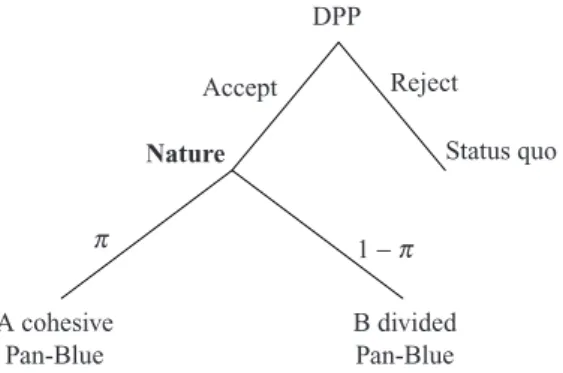
Figure 3 sets out the DPP's major concerns about the results of elec-toral competition among the KMT, the DPP, and the PFP.25 As mentioned above, since at least a three-quarters majority in the Legislative Yuan is needed to pass a constitutional amendment, given that it held 30.22 percent
Matthew S. Shugart and Stephan Haggard, "Institutions and Public Policy in Presidential Systems," in Presidents, Parliaments, and Policy , e d. Stepha n H aggard and Matthew D . McCubbins (Cambridge: Cambridge University Press, 2001), 69. See also Matthe w So-berg Shugart and John M . Carey, Pre sidents and Assem blies: Constitutional Design and
Electoral Dynamics (Cambridge: Ca mbridge University Press, 1992).
25Since seat-distributing is generally a zero-sum game, there is no alternative that can benefit all ve to players a nd replace the status quo. Thus, w e emphasize that figure 3 does not rep-resent a sequential game among the three parties, but a sequential process w ith incomplete information.
Figure 3
DPP's Choices of Electoral Reform
DPP Reject Status quo B divided Pan-Blue Accept Nature A cohesive Pan-Blue 1 − π π
of the seats, the DPP could have vetoed the electoral reform amendment if it had been satisfied with the status quo.
If the DPP approved the reform and the reform eventually passed, then the party could have faced two different kinds of political competition under the new mixed-member electoral setup. On the one hand, the DPP could have faced a cohesive pan-Blue coalition formed by the KMT, the PFP, and the NP. In this case, each district would have become a battlefield in which the pan-Blues would have been pitted against the pan-Greens (electoral outcome A in figure 3). On the other hand, had the DPP accepted the proposed amendment but the PFP had competed with the KMT in each district, the expected electoral result would have been B in figure 3. A and
B are two vectors containing the seat share for each political party/coalition i, i.e., A = {KMTA, DPPA, PFPA}, B = {KMTB, DPPB, PFPB}. Since A is
conditioned on the formation of a pan-Blue coalition between the KMT and the PFP, we assume that KMTA= PFPA, namely, the KMT and the PFP had
the same electoral payoff. In addition, given the KMT's defeat in the 2000 presidential election due to votes being split among its supporters, we claim that cooperation between the KMT and the PFP under MMM would earn them more seats than competition, i.e., KMTA> KMTBand PFPA> PFPB.
Due to the zero-sum characteristics of FPTP, we further infer DPPA<
DPPB. Last, we assume that the DPP could not know whether the PFP
would cooperate with the KMT under the new electoral system. It could merely assign a probability for their cooperation, and then the probability that the PFP would compete with the KMT was 1 – .2 6
The DPP would only adopt the Japanese-style MMM proposal put forward by the KMT and the PFP if the expected payoff of adopting the proposal was greater than that of rejecting it, namely × DPPA+ (1 – ) ×
DPPB DPPSQ. The inequality indicates four factors that affect the payoff
of each political party, A, B, and and SQ and these can be applied to derive the following lemmas:
26In other words, w e a pply to capture the extent of the disc ord be tween the KMT and the PFP. Suppose that the PFP only ra n candida tes in 10 out of 73 districts. In this case , might be c lose to 1.
Lemma 1. If DPPSQ> DPPB, given DPPA< DPPB, the DPP would reject
the proposal due to × DPPA+ (1 – ) × DPPB< DPPB DPPSQ.
Lemma 2. If DPPSQ> DPPA, given DPPA< DPPB, the DPP would approve
the proposal due to × DPPA+ (1 – ) × DPPB> DPPA DPPSQ.
Lemma 3. If DPPA DPPSQ DPPB& , the DPP
would approve the proposal.27
Lemma 1 represents the situation in which the DPP's expected
elec-toral payoff in the most favorable condition under MMM would be less than its real electoral payoff under SNTV. Since the real payoff would de-finitely outweigh the expected one, rejecting MMM would be the DPP's best strategy. In contrast with Lemma 1, Lemma 2 indicates that the DPP's expected electoral payoff in the most unfavorable condition under MMM would be greater than its real electoral payoff under SNTV. Insomuch as the expected payoff under MMM would expressly outweigh the real pay-off, the DPP would accept the proposal. Unlike Lemma 1 and Lemma 2,
Lemma 3 refers to a complicated situation in which the DPP's real electoral
payoff under SNTV lies in between its most favorable and its most unfavor-able expected payoffs under MMM. In this case, decreases in would in-crease the DPP's expected payoff under the new electoral system and lead it to approve the electoral reform.
The discussion above enables us to derive the theoretical hypotheses: 1. Increases in the DPP's expected seat shares under MMM, i.e.,
DPPAand DPPB, would lead it to adopt the electoral reform.
2. Decreases in the probability of cooperation between the KMT and the PFP, i.e., , would lead the DPP to adopt the electoral reform.
27D PP would acc ept the proposal if × DPP
A+ (1 – ) × D PPB DP PSQ (DPPB– DPPA) (DPPB– DPPSQ) .
Electoral Experience and Expected Electoral Payoffs
Among the four factors discussed above, SQ indicates the real elec-toral payoffs under SNTV. Table 1 shows the vote and seat shares of the pan-Blue and the DPP in the 2001 and 2004 elections.28
Despite generally benefiting from SNTV,29
as proved by Cox,30
the three major parties, the KMT, the PFP and the DPP, received relatively proportional outcomes.31
Compared with presenting the real election outcomes under SNTV, i.e., the status quo (SQ), predicting each party's expected payoffs under MMM is a tough task. The replacement of an old electoral system with a new one creates a great deal of uncertainty. To avoid installing an electoral system that would reduce its own seat share in the legislature, a political party needs to have sufficient understanding of institutional alternatives and to be able to estimate its expected seat share under each alternative
28Be cause the e lectoral reform was first passed in the Legislative Yuan in 2004 and then approved by the N ational Assembly in 2005, both the KMT and the D PP had two oppor-tunities to veto it. T hus, the outcomes of the 2001 a nd 2004 legislative elections are all taken into account.
29Gary W. Cox, "Is the Single Nontransferable Vote Superproportiona l? Evidence from Japan and Taiwan," American Journal of Political Science 40, no. 3 (August 1996): 740-55; and Cox and Niou, "Seat Bonuses under the Single Nontransferable Vote System: Evidence from Japan and Taiwan."
30See note 14 above.
31John Fuh-sheng H sieh and Richard G . Niemi, "Can D uverger's Law Be Extended to SNTV ? The Case of Taiw an' s Legislative Yuan Elections," Ele ctoral Studies 18, no. 1 (M arch 1999): 101-16; and Taagepera and Shugart, Seats and Votes, 170.
Table 1
Election Outcomes in the 2001 and 2004 Legislative Elections
KMT PFP DPP Seat share Vote share Seat share Vote sha re Seat share Vote share SNTV (SQ ) 2001 2004 30.22% 35.11% 31.30% 32.83% 20.40% 15.11% 20.30% 13.90% 38.67% 39.56% 36.60% 35.72% Source: Central Ele ction Commission, Taiwa n.
system.3 2
Prior electoral performance under the existing electoral system is perhaps the most reliable information on which to base its choice. In Taiwan, although no political party had experience of MMM, most of the parties were familiar with FPTP, which would be used for 65 percent of the seats, as that was the system used for electing city mayors and county magistrates. Thus, their electoral performance in these FPTP elections and in SNTV legislative elections became the most influential information used by the political parties to estimate their expected payoffs under MMM.
If we compare the DPP's performance in the elections of mayors and magistrates with that in legislative elections we find that from 1996, the DPP enjoyed stable electoral support in both single and multiple-member district elections. In SNTV legislative elections, the DPP consistently secured an average of 34 percent of the votes. After the formation of its pan-Green partner the Taiwan Solidarity Union (TSU, 台灣團結聯盟) in 2000, the DPP's vote share increased from 30 percent to 36 percent. In FPTP mayoral and magistrate elections, the DPP generally garnered 42 percent of the votes, a slightly better performance than in SNTV elections. The formation of the TSU did not damage the DPP's fundamental electoral support. Instead, in mayoral and magistrate elections TSU supporters tended to vote for DPP candidates, due to the influence of Duverger's psy-chological effect.33
In consequence, as shown in table 2, the DPP could generally gain electoral support from pan-Green voters in the elections for mayors and magistrates and the vote share of the DPP in FPTP elections was roughly equivalent to the sum of its and the TSU's vote shares in legis-lative elections. Consistent electoral support and better electoral perform-ance under FPTP thus shaped the DPP's general belief about its electoral experience under FPTP.
32Benoit and Hayden, "Institutional Change and Persistence," 400.
33Kenneth Benoit, "The Endogeneity Problem in Electoral Studies: A Critical Reexamination of Duverger's Mechanical Effect," Electoral Studies 21, no. 1 (Ma rch 2002): 35-46.
DPP's Expected Election Outcomes under MMM
Recalling the inequality × DPPA+ (1 – ) × DPPB SQ, we could
predict that the DPP would adopt a Japanese-style MMM if and only if the expected payoff for adopting the proposal was greater than that for rejecting it. The left-hand side of this inequality contains three elements: DPP's payoff DPPAfor the Blue vs. Green competition, the payoff DPPB
for competition among the KMT, the PFP and the DPP, and the probability of cooperation between the KMT and the PFP, . To generate the DPP's expected payoffs under MMM in the two diverse political circumstances above, we apply the election outcomes of the 2001 legislative election, the 2004 presidential election, and the 2004 legislative election. Since the MMM system contains two tiers, for estimating the expected seat shares in the list tier, we use the vote share each party acquired in SNTV election with the d'Hondt proportional representation rule.34
In addition, the six
34Due to the relatively high electoral proportionality and the lack of D urvergerian effects in the seat allocation of the party list, we a ssume that voters are less likely to concentrate their
Table 2
Prior Electoral Performance of the Pan-Greens
SNTV The 1998 legislative election The 2001 legislative election The 2004 legislative election DPP vote share TSU vote shoare FPTP DPP vote share TSU vote share 29.56% 0% The 1997 mayors and magistrates elections 43.3% 0% 36.6% 7.8% The 2001 mayors and magistrates elections 45.3% 0% 35.72% 7.79% The 2005 mayors and magistrates elections 42.% 1.13%
seats elected by highland and lowland aboriginals were all traditionally held by the pan-Blue coalition, with the exception of the seat occupied by the independent legislator, Kao Chin Su-Mei (高金素梅).
To simulate the estimated seat share in the nominal tier, according to the 73 single-member districts assigned to 25 administrative divisions, we incorporate the previous election outcomes with a Monte Carlo simula-tion.35
To simulate the expected electoral payoffs of Blue vs. Green com-petition, namely, the payoff vector A, we add up the votes of the KMT, the PFP, and the NP for the pan-Blue's votes and those of the DPP, the TSU, and the Taiwan Independence Party (TIP, 建國黨) for the DPP's expected votes at the level of neighborhoods, then cumulate each coalition's votes in each fictitious district. The coalition with the most votes in each fictitious district would earn itself a seat. To simulate the expected payoff for the situation in which the KMT and the PFP failed to cooperate, we simply cumulate the votes of the KMT, the PFP, and the pan-Green coalition re-spectively and the group with the greatest number of votes in each district wins a seat.
The Expected Payoffs of United-Blue vs. Green under MMM
Table 3 represents the expected payoff vector A based on the outcome of the 2001 legislative election. Comparing the pan-Blue seat share under SNTV (50.6 percent) with its expected seat share in MMM elections (67.96 percent), we observe that MMM would provide a larger seat share for the pan-Blue coalition. This finding confirms the argument that the KMT sub-mitted a Japanese-style mixed system in order to maximize its seat share in the Legislative Yuan. The pan-Green, in contrast, would be seriously underrepresented under MMM (expected vote share = 45.1 percent,
ex-votes on major parties. See Benoit, "The Endogeneity Problem in Ele ctoral Studies," 39; Downs, An Econom ic Theory of D emocrac y, 48; Ma urice Duverger, Political Parties:
Their O rganization and Ac tivity in the Modern State (London: Me thue n, 1954); and
Wil-liam H . Riker, "The Tw o-Party System and D uverger's La w: An Essay on the H istory of Political Science," American Political Science Review 76, no. 4 (D ecember 1982): 762. 35See Appendix for the function I use to produce the simulation.
pected seat share DPPA= 32.03 percent).36 In addition, in contrast to its
real electoral payoff under SNTV (DPPSQ= 38.67 percent), the DPP's
ex-pected seat share under MMM shows that in the event of Blue vs. Green competition, MMM would be detrimental to the DPP in terms of election outcomes.
The electoral landscape of Taiwan changed dramatically at the time of the 2004 presidential election. President Chen Shui-bian (陳水扁) faced a united opposition in the form of Lien Chan and James Soong (宋楚瑜) who had previously competed against each other. However, President Chen defeated the pan-Blue coalition and won a second term of office. This second victory was different from the first in several respects. First, in contrast to 2000, the DPP defeated a united pan-Blue coalition. Further-more, despite winning by only a small margin (0.22 percent), President Chen did win over 50 percent of votes in the 2004 election. Third, this victory showed the DPP that its support at the ballot box had increased and this encouraged it to pursue a nationalist campaign strategy. This victory
36In the 2001 election, the split in the K MT and the emergence of the PFP resulted in the KMT being under-represented (KMT vote share: 31.3 percent, sea t share: 30.33 percent) and a seat bonus for the DPP (DPP's vote share: 36.6 percent, seat share: 38.67 perce nt).
Table 3
Expected Electoral Payoffs of Green vs. Blue under MMM (Based on the 2001 Legislative Election Outcome)
2001 legislative
election
Coalition Simulation: N = 50,000 Constant
Mean Std. Dev. Min Max PR A borigine Sea t sha re Pan-Blue D PP 47.8 23.2 .5965 .5965 46 20 51 25 18 13 5 0 67.96% 32.03%
Source: Central Ele ction Commission, Taiwa n.
Note: Two seats are reserved for inde pendent candidates Yen Ching-piao (顏清標) a nd Lin Ping-kun (林炳坤) because the KM T did not nominate any candida tes to stand against them. The expe cted seat allocation of the PR list is c alculated acc ording to each party's vote sha re in the 2001 election. KMT: 11 seats, PFP: 7 seats, DPP: 13 seats, TSU: 3 seats.
not only updated the DPP's electoral experience, but also made it optimistic about its performance in the upcoming legislative election. Pollsters at the DPP headquarters told Asia Times Online that they were "pretty certain" of 113 seats for the pan-Green coalition.37
Table 4 shows the DPP's expected electoral payoff based on the outcome of the 2004 presidential election. From this data it is clear that if the party was faced with a cohesive pan-Blue coalition under MMM, given its electoral performance in the 2004 presidential election, the DPP could expect to acquire 46.54 percent of the seats in the Legislative Yuan.
Attentive readers may note that the result of the presidential election cannot be applied to predict the expected payoff under MMM. Indeed the DPP's performance in the following legislative election was expected to be worse than it had been in the presidential election as factors such as the assassination attempt on President Chen and Chen's personal charisma could not be transferred to the legislative election. The outcome of the sixth legislative election soon confirmed this expectation. In the last SNTV election, despite over-nominating candidates in SNTV districts, the DPP secured only 36 percent of the votes and picked up only one additional
37Asia Times, December 7, 2004.
Table 4
Expected Electoral Payoffs of Green vs. Blue under MMM (Based on the 2004 Presidential Election Outcome)
2004 presidential
election
Coalition Simulation: N = 50,000 Constant
Mean Std. D ev. Min Max PR Aborigine Seat share Pan-Blue DPP 32.41 38.59 .636 .636 30 36 35 41 17 14 5 0 48.15% 46.54%
Source: Central Election Commission, Taiwan.
Note : Two seats are reserved for independent candidate Yen Ching-piao and Lin Ping-kun because the KMT did not nominate any candidates to stand against them. The expected seat allocation of the PR list is estimated according to each party's vote share in the 2004 legis-lative and presidential elections. KMT: 11 seats, PFP: 6 seats, DPP: 14 seats, TSU: 3 seats.
nonproportional seat. However, far from discouraging the DPP from ad-opting the Japanese-style MMM, defeat in the sixth legislative election actually strengthened the party's resolve to pursue electoral reform. Table 5 presents the results of a simulation of the expected payoff under MMM based on the outcomes of the 2004 legislative election. This shows that had the DPP faced a cohesive pan-Blue coalition, it would have remained under-represented (expected vote share = 43.51 percent, expected seat share DPPA= 38.62 percent); nevertheless, the gap between the DPP's
ex-pected seat share under MMM and its real electoral performance (DPPSQ=
39.56 percent) under SNTV decreases from 6.64 percent to 0.94 percent. In other words, even though facing a cohesive pan-Blue coalition in an MMM election would mean that it would be underrepresented in terms of vote share, the DPP could, according to past electoral experience, reduce its electoral disadvantage in terms of seat share by gaining votes from pan-Green supporters.
The Expected Payoffs of Divided-Blue vs. Green under MMM
The second element of the inequality is B, which represents the ex-pected payoff of the multi-party competition among the KMT, the PFP, and the DPP. In this case, since the pan-Blue parties have failed to cooperate and to nominate a common candidate to represent the coalition, it is
reason-Table 5
Expected Electoral Payoffs of Green vs. Blue under MMM (Based on the 2004 Legislative Election Outcome)
2004 legislative
election
Coalition Simulation: N = 50,000 Constant
Mean Std. Dev. Min Max PR A borigine Sea t sha re Pan-Blue D PP 41.36 29.65 .751 .751 38 26 44 32 18 14 5 0 56.96% 38.62%
Source: Central Ele ction Commission, Taiwa n.
Note: Tw o seats are reserved for independent candidate Yen Ching-piao and Lin Ping-kun because the KMT did not nominate a ny c andidates to stand against them. The expected seat allocation of the PR list is according to each party's vote share in the 2004 election. KMT: 13 seats, PFP: 5 seats, D PP: 14 seats, TSU: 2 seats.
able to argue that the DPP would acquire a significant electoral advantage in a Japanese-style MMM system. Indeed, in our simulation, the KMT and the PFP together would have acquired 26.23 percent of seats in the 2001 election and 34.2 percent of seats in 2004. If the DPP had been able to con-solidate pan-Green voters in the FPTP tier, as it did in FPTP elections, it would have won 68.45 percent of the seats in 2001 and 61.27 percent in 2004 under MMM, which is at least 17.3 percent more than the seat share it actually acquired under SNTV (see table 6). This demonstrates that had the PFP and the KMT competed with each other rather than nominating common candidates in the nominal tier, the DPP, given its electoral ex-perience and performance in previous FPTP elections, could have won a majority of seats under MMM. This was one reason why the DPP switched from advocating a German-style MMP to adopting a Japanese-style MMM system.
The discussion above is concluded by comparing the DPP's expected electoral payoffs under MMM with the seat share it acquired under SNTV
Table 6
Expected Electoral Payoffs of Green vs. Divided-Blue under MMM (Based on the 2001 Legislative Election Outcomes)
2004 legisla tive
elec tion
Coalition Simulation: N = 50,000 Constant
M ean Std. Dev. Min Max PR Aborigine Seat share DPP K MT PFP 65.35 6.61 0.035 0.629 0.602 0.184 62 5 0 66 8 2 13 11 7 0 4 1 68.45% 19.12% 7.11%
Source: Central Election Commission, Taiwan.
Note : Two seats are reserved for independent candidate Yen Ching-piao and Lin Ping-kun because the K MT did not nominate any candida tes to stand against them.
2004 legisla tive elec tion DPP K MT PFP 55.24 15.76 0.001 0.772 0.772 0.034 52 14 0 57 19 1 14 13 5 0 4 1 61.27% 28.99% 5.3%
(see figure 4). As assumed in the previous section, the DPP's expected seat share under MMM is conditioned on the style of political competition it faces and an updated version of its performance in FPTP elections. Given its experience and consistent degree of support in previous FPTP elections, the DPP perceived that its expected seat share under MMM would be determined by whether the KMT and the PFP could form a consolidated coalition in the FPTP nominal tier. If it faced a pan-Blue coalition, the DPP's expected electoral payoff would be lower than what it actually ac-quired under SNTV. If the KMT and the PFP failed to form a coalition but competed with each other instead, then the DPP would acquire a significant electoral bonus. In addition, even if the DPP had a tough competition with a cohesive pan-Blue coalition, the expected electoral payoff would be only slightly less than the real seat share it acquired under SNTV. However, as shown in figure 4, if the political circumstances of the competition were most favorable to the DPP, the DPP's expected seat share would increase dramatically. Incorporating the simulation results based on the outcomes of the 2001 and 2004 legislative elections and Lemma 3, the DPP would opt for electoral reform if it perceived that the probabilities that the KMT and the PFP would form an electoral coalition, i.e., , were smaller than 80 percent and 95.85 percent, respectively. Putting together the two per-ceptions, that of the expected election outcomes under a Japanese-style MMM system plus its defeat of a cohesive pan-Blue coalition in 2004,
Figure 4
The DPP's Expected Electoral Payoffs under MMM
30% 40% 50% 60%
SNTV
Seat Share Expected Seat Share
under MMM DPPB
Updated Expected Seat Share under MMM DPPA (Presidential
Election) Expected Seat Share
under MMM DPPA
the DPP eventually decided to bet on the new mixed-member electoral system.
Probability of Cooperation between the KMT and the PFP ( ) The discussion above concludes that the DPP's expected seat share is based on whether the KMT and the PFP could form a cohesive coalition, that is, only nominate one candidate in each FPTP district and successfully attract the votes of all pan-Blue supporters. This reminds us of the third element of the inequality, , which refers to the probability that the KMT and the FPF could form an electoral coalition.
According to the inequality, × DPPA+ (1 – ) × DPPB DPPSQ,
the DPP's expected electoral payoff under MMM consists of DPPA, DPPB,
and . The former two factors represent the DPP's expected payoffs when facing either a cohesive or a divided pan-Blue coalition, and the simulation above based on previous outcomes of legislative elections has empirically demonstrated that DPPA< DPPSQ< DPPB. Thus, if the probability that
the KMT and the PFP would form a cohesive coalition under MMM was high, the DPP's expected payoff would be relatively low and vice versa. In other words, the DPP's expected payoff under MMM was also determined by and the lower the value of , the higher the DPP's expected electoral payoff. is not only applied to determine the DPP's expected payoff under MMM, but to estimate the DPP's perception of the extent to which the KMT and the PFP would cooperate under MMM. Based on Lemma 3, we derive that the DPP would accept the reform proposal if the probability that the KMT and the PFP would form an electoral coalition, i.e., , was smaller than 80.1 percent.
The DPP's perception of was also based on its previous electoral ex-perience. Founded by James Soong after his defeat in the 2000 presidential election, the PFP won 20.3 percent of the votes and 18.67 percent of the seats when it made its debut in the 2001 legislative election. Despite this early success, it was quite obvious that the PFP's electoral support over-lapped with that of the other pro-unification parties, the KMT and the NP.
From pairwise correlations between the vote shares of the KMT and the PFP, we find that both parties' vote shares in 2001 were positively corre-lated with the KMT's vote share in the previous elections (see table 7). Given the consistent level of electoral support enjoyed by the pan-Blues and pan-Greens, it is obvious that the PFP and the KMT were competing for votes from pan-Blue supporters. The correlation coefficient between the PFP's vote share and the KMT's vote share in the previous elections in single-member districts is relatively high (0.542) compared to the correla-tion coefficient in multi-member districts (0.061) (see table 8). Based on
Table 7
Pairwise Correlations among the Vote Shares of the KMT and the PFP
Vote Shares KMTt-1 KMT PFP KMTt-1 KMT PFP 1 0.229 0.332 0.229 1 –0.271 0.332 –0.271 1 Note: KMTt-1= the K MT's vote share in the former elections.
Source: Central Ele ction Commission, Taiwa n.
Table 8
Pairwise Correlations among the Vote Shares of the KMT and the PFP in Single-Member Districts and Multi-Member Districts
KMTt-1 KMT PFP K MTt-1 KMT PFP 1 0.229 0.542 0.229 1 –0.199 0.542 –0.199 1
Note: KMTt-1= the K MT's vote share in the previous elec tions. Source: Central Ele ction Commission, Taiwa n.
KMTt-1 KMT PFP
Vote shares in single-member districts
Vote shares in multi-member districts
K MTt-1 KMT PFP 1 0.093 0.061 0.093 1 –0.443 0.061 –0.443 1
the correlation statistics and discussion above, we can conclude that in con-trast to the situation in multi-member districts, in the single-member dis-trict the KMT and the PFP were more likely to compete for the limited number of pan-Blue supporters, namely, is low. This shaped the DPP's perception of its electoral experience and its institutional preference with regard to the single-member district. This was also the reason why the former DPP president Frank Hsieh claimed that the KMT and the PFP would be unlikely to co-ordinate a single pan-Blue candidate in each single member district.38
Together with the expected payoffs derived from its electoral experience, we find that the DPP's institutional choice of MMM is logically connected with its perception of a low (the probability of facing a united pan-Blue opposition), and its high expected electoral pay-offs in a worst-case scenario (vs. a united pan-Blue) and in a best case-scenario (vs. a divided pan-Blue).
In addition, according to the KMT's electoral and legislative reform proposal, the new Legislative Yuan would have 113 seats, 84 of which would be elected by FPTP. In the 2001 legislative elections, the pan-Blue had 114 seats and in 2004 they had 113, 82 of which were elected by SNTV. Halving the number of legislative seats would mean that KMT and PFP in-cumbents would have to compete for nominations to safe districts. This is why the KMT originally proposed a Japanese-style MMM system under which 84 members would be elected by FPTP. Furthermore, negotiating the electoral reform package enabled the DPP to stir up conflict within the pan-Blue camp, as by reducing the size of the Legislative Yuan or increas-ing the proportion of seats elected from party lists, the DPP could reduce the number of seats elected from the nominal list and fuel competition for candidacies among the pan-Blues.3 9
38Zhongguo shibao (China Times) (Taipei), February 19, 2001.
39Attentive readers might sugge st that the DPP would face a challenge from the TSU and that reducing the size of the Legislative Yua n might have the same effect on the DPP as we ll. Duverger's psychological effect provides an answer for this question. Given that the PFP won 20 percent of the votes in the 2001 legislative election and 14 percent in 2004, PFP voters might be expected to think that their candida tes had a chance of winning and they would therefore be less likely to sw itch to the KMT. The TSU, however, only gained 8
From the DPP's perspective, what happened during the process of negotiating electoral reform also demonstrated that the probability of the KMT and the PFP forming a cohesive coalition under MMM, namely, , was relatively low. The KMT-PFP proposal for electoral reform was for-mulated through negotiation between the two party caucuses, and this ignited serious conflict between the two parties. The PFP legislators dis-agreed with the constitutional revisions and it was generally believed that most of them were against the Japanese-style proposal.40
Even though the two parties eventually managed to reach a compromise on electoral reform, this was the result of a top-down edict rather than a general agreement within the party. Thus, the DPP expected that further conflict would break out between the KMT and the PFP during the nomination process.
Finally, what happened at the National Assembly's 2005 constitu-tional amendment conference strengthened the DPP's belief that there was little chance that it would face a cohesive pan-Blue coalition at the next election. Under pressure from the public, the PFP supported the electoral reform proposal in 2004 and it was adopted by a three-quarter majority in the Legislative Yuan that year. The party then realized that Japanese-style MMM would act to its own and other minor parties' disadvantage, so it opposed the draft and the electoral reform in the 2005 National Assembly. But the PFP suffered a decline in popularity and only won 6 percent of the seats in the constitutional amendment conference, so it could not veto the amendment. This disagreement between the KMT and the PFP over electoral and legislative reform caused the DPP to believe that the two parties would find it very difficult to form a cohesive coalition under MMM.
percent of the votes, so its supporters were more likely to vote strategically for the DPP candidates. Thus, we assert that given its past ele ctoral experience, the DPP pe rceived that reducing the size of the legislature might not have a drama tic impact on its electoral out-comes.
The 2008 Catastrophe
As noted at the outset, the DPP encountered a blast from the pan-Blue in the first MMM election. Its seat share declined from 40 percent to 26 percent and it surrendered most of its traditionally safe districts to the pan-Blue. If the DPP's choice of the Japanese-style MMM system was rational, why did it turn out to be wrong?
The DPP's first mistake was to fail to draw support from the pan-Green parties. According to rational choice theory, we assume that the DPP's preference for MMM was based on its previous performance in FPTP elections. And from the data in table 2, we can see that in contrast to the situation under SNTV, the DPP could generally gain pan-Green votes in an FPTP contest. However, in the 2008 legislative election the TSU sup-porters seemed to desert the rest of the Green camp. The DPP still secured its fundamental 35 percent of the votes, but contrary to the party's expecta-tions, TSU supporters did not vote strategically for DPP candidates. A number of factors may have contributed to this, including scandals in-volving President Chen's family and close aides, the poor performance of the DPP government, the declining economy and rising inflation. Losing support from these traditional pan-Green voters directly impacted on the DPP and crippled it in the Blue vs. Green competition, and the Japanese-style MMM system further magnified this disadvantage. The DPP got no seats at all in eighteen of the twenty-two administrative divisions plus Taipei (台北市), Kaohsiung City (高雄市), Jinmen (金門), and Mazu (馬 祖). Confounding the experts' pre-election predictions,41
the DPP lost at least 10 traditionally safe districts by failing to gain the support of the pan-Greens.
The DPP's second mistake was to underrate the KMT's chances of forming a cohesive electoral coalition with the PFP. As stated above, given the information the DPP had, halving the size of the Legislative Yuan and
41Chung-li Wu, "A Simple Model for Predicting the Outcome of the 2008 Legislative Yuan Elections in Taiwan," Issues & Studies 44, no. 4 (December 2008): 1-28.
reducing the seats elected via the nominal tier should have resulted in con-flicts within the pan-Blue camp. But information about past election out-comes was available to all political parties, and the KMT and the PFP must have known that their share of seats would dramatically decline if they failed to nominate a common candidate in each FPTP district. Once the PFP had approved the electoral reform proposal, there was no way it would compete with the KMT. This is why both the PFP and NP candidates ran for election under the KMT banner in 2008.
These two mistakes resulted in catastrophe for the DPP in the 2008 election. According to a simulation based on the outcome of the 2004 legislative election, the loss of support from TSU voters would have re-sulted in the DPP winning a mere 28.3 percent of seats under MMM, which is close to its 23.9 percent seat share in the first MMM election (see table 9).
Conclusion
Electoral competition is a typical zero-sum game in which one player's gain is exactly balanced by the losses of the other participant(s). When an old electoral system is replaced by a new one, the installation of the new system will definitely impact on the parties and the political system
Table 9
Expected Electoral Payoffs of Divided-Green vs. United Blue under MMM (Based on the 2004 Legislative Election Outcomes)
2004
Simulation: N = 50,000 Constant
Mean Std. Dev. Min Max PR Aborigine Sea t sha re Pan-Blue DPP 53.05 17.94 0.643 0.643 51 17 54 20 18 14 5 0 67.3% 28.3%
Source: Central Ele ction Commission, Taiwa n.
Note: Tw o seats are reserved for independent candidate Yen Ching-piao and Lin Ping-kun because the KMT did not nominate any candidates to stand against them.
as a whole and some political actors will benefit while others will lose out. Despite the fact that the political elites must reach near unanimity in order to adopt a new electoral system, these elites are sure to make miscalcula-tions and have over-optimistic expectamiscalcula-tions of the new electoral system. These mistakes might cost them seats in elections held under the new rules or even cause them to be eliminated from politics altogether.4 2
The same logic applies to the replacement of SNTV with MMM in Taiwan. The in-stallation of a mixed-member system won the approval of 88 percent of the Legislative Yuan and 84 percent of the National Assembly, but despite this degree of support, it was inevitable that some parties would be dis-advantaged by the new electoral system. In the Taiwan case, the DPP's seat share declined from 40 percent to 26 percent in the 2008 legislative election, and the TSU won no seats at all.
Despite this seemingly anomalous electoral outcome, we find that the DPP's strategic behavior was short-term at best, reflecting its exper-ience in the preceding elections. During the bargaining process for elec-toral reform, the DPP was aware that its expected payoff under MMM would depend on whether the KMT and the PFP could form a cohesive electoral coalition in the nominal tier of MMM. Given its prior electoral experience and consistent degree of electoral support in SNTV and FPTP elections, the DPP calculated that in the face of a cohesive pan-Blue coali-tion, it could offset its losses by drawing electoral support from the pan-Greens. In addition, had the KMT and the PFP failed to cooperate, the DPP could have acquired over 60 percent of the seats in the Legislative Yuan. These optimistic expectations of electoral outcomes under MMM, together with its prediction of conflict within the pan-Blue camp and confidence born of its historic victory in the 2004 presidential election encouraged the DPP to adopt a Japanese-style MMM system.
We point out the two major errors made by the DPP when they made their institutional choice. The first was that optimism about its expected vote share in the nominal tier caused the DPP to overestimate its seat
share under MMM. Then, overreliance on experience from the elections for county magistrates and city mayors and the 2004 presidential election caused it to overestimate its vote and seat shares in future elections. The DPP's vote share in the 2008 election shows that about 18 percent of tradi-tional pan-Green voters defected from DPP candidates.
In addition to overestimating its vote and seat shares under MMM, another blunder committed by the DPP was to underestimate the probabil-ity that the KMT and the PFP would form a cohesive coalition under MMM. As stated above, electoral competition is a typical zero-sum game in which each player has to maximize its own electoral payoff. Even though, during the bargaining process for electoral reform, the information the DPP acquired indicated a serious disagreement within the pan-Blue camp over MMM, there was no reason to believe that the pan-Greens would be able to form a successful electoral coalition and the pan-Blues would not. The 2008 election proved that the pan-Blues' ability to achieve effective electoral coordination outweighed that of the pan-Greens. The KMT, the PFP, and the NP avoided running more than one candidate be-tween them in most districts. Not only did seven PFP candidates fly the KMT banner in FPTP districts, but four were placed on the KMT party list for proportional seats.43
Attentive readers might raise the criticism that our analysis of the DPP's institutional choice and strategic behavior is based on its short-term calculations. However, as stated at the outset of this paper, since electoral institutions are self-perpetuating, it is doubtful that political actors will adopt an electoral reform proposal merely on the basis of the expected pay-off in one legislative election. That is, even if the pan-Blue camp had been divided and the DPP had succeeded in winning over 60 percent of the seats in the 2008 legislative election as it had predicted, the KMT and the PFP would have been sure to realize that they must cooperate in future elections under MMM in order to minimize their losses. In other words, from a long term perspective, adopting a Japanese-style MMM system remains an
tional choice for the DPP. We would agree with this criticism if we were analyzing the strategic behavior of political actors in a highly institution-alized country where they can clearly foresee the long-term outcomes of their institutional choices. In Taiwan, as in most transitional democracies, imperfect institutionalization and uncertainty prevent political actors from foreseeing their long-term payoffs and cause them to engage only in short-term strategic behavior.44
44Andrews and Jackman, "Stra tegic Fools," 80-82; and Johan P. O lsen, "Institutional D esign in D emocratic Contexts," Journal of Political Philosophy 5, no. 3 (September 1997): 203-29.
APPENDIX
To generate the expected payoffs for the pan-Blues vs. pan-Greens and solve the redistricting problem, we incorporate a Monte Carlo simulation with the voting-station level electoral outcomes. We first number each voting voting-station in a county/ city, and randomly draw the stations without replacement from the pool to produce a random sequence of voting stations. Based on the number of seats (k) elected from the county, we equally divide the sequence into k blocks to generate k ficti-tious districts and calculate each party's/coalition's votes in each district in order to decide who would be elected. The following R code is applied to define seat allocation in a k-member county.
RdBvsG.sim<-function(x,n,k,s){ # x:data
# n:numbe r of simulations. # s:random see ds
# k:numbe r of seats to be electe d
data<-as.matrix(x) # read the data
seats<-matrix(0,nrow=n,ncol=2) # genera te an empty ma trix to store the simulation booth<-nrow (data) # capture the number of voting stations in a county
dv<-booth/k # define how many stations in a block
set.seed(s) # set random seeds
ID<-rep(0,n) # generate a vector to store the number of simulations
for(i in 1:n){ blue<-rep(0,k) green<-rep(0,k)
temp.ve c<-sample(c(1:booth)) # randomly draw a sequence of voting stations temp.matrix<-data[temp.vec,1:2] # rearrange the da ta based on the seque nce above BvsG<-matrix(0, nrow =2, ncol=k) # genera te a temporary vector to store the result for (j in 1:k){
blue[j] <-sum(te mp.matrix[round(dv*(j-1)):round(dv*(j)),1]) # count pa n-Blue votes green[j]<-sum(temp.matrix[round(dv*(j-1)):round(dv*(j)),2]) # count pa n-Green votes
if (blue[j]>green[j]) { # define winner/loser
BvsG[1,j]=1 } else { BvsG[2,j]=1 } } Blue.se at <-sum(BvsG [1,]) Green.seat<-sum(BvsG[2,]) seats[i,1]<-Blue.seat seats[i,2]<-G ree n.seat ID [i]<-i
}