行政院國家科學委員會專題研究計畫 成果報告
電子行銷典範--子計畫二:網路拍賣的拍賣制度設計與顧客
忠誠之研究(3/3)
研究成果報告(完整版)
計 畫 類 別 : 整合型 計 畫 編 號 : NSC 95-2416-H-004-001- 執 行 期 間 : 95 年 08 月 01 日至 96 年 07 月 31 日 執 行 單 位 : 國立政治大學國際貿易學系 計 畫 主 持 人 : 邱志聖 計畫參與人員: 碩士級-專任助理:王詩晴 博士班研究生-兼任助理:莊旻潔 碩士班研究生-兼任助理:邱倬彬 報 告 附 件 : 出席國際會議研究心得報告及發表論文 處 理 方 式 : 本計畫可公開查詢中 華 民 國 96 年 10 月 18 日
2007 NSC Report
Buyer Satisfaction and loyalty Intention in Online Auction: Online Auction Website Versus Online Auction Seller
Jyh-Shen Chiou National Chengchi University
2
Abstract
This study intends to explore the antecedents of satisfaction and loyalty on both the online auction web site and the online auction seller. In addition, it will also explore the relationship between the loyalty toward online auction website and the loyalty toward online auction seller. The results of this study confirm that the e-service quality of the online auction website and seller has significant impact on overall satisfaction of online auction website. Overall satisfaction of the online auction website and the online auction seller will not only affect the loyalty intention of the online auction website and the online auction seller, but also affect the Specific Asset Investment (SAI) of the buyers on the online auction website and the online auction seller. SAI is found to affect loyalty intention in both the online auction website and the online auction seller. Finally, loyalty intention toward the online auction seller positively affects the loyalty intention toward the online auction website, whereas the loyalty intention toward the online auction website negatively affects the loyalty intention toward the online auction seller.
Keywords: Online auction website, Online auction seller, loyalty, Asset specificity, Satisfaction
both sellers and buyers (Lucking-Reiley et al. 2007). Traditionally, online auction websites serves individuals who want to buy and sell collectibles via an auction process. But increasingly online auction website is also acting as a shop-front for new goods sold by small-medium retailers at fixed price (Aldridge 2004). It is especially true in Asia pacific market where eBay has difficulties in competing with local competitors which focus on addressing the needs of small to medium independent retailers in the business-to-consumer segment (Song 2006; Vara and Chao 2006). Small retailers who initially explored online auctions as an additional channel are gradually move their businesses to online auctions (Walezak, Gregg, and Berrenberg 2006).
Like the other marketing channels, online auction web site normally charge listing and transaction fees on the sellers. Normally, the larger the pool of the sellers and buyers, the higher the bargaining power of the auction website. Therefore, in order to increase the pool size of sellers and buyers, many new online auction websites (generic or specialty) offer low or even free listing and transaction fee to attract new sellers (Doebele 2005). Established online auction websites constantly face competition from new challengers. Even eBay had to waive posting and transaction fees in the beginning when it entered China, Korea, Japan , and Taiwan markets to gain ground in these market.
When the seller becoming more and more established in the online auction website, the conflict of interests between the online auction website and the sellers in online auction website will become more severe. To avoid being charged of high transaction fees, a seller may persuade its buyers to move with it to a lower cost auction website or place orders at these lower cost sites if a seller in an online auction website can create strong transaction relationship with buyers. Therefore, it is very
4
important for the marketer of an online auction website to understand the sources of buyer satisfaction and loyalty to device a better competitive strategy in the market. If the sources of satisfaction and loyalty of the auction buyer is basically from a specific seller in the online auction website instead of the online auction website itself, the online auction seller should have more power in persuading its buyers to move with it to or place order at a lower cost online auction website. On the other hand, if the sources of satisfaction and loyalty of a buyer is basically from the auction web site instead of the seller, the online auction website should have stronger bargaining power in keeping the list fees of the auction website. Marketers of online auction websites has to examine the sources of buyer satisfaction and loyalty carefully to constitute the best marketing strategy and find way to promote the sellers in its website while restraining the buyers from sticking to a specific seller.
In sum, the primary purpose of this paper is to examine the issue of the determinants of buyer satisfaction and loyalty toward online auction websites and online auction sellers. The story is not complete to examine only the determinants of buyer satisfaction and loyalty toward the online auction websites. The different strength of satisfaction and loyalty on the two parties (the online auction web site and the independent seller) has different implications for the auction website owners and sellers. Specifically, this study intends to explore the antecedents of satisfaction and loyalty on both the online auction web site and the online auction seller. In addition, it will also explore the relationship between the loyalty toward online auction website and the loyalty toward online auction seller. Does a buyer’s loyalty toward an online auction website affect his/her loyalty toward the online auction sellers? And does a buyer’s loyalty toward the seller in the online auction website affect his/her loyalty toward the online auction website?
The article is organized as follows: in the next section, we will provide the conceptual framework and the research hypotheses. This section is followed by a description of our methodology and the results of the hypothesis testing. Finally, we conclude with a discussion of results and marketing implications.
Literature Review and Hypothesis E-Service Quality
The importance of service quality on consumer satisfaction and loyalty has been studied extensively and confirmed in several studies (Parasuraman and Zeithaml 2002). SERVQUAL is one of the most used scales in examining consumer perceived service quality (Parasuraman and Zeithaml 2002). The scale measures service quality on five dimensions: reliability, responsiveness, assurance, empathy, and tangibles. Although, traditional service quality scale provide reliable and validate measure for researchers to examine the people-delivered service quality issues, its suitability in examining ecommerce service quality is questionable (Parasuraman, Zeithaml, and Malhotra 2005). For example, Gefen (2002) extended the SERVQUAL conceptualization to the electronic context and found that the five service quality dimensions collapse into three.
In recent year, several e-service quality scales have been developed. For example, Loiacono, Watson, and Goodhue (2000) is among the first to create WebQual, a scale for rating Web site on twelve dimensions: information fit to task, interaction, trust, response time, design, intuitiveness, visual appeal, innovativeness, flow-emotional appeal, integrated communication, business process, and substitutability. However, the primary purpose of this scale is to generate information for Web site designers rather than to measure service quality as experienced by consumers. Yoo and Donthu
6
(2001) developed SITEQUAL to measure site quality on four dimensions: ease of use, aesthetic design, process speed, and security. This scale provides a good measurement on the quality of a website. However, it does not capture all aspects of purchasing process and therefore does not constitute a comprehensive assessment of a Web site’s service quality (Parasuraman, Zeithaml, and Malhotra 2005).
Wolfinbarger and Gilly (2003) develop a 14-item scale called eTailQ. The scale includes four factors: website design, reliability/fulfillment, privacy/security, and customer service. The development of the scale is very comprehensive. Various research methods such as online and offline focus groups, sorting tasks, and on-line customer panel survey were used in the process of developing the scale. The scale’s web site design and customer service sub-dimension, however, was challenged by Parasuraman, Zeithaml, and Malhotra (2005) for its lack of internal consistency and distinctiveness. Parasuraman et al. (2005) use the means-end framework as a theoretical foundation to develop E-S-Qual and E-RecS-QUAL scales. E-S-Qual includes 22-item scale of four dimensions: efficiency, fulfillment, system availability, and privacy. E-RecS-QUAL contains 11 items in three dimensions: responsiveness, compensation, and contact. Both scales demonstrate adequate psychometric properties based on findings from variety of reliability and validity tests in the study.
Although the scale is comprehensive, it deals mostly on online shopping site. Parasuraman et al. (2005) suggest that researchers using E-S-Qual and E-RecS-QUAL in other Internet sites—such as online newspaper, portals, free-download sites, and customer-to-customer sites have to do necessary modification on the scale.
E-Service Quality of Online Auction Website and Online Auction Seller
Buyers in an auction website perceive service quality on both the auction website and the sellers. Based on the sub-dimensions of the E-S-Qual and E-RecS-QUAL
scales, the perception of e-service quality of the auction web site should include website efficiency and system availability, privacy, contact, and compensation. The first two dimensions capture the design, convenience, ease of use, system flow, and availability of the auction web site. These are the basic infrastructures that an online auction website should provide for both the sellers and buyers. Privacy is related to whether the auction website protects personal data, web surfing behavior, and credit information. Online auction websites keep all the personal information of the buyers and sellers. The trust that the online auction website will protect this personal information is very important (Urban, Sultan, and 2000). Contact is whether the online auction website is easy to be contacted. Finally, compensation represent whether the web site compensates the buyers for problems it creates. Normally an online auction website provides protection program to protect loses of on-line transaction. It is so-called transaction protection program in eBay.
On the other hand, the perception of e-service quality of the online auction seller should include fulfillment, responsiveness, compensation, and contact. Basically, online auction website is only a channel for a seller to sell its products and services. It charges sellers a fee to list items for sale and takes a certain percentage of transaction fees once the item is sold. A seller has to take care of order fulfillment and buyer responses. Therefore, fulfillment service quality of the online auction seller is related to whether the seller delivers the promised orders at the agree-upon schedule (Parasuraman et al. 2005). Responsiveness is regarding whether the seller takes care of problems (order or return) promptly. In addition to the compensation from the online auction website, the sellers in the web site normally provide compensation for transaction problem it creates to gain trust and good credit from the buyers. Finally, contact is also a very important dimension of service quality for the auction seller.
8
Buyer contact the seller before, during, and after the order is placed. Whether the seller provide adequate contact method is very important for buyers’ service quality perception toward the sellers.
The Effects of E-Service Quality on Overall Satisfaction
Satisfaction is defined as ―pleasurable fulfillment‖ (Oliver 1999) and cumulative satisfaction is considered an affective response in Oliver’s loyalty framework (Oliver 1999). It is cumulative satisfaction stemming from an aggregation of e-service encounter experiences (Bitner & Hubbert 1994; Rust & Oliver 1994). In addition, both the e-service quality of online auction websites and online auction sellers are cognitive responses at the attribute level. They are transaction-specific, whereas overall satisfaction is relationship-specific (Shankar, Smith, & Rangaswamy 2003). Therefore, the evaluations of encounter e-service quality of online auction websites and online auction sellers form the foundation of buyers’ overall satisfaction. Thus, it is predicted that the e-service quality of the online auction website will positively affect overall satisfaction of the online auction website, while e-service quality of the online auction seller will positively influence overall satisfaction positively of the online auction seller..
Therefore, it is hypothesized that:
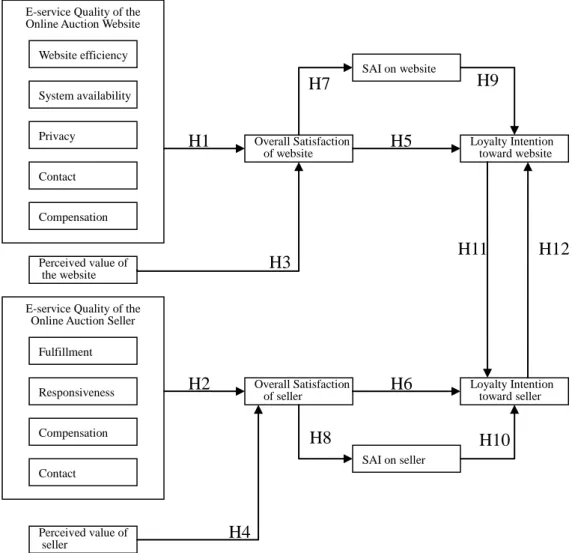
H1: The e-service quality of an online auction website will affect the overall
satisfaction of the buyer toward the online auction web site.
H2: The e-service quality of an auction seller will affect the overall
satisfaction of the buyers toward the online auction sellers.
Perceived value of the Online auction Website and Seller
As defined by Zeithaml (1988), perceived value is a consumers’ overall assessment of the utility of a product or service based on perceptions of what is
received and what is given. It is the trade-off between received benefit and cost. Therefore, perceived value of online auction websites and online auction sellers is defined as whether the online auction websites and the online auction seller offer competitive product variety, product quality, and price in the market.
Past literatures find that the influence of perceived value on loyalty will be mediated by customer overall satisfaction (Spreng, Dixon and Olshavsky 1993; Patterson and Spreng 1997; Andreassen and Lindestad 1998; Zins 2001). In efforts to conceptualize relationship among quality, satisfaction, value, and behavioral intentions, Cronin, Brady, and Hult (2000) found that perceived value had direct and positive impacts on overall satisfaction. Similarly, Patterson and Spreng (1997) found that perceived value directly affects overall satisfaction. If a buyer believes that a given auction website or seller creates higher value than alternatives, the buyer is likely to be more satisfied with the auction website or the seller (Simpson et. al. 2001). Thus:
H3: Auction buyers’ perceived value of purchasing from the online auction
website will positively affect his/her overall satisfaction toward the online auction website.
H4: Auction buyers’ perceived value of purchasing from the online auction
seller will positively affect his/her overall satisfaction toward the online auction seller.
Overall Satisfaction and Loyalty
In Oliver’s definition, loyalty is described as ―a deeply held commitment to re-buy or re-patronize a preferred product/service consistently in the future, thereby causing repetitive same-brand owner-brand purchasing, despite situational influences and marketing efforts having the potential to cause switching behavior‖ (Oliver 1997).
10
In this research, we define online auction web site and online auction seller loyalty as favorable behavioral intentions. When buyers behave loyally, they may praise the online auction web site and auction seller, express preference for the online auction web site and auction seller over others, intend to increase the volume of their purchase and so on (Zeithaml, Berry and Parasuraman 1996).
As defined, overall satisfaction of the online auction website and online auction seller is defined as a positive affective state resulting from the appraisal of all aspects of service relationship between the buyer and the online auction website and online auction seller. Satisfied consumers are more likely to repeat purchase, to resist competitive offers, and to generate positive word of mouth (Anderson and Sullivan 1993; Bolton 1998; Bolton and Lemon 1999; Cronin and Taylor 1992; Zeithaml, Berry, and Parasuraman 1996). Research in the American Customer Satisfaction Index provides additional empirical support for loyalty responses as the major consequence of consumer satisfaction (Fornell et al. 1996). Therefore we model a direct effect of overall satisfaction to loyalty intention. Thus:
H5: The overall satisfaction of an online auction website will positively affect
buyers’ loyalty intention toward the online auction web site.
H6: The s overall satisfaction of an online auction seller will positively affect
buyers’ loyalty intention toward the auction sellers.
Specific asset investment
Specific asset investment (SAI) refers to investments in assets that are dedicated to a particular transaction partner and whose redeployment entails considerable switching costs (Williamson, 1985). These idiosyncratic SAIs to support a particular exchange relationship may take different forms: they may be physical assets, monetary assets, knowledge, personal relationships, skills and so on (Williamson
1991; Chiou and Droge 2006). In our model, we have two constructs related to SAI: buyers’ specific asset investment on the online auction website and buyers’ specific asset investment on the auction sellers.
Buyers’ SAI on the online auction website refers to investments in physical or human assets that are dedicated to a particular auction website and whose redeployment entails considerable switching cost (Heide 1994; Joshi and Stump 1999). For example, buyers will lose the accumulate credit points in the website if s/he switch to other auction website. S/he also has to take time to get acquainted with flow, system, function, business process of the auction web site when switch to other online auction web site. Similarly, buyers’ SAI on the auction seller refers to investments in physical or human assets that are dedicated to a particular brand owner and whose redeployment entails considerable switching cost. For example, the buyer may need to learn the seller’s specific way of doing business with the seller and spend time getting acquainted with several different product types, functions, combinations, and suitability for occasion of the seller’s product offering; this leads to knowledge asset specificity.
SAI can be viewed as a type of switching cost (Burnham, Frels, and Mahajan 2003; Dick and Basu 1994; Hauser, Simester, and Wernerfelt 1994; Jones, Mothersbaugh, and Beatty 2000; Lee and Cunningham 2001; Lee, Lee, and Feick 2001), which points to ways a firm can engender idiosyncratic assets on the part of the buyer. A consumer’s SAI in a provider gives the provider some control over the consumer (Jap and Ganesan 2000). The most prominent B2B solution offered by transaction cost analysis to safeguard specific asset investments is vertical integration (Williamson 1985). However, unlike firms, it is very difficult for a consumer to vertically integrate the functions provided by the provider (DiMaggio and Louch
12
1998). Therefore, rational buyers will try to avoid dependency in unsatisfactory relationships by reducing the buildup of SAI. On the other hand, a buyer will increase SAI with a satisfactory online auction website or online auction seller. Therefore:
H7: Auction buyers’ overall satisfaction of the online auction website will
positively affect his/her specific asset investments on the online auction website.
H8: Auction buyers’ overall satisfaction of the auction seller will positively
affect his/her specific asset investments on the online auction seller.
Asset specificity creates dependency because considerable switching costs are involved to replace the service provider (Heide and John 1988; Joshi and Stump 1999). We propose that loyalty intention is affected by SAI since most specific asset investments are built up because of the buyer’s willingness to engage in a long-term relationship. A long-term orientation may be prerequisite to securing the rents from SAI (Williamson 1985). Therefore, asset specificity should be a direct antecedent of loyalty (Klemperer 1987; Wernerfelt 1985). Additionally, buyers may gradually perceive that SAI increase exchange efficiency (Gwinner, Gremier, and Bitner 1998; Stauss, Chojnachi and Hoffman 2001). Examples include: buyers communicating more efficiently with sellers because of human specific assets; buyers reducing buying task complexity through knowledge SAI; online auction website credit point system creating SAI through nontransferable credit points. Therefore:
H9: Auction buyers’ specific asset investments on the online auction website
will positively affect this/her loyalty intention toward the online auction website.
H10: Auction buyers’ specific asset investments on the online auction seller will
Online Auction Website Loyalty and Online Auction Seller Loyalty
The relationship between online auction websites and online auction sellers is both cooperative and competitive. They have to be cooperative to attract more buyers to visit the online auction website. However, the more buyers in the website the more bargaining power of the online auction website. The sellers may be charged more fees for listing and sales. Therefore, both the online auction website and online auction seller want to create loyalty from the buyers. If the online auction website can secure loyalty from the buyers, it will have more power in regulate the sellers in the online auction website. On the other hand, if the online auction seller can secure loyalty from the buyers, it can rely less on a specific online auction website to do business with.
Therefore it is interesting to explore the relationship between buyer’s loyalty toward online auction website and loyalty toward online auction sellers. If a buyer is loyal to an online auction website as a whole, s/he will praise the online auction web site, express preference for the online auction web site over others, and increase the volume of their purchase in the online auction website as a whole (Zeithaml, Berry and Parasuraman 1996). This will reduce the loyalty toward a specific seller in the online auction website. Therefore, it is predicted that the higher the online auction website loyalty intention the lower the online auction seller loyalty intention.
The influence of the loyalty intention of online auction seller on the loyalty intention of online auction website is predicted to be somewhat different. If a buyer is loyal to an online auction seller, s/he will praise the online auction seller, express preference for the online auction seller over others, and increase the volume of their purchase in the online auction seller (Zeithaml, Berry and Parasuraman 1996). To a buyer, however, the seller was met in the online auction website, s/he will give credits to the online auction website for attracting these good sellers into the online auction
14
website. In addition, during the searching and transaction process, the service of the online auction seller cannot be completed without the help from the online auction website. Therefore, loyalty intention toward the seller will positively affect the online auction website’s loyalty intention.
H11: Auction buyers’ loyalty intention toward the online auction website will
negatively affect this/her loyalty intention toward the online auction seller.
H12: Auction buyers’ loyalty intention toward the online auction seller will
positively affect this/her loyalty intention toward the online auction website.
Method Study Respondents
To reach online auction buyers, an Internet-based survey was employed to gather information. With the cooperation from the online auction websites, we posted an invitation letter in the discussion forums of two major online auction websites, Yahoo auction and Ruten, in Taiwan. Ruten is a joint venture between PChome Taiwan and eBay after eBay decided to withdraw from the Taiwanese market in mid 2006. Ruten auction website vowed to enable people to buy and sell at fixed price which is one of the major competitive strategies for Yahoo auction in Asia pacific and Japanese markets. In order to attract buyers and sellers into the auction website, Ruten offer free listing and transaction fee until this very moment. The online auction market in Taiwan is estimated to reach 2.4 billion USD according Marketing Intelligence Center, Taiwan.
A hyperlink that linked the respondents to the web-based questionnaire was included in the invitation letter. The respondents were guaranteed that all answers
were anonymous and about 5% of them would be randomly selected to receive a free iPod shuffle to encourage them to fill out the questionnaire. All respondents have to write down their correct email addresses for the researchers to contact them when their names are drawn from the random lottery. These email address enable us to do the double checking of questionnaire quality more precisely. To ensure that all respondents have experience of being a buyer in the online auction website, only those have purchased at least once in the past three month are included in the sample. 221 respondents completed the questionnaire successfully. Our sampling method was successful in soliciting respondents with varied personal characteristics, and the background proportion was consistent with surveys of typical online auction buyers in Taiwan. They varied in gender (female, 73.8%; male, 26.2%), age (< 18 years of age, 13.2%; 19-23 years of age, 32.6%; 24-28 years of age, 29%, 29-35 years of age, 20%, >36 years of age, 3.6%), and education (high school and below, 23.2%; university or higher 76.8%), most often used online auction website (Yahoo, 85.6; Ruten, 13.4%), and new or used product preferred (new product, 63.7%; used product, 5.8; indifferent, 30.5%).
The profile of our respondents is consistent with the recent national survey by insightxplorer Limited (http://www.insightxplorer.com) in the end of 2006. In the survey, it found that females and aged between 25 and 34 were the major buyers in the online auction website. Yahoo auction is also the major online auction website (the ever used rate is 96.8% for Yahoo auction and 22.4% for Ruten). More than 62.4 buyers prefer new products instead of used ones in the online auction website. The data also confirmed that most buyers purchase product directly from the auction website instead through auction process (direct purchase, 78.8%; auction, 21.2%).
16
Measure Development
There are two parts of the questionnaire. The first part focuses on the variables regarding the online auction website and the second part focuses on the online auction seller. The respondents were first asked their two most often used online auction websites. To increase the variances of the data, half of them answered the questions based on the most often used online auction website and the other half answered the questions based on the second most often used online auction website. In the second part of the questionnaire, the respondents were asked their two most often purchased online auction sellers. To increase the variances of the data, half of them answered the questions based on the most often used online auction seller and the other half answered the questions based on the second most often used online auction seller.
Self-administrated questionnaire were used for all measures. Where possible, established scales were used to measure the latent constructs in this study (see Table 1). Measures of service quality of online auction website and online auction seller are based on E-S-Qual and E-RecS-QUAL (Parasuraman, Zeithaml, and Malhotra 2005). As suggested by Parasuraman, Zeithaml, and Malhotra (2005), not all elements of the scale are suitable for the online auction industry. For the service quality of online auction website, only efficiency, system availability, privacy, compensation, and contact sub-dimension are included. All the questions are developed based on the original items in the scale except compensation. Since the online auction website normally provide transaction protection to compensate its buyers. We focused the compensation items on transaction protection and dispute resolution. For the online auction seller, only fulfillment, responsiveness, compensation, and contact sub-dimension are included in this study. All the questions are developed based on the original items in the scale.
The perceived value of using online auction website and online auction seller focus on the whether the website and seller have product variety and price competitiveness. Overall satisfaction was measured by three ―strongly agree (5)‖ to ―strongly disagree (1)‖ Likert scales taken from Oliver (1980). The measures of asset specificity were developed by consulting the five-point Likert scales developed by Chiou and Droge (2006), Jones et al. (2000), and Jap and Ganesan (2000). Since asset specificity is context relevant, a field pre-test was conducted to finalize the scales for the study’s context. Loyalty intention was assessed by the measures developed by proposed by Selin et al. (1988), Muncy (1983). These measures were used by Pritchard, Havitz, and Howard (1999) and were rated on a 5-point scale from strongly agree to strongly disagree.
---Table 1 about here---
Data Analysis Method
Following Anderson and Gerbing’s (1998) work, the models were tested using a two-stage structural equation model. First, we performed Confirmatory Factor Analysis (CFA) to evaluate construct validity regarding convergent and discriminant validity. In the second stage, we performed path analysis to test the research hypotheses empirically. The path-analytic procedure is becoming common in studies in which a small sample size (relative the total variables in the estimated model) restricts the use of the full structural equation model (c.f., Li and Calantone 1998; Chaudhuri and Holbrook 2001).
18
Results Measurement Model
CFAs were used to test the adequacy of the measurement model. We estimated the proposed measurement model using LISREL 8.50. The adequacy of the measurement models was evaluated on the criteria of overall fit with the data, convergent validity, discriminant validity, and reliability. The results indicate reasonable overall fits between the model and the observed data. The overall fit of measurement model wereχ 2(2008)=4119.45, p=.000, CFI=.97, NFI=.94 NNFI=.97.
NFI, NNFI and CFI exceeded the recommended .90 threshold levels (Bollen 1989; Hoyle and Panter 1995; Hu and Bentler 1995).
According to Anderson and Gerbing (1988), convergent validity can be assessed by determining whether each indicator’s estimated pattern coefficient on its proposed underlying construct is significant (greater than twice its standard error). An examination of the indicator loadings indicated that all factors loadings for individual indicator were significant. An inspection of the Cronbach’s alpha coefficients reveals that, among the eight alpha coefficients, all constructs are greater than .78 except SAI on the online auction seller (alpha =0.61), which indicates acceptable reliability (Nunnally 1978). These results provided supports for the unidimensionality of the scales.
The most common test of discriminant validity is that the confidence interval around the correlation between any two latent constructs does not include 1 (Smith and Barclay 1997). None of the correlations between latent constructs for both CFA models did reach 1. A more conservative test of discriminant validity involves comparing the values of models that either free or constrain (to a value of 1) the phi value and testing whether the constraint causes a significant decrease in fit (Bagozzi,
Yi, and Phillips 1992). Again in all cases, the overall fits of the models were significantly diminished by constraining the correlation to 1. Therefore, it is concluded that discriminant validity is adequate for the measurement model.
Having satisfied the requirement raising from the measurement issues, we subsequently tested the structural relationship using path analysis through structural equation procedure. The constructs in the path model were represented with summated scores using equally weighted scales developed from the results of the confirmatory factor analysis.
---Table 3 about here---
The Path Model and Hypothesis Testing
Table 4 present the assessment of overall model fit and the tests of research hypotheses. As shown, the results of path model indicated an adequate fit of the model: χ 2
(62)=340.43, p=.00, NFI=.97, NNFI=.94, FI=.91. NFI, NNFI and CFI exceeded the
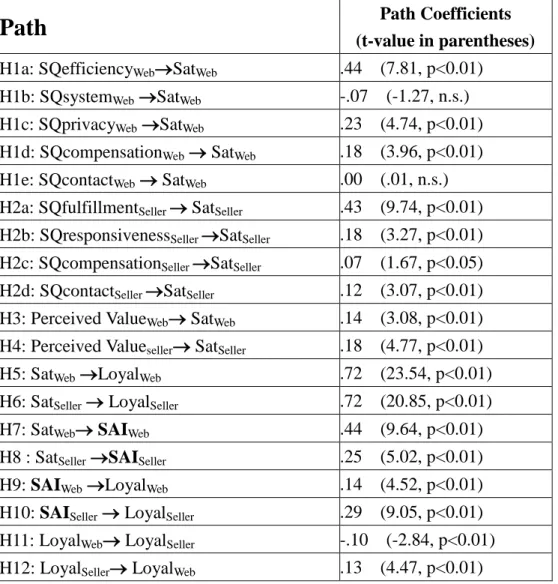
recommended .90 threshold levels (Bollen 1989; Hoyle and Panter 1995; Hu and Bentler 1995). The relationships between the constructs were examined using path coefficients in the model. The coefficients of hypothesis testing were presented in Table 2.
The relationship between e-service quality and overall satisfaction
For the online auction website, the e-service quality dimension of efficiency, privacy, and compensation were found to have significant impact on overall satisfaction of online auction website (γ= .44, p < .01; γ= .23, p < .01; γ= .18, p < .01, respectively). However, the e-service quality dimension of system availability and contact did not have significant relationship with overall satisfaction. Therefore, H1 was partially supported by the data. For the online auction seller, all measured
20
e-service quality dimensions had significant relationship with overall satisfaction (fulfillment, γ= .43, p < .01; responsiveness, γ= .18, p < .01; compensation, γ= .07, p < .05, contact, γ= .12, p < .01, respectively). Therefore, H2 was supported by the data.
The relationship between perceived value and overall satisfaction
Perceived value of purchasing at the online auction website was found to affect overall satisfaction of the online auction website significantly (γ= .14, p < .01). Similarly, perceived value of purchasing at the online auction seller was also found to have an significant relationship with the overall satisfaction of the online auction seller (γ= .18, p < .01). Therefore, h3 and H4 were supported by the data.
The relationship among overall satisfaction, SAI, and loyalty intention
Overall satisfaction of the online auction website was found to have significant relationship with loyalty intention of the online auction website (γ= .72, p < .01). Similarly, overall satisfaction of the online auction seller was found to have significant relationship with loyalty intention of the online auction seller (γ= .72, p < .01). Therefore, H5 and H6 were confirmed by the data.
Overall satisfaction of the online auction website was also found to have a significant impact on buyer’s SAI toward the online auction website (γ= .44, p < .01). Likewise, overall satisfaction of the online auction seller was found to have significant relationship with buyer’s SAI toward the online auction seller (γ= .25, p < .01). Therefore, H7 and H8 were supported by the data.
Finally, buyer’s SAI toward the online auction website was found to have a significant relationship with the loyalty intention of the online auction website (γ= .25, p < .01) and buyer’s SAI toward the online auction seller was found to have a significant relationship with the loyalty intention of the online auction seller (γ= .29,
p < .01). Therefore, H9 and H10 were supported by the data.
The relationship among overall satisfaction, SAI, and loyalty intention
The loyalty intention of online auction website was found to affect the loyalty intention of online auction seller negatively and significantly (γ= -.10, p < .01). On the other hand, the loyalty intention of online auction seller was found to affect the loyalty intention of online auction seller positively and significantly (γ= .13, p < .01). These results confirmed H11 and H12.
Discussions and Implications
The results of this study confirm that the e-service quality of the online auction website regarding efficiency, privacy, and compensation has significant impact on overall satisfaction of online auction website. In addition, the e-service quality of the online auction seller regarding fulfillment, responsiveness, compensation, and contact has significant impact on overall satisfaction of the online auction website. These results demonstrate that e-service quality is very important for securing buyer satisfaction. Both the online auction website and the online auction seller have to pay attention to various aspects of e-service quality improvement to increase buyer satisfaction.
It is also found that overall satisfaction of the online auction website and the online auction seller will not only affect the loyalty intention of the online auction website and the online auction seller, but also affect the SAI of the buyers on the online auction website and the online auction seller. SAI is found to affect loyalty intention in both the online auction website and the online auction seller. These results again exhibit the pivotal role of overall satisfaction in forming buyer loyalty intention toward the online auction website and online auction seller. Without satisfaction, buyers won’t invest specific asset on the relationship with the online auction website
22
and the online auction seller. Without satisfaction, buyers won’t show positive loyalty intention toward the online auction website and the online auction seller. Both online auction websites and online auction sellers have to provide chances for their satisfied buyers to experience more aspects of their services to create SAI with them. Buyers’ SAI on the online auction website refers to investments in physical or human assets that are dedicated to a particular auction website and whose redeployment entails considerable switching cost. The higher the SAI of the buyers, the stronger the loyalty intention.
It is interested to find that loyalty intention toward the online auction seller positively affects the loyalty intention toward the online auction website, whereas the loyalty intention toward the online auction website negatively affects the loyalty intention toward the online auction seller. These results demonstrate that the managers in the online auction website shouldn’t overreact to the strong relationship between buyers and a specific seller. The positive relationship between buyers and sellers can induce buyer’s loyalty intention toward the online auction website because it improves confidence for the buyer in the online auction website in attracting good sellers. This would induce them to use more the service provided by the online auction website. More importantly, when a buyer is loyal to an online auction website, s/he will be less likely to stick to a specific seller in the online auction website. This may provide reason why eBay enjoy ever strong competitive advantage in the US market (Aldridge 2004), while its Asian expansion has been rocky (Vara and Chao 2006). In most of these markets, eBay was a late entrant and cannot provide adapted e-service quality in the markets in the very beginning.
The results of this study provide less positive news for the online auction seller. A seller in an online auction website should be very careful in making online auction
website change decision. Although a seller can secure buyers’ loyalty intention by providing strong e-service quality, overall satisfaction and SAI, the buyers may not be very enthusiastic in moving with it to other auction website. More importantly, since sellers normally have to invest specific asset in its relationship with the online auction website such as the knowledge of using the online auction website and the accumulated credit point in the website, etc, it becomes more difficult for it to switch among different online auction website as it would wish. The decision of changing
online auction websites to sell it products should go gradually instead of at once. There are several limitations for this study. The first limitation is the
cross-sectional design employed. To provide a stronger inference, the model developed and tested here could benefit from being tested in a longitudinal design. Second, this study focuses solely on buyers’ perception on the online auction website and the seller in the website. Further research can incorporate the relationship between the seller and the online auction website to explore the interactive relationship among these three parties. Finally, our study examines the antecedents of the online auction website and the online auction seller in a single country. Although this setting allowed for control over extraneous factors, the findings may have limited generalizability to other countries. Past research has found that culture plays a significant role in Internet based e-shopping behaviors (Liao and Cheung 2001). The strength and relative importance of the proposed constructs in this study may differ by culture. More studies in other societies is needed for confirming the proposed model.
References
Aldridge, A. (2004), ―EBay is Emerging as The New Channel to Market,‖ Marketing, (August 18), 15.
24
Anderson, James C. and David W. Gerbing (1988), ―Structural Equation Modeling in Practice: A Review and Recommended Two-Step Approach,‖ Psychological Bulletin 103 (3), 411-423.
Anderson, Eugene W. and Mary W. Sullivan (1993), ―The Antecedents and Conse-quences of Customer Satisfaction for Firms,‖ Marketing Science ,12 (Spring), 125-143.
Andreassen T. W. and B. Lindestad (1998), ―Customer loyalty and complex services: The impact of corporate image on quality, customer satisfaction and loyalty for customers with varying degrees of service expertise,‖ International Journal of Service Industry Management, 9(1), 7-23.
Bagozzi, Richard P., Youjae Yi, and Lynn W. Phillips (1992). ―Assessing Construct Validity in Organizational Research,‖ Administrative Science Quarterly 36, 421-458. Bitner Mary Jo. and Amy R. Hubbert (1994), ―Encounter Satisfaction Versus Overall Satisfaction Versus Quality,‖ in Service Quality: New Directions in Theory and Practice. Eds. R. T. Rust and R.L. Oliver. Sage, Thousand Oaks, CA, 72-94.
Bollen, K. A. (1989), Structural Equations with Latent Variables. John Wiley & Son, New York.
Bolton, Ruth N. (1998), ―A Dynamic Model of the Duration of the Customer’s Relationship with a Continuous Service Provider: The Role of Satisfaction,‖ Marketing Science ,17 (1), 45-65.
Bolton, Ruth N. and Katherine N. Lemon (1999), ―A Dynamic Model of Customers’ Usage of Services: Usage as an Antecedent and Consequence of Satisfaction,‖ Journal of Marketing Research , 36(May), 171-186.
Burnham, Thomas A., Judy K. Frels, and Vijay Mahajan (2003) ―Consumer Switching Costs: A Typology, Antecedents, and Consequences.‖ Journal of the Academy of Marketing Science ,31(Spring), 109-126.
Calantone, Roger J., Jeffrey Schmidt, and X Michael Song (1996). ―Controllable Factors of New Product Success: A Cross-National Comparison,‖ Marketing Science 15, 341-358.
Cavusgil, S Tamer, and Shaoming Zou (1994). ―Marketing Strategy-Performance Relationship: An Investigation,‖ Journal of Marketing 58, 1-21.
Chaudhuri, Arjun and Morris Holbrook (2001), ―The Chain of Effects from Brand Trust and Brand Affect to Brand Performance: The Role of Brand Loyalty,‖ Journal of Marketing ,65(April), 81-93.
Chiou, Jyh-Shen, and Cornelia Droge (2006), ―Service Quality, Trust, Specific Asset Investment, and Expertise: Direct and Indirect Effects in a Satisfaction-Loyalty Framework,‖ Journal of the Academy of Marketing Science, 34(4), 613-627.
Cronin, J, M. K. Brady, and G. T. M. Hult (2000), ―Assessing the Effects of Quality, Value, and Customer Satisfaction on Consumer Behavioral Intention in Service Environments,‖ Journal of Retailing, 76, 193-218.
Cronin, J. Joseph, Jr. and Steven A. Taylor (1992), ―Measuring Service Quality: A Reexamination and Extension.‖ Journal of Marketing ,56 (July), 55-68.
Dick, Alan. S. and Kunal Basu (1994), ―Customer Loyalty: Toward an Integrated Conceptual Framework,‖ Journal of Academy of Marketing Science, 22(Summer), 99-113.
DiMaggio, Paul and Hugh Louch (1998), ―Socially Embedded Consumer Transactions: For What Kinds of Purchases Do People Most Often Use Networks?‖ American Sociological Review ,63(5), 619-637.
Doebele, Justin (2005), ―Standing Up to EBay,‖ Forbes, 175(8), 050.
Financial Times (2006), ―EBay Gets Bad Feedback from Sellers Higher Charges Raise Questions about Site’s Market Power,‖ Financial Times, (August 16), 12. Fornell, Claes , Michael D. Johnson, Eugene W. Anderson, Jaesung Cha, and Barbara Everitt Bryant (1996), ― The American Customer Satisfaction Index: Nature, Purpose, and Findings,‖ Journal of Marketing ,60 (October), 1-13.
Gefen, David (2002), ―Customer Loyalty in E-Commerce,‖ Journal of the Association for Information Systems, 3, 27-51.
Gwinner, Kevin, Dwayne Gremler, and Mary Jo Bitner (1998), ―Relational Benefits in Service Industries: The Customer’s Perspective,‖ Journal of the Academy of Marketing Science ,26 (Spring), 101-114.
Hauser, J. R., D.I. Simester, and B. Wernerfelt (1994), ―Customer Satisfaction Incentives.‖ Marketing Science ,13 (4), 327-350.
Heide, Jan B. (1994), ―Interorganizational Governance in Marketing Channels,‖ Journal of Marketing, 58(January), 71-85.
Heide, Jan B. and George John (1988), ―The Role of Dependency Balancing in Safeguarding Transaction-Specific Assets in Conventional Channel,‖ Journal of Marketing ,52 (January), 20-35.
Hoyle, Rick H. and Abigail T. Panter (1995), ―Writing About Structural Equation Modeling,‖ in Structural Equation Modeling. Ed. Rick H. Hoyle. Thousand Oaks, CA: Sage Publications, 158-176.
Hu, Li-Tze and Peter M. Bentler (1995), ―Evaluating Model Fit,‖ in Structural Equation Modeling. Ed. Rick H. Hoyle. Thousand Oaks, CA: Sage Publications, 76-99.
26
Jap, Sandy D. and Shanker Ganesan (2000), ―Control Mechanisms and the Relationship Life Cycle: Implications for Safeguarding Specific Investments and Developing Commitment,‖ Journal of Marketing Research ,37 (May), 227-245. Jones, Michael A. , David L. Mothersbaugh, and Sharon E. Beatty (2000), ―Switching Barriers and Repurchase Intentions in Services,‖ Journal of Retailing ,76 (2), 259-274.
Joshi, Ashwin W. and Rodney L. Stump (1999), ―The Contingent Effect of Specific Asset Investment on Joint Action in Manufacturer-Supplier Relationships: An Empirical Test of the Moderating Role of Reciprocal Asset Investment, Uncertainty, and Trust,‖ Journal of the Academy of Marketing Science ,27 (Summer), 291-305. Klemperer, Paul (1987), ―Markets With Consumer Switching Costs,‖ Quarterly Journal of Economics ,102 (May), 375-394.
Lee, Moonkyu and Lawrence F. Cunningham (2001), ―A Cost/Benefit Approach to Understanding Service Loyalty,‖ Journal of Service Marketing ,15 (November), 113-130.
Lee, Jonathan, Janghyuk Lee, and Lawrence Feick (2001), ―The Impact of Switching Costs on the Customer Satisfaction-Loyalty Link: Mobile Phone Service in France,‖ Journal of Service Marketing ,15 (January), 35-48.
Li, Tiger, and Roger J. Calantone (1998). ―The Impact of Market Knowledge Competence on New Product Advantage: Conceptualization and Empirical Examination,‖ Journal of Marketing 62, 13-29.
Liao, Z. and M. T. Cheung (2001), ―Internet-Based E-shopping and Consumer Attitudes: An Empirical Study,‖ Information & Management, 38, 299-306.
Loiacono, Eleanor, Richard T. Watson, and Dale Goodhue(2000), ―WebQualTM: A Web Site Quality Instrument,‖ working paper, Worcester Polytechnie Institute.
Lucking-Reiley, David, Doug Bryan, Naghi Prasad, and Daniel Reeves (2007), ―Pennies from eBay: The Determinants of Price in Online Auctions,‖ Journal of Industrial Economics, 55 (2), 223–233.
Market Intelligence Center
http://www.mic-global.net/pop/micnews4_op_new.asp?cred=2006/11/15&sno=271
Muncy, James D. (1983), ―An Investigation of Two-Dimensional Conceptualization of Brand Loyalty,‖ Ph. D. dissertation: Texas Tech University, Lubbock, TX.
Nunnally, Jum C. (1978). Psychometric Theory. 2nd ed. New York:McGraw-Hill. Oliver, Richard L . (1980), ―A Cognitive Model of the Antecedents and Consequences of Satisfaction Decisions.‖ Journal of Marketing Research 17 (November): 460-469.
--- (1997), Satisfaction: A Behavioral Perspective on the Customer. Boston: McGraw-Hill.
--- (1999), ―Whence Consumer Loyalty.‖ Journal of Marketing, 63 (Special Issue), 33-44.
Parasuraman, A. and Valarie A. Zeithaml(2002), ―Measuring and Improving Service Quality: A Literature Review and Research Agenda,‖ In Handbook of Marketing, Bart Weitz., ed. Thousand Oaks, CA: Sage.
Parasuraman, A., Valarie A. Zeithaml, and Arvind Malhotra (2005), ―A Multi-Item Scale for assessing Electronic Service Qualuty,‖ Journal of Service Research, 7(3), 213-233.
Patterson P. G. and R. A. Spreng (1997), ―Modeling the Relationship between Perceived Value, Satisfaction and Repurchase Intentions in a Business-to-business, Services Context: an Empirical Examination,‖ International Journal of Service Industry Management, 8(5), 414-434.
Price, Linda L., Eric J. Arnould, and Patrick Tierney (1995). ―Going to Extremes: Managing Service Encounters and Assessing Provider Performance,‖ Journal of Marketing 59, 83-97.
Pritchard, Mark P., Mark E. Havitz, and Dennis R. Howard (1999), ―Analyzing the Commitment-Loyalty Link in Service Contexts.‖ Journal of the Academy of Marketing Science , 27 (Summer), 333-348.
Rust, Ronald T., and R. L. Oliver (1994), Service Quality: New Directions in Theory and Practice, London: Sage.
Shankar, V., A.K. Smith, and A. Rangaswamy (2003), ―Customer Satisfaction and Loyalty in Online and Offline Environments,‖ International Journal of Research in Marketing, 20, 153-175.
Selin, Steven, Dennis R. Howard, Edward Udd, and Ted Cable (1988), ―An Analysis of Consumer Loyalty to Municipal Recreation Programs,‖ Leisure Science, 10(3), 217-223.
Simpson P.M., J.A. Siguaw, and T.L. Baker (2001), ―A Model of Value Creation - Supplier Behaviors and Their Impact on Reseller-Perceived Value,‖ Industrial Marketing Management, 30(2), 119-134.
Smith, J. Brock and Donald W. Barclay (1997), ―The Effects of Organizational Differences and Trust on the Effectiveness of Selling Partner Relationships,‖ Journal of Marketing ,61 (January), 3-21.
Song, Jung-A (2006), ―Gmarket Feels Force of Korean Shoppers The Retailer, Which is Clothing The Gap With EBay In South Korea, Wants to Try Its Success Abroad, Says Song Jung-A,‖ Financial Times, (August 22), 19.
28
Perceived Value on Satisfaction,‖ Journal of Consumer Satisfaction, Dissatisfaction and Complaining Behavior, 6, 50-55.
Stauss, Bernd, Klaus Chojnacki, and Frank Hoffmann (2001), ―Retention Effects of a Customer Club,‖ International Journal of Service Industry Management,12 (November), 7-19.
Urban, Glen, Fareena Sultan, and William Qualls (2000), ―Making Trust the Center of Your Internet Strategy,‖ Sloan Management Review, 42(Fall), 39-48.
Vara, Vauhini and Lortta Chao (2006), ―EBay Steps Back from Asia, Will Shutter China Site,‖ Wall street Journal, (December 19), A.3.
Walczak, Steven, Dawn G. Gregg, and Joy L. Berrenberg (2006), ―Marketing Decision Making for Online Auction Sellers: Profit maximization or Socialization,‖ Journal of Electronic Commerce Research, 7(4), 199-220.
Wernerfelt, Birger (1985), ―Brand Loyalty and User Skills,‖ Journal of Economic Behavior and Organization , 6(December), 381-385.
Williamson, Oliver E. (1985), The Economic Institutions of Capitalism: Firms, Markets, Relational Contracting. NY: The Free Press.
--- (1991), ―Strategizing, Economizing, and Economic Organization,‖ Strategic Management Journal ,12 (Special Issue),75-94.
Wolfinbarger, Mary and Mary C. Gilly (2003), ―e-TialQ: Dimensionalizing, Measuring and Predicting etail Quality,‖ Journal of Retailing, 79(3), 183-198.
Yoo, Boonghee and Naveen Donthu (2001), ―Developing a Scale to Measure the Perceived Quality of an Internet Shopping Site (Sitequal),‖ Quarterly Journal of Electronic Commerce, 2(1), 31-46.
Zeithaml, Valerie. A. (1988), ―Consumer Perceptions of Price, Quality, and Value:A Means-End Model and Synthesis of Evidence,‖ Journal of Marketing 52, 2-22.
Zeithaml, Valerie A., Leonard L. Berry, and A. Parasuraman (1996), ―The Behavioral Consequences of Service Quality,‖ Journal of Marketing, 60 (April), 31-46.
Zins, A. H. (2001), ―Relative Attitudes and Commitment in Customer Loyalty Models Some Experiences in The Commercial Airline Industry,‖ International Journal of Service Industry Management, 12(3), 269-294.
H12 H11 H10 H9 H8 H7 H6 H5 H4 H3 H2 H1
E-service Quality of the Online Auction Seller E-service Quality of the Online Auction Website Website efficiency System availability Privacy Contact Compensation Perceived value of the website Fulfillment Responsiveness Compensation Contact Perceived value of seller Overall Satisfaction of website Loyalty Intention toward website Overall Satisfaction of seller Loyalty Intention toward seller SAI on seller SAI on website
30 Table 1 Measurement Scale
Item Loading
(t value)
α E-Service Quality of Online Auction Website
Efficiency
This site makes it easy to find what I need. This site makes it easy to get anywhere on the site. This site enables me to complete a transaction quickly. Information at this site is well organized.
This site loads its pages fast. This site is simple to use.
This site enables me to get on to it quickly. This site is well organized.
This site’s auction system enable me to manage my auction efficiently The system of this site’s make me easy to find good priced products System Availability
This site is always available for business. This site launches and runs right away. This site does not crash.
Pages at this site do not freeze after I enter my order information. Privacy
This site protects information about my Web-shopping behavior. This site does not share my personal information with other sites. This site protects information about my credit card.
Contact
This site provides a telephone number to reach the company. This site has customer service representatives available online
This site offers the ability to speak to a live person if there is a problem. Compensation
This site helps me resolve transaction dispute when there is one. This site offers comprehensive buyer protection program This site proactively involves in solving transaction disputes.
0.72(12.07) 0.70(11.79) 0.79(13.88) 0.77(13.28) 0.71(11.81) 0.84(15.31) 0.83(15.07) 0.46( 7.10) 0.76(13.05) 0.55( 8.57) 0.88(16.12) 0.91(17.31) 0.66(10.69) 0.69(11.33) 0.87(16.22) 0.95(18.55) 0.92(17.76) 0.87(15.67) 0.75(12.57) 0.92(17.07) 0.89(16.85) 0.85(15.64) 0.97(19.32) 0.91 0.88 0.94 0.88 0.93
E-service Quality of seller in the Online Auction Website Fulfillment
The seller delivers order when promised.
The seller makes items available for delivery within a suitable time frame.
The seller quickly delivers what I order. The seller sends out the items ordered.
The seller has in stock the items the company claims to have. It is truthful about the seller’s offerings.
The seller makes accurate promises about delivery of products. Responsiveness
The seller provides me with convenient options for returning items. The seller handles product returns well.
The seller offers a meaningful guarantee.
The seller tells me what to do if my transaction is not processed. The seller takes care of problems promptly.
Compensation
The seller compensates me for problems he creates.
The seller compensates me when what I ordered doesn’t arrive on time. The seller picks up items I want to return from my home or business. Contact
The seller provides a telephone number to reach the company. The seller has customer service representatives available online. The seller offers the ability to speak to a live person if there is a
0.92(19.75) 0.95(19.11) 0.95(18.94) 0.93(18.33) 0.62(10.07) 0.90(17.35) 0.91(17.67) 0.83(15.19) 0.92(17.85) 0.89(17.02) 0.94(18.68) 0.94(18.56) 0.93(18.13) 0.88(16.47) 0.80(14.04) 0.95(18.95) 0.86(16.06) 0.96(19.13) 0.96 0.96 0.91 0.94
problem.
Perceived Value of purchasing from the Online Auction Website I can easily find price/value product from the auction website because it
carry a large pool of product varieties.
I have more seller choices because it carries a large pool of sellers. I have confidence in this website because it carries a large pool of good
credit sellers.
0.85(15.03) 0.91(16.84) 0.65(10.35)
0.84
Perceived Value of purchasing from the Seller The seller’s products are very unique.
The seller’s products is vary price competitive. The seller carries a large pool of product varieties.
0.65(10.26) 0.84(14.55) 0.74(12.37)
0.79
Overall Satisfaction of the Online Auction Website
I am happy about my decision to choose the online auction website I believe I did the right thing when I used the online auction website Overall, I am satisfied with the decision to use the online auction website
0.89(16.79) 0.93(18.17) 0.90(17.25)
0.93
Overall Satisfaction of the Online Auction Seller
I am happy about my decision to choose the online auction seller I believe I did the right thing when I used the online auction seller Overall, I am satisfied with the decision to use the online auction seller
0.97(19.88) 0.96(19.22) 0.94(18.68)
0.97
SAI on the online Auction Website
I will not be used to the interface of other website, if I switch to other online auction website.
I have to spend a lot of time to understand how to use an online auction website, if I switch to other online auction website.
I will lose the credit point of current online auction website, if I switch to other online auction website.
I don’t really care whether I should continue to use this online auction website or not. 0.75(11.43) 0.83(12.95) 0.51( 7.28) 0.20( 2.71) 0.61
SAI on the online Auction Seller
I will not be used to the transaction method, if I switch to other seller. I will lose the special treatment benefit if I switch to other seller.
I have spend a lot of efforts in evaluating whether the seller meet my needs. I have to spend a lot of time to get used to the communication style of the
seller, if I switch to other seller.
0.77(12.75) 0.74(12.06) 0.73(11.89) 0.81(13.64)
0.85
Loyalty toward the Online Auction Website
If I had to do it over again, I would choose the online auction website I try to use the online auction website because it is the best choice for me I consider myself to be a loyal patron of the online auction website
0.91(17.36) 0.90(17.10) 0.83(14.66)
0.91
Loyalty toward the Online Auction Seller
If I had to do it over again, I would choose the online auction seller I try to use the online auction seller because it is the best choice for me I consider myself to be a loyal patron of the online auction seller
0.93(18.07) 0.95(18.62) 0.73(12.51)
32
Table 2: Tests of the Hypotheses
Path
Path Coefficients(t-value in parentheses)
H1a: SQefficiencyWebSatWeb .44 (7.81, p<0.01)
H1b: SQsystemWebSatWeb -.07 (-1.27, n.s.)
H1c: SQprivacyWebSatWeb .23 (4.74, p<0.01)
H1d: SQcompensationWeb SatWeb .18 (3.96, p<0.01)
H1e: SQcontactWeb SatWeb .00 (.01, n.s.)
H2a: SQfulfillmentSeller SatSeller .43 (9.74, p<0.01)
H2b: SQresponsivenessSeller SatSeller .18 (3.27, p<0.01)
H2c: SQcompensationSeller SatSeller .07 (1.67, p<0.05)
H2d: SQcontactSeller SatSeller .12 (3.07, p<0.01)
H3: Perceived ValueWeb SatWeb .14 (3.08, p<0.01)
H4: Perceived Valueseller SatSeller .18 (4.77, p<0.01)
H5: SatWebLoyalWeb .72 (23.54, p<0.01)
H6: SatSeller LoyalSeller .72 (20.85, p<0.01)
H7: SatWeb SAIWeb .44 (9.64, p<0.01)
H8 : SatSellerSAISeller .25 (5.02, p<0.01)
H9: SAIWeb LoyalWeb .14 (4.52, p<0.01)
H10: SAISeller LoyalSeller .29 (9.05, p<0.01)
H11: LoyalWeb LoyalSeller -.10 (-2.84, p<0.01)
行政院國家科學委員會補助國內專家學者出席國際學術會議報告
報 告 人 姓 名邱志聖
服務機構 及 職 稱國立政治大學國際貿易系教授兼
系主任
時間 會議 地點July 11-14, 2007
Verona, ITALY
本會核定 補助文號電子行銷典範-子計畫二:網路拍
賣的拍賣制度設計與顧客忠誠之
研究(3/3)
會 議 名 稱(中文) 2007 年世界行銷跨年會
(英文)2007 World Marketing Congress
發表論文題目