行政院國家科學委員會專題研究計畫 成果報告
建立居家生活脈絡與產品使用行為的關係模式(II)
研究成果報告(精簡版)
計 畫 類 別 : 個別型
計 畫 編 號 : NSC 97-2221-E-009-096-
執 行 期 間 : 97 年 08 月 01 日至 98 年 10 月 31 日
執 行 單 位 : 國立交通大學應用藝術研究所
計 畫 主 持 人 : 鄧怡莘
報 告 附 件 : 出席國際會議研究心得報告及發表論文
處 理 方 式 : 本計畫可公開查詢
中 華 民 國 99 年 01 月 28 日
行政院國家科學委員會補助專題研究計畫成果報告
建立居家生活脈絡與產品使用行為的關係模式(II)
計畫類別:■個別型計畫 □整合型計畫
計畫編號:NSC-97-2221-E-009-096
執行期間:97 年 08 月 01 日 至 98 年 10 月 31 日
計畫主持人:鄧怡莘副教授 國立交通大學應用藝術研究所
共同主持人:游曉貞助理教授 國立臺中技術學院多媒體設計系
計畫參與人員:黃可薰、周雨虹、陳炫劭
執行單位:交通大學應用藝術研究所
中
華
民
國
9 8
年
1 0
月
2 6
日
1
行政院國家科學委員會專題研究計畫成果報告
建立居家生活脈絡與產品使用行為的關係模式(II)
Modeling the Relationships between Context of Use and
Behavior Pattern in Domestic Environment (II)
計 畫 編 號 :NSC 97-2221-E-009-096
執 行 期 限 :97 年 08 月 01 日至 98 年 10 月 31 日
主
持
人:鄧怡莘副教授 國立交通大學應用藝術研究所
共 同 主 持 人:游曉貞助理教授 國立臺中技術學院多媒體設計系
計畫參與人員:黃可薰、周雨虹、陳炫劭
一、中文摘要
隨著近年新技術與新產品開發的蓬勃發展,
遍佈運算的各項應用已在我們日常居家生活中成
為必須且隨處可見的。當這些遍佈運算的產品逐
漸我們的日常生活中普及並扮演重要的角色時,
我們需要對產品在居家生活脈絡中的使用行為,
以及其所牽涉的層面做進一步的了解,作為未來
企圖以家庭為研究與設計場域時設計與研究團隊
能有分析的基礎,幫助設計師做出產品的規劃。
本計畫第一年首先針對使用者在居家中生活
使用產品與行為活動脈絡進行其行為模式的研究
與建構,第二年則進一步探討當人造物介入其生
活脈絡後,人們與人、裝置、環境等因素所衍生
的互動及行為方式改變,透過前後活動模型的建
構,分析並歸納在產品介入居家生活的情況下,
使用行為所產生的變化因素與狀況。期望對於未
來當新技術導入生活中時提供具體的知識和參考
的基礎。
關鍵詞:居家生活脈絡;產品使用脈絡;使用行
為模式;分析模式建構
Abstract
According to the flourishing technology and the
well-developed product, the applications of
Ubiquitous Computing have applied in our domestic
environment. Based on field study, this research
aims at developing an analytical model for studying
context of use and user behavior in the domestic
environment. In the first year of this study,
contextual inquiry conducted to gather the general
factors of behavior patterns and the attitudes of
family members when they interact with artifacts
and other people in their daily life. In the second
year, we observe the difference of user’s activity,
interaction and the user behavior after the
intervention of artifact for building and analyzing the
reasons and factors behind. An analytical model of
users context and user behavior was formulated to
facilitate the investigation of new technology and
design in other field in the future.
Keywords: domestic environment, contextual
inquiry, behavior patterns, analytical model
二、前言
隨著科技進步與發展,電腦普遍進入我們的
日常生活中,人們與資訊產品互動時間越來越
長,這些產品並漸漸扮演著我們生活中不可或缺
的 角 色 。 現 今 人 機 互 動 ( Human-Computer
Interaction, HCI)的研究開始轉向從使用者的
角度,運用社會科學及人類學的研究方法,檢視
使用者在生活中使用資訊產品的真實樣貌,使資
2
訊產品設計之初即考量如何適切的融入使用者的
生活之中。
當資訊業者企圖將各式運算能力以遍佈運算
應用投入家庭場域時,我們必須更為關注使用者
在場域中的活動與使用脈絡,進行觀察與分析,
了解使用者在活動中運用的方式,以及其功能與
角色。本研究延續計畫第一年針對家庭中產品的
使用與活動脈絡進行其行為模式的研究與建構進
行,設計簡單的人造物並置入其生活脈絡中,觀
察人們的活動、他們與周遭人、機、環境的互動
以及行為方式的改變,並且透過分析在脈絡中,
使用者與產品的互動與活動模型,深入了解涉入
前後是否有變化,歸納比較在產品介入居家生活
的情況下,整理討論影響使用者可能產生變化的
因素與狀況。這個結果分析了居家環境中某些活
動下使用者是如何調整與改變產品功能結構的分
析框架與模式,幫助研究人員瞭解居家環境中,
人們使用產品的行為模式與生活脈絡的關係。
三、研究目的
使用者產品互動時,往往依據行為目的而對
這些產品的功能加以取捨運用,因為某些需求而
調整產品的功能或加以做組合運用滿足活動的需
求,這個活動進行的時空條件就是產品使用的脈
絡(context)。在使用脈絡下,使用者才是產品
功能的定義者,活動本身才是使用者關心的重點
而不是工具本身。探討使用者進行的活動、以及
使用者如何在這個活動中運用不同產品功能,有
助於規劃以活動為中心的產品設計,以及規劃該
產品可能互動的行為。
分析居家生活脈絡、產品使用脈絡以及產品
使用行為,特別是以使用者從事的活動為基礎,
分析在特定活動下使用者對功能的需求,有助於
設計師思考未來遍佈運算進入家庭後所帶來的人
機互動問題、安排更適切的互動設計,並更進一
步地為使用者設身處地設想使用情境。此外,透
過深刻的瞭解使用者使用脈絡也能幫助設計師與
系統開發者盡可能地以生活脈絡為導向,將科技
適切地導入使用者的日常生活之中。本研究的目
的即為瞭解使用者在居家生活脈絡中的活動,並
建立生活脈絡與產品使用行為的關係描述模式,
進一步將活動的研究與分析用以探究如何適切地
將資訊產品融入使用者的日常生活中,幫助產品
設計師,特別是居家環境中遍佈運算的系統設計
師們做產品功能的規劃與應用。
三、文獻探討
McCullough 曾撰文探討脈絡與特定場域的相
關性[2]。也就是產品的使用脈絡會依照不同的場
域而有特定的樣貌。我們鎖定了家庭或居家環境
生活中使用者的產品使用脈絡作為一種特定的研
究對象,即已將之視為一種特定的生活脈絡來探
討。
Venkatesh 教授所主持的諾亞計畫(NOAH
Project)是第一個長期針對家庭運算科技進行實
地調查分析的專案,從80 年代中期即調查美國一
般家庭的電腦使用情況直至2002 年計畫結束,至
今仍持續關注居家科技的相關議題[5]。他於一九
八五年提出了一個說明居家科技結構的理論模
式,在這個模式之中他將居家科技結構區分成社
會空間(Social)、活動空間(Activity)以及科技
空間
(Technology)三種。這三種空間彼此交互作
用,而身處於居家的科技空間之中的工業產品
對家庭成員也帶來了許多影響,其中包含了工具
性對比情感性的影響、工作導向對比娛樂導向的
影響、積極與消極的影響、單一功能與多
功能的提供以及社會衝擊的強弱等面相。然而,
若要深入探討產品使用脈絡與社會脈絡的關係,
科技空間中的社會衝擊則有再繼續深入研究探討
的必要。
Harper 等人從比較微觀的角度探討家庭內
藉由人造物的流通所帶來的社會連結,企圖瞭解
每一特定人造物對社會連結的影響[4]。他們運用
人誌學的方法,探討傳統紙本郵件與家庭中社會
組織的關係,藉以提出未來發展家庭中電子郵件
工具的依據。
Crabtree 等人針對家庭中溝通的例行性
活動發生區域進行民族誌調查,找出家庭中因
為不同溝通活動、房間的擺設與規劃、活動進
行的方式所聚落起來的區塊,將活動、家人之
間的互動以及家庭溝通媒體的分佈區之間的
3
互動集散地分成Ecological habitats, Activity
centers, Coordinate displays 三種區域[2]。
這些區域是由於行動者所採取的行動與建築空
間、物品擺設的交互作用所產生的行動累積效
果。除了居家內部的結構探討,有些學者也關注
居家場域透過科技的力量與外部社會結構連結的
現況,說明居家科技輔助、增進或增生家庭外部
社會組織結構的連結的現象。也說明了家庭生活
脈絡與其他社會組織所形成的社會文化脈絡,某
些部分亦因為科技的導入而產生新的社會結構
[3]。
生活脈絡、產品使用脈絡以及人們使用產品
的行為模式的交互作用下會影響科技的採用以及
科技串連不同的空間的形式。生活脈絡之中包含
了文化面、科技面、空間面、活動面以及角色面
等。而產品身處在科技空間或者物質空間,扮演
了媒介或延伸家庭成員進出社會空間以及活動空
間的多重角色。
四、研究方法
在第一年的計畫中,研究以受訪者的客廳作
為探索場域,藉由日誌、探針紀錄與脈絡訪查的
進行,深入了解他們在客廳中發生某些活動中,
生活脈絡與產品使用行為的組成因素,建構並整
理出他們生活使用產品與活動的行為模式(圖一
至四)。以此成果為基礎,在第二年計畫中,我們
想進一步瞭解人們在科技的影響下所造成的新型
態的活動方式與結構的改變模式。
圖一、年長者居家生活之溝通脈絡 圖二、年長者溝通行為所使用之聯絡資訊 圖三、年長者通訊活動場域 圖四、影響年長者溝通行為之文化背景本研究針對年紀54歲以上擁有不同生活型態
的年長者在居家環境生活中溝通與社交活動的脈
絡,為了觀察其媒體的使用互動與行為,研究依
照他們的生活脈絡,在活動場域中置入人造物
(artifact)後,觀察其生活型態的改變。
4
脈絡訪查(contextual inquiry)
研究分為兩個階段進行。第一階段首先就參
與者分別進行脈絡訪查,核心議題包括年長者生
活型態與背景、習慣聯絡對象與聯絡動機、使用
溝通媒體項目以及溝通媒體之使用狀況等問題。
脈絡訪查法本身即考慮了五種層面的議題:文化
影響面、空間影響面、角色關係面、生活痕跡面、
行動程序面[1]。雖然脈絡分析當初開發出來目的
是作為研究工作空間的脈絡,並沒有針對其他場
域。但是不辯自明地這五個層面在不同生活脈絡
中都確實存在,因此運用脈絡分析的方法可以協
助理解本研究所關注的居家生活脈絡。
針對想要研究的社交溝通的工具行為使用,我
們分別進行各組受訪家庭之年長者居家社交行為
與溝通之工作模式建立以及訪談分析,建立整合
各個層面的工作模式(work model),以呈現溝
通行為所牽涉的對象、溝通媒體、使用流程、使
用環境、相關之溝通物件以及影響溝通行為之各
種因素(圖五)。
圖五、分析影響年長者溝通行為之各層面因素居家溝通模式人造物探測
瞭解分析參與者的這些使用條件與因素後,
在他們既有的脈絡下,我們分別規劃了三種類型
的人造物於他們的生活中。針對僅使用手機進行
撥打的參與者,我們設計了與朋友、家人等問候
罐頭簡訊並指導他們使用;針對不會使用電話的
參與者,投入已經填寫好住址的心情明信片,指
導他們在想與親友聯繫時委託鄰居寄送;針對使
用網路的參與者,指導他們使用即時通訊軟體
等。在投入人造物後四個月中,經由提醒與刺激
鼓勵他們使用(圖六)。
圖六、三種類型人造物,由上而下罐頭簡訊、心情明信片、 即時通訊軟體投入人造物四個月後,我們隨即進行第二階段
的脈絡訪查。核心議題除了瞭解參與者對於人造
物的使用情形外,觀察其生活脈絡的型態是否產
生我們原先預期的使用變化,包括經過這段時間
後,環境、物件以及對象的溝通行為的狀態等等。
我們將結果建構成工作模式呈現,並與第一階段
的訪查建立的工作模式分析與比較討論(圖七)。
5
圖七、年長者通訊脈絡預測情況與實際變化五、研究發現
經由人造物置入的探索,以及兩個階段脈絡
訪查的進行,針對年長者居家生活的溝通狀況建
立工作模式(圖八)並做出分析比較後,統整歸
納出以下發現,結果如下表。
使用者 預期中變化 未預期之實際變化 U1 1. 願 意 使 用 簡 訊 1. 因簡訊轉寄功能附 加其他資訊不敢傳 送 2. 因女兒出國而開始 使用網路電話及視 訊 3. 使用書寫輸入方式 克服不會注音 U2 1. 主 動 邀 請 好 友加入 MSN 2. 放 棄 資 訊 背 誦記憶 3. 資 料 經 由 電 腦彙整 1. 使用 e-mail 發送資 訊 2. 改變群組分類方式 3. 公司禁止上班使用 MSN 等通訊軟體 4. 將資訊列印出來 U3 1. 能 透 過 簡 訊 向 家 人 傳 達 心理需求 1. 看護使用手機簡訊 2. 看護篩選訊息接收 人 3. 明 信 片 選 擇 性 有 限,無法表達情況 4. 明信片投遞困難 U4 1. 願 意 使 用 簡 訊 1. 簡訊操作步驟繁複 2. 習慣以電話聯絡親 友並寒暄 U5 1. 抗 拒 新 工 具 的使用 2. 親 友 開 始 傳 送簡訊 1. 簡訊只讀不發送 2. 不主動回應訊息比較五個受測的使用者在接觸使用人造物後
通訊行為脈絡預測的變化部分,探討預測其中改
變及實際改變項目與其原因:
圖八、年長者原先通訊與投入人造物後資訊互動關 係變化對照符合預期的脈絡變化
符合預測的脈絡變化可分為 1.生活工具的演
化、2.生活習慣與背景的改變、3.對身邊親友的
影響等三個方面。分別說明如下:
1.生活工具的演化:帶給使用者更加便利的使用
模式,如 U2 由於使用電腦後便不需再以背誦方式
記憶資訊;U3 也因為新工具得以表達心理上的需
求,不需等到會面時才傳達訊息。
2.生活習慣與背景的改變:則像是 U5 對學習新工
具時較其他使用者有許多主觀的意見,亦提及自
己對於使用簡訊的疑慮,因此即使學會閱讀簡
訊,也不主動予以回覆。U1 與 U5 在了解使用操作
簡訊後,考量到收訊者的使用能力與安全性,即
便自己學會了使用這樣的工具,也不願意讓親友
在使用上有任何的疑慮,寧可選擇較為保守或簡
單的工具聯繫。
3.對身邊親友的影響:新的工具除了改變使用者
本身,連帶的也影響周遭的人,U2 因為使用 MSN
的關係,極力邀請身邊友人一起加入使用,U5 也
因訪談測試中幫他發佈了群組簡訊,對方認為可
以使用簡訊溝通,使得親友有時會以簡訊問候,
讓他們除了電話之外,還讓親友多了簡訊與他們
的問候或聯繫的機會。
非預期的脈絡變化
比較兩階段的資料,歸納出年長者不同於預
測的因素有下列六個方面:1.環境限制、2.操作
能力、3.工具特性、4.生活需求、5.個人習慣、
6.親友影響。
1.環境限制:U2 與 U3 分別因為工作環境禁止使用
即時通訊軟體,以及看護無法抽身投遞明信片而
6
放棄使用新工具。
2.操作能力:工具操作的問題也影響使用的使用
意願,如 U4 由於手機本身的操作簡訊的方式過於
繁複;U2 則是打字速度太慢而改以 e-mail 方式取
代 MSN 即時通訊。
3.工具特性:工具的改變,其中可分為新工具的
「便利」以及「使用上的分群」
,U3 即是由於簡訊
的即時性及便利性而增加與親人交流的機會;U1
藉由手寫板與視訊克服不會使用注音輸入的問題
而開始使用電腦通訊;而分群指的是如 U2 與 U3
使用 e-mail 與簡訊後所連繫的對象變為使用同樣
工具的人。
4.生活需求:生活需求影響了人們使用工具的方
式,U2 使用 e-mail 分享新奇的事物,而由於朋友
喜好不同影響她改變信箱朋友群組的方式。原先
群組朋友以「場域分群」的概念,改以「共同興
趣的朋友」作群組分類;而平時茶敘時經常會分
享新鮮話題,所以使用者仍保留將資訊列印出來
的習慣;我們對 U3 所投入的明信片選項無法完全
貼近她的需求,降低使用者的使用意願。
5. 個人習慣:個人的性格與溝通習性也影響使用
方式;在「個人習慣」方面 U4 因為個性開朗,喜
歡聊天,所以放棄群組的簡訊傳送而選擇一對一
的電話通訊可以達到連絡的目的還可以寒暄,較
為親切;而 U5 因為脾氣較剛硬,不善與人交流,
即使收到對方的簡訊也不會回應,所以訊息通常
是單向接收的。
6.親友影響:資料中有一項較為特別的,原本投
入 U1 的工具為簡訊,但因為女兒出國而想與她保
持連絡,所以學習使用視訊與即時通訊軟體。在
其他的使用者中也因為我們投入的新工具,簡
訊、MSN、e-mail 等而改變周遭親友的通訊模式。
六、結論
此階段研究中我們歸納了幾個使用者在選擇
使用工具功能的重點:1.外在限制 2.心理與習慣
3.生活貼合度。
使用者因為周遭的環境無法預期與掌握,他
們會因為工作或生活場域無法配合而放棄使用;
也會依聯絡的對象不同選擇工具甚至嘗試學習全
新的工具,如親友出國促使其使用網路視訊;同
時因為連絡對象類型的不同設立不同群組模式的
連絡圈,例如依照工作場域、興趣嗜好、所在群
體等等。
參與者本身的個性與使用習慣造成選擇工具
使用方式的條件,喜好與人互動的使用者寧願選
擇慢慢的逐一打電話勝過有效率的廣播通知;也
會因為生活中長久的生活型態而不願改變原本的
使用模式,因為每天聚會需要而堅持除了把資訊
以 e-mail 發送外也列印出來。
工具是否有貼近生活也是影響使用者選擇的
一大要因,打字對年長者來說是一個很大的阻
力,同時也為此抗拒使用簡訊以及電腦,但是若
以視訊、語音、手寫等較貼合生活的動作為媒介,
亦能使他們有學習使用的動力。聯繫通訊的對象
亦是影響使用動力的很大角色,在某些目的使用
下,他們必須進行工具的學習使用,目的與使用
對象很容易輔助他們衍生最初的使用方式,原本
定期的連絡交流也會因為工具的便利而轉變為頻
繁,同時話題也不再僅止於具體的「要緊事」而
衍伸至一般的話家常。
新工具的使用對於使用者而言不只是一個媒
介,從中可以推測出他們的個性與生活型態;當
然更要與他們的生活需求息息相關。年長者需要
的不是功能強大的溝通工具,而是以原本習性為
出發點考量、不侷限在特定平台與領域、亦不試
圖區隔使用族群、可以涵蓋他們的朋友與環境。
幫助他們生活中有便利有效的工具輔助操作,衍
伸出沿著他們生活需求的使用脈絡。
七、參考文獻
[1] Beyer, H. and Holtzblatt, K. (1997), Contextual
Design : A Customer-Centered Approach to Systems
Designs, Morgan Kaufman Publishers
[2] Crabtree, A. and Rodden, T. (2004) Domestic
Routines and Design for the Home. Computer
Supported Cooperative Work: The Journal of
Collaborative Computing, vol. 13 (2)
[3] Frohlich, D. and Kraut, R., (2002), The Social
Context of Home Computing, in R. Harper (Ed.),
Inside the smart home, London: Springer-Verlag. pp
127-162.
[4] Harper, R., Evergeti, V., Hamill, L., and Shatwell,
B., (2003), The Social Organisation of
7
Communication in the Home of the Twenty-First
Century: an Analysis of the Future of Paper-Mail
and Implications for the Design of Electronic
Alternatives, Cognition, Technology, and Work,
vol.5, pp 15-22.
[5] O’Brien, J., Rodden, T., Rouncefield, M.,
Hughes, J.,
(1999) At Home with the Technology: an
Ethnographic Study of a Set-top-box Trial. ACM
Transactions on Computer-HumanInteraction 6(3)
pp 282-308
表 Y04
行政院國家科學委員會補助國內專家學者出席國際學術會議報告
年 月 日
報告人姓名
鄧怡莘
服務機構
及職稱
國立交通大學應用藝術研究所
時間
會議
地點
2009/6/24~2009/6/26
法國/巴黎
本會核定
補助文號
NSC 97-2221-E-009 -096
會議
名稱
(中文) 世界藝術人文與社會科學會議
(英文) World Congress on Arts, Humanities and Social Sciences
發表
論文
題目
(中文) CrazyVote 網路組團現象--線上社群與真實生活中社會互動模糊
的分野
(英文) Clubs Forming on CrazyVote - The Blurred Social Boundary
between Online Communities and the Real World
(中文) 以勸誘科技影響並改變人的永續觀念
(英文) Influencing attitude change for sustainability through
persuasion
(中文) 以設計而達成的共體驗
表 Y04
報告內容包括下列各項:
一、 參加會議經過
The World Congress on Arts, Humanities and Social Sciences 研討會,試著將跨領
域的研究與觀點提供一個互相交流的平台,參與者包含了世界各國的研究者、科學
家與工程師、學者,讓人文與科技能夠有機會彼此分享經驗和新概念,以及這些不
同領域的近期研究成果,特別是讓人文和社會科學的關注帶到資訊科技領域中。
主辦單位 WASET(World Academy of Science, Engineering and Technology,世界科
學、工程與技術學會)
,是一組織龐大的國際科技與工程學會,每年固定於世界各國
舉行不同主題的研討會,讓各國學界的工程與技術能彼此分享其概念與發展成果。
而今年於巴黎所舉行的世界藝術人文與社會科學會議,更特別將人文與藝術作為核
心議題,並加入了社會科學與文化上的設計思維,以擴充目前科技與工程技術可能
發展的面向之深度廣度。
本會議所包含的討論的議題有以下幾個類別(由於內容繁多以下例舉)
:
一、電機工程與資訊技術
電子工程、電力與控制: Retention Pond, FPGA, Induction motor, PSIM,
Voltage Controller, Hydraulic Machine, Hydro Electric Dam, EIA, ICOLD,
Propulsion Mechanism, Elastic Wing, Field-oriented Control, Solar Power
Generation, Voltage Drop, Cogeneration, PWM Inverter, Induction Motor,
Fluid Force, MOSFET, Capacitance, High Field Stress, Charged Defects,
ECG, Heart Rate Variability, Low Voltage Network, RR-inervals, etc.
環境工程:Factor Analysis, Garden City, Green Belt, Green City, Green
Space Forests, Natural Resources, Pastures, Population, etc.
運輸:Sustainable Transport, Mobility Management (MM), Land Use
Planning (LUP), Innovative U-turn Facility, Microsimulation, Travel Time,
Unconventional Intersection Design, etc.
行動通訊:Mobile Agent, Mobile Computing, Partial Connection, etc.
二、資訊科技
訊號分析:Digital Signal Filtering, Machining Monitoring, Noise
Cancelling, Sound.
人工智慧:Artificial Intelligence, etc.
資訊系統:System crashes, Hardware, Software, Security. Technology,
Technological evaluation, Technology Maturity, Info-Works RS, etc.
多媒體(影像辨識、資料加密與壓縮等):Finite Element Geometries, Data
Fitting (head muscles\facial animation), Hash Function, Cryptography,
Block Cipher, Message, Compression, Encoding, Tampering detection,
Watermark Detector, Watermark Embedder, Watermark Message, etc.
認知與資訊設計:Cognitive Dissonance, Cognitive Psychology,
表 Y04
三、網際網路
網路工程與資料探勘:Non-linearity Internet, Networks, Process Mining,
Process Similarity, Process Conformance, Neural network ensemble,
24-Hour Forecasting, Comparative study, Multi-unit auctions, Asymmetry
of Information, Discriminatory Auctions, distributed generation,
Reliability Indices, Data Analysis, Information, Communications
Technologies, Expertise´Levels.
電子商務:Globalisation, ICTs, ICT Policy, Market return, Trading
Volume, Access Management, Traffic Flow& Efficiency, Market Structure,
Performance, Banking
網路行為:Hypertext reading, Herding Behavior, Prescription Behavior,
Rational Prescription Thinking, Prescription Method, Virtual
Environments, Second Life, Instructional Strategies and Technology,
Contextual Inquiry Research Methods, etc.
四、人文與社會議題
教育:Illiteracy, Out of school, School Dropout Rate, Socioeconomic
Determinants, Scholarly Communication, Collaboration, Knowledge,
Classroom.
多元文化:Disciplinary Culture, Networked Information of Arab World,
Cross Culture.
政治與 e-Government 議題:Hobbes, Eloquence, Opinion, Science Policy,
Civil Obedience, Politics, Liberalism, Ideological Control.
社會互動議題:Social Computing, Social Interactions,
設計:User-centered Design.
其他:Anaerobic Oxidation, Microbial Fuel Cell.
6/24 前往大會報到,完成現場註冊、領取論文集、光碟和場次表。
6/25 參與學生的論文口頭發表過程;並參加多個場次的埨文發表
二、 與會心得
本次研討會所來自各國的學者非常多,在參與的過程中,有相當多的機會與不
同國家的學者進行交流與討論,尤其以往較少接觸的中東、亞洲,以及北歐等地的
學者。此外,除了有本所學生們三篇不同主題的報告,另外於會場也遇到來自於台
灣的環保署、成功大學、逢甲大學、屏東科技大學等學生,能知道國內外各領與所
關注的核心議題以及科技發展面向,實為一非常難能可貴之經驗。
研討會時間為期三天,6 月 24 日至 26 日,其中有逾百篇來各個領域的研究發
表,內容之寬廣與以往所參與過的研討會相當不同,綜合了電機工程領域、網際網
路與資訊科技、以及人文社會與設計研究議題。有機會分享與了解不同領域現階段
的技術,對於日後在學術思考的廣度上相信會有一定的幫助。
然而這次研討會的主辦單位,於發表的論文議題上並沒有做最完善的考量,在
同一會議場次中可能綜合了非常不同領域的研究報告,因為發表者的領域差異性過
表 Y04
大,也使得各學者發表後討論時間問題的深度受到限制,也使得聽眾難以選取某特
定議題的場次來參與。除此之外,所分配的口頭報告時間也因為各場次的主持人而
有所不同,亦即並非所有的發表者都能享有同樣的時間,由於這種時間安排上的鬆
散,想旁聽的與會者也沒有機會掌握想聽的論文發表時間。在會議期間亦發現,部
分主持人是於報到當天方才獲得自己所主持場次的所有論文之資料,這使得許多主
持人難以介紹和掌握場次的研究內容,這些缺失是該學會於法國的主辦單位應當檢
討的部份。
三、 建議
綜觀此研討會,與會的研究學者眾多,並來自於不同文化、國家,的確提供各
國學者有良好的機會理解和認識他國的研究方法和思潮。然而由於研討會的議題過
於寬廣,使發表之論文也相對的龐雜、繁複,並使得參與者不易安排適當的參與議
程。另外一明顯的特徵是,亞洲的參與者,尤其是台灣,較沒有勇氣於會議中參與
討論、發表自己的想法和意見,這使得學術交流的機會大為減少。在發表後的討論
過程中,能更深刻的感受到來自歐美以及印度、中亞的學者,就算所屬的領域與發
表論文議題不盡相同,也會對於發表者的研究方法、過程內容,提出適當的疑問和
建議、鼓勵,我想這是所有參與研討會的人最希望獲得的經驗分享,也是最有價值
的地方。或許台灣在未來教育學子的過程中,應當更鼓勵學子勇於發問、參與課堂
討論。
四、 攜回資料名稱與內容
1. 研討會之論文集,部分之書刊(該研討會將相關的論文以二十篇左右為一單位印
製,因此只獲得收錄自己發表論文之部分論文集)
。
2. 研討會之論文集,完整 CD。
五、
其他
World Academy of Science, Engineering and Technology 54 2009
659
Abstract—With the rapid growth and development of information and communication technology, the Internet has played a definite and irreplaceable role in people’s social lives in Taiwan like in other countries. In July 2008, on a general social website, an unexpected phenomenon was noticed – that there were more than one hundred users who started forming clubs voluntarily and having face-to-face gatherings for specific purposes. In this study, it’s argued whether or not teenagers’ social contact on the Internet is involved in their life context, and tried to reveal the teenagers’ social preferences, values, and needs, which merge with and influence teenagers’ social activities. Therefore, the study conducts multiple user experience research methods, which include practical observations and qualitative analysis by contextual inquiries and in-depth interviews. Based on the findings, several design implications for software related to social interactions and cultural inheritance are offered. It is concluded that the inherent values of a social behaviors might be a key issue in developing computer-mediated communication or interaction designs in the future.
Keywords—Social Computing, Social Interaction, User-centered Design, Contextual Inquiry.
I. INTRODUCTION
N account of the rapid expansion and improvement of information and communication technology, the Internet has played an irreplaceable and dominative role in online users’ social lives in Taiwan like in other countries. The accessibility to various emerging communication media has changed not only online users’ living contexts but also their interpersonal relationships. These developing technology applications both support new platforms for communication and offer numerous possibilities for an unprecedented increase in social interactions. There are now a variety of new social communities, virtual and physical [1][2].
In the past twenty years, information technology applications have been developed and redesigned for different purposes. Some unexpected forms of social interaction and other side effects have emerged which have slowly been adapted and K. H. Huang is with the Institute of Applied Arts, National Chiao Tung University, Hsinchu, Taiwan. (corresponding author to provide phone: 886-3-571-2121; fax: 886-3-571-2332; e-mail: [email protected]).
H. C. You is with the Department of Multimedia Design, National Taichung Institute of Technology, 129, San Min Road Section 3, Taichung 404, Taiwan (e-mail: [email protected]).
Y. S. Deng is with the Institute of Applied Arts, National Chiao Tung University, Hsinchu, Taiwan. (e-mail: [email protected] ).
incorporated into people’s lives [2][4]. For instance, the main functions supported by weblog have changed from traditional information disclosure to information sharing and exchanging. Besides, the development of community diaries and collaborative blogging present evidence of rich sociality and communicative competence [5]. In fact, personal on-line diaries not only serve as a means to record one’s experiences and express one’s emotions, but consequently also reflect one’s attitudes and expectations toward society as a whole and in relation to one’s cultural context [6][7].
In the related research fields of HCI and CSCW, it has become of great importance to comprehend the complex social interactions that take place in a real context in the online communities [8][9]. The extensive discussions of web 2.0, social software and social computing, also focus on the relationship of technology, interpersonal contact, and social communities. Individual social attitudes also rely heavily on one’s social context and cultural background [10][11]. Hence, the fundamental issues of technology media or online application development have extended from general usability problems to wider social aspects of interpersonal contact, information sharing, participation and culturally inherent needs [12]-[15].
In this study, it is fully explored that the teenagers’ social activities on the Internet are inherently embedded in their real life context. Therefore, a case study of unexpected phenomenon on a social website, teenagers’ voluntarily club forming, is presented. The study applies user experience research methods, which include practical observations and qualitative analysis by contextual inquiries and in-depth interviews [16]-[18]. These methods could reveal different characteristics of personal perceptions, values and requirements in relation to the overall social context. Additionally, the potential design implications for social interactions based on the findings are also addressed.
A. Teenagers’ Lifestyle in Taiwan
In Taiwan, the children are expected to study hard since they get into a primary school. Then teenagers in junior or senior high schools even study harder. They have to study from 7a.m. to 5p.m. at school Monday through Friday. If they are lucky at school which allows its students to take an hour a week to join extracurricular activities, they must be in very high spirit. However, the chance is very slim especially for senior high
Clubs Forming on CrazyVote -
The Blurred Social Boundary between Online
Communities and the Real World
Ko-Hsun Huang, Hsiao-Chen You, and Yi-Shin Deng
World Academy of Science, Engineering and Technology 54 2009
660 school students because a senior high school takes it a responsibility to help its students prepare themselves for getting into a university with a fine reputation. Matter-of-factly, senior high school students are under the academic competition pressure and for them university education is a top priority. After school, most parents also spend extra money sending their children to a cram school to learn more. Due to the tight schedule, making friends for them is to find friends from their classmates. However, there is no room for teenagers to have social activities with others.
The only fun the teenagers might have is to get on the Internet to surf the websites if they can steal some time at home after the long-hours studying. No doubt the majority of the teenagers in Taiwan are happily to be able to get on the Internet as often as possible. On different websites, the teenagers give themselves freedom to explore things new or challenging. However, parents do not approve their children, who are supposed to concentrate on school work, to have a face-to-face gathering with an online pal. Besides, they believe it might expose their children to risk especially when they are not companied by a reliable acquaintance. It is generally believed that online pals might hide their real identities.
B. The CrazyVote
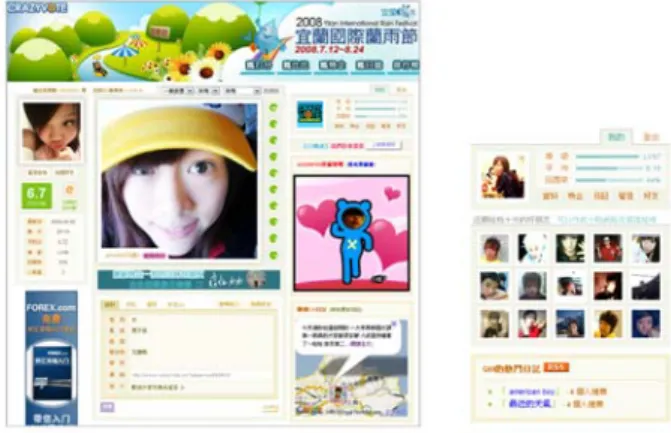
CrazyVote (CV) is a project for efficiency-evaluation of a technology company in Taiwan (Fig.1a). For system testing, it is designed as a web-based social platform, which provides teenagers personal web space to easily access, including diaries (blogs), photos, and personal message boards.
Fig. 1 (a) CrazyVote website (b) Admirer list
The major characteristic of the CrazyVote is the appreciation of others’ photos. It is different from regular on-line photo albums. Its rule is that a user can post only one photo on the CV, for the advantage of enabling users to browse all the photos of others in a short period of time. If the photo of a user is appreciated by others, who will give it a point ranked from 1 to 10, and 10 point means that the photo is the most admirable. The identity of the admirer shows when a high point arrives. Hence, the user is able to give a point back to that admirer about how he or she appreciates the admirer’s photo too (Fig.1b). To rank others photo with a simple click and to notify users of where the praise comes from make CrazyVote very unique. The
simple interaction promises that one can definitely come into contact with others easily.
In addition to the space for users to write their diaries, bulletins and the name list of good friends, users can also share the information of their life context. The Map: Where Users
Live shown in Fig.2, reveals how close those young users live
to each other. It makes those who live not far away from each other have more local topics and experiences to talk about and to share. That makes the CV totally different from other websites too, and then the localization and familiarity do deliver young users a possibility of making an online pal ending up a friend in reality.
Fig. 2 The Map: Where Users Live
In 2008 summer, there were more than 25,000 young people registered on CrazyVote, and it became the biggest social website for teenagers in Taiwan. Not surprisingly, 55% of the CV users were senior high school students while 24% are freshmen and sophomores. The main reason for its popularity is that online pals can be real, safe, cool, simple, easy to chat and interact without age differences because users are mainly between 16 and 19 years old, and they are the original target users of the CV. During the summer vacation in 2008, some of the CV users take an action voluntarily to recruit some users to have a face-to-face together and turn the online interaction among users into reality.
C. Cultural and social context in Design Issues
People interact with others through many social cues, including those determined by facial expression, eye contact, gesture, tone of voice, and temperament. In common ground theory, it is suggested that people are constantly checking these social cues to make certain they are attaining mutual understanding. A shortage of social information will have a direct impact on communication [2][19]. By referring to the theories of social science, many studies have dealt with the importance of social concerns in technology developments [20][21]. However, social issues are fundamentally related to cultural dimensions. In different cultures, people’s social activities, common understanding and needs are naturally not the same. In other words, the social issues emerging from interaction and interface design also represent the influence of contextual and cultural differences.
Since social context is one of the most important issues, understanding the culture that sustains a whole society is a must
World Academy of Science, Engineering and Technology 54 2009
661 for interaction design. Most studies, whether of usability problems or commercial issues of localization, all reveal the importance of cultural effects by inductively analyzing and categorizing the interfaces of existing online applications that show usage bias [13][14]. However, these studies do not take into account inherent cultural background and the results can be applied only to redesigning or amending existing interfaces.
As social issues arise in science and technology development, cultural causes and effects have been discussed extensively in different fields and some researchers have tried to apply anthropology theories to the design process. However, these theories and findings sometimes range over many complex categories and are too detailed to translate into design guidelines. Nevertheless, the qualitative research methods of the social sciences, such as ethno-methodology and narrative inquiry or narrative research methods, are still essential for investigating the obscure connotations and inherent motivations behind users’ behaviors, and for helping designers to comprehend cultural context.
Not only functionality and usability, but users’ attitudes toward technology should be deliberated in the technology design process. In addition, people’s behaviors, customs, motivations for usage and perceptions are all strongly influenced by their social and cultural context. To inspect whether the services and interactions provided by science and technology truly match users’ social needs and expectations, it is necessary to examine what role emerging technologies might play and what effects they might have in real context.
In this research, a thorough investigation of teenagers’ voluntarily club forming through a social website is conducted to present the ideas of identifying the abundant cultural features in their on-line behaviors and attitudes towards friendship and interaction. Understanding of teenagers’ perspectives about and needs of friendship might offer to enrich computer-mediated communication or information designs in the future.
II. METHOD
The administrator of CrazyVote (CV) web service noticed that during the summer in 2008 there were more than hundred users using the same titles as Saint, mdc, and CHIV in front of their account names. The administrator, therefore, made an inquiry into such a phenomenon and then disclosed that parts of those users had formed their own on-line clubs voluntarily on CrazyVote website.
To investigate the club promoters’ motivations and the members’ perceptions, user experience research methods has been applied to this research, which include practical observations and qualitative analysis through the use of contextual inquiries [16][22]. In order to distinguish the significant meanings of clubs forming willingly, nine active website users were chosen in this study (see Table I). Seven of the subjects had different positions in their own club, including three founders of the distinctive clubs and four club members. The others were two regular website users, who socially visited
online but did not join any clubs. In addition, there were another forty club members and forty regular users selected at random. All of the eighty subjects in the sample already registered on CrazyVote more than half a year, and got on the website actively at least once a week. Hence, the two groups were selected to examine if their online social behaviors would have changes on account of clubs forming.
For attaining a thorough understanding of club members’ perspectives and attitudes towards an online community and their actual social activities, in-depth open interviews were then conducted. The field date-gathering technique based on anthropology and ethnography are also applied to observation of the entire process of online social behaviors. All the data derived in the research were decoded into an affinity diagram to explore the significant meanings of club forming and to present the important design issues related to online communities.
According to the results of in-depth interviews and contextual inquiries, the enhanced cultural model (Fig. 3) was constructed to show that teenagers’ club forming phenomenon is triggered and influenced by their present motivations and permanent cognition and attitudes toward online social activities. This model articulates several components with the key issue how cultural context and current social trend influence the overall activity. The model Participant(s) indicates those that have involved in the activity, representing either a single person or a set of people with similar motivations and attitudes toward the social activity. Interaction represents interpersonal contacts and communications, or people’s actions upon the artifacts and environment of the activities. As shown in the Fig. 3, expansion of information and communication technology influences that the young generation have flexible communicating abilities to apply diverse platforms and to form their online friend-making processes. In addition, there exist social issues of meeting online friend which encourages them to form a unique network to ensure the true identities of their online friends and to develop the confidence in each other in reality (more details on this will be presented in the section of discussion).
By integrating the results of interviews and the simple comparisons of online activities between club members and others, the detailed description of teenagers’ social behviors, purposes and requirements is given in the next section.
III. FINDINGS
The main issues examined in the research comprise the overall context of teenagers’ online social behaviors and relevant activities at present. The results of interviews have been interpreted, analyzed, and categorized through a strict qualitative process. This section offers a complete presentation
TABLEI RESEARCH SUBJECTS
Subjects Club Member Regular User Total
Contextual Interview 7 2 9
World Academy of Science, Engineering and Technology 54 2009
662 of the club forming phenomenon, including the reasons of forming voluntarily, club structures, teenagers’ social relationships and activities.
A. Clubs Forming on CrazyVote
Three distinctive online clubs were formed continuously during the summer in 2008. All the young promoters have their own definite purposes and reasons to make friends, which indeed represent teenagers’ perceptions and needs for their social life.
1) Having more actual social activities with on-line pals
The first club is named Saint, which was formed by a 19-year-olded user, Pz. He wanted to make a team or a gathering with other CV users to do something interesting, new or different.
In the beginning, Pz and his roommates added Saint in front of their CV accounts for the sake of a special identity to show their close friendships. In July 2008, he thought it might be cool to put into action to post the idea on his own blog to recruit other users to join them and form a club online. A few days after that, about fifty users were happily to join his on-line club, and entitled this club “Saint.” The club members exchanged
their personal information, started to chat with each other through MSN and Yahoo messengers, and held several different actual activities.
2) Making congenial friends by restrictions
Following Pz’s step, other users started to form their own clubs for different reasons or purpose. A distinguishing club,
mdc, was named after the initials of its three promoters and was
set up for a clear purpose for making a circle of friends who must be congenial to each other one way or another.
The mdc promoters made a request that their members must have some qualifications. For example, a club member’s score has to achieve 9000 points (which are ranked by other CrazyVote users) and there must be more than 20 users on his or her own friend list. The exacting restriction also reflects that the club founders expect their members already have logined in CV website at a certain time and are very enthusiastic about making friends with others. In addition, the membership of mdc club is limited. The club promoters select a few members each time, and even give a thought to the gender ratio while recruiting.
3) Removing limitation with understandings
Since August 2008, another club CHIV has appeared on the website, which has no restrictions on member recruiting. At the
World Academy of Science, Engineering and Technology 54 2009
663 same time, the Saint club became more and more well-known among teenagers, and the number of the club members quickly soared to one hundred. However, Pz and several core members decided to excluded the club members from their club to manage the club successfully, who hadn’t joined in their online meetings enthusiastically.
A young girl then decided to form another club open to every user without restrictions, since many of her friends who might not be able to join club activities regularly had been excluded from Saint. It declared that CHIV means ‘Hi, all CV users.’ It allows those who are eager to join such clubs do not have much spare time interacting with others on the Internet, but do hope to be a member of one club.
4) Sharing and communicating within different clubs
With different club promoters’ characteristics and rules, the style of each club seems unique and the main social activities of each are different from each other. For instance, the members of the Saint club are fond of music and outing, while the members of club mdc enjoy playing online games. Most of the promoters not only ask their members to participate in club activities to the utmost, but also encourage the members to partake in other clubs’ outings. The following quotation collected from an in-depth interview and translated into English offers explanations about the benefits of various web clubs.
It’s nice to have different clubs on CV… Because the characteristics of each club are different, that allows us to have opportunities to learn something new from each other by exchanging views and experiences. It seems that if the members of another club are style-conscious, we can learn it from them how to dress ourselves. And maybe, we can share something special with them too. On the contrary, if we all join the same club, we might be assimilated into a way without characteristics and might not learn anything new… (A. In-depth interview. 27 August 2008, translated from Chinese)
Even though the styles of these clubs have no resemblance between each other, the main purpose of forming clubs is the same, having fun. In general, these club members are teenagers who are enthusiastic about making more friends with common interests and similar lifestyle. On CrazyVote website, the young users have developed their own ways to extend their social circle.
B. Roles and Organization
The average number of core members in each club is about 30, and the biggest one, Saint, has about 50 at present. To communicate with the others and hold club meetings successfully, teenagers develop their own club organization structures for sharing labor work. These positions include a club leader (chairman), publicists, managers, and chapter leaders.
1) Leaders: coordinated all interactions among members
A club promoter usually acts as a leader, who has the authority to accept or to terminate a club membership. In addition, a leader has to administer online meetings, to bulletin all information, and to make the final decision of club activities.
In the clubs, the elder members also take some kind of duty. The ages of club members are mainly from 16 to 19 years old,
and the small difference in age could make huge diversities of opinions, thoughts and attitudes. The elder members often play the role of mediator, trying to pour oil on troubled waters and making things right. In addition, the elder usually not only have better organizational competence but also provide leaders with more appropriate advices to handle the club activities.
As a leader, the most important task is to coordinate all interactions among club members. In an interview, for example, an interviewee mentioned that several club members were harassed by someone, who persistently abused the online messenger to broadcast personal information to others. After the annoyed members appealed to their leader, the leader expostulated with the troublemaker on his ungracious behaviors.
2) Publicists advertised clubs and recruited members
To expand the club efficiently, teenagers knew how to use marketing strategies. They chose several members to serve as publicists, who had to advertise and canvassed more CrazyVote users to join their club. However, these publicists were not in charge of approbating the applications of admission to the club.
3) Chapter leaders held the regional activities
On account of different districts or locations, the clubs are separated into several chapters in the north and in the south. As general social networking sites, online pals might live in different places throughout Taiwan. Even though the club members want to hold some actual activities and turn the virtual social contacts into face-to-face gatherings, teenagers encounter the problem due to distance and the cost of money. In Taiwan, most parents hardly allow their children especially under 18 years old to take a journey to a distant place with on-line friends. That is the reason why the club members are compelled to hold the regional activities such as a short-distance outing. Therefore, north chapters and south chapters are gradually formed in the clubs. The chapter also has its own leader and managers to hold activities.
In the study, most interviewees were proud of being a member of their clubs, and they also described that their clubs are managed like enterprises, which have a clear destination to enhance members’ social relationships and definite organization structures for work sharing to continue and to enlarge their clubs.
C. Club Activities
After joining a club, the members started to have frequent contacts with others. With common characteristics, such as habits, entertainment, or lifestyle, club members started to hold different social activities.
1) The process of holding activities is complex but effective
To conduct a club activity successfully, these teenagers show their flexibilities to access different web-based communicating platforms. The process of holding an activity includes proposing, discussing, and bulletining the final decision.
Firstly, a proposer writes an idea in his\her own blog, and asks club members to second the motion by leaving a message. If it is generally supported, club members would start to discuss
World Academy of Science, Engineering and Technology 54 2009
664 the details, such as when and where to manage an activity, through online chat room or messenger. Later, the club leader or activity promoter will collect and sort all suggestions for the members to choose their favorite one through the voting system on the Internet. The final decision will be bulletined on Club’s official site and in the club leader’s CV blog, which is made a final check to confirm who will participate to put the idea into action. In this case, the entire process of planning such an activity does not take a lot of time since all will be done on the websites.
2) Club activities are cohesive and diverse
Club members make arrangements for varied outdoor activities, such as going to a theme park, shopping, and singing at KTV (karaoke house in Taiwan), and they also develop their own online culture, like forming a small group to play online games or to chorus on Yahoo messenger:
We...about 20 to 30 members of our club…are very close now. There are more than ten members who participate in outdoor activities from time to time in Taipei…(B. In-depth interview. 27 August 2008, translated from Chinese).
We chat online every day and talk about everything. We play guitar and prepare our own music accompaniment to sing songs together on Yahoo IM Conferencing…Some people chat, some people sing, and some people request songs. It looks like sort of online KTV (A. In-depth interview. 27 August 2008, translated from Chinese)
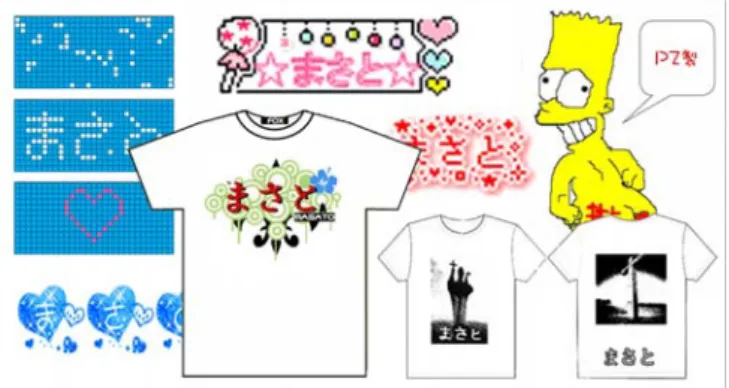
Having leisure activities, these teenagers are also promoting the image of their club, and trying to make all club members feel close to each other and like to belong to the club. As shown in Fig. 4, they held a badge design competition for the club, and proposed to use the first design to make their own uniforms and peaked caps. Furthermore, they decided to write a song for the club:
Most of our members can make the animated GIF pictures, and we designed many logos as club badges…. There are no specific rules in our badge design competition. However, we set the prize that we will apply the winner’s graphic design to make our uniform, a T-shirt probably, and the winner will receive a free one (A. In-depth interview. 27 August 2008, translated from Chinese).
Fig. 4 A badge design competition of club Saint
In the foregoing section, it is mentioned that the distance for teenagers causes the clubs to separate north chapters from south chapters. The regional differences, therefore, are reflected by the club members’ subjects, attitudes, habitual behaviors and the type of usual social activities. Most interviewees consider
the members in the south of Taiwan are much more native, enthusiastic and active, even though the members of north chapters are more. These south chapters have held a lot of small-group activities by themselves, and they are fond of sharing the wonderful experiences to others by posting the travel notes. In fact, the frequent outings encourage more club members to join such actual social activities.
D. Social Contacts of Club Members
If Teenagers want to make more friends and have actual social interactions beyond the virtual online community. At the outset, the members congregate in the online chat room to discuss the time and the place to have a get-together party. Having common topics gradually increasing, the group talk continues every day and makes club members more familiar with each other. They care for each other and have established ties of comradeship.
In addition, one of the interviewees even believes that the club he belongs to is just like a big class, where students are very keen to know their classmates. The sense of belonging of an organization itself brings natural relationships among the members.
Before clubbing, I logined CrazyVote every day, but do nothing special…But now, there is a sense of belonging, and I have more motivations to visit here. I know I have a lot of friends, right here (C. In-depth interview. 27 August 2008, translated from Chinese).
I post something innermost in the blog…They (club members) may encourage me or respond to it with a message, which is very worth reading…It is some kind of attachment… (E. In-depth interview. 27 August 2008, translated from Chinese).
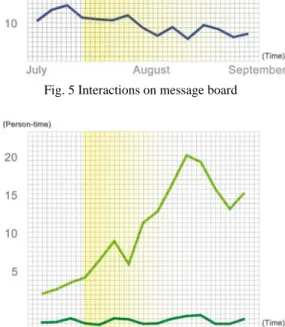
The club members have more interactions than those who do not join the club. In the study, 80 active users who regularly visited CrazyVote website were selected and their general online activities have been recorded. Half of the subjects are members of one of the clubs, and the others are ordinary users who are active on-line but do not join any club. In Fig. 5, the light blue line shows how many CrazyVote users there are that a club member interacts with in his\her own message board per day, and the dark blue line indicates the number of users that an ordinary user interacts with. As shown in the figure, those who join the clubs make friends faster and easily and then attract more users to visit their message boards. Since the first club
Saint was formed in the beginning of July, the average of users
each club member might interact with has increased obviously. In Fig. 6, the light green line shows an average of users who visit a club member’s blog per day, and the dark green line indicates an average of users who visit an ordinary user’s blog. Since clubs were formed, the average number of users who might share their sentiments on a club member’s blog has increased from 3 to 13.
The sense of belonging also makes club members try to strengthen their own club like a small society. Leaders encourage members to participate in club activities, and members try to build the image of their own club by making the badges, uniforms and songs. They browse friends’ CV blogs and message boards every day to make sure that they do care
World Academy of Science, Engineering and Technology 54 2009
665 about friends’ daily life. However, most leaders soon figured out that it is difficult to have all members stick to each other. In the interviews, an elder interviewee said:
After the summer vacation, everyone will become very busy...Maybe two or three years later, these senior high school students will grow up, and it will be easier for us to map out some activities. I think it is worthwhile to expect… (A. In-depth interview. 1 September 2008, translated from Chinese)
Most club members are students and have to put a lot of effort to study, especially for senior high school students at the ages between 16 and 18. In Taiwan, parents do not allow their children travel alone to a distant place and make some restrictions on children’s social behaviors due to protection. Accordingly, the participation of club activities depends on several important factors such as age, region, money, (school) work and lifestyle. As the previous paragraph mentioned, the leader of CHIV, who did not ask her members to get online continuously, confronts this situation firstly.
Fig. 5 Interactions on message board
Fig. 6 Interactions on personal on-line diaries
IV. DISCUSSION
Based on interpretations of the interviews in the case study which have explored teenagers’ social behaviors and attitudes towards the on-line clubs, it indicates a teenagers’ significant social model on the Internet in Taiwan.
First, the teenagers’ considerations of making friends on the Internet reveal that the teenagers’ intention to have real contacts with online pals. Second, the essence of the teenagers’
social context with online friends seems bound to real life. In addition, they have developed their own process of making friends on account of their great adaptability in an online environment. Furthermore, the action of forming a club reflects that they equip themselves with solid strategies to expand their social relationships in group activities and attract more members to join their clubs. The aspects of teenagers’ social issues will be discussed in the following sections.
A. Considerations
Teenagers’ considerations of making friends online presupposed the real contacts. Caring about not only the general characteristics of a friend, such as age, stature, weight, blood type, and constellation, but also place, school and hobbies, teenagers express the most important one of making friends on the Internet is one’s living area, age and honesty:
z Living Area: Most interviewees presented that their first concern is where they live. They expect to have sincere interactions in real life with the online friends. In terms of the distance problem presented in the previous section, one’s place becomes of the most importance since it might decide if a teenager is allowed to come out with online friends having a gathering.
z Age: The age limit of making online friends is similar to that in reality. The teenagers tend to make friends of their age. That reflects the demographics of CrazyVote website: over eighty percent of users are between 16-19 years old. In the study, the freshmen and sophomores in college are willing to associate with senior high school students, and all these teenagers present that they have no inclination to making friends with those in 20s, who are adults in the eyes of the teenagers.
z Authenticity: Most teenagers use their real identities to register on the website, including age, gender and living area. They are honest and acquainted with others. For this reason, they ask each other with sincerity, but they also visit one’s online album or blog to have a double check on one’s authentic identity.
z Devotion: Teenagers are interested in others’ social intentions, especially when they are earnest to maintain the relationships on the website. In the study, interviewees explained both situations would show one’s devotion to making friend and keeping friendship. One is how much time a person hanged on the website and the other is how enthusiastically he\she was to respond to others messages.
z Lifestyle: Teenagers are very excited and interested to see someone who shares with them the same taste, hobbies or similar lifestyle. Hence, personal web space serves to share one’s experiences and life backgrounds, which offer others with a topic to interact with. For teenagers, the main motive of making friends on the Internet is quite different from others in their 20s, 30s, or above. For instance, in the case of one’s living area, some of