行政院國家科學委員會補助專題研究計畫成果報告
※※※※※※※※※※※※※※※※※※※※※※※※※
※ ※
※ 寬頻網際網路之允入控制與訊務排程 (III)
※
※
※
※※※※※※※※※※※※※※※※※※※※※※※※※
計畫類別:□個別型計畫
█整合型計畫
計畫編號:NSC89-2219-E-009-021
執行期間: 89 年 8 月 1 日至 90 年 7 月 31 日
計畫主持人: 楊啟瑞 教授
共同主持人:
本成果報告包括以下應繳交之附件:
□赴國外出差或研習心得報告一份
□赴大陸地區出差或研習心得報告一份
□出席國際學術會議心得報告及發表之論文各一份
□國際合作研究計畫國外研究報告書一份
執行單位:交通大學資訊工程系所
中
華
民
國
90
年
9
月
15
日
行政院國家科學委員會專題研究計畫成果報告
寬頻網際網路之允入控制與訊務排程 (III)
Admission Contr ol and Tr affic Scheduling in Br oadband Inter net
計畫編號 : NSC89-2219-E-009-021
執行期限 : 89 年 8 月 1 日至 90 年 7 月 31 日
主持人 : 楊啟瑞
國立交通大學資訊工程研究所
一、中文摘要
今 年 , 我 們 設 計 了 一 個 運 用 在 broadband local/access 網路上,具QoS保證的 MAC層通訊協定 (QMAC),其中運作的原理 是藉由動態控制granularity (frame size) 的大 小,在依然保持最大的throughput的情況下, 提 供 隨 用頻 寬(bandwidth-on-demand) 的功 能。QMAC支援三種ATM訊務-CBR, VBR, ABR, 另 外 還 有 建 立 連 線 註 冊 用 的 訊 務 - Reservation Request (RVR)。CBR/VBR/ABR 的 訊 務 是 以 reservation access 的 方 式 , 在 reservation bandwidth上傳送; RVR 則 是 以 random access 的 方 式 , 在 contention bandwidth上傳送。QMAC以動態的方式,決 定 每 個由contention和reservation bandwidth 所 組 成 的 訊 框 大 小 。 對 於 reservation bandwidth的大小,以滿足所有已完成註冊 CBR/VBR/ABR訊務的QoS為先決條件,頻寬 的分配是將上述的條件加上weight-based的 排程機制來決定。此外,基於neural-fuzzy 訊 務 推 估 技 術 , 我 們 可 以 決 定 contention bandwidth的大小,仍以不破壞已完成註冊 CBR/VBR/ABR訊務的QoS為先決條件。透過 系統模擬的結果顯示,在現行數種不同的 MAC通訊協定之中,以M/Pareto和動態的訊 務 輸 入 之 下 , QMAC 在 throughput, access delay, 和blocking probability上皆有很好的表 現。所以,我們可以證明QMAC在broadband access 和local 網路上,不論在訊務排程或頻 寬控制都有很好的效能。 關鍵詞:媒體存取控制, 服務品質保證, 類 神經網路訊務預測技術。 Abstr act
In the project of this year, we have proposed a QoS-guaranteed MAC protocol (QMAC) augmented with dynamic granularity (frame size) control for broadband local/access networks, aiming to provide bandwidth-on-demand while retaining maximal throughput. QMAC supports three types of ATM traffic-CBR, VBR, ABR, along with Reservation Request (RVR) traffic for making connection reservation. While CBR/VBR/ABR is governed by reservation access over the reservation bandwidth, RVR is conducted by random access over the contention bandwidth. QMAC essentially exerts dynamic granularity control on per-frame-based allocation of the reservation and contention bandwidth. The reservation bandwidth is allocated following a weight-based scheduling policy. For the allocation of the contention bandwidth, based on a neural-fuzzy traffic prediction technique. Simulation results demonstrate that, compared to a set of MAC alternatives under M-Pareto-distributed and dynamic traffic settings, QMAC invariantly achieves superior performance with respect to throughput, access delay, and blocking probability. Ultimately, QMAC facilitates traffic scheduling and bandwidth control for broadband access and local networks.
Keywords: Medium Access Control (MAC), Quality-of-Service (QoS), Neural-fuzzy traffic prediction.
二、緣由與目的
It is envisioned that next-generation broadband local/access networks should be capable of supporting integrated multimedia services with a wide range of service rates and different Quality-of-Service (QoS) requirements. Expected supported services include Constant Bit Rate (CBR), Variable Bit Rate (VBR), and Available Bit Rate (ABR). Examples of QoS requirements for VBR and ABR traffic are bounded delay and Minimum Cell Rate (MCR), respectively. A major challenge pertaining to such wireless ATM networks is the design of traffic scheduling, namely a Medium Access Control (MAC) protocol achieving multiple access efficiency and QoS guarantees.
Existing MAC classes, such as Time-Division Multiple Access (TDMA) [1,2,3] and Code-Division Multiple Access (CDMA) [1,3], exhibit various performance merits and weaknesses. TDMA can be further categorized as either Frequency-Division-Duplex (FDD) [1], in which uplink and downlink traffic are carried by two distinct carrier frequencies, or Time-Division-Duplex (TDD) [2], where only one common carrier frequency is used. In this paper, we focus on the design of a TDMA FDD-based MAC scheme. Moreover, TDMA operates in one of three different manners: reservation-based, random-access-based, or the combination (hybrid-based). Compared to the former two schemes, the hybrid-based TDMA [1] has been considered most promising. In essence, reservation access is indubitably favorable for guaranteed (e.g. CBR/VBR) services, whereas random access is suitable for making reservation. Such reservation traffic is hereinafter referred to as Reservation Request (RVR) traffic.
Furthermore, medium bandwidth is generally shared on a frame basis. Most schemes proposed in the literature advocate the use of a fixed [4,5,6], or variable but unrestricted [7] sharing granularity (frame size). Using a simple fixed-size frame, PRMA and companions [4] considered the QoS guarantee
among CBR/VBR/ABR traffic via fixed granularity, PRMA/DA [5] unfortunately suffered from a noticeable increase in VBR delay in the presence of heavier CBR loads. Likewise, using fixed granularity, the scheme proposed in [6] separately considered QoS guarantees for CBR/VBR traffic and fair access for ABR traffic. Adopting a variable but unrestricted-length frame structure, RMAV [7] was shown viable for local networks supporting data traffic only. Essentially, we believe dynamic granularity facilitates a finer bandwidth control and would result in improved performance. This is the first primary feature of our MAC design.
Random access inevitably undergoes collisions, resulting in a decrease in network utilization and increase in access delay. To alleviate the problem, existing schemes have exerted various syntheses of the following three basic policies: collision avoidance (CA) [8,9], collision reduction [10], and collision resolution [8,11,12]. The former two policies engage in collision prevention by making the collision occurrence unlikely and less likely, respectively. Examples are the 802.11 CSMA/CA protocol [8] and controlled-ALOHA [10], respectively. The last policy undertakes collision correction should collisions have occurred. Examples are exponential backoff [8], feedback-based controlled retransmission [11], or dynamic tree splitting [12]. Unlike these policies, we tackle the problem by allocating the so-called “favorable bandwidth” suggesting maximal utilization, based on a novel neural-fuzzy traffic prediction technique. This is the second primary feature of our system design.
三、結果與討論
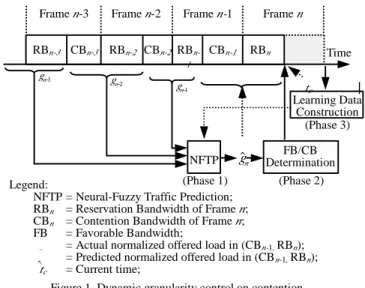
The major challenge we have encountered is the allocation of the Contention Bandwidth (CB). To approach it, we have designed a dynamic granularity control mechanism working in conjunction with a neural-fuzzy traffic prediction technique. Initially, dynamic granularity control predicts the normalized offered load of RVR traffic
contention period. Based on a closed-form formula, granularity control then derives the FB. If the FB is less than the remaining unreserved bandwidth, the final CB to be allocated is set as the FB. Due to more bandwidth to be supplied than demanded in this case, every MT is allowed to access bandwidth unconditionally by randomly contending for a slot uniformly distributed among the CB. This type of access is called uncontrolled-ALOHA (parameterized with
AL
p =1).
If the FB exceeds the remaining unreserved bandwidth, only the remaining bandwidth is allocated as the final CB. Unlike the previous case, owing to insufficient bandwidth, each MT can only access bandwidth with probability pAL aiming to
attain maximal throughput. This type of access is called controlled-ALOHA parameterized by
1
<
AL
p . Notice that the CB size and parameter
AL
p are broadcast to MT’s prior to the beginning of the contention period. In the sequel, we describe the detailed design of dynamic granularity control particularly on CB.
Essentially, the CB allocation process is performed serially in three phases: Neural-Fuzzy Traffic Prediction (NFTP), FB/CB determination, and learning data construction. Figure 1 depicts the three-phase process of determining CB allocation for frame
n, namely CBn, at time tc.
In the first phase, the NFTP network predicts gˆn at time tc, based on a set of m
input values (m=3, in Figure 2) taken from m
most-recent gk values (k = n-1 to n-m). In the
second phase, based on gˆn, the system derives
the FBn and ultimately determines the CBn. In
addition to prediction, at the end of contention period of frame n, NFTP has to perform the
learning operation using the learning data constructed in the third phase. This is indicated in Figure 2 by the dotted link pointing back to the NFTP network.
We undertook event-based simulation for a set of MAC schemes under two different traffic settings. The MAC schemes include CBF (Fixed CB)-x, CBV (Variable CB)-FF
(Fixed-Frame), CBV-WP (With Prediction), and QMAC. The CBF-x schemes used fixed
CB of x slots in length. The CBV-FF scheme,
based on a fixed frame structure, designated variable-size remaining unreserved bandwidth as the CB. Employing variable-size frames and the CB, CBV-WP was furnished with coarse traffic prediction based on the traffic characteristic from the previous frame. Finally, QMAC adopted variable-size frames and CB, but used NF-based traffic prediction (NFTP). In particular, NFTP is a correlation-based [12] network accepting twelve inputs respectively corresponding to twelve exponential-averaging
k-lag correlations, where k=1 to 12.
The two traffic settings were static M-Pareto-distributed traffic, and dynamic traffic. In the static setting, for any given load, we generated M-Pareto-distributed traffic [16] parameterized by a Hurst parameter, H=0.9. Simulation was terminated after reaching 95% confidence interval. In the dynamic setting, aiming to emulate realistic traffic with no priori distribution, for a given load, we generated Poisson arrivals of ten different loads, yielding the average load identical to the given load. For example, for a given load of 0.5, the load generated is u⋅x, where u is an
integer uniformly distributed between 1 and 10,
and ∑ = × = 10 1 / 10 5 . 0 k k
x . Simulation was terminated after an execution of 4
10 different sample paths, each of which elapsed for 100 frames long. Simulation results demonstrate that, compared to a set of MAC alternatives under M-Pareto-distributed and dynamic traffic settings, QMAC invariantly achieves superior performance with respect to throughput, access
Figure 1. Dynamic granularity control on contention bandwidth allocation.
Legend:
NFTP = Neural-Fuzzy Traffic Prediction; RBn = Reservation Bandwidth of Frame n; CBn = Contention Bandwidth of Frame n; FB = Favorable Bandwidth;
= Actual normalized offered load in (CBn-1,RBn); = Predicted normalized offered load in (CBn-1,RBn);
tnc = Current time; gˆ n g Frame n RBn-3 CBn-3 RBn-2 CBn-2 RB n-1 CBn-1 RBn Frame n-3 Frame n-2 Frame n-1
Learning Data Construction (Phase 3) tc 3 − n g 2 − n g 1 − n g Time NFTP gˆn DeterminationFB/CB (Phase 1) (Phase 2)
delay, and blocking probability.
四、計畫成果自評
Simulation results demonstrated that QMAC is superior to five other MAC schemes, with respect to throughput, access delay, and blocking probability, under both static M-Pareto-distributed and dynamic traffic settings. Significantly under dynamic traffic, QMAC is at least two orders of magnitude better than static-granularity-based MAC schemes in access delay and blocking probability. Finally, QMAC achieves much improved throughput and access delay than the MAC scheme using coarse traffic predication under dynamic traffic. A formal form of this report has been accepted and published in IEEE ICC 2001. Finally, the basic design and architecture is under patent application.
五、參考文獻
[1] I. Akyildiz, et al., “Medium Access Control Protocols for Multimedia Traffic in Wireless Networks,” IEEE Network, July/Aug., 1999, pp. 39-47.
[2] N. Passas, S. Paskalis, D. Vali, and L. Merakos, “Quality-of-Service-Oriented Medium Access Control for Wireless ATM Networks,” IEEE Comm. Mag., 1997, pp. 42-50.
[3] N. Wilson, R. Ganesh, K. Joseph, and D.
Raychaudhuri, “Packet CDMA Versus
Dynamic TDMA for Multiple Access in an Integrated Voice/Data PCN,” IEEE JSAC, vol. 11, no. 6, Aug. 1993, pp. 870-883.
[4] P. Narasimhan, and R. Yates, “A New Protocol for the Integration of Voice and Data over PRMA,” IEEE JSAC, vol. 14, no. 4, May 1996, pp. 623-631.
[5] J. Kim, and I. Widjaja, “PRMA/DA: A New Media Access Control Protocol for Wireless ATM,” Proc. IEEE ICC , 1996, pp. 240-244. [6] C. Chang, K. Chen, M. You, and J. Chang,
“Guaranteed Quslity-of-Service Wireless Access to ATM Networks,” IEEE JSAC, vol. 15, no. 1, Jan. 1997, pp. 106-117.
[7] D. Jeong, C. Choi, and W. Jeon, “Design and Performance Evaluation of a New Medium Access Control Protocol for Local Wireless
742-752.
[8] G. Bianchi, “Performance Analysis of the
IEEE 802.11 Distributed Cooridination
Function,” IEEE JSAC, vol. 18, no. 3, March 2000, pp. 535-547.
[9] R. Garces, and J. Garcia-Luna-Aceves, “Collision Avoidance and Resolution Multiple Access for Multichannel Wireless Networks,”
Proc. IEEE INFOCOM, 2000, pp. 595-602. [10] S. Jangi, and L. Merakos, “Performance
Analysis of Reservation Random Access Protocols for Wireless Access Network,” IEEE
Trans. Comm., vol. 42, no. 2/3/4,
Feb./March/April 1994, pp. 1223-1234.
[11] B. Paris, and B. Aazhang, “Near-Optimum
Control of Multiple-Access Collision
Channels,” IEEE Trans. on Comm., vol. 40, no. 8, Aug. 1992, pp. 1298-1309.
[12] M. Yuang, and P. Tien, “Multiple Access Control with Intelligent Bandwidth Allocation for Wireless ATM Networks,” IEEE JSAC, vol. 18, no. 9, Sept. 2000.
[13] W. Stallings, High-Speed Networks- TCP/IP and ATM Design Principles, Prentice Hall, 1998.
[14] C. Chang, and J. Thomas, “Effective Bandwidth in High-Speed Digital Networks,”
IEEE JSAC, vol. 13, no. 6, 1995, pp. 1091-1100.
[15] D. Bertsekas, and R. Gallager, Data Networks, Second Edition, Prentice Hall, 1992.
[16] R. Addie, M. Zukerman, and T. Neame,
“Broadband Traffic Modeling: Simple
Solutions to Hard Problems,” IEEE Commun. Mag., vol. 36, Aug. 1998, pp. 88-95.