
高雄市銀髮族太極拳運動參與者參與動機之研究
86
0
0
全文
(2) Content 摘要...............................................................................................................................V Abstract ...................................................................................................................... VII Chapter1 Introduction ....................................................................................................1 1.1 Research background and motive ....................................................................1 1.2 Research objective ...........................................................................................3 1.3 Contribution .....................................................................................................4 1.4 Research process..............................................................................................5 Chapter2 Literature review ............................................................................................7 2.1 Sport participation motivation .........................................................................7 2.2 Sport fan participation motivation .................................................................11 2.3 Related participation motivation in martial arts.............................................14 2.4 Characteristics of Tai Chi Chuan ...................................................................16 Chapter3 Research methodology .................................................................................19 3.1 Research method............................................................................................19 3.2 In-depth interview..........................................................................................20 3.2.1 Interview with master Chang (張光明) ..............................................20 3.2.2 Interview with master Li (李武忠) .....................................................22 3.3 Focus group interview....................................................................................25 3.3.1 Basic descriptions of the interview .....................................................25 3.3.2 Summary of the interview...................................................................25 3.4 Questionnaire method ....................................................................................28 3.4.1The definition of variables ...................................................................28 3.4.2 Questionnaire design...........................................................................28 3.4.3 Sampling method ................................................................................31 3.4.4 Data analysis .......................................................................................32 3.5 Research limitations.......................................................................................34 Chapter4 Results and discussion..................................................................................35 4.1 Descriptive statistics analysis ........................................................................35 4.2 Factor analysis ...............................................................................................39 4.3 Cluster analysis ..............................................................................................45 4.4 Difference analysis on the clusters.................................................................48 Chapter5 Conclusion and suggestion...........................................................................52 5.1 Research findings...........................................................................................52 5.2 Managerial implications.................................................................................54 5.3 Further research .............................................................................................56 References....................................................................................................................57 II.
(3) Appendix B: In-depth interview questionnaire (Original Chinese Edition) ................65 Appendix C: Focus group interview questionnaire (English Translation)...................66 Appendix D: Focus group interview questionnaire (Original Chinese Edition)..........67 Appendix E: The professionals and the check list of formal questionnaire (English Translation) ..................................................................................................................68 Appendix F: The professionals and the check list of formal questionnaire (Original Chinese Edition)...........................................................................................................70 Appendix G: Formal questionnaire (English Translation)...........................................72 Appendix H: Formal questionnaire (Original Chinese Edition) ..................................76. III.
(4) Figure and Table content Figure1-1: The chart of the research process .................................................................6. Table 2-1: Results of sport motivation researches in Taiwan ........................................9 Table 3-1: Profiles of two interviewed Tai Chi Chuan masters ...................................20 Table 3-2: motives to practice Tai Chi Chuan by interviewing the two masters .........24 Table 3-3: Background of the interviewees of focus group interview.........................25 Table 3-4: The questionnaire and its references of each question ...............................29 Table 4-1: Descriptive statistics of personal data.........................................................35 Table 4-2: Mean and order of each motive ..................................................................37 Table 4-3: Factors of participative motives..................................................................40 Table 4-4: reliability and communality of the factors of Tai Chi Chuan participative motives for aged people ...............................................................................................43 Table 4-5: Frequencies of the clusters..........................................................................45 Table 4-6: One-way ANOVA on the clusters and the motive factors ..........................46 Table 4-7: Chi-square analysis on the clusters and personal data................................48 Table 4-8: One-way ANOVA on personal data and clusters ........................................50 Table 4-9: Bivariate correlation between years of practice and the factors .................50. IV.
(5) Dedication Finally, it’s time to finish this thesis. It’s really a hard and joyful task for me. From the day that I decided to write this thesis, I have received a lot of help from many people. And I think this is a good opportunity to appreciate their kindness. Among these people, first of all, I’d like to appreciate my advisor, Huang Junying, without his advice, I can not understand how to accomplish my first thesis. Second, I’d like to appreciate master Chang Kwang-Ming. He teaches me a lot of martial art skills and abundant concepts and does great help while I interview him. Also, two experienced coaches: Li Wu-Chung and Hsieh Shih-Ching help me find the interviewees of this research. Moreover, Tristan Tai helps me conduct some statistic analysis, Sophie Yang and Clare Kao help me revise my English writing. Without them, this thesis could not be done at this time. Finally, I’d like to appreciate my parents. They give me the opportunity to receive master education in NSYSU and are always my reliable support. Therefore, this is dedicated to all people who have helped me in light of their kindness. And I think I won’t forget the enchanting sunshine and the shore here. Huang Cheng-Yao 2005/6/25. V.
(6) 摘要 近年來,由於醫療技術進步,使人民壽命增加,已開發國家老年人口占總 人口比率日漸上升,而週休二日制的實施使得人民擁有更多的休閒時間,在這 樣的潮流下,人們對運動休閒保健更趨重視。 在許多老年人從事的休閒運動中,太極拳被認為對健康相當有助益,目前 世界有百餘個國家有設立太極拳協會,且近年來常有萬人以上的活動規模,然 而目前之研究多著墨於太極拳對於身心功能的幫助,缺乏參與動機之研究。 因此,本研究試圖找出影響銀髮族參與太極拳運動的主要動機,並將不同 動機的銀髮族參與者區隔成不同群體,以供後續的推廣者制訂相關的行銷策略。 在研究方法上,本研究先採用深度訪談,藉太極拳專家多年來的教學經驗, 了解其學生因何參加太極拳運動,並了解太極拳之特性。之後由焦點團體法實 際了解參與者的動機,並依據深度訪談及焦點團體法的結果做成問卷。 本次研究針對高雄市 50 歲以上的銀髮族練習者共發出 380 份問卷,由於缺 少練習者名冊,因此採用便利抽樣於高雄各地的練習場進行問卷發放,回收問 卷為 280 份,有效樣本為 259 份。經過因素分析,共萃取出五項因素,分別為 「外在表現與認同」、「增進身心健康」、「追求太極拳哲理與技術」、「休閒、逃 避壓力及交友」、「長壽及心靈激發」、與「身材雕塑」。而後由集群分析以五項 因素為基礎將樣本分為三群,各別命名為「外在認同追求群」、「心靈激發與心 理健康追求群」、及「身心健康平衡群」。最後藉由卡方檢定及變異數分析,發 現平均練習年數與「外在表現與認同」、「增進身心健康」、「長壽及心靈激發」 有顯著相關。 因此,推廣者可藉由以上主要動機,發掘銀髮族參與太極拳運動的需求, 並根據各區隔制訂符合其需求的活動,使推廣的成效更為彰顯。 關鍵字:銀髮族、太極拳、參與動機. VI.
(7) Abstract In recent years, the progress of medical care has increased the longevity much. Hence, the aged people hold a growing proportion of total population in developed countries. Besides, people in Taiwan have more spare time because the authority regulates workers in Taiwan own two holidays per week. And under such trend, people put sports recreation and health care at a premium. Among a lot of sports that aged people engage in, Tai Chi Chuan is considered to benefit our health. At this moment, over 100 countries have established Tai Chi Chuan associations and some activities of them call more than 10 thousand people to participate in. However, most of present researches just focus on the advantages that Tai Chi Chuan do for physical and mental functions. But there is still in lack of research about their participative motives. Hence, this research is making efforts to find out the primary motives that influence the silver-haired people to participate in Tai Chi Chuan, and then separate the aged people into different groups by their motives. And the promoters will be able to work out their marketing strategy toward these aged participants. About the research methods, this research adopts in-depth interview first. By abundant experience of Tai Chi Chuan masters, the participative motives of their students and the features of Tai Chi Chuan are found out. Later, through a focus group interview, the motives of Tai Chi Chuan participants are also discussed. Then, these found motives are used to make the questionnaire. Because of lack of member book of the participants the questionnaires are distributed on a convenient basis. In the research, 380 questionnaires are distributed to silver-haired participants who are over 50 years old. 280 questionnaires are received and the valid samples attain to 259. After factor analysis, five factors are VII.
(8) extracted, including “Extrinsic behavior and identity”, “Improving physical and mental health”, “Pursuit of Tai Chi Chuan philosophy and skills”, “Recreation, escape from pressure, and making friends”, “Longevity and soul inspiration”, and “Body shaping”. And then according to cluster analysis, three groups are separated on the basis of the five factors. Each of them is named “Pursuit of extrinsic identity”, “Pursuit of soul inspiration and mental health”, and “Pursuit of balanced physical and mental health”. Finally, by Chi-square test and ANOVA analysis, this research discovers that the average years of practice is significant related to “Extrinsic behavior and identity”, “Improving physical and mental health”, “Longevity and soul inspiration”. Therefore, promoters can find the needs of the silver-haired Tai Chi Chuan participants by these chief motives and design unique activities for each segment to make their promotion more effective. Keyword: silver-haired, Tai Chi Chuan, participative motive. VIII.
(9) Chapter1 Introduction In a number of martial arts in the world, Chinese martial arts are the most enchanting ones because of their history and complicated philosophy. Some people name Chinese martial arts with a special term “Kung Fu”. While we hear the term, we all know they refer to Chinese martial arts. Among existing Chinese martial arts, Tai Chi Chuan must be the most well known one by people around the world. By far, it is advocated in over a hundred of countries and has become one of the most popular martial arts in the world.. 1.1 Research background and motive In recent years, the longevity of people has increased dramatically because the progress of medical care. According to a population estimate from the United Nation, the top 25 countries all have a life expectancy of above 77 years of age between 2000~2005, while the average number for the world is 66.. The United Nation. estimated that in 2045 to 2050, the top 25 will be all over 81 years of age, while the average for the world will also increase to 76. Furthermore, some countries will contain a greater coverage of older people and the proportion of their age structure will therefore be older. For instance, some European countries like Italy, Greece, and Spain, will have 40% of its population that are over the age of 60 in 2050, with the other 20 European countries over 35%. In Asia, Japan will increase from 23% in 2000 to 42% in 2050.. These estimations. argue that the population of the world is aging, especially in European countries. In Taiwan, with today’s per couple only procreating 1.8 kids, the age structure will sure be much greyer in a couple of decades. Beside age structure, in 2000, Taiwan authority implemented the act that regulates workers in Taiwan only need to work 40 hours or 5 days a week. And in the 1.
(10) year, around half of the whole workers are able to benefit from the act. Hence, people can hold more leisure time on their holidays and do some exercise. Therefore, in these years, people have more spare time and are willing to pay more attention to take some recreational sports. About Tai Chi Chuan, it has been proved by lots of medical research that practicing Tai Chi Chuan can improve human health. Most studies on Tai Chi Chuan just focus on the effects of health improving, especially for the aged people. In America, some advocators promote Tai Chi Chuan to the old people to prevent them from falling to decrease the expense of medical care. And in Chinese culture region, it is commonly believed that to practice Tai Chi Chuan can make them healthier and younger. As a result, a large proportion of Tai Chi Chuan participants are old people, not those people who still remain strong and young bodies. Therefore, Tai Chi Chuan is just regarded as the sports for the aged people by most people. But these people forget one thing, that is, Tai Chi Chuan is also an ancient Chinese martial art. As for me, I am also a Chinese martial arts participant. I think it is a pity that many researches have proved the advantages of taking part in Tai Chi Chuan, but there is still lack of research on why so many people feel like to join it. I think, if we want to promote Tai Chi Chuan more effectively, this is what we must know first.. 2.
(11) 1.2 Research objective In recent years, some western martial arts have been commercialized. Some unions like UFC (Ultimate Fighting Club), K-1 contains many types of martial arts players and provide a stage for them to compete. They are created successfully with new business models and are able to earn profits. On the contrary, although a lot of Chinese martial arts are quite famous, we still don’t know how to make them commercialized. Moreover, we even do not know why people feel like to join or to watch the shows of martial arts performances. So it is quite necessary to find out why people feel like to get involved in these martial arts. Among all Chinese martial arts, Tai Chi Chuan is regarded as a kind of sport which can make people healthier with low possibility to get hurt. Hence, it is suitable for everybody to practice. Especially for the old people, they practice Tai Chi Chuan to remain their health. In Beijing and Paris, some activities were held to invite over at least 10000 participants to practice Tai Chi Chuan at the same place this year. So far, only few articles explored the reasons why people practiced Tai Chi Chuan. So it still leaves much to do to understand why these aged people want to join Tai Chi Chuan practice. In south Taiwan, Kaohsiung is the largest city. And according to Kaohsiung Tai Chi Chuan association, Kaohsiung City contains over 30,000 Tai Chi Chuan participants. So it can be a base that offers enough samples for us to study. As a result, the objectives about this research are as follows: (1) To find out the motives that make these silver haired people participate in Tai Chi Chuan practice and the factors that influence most. (2) To separate these participants into different groups with different motives. 3.
(12) 1.3 Contribution Chinese martial arts are very famous with great positive images. But we still do not know how these martial arts are able to attract so many people. And among these Chinese martial arts, Tai Chi Chuan must be the most famous one and owns the greatest number of participants. So, after finding out the most influential factors which motivate these silver haired people to participate in Tai Chi Chuan practice. These factors can be used to represent the needs of these participants. Tai Chi Chuan promoters, no matter they just want to promote Tai Chi Chuan to the citizens without earning profits or to make this type of martial art commercialized, are able to exploit the factors to design special activities to meet the needs of these targeted people. Besides, after separating these people into different groups, these groups can represent different target markets with varied needs to play Tai Chi Chuan. Thus, if promoters want to design unique activities to attract the people in a specific segment, they can use these separated groups as the objectives to develop the activities for them. To sum up, this research makes following contributions: (1). the found motives can be used to represent the needs of these silver haired Tai Chi Chuan participants to design activities to attract them. (2). the separated groups can be regarded as different segments with varied motives, and the promoters may focus on any group of them.. 4.
(13) 1.4 Research process As shown in Figure1-1 the research process begins with confirmation of research objective, and followed by review of related literatures. About the research instruments, this research adopts in-depth interview and focus interview to gather wisdom from Tai Chi Chuan masters and participants. By their experience and the past literature, a questionnaire is made and distributed to find out participation motives for silver-haired Tai Chi Chuan participants. After calling back the questionnaires, the data is analyzed by some statistics methods. And finally, some conclusions and suggestions are made for the promoters.. 5.
(14) Figure1-1: The chart of the research process Confirm the research motivation and research objective. Review related literature. In-depth interviews. Focus group interview. Make and modify questionnaires. Send out the questionnaires. Gather and analyze data. Make conclusion and suggestion. 6.
(15) Chapter2 Literature review 2.1 Sport participation motivation Sport participation has been proved to have great positive effect on human body and strong motivations also make people to participate in a particular sport continuously, but not all positive effects are strong enough to make people participate in the sports. Several studies have demonstrated that the motives given for sport participation are not only the physical aspects, but a number of other ones, such as weight control and appearance, stress and mood management, competition and enjoyment, fun and excitement (Cash, Novy, and Grant, 1994; Dwyer, 1992; Flood and Hellstedt, 1991; Frederick and Ryan, 1993; Gill and Overdorf; 1994). Additionally, motives are quite different from one to another for several factors, i.e., age and gender (Duda and Tappe, 1989’ Gill and Overdorf, 1994; Markland and Hardy, 1993). To explain the differences, for example, older adults and females seem to value competition less than younger adults and males. In addition, social incentives are valued less by younger adults and by males compared to older adults and females respectively. Besides, weight control and appearance are strong participative motives for women, and especially younger women. (See the review in Koivula, 1999) Beside above literatures, some studies on specific sports also found the motives for people to participate in sports. According to Nash (1976), participative motives for joggers were to control weight, to become healthier, to recreate, or to escape from daily routines. Some related literatures also revealed that weight control is a primary motive for taking part in sports, which is to control one’s weight and maintain nice build (Brown, 1992; Clough, Shepherd, and Maughan, 1989; Duda and Tappe, 1989; Master, Ogles, and Jolton, 1993). In addition, to associate with others is also a primary motive for sport participation (Duda and Tappe, 1989; Schroeder, 1995). 7.
(16) Some other studies also proved sociality makes great influence on sport participation (Clough et al., 1989; Schuett, 1993; Master et al., 1993). Moreover, release physical and mental pressure and tension, to obtain physical and mental comfort, make people feel like to participate in sports as well (Beard and Raghed, 1983). Another motive which is related to sport participation is healthy physical fitness; Master (1993) indicated the reason that makes people participate in cardio-exercise persistently is to gain health and physical fitness. Some other researches also support health is one of primary motives for sport participation (Fan, 范智明, 1999; Clough et al., 1989; Duda and Tappe, 1989; Master et al., 1993; Schuett, 1993). The motives for sport participation are diversified and are not easy to conclude. But some studies have tried to conclude the motives for sport participation in different type of sports and participants. Like Chen (陳文長,1995), has found the motives which motivate college students to participate in recreational sports including (a) physical fitness, (b) psychological needs, (c) social needs, (d) escape from stimulations, and (e) needs for knowledge. And in a later research on the students in Munich University (Chen 1996), the motives for participating sports were also separated into the five factors mentioned above. In the research, motives for different genders revealed no significant difference, but age did make difference with motives to participate in sports. Shieh (謝秀芳,1996) divided the participation motivations of some vocational college students into three factors: (a) pursuit of health, (b) self-fulfillment, and (c) need for achievement. In her research, age makes significant differences in self-fulfillment and need for achievement while males score higher in these two dimensions. In a research investigated German people’s sport participation motivations in their leisure time (Lin, 林千源,1994), six factors were found including: (a)eustress and 8.
(17) entertainment, (b) release of physical strength, (c) health, (d) self enhancement, (e) physical fitness, (f) social contact. Hung (洪輝宗,2004) made an extensive review pertaining to several past studies about sport motivations in Taiwan, which is integrated as following: Table 2-1: Results of sport motivation researches in Taiwan Author Wang (王武 昌,1980). Object. Motivation. 400 athletes. physical, psychological, social motivations. Liao (廖本 寬,1984). 593 college students. psychological, healthy, fitness motivations. Weng (翁志 成,1990). college students in. body developing, self cultivate, enrich. Chinese martial art club. leisure life, curiosity, others. Chen (陳顯 宗,1991). college korfball players. honor, quality of instructors, satisfying needs of sports, escape from learning, curiosity, reinforcement, easiness, gentle exercise, making friends, enjoyment. Chang (張志 銘,1996). 168 high school students. features of competition, social status, development of skills, human relationship, intimate relationship, pressure to get higher education, team atmosphere, expectation from others, fitness. Huang (黃國 恩,1996). college judo players. future and encouragement, enjoyment and achievement, fitness and mental cultivation, vigor and curiosity. Tai (戴遐齡,. golf players in Taipei. health and fitness, obtaining achievability, enhancing social status, atmosphere of courts, relax and entertainment, self achievement, convenience. Huang (黃文 祥,1998). soccer players. release pressure, fitness, obtaining knowledge, pleasure, developing companionship, skill performing, development of vocational career. O-Yu (歐陽金. 454 college students. enjoyment and achievement,. 1997). 9.
(18) 樹,1998). on bowling. intellectuality and sociality, psychological needs, fitness, sports skills, healthy needs, relax and comfort, compensatory effects. Lai and Wu (賴 557 people above 森林,吳兆 eighteen years old 欣,1999). self challenge, health, relax and escape, self-esteem and intellectuality, relationship, achievement. Lu, Su, and college students Chang (呂崇 銘,蘇榮立, 張志銘,1999). features of sports, excitement and challenge, human relationship, pressure from school courses, release of energy, fitness. Lin (林彰榜,. features of sports, human relationship and vigor, excitement and challenge, intimate relationship, fitness, skill developing. 2001). high school students. Source: Hung (2004). (洪輝宗,2004,國小學童國術運動參與動機因素之差異性 研究) Chang, Lin, and Yu (張孝銘,林樹旺,余國振,2004) made a research on joggers. In the research, sociality, weight control, health and physical fitness and to release pressure were found to be the motives that make joggers participate in jogging sport. In a nut shell, health, release physical and mental pressure, entertainment, self-fulfillment, need for achievement, sociality, weight control, etc are mentioned in the past literature about sport participation in Taiwan.. 10.
(19) 2.2 Sport fan participation motivation The motives for sport consumption are varied and multidimensional and are hard to classify; however, researches (Sloan, 1989; Zillman et al., 1989; Wann, Schrader & Wilson 1999) have sought to group the motives into broad classifications. Based on an extensive review of literature, Wann(1995) developed the Sport Fan Motivation Scale(SFMS) based on a summary of eight classifications of motivations for sport consumption which included: (a) entertainment(desire to be entertained by sports), (b) eustress (which refers to positive levels of arousal or stress release experienced by the people when they consume sport), (c) self-esteem or personal enhancement (individuals obtain from their sport consumption experiences), (d) escape(i.e., an opportunity to use sport consumption as a diversion from everyday life), (e) affiliation needs (offered by the contact/association with other people who consume sports), (f) economic gains (offered via sports such as wagering), (g) family motives (sport consumption motivated by the desire to spend time with family members), and (h) the aesthetic value of sports (beauty and artistic characteristics of sport performance). The SFMS developed by Wann(1995) concludes the motives that people feel like to be fans of sports, and in the previous literature, age was not found to be related to sport fan motivation (Wann 1995, Wann, Schrader, and Wilson 1999). Gender and its relationship with motivation were also examined by Wann (1995) and Wann, Schrader, et al., (1999). In the literature, several differences were found in the motivational 11.
(20) patterns of males and females in contrast to age. Female reported higher levels of family motivation than males, while males reported higher levels of eustress, self-esteem, and aesthetic motivation. In addition, in a study about racial differences investigated by Bilyeu, Wann (2002), gender difference was also compared. In this study, males reported higher levels of levels of economic motivation than females, while females were found to have higher levels of family motivation. Moreover, in a study compared female and male sport fans on sport consumption(both spectating and active sport participation) motives (James, Ridinger, 2002), it discovered that females just enjoyed the sports, but males enjoyed and also derived an important social identity from sport. It was also consistent with the previous study (Tajfel and Turner, 1986). Besides, in SFMS developed by Wann (1995), it did not mention about the racial differences in sport fan motivation. Later, one study had empirically examined racial differences in sport fan motivation by Wann, Biyeu, Brennan, Osborn, and Gambouras (1999). In this research, the sport fan motivation of European Americans and African Americans was compared, the participants were asked to complete the SFMS (Wann, 1995) and the results reported that European American and Africa American participants had differential motivational patterns. Overall, European Americans had higher motivation scores than African Americans, with European Americans reporting significantly higher levels of eustress, self-esteem, escape, and family motivation. African Americans did not report significantly higher levels of motivation than European Americans on any of the subscales. Although these data seemed to suggest that European Americans are more highly motivated as fans than African Americans, this conclusion is premature in light on research suggesting that African Americans are disproportionately probable to be interested in sport as fans(Schurr, Ruble, Wittig, & Ellen, 1988). In a later literature about racial difference in sport fan motivation by 12.
(21) Bilyeu, Wann(2002), it also found that European Americans scored higher SFMS than African Americans. In this research, African American participants only got higher scores in escape, self-esteem, family subscales, and the result was consistent with previous studies.. 13.
(22) 2.3 Related participation motivation in martial arts Although studies on sport participation have generated much concern these years, there is still lack of the studies on participation motivation in martial arts or “Wushu”, which is another name of Chinese martial arts. Yu and Wang (于海濤,王鐵道,2000) divided the motives that influence college students to learn martial arts in two types: (a) direct short-term motives, and (b) indirect long-term motives. In this research, the students who hold direct short-term motives are to compete with others or to seek for escape from the reality, while other hold indirect long-term motives are to build their bodies, to learn the spirit of compete, to know more about the martial arts. Zhou (周爭蔚,2003) revealed the motivations that people in Hunan Province participate in Tai Chi Chuan practice, including physical health improvement, longevity, disease prevention, mental well–being, social identity, entertainment, skill learning, aesthetic, improving vigor, game attendance, for interest, competition, to make personality better, in pursuit of fashion. And among these motives, all participants rated longevity, disease prevention, improving vigor the highest three motives. But there are still differences from individuals, for example, males rated social identity much higher than females, and young adults rated aesthetic much higher than older adults, and on competition motive, younger adults also rated higher than older ones. Lai and Peng (賴錦松,彭建偉,2003) made a study on college students to understand their participation motivations toward Wushu. In this research, three major motivations were included, including learning combat skills, to understand Wushu, improvement of body. Lei (雷鵬,2004) conducted an investigation in Henan Province to understand citizens’ Wushu participation motivations. This investigation reveals people like to join Wushu because of its advantage about of health. And other motivations include keeping good moods, to associate with other people. 14.
(23) In Taiwan, Tai(戴旭志,2000) studied Tai Chi Chuan participants in Taipei City and found the major participative motive is to improve physical fitness and increase confidence. To sum up, these literatures also revealed some differences between different ages. For young people, they participate in Wushu practice for self defense or combat, but older people rate self defense much lower than these young people. So some demographic variables may cause great difference in martial arts participation motivation. To compare with literatures about sport motivations, some of the motives for participating martial arts are similar to other sport participation motivations, and differences between different gender and age can also be found to exist as well.. 15.
(24) 2.4 Characteristics of Tai Chi Chuan The term “Tai Chi” has been referred to as a “moving meditation”(Chen, 陳怡 靜,2001; Su, 蘇清標,2003,and see the review in Kessenic, 1998). And Tai Chi Chuan is an ancient Chinese martial art which was developed concordant to Tai Chi thoughts in the late Ming (1368-1644) and early Ching (1644-1911) dynasties and is commonly taken as ethnic treasure of Chinese people, including its self defense value and great philosophy (Hsu, 徐必友,2000; Yie, 葉偉,1997). The philosophy of Tai Chi Chuan derived from Tai Chi thoughts which are discovered by some ancient Taoists, and they discovered being circular and empty are the basic features of the natural environment. Therefore, the philosophy is concordant to its actual practice, for example, each Tai Chi Chuan movement is circular and concealed variations and changes, being empty and full at the same time. (Yie, 葉 偉,1997; Li, Hong, Chan, 2001). Besides, Tai Chi Chuan philosophy also teaches its participants to keep mental and physical practices moderate and emphasizes the value of allness (Yie, 葉偉,1997; Hsu, 徐必友,2000). Thus, Tai Chi Chuan practice put highly emphasis on concordance in movement, mind, and breath (Yie, 葉偉,1997). Moreover, it also considers some contrary attributes often exist at the same time, for example, softness and strength, fake and virtuality, move and quiescence, nothingness and allness, (Su, 蘇清標,2003; Yie, 葉偉,1997), and all of the philosophy influence actual practice of Tai Chi Chuan. In addition to the contrary concepts, Tai Chi Chuan is also a type of martial art that especially stress on the “whole” concept, it regards that body and mentality should cooperate because they both influence each other. Thus, keeping physical body and mentality concordant is the way to make the “whole” better (Chen, 陳怡靜,2001; Hsu, 徐必友,2000; Su, 蘇清標,2003), and some literatures have also revealed that keeping physical body and mental status stable is also an important feature of Tai Chi 16.
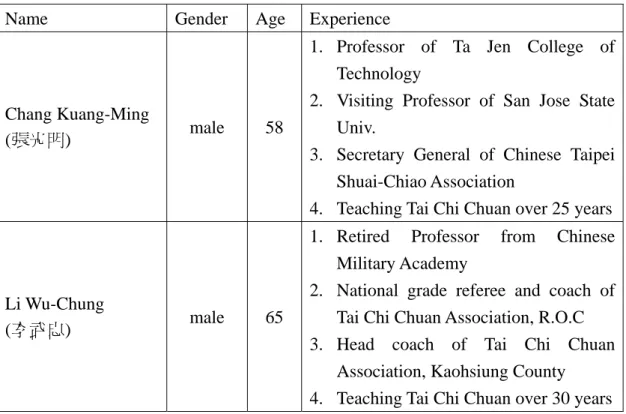
(25) Chuan (Chen, 陳怡靜,2001; Tai, 戴旭志,2000; Hsu, 徐必友,2000; Yie, 葉偉, 1997). Moreover, some literatures also articulated that Tai Chi thought is also helpful for pursuit of mental serenity (Hsu, 徐必友,2000; Kessenic, 1998; Su, 蘇清標,2003; Yie, 葉偉,1997). Hence, some people often find the abundant philosophic inspiration in the practice of Tai Chi Chuan, and it is commonly believed that practicing Tai Chi Chuan may make people become more cultural and increase wisdom (Hsu, 徐必友, 2000; Chen, 陳怡靜,2001, Su, 蘇清標,2003). Beside philosophic inspiration, Tai Chi Chuan has also been proved to be a kind of martial art that is able to make people healthier. Originally, Tai Chi Chuan was created for the use of self defense, but over time, the emphasis in Tai Chi evolved to the modern focus on slow, graceful and precise body movements designed to enhance well-being and health. Today, the focus in Tai Chi is on a stable body environment and a symbiosis of the mind and body (see the review in Kessenic, 1998). There are a plenty of benefits in Tai Chi Chuan practices, it has been verified that continued practice of Tai Chi strengthens one's vital energy and consequently reduces the potential for serious illness, and Tai Chi creates an environment of focused energy and increased awareness of one's breathing, flexibility, muscle control, and balance (see the review in Kessenic, 1998). Some western medical studies argued that Tai Chi Chuan practice is pretty good for the old people to prevent from falling (Gallagher, 2003; Gorman and Bjerklie, 2002; Kessenic, 1998; Li, Hong, and Chan,2001) because it can help the elder people improve their muscles. Thus, people can strengthen their muscles, improve their stability of physical body and make themselves to keep balanced while taking exercise by practicing Tai Chi Chuan, especially for those old people whose bones and muscles are too fragile to burden their weight (Gallagher, 2003; Gorman and Bjerklie, 2002; Kessenic, 1998; Li, Hong, and Chan, 2001; Tang and Ma, 譚永洁,馬彥君, 17.
(26) 1997; Yang, 楊軍,1997). Besides, some studies have supported that to practice Tai Chi Chuan is also helpful for lowering blood pressure in older adults nearly as much as moderate-intensity aerobic exercise for its slow and relax movements. Some other studies also revealed that to lower High blood pressure also reduces a risk factor for stroke and heart attack (Derrick,1998; Gallagher, 2003; Li, Hong, and Chan, 2001; Tang and Ma, 譚永洁,馬彥君,1997; Taylor and Froelicher , 2004; Yang, 楊軍, 1997). Some researches also mentioned about the effect Tai Chi Chuan help enhance cardio-respiratory fitness. Continuous Tai Chi Chuan practice can help people have better control of their hearts, and make the heart rate lower to strengthen their heart (Derrick,1998; Gallagher, 2003; Li, Hong, and Chan, 2001; Tang and Ma, 譚永洁,馬 彥君,1997; Taylor and Froelicher , 2004; and see the review in Tai, 戴旭志,2000). Meanwhile, previous researches on Tai Chi Chuan practitioners have also argued the positive effects on immune system, lowering anxiety, flexibility, mental and emotional control, digest system, and physical reactions for Tai Chi Chuan is a type of sport that especially emphasize on the cooperation of each part of body (Derrick,1998; Gallagher, 2003; Hsu,徐必友,2000; Li, Hong, and Chan, 2001; Su, 蘇清標,2003; Tang and Ma, 譚永洁,馬彥君,1997; Taylor and Froelicher , 2004; Yang, 楊軍, 1997; and see the review in Tai, 戴旭志,2000). To sum up, Tai Chi Chuan has already been proved to be beneficial for people to increase their physical fitness, including muscle and skeleton development, improvements of immune system, digest system, flexibility, etc. And it also does good to mental health like diminishing of anxiety and emotional control. Also, the abundant of philosophy do attract people to practice to pursue mental serenity and some other meanings in human life. And what cannot be forgotten is the self defense benefit of its martial art feature. 18.
(27) Chapter3 Research methodology 3.1 Research method This research adopts three methods to study the motives that motivate aged people to practice Tai Chi Chuan; the first one is two in-depth interviews on two masters in Tai Chi Chuan, by their abundant experience, they can provide some useful information about why their students feel like to participate in Tai Chi Chuan practice. The second one is focus group interview, in the interview, several Tai Chi Chuan participants who are all over 50 years old will be invited to share their participative motives on Tai Chi Chuan practice. The last one is questionnaire investigation method. In this phase, the results of interviews on two masters, the focus interview and the past literature will be concluded to make up a questionnaire to investigate the motives of these aged people.. 19.
(28) 3.2 In-depth interview In this research, two experienced Tai Chi Chuan masters were interviewed to tell what motivates their students to participate in Tai Chi Chuan. And the profiles of the two masters are as follows: Table 3-2: Profiles of two interviewed Tai Chi Chuan masters Name. Chang Kuang-Ming (張光明). Li Wu-Chung (李武忠). Gender. male. male. Age. Experience. 58. 1. Professor of Ta Jen College of Technology 2. Visiting Professor of San Jose State Univ. 3. Secretary General of Chinese Taipei Shuai-Chiao Association 4. Teaching Tai Chi Chuan over 25 years. 65. 1. Retired Professor from Chinese Military Academy 2. National grade referee and coach of Tai Chi Chuan Association, R.O.C 3. Head coach of Tai Chi Chuan Association, Kaohsiung County 4. Teaching Tai Chi Chuan over 30 years. 3.2.1 Interview with master Chang (張光明) In the first interview, master Chang shared the motives of participation in Tai Chi Chuan, and the summary is as follows: (1). Comparisons with other types of sports Tai Chi Chuan is slower, softer, and is able to make the whole body exercise. It is quite suitable for the middle age and old people to practice because a set of Tai Chi Chuan will last around 25-30 minutes. Besides, it can also be practiced to defense oneself or for attack use and the movements are all flexible and soft which make people not easily to get hurt. (2). Motives that influence people to practice Tai Chi Chuan Some students regard its movements are graceful and full of value of art, to be 20.
(29) appreciated by others. And some people may feel themselves belong to a group while they practice together. Moreover, some people think it is honorable when they make great progress in Tai Chi Chuan practice. (3). Differences in participative motives among Tai Chi Chuan participants between different age and gender Young adults (18-28 years old, whose education are over college degree) participate in the practice because of the aesthetic value of human body, some of them practice Tai Chi Chuan to control their weight or make their figures more attractive. And some practice it to learn the skills for combat or self defense, to make their body stronger or to improve their explosive power of muscles. As for the students who are under junior high school, most of them are not interested in Tai Chi Chuan because they think it is too slow. The middle-aged people (who are between 40-60 years old) participate in Tai Chi Chuan practice to keep them fit, or to release tension and prevent from disease. The aged people (who are over 60 years old) participate in it to keep themselves healthy and to pursue longevity. As a whole, the motives that make females to participate in is to make themselves relaxed or for recreation. In contrast, males are much more interested in exciting and fierce sports. But as for old Tai Chi Chuan participants, it does not make significant differences in participative motives because they both focus on the value of keeping healthy. In addition, compared with other sports, to practice Tai Chi Chuan does not need big spaces or expensive equipments, so it can be easily to practice anytime and everywhere. (4). Other motives except physical ones Psychologically, some people think it will earn respect if they practice Tai Chi Chuan and then they will receive appreciation from others. Besides, to associate with 21.
(30) others is also an important motive for the old people to participate in because these old people need affiliation. And some aged people participate in it as a tool to get familiar with others or to enhance their social status. As for the children, the motives that motivate them to participate in Tai Chi Chuan may be resulted from their families because some their family regards Tai Chi Chuan as family treasure so these children have to inherit these skills. Some other kids feel like to participate in it because they adore the heroes. 3.2.2 Interview with master Li (李武忠) In the second interview, master Li also shared some motives which influence his students to join in Tai Chi Chuan practice, and the following is the summary: (1). Physical health In fact, the original motive of Tai Chi Chuan participants is to keep themselves healthy or to improve their chronic disease, especially for the old people. Besides, to practice Tai Chi Chuan indeed help the old people develop their strength of legs to prevent them from falling. And some people continue practicing Tai Chi Chuan because it may make them feel vigorous, and they think they can take advantage of it to keep their body young. To sum up, Tai Chi Chuan can do good to both extrinsic and intrinsic strength. (2). Pressure release and mental discipline In addition to physical health, some people practice Tai Chi Chuan to release their daily pressure and for mental discipline because the movements of Tai Chi Chuan are quite slow and soft, and will be helpful for forgetting the trifles. So some people begin to practice Tai Chi Chuan when they feel unable to concentrate to their works. Moreover, Tai Chi Chuan is also regarded as a martial art that is very hard to master. After practicing it once again, a lot of people found them realize Tai Chi philosophy more and the concordance between body and mind is much better than ever. 22.
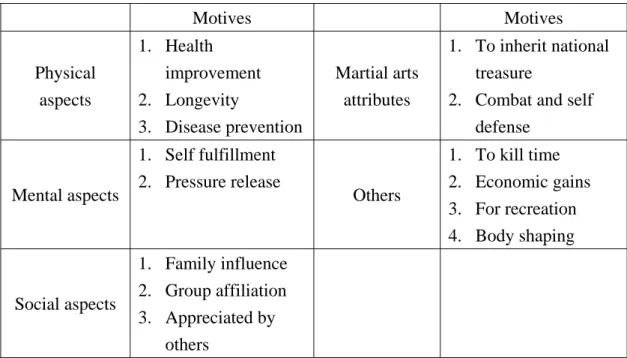
(31) (3). Affiliation Some people participate in Tai Chi Chuan because of their family and friends. Once these people find it good to practice, they will introduce Tai Chi Chuan to their friends. Additionally, some people continue participating in the practice because they have made some friends with the same interests, and this also strengthens their motives for participation. (4). Other motives Some motives also occur when a person practices Tai Chi Chuan. For example, economic gains, body shaping, combat skills improving, etc. These are all true for people to practice it. But for some people, they start to participate in Tai Chi Chuan practice may just for health. After they practice for a period of time, they will also find other advantages from it and these advantages will also be other motives for them to continue to participate in. Hence, some people practice Tai Chi Chuan to develop a habit of regular exercise. (5). Age and gender differences Actually, motives for old adults to practice Tai Chi Chuan are often health keeping. But for young adults, they are still healthy so they often participate in it because they want to develop martial arts skills, or to shape their bodies. Besides, among old adults, males are more motivated to develop martial skills and females are much motivated to practice it for health. Through these interviews on two experts, motives to practice Tai Chi Chuan can be concluded to be as follows:. 23.
(32) Table 3-3: motives to practice Tai Chi Chuan by interviewing the two masters. Physical aspects. Mental aspects. Social aspects. Motives. Motives. 1. Health improvement 2. Longevity 3. Disease prevention. 1. To inherit national treasure 2. Combat and self defense. Martial arts attributes. 1. Self fulfillment 2. Pressure release. Others. 1. Family influence 2. Group affiliation 3. Appreciated by others. 24. 1. 2. 3. 4.. To kill time Economic gains For recreation Body shaping.
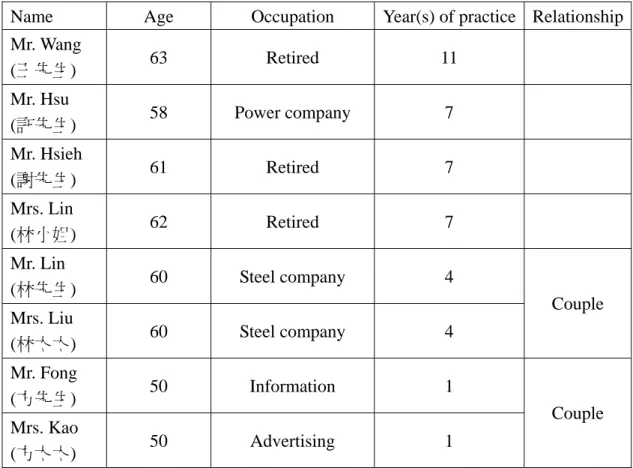
(33) 3.3 Focus group interview 3.3.1 Basic descriptions of the interview In this research, focus group interview is also used to find out the participative motives of Tai Chi Chuan. The interviewees are selected from Yang style Tai Chi Chuan association, Kaohsiung branch, R.O.C and their backgrounds are as follows. Besides, to protect their privacy, each first name is not shown in the table. Table 3-4: Background of the interviewees of focus group interview Name. Age. Occupation. Year(s) of practice Relationship. Mr. Wang (王先生). 63. Retired. 11. Mr. Hsu (許先生). 58. Power company. 7. Mr. Hsieh (謝先生). 61. Retired. 7. Mrs. Lin (林小姐). 62. Retired. 7. Mr. Lin (林先生). 60. Steel company. 4. Mrs. Liu (林太太). 60. Steel company. 4. Mr. Fong (方先生). 50. Information. 1. Mrs. Kao (方太太). 50. Couple. Couple Advertising. 1. From Table 3-3, the interviewees of this interview are all over 50 years old, and contain two couples in it. 3.3.2 Summary of the interview In this interview, a lot of precious experiences and personal motives are shared, and the following is the summary for the interview: (1). Physical aspect In the interview, the participants regard physical health as the most important 25.
(34) motive that drives them to participate in. Including pain improvement, to reinforce immuno-competence, development of muscles (especially for legs), to increase physical strength, to lower the fat of body, to further physical flexibility, to reinforce cardiopulmonary function, fall prevention, to improve arthrosis disease, etc. (2). Mental and spiritual aspects Besides, the interviewees also emphasize that some mental and spiritual motives also have great influence on them to make them continue participating, including tension release, to calm down their emotion, to cultivate their mind. (3). Family and group affiliation In the interview, the two couples both mentioned the motive that makes him/her participate in Tai Chi Chuan is their wives or husbands. And they are also motivated by their friends in the same group. Once they discover the people in the group are all easy going, it can be a strong motive that makes them continue participating in. (4). In pursuit of Tai Chi Chuan philosophies and martial arts skills These interviewees also mentioned that some Tai Chi Chuan philosophies also encourage them to continue to practice, when they practice once and again, they can find themselves grow up. Mrs. Kao even mentioned that she had admired those people who can practice Chinese Kung Fu well very much since she was still a young girl. Further, these old interviewees enjoy joint hands operation to improve their skills of martial art. (5). Other motives The motives to participate in Tai Chi Chuan are various. In the interview, these participants also shared some other motives like developing the sport habits, and to find a sport that is not restrained by the place. To conclude, in the interview, these participants all agree that the most important motive which makes them to participate in Tai Chi Chuan is the advantage for 26.
(35) physical health. But the longer they participate in, the better they know about Tai Chi Chuan. Therefore, the philosophies of Tai Chi Chuan and group affiliation and some other motives become more and more important as the years of practice increases. (6). Ambivalent motives In the focus group interview, some opinions of participative motives from the interviewees are ambivalent. And they may derive from the component of the interviewees. First, Mr. Wang and Mr. Hsieh regard to participate in Tai Chi Chuan can enhance their physical explosive force. But Mrs. Liu and Mrs. Kao do not think so. Second, the two couples mention that they both influence each other to participate in Tai Chi Chuan practice, but the others do not think they come to participate in the practice because of their family. Third, all interviewees regard that Tai Chi Chuan is a graceful martial art, but none of them agree that they come to join in the practice because of its graceful movements. Fourth, Mr. Hsieh, Mr. Fong and Mrs. Kao think Tai Chi Chuan can be practiced for recreation; especially when they get tired of their tasks. But they do not think they practice Tai Chi Chuan just kill time. This reveals something conflict with the in-depth interviews. The last, each interviewee agrees that to practice Tai Chi Chuan does not need big spaces and a lot of numbers to play with. But the same as the third one, they do not agree that can be a strong motive which makes them to participate in.. 27.
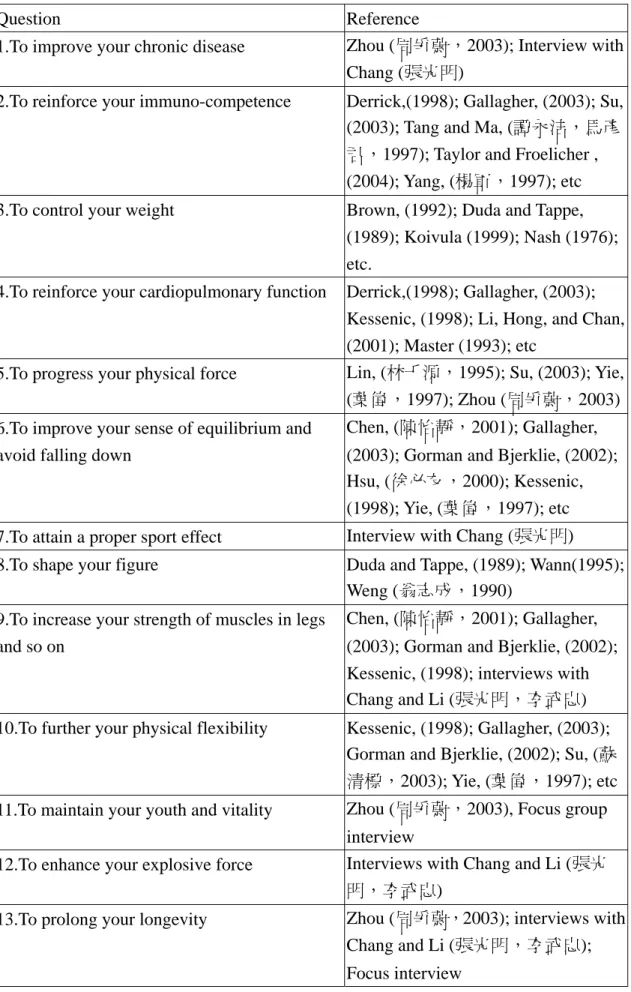
(36) 3.4 Questionnaire method 3.4.1The definition of variables This research collects data from Tai Chi Chuan participants by means of questionnaire method. And the definitions of variables are as follows: (1). Tai Chi Chuan There are a lot of styles of Tai Chi Chuan in Taiwan, including Chen style, Yang style, Cheng style, and so on. In this research, Tai Chi Chuan refers to all styles of Tai Chi Chuan and participative motives of each style are assumed to be the same. (2). Participants In this research, the participants of Tai Chi Chuan refer to people who have participated in Tai Chi Chuan practice, no matter how long the time they have practiced. Besides, the participants are limited to the people who live in Kaohsiung city and are over 50 years old. (3). Motives Motives refer to what motivate these Tai Chi Chuan participants to participate in the practices in this research. 3.4.2 Questionnaire design To study the participative motives of the aged people, this research conducts questionnaire investigation method to understand what motivates them to participate in Tai Chi Chuan practice. By literature review, in-depth interviews and a focus group interview, a questionnaire is made. To measure the participative motives, five-point Likert scale is adopted and associated reference are listed as follows:. 28.
(37) Table 3-5: The questionnaire and its references of each question Question. Reference Zhou (周爭蔚,2003); Interview with Chang (張光明). 1.To improve your chronic disease 2.To reinforce your immuno-competence. Derrick,(1998); Gallagher, (2003); Su, (2003); Tang and Ma, (譚永洁,馬彥 君,1997); Taylor and Froelicher , (2004); Yang, (楊軍,1997); etc. 3.To control your weight. Brown, (1992); Duda and Tappe, (1989); Koivula (1999); Nash (1976); etc.. 4.To reinforce your cardiopulmonary function. Derrick,(1998); Gallagher, (2003); Kessenic, (1998); Li, Hong, and Chan, (2001); Master (1993); etc Lin, (林千源,1995); Su, (2003); Yie, (葉偉,1997); Zhou (周爭蔚,2003). 5.To progress your physical force 6.To improve your sense of equilibrium and avoid falling down. Chen, (陳怡靜,2001); Gallagher,. 7.To attain a proper sport effect. Interview with Chang (張光明). 8.To shape your figure. Duda and Tappe, (1989); Wann(1995); Weng (翁志成,1990). 9.To increase your strength of muscles in legs and so on. Chen, (陳怡靜,2001); Gallagher,. 10.To further your physical flexibility. Kessenic, (1998); Gallagher, (2003); Gorman and Bjerklie, (2002); Su, (蘇 清標,2003); Yie, (葉偉,1997); etc. 11.To maintain your youth and vitality. Zhou (周爭蔚,2003), Focus group. 12.To enhance your explosive force. interview Interviews with Chang and Li (張光 明,李武忠). (2003); Gorman and Bjerklie, (2002); Hsu, (徐必友,2000); Kessenic, (1998); Yie, (葉偉,1997); etc. (2003); Gorman and Bjerklie, (2002); Kessenic, (1998); interviews with Chang and Li (張光明,李武忠). Zhou (周爭蔚,2003); interviews with Chang and Li (張光明,李武忠);. 13.To prolong your longevity. Focus interview. 29.
(38) Tai (戴旭志,2000); Zhou (周爭蔚,. 14.To follow the current trend of sports. 2003) Lai and Wu (森林,吳兆欣,1999); Lin, (林千源,1995); Lin (林彰榜, 2001); Weng (翁志成,1990);. 15.To transcend yourself. 16.To relax yourself into a selfless state. Wann(1995) Yie, (葉偉,1997); Hsu, (徐必友,. 17.To concentrate your attention. 2000) Yie, (葉偉,1997); Hsu, (徐必友, 2000). 18.To escape the pressure from work and daily Beard and Raghed, (1983); Lai and Wu (森林,吳兆欣,1999); Lin, (林 life 千源,1995); Nash (1976); Wann(1995); Yu and Wang (于海濤, 王鐵道,2000) 19.To increase your confidence. Huang (黃國恩,1996). 20.To be proud of yourself. Chen (陳顯宗,1991); Shieh (謝秀 芳,1996); Wann(1995). 21.To earn respects and compliments. Interview with Chang (張光明). 22.To help develop your social status. Chang (張志銘,1996); Tai (戴遐齡,. 23.To earn identity from your family and friends. 1997) Interviews with Chang and Li (張光 明,李武忠) Chen (陳文長,1995); Huang (黃文 祥,1998); Lei (雷鵬,2004); Lin, (林 千源,1995); Wang (1980);. 24.To associate with people. Wann(1995) 25.To practice with your family. Wann(1995); Interviews with Chang and Li (張光明,李武忠); Focus group interview Wann(1995); Zhou (周爭蔚,2003). 26.It is graceful to practice Tai Chi Chuan 27.The admirations for martial art. Yu and Wang (于海濤,王鐵道, 2000); interview with Chang (張光明). 28.Enjoy the pleasure of joint hands operation with others. Interviews with Chang and Li (張光 明,李武忠); Focus group interview. 29.To increase economic gains. Wann(1995); Interview with Chang (張光明). 30.To perform in public or join competitions. Chang (張志銘,1996); Yu and Wang. 30.
(39) (于海濤,王鐵道,2000); Zhou (周爭 蔚,2003) Chen, (陳怡靜,2001); Hsu, (徐必 友,2000); Su, (蘇清標,2003); Zhou (周爭蔚,2003). 31.To cultivate your mind and body. 32.To learn philosophical principles of Tai Chi Chen, (陳怡靜,2001); Hsu (徐必友, 2000); Su, (蘇清標,2003); Yie, (葉 Chuan 偉,1997) 33.To inherit and hand down Tai Chi Chuan. Zhou (周爭蔚,2003); Interviews with Chang and Li (張光明,李武忠). 34.To understand the rationale of Tai Chi Chuan. Lai and Peng (賴錦松,彭建偉,2003); Yu and Wang (于海濤,王鐵道,2000). 35.To learn skills of joint hands operation and self defense. Hsu (徐必友,2000); Lai and Peng (賴 錦松,彭建偉,2003); Yie, (葉偉,. 36.To develop sport habits. 1997) Interview with Chang (張光明);. 37.To seek a tender sport which is not easy to get hurt. Focus group interview Chen (陳顯宗,1991); Interview with Chang (張光明). 38.To motivate yourself to exercise. Chen (陳顯宗,1991). 39.To kill time. Tai (戴遐齡,1997); Interview with Chang (張光明). 40.View it as recreation. Huang (1996); Lin, (1995); Nash (1976); Tai (1997); Wann(1995) Interviews with Chang and Li (張光 明,李武忠); Focus group interview. 41.Without limitations of places and numbers of people. 42.Attracted by the people who practice Tai Chi Focus group interview Chuan To ensure the validity of this questionnaire, it has been sent to the advisor and the two masters who are mentioned above to examine whether the words are proper in the questionnaire. And then the revised questionnaires (shown above) were distributed to 10 Tai Chi Chuan participants to see if they are able to understand the questions. 3.4.3 Sampling method Because of lack of the member book of all Tai Chi Chuan associations in Kaohsiung, it is difficult to employ random sampling in this research. Instead, this 31.
(40) research exploits convenient sampling to collect data. Hence, questionnaires are distributed to Tai Chi Chuan groups who practice in parks, schools, and other places in Kaohsiung. Although these samples are selected on a convenience basis, this technique still has its benefits. For example, the rate of response was greater than that of typical mail survey. In this research, a total of 380 questionnaires were distributed, with a total return of 280 questionnaires, thus the attained call back rate is 73.68%. Then, 21 questionnaires that had same or missed answers were deleted. Hence, 259 valid returned questionnaires, 92.5% of the total samples. 3.4.4 Data analysis In this research, SPSS is used as our statistical tool to analyze data. And the statistical methods which are used just list as follows: (1). Descriptive statistics analysis To understand personal data of the samples in this research, descriptive statistics analysis is adopted. These personal dataset include gender, age, occupation, education, days of practice per week, time of practice every day, and years of practice. (2). Factor analysis Exploiting Principal Component Analysis to conduct factor analysis to extract common factors, and these factors will be used to conduct later analyses. (3). Cluster analysis Separating the whole samples into different clusters by factors to find out different groups that emphasize on different participative motives. (4). One-way ANOVA First, to inspect the relations between clusters and factors. And then, to see if there is any difference between clusters and personal data like age, education, days of practice per week, time of practice every day, years of practice. (5). Chi-square 32.
(41) To examine the relations between clusters and personal data like gender and occupation. (6). Correlation To find out the most important personal data that influences the factors.. 33.
(42) 3.5 Research limitations Due to finite resources of human, time, and expense, this research has limitations as follows: (1) Because of lack of member book of Tai Chi Chuan participants, this research only exploits convenient sampling instead of random sampling. Hence, the representative effect of samples may be suspicious. (2) This research only studies aged Tai Chi Chuan participants in Kaohsiung City. Therefore, the samples can not represent all aged Tai Chi Chuan participants in Taiwan.. 34.
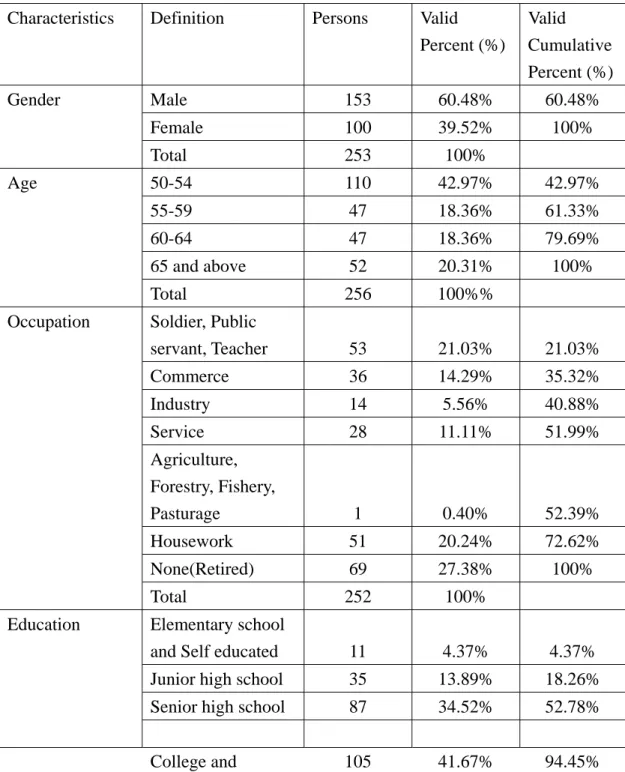
(43) Chapter4 Results and discussion 4.1 Descriptive statistics analysis First of all, descriptive statistics analysis is used to understand the characteristics of the samples. Table 4-1 shows the statistics of personal data in this research. Table 4-1: Descriptive statistics of personal data Characteristics. Definition. Gender. Male. Age. Occupation. Education. Persons. Valid Percent (%). Valid Cumulative Percent (%). 153. 60.48%. 60.48%. Female. 100. 39.52%. 100%. Total. 253. 100%. 50-54. 110. 42.97%. 42.97%. 55-59. 47. 18.36%. 61.33%. 60-64. 47. 18.36%. 79.69%. 65 and above. 52. 20.31%. 100%. Total. 256. 100%%. Soldier, Public servant, Teacher. 53. 21.03%. 21.03%. Commerce. 36. 14.29%. 35.32%. Industry. 14. 5.56%. 40.88%. Service. 28. 11.11%. 51.99%. Agriculture, Forestry, Fishery, Pasturage. 1. 0.40%. 52.39%. Housework. 51. 20.24%. 72.62%. None(Retired). 69. 27.38%. 100%. Total. 252. 100%. Elementary school and Self educated. 11. 4.37%. 4.37%. Junior high school. 35. 13.89%. 18.26%. Senior high school. 87. 34.52%. 52.78%. College and. 105. 41.67%. 94.45%. 35.
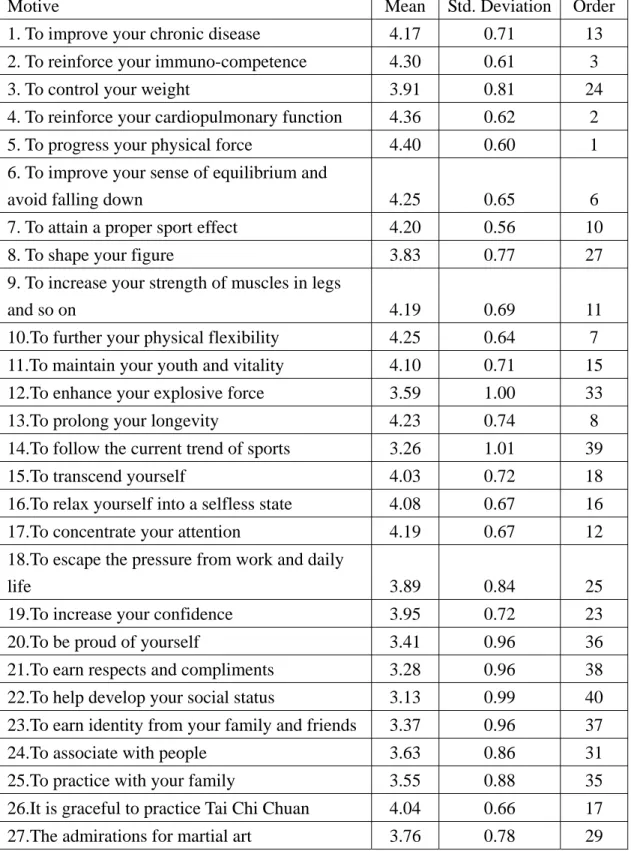
(44) University. Days of practice per week. Time of practice every day. Years of practice. Graduate school and above. 14. 5.55%. Total. 252. 100%. One day. 15. 5.86%. 5.86%. Two days. 24. 9.38%. 15.24%. Three days. 42. 16.41%. 31.65%. Four days. 27. 10.55%. 42.2%. Five days and above. 148. 57.81%. 100%. Total. 256. 100%. 30 minutes and under. 19. 7.39%. 7.39%. 30-60 minutes. 88. 34.24%. 41.63%. 60-90 minutes. 97. 37.74%. 79.37%. 90-120 minutes. 37. 14.40%. 93.77%. Over 120 minutes. 16. 6.23%. 100%. Total. 257. 100%. Under 1 year. 40. 15.87%. 15.87%. 1-3 years. 45. 17.86%. 33.73%. 3-5 years. 55. 21.83%. 55.56%. 5-10 years. 47. 18.65%. 74.21%. Over 10 years. 65. 25.79%. 100%. Total. 252. 100%. 100%. Within 253 effective samples, 153 are male and 100 are female. About age, 50-54 accounts nearly 43% and is more than other ages. As for occupation, soldier, public servant and teacher account the biggest percentage, and housework is only second to that. Besides, 41.67% of the samples have a degree at college level. 57.81% of the participants practice at least 5 days a week and all of the samples practice about 60-90 minutes every day. Finally, people who have practiced at least 10 years is at the first place of years of practice, and the second is 3-5 years. Each mean score of the motives is listed in table 4-2, and all of the means are between 4.40 to 2.71. The top three are “To progress your physical force”, “To 36.
(45) reinforce your cardiopulmonary function”, “To reinforce your immuno-competence”. The last three are “To perform in public or join competitions”, “To increase economic gains”, “To help develop your social status”. Table 4-2: Mean and order of each motive Motive. Mean. Std. Deviation. Order. 1. To improve your chronic disease. 4.17. 0.71. 13. 2. To reinforce your immuno-competence. 4.30. 0.61. 3. 3. To control your weight. 3.91. 0.81. 24. 4. To reinforce your cardiopulmonary function. 4.36. 0.62. 2. 5. To progress your physical force. 4.40. 0.60. 1. 6. To improve your sense of equilibrium and avoid falling down. 4.25. 0.65. 6. 7. To attain a proper sport effect. 4.20. 0.56. 10. 8. To shape your figure. 3.83. 0.77. 27. 9. To increase your strength of muscles in legs and so on. 4.19. 0.69. 11. 10.To further your physical flexibility. 4.25. 0.64. 7. 11.To maintain your youth and vitality. 4.10. 0.71. 15. 12.To enhance your explosive force. 3.59. 1.00. 33. 13.To prolong your longevity. 4.23. 0.74. 8. 14.To follow the current trend of sports. 3.26. 1.01. 39. 15.To transcend yourself. 4.03. 0.72. 18. 16.To relax yourself into a selfless state. 4.08. 0.67. 16. 17.To concentrate your attention. 4.19. 0.67. 12. 18.To escape the pressure from work and daily life. 3.89. 0.84. 25. 19.To increase your confidence. 3.95. 0.72. 23. 20.To be proud of yourself. 3.41. 0.96. 36. 21.To earn respects and compliments. 3.28. 0.96. 38. 22.To help develop your social status. 3.13. 0.99. 40. 23.To earn identity from your family and friends. 3.37. 0.96. 37. 24.To associate with people. 3.63. 0.86. 31. 25.To practice with your family. 3.55. 0.88. 35. 26.It is graceful to practice Tai Chi Chuan. 4.04. 0.66. 17. 27.The admirations for martial art. 3.76. 0.78. 29. 37.
(46) 28.Enjoy the pleasure of joint hands operation with others. 3.76. 0.83. 28. 29.To increase economic gains. 2.74. 0.99. 41. 30.To perform in public or join competitions. 2.71. 1.11. 42. 31.To cultivate your mind and body. 4.29. 0.57. 4. 32.To learn philosophical principles of Tai Chi Chuan. 4.02. 0.70. 19. 33.To inherit and hand down Tai Chi Chuan. 3.60. 0.88. 32. 34.To understand the rationale of Tai Chi Chuan. 3.95. 0.66. 22. 35.To learn skills of joint hands operation and self defense. 3.98. 0.67. 20. 36.To develop sport habits. 4.27. 0.56. 5. 37.To seek a tender sport which is not easy to get hurt. 4.22. 0.55. 9. 38.To motivate yourself to exercise. 3.89. 0.78. 26. 39.To kill time. 3.56. 0.96. 34. 40.View it as recreation. 3.96. 0.71. 21. 41.Without limitations of places and numbers of people. 4.15. 0.68. 14. 42.Attracted by the people who practice Tai Chi Chuan. 3.64. 0.85. 30. 38.
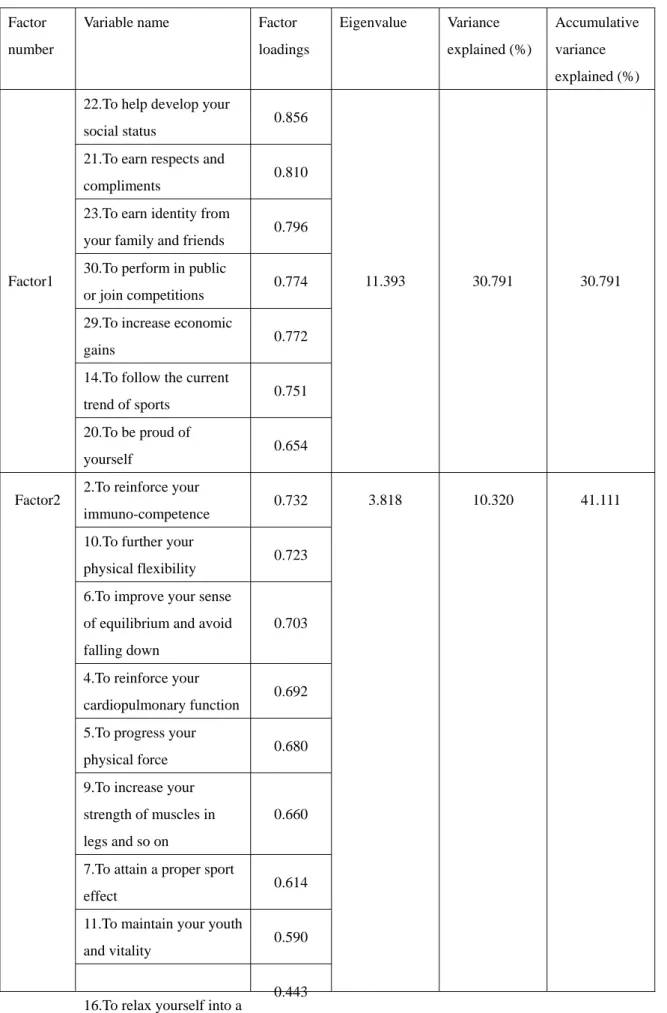
(47) 4.2 Factor analysis To realize what motives indeed motivate the aged people to participate in Tai Chi Chuan practice, factor analysis is conducted to extract common features in this research. In factor analysis, there are five questions not included in the factor analysis because each of them reveals nothing in common with its factor. Besides, according to the focus group interview held before, these questions gained conflict opinions among the interviewees. Hence, the five questions are not included in the later factor analysis. The five questions are: “12.To enhance your explosive force”, “25.To practice with your family”, “26.It is graceful to practice Tai Chi Chuan”, “39.To kill time”, and “41.Without limitations of places and numbers of people”. Later, factor analysis is conducted again and only contains 37 questions in it. In the factor analysis, Bartlett's Test of Sphericity attains to 4268.79, and Kaiser-Meyer-Olkin Measure of Sampling Adequacy attains to 0.901. As the result, it reveals that the samples are quite suitable for factor analysis. And then this research use method of principal component extraction with varimax rotation is used to minimize the number of variables and to pursue high loadings on each factor and to simplify the interpretations of the factors. In this research, factors which eigenvalue is higher than 1 are extracted. Six factors were extracted and their accumulative variance explained attain to 58.297%. The factors of participative motives are shown in table 4-3, including factor number, variable names, factor loadings, eigenvalue, percent of variance explained, and accumulative percent of variance explained.. 39.
(48) Table 4-3: Factors of participative motives Factor. Variable name. number. Factor. Eigenvalue. loadings. Variance. Accumulative. explained (%). variance explained (%). 22.To help develop your social status 21.To earn respects and compliments 23.To earn identity from your family and friends Factor1. 30.To perform in public or join competitions 29.To increase economic gains 14.To follow the current trend of sports 20.To be proud of yourself. Factor2. 2.To reinforce your immuno-competence 10.To further your physical flexibility. 0.856. 0.810. 0.796. 0.774. cardiopulmonary function 5.To progress your physical force. 0.732. 0.723. 0.703. 0.692. 0.680. 0.660. legs and so on 7.To attain a proper sport effect 11.To maintain your youth and vitality. 16.To relax yourself into a. 3.818. 10.320. 41.111. 0.654. 9.To increase your strength of muscles in. 30.791. 0.751. falling down 4.To reinforce your. 30.791. 0.772. 6.To improve your sense of equilibrium and avoid. 11.393. 0.614. 0.590. 0.443 40.
(49) selfless state 1.To improve your chronic disease. 0.432. 34.To understand the rationale of Tai Chi. 0.711. Chuan 35.To learn skills of joint hands operation and self. 0.698. defense 32.To learn philosophical principles of Tai Chi Factor3. 0.633. Chuan 27.The admirations for martial art 33.To inherit and hand down Tai Chi Chuan. 2.657. 7.182. 48.293. 1.408. 3.806. 52.098. 1.199. 3.241. 55.340. 0.608. 0.590. 28.Enjoy the pleasure of joint hands operation with. 0.582. others 38.To motivate yourself to exercise. 0.700. 36.To develop sport habits. 0.666. 40.View it as recreation. 0.601. 37.To seek a tender sport which is not easy to get Factor4. 0.601. hurt 24.To associate with people. 0.532. 42.Attracted by the people who practice Tai Chi. 0.493. Chuan 18.To escape the pressure from work and daily life Factor5. 13.To prolong your longevity 17.To concentrate your attention 15.To transcend yourself. 0.445. 0.661. 0.594 0.559 41.
(50) 31.To cultivate your mind and body 19.To increase your confidence Factor6. 0.537. 0.434. 3.To control your weight. 0.757. 8.To shape your figure. 0.510. 1.094. 2.957. 58.297. After factor analysis, the motives for participation in Tai Chi Chuan for the aged people can be divided into six dimensions. Each factor is named as follows: Factor 1: Including 7 motives. As a whole, they all refer to perform outside to earn identity from the others, and to make economic gains. Therefore, Factor1 is named “Extrinsic behavior and identity”. Factor 2: Including 10 motives. They all mention about physical and mental health. Hence, Factor2 is named “Improving physical and mental health”. Factor 3: Including 6 motives. These motives all refer to pursue the nature and the skills of Tai Chi Chuan. Consequently, Factor3 is named “Pursuit of Tai Chi Chuan philosophy and skills”. Factor 4: Including 7 motives. And they mention about recreation, escape from pressure and to make friends. Therefore, Factor4 is named “Recreation, escape from pressure, and making friends”. Factor 5: Including 5 motives. They are related to longevity, mental well-being, and self cultivation. So Factor5 is named “Longevity and soul inspiration”. Factor 6: Including 2 motives. They both mention about the figure of the body. Therefore, Factor6 is named “Body shaping”. Besides, to ensure the reliability and validity of the factors, Cronbach’s αis used to examine their internal reliability and the result is shown in table 4-4. Table 4-4 reveals each Cronbach’s α of the dimensions is from 0.776 to 0.913, and the reliability of this questionnaire attains to 0.946. Therefore, its reliability is quite high. 42.
(51) As for the communality, most of the variables are over 0.5 except some only between 0.4 and 0.5. Thus, the communality can be quite good. Table 4-4: reliability and communality of the factors of Tai Chi Chuan participative motives for aged people Factor name. Variable number. Cronbach’s α. 14. 0.606. 20. 0.489. 21. 0.614. Extrinsic behavior and identity. Communality. 0.913. 22. 0.503. 23. 0.505. 29. 0.557. 30. 0.762. 1. 0.402. 2. 0.593. 4. 0.771. 5. 0.626. Improving physical. 6. and mental health. 7. 0.628. 9. 0.549. 10. 0.603. 11. 0.507. 16. 0.662. 27. 0.565. 28. 0.502. Pursuit of Tai Chi Chuan philosophy and. 0.880. 32. 0.834. 0.575. 0.651. 33. 0.683. 34. 0.583. 35. 0.656. 18. 0.503. 24. 0.505. Recreation, escape. 36. 0.557. from pressure, and. 37. making friends. 38. 0.793. 40. 0.737. 42. 0.566. skills. 0.780. 43. 0.762.
(52) 13. 0.634. 15. 0.631. Longevity and soul inspiration. Body shaping. 0.787. 17. 0.614. 19. 0.503. 31. 0.505. 3. 0.776. 8. 0.771 0.626. Cronbach’s α on all questions=0.946. 44.
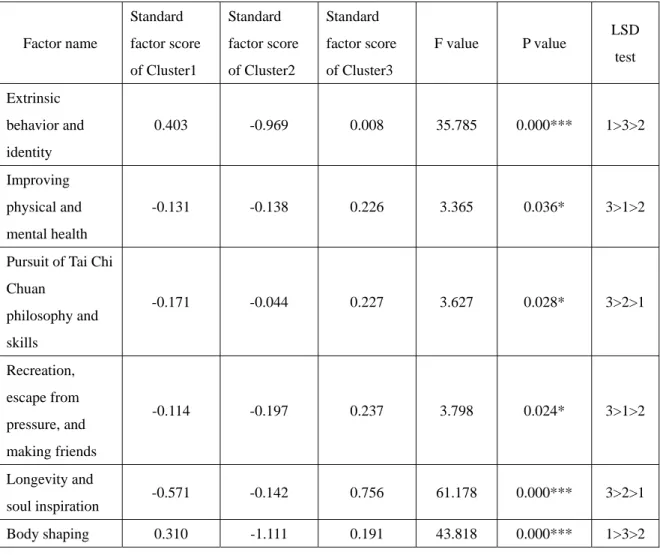
(53) 4.3 Cluster analysis To separate the samples into different groups which emphasize different motives. This research employs Ward’s method as the tool for cluster analysis, and then divides the samples into several clusters according to the factors. After several tests, the separation effect can be the best while separating the samples into three clusters. The frequencies of each cluster are shown in table 4-5. Table 4-5: Frequencies of the clusters Cluster. 1. 2. 3. Missing. Total. Samples. 97. 41. 81. 40. 259. Valid percent (%). 44.29%. 18.72%. 36.99%. 100%. In table 4-5, some of the samples have missing data in it and can not be separated by cluster analysis. The rest samples are separated into three clusters apparently, this means that it the samples are well separated by the results from factor analysis. The first cluster has 97 people in it, the second is 41 and the third is 81. Next, to inspect whether there are significant differences between the clusters and the factors, One-way ANOVA is employed to examine the differences. The standard factor score of each cluster and LSD test are used to inspect which factors influence the separation of the cluster higher. The result is shown in table 4-6.. 45.
數據

+7

相關文件
- [ Configuration Properties > Microsoft Macro Assembler > General > Include Paths ]. • Enter the paths to your
Webots also contains a number of interfaces to real mobiles robots, so that once your simulated robot behaves as expected, you can transfer its control program to a real robot
Once you get down to a purely business level, your influence is gone and the true light of your life isdimmed. You must work in the missionary spirit, with a breadth of charity
The broken teapots have been kept aside ______ you need them to support a claim on your suppliers
Providing participants with opportunities to design appropriate tasks and activities to help students develop their skills in selecting, extracting, summarising and
How Can Parents Help Their Children Adapt to School Life Home-School Co-operation for Nurturing the New Generation Develop Children’s Potential through Comprehensive and
Oxford Learner’s Dictionary 最潮的英⽂7. Urban
Recycling Techniques are Available to Address Specific Pavement Distress and/or Pavement Structural Requirement.. Introduction to Asphalt Introduction
