國立交通大學
資訊工程學系
博士論文
提升固定式與行動通訊整合環境之號碼可攜服務效能
Enhancing The Efficiency Of Number Portability Service On
Fixed-Mobile Convergence Environment
研 究 生 : 鄭靜紋
指導教授 : 鍾乾癸 博士
提升固定式與行動通訊整合環境
之號碼可攜服務效能
Enhancing The Efficiency of Number Portability Service on
Fixed-Mobile Convergence Environment
研究生: 鄭靜紋
Student: Ching-Wen Cheng
指導教授 : 鍾乾癸 博士
Advisor: Dr. Chyan-Goei Chung
國立交通大學
資訊工程學系
博士論文
A Dissertation Submitted to Department of Computer Science
College of Computer Science National Chiao Tung University in partial Fulfillment of the Requirements
for the Degree of Doctor of Philosophy
In
Computer Science July 2007
Hsinchu, Taiwan, Republic of China
中華民國九十六年七月
國
立
交
通
大
學
博 碩 士 論 文 全 文 電 子 檔 著 作 權 授 權 書
(提供授權人裝訂於紙本論文書名頁之次頁用)
本授權書所授權之學位論文,為本人於國立交通大學 資訊工程 系所
______組, 95 學年度第_2__學期取得博士學位之論文。
論文題目:提升固定式與行動通訊整合環境之號碼可攜服務效能
指導教授:鍾乾癸
■ 同意 □不同意
本人茲將本著作,以非專屬、無償授權國立交通大學與台灣聯合大學系統圖
書館:基於推動讀者間「資源共享、互惠合作」之理念,與回饋社會與學術
研究之目的,國立交通大學及台灣聯合大學系統圖書館得不限地域、時間與
次數,以紙本、光碟或數位化等各種方法收錄、重製與利用;於著作權法合
理使用範圍內,讀者得進行線上檢索、閱覽、下載或列印。
論文全文上載網路公開之範圍及時間:
本校及台灣聯合大學系統區域網路
■ 中華民國 96 年 7 月 31 日公開
校外網際網路
■ 中華民國 96 年 7 月 31 日公開
授 權 人:鄭靜紋
親筆簽名:______________________
中華民國 96 年 7 月 31 日
國
立
交
通
大
學
博 碩 士 紙 本 論 文 著 作 權 授 權 書
(提供授權人裝訂於全文電子檔授權書之次頁用)
本授權書所授權之學位論文,為本人於國立交通大學 資訊工程 系所
______組, 95 學年度第_2__學期取得博士學位之論文。
論文題目:提升固定式與行動通訊整合環境之號碼可攜服務效能
指導教授:鍾乾癸
■ 同意
本人茲將本著作,以非專屬、無償授權國立交通大學,基於推動讀者間「資
源共享、互惠合作」之理念,與回饋社會與學術研究之目的,國立交通大學
圖書館得以紙本收錄、重製與利用;於著作權法合理使用範圍內,讀者得進
行閱覽或列印。
本論文為本人向經濟部智慧局申請專利(未申請者本條款請不予理會)的附
件之一,申請文號為:____________________,請將論文延至____年____月
____日再公開。
授 權 人:鄭靜紋
親筆簽名:______________________
中華民國 96 年 7 月 31 日
國家圖書館博碩士論文電子檔案上網授權書
ID:GT008617815
本授權書所授權之論文為授權人在國立交通大學 資訊 學院 資訊工程 系所
_________ 組 _95_學年度第_2_學期取得博士學位之論文。
論文題目:提升固定式與行動通訊整合環境之號碼可攜服務效能
指導教授:鍾乾癸
茲同意將授權人擁有著作權之上列論文全文(含摘要)
,非專屬、無償授權國家
圖書館,不限地域、時間與次數,以微縮、光碟或其他各種數位化方式將上列論
文重製,並得將數位化之上列論文及論文電子檔以上載網路方式,提供讀者基於
個人非營利性質之線上檢索、閱覽、下載或列印。
※ 讀者基於非營利性質之線上檢索、閱覽、下載或列印上列論文,應依著作權法相關規定辦理。
授權人:鄭靜紋
親筆簽名:_______________
民國 96 年 7 月 31 日
提升固定式與行動通訊整合環境之號碼可攜服務效能
學生:鄭靜紋
指導教授:鍾乾癸博士
國立交通大學資訊工程系博士班
摘要
在通訊環境整合之前, 固接式電話(fixed- lined)與行動電話(mobile)通常各別 維 運 , 通 訊 服 務 也各 自 獨 立 。 固 定 式 與 行 動 通 訊 整 合 環 境( Fixed-mobile convergence, FMC)提供一個可供固接式與行動電話業者互通並分享服務的共同 平台, 將兩種電信網路的通訊服務、通訊網路、以及營運與商業模式結合為一個 整體。在此平台上,固接式與行動電話的使用者能無阻礙地彼此通訊。 隨著通訊技術精進,電信自由化,以及通訊市場成熟,更多業者投入 FMC 的電信通訊市場。使用者有更多機會根據業者提供的服務項目、服務品質、以及 收費機制選擇最適合的電信公司,更換電信服務公司的意願與機會也隨之提高。 在此競爭激烈的電信環境中,能讓使用者即使更換電信服務公司,也依然能保有 原來電話號碼的號碼可攜服務(number portability service)成為重要的服務項目。 電信公司必須提供號碼可攜服務以吸引更多使用者,藉此提昇本身的市場競爭 力。 號碼可攜服務實行之前,每個固接式或行動電話號碼可對應到使用者所屬電 信服務公司的特定交換機,經由該交換機即可連結到該號碼對應的實際位址。然 而,號碼可攜服務打散了電話號碼與電信公司以及使用者實際位址之間的關連 性。為了將可攜式號碼重新對應至使用者的實際位址,電信公司必須建立一個共 有的可攜式號碼資料庫(number portability database, NPDB)以管理 FMC 環境中所有可攜式號碼與使用者實際所在位址間的對應關係,並委由一個中立的可攜式 號碼管理機構(number portability administration center, NPAC)管理。電信公司 經由查詢 NPAC 而將可攜式號碼轉換為使用者的實際位址,進而接通撥打給可攜 式號碼的電話。 NPDB 的規模會隨著號碼可攜服務的使用者增加而擴大,當使用者數量很大 時,NPDB 隨之增大,可能造成資料搜尋時間增加,使得整體可攜式號碼轉換的 時間延長。然而,NPAC 的處理速度以及傳輸流量皆有限,為了進行可攜式號碼 轉換所引發的大量 NPAC 查詢可能造成 NPAC 與網路壅塞,並阻礙其他話務進 行。此外,自使用者撥出電話號碼開始,直到電話被接通,需佔用通訊頻寬進行 接通話務的訊號傳輸。當撥打給可攜式號碼的電話數量增加,而可攜式號碼轉換 的時間又延長,會降低通訊網路的使用效能與服務品質。 電信網路的架構設計使可攜式號碼的處理、以及號碼轉換時所需要的知識都 集中在交換網路(switching network),要提高號碼可攜服務效能,必須降低交換 網路壅塞的可能性;因此,必須減少 NPAC 查詢的數量才能提升號碼可攜服務的 效能。根據這項觀察結果,我們提出將可攜式號碼轉換所需的知識分散到其他電 信網路元件,由其他電信網路元件負責可攜式號碼轉換,藉此減輕 NPAC 的運算 負擔以及所需處理的話務量。 根據這個想法,我們經由分析使用者的移動與通話行為,提出三項新的機 制,以提升 FMC 環境中號碼可攜服務的效能: 1. 對於傳統固接式電話網路,我們提出將可攜式號碼轉換的知識與功能建立在 PBX 上。若大部分的可攜式號碼皆在 PBX 就被轉換為受話端的實際位址, NPAC 的查詢量將得到紓解,可攜式號碼查詢與轉換的時間縮短,可使號碼 可攜服務效能提升。 2. 對於並未提供數據通訊頻道的 2G 行動通訊系統,我們提出的作法是以學 校、辦公大樓、工廠等機構的區域網路為基礎,建立行動通訊的 PBX 系統, 並將可攜式號碼轉換的知識與功能建立在這類行動通訊 PBX 上,以達到提
升號碼可攜服務效能的目的。 3. 對於具有數據通訊特性的 3G 行動通訊系統,我們提出的機制為:將個人化 的可攜式號碼轉換知識存放於使用者端的智慧型手機,並利用 IP 網路更新 手機上的知識,在使用者終端進行可攜式號碼轉換。此方法可將 NPAC 的查 詢量減到最小,能最有效地紓解經由查詢 NPAC 以獲取受話端實際位址所造 成的號碼轉換延遲。 在此論文中,我們證明經由上述的三項機制,可正確地將可攜式號碼轉換為受話 端的實際位址,並可有效減少對 NPAC 進行可攜式號碼轉換的查詢量,降低可攜 式號碼轉換所造成的延遲,提高號碼可攜服務的效能,並且可增進電信網路的使 用效能與服務品質。所提出的方法對使用者以及電信服務提供者都有實際上的效 益。
Enhancing The Efficiency of Number Portability
Service On Fixed-Mobile Convergence Environment
Student: Ching-Wen Cheng
Advisor: Dr. Chyan-Goei Chung
Department of Computer Science
College of Computer Science
National Chiao Tung University
Abstract
Fixed and mobile convergence (FMC) is the combination of previously separate fixed and mobile services, networks, and commercial practices. A common platform to access both fixed and mobile telecommunications services is provided in FMC environment, such that users can set up calls to both fixed and mobile telecommunication systems.
Deregulation, market demand, and technological development encourage more service providers to join FMC telecommunications market. Users have more choices and are more likely to change service providers according to the service, quality, and the billing policy offered by the operators. Number portability (NP) service allows a user to keep the same telephone number when changing operators. In the competitive telecommunications market, operators must provide NP service to attract subscribers and to enhance their competitiveness.
However, NP service broke the relation between telephone numbers and the destination networks. For allowing switching systems to translate a ported number to the destination address, telecommunication operators establish a neutrally operated number portability administration center (NPAC) with a global NP database (NPDB) together to maintain the mapping of ported numbers and the information to reach the destination. NPDB maintains the mapping information of all ported numbers of the FMC environment. The size of NPDB grows enormously along the increase of NP users. The increase of NP users results in a huge NPDB will prolong the latency of data searching. The process and traffic capacity of NPAC is limited that the enormous NPAC queries for ported number translations may block other queries and cause congestion of the switching network. In addition, the communication resource is
occupied in call setup process. A large amount of NPAC queries will degrade the utility and service quality of the communication network.
Studying the architecture of telecommunications networks, the process and the knowledge of ported number translation is centralized in the switching networks. The efficiency of NP service can be enhanced by minimizing message passing for ported number translation. Hence, our approach is to dispatch the process and the knowledge of ported number translation to other network entities to alleviate the workload and the offered traffic of NPAC.
Based on the concept, we investigate the mobility and calling behavior of users and propose three new mechanisms for providing efficient NP service in FMC environment:
1. For fixed-line telecommunication systems, we propose to provide ported number translation functions in PBX-based telecommunications networks. When most NP calls can be translated in local telecommunications network, NPDB queries will be reduced and the efficiency of NP call setup will be enhanced.
2. For 2G mobile telecommunications system which does not provide data
transmission channel, we propose an organization-based mobile telecommunications network to act as a mobile PBX to perform ported number translations in mobile local networks.
3. For 3G mobile telecommunications system which provides data communication
features, we propose a mechanism to update routing information from NPAC to intelligent user terminals (e.g., 3G/WLAN dual- mode mobile handsets) via IP (Internet protocol) network. Thus, the routing information of ported numbers can be solved in user-end.
In this dissertation we prove that the amount of NP queries can be remarkably reduced by the above proposed mechanisms; hence, the efficiency and performance of NP service can be improved without affect the profit of telecommunications operators and users.
誌謝
能夠進入交大就讀,並且順利完成這篇論文,是幸運而快樂的經
歷!最感謝的是我的指導教授鍾乾癸老師,在我碩、博士修業期間,
不論學業或待人處世方面,始終不厭其煩地諄諄教誨。老師認真負
責、人本思考的嚴謹態度,以及鼓勵與包容多元思考的氣度,始終為
我表率。也要感謝師母吳秀琴老師一直不斷給予我關心與鼓勵。
更特別感謝饒仲華博士,在我就業與博士班就學期間,容忍我的
莽撞與不成熟,引領我拓展研究與實務應用的新視野。
在此感謝撥冗參與口試審查會的林一平教授、陳耀宗教授、陳澤
雄教授、楊竹星教授、以及蔡志宏教授(以上按姓氏筆劃排列)的指
導與寶貴意見,皆是我往後需時時參考與警惕的原則。
感謝所有給予我指導與鼓勵的老師們,也謝謝甘苦與共的實驗室
夥伴們,使我有機會成長,同時讓研究生涯增添許多樂趣。一直受到
太多人的幫助,無法一一表示,在此一併致謝!
最後,衷心感謝家人對我的支持與鼓勵。謹將這份榮耀獻給我的家
人,並致上最誠摯的謝意!
Index
List of Figures ... iii
List of Tables ... v List of Tables ... v 摘要 i Abstract iv 誌謝 vi Chapter 1. Introduction... 1
Chapter 2. Background and related works ... 7
2.1 Background ... 7
2.2 Related works ... 14
Chapter 3. An organization-based cache approach for supporting fixed- lined telecommunications number portability service... 18
3.1 Motivation... 18
3.2 Applying caches to PBX-based networks... 19
3.2.1 Issues... 21
3.3 Cost and performance evaluation ... 25
3.3.1 Cost evaluation ... 25
3.3.2 NP call setup time evaluation ... 26
Chapter 4. An organization-based cache mechanism for supporting PCS number portability service ... 31
4.1 Motivation... 31
4.2 Design of iNetwork... 32
4.2.1 iNetwork architecture ... 33
4.2.2 iNetwork operation model ... 37
4.3 Providing mobile NP service by utilizing OGB mobile telecommunication system ... 41
4.3.1 Call setup process in an iNetwork ... 42
4.3.2 Set up an NP call to the GSM system... 44
4.3.3 Side effects of OGB-based cache ... 45
4.4 Cache establishment and update ... 45
4.5 Cost and benefit analysis ... 46
4.5.1 Comparison of NP call setup time ... 47
4.5.2 Cost-benefit analysis... 50
mobile number portability service ... 52
5.1 Introduction... 52
5.2 The implementation of dual- mode mobile NP service ... 54
5.2.1 Utilize SS information to enhance mobile NP service... 54
5.2.2 Update cached data ... 56
5.2.3 The worse case... 58
5.3 Performance and cost analysis of user-end caching ... 59
5.3.1 The evaluation of call setup time and NPAC traffic load ... 59
5.3.2 The evaluation of NP call setup delay ... 60
5.4 Alleviate COD and VHO overhead of using 3G/WLAN DMS... 61
5.4.1 Issues and problem analysis... 63
5.4.2 Design of DMS training algorithm (DTA) ... 65
5.5 Analysis model and performance evaluation of DTA ... 67
5.5.1 Analysis model ... 67 5.5.2 Performance evaluation ... 70 5.6 Conclusion... 72 Chapter 6. Conclusion... 74 6.1 Conclusion... 74 6.2 Future works ... 76 References... 77
List of Figures
Fig. 1-1 The approaches of applying caches to telecommunication networks ... 3
Fig. 1-2 The bottleneck of NP service ... 4
Fig. 2-1 The hierarchy of telecommunication networks ... 7
Fig. 2-2: SRF-based NP call routing... 9
Fig. 2-3 IN-based number portability service architecture ... 10
Fig. 2-4 IN-based solution of NP call routing ... 11
Fig. 2-5 Off-switch NP schemes ... 12
Fig. 2-6 The bottleneck of NP service ... 14
Fig. 3-1 The hierarchy of telecommunication networks... 19
Fig. 3-2 An OAI-enabled PBX ... 20
Fig. 3-3 A special code (e.g., *14*) is used to indicate a cache hit ... 20
Fig. 3-4 Simplified NP call setup stages and time table ... 26
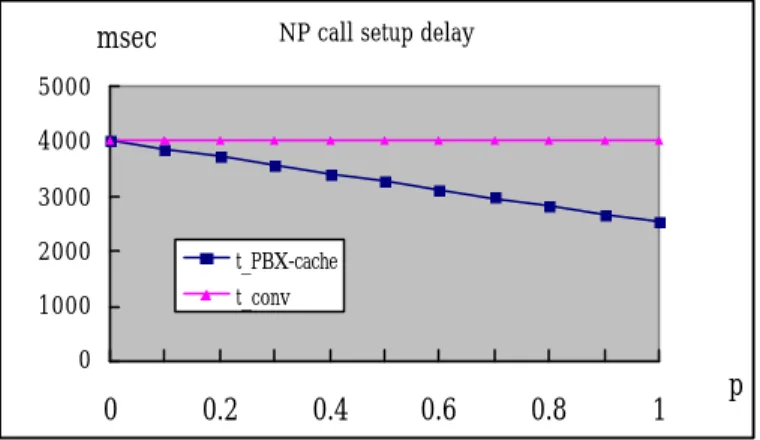
Fig. 3-5 The relation of FDN utility rate (p) and the average call setup time (in msec) ... 27
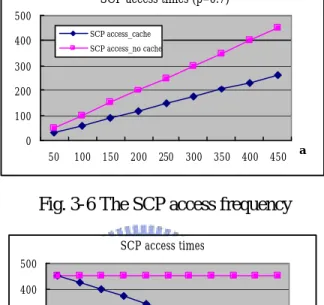
Fig. 3-6 The SCP access frequency ... 29
Fig. 3-7 The frequency of SCP accesses when the arrival rate is 450 (calls/hr)... 29
Fig. 4-1: The concept of an organization-based communication system ... 32
Fig. 4-2 iNetwork architecture ... 34
Fig. 4-3 iNetwork signaling protocol stack ... 36
Fig. 4-4 iNetwork Register. ... 36
Fig. 4-5 Intra- iNetwork communication... 38
Fig. 4-6: iNetwork register process ... 39
Fig. 4-7: Call setup in an iNetwork community ... 40
Fig. 4-8 Set up a call to a roaming iNetwork user ... 41
Fig. 4-9: Set up a call in an iNetwork community... 43
Fig. 4-10 Call setup process of iNetwork... 43
Fig. 4-11: NP call setup between iNetwork and GSM... 45
Fig. 4-12 The time for setting up a call from iNetwork to a roaming GSM user ... 49
Fig. 5-1 The routing information retrieving and delivering for WLAN ... 57
Fig. 5-2 The worst case of NP call routing ... 58
Fig. 5-3 The average waiting delay of a NP call setup process ... 61
Fig. 5-4 The procedure for choosing a communication network... 66
Fig. 5-5 VHO timing diagram ... 69
Fig. 5-6 Probability intensity function of users’ dwell time ... 70
Fig. 5-7 The amount VHO traffic load (off time) ... 71
List of Tables
Table 5-1. Extra information in the address book of the dual- mode MS... 55 Table 5-2. The information elements of a SETUP message ... 55 Table 5-3 An entry of circumstance record on a DMS ... 64
Chapter 1. Introduction
Telecommunications technologies evolved from fixed- lined voice and data services to mobile multimedia communications. PSTN is a long developed and ubiquitous fixed- lined telecommunications system which has become a utility. The demand of mobility brought out the evolve ment of mobile telecommunications systems. The popularity of mobile telecommunications carried out along the maturity of mobile technologies and the reduction of terminal and communication fees. The requirement of intercommunication between fixed and mobile telecommunications users causes the demand of fixed and mobile convergence (FMC). FMC supports fixed and mobile telecommunications services on a common platform. In FMC environment, subscribers of fixed- lined telecommunications systems must be able to set up calls to mobile telecommunications systems, and vice versa. Therefore, both the fixed- lined and mobile switching networks need to be able to determine and to route calls to the destination networks of the called parties.
Telecommunications liberation encourages more service providers to join fixed and mobile telecommunications market. Users have more choices and are more likely to change service providers according to the service, quality, and the billing policy offered by the operators. Conventionally, every operator has a unique numbering plan with respect to the national numbering plan and telecommunications policy. Changing telecommunications service provider implies changing telephone numbers. It is very inconvenient to users because they may miss calls that are set to the old subscription numbers. Number portability (NP) service allows a user to keep the same telephone number even when she changes operators. The calling and called parties will not sense about the physical routing of a NP call. In the competitive telecommunications market, operators must provide NP service to attract subscribers and to enhance their competitiveness.
The conventional telecommunications numbering plan connects a telephone number to a physical location or a definite subscriber. Switches of the core network route a call to the routing or destination address directly by parsing the prefix of the dialed number, the process is known as global title translation (GTT). However, NP service smashes the relation between dialed numbers and the destination routing addresses while ported numbers does not provide definite routing information for call routing. A mechanism to translate a ported number to the callee’s current subscription number or the physical routing address is necessary of NP service. Hence, the facility for ported number translation must be available to all operator networks.
(on-switch), or be maintained separately in the core network (off-switch) [1]. On-switch solutions modify routing rules in switches of core networks to route ported numbers to the destination address. The modification of routing knowledge in switches happens whenever a number was ported out or into a service operator, which is costly and inefficient. By contrast, off-switch solutions based on the architecture of intelligent network (IN) maintain the mapping of all ported numbers and the corresponding routing addresses of the numbers’ subscription networks separately in a number portability database (NPDB). By accessing NPDB, switches can route ported numbers to the destination addresses of the called parties. Usually off-switch solutions are adopted because the update of routing information is easy without altering the switching system. Because dialed numbers and physical addresses are completely decoupled with number portability, a common information center to keep the link of a ported number and the current subscription network of the number is necessary. Usually all the telecommunication operators in the telecommunications environment establish a number portability administration center (NPAC) with a global NPDB together to fulfill the requirement. The NPAC must be neutrally operated. For the sake of load balancing and efficiency, operators may duplicate NPDB to local switching network to shorten the delay of NPAC queries.
In FMC environment, fixed- line telecommunications subscribers need to setup NP calls to mobile subscribers, and vice versa. The knowledge of translating fixed- lined and mobile ported numbers are maintained separately in fixed and mobile telecommunications networks. Therefore, the core network of every service provider in the FMC environment must be able to determine whether a dialed number indicates a fixed- lined or a mobile telecommunications network. The translation of ported numbers is processed in the caller ’s telecommunications network.
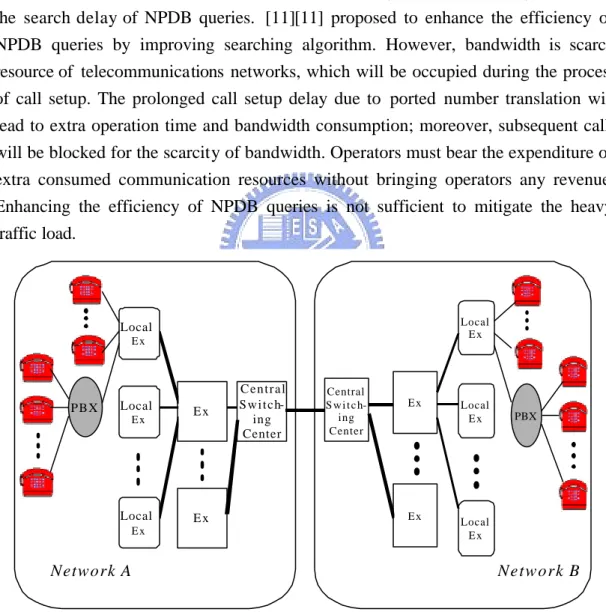
For providing NP services, two extra procedures are required in the call-origination process. First, whenever a number is dialed, the switching network needs to distinguish ported from non-ported numbers. In the IN-based NP service models, the determination of ported numbers requires the support of service switching and service data functions. Second, whenever a number is determined as a ported number, NPAC queries are triggered to translate the numbers to a reachable address. The two procedures will elongate the call setup time and increase the traffic load of the switching network. Moreover, not only ported numbers trigger NPAC queries. When a number was recorded as a ported number, the entire group of numbers was taken as ported numbers [2]. Every such NP and non-NP call brings about ported number translation and queries NPAC. As shown in Fig. 1-1, the design of telecommunication networks assemble s the routing and signaling processing knowledge in the central switching center. For providing NP service in FMC
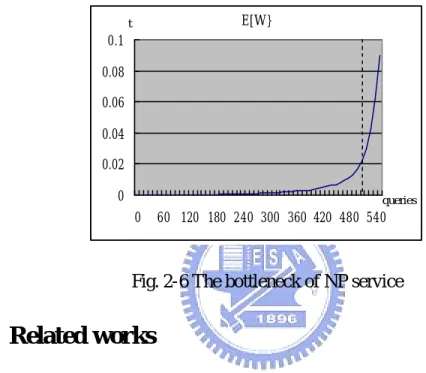
environment, NPDB must maintain the routing information of all ported numbers of fixed- lined and mobile telecommunications systems. Whilst the size of NPDB grows enormously, searching routing information in a NPDB will be time-consuming. When the offered load of NPAC queries exceeds the threshold workload of NPAC (the dot line in Fig. 1-2), the waiting time of NPAC queries increases rapidly because of the queuing and database searching delay (Fig. 1-2). The latency delay of routing information query may block other queries and cause the congestion of the transmission network, which results in prolonged response time of ported number translation.
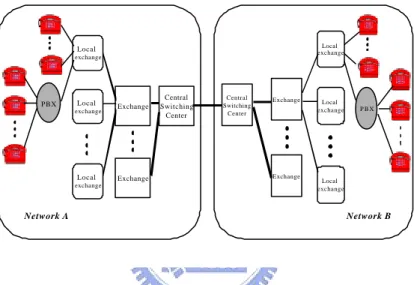
Some researches tended to enhance the efficiency of NP services by shortening the search delay of NPDB queries. [11][11] proposed to enhance the efficiency of NPDB queries by improving searching algorithm. However, bandwidth is scarce resource of telecommunications networks, which will be occupied during the process of call setup. The prolonged call setup delay due to ported number translation will lead to extra operation time and bandwidth consumption; moreover, subsequent calls will be blocked for the scarcity of bandwidth. Operators must bear the expenditure on extra consumed communication resources without bringing operators any revenue. Enhancing the efficiency of NPDB queries is not sufficient to mitigate the heavy traffic load. E x Local E x Local E x Local E x Central S w i t c h-ing Center E x PBX C e n t r a l S w i t c h-ing Center E x PBX E x Local E x Local E x Local E x Network A Network B
E[W} 0 0.02 0.04 0.06 0.08 0.1 0 60 120 180 240 300 360 420 480 540 t queries
Fig. 1-2 The bottleneck of NP service
The study of [5] discovered that 99% of the calls are set to the numbers had been called in a week. That is, most of the accessed data will be accessed again in the near feature. Based on the observation, keeping the recently accessed data locally can avoid a large part of long-term NPAC queries and shorten the average NP call setup delay time. Accordingly, [4][5]suggested applying caches to operator networks can effectively alleviate the amount of query messages and improve the efficiency of information query. The effect of caches depends on the cache hit rate and the cache size [5]. The amount of served users of central switches is so large that the required cache size should be very large too. An enormous cache may incur longer search time; hence, the numerous requests of ported number translation will congest the core network of telecommunications networks. On the contrary, the size of caches in local switches is small but very helpful to enhance the efficiency of ported number translation [3]. But the exchange of updated routing information between NPDB and local caches must be transmitted through voice transmission lines, which will consume extra communication bandwidth and crowd out arrival calls.
The works of [6][7] presented the chance to solve NP problem by caching routing informatio n of ported numbers in user terminals. The results showed that shift knowledge to intelligent peripherals with better computation power and storage capacity can minimize information passing and effectively alleviate traffic load of core network. But replacing user terminals by intelligent peripherals is a tremendous project. On the other hand, the correctness of the routing information of dialed ported numbers must be guaranteed to set every call to the right destination. Consequently, a mechanism to synchronize the routing information of NPDB and user terminals is necessary. However, PSTN and mobile telecommunication systems before 2.5G (GPRS) were not designed for data transmitting. Distributing information from core network to user-ends is not easy in PSTN and the mobile telecom systems before 2.5G. The telecommunications systems must seize lines or arrange bandwidths to dispatch
information from core networks to customers. Although data channels are available in 2.5G and 3G systems, delivering routing information to user-ends will consume a large amount of computation resources and bandwidth. Calls will be blocked during the dispatching of information, the cost is too expensive to be feasible.
From the above discussion, we found that the existing solutions confront the following problems: (1) non- intelligent peripherals can not translate ported numbers to the destination address of the called party. NP calls originated from non- intelligent peripherals require NPAC queries for ported number translation. NPAC will be encumbered with considerable quantities NPAC queries that the performance may be degraded and block other queries. Thus, the call setup delay will be prolonged. (2) The update of routing information in intelligent peripherals is transmitted through telecommunication lines. That may occupy telecommunication resource and obstruct call setup.
Considering the first problem, a mechanism to determine and translate ported numbers dialed from non- intelligent peripherals in the early stage of NP call process is the key factor to alleviate the workload of NPAC and to prevent the congestion of telecommunications bandwidth. More NP calls be solved and translated in the early stage, less routing information queries are issued. Thus, NPAC query delay will be shortened and the network congestion will be prevented. On the other hand, the update of the routing information of ported numbers on user terminals can be performed through data networks (e.g., Internet Protocol-based network) to omit unnecessary telecommunications resource consumption. These two notions can support service providers to decrease the cost of providing NP service and help subscribers to reduce the waiting time of NP call setup. Based on the concept, three new mechanisms for providing efficient NP service in FMC environment are proposed in this research:
1. For fixed- line telecommunication systems, we propose to provide ported number translation functions in PBX-based telecommunications networks. When most NP calls can be translated in local telecommunications network, NPDB queries will be reduced and the efficiency of NP call setup will be enhanced.
2. For mobile telecommunications systems before 2.5G that do not provide data transmission channel, we propose an organization-based mobile telecommunications network to act as a mobile PBX to perform ported number translations in mobile local networks.
3. For 2.5G and beyond 2.5G mobile telecommunications systems that provide data communication features, we propose a mechanism to update routing informatio n from NPDB to intelligent user terminals (e.g., 3G/WLAN dual- mode mobile handsets) via IP network. Thus, the routing information of ported numbers can be
solved in user-end.
The amount of NP queries can be remarkably reduced by the above proposed mechanisms; hence, the efficiency and performance of NP service can be improved without affect the profit of telecommunications operators and users.
A brief synopsis of the remaining chapters follows.
n Factors which affect the efficiency of NP call setup process: In chapter 2 we state the state of the art of NP solutions. The researches about solving the problems are reviewed, and the factors which affect the efficiency of NP service in FMC environment are investigated.
n Enhancing the efficiency of PSTN NP service: PSTN is the most important worldwide fixed- lined telecommunication system. By observing the calling behavior of PSTN users, it is found that most of the calls are originated from PBX of organizations in business hours. In chapter 3 we introduce a mechanism to perform ported number translations in PBX to shift the workload of NPAC, and discuss the feasibility and cost-efficiency of the mechanism.
n Enhancing the efficiency of mobile NP service before 2.5G mobile telecommunication systems: In mobile telecommunication systems without the support of data transmission channels, solving ported number translation in user terminal is not feasible. In business hours, most of the mobile users reside in designated areas (usually in the organization they belong to) and most of the calls are originated from organization members. In chapter 4 we introduce a mobile PBX to achieve the purpose of providing ported number translation in organization-based networks to enhance the efficiency of mobile NP service. The architectur e, functions, and the operation model of the mobile PBX are illustrated. Also the benefit of the mechanism is studied.
n Enhancing the efficiency of mobile NP service in 3G and beyond mobile telecommunication systems: In the mobile telecommunication environment with the support of data transmission channels and customized data service, providing the function of ported number translation in user terminals is practicable. In chapter 5 we present a mechanism for user terminals to convey the translated routing information of ported numbers, and for the switching network to distinguish the information and route the call. An IP-based data synchronization scheme is offered to guarantee the validity of routing information, and an algorithm to decrease the power consumption of user terminals is proposed. n Finally, conclusions and future works are drawn in chapter 6.
Chapter 2. Background and related works
2.1 Background
Number portability (NP) is a generic service concept which provides a network capability to enable a subscriber to keep his/her telephone number the same with a change of network operator, location and service type, etc. There are three types of number portability services: service provider portability, location portability, and service portability [13]. With service provider portability, a subscriber may switch service provider without changing his/her telephone number. With location portability, a subscriber may change location without changing telephone number. With service portability, a subscriber may keep the same telephone number when changing telecommunications services, such as changing from fixed-lined telecommunications service to mobile service.
In most countries, location portability and service portability are not enforced, and only service provider portability is implemented. Service provider portability is considered essential for fair competition among operators, while location portability and service portability are typically treated as value-added services. Location mobility has been implemented in mobile system because whenever a subscriber moves into a mobile network, the visiting network updates the location information of the subscriber to the subscriber’s subscription network. Besides, the numbering plans of fixed- lined and mobile telecommunication services are different in most countries, where service portability is not available unless the numbering plan is modified. Therefore, we focus our discussion on service provider portability.
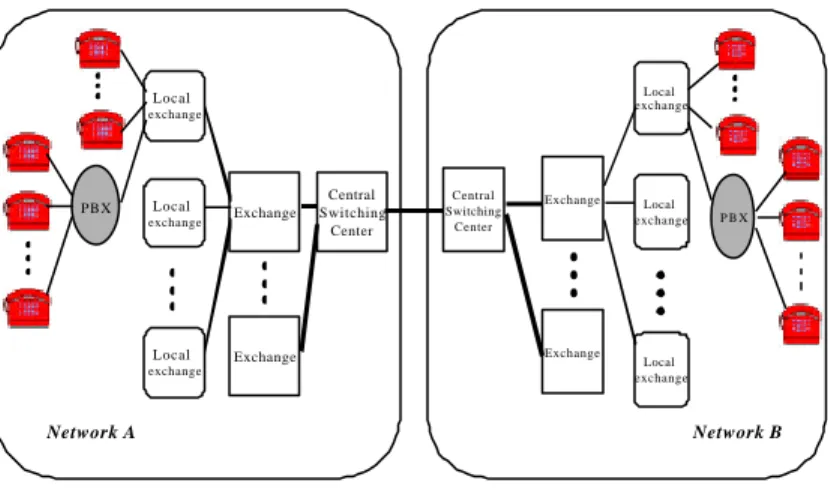
Exchange Local exchange Local exchange Local exchange Central Switching Center Exchange P B X Central Switching Center Exchange PBX Exchange Local exchange Local exchange Local exchange Network A Network B
As illustrated in Fig. 2-1, a telecommunications network is a hierarchical architecture consisting of several layers of exchanges. Usually the North American Numbering Plan (NANP) in the format of NPA-NXX-XXXX is adopted as the naming mechanism of a fix- lined telecommunications system, where numbering plan area (NPA) is a non-geographic code or a service access code, N is a number between 2 and 9, and X is a number between 0 and 9. Following NANP, a local exchange serves the numbers from NPA-NXX-0000 to –9999. The communication region of a city may consist of several local exchanges. Once a number within a local exchange was ported to another network, the local exchange considers the whole set of numbers, which is called a number block, as ported numbers.
Conventionally, every operator has a unique numbering plan with respect to the national numbering plan and telecommunications policy. In fixed- lined telecommunications system, every telephone number indicates a physical location. The routing of calls relies entirely on the network that originally issued the phone
number, which is called the donor network of the telephone number. For routing,
number portability relies on the capability of a switching network to route a ported number to the network that is currently serving the number. In mobile telecommunications system, a directory number (mobile telephone number) ind icates a subscriber, while the identification number uniquely identifies a mobile station (MS) in the mobile network. The donor network which first issued the directory number to a subscriber, and the subscription network which a subscriber registered to must track the location of the subscriber and his/her MS. In order to distinguish ported numbers and determine the destination network of them, number portability is a necessary network function to allow the switching network to route calls to the called parties.
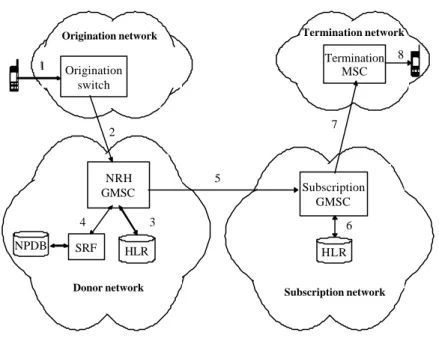
NP implementation schemes can be classified into on-switch solutions and off-switch solutions [14]. In the fixed- lined network systems, for intercepting and routing ported calls efficiently, the on-switch solution always routes calls to the donor network and are then onward routes them to the destination network. Analogous to the on-switch solutions of the fixed- lined telecommunication system, signal relay function (SRF)-based solutions modify switches to support NP service in mobile network systems. SRF-based solutions founded on SS7 communication architecture enhance the switch functions and utilize the MAP (mobile application part) protocol to enable the translation of the dialed number and the destination address. Depending on the implementation, the translation can be performed in the donor network or the subscription network. The SRF is typically implemented on signaling transfer points (STP) in the SS7 communication model.
Origination switch NRH GMSC Subscription GMSC Termination MSC HLR HLR 2 4 5 6 7 3 NPDB SRF
Origination network Termination network
Donor network Subscription network
1 8
Fig. 2-2: SRF-based NP call routing
Methods of on-switch solutions implement routing knowledge on the switching center of service providers. When a caller dialed a call via an originating network, which a caller connects to, the originating network routes the call to the donor
network by the prefix of the dialed number. The call is routed via the donor network to
the destination network, hence the mapping of dialed numbers and the routing addresses of the gateway of the destination network or the destination address of the called party are maintained in the gateway switches of the donor network. The simplified NP call process is illustrated in Fig. 2-2. The origination network receives a call initiation request from a subscriber (step 1). It identifies the donor network of the called party by the prefix of the dialed number (MSISDN). The origination network issues an ISUP IAM message to the donor GMSC to initiate a call (step 2). The donor GMSC consults HLR and identifies the number was ported out (step 3), then it consults NPDB by MAP sending routing information message (step 4) to determine the routing number of the subscription network. The donor network forwards the IAM message to the subscription network (step 5), and the subscription GMSC queries HLR for the routing number (mobile station roaming number, MSRN) of the called party (step 6). The MSRN indicates the address of the termination switch, thus the subscription network can route the IAM message by the MSRN to the termination switch to set up the call (step 7).
Following this method, the operation logic of a switching center alters whenever a number is ported out or in. On-switch solutions confront the following problems: (1) The frequent alteration decreases the stability of communication services and increases the cost of system operation and maintenance, and (2) the growth of ported numbers leads to a large number of routing messages for number translation.
On the contrary, to prevent the alteration of switch networks, off-switch solutions use Intelligent Network (IN) to intercept and route ported calls without the participation of the donor network. [15]. NPDB that manage the mapping of ported numbers and corresponding routing information are involved in the process of call setup. Switch network queries NPDB to obtain the routing address of the dialed numbers that are marked in the switch as ported. NPDB can be established as an internal database that keeps only the NP information of numbers which are assigned from or subscribed to the network, or be centrally maintained by a neutral organization (Number Portability Administration Center, NPAC) that all ported numbers of every service provider are recorded. Fig. 2-3 represents the architecture of IN-based NP services in a switched circuit network (SCN, including ISDN and cellular networks) and IP telephony interoperable environment. In IN-based network architecture, the service data functions (SDF) return a routing number for a ported number that indicates an end-point or an end-user in a network. The service management system (SMS) manages the content of SDF and handles the data consistency between SDF and NPDB. For the query to the IN nodes, different protocols are used in different networks and by different operators. In the IP network, number gateways translate telephone numbers to IP addresses. The location servers (LS) work as SDF that maintain the location information of subscribers.
S M S S C F SSF S D F N P D B Numbering gateway SS L S S C N IP network Signaling gateway
Fig. 2-3 IN-based number portability service architecture
As shown in Fig. 2-4, the origination network receives a call initiation request from a subscriber (step 1), it determines the dialed number indicates to a NP subscriber and issues an ISUP IAM to the donor network for initiating a call (step 2). The donor network queries HLR and determines the number was ported out (step 3), and consults NPDB by an INAP initialDP for the routing number of the subscription network (step 4). The donor network forwards the IAM message to the subscription network (step 5). The subscription network queries HLR for the MSRN of the called party (step 6) to reach the termination network, and forwards the IAM message to the termination MSC to setup the call (step 7).
Origination switch NRH G M S C Subscription G M S C Termination M S C HLR H L R 2 4 5 6 7 3 N P D B 1 Origination network T e r m i n a t i o n n e t w o r k D o n o r n e t w o r k Subscription network 8
Fig. 2-4 IN-based solution of NP call routing
The IN-based solutions differ form the SRF-based solutions in the way to access NPDB. In the SRF-based solution only GMSC can query NPDB. But the IN-based solutions are implemented in the service control point (SCP). Every switch equipped with the IN protocol can access NPDB [15]. SRF-based solutions may centralized workload to and burden specific network entities, where IN-based solution mitigates that problem. By IN architecture, it is not necessary to re-test the function of switches when updating the routing information of new ported numbers. Off-switch solutions are wildly adopted for better flexibility and extensibility.
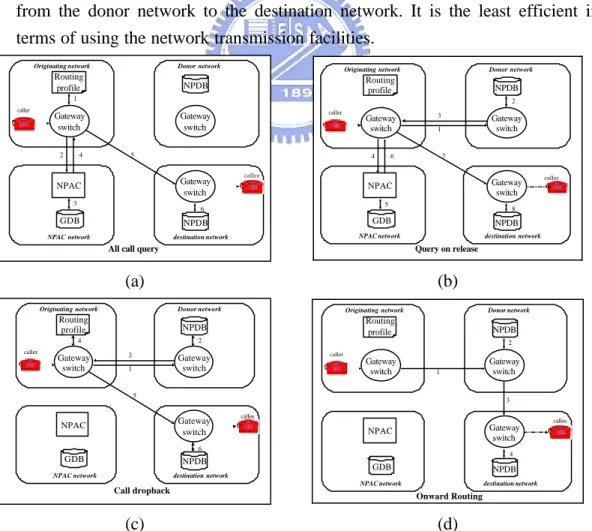
There are four off-switch schemes for supporting NP service: all call query (ACQ), query on release (QOR), call dropback (also known as return to pivot, RTP), and onward routing (OR) [16].
n All call query (ACQ): ACQ scheme requires a centralized database to keep information of all ported numbers of every service providers. As shown in Fig. 2-5(a), the originating network detects the dialed number is a ported number, and initiates a query to NPAC. NPAC returns the routing information of the dialed number to the originating network, then the originating network routes the call to the destination network to set up the call. The determination of ported numbers is performed in the origination network. In this method, the operation of the donor network was not affected by the operation of NP call setup. ACQ is the most efficient of using the network transmission facilities; therefore, it is widely adopted as NP solutions in many countries.
n Query on release (QoR): QoR scheme is a form of call re-routing method, which grounds on the release messages of the donor network that detect a dialed number was ported out. In Fig. 2-5(b), when the originating network detects that the dialed number is a ported number, it routes the call to the donor network by the prefix of the number. If the number is ported out, the donor network returns a release message to the originating network, then originating network queries NPAC for the routing information of the dialed number. When the originating
network receives the routing information, it re-routes the call to the destination network. The occupancy of transmission resources during the routing of calls may degrade the efficiency of source network.
n Call dropback: In Fig. 2-5(c), the originating network receives a call from the caller and routes the call to the donor network by the prefix of the number. The donor network determines the number was ported out, it returns the routing information of the number to the originating network and release the call. Then the origination network re-routes the call to the destination network. Following this method, the routing information is maintained separately in different donor networks of ported numbers, and the donor networks of every ported number need internal NPDB for recognizing whether the number is ported out.
n Onward routing (OR): As pictured in Fig. 2-5(d), the originating network routes the received call to the donor network of the dialed number. The donor network detects the number was ported out, and checks an internal NPDB for the routing information. Then the donor network routes the call to the destination network by the routing information. The scheme requires the setup of two physical call segments, one from the originating network to the donor network and the other from the donor network to the destination network. It is the least efficient in terms of using the network transmission facilities.
All call query
GDB NPDB NPAC NPDB Routing profile Gateway switch Gateway switch Gateway switch Originating network caller callee
NPAC network destination network Donor network 1 2 4 5 6 3 callee GDB NPDB NPAC NPDB Routing profile Gateway switch Gateway switch Gateway switch Originating network caller
NPAC network destination network Donor network 1 2 3 4 6 7 8 5 Query on release (a) (b) GDB NPDB NPAC NPDB Routing profile Gateway switch Gateway switch Gateway switch Originating network caller callee
NPAC network destination network Donor network 1 2 3 4 5 6 Call dropback GDB NPDB NPAC NPDB Routing profile Gateway switch Gateway switch Gateway switch Originating network caller callee
NPAC network destination network Donor network 1 2 3 4 Onward Routing (c) (d)
The four schemes exist in the NP solutions of different countries: UK, Finland, France, Germany, Span, Singapore, etc. [17][18][19] The considerations of which scheme to adopt include the network resources, the policy of addressing and routing, the impacts on the signaling system, and the interworking with other services. ACQ and call dropback are the two most popular solutions.
Providing NP service in fixed- lined telecommunication environment requires two procedures to determine and translate ported numbers in call setup process. First, whenever a number is dialed, the switching network needs to distinguish ported from non-ported numbers. Every call in FMC telecommunications environment can be set to a ported or non-ported number of a fixed- lined or mobile telecommunications subscriber. The switching network of a telecommunication system must determine the destination network of a dialed number to setup a call. While NP service broke the relation between dialed numbers and the corresponding subscription networks, the ported number marks of both fixed- lined and mobile telecommunication networks need to be maintained in every network in FMC environment to distinguish NP and non-NP call processes. The ported number marks in switches increase with the growing amount of NP users. When the amount of NP users grows to be enormous, the latency of this procedure will be long. Second, every call terminated to a ported number initiates NPDB queries. Moreover, not only ported numbers trigger NPDB queries. When a number was recorded as a ported number, the entire group of numbers was taken as ported numbers [15]. Every such NP and non-NP call brings about queries to NPDB. The databases search time is log2N in average for every call, where N is the number of NP users. As shown in Fig. 2-1, the hierarchy of telecommunications networks assembles the routing and signaling processing knowledge in the central switching centers. When the arrival rate of NPDB queries exceeds the threshold service rate of NPDB (the dot line in Fig. 1-2), the waiting time of NPDB queries increases rapidly because of the queuing delay (Fig. 1-2). The latency delay of NPDB searching will block other NPDB queries and cause the congestion of the transmission network, which results in prolonged response time of ported number translation. The prolonged call setup delay due to ported number translation leads to extra operation time and bandwidth consumption. Operators must bear the expenditure on extra consumed communication resources without bringing operators any revenue.
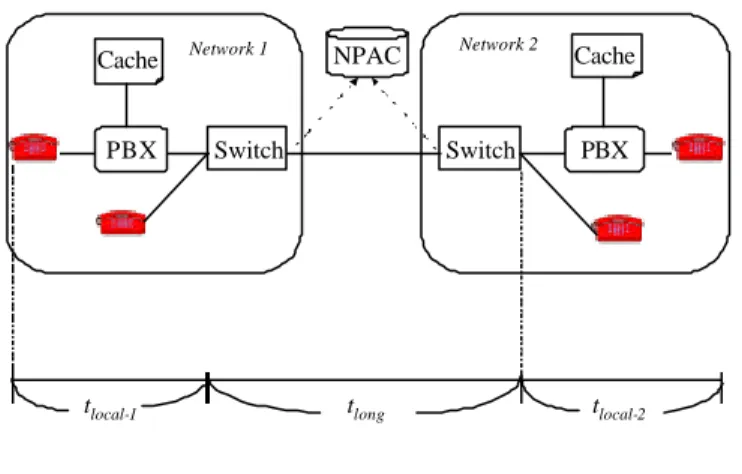
The process to set up a NP call consists of the following procedures: process and transmission of messages, determination of NP calls, NPDB queries for the translation of ported numbers, and seizure of transmission line. Let tlocal and tglobal represent the
transmission time in local and in global network, tprocess and tseizure are the time
line/channel to the call, tdetermination is the latency for distinguishing portable and
non-ported numbers, and tNPDB-query presents the routing information query delay when
consulting NPDB. The setup delay of a NP call can be presented as the following: tcall-setup = tlocal + tglobal + tprocess + tseizure + tdeterminiation + tNPDB-query
Where ttranslation and tNPDB-query will increase when the amount of NP subscriber
increases; however, tlocal, tglobal, tprocess, and tseisure will not vary with the amount of NP
subscribers. Therefore, data search delay must be reduced to enhance the efficiency of NP service and to utilize telecommunication resources.
E[W} 0 0.02 0.04 0.06 0.08 0.1 0 60 120 180 240 300 360 420 480 540 t queries
Fig. 2-6 The bottleneck of NP service
2.2 Related works
For the purpose of enhancing the efficiency of NP service, some researches tended to enhance the efficiency of NP services by improving the response time of NPDB queries. [11][11] proposed to enhance the efficiency of NPDB queries by improving searching algorithm. However, bandwidth is scarce resource of telecommunications networks, which is occupied during the process of call setup. When data search delay exceeds the threshold, the efficiency of NP call process degrade rapidly that will result in the congestion of transmission lines. Enhancing the efficiency of NPDB queries is not sufficient. Unless service providers mitigate the heavy traffic load or establish more telecommunications lines to tolerate the traffic load, the enhancement is limited.
In order to alleviate the heavy workload of operator networks to enhance the efficiency of NP service, many studies proposed that implementing caches in telecommunications system can effectively alleviate the amount of query messages and improve the efficiency of data access [16][4][5][20]. Kim and Yong stated the factors affecting the cache hit ratio in mobile computing environment including the distribution of queried target objects and the query pattern [16]. Telecommunication
networks are designed as computation and intelligent centric, implementing caches in operator networks is easy to maintain and benefit environment-dependent decision making [22]. Refer to the hierarchy of telecommunications network (Fig. 2-1), central switches serve so many users and the dialed numbers a central switch receives is scattered. Every NP call requires ported number translation. The size of a cache should be large to accommodate sufficient data (double of the size of the numbers dialed from users) to achieve acceptable hit ratio. Jain et al. proposed a hashing scheme in [11] to improve cache hit ratio. But keeping the large amount of portable users in FMC environment will require a lot of memory size. The cache size and the probability of collision will increase as the amount of portable users increases. Chan and Leong addressed that clients should take a more active role in maintaining cached items. In [21], [16] and [4], authors suggested distributing spatial replicas of databases to different sites and proposed caching schemes on mobile handsets (MS) with respect to environment properties to provide efficient data access to users. However, mobile users move in and out of several service regions, the limited cache size on a MS will be hard to keep ample environment information. In order to guarantee the validity of cached data, MS need to update cached data frequently according to temporal and spatial properties. The requests of cache updates from a large amount of MS will cumulate the traffic of the operator network.
The study of Carpenter et al discovered that 99% of the calls are set to the numbers had been called in a week, and assumed that an individual customer’s calling behavior exhibits a strong locality of reference [5]. Assuming intelligent peripherals are available, they proposed to maintain a profile and a cache of a user ’s frequently accessed data in the user ’s terminal. The work of [6][7] presented the chance to solve NP problem by enhanced user terminals. The results showed that shift knowledge to intelligent peripherals with better computation power and storage capacity can minimize information passing and effectively alleviate traffic load of core network. Therefore, performing ported number translation in user terminals will alleviate the traffic load of NPDB queries and mitigate the workload of NP call process in operator networks. But it is expensive and tardy in updating user terminals comprehensively. And the update of the routing information in local caches will occupy telecommunications lines, which consumes extra communication bandwidth and crowd out arrival calls.
While a comprehensive solution to solve NP problem is not available, another solution is to find some mechanism which can effectively reduce the amount of requests needed for ported number translations. If the amount of requests which need for ported number transla tion is small, the switch system will have enough computation capability to handle the received call request. From the result of [5],
number translation should be performed in a network entity with the properties of evident dialed number locality; consequently, the quantity of routing information needed to be maintained is modest. In addition, the network entity must possess ability of storage and computation to keep valid routing information of ported numbers and to provide the service of ported number translation.
In the fixed- lined telecommunications environment, most organizations establish PBX to save telecommunications cost and benefit intra-organization communications. That is, most of the calls (both NP and non-NP calls) in business hours are relayed by PBX to the public telecommunications network. PBX is a network entity with computation power and storage that can perform the function of ported number translations. In business hours, a major part of the calls are generated from organizations. Applying the knowledge of number translation and keeping the routing information of ported numbers in organization-based telecommunication networks will be an effective approach to enhance the efficiency of NP service. In mobile telecommunication systems before 2.5G, intelligent terminals and data transmission channels are not available. Ported number translations can not be performed in user terminals. An organization-based network which possesses the property of dialed number locality can be utilized to provide the service of ported number translation. However, mobile PBXs are not generally available. A network entity to act as a mobile PBX in the mobile telecommunication network is required. In 3G mobile telecommunication systems, user terminals are smart and powerful to perform computation and storage tasks. Because the dialed numbers of an individual user often presents strong locality, keeping the routing information of a user’s frequently dialed ported numbers in the terminal will benefit the efficiency of NP service.
On the other hand, a mechanism to synchronize the distributed routing information with that in NPDB is necessary to guarantee that every dialed ported number can be translated to the right destination address. Dispatching routing information from NPDB to organization-based network and 3G mobile terminals can be transmitted by IP-based networks without consuming telecommunication transmission resource. When ported numbers are resolved in the early stage of NP call process, the translated routing information must be recognizable to the public switching network. A method for local telecommunications networks and 3G user terminals to notify the switching core networks that the dialed numbers were translated to effective addresses is also needed.
Based on the above idea, the following three mechanisms which can tell the central switching system that the call-origination request needs for ported number translation or not are proposed:
n An organization-based mobile PBX system with ported number translation capability
n The dual mode mobile phone with ported number translation capability
Chapter 3. An organization-based cache approach
for supporting fixed-lined telecommunications
number portability service
3.1 Motivation
In the conventional fixed-lined telecommunication system, to connect a call, the PSTN (public switched telephone network) switching network sho uld translate the global title digits (i.e., the dialed number) to determine the destination network and the routing address (GTT), and a routing table is used in translation. Number portability service break the relation of a PSTN telephone number and destination network. The switching network has to determine whether the dialed number is ported or not and translate the ported number to the corresponding global title digits before using the GTT process to connect the call. Hence the waiting time of the call setup should be increased, and the call setup waiting time will increase when the size of NPDB is increased. Since every dialed rumble should be checked, the amount of call connection per unit time of the central switching network will be decreased. Of all calls are dialed from intelligent terminals, the central switching network doesn’t need to do ported number checking and translation because the received global title digits is correct. However, it is impossible in real situation. We should find some ways to reduce the number of calls which the central switching network should do ported number checking and translation activity.
A major part of conventional telecommunication traffic load was generated from organizations (i.e. government offices, enterpris es, factories, etc) during the office hours. Most of the calls (both NP and non-NP calls) in business hours are issued from organizations. Organizations usually establish PBX (Private Branch Exchanges) for saving telecommunication cost and benefiting intra-organization communications. That is, most of the calls (both NP and non-NP calls) in business hours are relayed by PBX to the public network.
The telephone numbers dialed from an organization often exhibit locality. For example, organizations like government departments or retail businesses have static contact targets to solve problems or to supply merchandise; manufacturing industries
have a set of upstream suppliers and downstream customers, and insurance companies have a set of static cooperation enterprises, such as banks, airlines, hospitals. We found that almost every organization has a set of frequent dialed numbers that consists of businesses partner, cooperation industries, friends and families of employees, etc, and the variation of these contact targets is infrequent. Of these frequent dialed numbers and corresponding routing information is kept in the memory of PBX, then when one of these number is dialed PBX can tell the switching network that this number need not do number checking and translation activity. This will save lots of connection loading of switching network. Based on this concept, the design of PBX with frequent dialed number routing information is described as follow.
Exchange Local exchange Local exchange Local exchange Central Switching Center Exchange P B X Central Switching Center Exchange PBX Exchange Local exchange Local exchange Local exchange Network A Network B
Fig. 3-1 The hierarchy of telecommunication networks
3.2 Applying caches to PBX-based networks
A PBX is a telephone exchange which provides internal communications for a set of users on local lines while allowing all users to share a certain number of external phone lines. Every PBX belongs to an organization that enables the communication between organization members without going through the public network, and to make and receive calls from subscribers served by the public network. A PBX connects to the public network by one or more physical channels. The communication between a PBX user and a subscriber of the public network is routed by the public switching network which the PBX connects to. While a PBX may not have the capability to perform database search or processing functions, a computer is added to the system by the open application interface (OAI) as shown in Fig. 3-2 [5]. Hence the computation tasks are realized on the PBX.
PBX
OAI
Cache
Fig. 3-2 An OAI-enabled PBX
The communication beyond a PBX service region is transmitted through the public network. In the conventional call originating process, a PBX routes every external call to the connected public switching network, and the switching network follows the embedded routing logic to route the request. When applying cache-stored ported number translation knowledge to PBX, a PBX checks cache before routing an external call to the connected local exchange. A cache hit indicates that the routing address of the dialed number is determined and confirmed, which is proved by the relaying PBX, and the NPDB queries can be omitted. Consequently, a mechanism is required for a PBX to inform the public switching network about the confirmation of the routing address. Thus, the switching network can omit NPDB queries and route the call to the address directly.
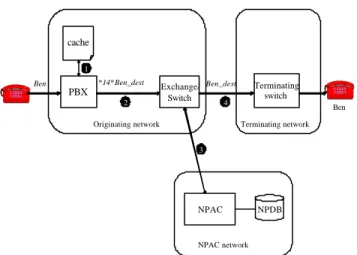
According to the function of special code service in IN-based network, a PBX can add a special code (e.g., *14*, *30*) in front of the dialed number to indicate that the routing address of a dialed number is appended to the call originating request. The switching network recognizes the code and routes the call by the appended routing address directly. PBX cache Exchange/ Switch Terminating switch
Ben *14* Ben_dest Ben_dest
Ben
1
2
3 4
Originating network Terminating network
NPAC network
NPDB NPAC
Fig. 3-3 A special code (e.g., *14*) is used to indicate a cache hit
member within a PBX service region to a public telecommunications subscriber Ben. The PBX determines the call is an external user and checks cache for the routing address of Ben (step 1). In the case of cache hit, the PBX obtains and appends the routing address of Ben to the call originating request, adds a special code “*14*” in front of the request, and sends the request to the public network (step 2). According to the routing address, switches routes the request to the terminating network (step 4) without querying NPDB. The terminating network routes the call to Ben to setup the call.
When the dialed number and the corresponding routing address are not kept in the cache, it will be a case of cache miss. Hence, the PBX routes the call originating request to the public switching network without modification and special code. The public switching network determines the dialed number is a ported number consults NPDB to translate the ported number (step 3), then routes the request to the terminating network according to the obtained routing information (step 4).
The signaling systems of service providers usually have the function to process special codes (e.g., the code “*67” in USA prohibits displaying the caller’s telephone number to the called party). Applying caches to PBX requires adding a routing rule in the signaling system without altering existing operation logic. It is feasible for service providers to diagnose and process the specia l code to omit time-consuming NPDB queries.
3.2.1 Issues
From the perspective of organizations, cost is the most important issue when applying caches in PBX. The cache size should be small but sufficient for comprehending frequently used data that can perform fine cache hit rate. The update of routing information in a cache should be simple and efficient without obstruct the communication service of an organization. From another point of view, routing information of ported numbers is valuable information of telecommunications service providers that should not be distributed to subscribers arbitrarily. The distribution and update of routing information should be based on contract or agreement without interfering with the communication service. Thus, the issues of applying caches to PBX encompass the policy of establishing a cache, the update of cached data, and the size of a cache.
l Cache establishment
Caches on PBX should keep as many routing information of ported numbers as possible to minimize NPDB queries. However, the size of a cache is restricted that the data can be kept is limited. Cache hit rate increases when the accesses of data exhibit locality. In order to improve the hit ratio of cached data, the cached data should
expose the communication habits of users in the PBX service region.
There are two approaches for cache establishment: Cache the most recently dialed numbers because they might be dialed again in a span; or cache the frequently dialed numbers for they are the most usually dialed numbers for a long-term observation. The two approaches are referenced as dynamic cache policy and static cache policy respectively in the following descriptions.
Under the assumption that the recently dialed numbers are most likely to be dialed repeatedly in a span, the dynamic cache policy argues to keep the most recently dialed numbers. When the cache is full and a new data entry is being inserted, a replacement process is triggered automatically by the cache management system to replace an old entry with new one. Dynamic cache policy has the advantage that the cached data represents the recent calling behavior of users. However, considering that a cached number is ported to another service provider, the cached routing information becomes obsolete. A hit of obsolete data brings about a miss-routing that consumes extra signaling and transmission resources and prolongs the call setup time. Calls that arrived before the obsolete data was updated will be routed to wrong routing addresses or be blocked until the data was renewed. To update obsolete data in the cache dynamically, the public switching system must be modified to notify PBX that the cached data is wrong and to send back the renewed routing information immediately. To prevent miss-routing caused by obsolete data, cache update must be processed immediately when a data-renewal notification is received; furthermore, cache replacement must be processed whenever a new data is inserted to the cache. Access an updating cache will result in miss-routing. For the reason, cache access should be forbidden during cache update. But all the external calls will be blocked in the period. The costs to modify the signaling system of a public telecommunication network, to management a dynamic cache, and to update renewed routing information to the cache dynamically are expensive. Consequently, dynamic cache policy is not a feasible solution for PBX-based cache s.
On the contrary, a static cache keeps the telephone numbers and the corresponding routing addresses of the most frequently contact targets of a PBX service region, the telephone numbers are referenced as frequently dialed numbers (FDN) that represents the cooperative enterprises, agents, families and friends of organization members, etc. The establishment and alteration of a static cache are manually performed by the system administrator. When a member joined an organization, the member proposes a set of FDN to the system administrator. The system administrator sends the FDN set to a contracted telecommunications service provider to obtain the routing information of the FDN set. Service providers provide an add-on service to allow PBX to consult the routing information of telephone numbers, and to notify PBX of the update of