Highly efficient deep blue organic electroluminescent device based on
1-methyl-9,10-di(1-naphthyl)anthracene
Meng-Huan Ho, Yao-Shan Wu, Shih-Wen Wen, Meng-Ting Lee, Teng-Ming Chen, Chin H. Chen, Kwong-Chau Kwok, Shu-Kong So, Kai-Tai Yeung, Yuen-Kit Cheng, and Zhi-Qiang Gao
Citation: Applied Physics Letters 89, 252903 (2006); doi: 10.1063/1.2409367 View online: http://dx.doi.org/10.1063/1.2409367
View Table of Contents: http://scitation.aip.org/content/aip/journal/apl/89/25?ver=pdfcov
Published by the AIP Publishing
Articles you may be interested in
Phase transition characteristics under vacuum of 9,10-di(2-naphthyl)anthracene for organic light-emitting diodes
J. Vac. Sci. Technol. A 32, 020601 (2014); 10.1116/1.4831935
Study of electric characteristics and diffusion effects of 2-methyl-9,10-di(2-naphthyl)anthracene doped with cesium fluoride by admittance spectroscopy
Appl. Phys. Lett. 96, 133310 (2010); 10.1063/1.3377921
Studies of the degradation mechanism of organic light-emitting diodes based on tris (8-quinolinolate)aluminum Alq and 2-tert-butyl-9,10-di(2-naphthyl)anthracene TBADN
J. Appl. Phys. 105, 034905 (2009); 10.1063/1.3072622
Study of efficient and stable organic light-emitting diodes with 2-methyl-9,10-di(2-naphthyl)anthracene as hole-transport material by admittance spectroscopy
Appl. Phys. Lett. 94, 023306 (2009); 10.1063/1.3072616
Stable styrylamine-doped blue organic electroluminescent device based on 2-methyl-9,10-di(2-naphthyl)anthracene
Appl. Phys. Lett. 85, 3301 (2004); 10.1063/1.1804232
This article is copyrighted as indicated in the article. Reuse of AIP content is subject to the terms at: http://scitation.aip.org/termsconditions. Downloaded to IP: 140.113.38.11 On: Thu, 01 May 2014 01:40:36
Highly efficient deep blue organic electroluminescent device based
on 1-methyl-9,10-di
„1-naphthyl…anthracene
Meng-Huan Ho,a兲Yao-Shan Wu, Shih-Wen Wen, Meng-Ting Lee, and Teng-Ming Chen Department of Applied Chemistry, National Chiao Tung University, Hsinshu, Taiwan 300,
Republic of China Chin H. Chen
Display Institute, Microelectronics and Information Systems Research Center, National Chiao Tung University, Hsinshu, Taiwan 300, Republic of China
Kwong-Chau Kwok, Shu-Kong So, Kai-Tai Yeung, Yuen-Kit Cheng, and Zhi-Qiang Gao Centre for Advanced Luminescence Materials (CALM), Hong Kong Baptist University, Kowloon Tong, Hong Kong
共Received 22 August 2006; accepted 16 November 2006; published online 19 December 2006兲 The author have developed 2-methyl-9,10-di共1-naphthyl兲anthracene 共␣,␣-MADN兲 as an effective wide band gap host material for Förster energy transfer to the unsymmetrical mono共styryl兲amine deep blue fluorescent dopant 共BD-1兲. This guest/host emitting system, at the optimal doping concentration of 3%, can also increase the probability of carrier recombination near the hole-transport/emitting layer interface for the blue organic light emitting device which produces electroluminescence efficiencies of 3.3 cd/ A and 1.3 lm/ W and a deep blue CIEx,y color coordinates of 共0.15, 0.13兲 that are 50% better than those of the traditional ,-isomeric host 共MADN兲 with the same dopant. © 2006 American Institute of Physics. 关DOI:10.1063/1.2409367兴
In recent years, there has been considerable interest in developing blue organic light emitting diodes共OLEDs兲 with high efficiency, deep blue color, and long operational lifetime.1 Deep blue color is defined arbitrarily as having a blue electroluminescent emission with a Commission Inter-nationale d’Eclairage 共CIEx,y兲 coordinates of x⬃0.15 and y⬍0.15. Such an emitter can effectively reduce the power consumption of a full-color OLED共Ref. 2兲 and also be
uti-lized to generate light of other colors by energy cascade to a suitable emissive dopant.3
Up until recently, formal reports with full disclosure on deep blue OLED dopant/host materials and devices are rare and sketchy. One notable example recently was by Idemitsu Kosan Co., which utilized a styrylamine-based dopant to produce an electroluminescence共EL兲 efficiency of 7.0 cd/A and a blue color of共0.14, 0.16兲.4The other was disclosed by Canon Co., which exploited the fluorene-based blue emitter to generate an EL efficiency of 6.0 cd/ A with a CIEx,y of 共0.15, 0.13兲.5 Recently, it has also been fully disclosed that an anthracene-based blue host material, 2-methyl-9,10-di共2-naphthyl兲anthracene6 共abbreviated as
, MADN or MADN兲 doped with an unsymmetrical mono共styryl兲amine fluorescent dopant 共BD-1兲, achieved an EL efficiency of 2.2 cd/ A at 20 mA/ cm2 with a saturated blue CIEx,yof共0.15, 0.12兲 and a normalized operational life-time of 10 000 h at an initial brightness of 100 cd/ m2.7
Although BD-1 doped MADN emitter could achieve a saturated deep blue color, the device efficiency is still low and inadequate. It is well known that a guest-host doped emitter system can significantly improve device performance in terms of EL efficiency and emissive color.6Therefore, key for developing deep blue OLEDs is not only finding the highly fluorescent deep blue dopant but also the appropriate
matching host material in order to enhance the probability of carrier recombination as well as the efficiency of Förster en-ergy transfer from the host to the dopant molecule.
In this letter, we report the development of an anthracene-based wide band gap host material in which the 2-共naphthyl兲 substituent of MADN is replaced by the steri-cally more demanding 1-共naphthyl兲 substituent. The small methyl substituent at C-2 position of the anthracene moiety is preserved with the purpose of disrupting the symmetry of 9,10-di共2-naphthyl兲anthracene 共ADN兲 and suppressing its problematic crystallization. We find that BD-1 /␣,␣-MADN guest/host system can achieve 50% higher EL efficiency of 3.3 cd/ A at 20 mA/ cm2 and a more saturated blue color of CIEx , y共0.15, 0.13兲 than those of BD-1/MADN system.
To demonstrate the efficacy of ␣,␣-MADN, four blue devices with the structure of indium tin oxide 共ITO兲/CFx/ N , N
⬘
-bis共1-naphthyl兲-N,N⬘
-diphenyl-1 , -diphenyl-1⬘
-biphenyl-4 , 4⬘
-diamine 共NPB兲 共50 nm兲/emitting layer 共EML兲 共40 nm兲/tris共8-quinolinolato兲aluminum 共Alq3兲共10 nm兲/LiF 共1 nm兲/Al 共200 nm兲 have been fabricated. De-vices I and II are standard blue deDe-vices with undoped MADN and␣,␣-MADN as EML, while devices III and IV are blue doped devices with 3% 1/MADN and 3% BD-1 /␣,␣-MADN, respectively. The molecular structures of MADN,␣,␣-MADN and BD-1 are depicted in Fig.1. CFx, NPB, and Alq3were used as the hole injection material8and
hole and electron transport materials, respectively. For study-ing the transport phenomenon, two additional carrier-only devices were also fabricated. The electron-only device struc-ture was ITO/2,9-dimethyl-4,7-diphenyl-1,10-phenanthroline 共30 nm兲/neat ␣,␣-MADN or MADN 共60 nm兲/Alq3
共20 nm兲/LiF 共1 nm兲/Al 共200 nm兲 and the hole-only device structure was ITO/ CFx/ NPB 共20 nm兲/neat ␣,␣-MADN or MADN共60 nm兲/NPB 共20 nm兲/Al 共200 nm兲.
a兲Author to whom correspondence should be addressed; electronic mail:
APPLIED PHYSICS LETTERS 89, 252903共2006兲
0003-6951/2006/89共25兲/252903/3/$23.00 89, 252903-1 © 2006 American Institute of Physics
This article is copyrighted as indicated in the article. Reuse of AIP content is subject to the terms at: http://scitation.aip.org/termsconditions. Downloaded to IP: 140.113.38.11 On: Thu, 01 May 2014 01:40:36
Figure 1 depicts the absorption spectrum of BD-1 and the solution photoluminescence共PL兲 spectra of MADN and
␣,␣-MADN in toluene. It is apparent that the spectral over-lap between the absorption of BD-1 and emission of MADN is poor and the Förster energy transfer from host to dopant is not expected to be efficient. On the other hand, the fluores-cence wavelengthmaxof ␣,␣-MADN is 413 nm, which is
blue shifted around 17 nm with respect to that of MADN, albeit the relative fluorescence quantum yield of
␣,␣-MADN is considerabl lower to the extent of only 60% of MADN. The principal cause of the hypsochromic shift is most likely due to the stronger H atom-H atom repulsions between the 1-共naphthyl兲 substituent and anthracene moiety of␣,␣-MADN, which causes the naphthyl group to decon-jugate from the anthracene chromophore in the ground state. As a result, the blueshifted emission spectrum of
␣,␣-MADN is found to overlap well with the absorption spectrum of BD-1 that is essential for efficient Förster energy transfer. The emission spectra of 5% BD-1 doped MADN and ␣,␣-MADN thin films 关spin coated with polymethyl-metta acuylate共PMMA兲兴 are also depicted in Fig.1. We find that the emissive intensity of BD-1 /␣,␣-MADN film is 1.2 times higher than that of BD-1/MADN film, confirming that the Förster energy transfer is indeed more efficient between
␣,␣-MADN and BD-1.
The charge transporting properties of ␣,␣-MADN and MADN were examined further in the form of amorphous films as functions of electric field and temperature by means
of time-of-flight technique.9,10 Figure 2 depicts the field dependent hole and electron mobility of␣,␣-MADN versus MADN at room temperature. We find that MADN shows nearly identical hole and electron mobilities 关共2–3兲⫻10−7cm2V−1s−1兴 under various field strengths.
However, it appears that there is considerable improvement in carrier mobility by changing the substituents attached to anthracene core from 2共兲-naphthyl to 1共␣兲-naphthyl, especially the hole mobility. The hole and electron mobilities of ␣,␣-MADN are 共3–5兲⫻10−7 and 共2–4兲 ⫻10−7cm2V−1s−1, respectively, which are all higher than
those of MADN.
The detailed EL performances are summarized in TableI. The voltage, luminance yield, power efficiency, ex-ternal quantum efficiency共EQE兲, and color coordinates were measured at 20 mA/ cm2. The EL efficiencies of the undoped
␣,␣-MADN device are only 0.7 cd/ A and 0.3 lm/ W at 6.7 V with a CIEx,y 共0.15, 0.08兲. But the BD-1 doped
␣,␣-MADN system produced EL efficiencies of 3.3 cd/ A and 1.3 lm/ W at 6.5 V with a CIEx,y of 共0.15 0.13兲 that is 1.5 times higher than that of BD-1/MADN system of 2.2 cd/ A.
It is interesting to note that ␣,␣-MADN possesses con-siderably higher carrier mobility than MADN and yet, de-vices II and IV of the former have a higher applied voltage than devices I and III共see TableI兲. To explore the underlying
physics further, we studied the J-V characteristics of the carrier-only devices. The highest occupied moleculor orbitals lowest unoccupied molecular orbitals共HOMOs/LUMOs兲 of
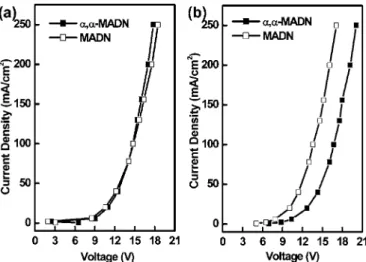
␣,␣-MADN and MADN are 5.8/ 2.8 and 5.6/ 2.6 eV, respec-tively. Figure3共a兲shows J-V characteristics of the electron-only devices which reveal that the device of␣,␣-MADN has a lower applied voltage under high current density 共over 40 mA/ cm2兲. The result can be rationalized by the lower
energy barrier共0.1 eV兲 between the LUMOs of␣,␣-MADN
TABLE I. EL performances of blue devices driven at 20 mA/ cm2.
Device Voltage 共V兲 Yield 共cd/A兲 Efficiency 共lm/W兲 EQE. 共%兲 CIEx,y I 6.4 1.3 0.6 1.7 共0.15, 0.10兲 II 6.7 0.7 0.3 1.0 共0.15, 0.08兲 III 6.1 2.2 1.1 2.3 共0.15, 0.12兲 IV 6.5 3.3 1.3 3.0 共0.15, 0.13兲
FIG. 1. Structures, absorption, and emission spectra of dopant BD-1 and host MADN,␣,␣-MADN in toluene along with the thin-film solid PL spectra of BD-1 doped MADN, and␣,␣-MADN in PMMA.
FIG. 2. Field dependent hole and electron mobilities of MADN and
␣,␣-MADN at room temperature.
252903-2 Ho et al. Appl. Phys. Lett. 89, 252903共2006兲
This article is copyrighted as indicated in the article. Reuse of AIP content is subject to the terms at: http://scitation.aip.org/termsconditions. Downloaded to IP: 140.113.38.11 On: Thu, 01 May 2014 01:40:36
共2.8 eV兲 and electron-transporting Alq3共2.9 eV兲, which
pro-vides an effective pathway for electron to inject from Alq3to
␣,␣-MADN, especially under high current drive conditions. On the contrary, Fig.3共b兲shows that ␣,␣-MADN hole-only device has a higher applied voltage than that of the MADN under the same drive current density. We attribute this to the higher energy barrier共0.4 eV兲 between the HOMOs of hole-transporting NPB共5.4 eV兲 and␣,␣-MADN共5.8 eV兲, which makes hole injection more difficult from NPB to
␣,␣-MADN. From the J-V characteristics of the carrier-only devices, we conclude that the deeper HOMO of␣,␣-MADN is the primary reason for causing the high applied voltage of devices II and IV.
Further, in most Alq3-based OLEDs, the dominant
car-rier is often the injected hole. With the low-lying HOMO of
␣,␣-MADN which creates a high barrier共0.4 eV兲 for hole to inject from the hole-transport layer of NPB to the emitter, the probability of carrier recombination near the NPB/
␣,␣-MADN interface where there will be more hole accu-mulated would be much increased. This restraint of hole in-jection can also make the hole-electron recombination more efficient in the emitting layer of ␣,␣-MADN device than that of MADN. We believe that the combined effect of higher carrier mobilities and more balanced carriers for re-combination in␣,␣-MADN device is another reason for the enhanced device efficiency in addition to the more effective Förster energy transfer.
Figure4 shows the operational lifetime of the four blue devices under a constant current density of 20 mA/ m2 moni-tored in a dry box. The t80 共the time for the luminance to
drop to 80% of initial luminance兲 and initial luminance 共L0兲 measured for devices I, II, III, and IV were 210 h
at L0= 288 cd/ m2, 85 h at L
0= 126 cd/ m2, 435 h at
L0= 484 cd/ m2, and 350 h at L0= 660 cd/ m2, respectively. It
is apparent that the␣,␣-MADN device stability can be sig-nificantly improved with BD-1 doping and can become as stable as the BD-1/MADN device. Assuming scalable
Cou-lombic degradation,11driving at a L0value of 100 cd/ m2, the
half-lives共t1/2兲 of devices III 1/MADN兲 and IV
共BD-1 /␣,␣-MADN兲 are projected to be 10 000 and 9600 h, respectively.
In summary, we have developed␣,␣-MADN as an ef-fective wide band gap host material for the doped deep blue OLED. We find that ␣,␣-MADN can be more efficient in Förster energy transfer to the deep blue dopant共BD-1兲. It can also make the injected carriers for recombination more bal-anced in the emitting layer which results in significant im-provement in EL performance giving rise to blue OLED with EL efficiencies of 3.3 cd/ A and 1.3 lm/ W and a deep blue CIEx,y color coordinates of共0.15, 0.13兲.
The authors are grateful to a JD research grant of Industry/Academia Cooperation Project provided by e-Ray Optoelectronics Technology Co., Ltd. Taiwan, and a Faculty Research Grant provided by Hong Kong Baptist University. One of the authors 共S.K.S兲 would like to acknowledge the support of the Research Grant Council of Hong Kong under Grant No. HKBU/2173/04E.
1Y. Kijima, N. Asai, and S. Tamura, Jpn. J. Appl. Phys., Part 1 38, 5274
共1999兲.
2Y. J. Tung, T. Ngo, M. Hack, J. Brown, N. Koide, Y. Nagara, Y. Kato, and
H. Ito, SID Int. Symp. Digest Tech. Papers 48共2004兲.
3C. W. Tang, S. A. Van Slyke, and C. H. Chen, J. Appl. Phys. 65, 3610
共1989兲.
4T. Arakane, M. Funahashi, H. Kuma, K. Fukuoka, K. Ikada, H.
Yamamoto, F. Moriwaki, and C. Hosokawa, SID Int. Symp. Digest Tech. Papers 37共2006兲.
5A. Saitoh, N. Yamada, M. Yashima, K. Okinaka, A. Senoo, K. Ueno, D.
Tanaka, and R. Yashiro, SID Int. Symp. Digest Tech. Papers 150共2004兲.
6M. T. Lee, H. H. Chen, C. H. Tsai, C. H. Liao, and C. H. Chen,
Appl. Phys. Lett. 85, 3301共2004兲.
7M. T. Lee, C. H. Liao, C. H. Tsai, and C. H. Chen, Adv. Mater.
共Weinheim, Ger.兲 17, 2493 共2005兲.
8L. S. Hung, L. R. Zheng, and M. G. Mason, Appl. Phys. Lett. 78, 673
共2001兲.
9H. H. Fong, K. C. Lun, and S. K. So, Chem. Phys. Lett. 353, 407共2002兲. 10S. C. Tse, S. K. So, M. Y. Yeung, S. W. Wen, and C. H. Chen, Chem. Phys.
Lett. 422, 354共2006兲.
11S. A. Van Slyke, C. H. Chen, and C. W. Tang, Appl. Phys. Lett. 69, 2160
共1996兲. FIG. 3. Current density-voltage共I-V兲 characteristics of carrier-only devices.
共a兲 Electron-only device and 共b兲 hole-only device.
FIG. 4. Device operational stability of the blue devices.
252903-3 Ho et al. Appl. Phys. Lett. 89, 252903共2006兲
This article is copyrighted as indicated in the article. Reuse of AIP content is subject to the terms at: http://scitation.aip.org/termsconditions. Downloaded to IP: 140.113.38.11 On: Thu, 01 May 2014 01:40:36