698 IEEE COMMUNICATIONS LETTERS, VOL. 14, NO. 8, AUGUST 2010
An Upper Bound of the Throughput for
Multi-Radio Wireless Mesh Networks
Rong-Hong Jan, Shu-Ying Huang, and Chu-Fu Wang
Abstract—This paper focuses on how to determine an upper
bound of maximum throughput from mesh clients to the Internet (or from the Internet to mesh clients) for multi-radio Wireless Mesh Networks (WMNs) under an interference-free assumption. In the case of the number of channels for assignment being high enough in a multi-radio WMN to meet the interference-free assumption, then the resulting solution can provide the basis for channel assignment and routing to achieve optimal throughput.
Index Terms—Multi-radio wireless mesh networks, maximum
flow problem, throughput.
I. INTRODUCTION
M
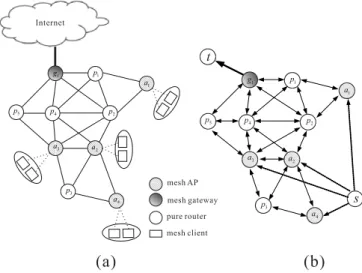
ULTI-RADIO WMNs are the most promising network-ing technology recently to extend last-mile broadband Internet access. Due to the fact that a multi-radio WMN contains no wired infrastructure within its serving field, it has a low cost of deployment and maintenance. It is therefore attrac-tive to several wireless network applications, e.g., wireless last mile access of ISPs, broadband home networking, community and neighborhood networks, enterprise networking, building automation, and so on [1]. A multi-radio WMN consists of mesh routers and mesh clients where mesh routers have minimal mobility and form the wireless backbone through wireless links. Other than their routing functionality, mesh routers provide additional functions to support mesh network-ing. With access point functionality, mesh routers can provide network access for mesh clients within their coverage area. With gateway functionality, mesh routers can connect to the wired Internet. Mesh routers can thus be classified into three types, i.e., pure routers, mesh gateways, and mesh APs (see Fig. 1(a)). Each mesh router is equipped with multiple radio interfaces for effective use of available orthogonal channels. Thus, they can reduce wireless interference and increase network throughput [2]. Two of the most challenging research issues in multi-radio WMNs are the channel assignment and the routing problems, which are usually coupled together to maximize network throughput. The channel assignment problem determines the connectivity between nodes, thus the network topology of the WMN is then determined. Based on the resulting network topology, routing decisions can alsoManuscript received January 6, 2010. The associate editor coordinating the review of this letter and approving it for publication was H.-H. Chen.
R.-H. Jan and S.-Y. Huang are with the Department of Computer Science, National Chiao Tung University, Hsinchu, 300, Taiwan, ROC.
C.-F. Wang (corresponding author) is with the Department of Computer Science, National Pingtung University of Education, Pingtung, 900, Taiwan, ROC (e-mail: [email protected]).
This paper was supported in part by the National Science Council of the ROC, under grant NSC 97-2221-E-009-049-MY3. The authors would also like to thank Dr. An-Kai Jeng for his helpful assistance in conducting the simulation results.
Digital Object Identifier 10.1109/LCOMM.2010.08.100023
Fig. 1. An example for illustrating the problem formulation in multi-radio WMNs.
be made. However, in order to achieve better results, these two optimization problems should be considered jointly, not sequentially [3]. Unfortunately, the joint problem of finding optimal throughput is NP-hard [4].
In this paper, we want to find an upper bound of the through-put for multi-radio WMNs. More precisely, our problem is that, given the deployment of mesh routers and the number of radio interfaces of each mesh router, we want to find the maximum flow from mesh clients to the wired Internet or from the wired Internet to the mesh clients under an interference-free assumption. Since these two cases are symmetric, we only consider the previous case in this paper.
II. PROBLEMDEFINITION
The sets of the pure routers, the mesh gateways and the mesh APs are denoted as 𝑉𝑃,𝑉𝐺, and𝑉𝐴, respectively. The
network model for finding the maximum throughput from mesh clients to the wired Internet in the multi-radio WMN under an interference-free assumption can be modeled as a directed graph𝐺 = (𝑉, 𝐸), called the communication graph,
where𝑉 is a set of nodes containing all mesh routers plus a
source𝑠 and a sink 𝑡; that is 𝑉 = 𝑉𝑃∪ 𝑉𝐺∪ 𝑉𝐴∪ {𝑠, 𝑡}. The
source𝑠 represents all mesh clients, and the sink 𝑡 represents
the wired Internet. Given any two mesh routers, if the distance between them is less than the transmission radius (we assume that all interfaces have identical transmission radii), there are two directed edges with opposite directions between them. We add an edge from𝑠 to every mesh AP and also add an edge
from every mesh gateway to 𝑡 (the corresponding
communi-cation graph of Fig. 1(a) is shown in Fig. 1(b)). Now, we will
JAN et al.: AN UPPER BOUND OF THE THROUGHPUT FOR MULTI-RADIO WIRELESS MESH NETWORKS 699
formulate the maximum throughput problem of a multi-radio WMN as a network flow-like problem, called the Augmenting
Network Flow Problem (ANFP) in communication graph𝐺.
Let 𝑅𝐵
𝑖 be the number of backhaul interfaces equipped in
mesh router𝑖 for backbone communication, 𝑅𝐶
𝑖 be the number
of client interfaces of mesh AP𝑖, 𝑐𝑤 be the capacity of the
wired link and𝐶 be the channel capacity. Thus, the maximum
capacity of mesh router (mesh AP) 𝑖 is equal to 𝑅𝐵 𝑖 × 𝐶
(𝑅𝐶
𝑖 × 𝐶), respectively. The edge capacity 𝑐𝑖𝑗 for each edge
(𝑖, 𝑗) ∈ 𝐸 can then be set as follows:
𝑐𝑖𝑗 = ⎧ ⎨ ⎩ 𝑚𝑖𝑛{𝑅𝐵 𝑖 , 𝑅𝐵𝑗} × 𝐶, if 𝑖, 𝑗 ∈ 𝑉 − {𝑠, 𝑡} 𝑅𝐶 𝑗 × 𝐶, if𝑖 = 𝑠, and 𝑗 ∈ 𝑉 − {𝑠, 𝑡} 𝑐𝑤, if𝑖 ∈ 𝑉 − {𝑠, 𝑡} and 𝑗 = 𝑡, (1) The flow on𝐺 must satisfy two types of basic constraints, i.e.,
the edge capacity constraint and the node capacity constraint. Let 𝑥𝑖𝑗 denote the flow on edge (𝑖, 𝑗). The edge capacity constraint ensures that the flow on each link cannot exceeded the capacity of the edge and the property of flow conservation. For the node capacity constraint on each mesh router, the sum of incoming flows and the sum of outgoing flows must not exceed its capacity, i.e., its backhaul interfaces multiplied by channel capacity. Therefore, our problem ANFP can be mathematically formulated as follows:
Maximize𝑓 Subject to ∑ 𝑗∈𝑉 𝑥𝑖𝑗− ∑ 𝑘∈𝑉 𝑥𝑘𝑖= { 𝑓, if𝑖 = 𝑠 0, if𝑖 ∈ 𝑉 − {𝑠, 𝑡} −𝑓, if 𝑖 = 𝑡 , ∀𝑖 ∈ 𝑉 (2) 0 ≤ 𝑥𝑖𝑗≤ 𝑐𝑖𝑗, ∀𝑖, 𝑗 ∈ 𝑉 (3) ∑ 𝑘∈𝑉 𝑥𝑘𝑖+ ∑ 𝑗∈𝑉 𝑥𝑖𝑗≤ 𝑅𝐵𝑖 × 𝐶, ∀𝑖 ∈ 𝑉𝑃 (4) ∑ 𝑘∈𝑉 𝑥𝑘𝑖+ ∑ 𝑗∈𝑉 −{𝑡} 𝑥𝑖𝑗≤ 𝑅𝐵𝑖 × 𝐶, ∀𝑖 ∈ 𝑉𝐺 (5) ∑ 𝑘∈𝑉 −{𝑠} 𝑥𝑘𝑖+ ∑ 𝑗∈𝑉 𝑥𝑖𝑗≤ 𝑅𝐵𝑖 × 𝐶, ∀𝑖 ∈ 𝑉𝐴 (6)
III. PROBLEMTRANSFORMATION
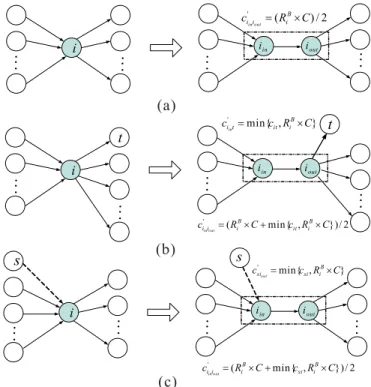
In this section, we present how to transform the problem ANFP into a maximum flow problem. Comparing problem ANFP to the maximum flow problem, problem ANFP has additional node capacity constraints (4)-(6). Our approach is to transform each of the constraints (4)-(6) into a set of flow conservation constraints and edge capacity constraints using node splitting on sets𝑉𝑃,𝑉𝐺, and𝑉𝐴, respectively. As shown in Fig. 2(a), we split each pure router node𝑖 ∈ 𝑉𝑃 into two connecting nodes𝑖𝑖𝑛and𝑖𝑜𝑢𝑡. Node𝑖𝑖𝑛has an edge entering it for every edge entering 𝑖, while node 𝑖𝑜𝑢𝑡 has an edge leaving it for every edge leaving𝑖. We call the resulting graph 𝐺′
𝑃 = (𝑉𝑃′, 𝐸𝑃′ ) an augmenting communication graph with
pure router nodes splitting. The constraint (4) in ANFP can be rewritten as follows: ∑ 𝑘∈𝑉 𝑥𝑘𝑖+∑𝑗∈𝑉𝑥𝑖𝑗≤ 𝑅𝑖𝐵× 𝐶, ∀𝑖 ∈ 𝑉𝑃 ⇒ ∑𝑘∈𝑉 𝑥𝑘𝑖+∑𝑘∈𝑉𝑥𝑘𝑖≤ 𝑅𝐵𝑖 × 𝐶, ∀𝑖 ∈ 𝑉𝑃 (by constraint (2)) ⇒ ∑𝑘∈𝑉 𝑥𝑘𝑖≤ (𝑅𝐵 𝑖 × 𝐶)/2, ∀𝑖 ∈ 𝑉𝑃 (7)
Fig. 2. The illustration of nodes splitting.
Let flow 𝑥′
𝑖𝑖𝑛𝑖𝑜𝑢𝑡 on edge (𝑖𝑖𝑛, 𝑖𝑜𝑢𝑡) ∈ 𝐸𝑃′ be
∑
𝑘∈𝑉𝑥𝑘𝑖.
Inequation (7) can be rewritten as𝑥′
𝑖𝑖𝑛𝑖𝑜𝑢𝑡 ≤ (𝑅𝐵𝑖 ×𝐶)/2, ∀𝑖 ∈
𝑉𝑃 (an edge capacity constraint). The flow 𝑥′𝑖𝑖𝑛𝑖𝑜𝑢𝑡 can be
rewritten as 𝑥′
𝑖𝑖𝑛𝑖𝑜𝑢𝑡 −
∑
𝑘∈𝑉 𝑥𝑘𝑖 = 0 (a flow conservation
constraint). And by constraint (2), the flow 𝑥′
𝑖𝑖𝑛𝑖𝑜𝑢𝑡 can also
be rewritten as∑𝑗∈𝑉𝑥𝑖𝑗−𝑥′𝑖𝑖𝑛𝑖𝑜𝑢𝑡 = 0 (the flow conservation
constraint). Thus, constraint (4) can be replaced by two flow conservation constraints and an edge capacity constraint. If we set capacity of edge(𝑖𝑖𝑛, 𝑖𝑜𝑢𝑡), ∀𝑖 ∈ 𝑉𝑃 in𝐺′𝑃 to(𝑅𝐵𝑖 ×𝐶)/2
and set the other edges’ in 𝐺′
𝑃 to 𝑐𝑖𝑗, then, we have the
following lemma.
Lemma 1. A flow meets the constraint (2)-(4) in 𝐺 of
the problem ANFP, which also meets the flow conservation constraints and the edge capacity constraints in𝐺′
𝑃.
Now, we define the augmenting communication graph𝐺′ 𝐺=
(𝑉′
𝐺, 𝐸𝐺′ ) with gateway router nodes splitting as follows. Each
mesh gateway node𝑖 in 𝐺 is split into two connecting nodes 𝑖𝑖𝑛 and𝑖𝑜𝑢𝑡. The node 𝑖𝑖𝑛 has an edge entering it for every edge entering𝑖. The node 𝑖𝑜𝑢𝑡has an edge leaving it for every edge leaving𝑖 (see Fig. 2(b)). The constraint (5) in ANFP can
be rewritten as follows: ∑ 𝑘∈𝑉 𝑥𝑘𝑖+∑𝑗∈𝑉 −{𝑡}𝑥𝑖𝑗 ≤ 𝑅𝐵𝑖 × 𝐶, ∀𝑖 ∈ 𝑉𝐺 ⇒ ∑𝑗∈𝑉 𝑥𝑖𝑗+ (∑𝑗∈𝑉𝑥𝑖𝑗− 𝑥𝑖𝑡) ≤ 𝑅𝐵𝑖 × 𝐶, ∀𝑖 ∈ 𝑉𝐺 (by constraint (2)) ⇒ ∑𝑗∈𝑉 𝑥𝑖𝑗 ≤ (𝑅𝐵 𝑖 × 𝐶 + 𝑥𝑖𝑡)/2, ∀𝑖 ∈ 𝑉𝐺 (8) Note that 𝑥𝑖𝑡 ≤ 𝑚𝑖𝑛{𝑐𝑖𝑡, 𝑅𝐵 𝑖 × 𝐶}. Then, inequation (8) can be rewritten as ∑𝑗∈𝑉𝑥𝑖𝑗 ≤ (𝑅𝐵 𝑖 × 𝐶 + 𝑚𝑖𝑛{𝑐𝑖𝑡, 𝑅𝑖𝐵× 𝐶})/2, ∀𝑖 ∈ 𝑉𝐺. Similarly, let flows𝑥′
𝑖𝑖𝑛𝑖𝑜𝑢𝑡=
∑
𝑘∈𝑉𝑥𝑘𝑖and 𝑥′
𝑖𝑜𝑢𝑡𝑡= 𝑥𝑖𝑡. We replace constraint (5) by a capacity constraint
𝑥′
𝑖𝑖𝑛𝑖𝑜𝑢𝑡 ≤ (𝑅𝐵𝑖 × 𝐶 + 𝑚𝑖𝑛{𝑐𝑖𝑡, 𝑅𝐵𝑖 × 𝐶})/2, ∀𝑖 ∈ 𝑉𝐺 and
two flow conservation constraints ∑𝑘∈𝑉𝑥𝑘𝑖− 𝑥′𝑖𝑖𝑛𝑖𝑜𝑢𝑡 = 0
and𝑥′
𝑖𝑖𝑛𝑖𝑜𝑢𝑡− (𝑥′𝑖𝑜𝑢𝑡𝑡+
∑
700 IEEE COMMUNICATIONS LETTERS, VOL. 14, NO. 8, AUGUST 2010
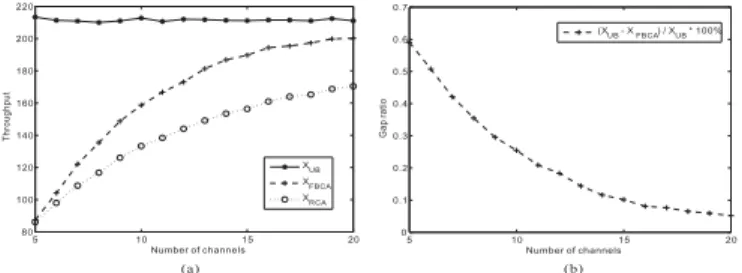
Fig. 3. Numerical results.
∑
𝑗∈𝑉 −{𝑡}𝑥𝑖𝑗) = ∑𝑘∈𝑉𝑥𝑘𝑖 −∑𝑗∈𝑉 𝑥𝑖𝑗 = 0. If we set
the capacity of the edge (𝑖𝑖𝑛, 𝑖𝑜𝑢𝑡), ∀𝑖 ∈ 𝑉𝐺 in 𝐺′𝐺 to
(𝑅𝐵
𝑖 × 𝐶 + 𝑚𝑖𝑛{𝑐𝑖𝑡, 𝑅𝐵𝑖 × 𝐶})/2, and set the capacity of the
edge (𝑖𝑜𝑢𝑡, 𝑡) to 𝑚𝑖𝑛{𝑐𝑖𝑡, 𝑅𝐵
𝑖 × 𝐶}, and set the other edges
in𝐺′
𝐺 to𝑐𝑖𝑗, then, we have the following lemma.
Lemma 2. A flow meets constraint (2)-(3) and (5) in 𝐺 of
the problem ANFP, which also meets the flow conservation constraints and the edge capacity constraint in𝐺′
𝐺.
Similarly, constraint (6) can be transformed by two flow conservation constraints and a capacity constraint in the
augmenting communication graph 𝐺′
𝐴 = (𝑉𝐴′, 𝐸𝐴′ ) with
mesh AP router nodes splitting (see Fig. 2(c)). If we set the capacity of the edge (𝑖𝑖𝑛, 𝑖𝑜𝑢𝑡), ∀𝑖 ∈ 𝑉𝐴 in 𝐺′𝐴 to
(𝑅𝐵
𝑖 × 𝐶 + 𝑚𝑖𝑛{𝑐𝑠𝑖, 𝑅𝐵𝑖 × 𝐶})/2, and set the capacity of the
edge(𝑠, 𝑖𝑖𝑛) to 𝑚𝑖𝑛{𝑐𝑠𝑖, 𝑅𝐵𝑖 × 𝐶}, and set the other edges in 𝐺′
𝐴 to𝑐𝑖𝑗, we have the following lemma.
Lemma 3. A flow meets constraint (2)-(3) and (6) in 𝐺 of
the problem ANFP, which also meets the flow conservation constraints and the edge capacity constraint in𝐺′
𝐴.
Let 𝐺′
𝑃 𝐺𝐴 = (𝑉𝑃 𝐺𝐴′ , 𝐸𝑃 𝐺𝐴′ ) be the resulting augmenting
communication graph with vertex sets𝑉𝑃,𝑉𝐺, and𝑉𝐴 split-ting. And let the capacity𝑐′
𝑖𝑗 of edge(𝑖, 𝑗) in 𝐺′𝑃 𝐺𝐴 be the
values defined in Lemmas 1-3 (see Fig. 2). Then we have a network flow problem on graph𝐺′
𝑃 𝐺𝐴. By Lemmas 1-3, we
have the following theorem.
Theorem 4. The problem ANFP in graph 𝐺 can be
trans-formed into the network flow problem in𝐺′ 𝑃 𝐺𝐴.
IV. ANALYSIS
Now, we give the time complexity analysis for solving the network flow problem in 𝐺′
𝑃 𝐺𝐴. Note that the cost of
splitting every mesh router 𝑖 into 𝑖𝑖𝑛 and 𝑖𝑜𝑢𝑡, to obtain
𝑉′
𝑃 𝐺𝐴 is 𝑂(∣𝑉 ∣). The cost of adding a new edge (𝑖𝑖𝑛, 𝑖𝑜𝑢𝑡)
and assigning its capacity, repeated∣𝑉 ∣ times, is also 𝑂(∣𝑉 ∣).
The total cost of this construction is therefore𝑂(∣𝑉 ∣). Note
that∣𝑉′
𝑃 𝐺𝐴∣) = 2∣𝑉 ∣ and ∣𝐸𝑃 𝐺𝐴′ ∣ = ∣𝐸∣ + ∣𝑉 ∣, if we apply
the Edmonds-Karp algorithm to the graph𝐺′
𝑃 𝐺𝐴. Hence, the
total cost of finding a maximum flow in the original graph
𝐺 = (𝑉, 𝐸) is 𝑂(∣𝑉 ∣)+𝑂(∣𝑉′
𝑃 𝐺𝐴∣∣𝐸𝑃 𝐺𝐴′ ∣2) = 𝑂(2∣𝑉 ∣(∣𝐸∣+ ∣𝑉 ∣)2).
On the other hand, we have conducted simulations to demonstrate how tight the proposed throughput upper bound is. In the simulations, we observe the gap between the throughput upper bound (𝑋𝑈𝐵) and the solution values (the
lower bounds) found by two heuristic channel assignment algorithms, the flow-based channel assignment (FBCA) algo-rithm and the random channel assignment (RCA) algoalgo-rithm,
respectively. The FBCA algorithm uses a greedy approach to assign channels. At first, it ignores the channel interference constraint and performs the maximum-flow algorithm on the communication graph 𝐺 to determine the possible total
in-coming load of each node. Then, it assigns the remaining available channels to the interfaces of nodes one by one in non-increasing order of the load value of each node. For the RCA algorithm, the channels are randomly assigned to each node’s interfaces. The solution values found by the FBCA algorithm and the RCA algorithm are denoted by 𝑋𝐹 𝐵𝐶𝐴
and 𝑋𝑅𝐶𝐴, respectively. In the simulations, we consider an 8 × 8 grid network. For each topology, we choose 30 mesh APs and 6 mesh gateways randomly. The remaining nodes are pure routers. Each pure router (mesh gateway) is equipped with 2 (5, respectively) backhaul interfaces. Each mesh AP is equipped with 2 backhaul interfaces and 1 client interface. The capacity of each channel is 10 Mbps and the capacity of the wired link is 100 Mbps. Fig. 3(a) shows the effects of the number of channels on the network throughput. Each data point in Fig. 3(a) is the average over the 1000 topologies. Note that𝑋𝐹 𝐵𝐶𝐴 and𝑋𝑅𝐶𝐴 can serve as the lower bounds of the optimal throughput and 𝑋𝐹 𝐵𝐶𝐴 is better than𝑋𝑅𝐶𝐴. Thus, the optimal throughput is guaranteed to fall between
𝑋𝑈𝐵 and 𝑋𝐹 𝐵𝐶𝐴. Fig. 3(b) shows the gap ratios of the value 𝑋𝐹 𝐵𝐶𝐴 to the upper bound𝑋𝑈𝐵 where the gap ratio
is defined to be(𝑋𝑈𝐵− 𝑋𝐹 𝐵𝐶𝐴)/𝑋𝑈𝐵× 100%. From Fig.
3(b), we learn that the gap ratio is less than10% if the number of available channels is greater than15. This means that our proposed throughput upper bound𝑋𝑈𝐵 is close to the optimal
throughput if the number of available channels is greater than 15.
V. CONCLUSION
In this paper, given the deployment of mesh routers and the number of radio interfaces of each mesh router, we want to find the maximum flow from mesh clients to the wired Internet under an interference-free assumption. We define the maximum throughput of the problem as an upper bound of the throughput for the given wireless mesh network. The proposed problem is transformed into a maximum flow problem, and then the problem can be solved by existing maximum flow algorithms. Therefore, an upper bound of the throughput for the given wireless mesh network can be obtained in polynomial time.
REFERENCES
[1] I. F. Akyildiz, X. D. Wang, and W. L. Wang, “Wireless mesh networks: a survey,” Computer Networks, vol. 47, pp. 445-487, 2005.
[2] A. Raniwala, K. Gopalan, and T. C. Chiueh, “Centralized channel assignment and routing algorithms for multi-channel wireless mesh networks,” ACM SIGMOBILE Mobile Computing and Commun. Rev., vol. 8, pp. 50-65, 2004.
[3] J. Chen, S. He, Y. Sun, P. Thulasiramanz, and X. Shen, “Optimal flow control for utility-lifetime tradeoff in wireless sensor networks,”
Computer Networks, vol. 53, pp. 3031-3041, 2009.
[4] K. Jain, J. Padhye, V. N. Padmanabhan, and L. Qiu, “Impact of interference on multi-hop wireless network performance,” in Proc. 9th
Annual International Conference on Mobile Computing and Networking,