Contemporary EducationalR的已archQuarterly Septemb叫 20121VOl.20NO.31 pp.129-169
A Critical Examination of the
Appropriateness of Characterising
Character Education in Terms of the
Inculcation of Virtues
Yi-Lin Chen*
Abstract
A troublesome question that first confronts a researcher into character education is the concept itself. In other words, it is incumbent of one to specify the particular version under consideration. Thepu中oseof this study was to draw on two ready-made frameworks for classification,of which the most popular and influential version, i.e. character education in a non-expansive sense, which is generally characterised in terms of the inculcation of virtues, is chosen as the target of discussion. In contrast to the elusive large concept of character, terms related to virtue are more concrete and easier to operationalise,and it seems to make sense to shift the focus from character to virtues, and characterise character education in terms of the inculcation of virtues. However, the case is made that for character education to precede more productively, some misgivings and shortcomings of this
• Yi-Lin Chen, Assistant Professor, Center for Teacher Education, National Taiwan University
E-mail:che叩n哼叭圳y抖州ilin叮in@n肌uω1.edωu肌叫1.叫.t
130
{當代教育研究〉季刊第二十卷第三期 開而r.r.rr:TlTI:r:ITmI l 川﹒'1; rrrr:T1吋 1.TTTTTr(over) simplified characterisation needs to be taken into full account and properly remedied. The most important issue is that character education runs the risk of giving the false impression that it is nothing more than a duplication of the
“
bag of virtues" approach. Secondly,the cultivation of the various virtues is emphasised at the cost of paying due consideration to the inevitable outcome, namely,individualisation of (moral) character and its sister thesis of the varieties of moral personality. Finally,considering the multiple senses of character and the primacy of the ethical sense of character,it is argued that non-expansive character education is defensible with the caveat that it is
“
moral character" rather than“
character as a thewhole" that is at issue.
ii132ji--isa
Keywords: character education
,
the inculcation of virtues,
the“
bag of virtues" approach,
the individualisation of character,
moral character《當代教育研究》季刊 第二十卷第三期· 2012 年 9 月,頁 129-169
以「德目教學」界定「品格教育」
之適當性探討
陳伊琳 摘要 品格教育研究者首先面臨的棘手問題便是「品格教育」概念本身,明確 界定所探討的品格教育派別於是成為他/她責無旁貸的責任。筆者利用兩個現 成的分類架構,挑選出最盛行、最富影響力的版本,即以「品格教育的根本 義」做為批判性檢視的對象,一般是從「德目教學」的角度予以界定。相較於 「品格」這個微妙、難以捉摸的倍大概念, ,-德目語詞」顯得較為具體、容易 操作,因此論述焦點由品格轉向德目似乎是可以理解的,這同時說明了以「德 目教學」界定品格教育的表面信度。然而,本文冒在論證為了品格教育更有成 效地進展,這種(過度)簡單的界定所產生的一些疑慮與缺失,需要被納入充 分考量與適度補救。首先,它容易給人「品格教育不過是「德日錦囊法』的翻 版」的錯誤印象。其次,這種品格教育觀在強調培養各種殊德的同時,未能適 當關照德日教學必然生成的後果一一(道德)品格的個殊化與道德人格的多 樣性。最後,有鑑於品格的多義性及其倫理意涵的首要性,筆者認為「品格教 育的根本義」是可以證成的,惟須特別強調的是,精確而言,當代品格教育關 陳伊琳,國立臺灣大學師資埠育中心助理教授 電子郵件: [email protected] 投稿日期: 2011 年5 月 4 日;修正日期: 2011 年 10 月 11 日;接受日期: 2012 年8 月 24 日132
{當代教育研究〉季刊第二十卷第三期柯i\U"T,!·J/.flI l :f:ITml r:r.r:'1恥,正 川
心的是「道德品格J '而非「品格整體J 0
機陳 f尹琳 台叫辦轉學雷 j 絲;發言它還存言
133
[}:1是通闊前最頭闖世EE揖J.~_遍世聲唱區II!!個Introduction
Contemporary character education-has been popular in current educational policies and practices in many countries (Kristjansson, 2002; McLaughlin &
Halstead, 1999). However, despite its vitality, many scholars (Kohn, 1997;
Kristjansson,2002; Leming, 1997; Lickor泊, 1998; Lockwood, 1997; McLaughlin&
Halstead,1999) have cried out for the necessity to place it under critical scrutiny,and it has even been suggested that the task should be undertaken by a philosopher of education (Nash, 1997). This paper can be seen as an a悅mptmade to contribute to this large project. Specifically, it aims to subject an influential conception of character education to a critical examination.
Since a review of the relevant literature indicates that the concept of
“
character education" 的 amajor source of confusion in itself,it is suggested that it should first be clarified, and the general understanding that character education is a distinct approach to moral education-(Noddings, 1997) is not su血ciently informative. Considering the great variety of existing versions of character education,this paper aims to put a specific prevalent and robust notion of character education to the test.o
Itneeds to be noted that a prefix which is often added to the current character education is“contemporary" or "new". This is because it is widely accepted that character education is not only the latest fad,but also the oldest mission in American education (Ryan,1996). For that matter,the present revival of interest in character education represents a resurgence of awareness of the issues and concerns which have been a constant in education (Purpel,
1997),and this is best understood from a historical perspective.
.. From a historicalperspectiv巴, it is appropriate to regard character education as a distinct approach to moral education,along with two other dominant approaches at that time,i.e. values clarification andKohlbe嗯'scognitive developmental theory of moral reasoning.
134
(當代教育研究〉季刊第二十卷第三期 柯叮叮rr.TlTI:r:11ml r:r.r.1 1:m 州呵°nr.TirT; r蟬聯鈴The case will be made that it can afford a plausible (and provisional) account from which character education proceeds,but character education thus characterised is not without problems. Some defects of this simple characterisation are brought to light which need to be properly remedied,if character education is to proceed in a more sophisticated way.
To this end, I will firstly,delineate the whole contour of character education developed so far by means of two frameworks of classification, and secondly,
pinpoint a particular version of character education as the target of my discussion. This is character education in the non-expansive sense (non-expansive character education, NECE, for short), and it is widely accepted to be the most popular and widespread faction and generally understood to be an educational enterprise aimed at certam scrutmy, critical to subject being of virtues. - After inculcation the 1 : j 1 4 1 4 . 潤,
8The terms,“virtue" and its opposite“vice," are old-fashioned,but the concerns are still relevant.Nowadays,they are largely captured by terms ofcharacter 仕aits,such as honesty,
justice,courage,temperance,and their opposites. Virtues and vices are generally defined as being relatively stable dispositions to act in certain ways. For example,an honest person is believed to act honestly across a variety of situations. For this reason,they are often confused with purely behavioural dispositions. A major problem with this is that certain essential elements of virtues are thereby omitted,which distorts the real nature of virtues. These missing dimensions of virtues are not specifiable in behavioural terms. ForAristotle,
the agent's proper psychological states are indispensable to the possession of virtues,
because
“
we generally think that we should not only 虹Y to do the right thing,but also aspire to do itinthe right spirit (Dent,1984:7)."“The right spirit" signals an essential set of complex psychological states which a virtuous person must embrace, and this is so central that it serves as an important criterion to differentiate virtues (andcharacter 仕'llits) 企om mere behavioural dispositions. For example, without the simultaneous presence of appropriate psychological states,a boy who has a behavioural disposition to treat his sister kindly cannot be said to possess kindness as a trait of character (and virtue). As a result,in135
還軍撞撞II!聾躍謂對. .噶爾聲喝區軍官擱
擇了章,
陳伊琳
shortcomings of the common practice of characterising character education in terms of the inculcation of virtues are highlighted. Among others,a familiar doubt often cast on this conception is whether character education is simply a duplication of the
“
bag of virtues" approach, derogatorily dubbed by Kohlberg, who criticises the problematic practice that the virtues are taught in an entirely separate and 企agmented way, as if they were randomly scattered in a bag and completely disconnected to one another. Secondly,a serious drawback of this characterisation is that the task of cultivating a full set of virtues is often emphasised at the cost of giving due attention to the critical issue of the individualisation of (moral) character and the variety of moral personality. That is,it turns a blind eye to the obvious fact that virtuous people in the world are in actuality of different sorts. What is more, considering the close connection between virtue and character, a question about the terminology in use is raised: if the inculcation of virtues is the primary concern,why choose the term of“
character education" instead of“
virtue education?" After exploring the three senses of character,the case will be made that NECE is mainly being talked about in the ethical sense of character, and that the practice of narrowing“
character" down to“
moral character" is defensible. Hence,it must be borne in mind that it is moral character rather than character as a whole that is at Issue.not stop at observing what he/she does, but extends to the motive, desire and intent displayed in,or revealed by,what is done (Dent,1984). To ensure that one's psychological state is on the right track is essential to attributing a virtue. In a nutshell, it is widely accepted that virtues are
“
dispositions to act,think and feel in certain ways(Annas,2003:136
<當代教育研究〉季刊第二十卷第三期 叮叮;,.n.,f. j.j l·flI l :r:~1叫什;【的:rr:l;,(o 川Framework of classification:
“non-expansive" and
“expansive" conceptions of character education
As already mentioned, a thorny question which confronts a researcher of character education in the first place is the concept itself,given that there are an incredibly large number of factions of character education in existence. This fact explains why it is claimed that
“
character education' is clearly no single thing,and is capable of being interpreted in a number of different ways (McLaughlin & Halstead, 1999: 133)." As a result,it is incumbent on the researcher to specify the particular version under consideration.Fortunately, there are two ready-made classificatory schemas respectively proposed for use by McLaughlin and Halstead (1999) andKris~ansson(2002). Both of these classify the various factions into two categories, namely, NECE and expansive (expansive character education,ECE,for short),but it needs to be not吋
that the criteria according to which the classifications are made are different. More specifically,although Kristjansson takes his cue 企omMcLaughlin and Halstead,he develops a different set of criteria according to which his specification of non-expansive and non-expansive forms of character education is substantially different from that of McLaughlin and Halstead.
Let me begin with McLaughlin and Halstead's 企amework in which the three criteria of classification are, individually, the nature of the rationale for character education,the nature of the qualities of character proposed for development,and the emphasis placed on the exercise of appropriate reasoning on the part of the student.
陳伊琳
V呵呵輛“神間隨撞撞闢週扭扭曾盟
137
conceived, and the emphasis placed on the role of reasoning is restricted (McLaughlin & Halstead, 1999). More specifically, firstly, character education is usually regarded as being a remedy for individual and social ills. Secondly, the qualities of character suggested for development are basic core values, which are alleged to be universally accepted. Finally, the cultivation of these qualities of character precedes an open discussion of controversial moral issues (McLaughlin & Halstead,1999).·
In contrast,the rationale given by ECE is more elaborate. For instance,in some cases, the nature of a liberal democratic society is taken to be a context for its argument for character education (McLaughlin & Halstead, 1999). As to the qualities of character, they go beyond certain basic values to include a complex set of substantial and particular virtues. In some cases,these are intended to be applied to particular schooling contexts, such as religious schools, while in others, these qualities of character are not directly connected to moral life as a whole,but to a particular domain of life. For example,civic virtues are specific to the political and public dimension of0肘 's life and education for citizenship. Finally,the nature and scope of moral reasoning is especially underscored.
Even if McLaughlin and Halstead's schema provides a useful preliminary contrast between NECE and ECE on the one hand,and highlights the shared concern
• Other characteristics of NECE include: (l) great emphasis being placed on the manifestation of proper behaviour, which is seen as evidence of the success of the inculcation of virtues; (2) character education should be undertaken systematically and explicitly,and it is necessary to directly instruct moral rights and wrongs; (3) emphasis should be placed on the influence of moral examples set by the teacher and the school ethos (McLaughlin&Halstead,1999).
1 豆豆1晝且整晝jJf究〉季刊第二十卷第三期
何 {'of. 叮叫缸,叫川吋;刊的m il:o 川
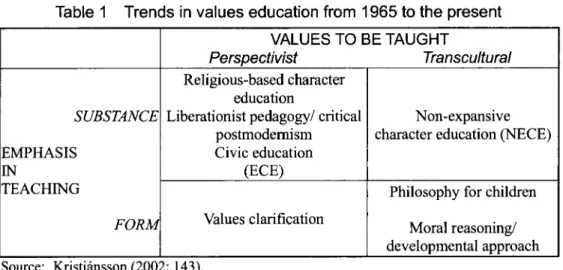
of character education,i.e. the development of certain qualities of character on the other hand,I agree withKristjansson on the point that this schema doesn 't do justice to NECE, since it unduly favours the common criticism of NECE. Among other things,not all NECE ignores the important role of reasoning,or regards character education as merely being a remedy for social deterioration and moral crisis (Kristjansson,2002). As a result,he puts forth an allegedly superior framework of classification, the distinctiveness of which can generally be illus仕的ed in three aspects(Kristjansson,2002): the first is that NECE is not characterised as neglecting moral reasoning or offering a naIve rationale for character education. Secondly,it points out that moral reasoning is not equally stressed by all conceptions ofECE. For example,religious-based character education may not place the same emphasis on moral reasoning. Thirdly,an advantage ofKristjansson's frameworkis 血的 itcan not only classi
fY
various factions of character education,but also distinguish charactereducation 企om non-character education orientated approaches to values education,
such as values clarification and Kohlberg's developmental the。可 of moral reasoning. This schema is graphically presented in table 1.
According to Kristjansson, moral cosmopolitanism and methodological substantivism are two sufficient conditions and defining characteristics of NECE. Firstly, in terms of the content of character education, moral cosmopolitanism indicates that
“
there exist transcultural moral valuesthat 仕anscend the boundaries of time and geography,"and the precise core of character education is the cultivation of these universal virtues (Kristjansson,2002: 138). In contrast, moral perspectivism contends that the virtues espoused by NECE are“
too narrow,too underdetermined,e 陳伊增 139 特意為n圖畫闖擺攤,喝酒扭扭輝
Table 1 Trends in values education from 1965 to the present VALUES TO BE TAUGHT
Perspectivist Transcultural
Religious-based character education
SUBSTANCE Liberationist pedagogy/ critical Non-expansive
postmodernism character education(NECE)
EMPHASIS Civic education
IN (ECE)
TEACHING Philosophy for children
FORM Values clarification ~oralreasoning/
developmental approach Source: Kristjansson (2002: 143).
be complemented or replaced by
“
a set of perspective-sensitive virtues, reflecting more specific moral concerns of a society, culture or religion (Kristjansson,2002: 138)." The job of ECE is to cultivate an expansive set of perspectivist vi巾的. Secondly, in terms of the emphasis within teaching, while methodological substantivism places more emphasis on the content than the method by which these moral values and virtues are taught,for methodological formalism,moral education aims to develop ways of thinking about moral issues(Kristjansson,2002). Based on this premise,both NECE and ECE are methodologically substantial,and concerned with the inculcation of virtues and values,while the moral content of the former is transcultural,and that ofthe latter is perspectivist.In the light of the framework for classification,the target of discussion in the paper is NECE, which is generally characterised in terms of the inculcation of VI巾的.This choice is made basically on the grounds that it is widely agreed that the contemporarγcharactereducation movement is concerned with the notion in a non-expansive sense (Kristjansson,2002; McLaughlin & Halstead, 1999). This is made
140
<當代教育研究〉季刊第二十卷第三期叮圳,叫仰,吼叫1川晶IH(·j(咱還可聽罷恥γ
explicit byKristjansson (2002: 137):
The view trotted out under the banner of
‘
character education' in the United States and elsewhere is more often than not synonymous with a specific conception of character education,espoused by thinkers such as shall, a conception that I Bennett,and Lickona, Kilpatrick, Wynne
following McLaughlin and Halstead's(1999)lead,term
“
non-expansive."Some misgivings of characterising character education as
the inculcation of virtues
this common practice of defining character to
response my
general,
In
education in terms of the inculcation of virtues is two-folded. For one thing,insofar as the close connection between virtue and character is concerned, characterising character education in terms of the inculcation of virtues seems fairly sensible. However, for another thing, this simple characterisation is not without problems. Before setting out to spell out the specific misgivings of it,I want to make explicit the conceptual affinity between virtue and character which grounds the apparent plausibility ofthis simple characterisation in question.
In the first place, let me cite some statements below as proof to show the
concep 仙alaffinity in question:
(1)Dent(1984: 4)puts it:
fEiijiAj--itj4A11
噩噩
although the term
“
virtue" may sound awkwardly in ordinary talk,people still do discuss a person's honesty,generosity,kindness,selfishness,greed,malice etc.; and in so talking they are talking of his virtues and vices even though these specific words are not used.
-z叫幫京 師VF 新泊 v 琳心
,
F aa 冒﹒ 陳 @141
隸之間II撞撞鬧鬧矗圓圓配嘲國軍官攝(2) Goldie (2004: 40) says that:
whilst we don 't these days use the words “virtue" and“vice"(“vice" these days has an entirely different sense-一“vice-rings" and so on),we are still talking about virtues and vices when we talk about character traits as being good or bad-about Bryron's being kind and about David owen冶
(supposedly) being a shit. So whilst the language that moral philosophers use may be somewhat out of date,the topic is not. There are still kind and generous people,and cruel and heatless ones.
(3) Carr(1991: 44-45) indicates that:
For us the term
“
virtue" refers primarily to particular states or qualities of human character such as honesty or generosity or perhaps less surely to the idea of a rule or principle which people invest with some sort of moral value.(4) Haydon (2006: 36) has it that:
We have in English an old word that we can use as roughly equivalent t。
“
a (morally) good way a person can be in their thinking and action." The word is“
virtue." Though it has rather fallen out of use in everyday language it is a useful word for picking out the kinds of personal quality that we find morally desirable or admirable. So we can say that tolerance, unselfishness or integrity are virtues.These notions demonstrate that the specific word,“virtue" is old-fashioned and hence is seldom used in present-day ordinary language. The same objects previously described in terms of virtue are now signified in terms of character trait. A virtue is basically a trait,state,or disposition of character which is relatively enduring,and an
142
{當代教育研究〉季刊第二十卷第三期~閃開Tr.TlTI:I'lrrr.r;,lr.TOT恥
excellence acquired and developed over time (McLaughline & Halstead, 1999). Or, bluntly, as Hursthouse (2006: 141) puts it,“virtues have to be character traits." It
seems plausible to say that it is exactly this strong link:between the two words,virtue and character,that makes sense of the apparent plausibility of the characterisation at Issue.
In the next place,Cunningham (2005: 168) offers a reason further explaining people's preference for virtue to character as follows:
Character is difficult or impossible to operationalize-to verbalize, to theorize, and to rationalize-and so it has been difficult to study. Educational researchers have concentrated on less encompassing terms: specific traits,such as honesty,self-deceit,self-esteem,specific behaviors, such as drug use or cheating,specific academic skills,artistic creativity,or physical stamina and prowess.
That is,in contrast to the tricky large concept of character,terms of virtue are more concrete and easier to pin down the objects in question. In this regard, Hartshorne and May's celebrated
@tIt was a five-year project (1924-1929) launched at the Teachers College, Columbia University, at the request of, and financed by, the Institute of Social and Religious Research,and co-directed by Hartshorne and May.Itwas undertaken in a wide atmosphere of stressing the use of scientific laboratory methods to investigate the objective effects of moral and religious education. The research report was published under the general title,
‘
Studiesin 也eNature of Character',which comprises three volumes: volume I : Studies in Deceit (1928), volume II: Studies in service and self-con仕01 (1929), and volumeill(1930): Studies in the organization of character (1930) (Hartshorne& May, 1930). This study is generally acknowledged to be the most ambitious and extensive empirical study on the subject of character. Besides,it is seen as a landmark in the history of character education,since it is widely accepted that it delivered a death blow to character education
lit 陳伊琳
143
啦!嗨11'1';揖酬謝祖國咽國軍官擱
They admitted that although the objective of this study was to measure the solid reality of character,given its elusive na仙時, it had to be approached in a somewhat piecemeal fashion (Hartshorne & May, 1930).- For this reason, the conduct tests were implemented in the form of an observation of the research subjects' ac仙al performance, which involved developing tests of four types of behaviour, namely,
deception, service, inhibition and persistence (emphasis mine) (Hartshorne & May,
1930).Itneeds to be noted that these four sorts of behaviour are also understood as being 仕aits of character and terms of virtue. For example, deception (and its opposite, honesty) is classified as one type of behaviour in the first place while, when it comes to the analysis of the research findings, it is treated as a trait of character. Here, a change in focus from character to virtue (and even further to its associatedp甜emsofbehaviour) is fairly obvious.
In spite of the advantage of shifting the focus of attention from character to virtue,as indicated previously,this simple characterisation of character education in terms of the inculcation of virtues is nevertheless seriously deficient,since it runs the risk of neglecting to consider some crucial issues of character education which need to be further addressed.
at onetIme.
~Tobespeci祉, in the study,character was understood in four aspects,namely,intellectual factors, dynamic factors (such as desires, attitud郎, and motives), perfO!τnance factors (social behaviour), and selfcon甘01 (which refers to the relationship among the former three factors,and their relationship with social-self integration) (Hartshorne& May,1930),
and therefore,moral knowledge tests,attitude tests,and conduct tests were designed and carried out respectively.
144
(當代教育研究〉季刊第二十卷第三期 年Ti\H,,'·!·Il,f11I :flITr.r.1.U':r.r:'!恥削;rz':liI-ITr.Tl吋轉瞬絲;Duplication of the
“
bag of virtues" approach?
A question often raised about NECE is how to differentiate it from the
“
bag of virtues" approach, which is severely criticised by Kohlberg.· McLaughlin and Halstead(1999: 145) express this concern and suggest a way out ofthe misgiving:Often the virtues are presented as if they were distinct items on a list which can be tackled systematically and separately by educators. This has been described as the
“
If it's Tuesday,this must be Honesty's approach (Kohn, 1997: 154)." Further,the impression is sometimes given that the virtues are merely separable and isolatable pieces of behavior. In the absence of an overall and adequately sophisticated characterisation of the nature and structure of the virtues,and a specification of the ingredients of the sort of practical reasoning with which they must be inseparably connected, proponents of“
character education" are in danger ofbeing left with a mere“
bag of virtues" for transmission. This makes it difficult to address, let alone resolve,questions of meaning,priority and coherence with respect的f)Itis well-known that Kohlberg's objections to character education are mainly expressed in his criticism of the
“
bag of virtues" approach. However,in a later paper co-authored with his colleagues, Kohlberg concedes that his earlier work errs in confusing Aristotle's approach to moral education with the contemporary fashionable“
bag of virtues" approach. As a result,his criticismof 也elatter cannot necessarily be applied to the former,since it does not do justice to Aristotle's conception of virtue, and his envisaged processes of character education (Power,Higgins,& Kohlberg, 1989). This is manifest in Kohlberg's remark that“despite its being named ‘virtue ,'也e ‘bagof virtues' had virtually nothing in common with the classical tradition of the discourse of virtue,"since“
what he speaks of would be the imposition of arbitrarily chosen exterior acts upon students in the name of virtue (Power et aI.,1989: 146)."145
~濃點欄間環路抽回顧ffij闢扭間電
崙 陳{尹琳
r 戶;!,呵呵恥哩 專長
the virtues. For example,it is difficult to attend to important considerations relating to the overall structure of a person's qualities of character and virtue. (emphasis mine)
This doubt is derived from the familiar flawed practice,namely that character education is often conducted in the form of transmitting a list of virtues, each of which is specified by a set of definite rules of conduct,as if a virtue could be fully defined by a narrowly specified behavioural pattern,independently of the context.
This misconception of character education falls prey to Kohlberg's critique of the
“
bag of virtues" approach according to which moral virtues are understood in terms of the teaching of specific rules of behaviour which constitute the substantial contents of moral education (Hamm,
1977). Moreover,
this problematic practice treats the virtues as if they were completely detachable and disconnected to each other altogether. No wonder, the virtues are often inculcated one by one in an entirely isolated way, e.g. one virtue per week. On this view, the formation of virtuous character is seen to be the mere aggregation of lots of freestanding virtues. This defective picture is well depicted by Kent(1999: 111) as follows:Virtuous character threatens to dissolve into a hodgepodge of admirable traits,leaving moral development to look like nothing more than a matter of acquiring more such traits, no matter which combination or in which order.
With regard to the genesis and prevalence of the defective practice, some explanations are needed. For a start, the practice of specifying a given virtue by a typical set of moral rules appropriate to it has to do with the common endorsement of a defectively narrow understanding of virtue. More specifically,these behavioural
146
<當代教育研究〉季刊第二十卷第三期堂先
年Tol閃開Tr.TlTlI前ITml 川
rules are merely generalisations about what typically counts as specifications of particular virtues, for example,“generally,standing one's ground in the face of the enemy is brave," and
“
generally,giving goods to those more in need is an act of generosity (Sherman,1999: 39)." A serious drawback of this is that it fails to address the intelligent adaptability and situation-sensitiveness internal to moral virtues. These features are a decisive discriminative criterion of a virtuous person from a moral novice. A virtuous person's moral understanding is manifested in his/her delicate decisions, which display sensitivity to the particulars of the situations, whereas a moral beginner mainly acts merely out of habit,and is therefore unable to respond to situations flexibly (Annas, 2003). In this regard, Annas (2003: 26) compares a virtuous and practically wise person to a master plumber,and highlights sltuatlO n-expert's and routinised habits a novice's contrast between the an sensitivities:What makes them expe郎, rather than learners, is that they understand
the rule-book, but follow
not mechanically do
what they do. They
approach each new challenge in a way informed by long practice, but sensitive to the particular demands of the situation,and ready to respond in creative ways to unfamiliar challenges. We want our practical experts to have learned 企omexperience and practice,but we do not expect them to have developed a routinized habit that produces predictable outcomes
fji--青晶
3Hizi--ag
whatever the nature ofthe individual challenges.
some simply extracted from are of thumb these rules smce 扎10reover, and characteristic ways of acting (Sherman, 1999: 39)," they are undoubtedly limitedin
vlrtue, of expressIon the for contexts paradigmatic or
“
characteristic實建議;讀寶島主富聶厭那~獨唱回廠闢扭輝
.
陳伊琳接?啊! 147
their ability to account for the related virtues. As a result,a pernicious consequence is that,if they are mistakably identified with the virtues,some substances of virtues are thereby neglected, or dismissed out of consideration altogether. For example, courage is traditionally seen to be a militaryvirt間,since it is often characterised as a virtue specifically dealing with physically dangerous situations. Given this over-simplistic and misleading conception, it is not uncommon to find that someone is physically courageous,but not brave in the presence of social threats and pressures, say,ridicule and disapproval. In summa可,it is not possible to specify any particular virtue exhaustively with a comprehensive list of relevant rules of conduct,nor is it appropriate to reduce a given virtue to a limited number of moral rules.
Whilst acknowledging that this misgiving has some truth in it,especially with reference to ac個al character education practised in schools,I submit that properly construed character education can escape this criticism, and that the crux lies in explicating the interrelationship of the virtues. More explicitly, I agree with McLaughlin and Halstead on the point that in order to dispel this misgiving, the main job consists in clarifying the ve可 natureof virtue,and the relationship among the virtues in particular,which is typically rendered in the long-standing doctrine of the unity ofthe virtues(U~ for short).- By and large,UV is intended to express the
f3UV is open to many inte中retations. Hursthouse (1999) indicates that Timothy Chappell once claimed that there were thirty versions of the doctrine of the unity of the virtues. Among them,a classic version holds that one can have a virtue in a developed form if,and only if, one has all of the virtues, and this view is claimed to be representative of
Aristotle's notion of thedoc的ne(Badhwar, 1996;MacInty間, 1985). More specifically,it contends that one cannot possess one virtue without possessing the rest, and one can possess a virtue if,and only if,one has all of them. In other words,the possession of any virtue entails the possession of all the others,and the absence of any virtue entails the
148 <當代教育研究〉季刊第三十卷第三期
...'<r-Til
r:l'i'i'T=H而缸,叫thought that the virtues are unified in some sense,at least insofar as the appropriate exercise of any given virtue demands specific knowledge of all the other virtues. This is most clearly manifested in complex moral cases where more than one moral consideration is relevant. In order to appropriately exercise a particular virtue, the moral agent must weigh its importance in relation to all of the other concerns simultaneously present in the same moral situation.Itis in this sense that the virtues cannot be seen as being entirely disconnected 企omeach other. For that matter,the individual virtues are not to be acquired in a wholly separate, disconnected way. Quite thecontra句, the unavoidable chances of the compresence of moral concerns of (some of)the various virtues in a complex moral situation highlight the point that the virtues are unified and connected to each other in a certain sense. In a nutshell, the gist ofUV is that the more virtuous one is,the more integrated one's acquired virtues are with each other. That is,the educational goal of becoming virtuous cannot be exhausted solely by the idea of accumulating the virtues as more as possible,since the unity and integration of the virtues is also an indispensable aspect of the educational business ofthe inculcation ofvirtues. On this score,UV is suitably taken as a further step of the notion of the inculcation of the various particular virtues.
Neglect of the individualisation of character
Another problem with this simple characterisation is that the natural
absence of all of them.For 血atmatter,UVis meant to express“the mutual implication of the virtues(Halp 缸" 1999)." In this paper,I adopt Wolf's (2007) weak and more plausible version ofU吭 whichis said to regard the commonobservation 曲的 someone has some virtues without the coincidence of others as a platitude. For a full and detailed argument for this weak version of UV,please consult Wolf (2007).
,
陳伊琳 l149
?莓D兩聶衛臨籬,圓圓扭扭闡
consequence of the inculcation of virtues,viz. the particularity and individuality of character,is overlooked,and this is well illustrated by Kupperrnan(1991: 9-10):
Character has much to do, we might say, with the particularity of a person's life, with making it the possibly distinctive life of this person. This suggests a more continuous and less impersonal role for character than that of, s呵, the virtue of being honest. What matters in the virtue of honesty will be pretty much shared by all honest people, and its importance will be largely limited to those special moments when we are offered a chance to be dishonest. What matters in your character may well be important, continuously, as shaping your life and the way you experience it,and it also will set you apart from at least some other people of good character.
Thus characterised, character education presents itself as if moral agents,by being educated, would ultimately tum into virtuous people of the same kind, i.e. perfectly virtuous people. Thus,the individuality of (moral) character as anecessa可
result of this educational business is unduly brushed off in the existing simple-minded discourse about fully inculcating all the virtues indiscriminately in people. Character education thus portrayed is very likely to convey a misleading, or rather mistaken message to the effect that the ideal moral character is singular,and one and the same for all,and that,through education, all people are expected and presumed to be able to develop and possess all virtues equally and fully at long last.To debunk the unreality ofthis view,I shall argue that,it is imperative for character education to fully take into account a more personal dimension of character development and certain decisive factors which are unavoidably involved in the educational process,
150
(當代教育研究〉季刊第三十卷第三期相同~京~l r:r.r.l l:悶悶恥叫儡露露:“
and consequently, conducive to the individualisation of (moral) character. These include the influence of temperament, the assuming of different social roles and occupations,and the pursuit of different good lives,to name some. After taking full account of this issue, I submit, we are ready to accept Flanagan's notion of the varieties of moral personality,and this raises a further question about how to set an appropriate and defensible goal of character education for real people.
On balance, addressing this more personal aspect of character development helps to highlight both the individual's active role and the limits of one's agency in constructing character. In terms of the former, this theme may act as a healthy antidote to the predominant instrumental argument for character education- by shedding light on the significance of character building for personal flourishing. As to the latter,highlighting the inevitable influence that temperament may exert on the inculcation of virtues acts as an important counter-weight to an exaggerated claim on
C)I have argued elsewhere that the relevant literature on character education is permeated by a means-end argument,according to which,contemporary character education is proposed to be a remedy against perceived social ills and moral decline(Arthur,2005; Lockwood,
1997; McLaughlin & Halstead, 1999; Molnar, 1997; Rusn此, 1998). Put different旬, a healthy dose of character education is seen to be a panacea to prevent the young from causing disturbing problems (Rusnak, 1998). This instrumental argument is at risk of misconceiving character education as being nothing more than an effective means of reducing social problems. More seriously,its仕esses the social benefits which are likely to be generated by character education at the cost of articulating its intrinsic value,i.e. the significance of character development for the individual. If it is fair to say that character education is worthwhile,not only in its own right,but also for the many desirable results it may produce (Pritchard, 1988), evidently enough, the existing discourse is one-dimensional and not sufficiently profound,since the intrinsic value of character education is inappropriately downplayed,or even entirely ignored. For thatrna仕er,a sound argument which maintains an appropriate balance between instrumental value versus intrinsic value,
@ 陳伊琳
話,少 151
持軍濤漲,起草 E甜甜屬回闖謹過祖間電
behalf of deliberate self-making with regard to character(Jacob, 200 I). This is the case because it is shown that our inherited temperaments unavoidably set limits to our disposition toward certain virtues,and away from others. For example, in the cases of fortune's favourites,their temperamental dispositions endow them with a salutary breeding ground for certain virtues,the cultivation of which thereby appears less difficult,or relatively easy.· Also,since people are simply passive recipients of the blessing or misfortune of their temperament,we cannot be held responsible for having, or lacking, certain temperamental dispositions, nor can we be accountable for the way in which temperament figures in the inculcation of virtues, and thus contributes to the individualisation of character. Briefly,this educational business in question is not wholly within one's control.
Further, the thesis of the individualisation of character encourages people to consider the development of character as a whole, and to think about the proper place of each virtue,and the relative importance and priority of the various virtues in one's life. On that score,it helps to remedy a defect made clear by Davidson (2005: 226):
I would suggest that character education has broken character down into its composite elements, but has failed to present an adequate vision of character in its wholeness--especially forpre闡adolescents and adolescents who require a deeper rationale of what it is and why it's important.
G
Aristotle touched on this idea briefly in his concept of“natural virtue." It is well known that natural virtue is notAristotle's major concern,since natural dispositions are simply an inclination to act in certain ways,and without the guidance of reason,they are liable to lead people astray and are,therefore,harmful.Briefly,natural virtue without reason is like a strong body which may stumble badly without sight(Aristotle,1998)152 (當代教育研究〉季刊第二十卷第三期
各黨主義
...~U.. j.j ·j t.T lil :r. ~l 川 '1: nTr.Tl司達到叫
In summa句, I begin with NECE, which is generally understood to be the inculcation ofvirtues. Itis argued that,firstly,to distance it from the
“
bag of virtues" approach, it is imperative to elaborate on the nature of virtue, and illustrate the relationship among the virtues. Secondly,in order to forestall the misconception that virtuous people must be of the same sort,the missing piece of the individualisation of character as a necessa可 corollary of the inculcation of virtues must be brought into the present puzzle of character education.Character education or virtue education?
Itis odd to find that in contrast to the conspicuous place of virtue,character is mentioned far less in current character education discourse. Yet, is not
“
character" education? It may be said that terms of virtue are more workable and manageable than the huge concept of character,which according to Cunningham is difficult to operationalise. Another possible reason has to do with the theoretical concern of virtue ethics,which is widely recognised as being the main philosophical foundation of contemporary character education, specifically NECE. That is, virtue ethiciststltAqa---zfgAgaa consider that vi此間, rather than character, is most central to theirthe。可﹒ Forthem,
“
the concept of virtue is in some way theoretically dominant (Watson,2003: 232),"and character is generally understood to be a collection of dispositions,virtues and vices (Athanassoulis,2005).
In the face of the imbalanced focus on virtue,people may wonder why it should not just be called "virtue education.州 After all, it seems more appropriate to
.
陳伊琳153
喇叭且需要講清扭扭扭區聶自由矗也自由describe what is really going on as being virtue education rather than character education. A simple response is, as mentioned above, that the word
“
virtue" is outdated,
while“
character" is still in wide use. Apart from this,
I will argue that taking a close look at the tight connection and subtle differences between virtue and character helps to judge whether character education, thus characterised, is defensible. For this pu中ose, McKinnon's account of the three senses of character will be heavily drawn on.Three senses
ofcharacter
Naturalistic sense of character
As its name implies,the naturalistic sense of character has to do with human nature. Its main idea is roughly that: human beings are born with various dispositions,whether physical or psychological,but without a character,and that it is part of human nature to construct a character afterwards (McKinnon, 1999). With maturity, eve可 normal human being is destined to go through it. In short, the naturalist sense stresses that the task ofbecoming a person with character is innate to human nature.
More specifically, in the ve可 early years, small children begin to see themselves as discrete entities,physically separate from others,and in possession of subjective perspectives and experiences of the world. At that time,what they have is a proto-self.8 At this level,the self has no distinctive characteristics which can give its possessor determinate directions. Later on,they begin to observe and assess other
"This is
“
a minimal person,"in Flanagan's(1991)terms. A minimal person is an individual (in a physical sense) who possesses a subjective point ofview (Flanagan,1991).154
(當代教育研究〉季刊第二十春第三期 開叮叮jTJ:r:IT1:r;m:T.~:":而'r.m;Yom﹒TlmfE棋people's characters,and consider the kind of character they judge as being admirable and better to emulate,before deciding the kind of person they want to be in a self-reflexive way. Moreover, people are not satisfied with merely choosing their character in some way,and instead,they go further to reflect on their choices and assess them. This is because
“
humans are the kinds of beings who cannot thrive or lead fulfilling lives unless they have evaluated their commitments and goals,and are relatively pleased with them (McKinnon, 1999: 60)." This assessment provides them with an important source of self-worth,because when they endeavour to narrow the gap between the present character and the admired one,they achieve a sense of self-worth according to the proximity of the fit.This raises a further question about the criteria by which character is properly evaluated. Since people have some shared consensus on the evaluative valence of character,it is implausible to say that the criteria are entirely subjective,and this is clearly demonstrated by people's reproach of a criminal's cruelty,and their praise of the bravery shown by a person who rescues a child from a burning building. In this respect, McKinnon (1999) contends that there are objective evaluative standards rooted in human natu間, by which we evaluate people's characters, and determine what it is to be a good person leading a good life. Here,the ethical sense of character is thus brought to thefore企ont.
Ethical sense of character
The use of character in its ethical sense is most familiar to us, since it is a commonplace that
“
the modern concept of character emphasizes aspects of what a person is that are closely related to good (or bad) ethical choice (Kupperman,1999: 202)." When we talk about someone's vi巾的 or vices,we refer to some traits of當陳伊琳
155
咿辦事遁"~i亟草棚躍囑團回艦岫臨嘲 character in the ethical sense, and in this respect, it can be said that character education in the current form is mainly being talked about in the ethical sense of character.Notwithstanding its cen仕ali旬, it should be noted that character cannot be exhausted by moral 仕aits. Then,what else is implied by character? On this point, Kupperman's two pairs of concept,i.e. s仕ong and weak character on the one hand, and good and bad character on the other,help to illustrate the point that character cannot be reduced to a simple collection of virtues and vices. The two twin concepts make up four states of character,namely,a good and s仕ong character,a good and weak character,a bad and strong character,and a bad and weak character.· That is, the criteria by which the two contrasting pairs are made are not only different,but also independent. An obvious example to illustrate their independence is that we would be relieved to find that a bad person does not persist in doing evil things.
This familiar set of contrasting good and bad characters is classified in the light of the goodness of character. If someone is judged to possess a good character, it suggests the presence of virtues and the absence of vices (Kupperman, 1991). Moral paragons are paradigmatic of people with good character. In contrast,having a bad character suggests the presence of vices and the lack of virtues. When describing a character in positive terms,we refer to certain virtues possessed. If evaluating it in a negative way,it is certain vices that come to mind (Steutel,1997). Clearly enough,
.For Aristotle(1998: 34),a virtuous person's character is“finn and unchangeable" in the sense that he/she is not easily swayed by the situation,and is resistant to temptations and pressures. Similarly,a vicious person 's character is also finn and unchangeable,though in a negative sense. For thatmatte丸 strength of character is a necessary condition for both good and bad character.
15些正畫且整璽研理主空型l 第二十卷第三期 何仙汀,叫叫叭,叫r.r.r.1 1:
the presence or absence of moral traits counts a great deal in our assessment of character. Itcan be said that character is mainly evaluated along ethical dimensions, i.e. whether the possessor of the character leads a good human life, and has traits which are taken to be necessary for such a life (McKinnon, 1999). In summa句,
character is mainly judged in the ethical sense,and hence moral traits,i.e. virtues and vices,count most heavily in the evaluation.
The central place ofmoral 甘aitsin the assessment of character is sometimes so exaggerated that virtues and vices are treated as being interchangeable or co-extensive with character traits. This is instantiated by Steutel's (1997: 387) remark "not only do all virtues and vices appear to be traits of character, it seems also possible to regard all traits of character as virtues or vices." However,this idea is proven to be untenable when the second set of the twin concept is taken into consideration.
The second pair of the concept, strong and weak character, is classified according to strength of character. Having a strong character means that its possessor is loyal to ongoing concerns,committed to long-term projects,even when∞nfronted by difficulties or under pr臼S叮e (Kupperman, 1991). In co甜甜, someone with a weak character is not resistant to great temptation, pressure, difficulti白, or others'
心…at川
which entirely centres on moral traits,many non-ethical dispositions and abilities are involved in the second pair. Among others, the ability to persevere and endure challenges,a tendency to rebound from failure,and a disposition to maintain one's position even underpress叮e, are all consistent with a strong character,and count a lot in our account of someone's character, although none of them is specifically
帶陳伊琳
157
i 咿喘時攔軍車間輛軍圓圈嘲區E咽ethical (Kuppennan, 1991, 1999). Moreover, some traits of character, such as considerateness,self-reliance and the like,are in a grey area,because it is not always clear whether or not they count as moral traits,since it depends on how narrowly or broadly morality is understood (Kuppenn徊, 1991). Yet, it cannot be denied that all
of these qualities playa role in our description and evaluation of character,and for that reason,they are also important contents of character. This is well summarised by Kuppennan(1991: 8),who says:
What we praise and admire in someone's character often will include a broader range of excellences than those that would commonly be placed within the domain of morality; conversely, what we condemn and scorn can include unattractive qualities that would have no direct connection with what we would consider morally wrong behavior.
The breadth of character is thus underscored. Nevertheless, as repeatedly stressed,when someone's character is concerned,honesty,courage,and other moral qualities will first come into the evaluator's mind. Therefo時, some scholars endeavour to give consideration to both the breadth of character and the strong moral overtone of character. Kuppennan (1999: 202) provides a good example when he says:
Clearly then character cannot be regarded as straightforwardly and simply an ethical concept. Never the less, when we are describing someone's character,those features that are crucial to being morally reliable will be very promment.
Nonmoral virtues, if we are willing to speak of such, count in the assessment of character, but moral virtues count most heavily.
158
(當代教育研究〉季刊第二十卷第三期 何可;r;rr;TITI軍Ilr.r.'I r:T.T:1 1;叫(.l'l':l i1:﹒川(Kuppennan,1991:9)
To sum up,most of the time character is used in its ethical sense,and includes
moral 甘aits of character, generally known as virtues and vices. For that matter,
character education under consideration is mainly being talked about in the ethical sense of character.
However,when considering the wholeness of character,there may be doubt that character education in its modem guise is comprehensive enough and justifiable. In this respect, Kuppennan argues that a moralistic person tends to see character as entirely lying within the domain of morality,and regards the education of character as being co-extensive with moral education. This equates the possession of a good character to having moral virtues to a high degree,and yet the moralistic conception of character raises the question,“to the extent that moral virtues count in our assessment of someone's character, can talk of character be replaced by talk of virtues (Kuppenn妞, 1991: 9)?" I will come back to this question after expounding the third sense of character.
Metaphysical sense of character
Although it may be said that two people have the same virtue,say,honesty,it cannot be said that they have the same character. This is because character plays a less impersonal role than virtue,and what matters in virtue is shared by eve可one
who possesses it
,
while what matters in one's good character sets one apart from other people of good character (Kuppennan, 1991 ). This subtle, but crucial,difference can explain why we are inclined to identify people by their characters, rather than the sum of their virtues and vices (McKinnon,1999). This distinguishing feature highlights the metaphysical sense of character, which emphasises that it is
159
E講,攝讀1m]都IJ~置,團圍詛盟軍胃
.
陳伊琳心?精暫T!
character which makes one who one is, and provides a criterion of identity to distinguish one person 企om another. Character is unique to the possessor, and no-one else can have another person's character (McKinnon,1999). This invokes ideas of moral identity and continuity,that is that one's character persists through physical changes, and endures throughout one's whole lifetime (McKinnon, 1999). In contrast, virtue lacks such features as uniqueness, individuality, and the identity characteristic of character.
To conclude, the three senses of character can be summarised as follows: naturalistic sense stresses that it is part of human nature to construct a character for oneself
,
which gives a meaning and direction for one's life,
and constitutes an essential component of a flourishing human life. Ethical sense explains the close connection between character and moral 個its, and highlights the central place ofmoral 仕aitsin the assessment of character. Finally,metaphysical sense indicates that character is an important criterion of identity.
Is
‘
character' education in the current form defensible?
First of all,it must be admitted that,in contempora可 character education,the ethical sense of character is emphasised at the cost of the other two senses,and as
仕aits of character, virtues and vices are stressed at the expense of other non-moral traits of character. In this respect, character education in the current form is fairly restricted. In Kupperman's view, it seems that it is utterly representative of a moralistic conception of character education. In contrast, the sort of
‘
education of character' advocated by Kupperman concerns“
shaping the development of what (at the start) are not in the fullest sense persons into ones of certain sorts." Put briefly,it160
<當代教育研究〉季刊第三十卷第三期 呵呵呵rr.TlTI:r;j"1R;川r.ll;r1"l'"r.m;t:川is about
‘
personmaking' (Kupperman,1991),and no doubt,this is a far larger project than the one under consideration. It is plausible to say that,if Kupperman's version of character education was to be carried out,it would be very different from what we have now. It is sure that, by Kupperman's standard, NECE is not comprehensive enough,but I shall argue that it is defensible as far as the primacy ofthe ethical sense of character is concerned. After all,character education is proposed to be a distinct approach to moral education, andtherefo時,a selective focus on the moral dimensionand ethical sense of character meets the case. Nevertheless,considering the breadth and wholeness of character, it may be better to make it explicit that what is concerned is moral character,rather than character,simpliciter.
Here I defend character education in its current form on the strength of the inherent moral overtone of character,the primacy of the ethical sense of character,
and the specific context in which it is advocated as a distinct approach to moral education, and dismiss Kupperman's proposal of comprehensive character education. However, it cannot be denied that both Kupperman's and McKinnon's accounts help shed light on the limitations of the simple characterisation of character education as the inculcation of virtues.
Conclusion
A researcher into character education is destined to face a knotty conceptual question: the definition of character education. After drawing on two ready-to-wear frameworks for classification to map the whole terrain of character education in a sketchy way,I select the most common and influential version,namely,NECE to be the target of a critical examination by reflecting on the appropriateness of defining
動陳伊琳
161
只們斬草攝制圖禮服揖睡圍觀劃圍扭扭扭團 lcharacter education in terms of the inculcation of virtues. Certain misgivings and shortcomings of this characterisation are brought to light. First and foremost,it runs the risk of giving the impression that character education is nothing more than a duplication of what Kohlberg derogatorily dubbed, the
“
bag of virtues" approach. Secondly,predominantly great emphasis is placed on cultivating the various virtues at the cost ofbringing its natural corollary,viz. the individualisation of character and its sister thesis of the varieties of moral personality, which denotes that virtuous people need not be alike,and in fact,they are of different types,to the forefront. The case is made that for character education to proceed more productively,these defects need to be properly remedied,and some ways out of these predicaments are suggested.In the face of the far more frequent occurrence of
‘
virtue', in contrast t。“
character,"in the relevant literature,a question about the terminology used is raised. As a response,some reasons are given to explain why people have a preference for“
character" to“
virtue," and abandon“
virtue education" in favour of“
character education." Further,in order to make clear the subtle differences between virtue and character,an elaboration of the three senses of character is under way. It is argued that contemporary character education, thus characterised, is concerned with character mainly in its ethical sense,andtherefo時, it should be noted that,precisely speaking,what is concerned is“
moral character" rather than character as a whole. Considering the multiple senses of character,NECE is undeniably fairly limited in scope. However,on the other hand,in view of the specific context in which character education is proposed,and the primacy of the ethical sense of character,character education in the current form is defensible.162
{當代教育研究〉季刊第二十卷第三期 可:加all educators partaking in NECE should realise that suchlike character education is restricted in scope in the sense that it is concerned about the fonnation of moral character rather than the construction of character as a whole. Surely,it is another important issue as to how to integrate moral character with character as a whole. Secondly, given that the unity and integration of the virtues is an integral part of moral character, it requires much attention and concern to correct the undesirable tradition of teaching the virtues one by one and in an entirely isolated manner. Among other things,the educated should be guided to notice the fact that the moral reqmrements of some vIrtues may come about simultaneously
m
certam circumstances,and they must learn to weigh their respective importance against each other,and sort out an appropriate course of conduct as a response. Last but not least,the individualisation of moral character as a natural byproduct impels us to pay attention to this more personal aspect of character education, along with the apparently impersonal task of the inculcation of virtues. This crucial issue of the individualisation of moral character re-directs our attention to the fonnation of moral character as a whole.
Acknowledgements
This paper is a revised version of one chapter of my doctoral thesis. I would like to express my sincere thanks to my supervisor,Dr. Graham Haydon,and two examiners of my doctoral thesis, Professor Kristjan Kristjansson at the School of Education, University ofIceland, and Professor Paul Standish at the Institute of Education, University of London. Also, I thank the anonymous reviewers for offeringve可 helpfulcomments on earlier versions of this paper.
@ 陳伊琳
寒灣警那種潛aJ=it頭-喝喝酒奮-喝酒哥姐祖叫個
163
References
Annas,1.(2003). Virtue ethics and social psychology.A Priori,2,20-31.
Aristotle (1998). The Nicomachean ethics (w. D. Ross, Trans.). In 1. L. Ackrill & 1. O. Urrnson,Eds.). Oxford,UK: Oxford University Press.
A吋1Ur,1.(2005). The re-emergence of character education in British education policy.British Journal ofEducationalStudi白, 53(3), 239-254.
Athanassoulis,N. (2005). Morali紗; moral luck and responsibility: Fortune
s
web. London:Palgrave Macmillan.
Badhw缸, N.K.(1996).The limited unity ofvirtue.Noils,30(3),306-329.
Ca汀, D. (1991). Educating the vir,的es: An 臼say on the philosophical psychology of moral development and education. London: Routledge.
Cunningham, C. A. (2005). A certain and reasoned art: The rise and fall of character education in America. In D. K. Lapsley & F. C. Power (Eds.),Character psychology and character education (pp. 166-200). Notre Dame, IN: University of Notre Dame Press.
Davidson,M.L. (2005). Harness thes凹,channel the wind: The art and science of effective character education. In D. K. Lapsley& F.C.Power (Eds.),Character psychology and character education(pp. 218-244). Notre Dame,IN: University ofNotre Dame Press. Dent,N. 1. H. (1984). The moral psychology of the virtues. Cambridge,UK: Cambridge
University Press.
Flanagan, O. (1 991). 均rieties of moral personality: Ethics and psychological realism.
London: Harvard University Press.
Goldie,P. (2004).On personality: Thinking in action. London: Routledge.
Halper,E. (1999). The unity ofthe virtues in Aristotle.Oxford Studies in Ancient Philosophy,
X阿'1, 115-143.
Hamm,C.M. (1977). The content of moral education,or in defense of the
“
bag of virtues."The School Review,8月2), 218-228.
Hartshorne,旺, & May,M. A. (1930). A summary of the work of the character education inquiry (Part I).Religious Education,2月7), 607-619.
164
{當代教育研究〉季刊第二十卷第三期l(;Ti1fl"i"iT;'T亦TlTI:I'lm;r"隔兩:山叫i1:.ITr.Tlm{. .回蜘恥 J
Hursthouse,R.(1999). On virtue ethics. Oxford,UK: Oxford University Press.
Hursthouse, R. (2006). Applying virtue ethics to our treatment of the other animals. In1.
Welchman (Ed.), The practice ofvirtue: Classic andcontemporaη readingsin virtue ethics(pp. 136-155). Indianapolis,IN: Hackett.
Jacob,1.(200 I). Choosing character: Responsibility for virtue and vice. Ithaca,NY: Cornell University Press.
Kent,B. (1999). Moral growth and the unity of the virtues. In D. Carr& 1. Steutel (Eds.), 的rtueethics and moral education: Routledge international studies in the philosophy of education(pp. 109-124). London: Routledge.
Kohn,A.(1997). The 甘oublewith character education. InA. Molnar(Ed心 Theconstruction of children:v character: Nine砂-sixthyearbook of the national society for the stu砂 of
education (pp. 154-162). Chicago: NSSE.
Kristjansson, K. (2002). In defence of
“
non-expansive" character education. Journal ofPhi仙ophyofEducation,36(2),135-156
Kupperman, 1. 1.(1991). Character. Oxford,UK: Oxford University Press.
Kupperman, 1. 1. (1999). Virtue, character,and moral dispositions. In D. Carr & 1. Steutel
(Eds.),的rtue ethics and moral education: Routledge international studies in the philosophy ofeducation(pp. 199-209). London: Routledge.
Lemir嗯,1. S. (1997). Whither goes character education? Objective pedagogy and research in education programs. Journal ofEducation,179(2),11-33.
Lickona,T. (1998). Foreword. In M. M. Murphy (Ed.), Character education in Americas Blue Ribbon schools: Bestpractices戶rmeeting the challenge (pp. xiii-xv). Lancaster,
PA: Technomic.
Lockwood,A. L.(1997). What is character education? In A. Molnar (Ed.),The construction of children
s
character: Nine!}吋ixthyearbook of the national society for thestu砂 ofeducation(pp. 174-185). Chicago: NSSE.
Lockwood,A. T.(1997). Character education: Controversy and consensus. Thousand Oaks,
CA: Corwin.
MacIntyre,A.(1985). After virtue: A study in moraltheoη(2nded.). London: Duckworth. McKinnon,C.(1999).Charac的 virtue theor前, and the vices. Ontario,Canada: Broadview. McLaughlin, T.且, & Halstead, 1. M. (1999). Education in character and virtue. In J. M.
.
陳伊琳165
做得隸主黨講點盟關單草屬回眉酷珊區,膚擱Halstead
&
T. H. McLaughlin (Eds.),Education in morali 砂(pp. 132-163). London: Routledge.Molnar,A. (1997). Commercial culture and the assault on children 's character. In A. Molnar (Ed.), The construction of children:S character: Ninety-sixth yearbook of the national
socie砂戶rthe study ofeducation(pp. 163-173). Chicago: NSSE.
Nash, R. J. (1997). Answering the “virtuecrats ": A moral conversation on character education. New York: Teachers College Press.
Noddin醉, N. (1997). Character education and ∞mmunity. In A. Molnar (Ed.), The
construction ο{children50 character: Nine砂-sixthyearbook of the nationalsocie砂戶r
the study ofeducation (pp. 1-16). Chicago: NSSE.
Power,仁, Higgins, A., & Kohlberg, L. (1989). The habit of the common life: Building character through democratic community schools. In L. P. Nucci (Ed.), Moral development and character education: A dialogue (pp. 125-143). Berkeley, CA: McCutchan
Pritchard, 1. (1988). Character education: Research prospects and problems. American Journalο{Education, 96(4),469-495.
Purpel, D. E. (1997). The politics of character education. In A. Molnar (Ed心 The construction ο{children50 character: Nine砂-sixthyearbook of the nationalsocie砂戶r
thestu砂 ofeducation(pp. 140-153). Chicago: NSSE.
Rusnak, T. (1998). Introduction: The six principles of integrated character education. InT.
Rusnak (Ed扎 An integrated approach to character education (pp. 1-19). Thousand Oaks,CA: Corwin Press.
Ryan, K. (1996). Foreword. In P. F. Vincent (Ed.), Promising practices in character education: Nine success stories from around thecoun的!(pp. ix-xii). Chapel Hill,NC: Character Development Group.
Sherman,N. (1999). Character development and Aristotelian virtue. In D. Carr &J. Steutel
(Eds.),的rtue ethics and moral education: Routledge international studies in the philosophy ofeducation (pp. 35-48). New York: Routledge.
Steutel,J.W.(1997). The virtue approach to moral education: Some conceptual clarification
Journal ofPhilosophy ofEducation,31 (3),395-407.
229-166
<當代教育研究〉季刊第二十卷第三期. . . .~nII·
250). Oxford,UK:Blackwell.
•
陳伊琳 167ι 恩將軍師講輛軍臨睡鑼回國扭扭揖嘲
Appendix 1: Asummary of the whole argument of the paper
The contemporary character education movement is heterogeneous and is of a great variety of versions.
G
Thetwo 企ameworks for classification developed by McLaughlin and Halstead (1999) andKristjansson (2002) are employed to delineate the whole contour ofCE
and to pinpoint a particular version of CE as the target of discussion. This is character education in the non-expansive sense(NECE,for short) which is generally characterised as an educational enterprise aimed at the inculcation of virtues. NECE represents the most prevalent and influential conception ofCEo
G
Is this simple characterisation of CE as the inculcation of virtues defensible? The plausibility and the defects ofthis simple characterisation aredemons仕ated.