Vol. 9, pp. 101-122 March 2014
The Role of EFL Teacher Beliefs in Web-Supported Writing
Instruction and Feedback Practices
Yi-chun Christine Yang
点点, Yu-chuan Joni Chao
点, Chung-kai Huang
点Abstract
Research on writing via computer-assisted language learning (CALL), particularly for learners of English as a foreign language (EFL), has documented a great number of benefits. Yet how teacher beliefs impact their practices in a web-supported learning environment has not been fully explored. This study is to investigate whether teacher beliefs lead to different approaches to utilizing blogs as a tool for a writing curriculum. Two Taiwanese teachers from two universities in central Taiwan were selected because of the co-created syllabus for implementing blogs as the web-supported writing tool in classes and the similar teaching activities that they utilized in process-oriented writing instruction. First, qualitative methods of in-depth individual interviews and a group interview afterwards were conducted for investigating teachers’ beliefs. Then two retrospective protocols of teachers’ feedback were also explored for their patterns of feedback provision, such as the frequencies of teachers’ correction on students’ errors as well as their feedback on the content-wise issues. The analysis of interview data identified four categories, namely 1) teachers’ teaching in general, 2) teachers’ feedback provision in different modalities, 3) teacher beliefs in error correction, and 4) teachers’ beliefs in web-based feedback. Further analyses of both qualitative and quantitative data suggest that teacher beliefs in the treatability of errors contributed to their selective error correction. In addition, teacher beliefs in the feasibility of online teacher feedback varied greatly and led to their different adaptation of it. Furthermore, teachers’ experience also mediated their implementation of feedback on error correction and content-wise issues. Finally, pedagogical implications of the study suggest the important role that teacher beliefs play in sustaining the practice of CALL.
Keywords: teacher beliefs, EFL writing, blended learning, teacher feedback
点
Assistant Professor, Department of English Language, Literature, and Linguistics, Providence University. First Author
点
Associate Professor, Department of English Language, Literature, and Linguistics, Providence University. First Co-Author.
点
Assistant Professor, Department of International Business, National Taipei University of Business. Second Co-Author
⚳䩳⼘⊾ⷓ䭬⣏⬠㔯⬠昊⬠⟙ 䫔ḅ㛇炻枩 101-122 Ḵ˕ᶨ⚃⸜ᶱ㚰
௲
௲ৣߞۺӧᆛၡᇶշमᇟቪբ௲ᏢаϷϸ㎸ჴࡼ܌תᄽϐفՅ
ླྀຽ։
ɀǵᇳ྆ሑ
ɀǵҸི
ɀᄔा
ႝတᇶշᇟق௲Ꮲᆶቪբ௲ᏢፐำᔈҔޑࣴزǴЀځࢂଞჹаमᇟࣁѦ୯ᇟ ᏢಞޣޑϩǴԖࡐᙦᅺޑԋ݀ǶԶךॺΨ࣮ډႝတᇶշᇟق௲Ꮲჹቪբ௲Ꮲޑӳ ೀࡐӭǴՠࢂԖᜢԴৣޑߞۺӵՖቹៜԴৣӧаᆛၡࣁᇶշޑ௲Ꮲᕉნϸ㎸ޑჴ ࡼǴ߾ۘคϼӭวǶ೭ঁࣴزЬԑӧܭԴৣޑߞۺࢂցᏤठԴৣӧаပ ࣁπڀϐቪբፐำ܌٬Ҕޑόӕޑ௲ᏢБݤǶٿՏவѠύεᏢޑԴৣࣁԜ ࣴزϐୖᆶޣǴӢࣁдॺӅӕബࡌаჴࡼပࣁᆛၡᇶշቪբπڀϐӅӕፐำ εᆜǴ٠ܭፐᔈҔаቪբၸำࣁЬޑᜪ՟௲ᏢࢲǶ२Ӄ೭ঁࣴزၮҔ፦ϯБ ݤٰԏၗǴЬाаঁձکဂᡏೖፋࣁЬǴҔаΑှԴৣϐߞۺǶќѦٿঁϸࡘ ᜪࠠϐൔ߾ࢂाٰԴৣॺჹܭᒱᇤޟ҅аϷϣ࣬ᜢϐϸ㎸ჴࡼϷԛኧϩǶ य़ፋၗϩϩԋѤεᜪ: ಃঁ: ঁձԴৣᡏޑ௲ᏢǵಃΒঁ: Դৣӧόӕޑ ნύჹܭϸ㎸ᜪࠠჴࡼޑኳԄǵಃΟঁ: Դৣჹܭᒱᇤޟ҅ޑߞۺǵಃѤঁ: Դৣჹ ܭаᆛၡࣁЬޑϸ㎸ჴࡼޑߞۺǶଞჹ፦ϯၟໆϯၗޑϩǴךॺวԴ ৣჹܭᒱᇤࢂցૈޟ҅ޑߞۺቹៜډдॺჹܭᒱᇤޟ҅ޑᒧǴԶЪԴৣჹܭ ጕ௲ৣϸ㎸ჴࡼޑёՉ܄ϐߞۺΨԖࡐεޑৡ౦ǴΨᏤठдॺჹܭᆛၡ௲ৣϸ㎸ ჴࡼၮҔޑৡձǶ׳ԶقǴ௲ৣޑ௲ᏢᡍΨቹៜдॺჹܭᒱᇤޟ҅ޑϸ ㎸ჴࡼǴᗋԖځдԖᜢቪբϣୢᚒޑϸ㎸ჴࡼǶനࡕԜࣴزϐ௲ᏢࡌᡉҢр௲ ৣߞۺӧၮҔႝတᇶշᇟق௲Ꮲ܌תᄽޑख़ाفՅǶ ᜢᗖຒǺ௲ৣߞۺǵमᇟࣁѦᇟቪբǵషӝԄᏢಞǵ௲ৣϸ㎸ 点 朄⭄⣏⬠劙⚳婆㔯⬠䲣≑䎮㔁㌰ˤ䫔 IJ ἄ侭ˤ 点 朄⭄⣏⬠劙⚳婆㔯⬠䲣∗㔁㌰炻ℙ⎴ἄ侭 1ˤ 点 ⚳䩳冢⊿⓮㤕⣏⬠⚳晃⓮⊁䲣≑䎮㔁㌰炻ℙ⎴ἄ侭 2ˤġ ⇘䧧㖍㛇烉2013 ⸜ 12 㚰 18 㖍ˤIntroduction
While the product-oriented approach in writing instruction addresses writing as a final result of student’s performance and treats students’ errors critically, the recent trend of writing research shifted from product-oriented to the process-oriented approach. As Deqi (2005) pointed out, the change to a process approach in writing instruction represented as a “paradigm shift (Reid 1993)” (p. 67), which led to greater amounts of peer and teacher feedback on facets of writing beyond error correction.
The debate over which approach’s treatment of errors is more conducive to fostering EFL learners’ writing accuracy continues to be waged due to many and opposing findings in the research on written feedback. For example, Truscott’s research on error correction (1996, 2001, 2004, 2007, 2010) has indicated that teachers’ error correction feedback does not contribute to students’ improved writing accuracy, whereas Ferris (2001, 2002, 2004, 2006, 2007, 2010) argues that the documented reduction of student errors across drafts indicates that they do indeed attend to teachers’ error correction and adapt their revisions accordingly. Nevertheless, it is likely that teacher provision of feedback may vary in different teaching contexts and factors, such as real-time or online interaction and teacher beliefs in teaching writing could lead to their different patterns of providing teacher feedback. It can be seen from the studies in error correction that teachers’ beliefs have not been taken into much account regarding how their beliefs interact with their feedback on students’ writing issues, including linguistic errors particularly in web-supported learning surrounding, namely a “blend of both face-to-face experiences and online interactive activities” (Liang & Bonk 2009, p. 3) (Face to face will be abbreviated as f2f hereafter). Such exploration can reveal EFL teachers’ teaching, their provision of written feedback in the language classroom and how their beliefs influence their practices. Blogs, for example, have been integrated in EFL/ESL writing classes and abundant research has been conducted to investigate the effects of blogs on enhancing students’ writing ability with respect to vocabulary capacity, more complex grammatical structures, and critical thinking skills. (e.g., Arslan & Şahin-Kızıl 2010; Fellner & Apple 2006; Jones 2006; Liang 2010; Miyazoe & Anderson 2010; Mynard 2008; Zhang 2009). Yet how teacher beliefs interact with their feedback practice in a web-supported EFL writing classroom has not been fully explored. Thus, this study aims to fill part of that gap by investigating whether teachers’ beliefs contribute to different feedback practices in the blended learning context.
Literature Review
Teacher Beliefs
Definition of Teacher Beliefs
Teacher beliefs have come under examination by researchers with respect to pre-service teachers, for example (e.g., Lee, Tsai, & Chai 2012; Teo & Chai 2012; Teo, Chai, Hung, & Lee 2008). What is exactly meant by the term “belief”, however, is foggy in the literature. Several terms have been used simultaneously in the research of teacher education to understand teachers’ values or their knowledge systems concerning language teaching. With a comprehensive review of studies in teacher cognition, Borg (2003), however, seems to use the two terms, beliefs and cognition, interchangeably to refer to the same concept when discussing teacher cognition. He further characterized the notion of “teacher beliefs” by stating that teachers make instructional decisions and choices “by drawing on complex, practically -oriented, personalized, and context -sensitive networks
of knowledge, thought, and beliefs” (p. 81). In a similar vein, Zheng (2009) reviewed teacher belief research on EFL pre-service teachers. Noting the ambiguity existing between the two terms “knowledge” and “beliefs” in the literature, Zheng (2009) defined teacher beliefs as ‘the complexity of teachers’ mental lives underlying their practices.” (p. 74). To sum up, in this study teacher beliefs were referred to as a teachers’ knowledge system with respect to language teaching and learning and a network that teacher would tap into when it comes to decision making in instruction.
Trends in teacher beliefs have been related to those concerning language teaching in general (Basturkmen 2012; Pajares 1992), grammar teaching (Borg 2003; Eisenstein -Ebsworth & Schweers,1997; Connelly & Clandinin 1988; Elbaz 1981; Kagan 1992; Kagan & Tippins 1991), literacy instruction (Phipps & Borg 2009), and pronunciation instruction (Baker 2013; Chiu 2008). As teaching ESL/EFL writing has surfaced as the most challenging among the four language skills, external factors, such as large class sizes or grading work overload, also pose difficulties on teachers’ writing instruction. Given the inherent complexity of teaching writing, how teachers think about their work and what their mentality towards teaching writing play critical roles in their choice of teaching approaches and feedback practices in an EFL writing classroom (Borg 2009, 2011; Calderhead 1996). Khanalizadeh & Allami (2012) investigated how teacher beliefs have impacted on EFL writing Instruction and the findings suggested that teacher beliefs on the basis of three views, namely product-oriented, process -oriented, and socio-cultural-oriented, were not associated with their education, gender, and teaching experience. Furthermore, the majority of the teachers still held product-oriented perspective as critical in writing instruction.
With the advance of computer technology it is more achievable to communicate in the written language of English, comparing to paper-based writing. In a similar vein, the use of web-supported writing instruction provides EFL learners with considerable opportunities to write and to communicate beyond the time constraint and the onsite classroom. Increasingly, writing teachers have incorporated web-supported tools into their writing courses. Writing on the web is not simply a distribution channel for students’ work anymore, but a more engaging and meaningful process of self monitoring and peer interaction. Researchers (e.g., Lin, Chen, Liaw, & Liou, 2005; Wible, Kuo, Chien, & Liu, 2001) have discussed and urged the use of computer-mediated writing in the EFL class and two of the most widely-studied tools for writing are the blog and the wiki. The blog and the wiki offer prominent features for EFL writing and are pedagogically open source platforms that provide a solid ground on social interaction and collaboration (Godwin-Jones, 2003; Su, 2005). Furthermore, the advantages of computer-based writing instruction have been investigated since two decades ago (e.g., Beauvois, 1997; Gruber, 1995; Robinson-Staveley, 1990; Sullivan & Pratt, 1996). Many Taiwanese researchers (e.g., Chao & Huang, 2007; Lin, Chen, Liaw, & Liou, 2005; Wible, Kuo, Chien, & Liu, 2001; Yang, 2009) have discussed and urged the use of computer-mediated writing in the EFL class. Nevertheless, Petko (2012) argued that despite the availability of computers and the Internet in many schools, many factors remained influential in determining teachers’ willingness to use technology in the classrooms, and among them teacher’s competencies and beliefs are still considered essential.
Correspondence and Mismatches Between Teachers’ Stated Beliefs and Their Practices
between teachers’ stated beliefs and their classroom practices due to many contextual factors, such as students’/parents’ expectations or administrative pressure (e.g., Kim 2006; Lim & Chai 2008; Mak 2011; Ng & Farrell 2003; Phipps & Burg 2009). Basturkmen (2012) indicated that novice teachers’ stated beliefs deviated from their classroom teaching mainly because of this changing process that they were in whereas experienced teachers’ beliefs were inclined to be more corresponding to their teaching practices due to their teaching experience. Lee (2009) extrapolated correspondences and mismatches between secondary teacher beliefs and written feedback practice and indicated that teachers spent more time on language form whilst they believed accuracy is not the only factor leading to good writing. Furthermore, teachers inclined to attribute their constraints of practicing their beliefs in reality to external factors, such as the exam culture or pressure from their institutions. However, it is still inconclusive how those factors contribute to the matches and mismatches between teachers’ stated beliefs and their teaching behavior.
Teachers’ Practices of Feedback in the EFL/ESL Writing Classrooms
Writing instruction has long held a central position in the teaching and learning of English as a second/foreign language. There is an extensive body of research on EFL/ESL writing instruction, and much attention has been paid to the usefulness of teacher feedback on error correction and that of their feedback on higher order writing concerns in improving student writing. After the publication of Truscott’s (1996) article, which claims that error correction does not improve students’ accuracy in writing, many studies have been conducted to further validate or invalidate the claim (Btichener, Young, & Cameron 2005; Ferris 1999, 2002, 2004, 2006, 2007, 2010; Truscott 1999, 2001, 2004, 2007, 2010). On the basis of abundant research findings in CF, Ellis (2009) reviewed research in CF and proposed a guideline to assist in teacher’s provision of feedback in the classrooms. He argued that error correction appears to be beneficial to L2 acquisition regardless of oral or written CF (Bitchener & Knoch 2010; Bitchener, Young, & Cameron 2005; Sheen 2007; Ellis, Sheen, Murakami, & Takashima 2008). This viewpoint clearly speaks against Truscott’s claim. As Ellis (2009) concluded, “CF is clearly a topic of importance in teacher education programs, not least because of the growing evidence that it can play an important role in enhancing both oral and written linguistic accuracy, the key issue is how to handle this complex issue.” Thus, it is important to understand teacher beliefs in feedback provision as to explore the relationship between their patterns when offering feedback in the classrooms and students’ expectations and/or perceptions of corrective feedback (Hyland 2010). Sheen (2010) conducted a study attempting to investigate the effects of both oral and written corrective feedback (CF) on L2 learners’ acquisition of English articles. One critical perspective of this study was whether the explicitness of corrective feedback affected learners’ learning of the target linguistic feature. Students were divided into four groups in which three of them were the experimental ones for oral and written feedback and the other was the control group. The findings showed that the explicitness of CF was the significant factor in enhancing students’ acquisition of the features. The type of feedback emphasized in this study, however, was predominantly associated with that in error correction, not content-wise issues and the role of teacher beliefs in the provision of written feedback was still not clear.
Stepping away from the question of which feedback type is ideal, Diab (2005) argued that while ESL writing research encouraged teachers to provide feedback on content and organization, in reality most of the teachers focus on correcting students’ linguistic errors. In light of the controversy that surrounds form-focused feedback versus
content-based feedback, Diab examined teacher beliefs with regard to their responses to ESL writing. The results showed that teachers addressed both grammar/sentence-level and content-wide concerns. A factor not explored by Diab’s (2005) study is whether and how teacher beliefs about teaching ESL/EFL writing have impacted the types of feedback they prefer to provide.
Notably, a majority of the research into ESL/EFL writing instruction has taken place in a western context. Writing instruction in eastern and western context has been differentiated with regard to teachers’ teaching styles, political issues (Casanave 2003), as well as the influence of cultures (Hamp-Lyons 2006; Hamp-Lyons et al. 2001; Lee 2008; Lee & Coniam 2013). Thus, it is critical to understand teachers’ writing instruction in an eastern context. Lee (2008) conducted a study to understand teachers’ practice of providing written feedback in secondary education in Hong Kong. Many teachers in this study indicated that they had to provide error corrections on students’ compositions in order to meet student and parent expectations as well as administrative demands, although this ran counter to their beliefs that written corrective feedback was not beneficial to students. This study, while providing a valuable window into Asian teachers’ beliefs about paper-based writing feedback, did not explore the relation between teacher’s online
feedback and teacher beliefs. To fill the gap between teacher beliefs and classroom practices, Hyland (2010)
asserted that “the global reach of English suggests that need for wider ranging research on teachers’ beliefs and practices to reflect the myriad variety of context where feedback on L2 writing is given and used.” (p. 175). This statement highlights the importance of understanding teachers’ beliefs in teaching ESL/EFL writing and why it is critical to examine how teachers provide written feedback on form and content. Hyland went on to cite a number of studies which had stressed the limitations of web-based feedback capabilities as the basis for her push for further research into how web-based feedback could be best used in combination with face-to-face and peer feedback. Thus, in response to Hyland’s observations, and grounded in the literature, this study aimed to explore the following questions in the context of college education in Taiwan:
1. What are teacher beliefs in terms of teacher feedback practices in web-supported EFL writing instruction?
2. What is teacher beliefs’ role in their provision of written feedback in an EFL web-supported writing environment?
Method
Participants
In selecting the participants for this study, the framework postulated by Mishra and Koehler (2006) has been employed. TPCK (i.e. technological pedagogical, content knowledge) is based on Shulman’s (1986) notion about teacher knowledge as being a function of pedagogical and content knowledge, known as PCK. Schulman’s PCK framework attempts to explain how aspects of content knowledge can be organized and integrated into pedagogies to make a subject matter more suitable for instruction. By adding a technological component (T), Mishra and Keohler (2006) argued that contemporary teachers have to adapt to the rapid progress of educational technology and should actively develop their ability to apply technologies to enrich their teaching and thus postulated the TPACK framework, which underpinned the intersection of the three types of knowledge. Nevertheless, the three individual types of knowledge in this framework were addressed to locate the two teachers’ expertise without considering the intersection of the three areas of knowledge.
In light of this framework, the two selected participants in this qualitative study were Ming and Ping (names are pseudonyms). Ming is a male part-time novice instructor at a public university with a PhD degree in curriculum and instruction. Ping is a female full-time experienced writing instructor in the English department of a private university with a PhD degree in applied linguistics. Ping had been an English teacher for more than ten years and was a very experienced instructor. Her teaching specialty is English compositions and had taught writing classes for many years. In addition, Ping became interested in CALL (computer-assisted language learning) years after she obtained her PhD degree and henceforth combined web-based teaching approaches in her writing classes. Ming’s teaching specialty is using technology to teach English of different language skills and taught part-time when the study was conducted. The focus features of the two teachers were the following: First, they both had teacher training in Teaching English as a Second Language (i.e. Ping has a PhD degree in applied linguistics and Ming has a master’s degree in TESOL). Second, they both had the three types of knowledge indicated in the TPACK framework (Mishra & Koehler, 2006). Third, they both had strong motivation in using technology or web-supported writing approaches in the classrooms. Forth, they both employed technology for students to provide peer feedback. Furthermore, the course syllabus was co-created by the two teachers and integrated blog-writing into writing courses during the same semester at their respective institutions; thus, ensuring a high level of agreement in essentials, such as teaching content and approaches. Fifth, they co-constructed the syllabus and used similar methods in their writing classes.
Students from the two classes were composed of those with greatly varied English proficiency levels. Ming’s class was a cohort of students at a public university, entailing much higher English ability. In contrast, Ping’s students’ English proficiency was much lower than those in Ming’s class. The prominent differences between the two cohorts of students could be distinguished by their writing on blogs with regard to length and the complexity of students’ compositions. Students were required to write descriptive and narrative compositions and were assigned to comment on three of their peers’ writing on blogs based on the consecutive school ID. For instance student whose school ID was number one had to comment on those students whose ID numbers are No. 2, 3, and 4 consecutively and so forth (see appendix C for more details).
Data Collection
In order to obtain analyzable data regarding teachers’ beliefs about providing written feedback, two individual interviews, and one group interview were conducted, and retrospective reports about feedback practices were collected from the teachers. Both the individual interviews and the group interview were semi-structured and were conducted in English (see appendix A and B). The individual interviews lasted about 40 to 45 minutes each whereas the group interview lasted about 40 minutes. The interviews were recorded and transcribed, and member checking was administered to ensure the authenticity and the correctness of the transcripts. With respect to the retrospective reports, the researcher randomly selected three pieces of students’ writing from their blogs for each teacher respectively to aid for in their reflections on the feedback they may have given their students. Furthermore, the syllabuses for both classes were also collected as artifacts to provide further details concerning the teachers’ beliefs and their instruction.
Data Analysis
Content comparison method was utilized for the interview data and the frequencies of types of written feedback were calculated for the retrospective reports. The interviews
were analyzed by first identifying concepts in the data. Initially, two overarching themes were identified. (a) teachers’ conceptions concerning EFL writing and their provision of written feedback on student blogs (b) comparison between teacher beliefs in providing written feedback in paper-based and web-based modality. In addition, another researcher was invited to reexamine the codes, categories, and subcategories in order to confirm the trustworthiness of the data analysis protocols. The agreement rate between the two researchers on the coding scheme of the categories was 90%. Satisfactory relocation of two problematic categories was achieved via negotiation.
Results
The Findings from Qualitative Data
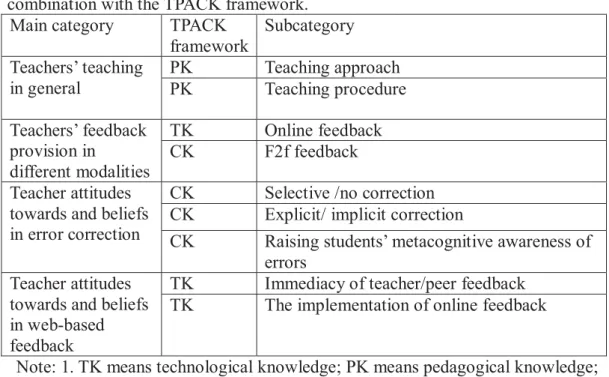
The analysis of the data revealed four major categories (a) Teachers’ teaching in general (b) teacher’s feedback provision in different modalities of writing instruction (c) teachers’ beliefs in error correction (d) teachers’ attitudes towards and beliefs in written feedback to online and analog writing. All of the main categories and the subcategories are shown below in Table 1, and will be concisely discussed in the analysis. Furthermore, the findings were combined with the TPACK framework (Mishra & Koehler, 2006) indicated in the method section to elucidate the relationship between teachers’ beliefs and the conceptions with the premise in mind that Ping has more content knowledge than Ming while Ming has more technological knowledge than Ping because of their specialties in language education and the differential teaching experience.
Table 1: Categories and the subcategories identified in the interview data in combination with the TPACK framework.
Main category TPACK framework Subcategory Teachers’ teaching in general PK Teaching approach PK Teaching procedure Teachers’ feedback provision in different modalities TK Online feedback CK F2f feedback Teacher attitudes
towards and beliefs in error correction
CK Selective /no correction CK Explicit/ implicit correction
CK Raising students’ metacognitive awareness of errors
Teacher attitudes towards and beliefs in web-based feedback
TK Immediacy of teacher/peer feedback TK The implementation of online feedback
Note: 1. TK means technological knowledge; PK means pedagogical knowledge; CK means content knowledge.
Teacher’s Teaching in General
Teaching approach
Both teachers utilized a mixed process writing and genre writing approach in their classrooms whilst integrating web-based writing with face-to-face instruction.
The teaching method that I applied…is based on the process writing…a mixture of genre-based and process-based writing (Ming)
Basically similar to Ming’s process writing and the genre-based (Ping)
The genre-based process writing approach focuses on the development of content and appropriate organization of writing, thus shifting teachers’ focus of correction to helping students express their thoughts and ideas about the topic in question.
Teaching procedure
Despite the similar teaching approach that both teachers applied in their writing classes, their teaching procedures varied to some extent. The following are brief descriptions of their teaching procedures.
First (I) will encourage them or the positive part of writing, so positive comments, always needed at the very beginning. And then … turn to…some area they need to improve. (Individual interview: Ping)
Actually we have three steps. The first one is compliment and suggestions, and correction…blog. So they will follow the three steps…we also give them a guideline that they can focus on in terms of the organization, content, and grammar. (Individual interview: Ming)
Both Ming and Ping follow a determined set of steps in their teaching procedures. Differences did emerge, however. Ping usually started her class with a mini-lesson and a short in-class writing activity on which she gave her students feedback immediately. In Ming’s class, he usually started with brainstorming activities followed by drafting and revising.
In essence, both Ping and Ming had similar teaching approaches due to this co-constructed syllabus as well as their similar background in language teaching. Hence, their pedagogical knowledge was approximate and did not differ to a great extent.
Feedback Provision in Different Modalities
Online Feedback
Both teachers indicated that they provided students with online written feedback because of the functions that blog writing can offer. In blog writing, teachers address more of the content and organization. The following is an excerpt from Ping to show her feedback behavior in the online modality.
No, blog writing, you cannot correct them (errors)…Comments in the blog should be
talking more about the content or the organization. (Individual: Ping) As can be seen from the excerpt, Ping did not give much error correction on students’
blog writing but focused more on content issues. Similarly, Ming emphasized on the content as well.
F2f feedback
To complement the online feedback provided to students’ online writing, teachers provided feedback via focus class instruction and individual conferences outside of the
class time. The following are two excerpts from interviews regarding the face-to-face feedback that they provided in the real classrooms.
Usually, for these two writings, since all the students are writing in (on) the web, so
in the class, I can do oral feedback by showing the example I have targeted. (Individual: Ping)
I think teacher-student conferencing is good. I also want to show the student’s individual essay on the screen, and everybody can read it… and give the feedback at the same time. (Individual: Ming)
Both Ming and Ping targeted common issues that they found in many students’ writing regardless of the issue types, for classroom discussions. The teachers addressed both the local errors and the content issues so as to show students what they could do later to improve their own writing. However, teachers may put a different emphasis on their provision of feedback when teaching students face-to-face. Ping, for instance, indicated that she would focus on the organization of students’ writing in the real classroom. This is type of negotiation and reciprocal feedback can hardly be achieved on the internet due to the impossibility of getting all of the students online at the same time. Thus, Ping addressed more of students’ errors in f2f feedback, which also showed that her possession of content knowledge was more than Ming’s because of her rich teaching experience in the traditional classroom setting.
Teachers’ Attitudes towards and Beliefs in Error Correction
Selective correction or no correction
Given the fact that students made errors in writing most of the time, it is not likely for teachers to correct all of the errors. Both Ming and Ping engaged in selective error correction practices, and sometimes opted to simply not correct errors at all. The below excerpts illustrate one of their rationales for doing so.
I remember there’s a research by a scholar at Ching-Hua University, Truscott’s, he did the experimental design and there’s no difference teachers who correct the errors and who don’t. So based on that paper, I believe we can do adequate correction rather than comprehensive. (Individual: Ming)
Another important reason that teachers selectively corrected or did not correct students’ writing errors was their emphasis on developing writing fluency over accuracy. Furthermore, one more critical aspect of teachers in choosing to selectively correct errors is their belief about the treatability or the prominence of errors (Bitchener et al., 2005).
Researcher: So why are you giving this kind of, correct errors selectively?
Ping: Because I believe these are treatable errors... The other parts, the other ones are untreatable…those are lexical grammatical one. (Individual: Ping)
Both teachers held somewhat similar perspectives on selectively correcting errors. They believed that some errors were more treatable than others, that common errors were more worth addressing than uncommon ones, and that correcting some errors would not be useful as the represented aspects of the language beyond students’ current language proficiency.
Explicit/Implicit correction
Ping and Ming varied in the ways that they provided error correction. Whereas Ming dwelled on what he called implicit correction, Ping preferred a simple and direct approach. The following are two excerpts from them to illustrate their attitudes towards the explicitness of error correction.
Ming:..I copy and paste the sentence. … It’s very implicit...I copy and paste the
sentence, but I say “Oh, there’s a grammatical error” or fragment…I didn’t point out. (Individual: Ming)
For example, if I say, talk about SV agreement, I will point (it) out, show them
some examples, and they will see how many (same kind of errors) they have made. (Individual: Ping)
As can be seen from the examples, Ming did not give students the correct forms of the grammatical errors but attempted to elicit reflections and self-correction from students. Ping, on the other hand, would show her students explicit examples of the errors that have been made in the majority of students’ writing. In addition, both stated their purposes of utilizing explicit/implicit correction were to raise students’ metacognitive awareness of their own errors.
Teachers’ Beliefs in Web-based Feedback
Immediacy of teacher/peer feedback
Both teachers mentioned the openness of the web and how this openness is beneficial to both students and teachers with respect to tracking students’ progress in writing.
I prefer web-based feedback. The feedback can be reviewed… over and over again…So feedback, if it’s web-based, probably they (students) can review it at night time, or when they need it. (Individual: Ping)
I prefer web-based feedback, and I can see how students modify their essay after they receive my suggestions or comments, and what kind of modification they have made through this process. (Individual: Ming)
Although the feedback that Ping provided was traditional in that it was oral and directed at the whole class, it was facilitated by a modern web-based environment. She was able to see her students’ writing immediately, and, therefore, responded both orally and on-screen immediately, which resulted in the immediacy of teacher feedback. Furthermore, both teachers stated that the immediacy of online teacher/peer feedback led to collaborative learning because online feedback was available for all the learners to view and, therefore, any students could learn, not just from one’s errors, but from the errors of others as well. An excerpt by Ming illustrates this perspective.
When we use the web-based environment, we want to bring in the peers, peer feedback; otherwise there is no reason to use a web-based platform…also we want more people to read the students’ essay…I believe the openness of the web
environment. (Individual: Ming)
The implementation of online teacher feedback
about the effectiveness of teacher feedback on students regarding viewing teacher feedback before or after performing peer review. Ming required students to offer peer feedback on blog entries before giving his own. In contrast, Ping did not do peer feedback first but provided her feedback on students’ blogs immediately.
Okay, the blog writing, if I give any comment before peer feedback activity, I think my comments will influence students’ (opinions). Or they don’t know what to say, so I’d better let them say it first.
(Individual: Ping)
It is shown that teachers’ beliefs in the implementation of online feedback affected their priority of giving feedback when combining peer feedback in the online environment. It was Ping’s concern that if she gave her feedback online; then all of the students would read it immediately and it may lead to students’ lower motivation in giving their peer feedback. However, Ming’s choice of applying peer feedback prior to teacher’s feedback suggested that students’ preview of teacher’s feedback was not a concern to him. When explaining this phenomenon with the TPACK framework, it seemed that Ming considered it the first priority for students to provide their feedback on their peers’ writing before his own and this different priority may have been attributable to his abundant training and specialty in educational technology while Ping still regarded it important for her students to obtain teacher feedback first.
The Findings from the Quantitative Data
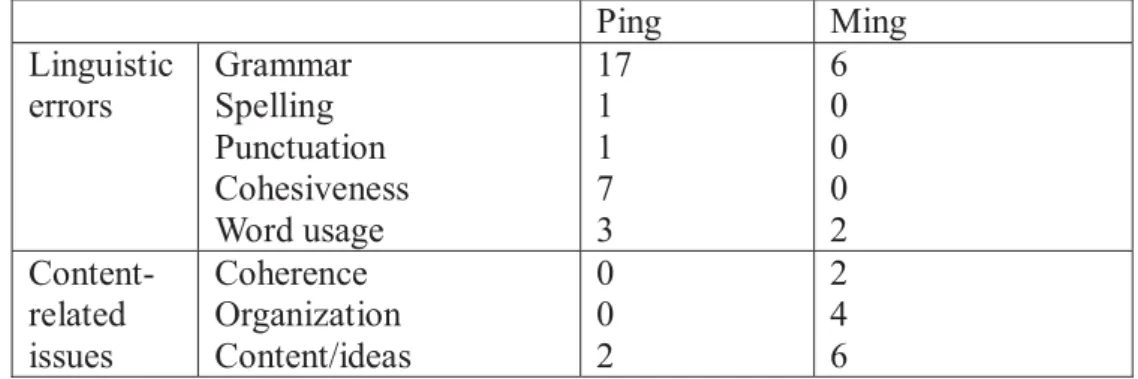
Table 2 below illustrates the two teachers’ error correction, based on their retrospective reports.
At first glance, it appears that Ping administered error correction more than Ming, which contradicts what she claimed in her interview about focusing on content and organization issues. However, as Ping indicated in the interview, she tended to made more error correction because students asked for it. This stands in agreement with many studies that have concluded that ESL/EFL learners prefer teachers’ written feedback on their errors to feedback on content (Lee, 2008). However, she pointed out students’ linguistic errors and content-related issues mostly in face-to-face situations or during the individual teacher-student conferences outside of the class time. Ming’s feedback numbers corresponded closely to his claim regarding putting emphasis on content-related issues. As can be seen in Table 2, Ming addressed content/idea issues more than the coherence issue. He also frequently pinpointed students’ issues of organization issue. In contrast, Ping corrected more of students’ linguistic errors, in particular grammar errors.
The difference between the two teachers’ provision of feedback on varying aspects
Ping Ming Linguistic errors Grammar Spelling Punctuation Cohesiveness Word usage 17 1 1 7 3 6 0 0 0 2 Content- related issues Coherence Organization Content/ideas 0 0 2 2 4 6
of students’ writing is probably due to their teaching experience and their individual understanding of students’ expectations from teachers. Ping, as an experienced instructor at the college level was very aware of her students’ expectations for writing classes. Ming, who is a novice teacher, may not have had much understanding regarding his students’ expectations. Furthermore, the students’ English proficiency varied a great deal between the two classes, which may have caused the different patterns of feedback provision between the teachers in retrospective reports.
Discussion
The two teachers’ beliefs in providing online feedback have been affected by their expertise as well as their personal exposure and preferences to the rapidly advancing technologies available to instructors. They preferred web-based feedback due to their familiarity with tools and feasibility of the online learning environment, and due to their beliefs that open access for students to review teachers’ and peer’s feedback is of benefit to students. Part of the findings contradicted with the results of Khanalizadeh and Allami’s (2012) study and the probable factors of the differences between the current study and Khanalizadeh and Allami’s (2012) may lie in the sample size and the research methods. Nevertheless, both teachers in the current study did not discard the more traditional methods of teaching in writing, but reinforced instruction through the application of technology.
As the results suggested, Ping and Ming implemented different types of feedback in different modalities and gained insight into how to raise their students’ awareness of different writing problems. Furthermore, both teachers harbored different levels of concerns with respect to the effects of peer feedback on students’ comments on their peer’s writing. In this aspect, teachers’ teaching experience mediated their decisions on the priority of giving teacher and peer feedback online.
Both teachers’ beliefs in error correction and feedback on other writing issues have been tremendously influenced by research findings in ESL/EFL writing and their academic training in the field of study. For example, Ping mentioned that her beliefs in feedback provision have been formed based on her understanding of research findings and her experiments with her own students over years of instruction of the same course. Ming, on the other hand, established his teaching beliefs formed when receiving academic training as a graduate student. Figure one shows the relationship between the three types of knowledge, the two teachers’ beliefs, and how they have contributed to their teaching from different perspectives.
Figure 1: The TPACK framework, teacher beliefs, and teachers’ teaching
In figure 1, the dotted arrow indicated the extent to which teachers’ knowledge of different areas was co-related with their beliefs and eventually their teaching behaviors. For example, language teachers who did not have much knowledge or strong interest in using technology in the classroom may not provide any online feedback or even adapt Technological Knowledge
Pedagogical Knowledge Content Knowledge
Teacher belief in writing instruction
Teachers’ teaching in general Provision of teacher feedback
Attitude toward and belief in error correction
Attitude towards and beliefs in web-based feedback
online peer feedback. The two teachers in this study, however, possessed different levels of the three types of knowledge and their beliefs in writing instruction reflected their teaching behaviors despite the fact that they both advocated the use of technology in language teaching.
The findings of the study indicated that there is a gap between teacher beliefs and their actual practices in a web-supported EFL classroom. This gap seems to be a common artifact among EFL teachers as they respond to factors, such as students’ expectations that teachers will provide comprehensive error correction of their writing (Lee, 2010). Regardless, teachers’ deeply held beliefs in error correction and other feedback on student writing still greatly influenced their teaching and feedback provision in the classroom. Ping, for example, gave mini lessons based on common errors in the online writing, and went through students’ in-class writing immediately in order to identify and address major errors and other writing issues with students during in-class. Ming focused more frequently on issues of content, organization, or ideas yet still corrected students’ linguistic errors from time to time. It is likely that due to Ming’s students’ much higher proficiency level, it is not critical for him to correct students’ grammatical and lexical errors all the time and he could therefore direct more of his attention to the content of students’ writing.
Teaching implications
In this section, we will discuss implications for the future of teaching EFL writing in a web-supported context. In accordance with the findings, teachers’ knowledge as well as their ability to combing online writing tools into their writing instruction can enrich their teaching in general (Bache and Taslaci 2009). The implications of teachers’ shift towards online writing instruction, and the implications of both teachers’ perspectives and adaptations to this shift, indicate that f2f feedback is changing shape dramatically. Teachers will have to implement different types of f2f feedback in order for analog correction to stay relevant and research suggests that they need to stay relevant because they offer things that digital feedback avenues cannot provide. Furthermore, teachers’ awareness of their roles in such a blended learning environment should be emphasized to a greater extent. (Motteram and Sharma 2009) Put differently, an ever-expanding variety of online writing activities are available (e.g., error logs or writing logs) as well as differing forms of feedback in the online and analog modalities, and teachers need to know how to best employ all of the above in order to raise their students’ error awareness and foster self-correction and autonomous learning habits in the long run.
In order to make informed decisions about the use of many CALL tools, EFL writing teachers will need to know students’ strengths and weaknesses in English writing before the class officially begins. Teachers may, for example, ask students to write a short paragraph of self-introduction online. A further analysis of students’ writing pieces will help teachers establish a learner profile as a data base on blogs and take notes to document each student’s potential writing ability at the time. Through the integration of online writing as well as types of feedback, such as peer feedback, teachers can ask students to compare their own writing errors with their peers and then divide students into small groups based on the errors or writing issues that they have made in common so that they can work collaboratively to enhance their writing accuracy and fluency simultaneously through the utilization of online writing tools. Teacher’s role in the instructional setting will be as facilitators and should provide students at different proficiency levels with variant guidance in writing when combining CALL in writing instruction. For students of lower levels, more emphasis can be placed on their grammatical and lexical aspect in
addition to the content and teachers can utilize many online tutoring tools to help students correct their linguistic errors first and then teachers are able to pay more attention to students’ content issues. To assist students of higher writing ability and through the employment of online writing tools, teachers can direct more of students’ attention to their content-related issues by pinpointing how they have presented their thoughts and ideas in their writing and how the logic behind their writing may have been affected by their first language or how their writing can be revised to be more compatible with English writing styles. Additionally, through updating learner ’s online writing profiles throughout the period of instruction teachers can see the progress that students have made. The learner profiles can also provide teachers with important information regarding what has been missing in students’ writing and how teachers can fill the gap through various writing practices and activities in both online and f2f situations.
Conclusion and limitations
This study has contributed to the field of ESL/EFL education research by exploring teachers’ beliefs in web-based writing instruction and their feedback provision. Whilst the qualitative data showed that both teachers’ stated beliefs in writing instruction have been interacted with research findings in ESL/EFL writing and with their own academic training, the quantitative data indicated that teachers’ teaching experience plays a role in mediating their beliefs and feedback practices when giving peer and teacher feedback online. Students’ expectations appear to be particularly influential in teachers’ decision about what types of feedback to provide their students with.
There were limitations to this study. Because it is a qualitative study, the teacher beliefs that have been identified here cannot be generalized to other EFL teachers who are also currently teaching at the college level but may lack the technological knowledge held by the two teachers in this study. Furthermore, the two participating teachers’ knowledge about integrating technology in their classrooms may have precipitated beliefs about teaching EFL writing and feedback provision that were different from those of traditional EFL writing teachers. Finally, a larger sample of teachers would provide more comprehensive information on teacher beliefs in relation to feedback practices in a web-based context.
Appendices
Appendix A
Prompts for individual teacher interviews
1. What are your beliefs regarding paper-based feedback and web-based feedback when teaching EFL writing?
2. What do you usually do to correct your students’ errors in writing? Are there any aspects of errors that you put more emphasis on when commenting on your students’ writing? Why?
3. Do you mark errors selectively or comprehensively? Why? Can you also describe and explain your preferred error feedback strategies.
4. Has your previous training given you any idea about how to provide feedback on student writing? What do you know about ‘‘effective’’ feedback?
5. What kinds of feedback to student blog writing and their wiki space writing do you usually give and why?
6. How have your beliefs in teaching EFL writing been changed after teaching this class? 7. How do you feel about teaching writing at the college level and how long have you
been teaching writing classes?
8. What else can you think of concerning teaching ESL/EFL writing, responding to students’ papers?
Appendix B
Prompts for the group interview
1. What teaching methods in writing do you usually use in your classrooms and why? 2. How do you think responding to your student’s blog writing may assist in your
writing instruction?
3. How do you feel about giving feedback to your students’ blog writing and what would you pay attention to when giving your students feedback?
4. What else can you think of concerning teaching ESL/EFL writing, responding to students’ papers…?"(Adapted from Diab, 2005)
Appendix C
The course content and assignments of the two writing classes
Content & Assignment
x Introduction of the course syllabus
x Web-based writing orientation (i-writer, blog) x Pretest: Timed essay in 40 mins
x Blog (1): Set up a personal blog space & self introduction x Writing process: Pre-writing (listing)
x Writing genre: Descriptive http://www.roanestate.edu/owl/Describe.html x In-class exercise: Describe a person
x Blog (2): Continue your class into a 400-word easy x Writing process: Peer editing
x Writing genre: Descriptive
x In-class exercise: Training of giving peer comments
x Feedback on blog(2): Provide peer feedback to 3 classmates with consecutive school ID numbers
x Writing genre: Descriptive
x In-class exercise: Training of revising
x Blog (3): Revise blog (2) into a 500-word essay based on the feedback received x Writing process: Pre-writing (mind mapping)
x Writing genre: Narrative http://www.roanestate.edu/owl/Describe.html x In-class exercise: Describe an experience
x Blog (4): Continue the class draft into a 400-word easy x Writing process: Peer editing
x Writing genre: Narrative
x In-class exercise: Story summary
x Feedback on blog (4): Provide peer feedback to 3 classmates x Writing process: Revising
x Writing genre: Narrative
x In-class exercise: Timed essay with a mind map (An inspiring person/event/book )
x Blog (5): Revise blog (4) the draft feedback into a 500-word essay based on the feedback received
References
Arslan, R. S. & Şahin-Kızıl, A. (2010). How can the use of blog software facilitate the writing process of English language learners? Computer Assisted Language
Learning, 23(3), 183-197.
Bache, A., & Taslaci, N. (2009). Learners’ perception of blended writing class: blog and face to face. Turkish Online Journal of Distance Education, 10(4), 188-202.
Baker, A. (2013). Exploring teachers’ knowledge of second language pronunciation techniques: teacher cognitions, observed classroom practices, and student perceptions. TESOL Quarterly. doi: 10.1002/tesq.99.
Basturkmen, H. (2012). Review of research into the correspondence between language teachers’ stated beliefs and practices. System, 40, 282-295.
Beauvois, M. H. (1997). Computer-mediated communication: Technology for improving speaking and writing. In M. D. Bush & R. M. Terry (Eds.), Technology-enhanced
language learning (pp. 165-184). Lincolnwood, IL: National Textbook Company.
Bitchener, J., S. Young, & Cameron, D. (2005). The effect of different types of corrective feedback on ESL student writing. Journal of Second Language Writing, 14(3), 191-205.
Borg, S. (2003). Teacher cognition in grammar teaching: A literature review. Language
Awareness, 12(2), 96-108.
Borg, S. (2011). The impact of in-service teacher education on language teachers’ beliefs.
System, 39(3), 370-380.
Calderhead, J. (1996). Teachers: Beliefs and knowledge. In D. Berliner, & R. Calfee (Eds.), Handbook of educational psychology (pp. 709–725). New York: Macmillan Library Reference.
Casanave, C. P. (2003). Looking ahead to more sociopolitically-oriented case study research in L2 writing scholarship (but should it be called ‘‘post-process’’?).
Journal of Second Language Writing, 12(1), 85–102.
Chao, Y. C. J., & Huang, C. K. (2007). The effectiveness of computer-mediated communication on enhancing writing process and writing outcomes: The implementation of blog and wiki in the EFL writing class in Taiwan. In World
Conference on Educational Multimedia, Hypermedia and Telecommunications
(Vol. 2007, No. 1, pp. 3463-3468).
Chiu, H. H. W. (2008). Practical understandings: Teachers’ beliefs and practices in pronunciation teaching. Unpublished mater’s thesis. (The University of Texas at Arlington).
Connelly, F. M., & Clandinin, D. J. (1988). Teachers as curriculum planners: Narratives
of experience. New York: Teachers College Press.
Deqi, Z. (2005). The process-oriented approach to ESL/EFL writing instruction and research. CELEA Journal, 28(5), 66-70.
Diab, R. L. (2005). Teachers’ and students’ beliefs about responding to ESL writing: A case study. TESL Canada Journal, 23(1), 28-43.
Eisenstein-Ebsworth, M. & C. W. Schweers (1997). What researchers say and practitioners do: Perspectives on conscious grammar instruction in the ESL classroom. Applied Language Learning, 8, 237−60.
Elbaz, F. (1981). The teacher’s" practical knowledge": Report of a case study. Curriculum
inquiry, 11(1), 43-71.
Ellis, R. (2009). Corrective feedback and teacher development. L2 Journal, 1(1), 3-18. Ellis, R., Sheen, Y., Murakami, M., & Takashima, H. (2008). The effects of focused and
System, 36, 353–371.
Fellner, T., & Apple, M. (2006). Developing writing fluency and lexical complexity with blogs. The JALT CALL Journal, 2(1), 15-26.
Ferris, D., & Roberts, B. (2001). Error feedback in L2 writing classes: How explicit does it need to be?. Journal of Second Language Writing, 10(3), 161-184.
Ferris, D. R. (2004). The “Grammar Correction” Debate in L2 Writing: Where are we, and where do we go from here?(and what do we do in the meantime…?). Journal of
Second Language Writing, 13(1), 49-62.
Ferris, D. (2006). Does error feedback help student writers? New evidence on the short-and long-term effects of written error correction. Feedback in second
language writing: Contexts and issues, 81-104.
Ferris, D. (2007). Preparing teachers to respond to student writing. Journal of Second
Language Writing, 16(3), 165-193.
Ferris, D. R. (2010). Second language writing research and written corrective feedback in SLA. Studies in Second Language Acquisition, 32(2), 181-201.
Godwin-Jones, R. (2005). Emerging technologies: Messaging, gaming, peer-to-peer sharing: Language learning strategies & tools for the millennial generation.
Language Learning & Technology, 9(1), 17-22.
Gruber, S. (1995). Re: Ways we contribute: Students, instructors, and pedagogies in the computer-mediated writing classroom. Computers and Composition, 12(1), 61-78. Hamp-Lyons, L. (2006). The impact of testing practices on teaching: Ideologies and
alternatives. In Cummins, J., & Davison, C. Eds. International handbook of
English language teaching. Vol. 1 (pp.487–504). Norwell: Springer.
Hamp-Lyons, L., Chen, J., & Mok, J. (2001). Introducing innovation incrementally: Teacher feedback on student writing. ThaiTESOL bulletin: Selected papers from
the 21st annual Thai TESOL international conference, vol. 14, no. 2 (pp. 59-66).
Hartshorn, K. J., Evans, N. W., Merrill, P. F., Sudweeks, R. R., STRONGƮKRAUSE, D. I. A. N. E., & Anderson, N. J. (2010). Effects of dynamic corrective feedback on ESL writing accuracy. TESOL Quarterly, 44(1), 84-109.
Hyland, F. (2010). Future directions in feedback on second language. International
Journal of English Studies, 10(2), 173-182.
Kagan, D.M., 1992. Implications of research on teacher belief. Educational Psychologist
27, 65-90.
Kagan, D. M., & Tippins, D. J. (1991). How student teachers describe their pupils.
Teaching and Teacher Education, 7(5), 455-466.
Khanalizadeh, B., & Allami, H. (2012). The Impact of Teachers‟ Belief on EFL Writing Instruction. Theory and Practice in Language Studies, 2(2), 334-342.
Kim, T. E. (2006). Writing instruction for English language learners: teacher beliefs, writing tasks and methods. Doctoral dissertation (University of Illinois at Urbana-Champaign).
Kim, C., Kim, M. K., Lee, C., Spector, J. M., DeMeester, K. (2013). Teacher beliefs and technology integration. Teaching and Teacher Education, 29, 76-85.
Lee, I. (2008). Understanding teachers’ written feedback practices in Hong Kong secondary classrooms. Journal of Second Language Writing, 17(2), 69-85.
Lee, I. (2009). Ten mismatches between teachers’ beliefs and written feedback practice,
ELT Journal, 63(1), 13-22.
Lee, I. (2010). Writing teacher education and teacher learning: Testimonies of four EFL teachers. Journal of Second Language Writing, 19(3), 143-157.
Lee, I., & Coniam, D. (2013). Introducing assessment for learning for EFL writing in an assessment of learning examination-driven system in Hong Kong. Journal of
Second Language Writing, 22(1), 34-50.
Lee, M., Tsai, C., Chai, C. (2012). A comparative study of Taiwan, Singapore, and China preservice teachers’ epistemic beliefs. The Asia-Pacific Education Researcher. http://ejournals.ph/index.php?journal=TAPER&page=article&op=view&path%5B %5D=5680. Accessed 02 April 2013.
Liang, M. Y. (2010). Using synchronous online peer response groups in EFL writing: Revision-related discourse. Language Learning & Technology, 14(1), 45-64. Lim, C. P., & Chai, C. S. (2008). Teachers’ pedagogical beliefs and their planning and
conduct of computerƮmediated classroom lessons. British Journal of Educational
Technology, 39(5), 807-828.
Lin, C. C., Chen, H. J., Liaw, M. L., & Liou, H. C. (2005). Teachers’ reflections on infusing the CANDLE Project into college English classes. English Teaching &
Learning, 29(4).
Mak, S. H. Y. (2011). Tensions between conflicting beliefs of an EFL teacher in teaching practice. RELC, 42(1), 53-67.
Mishra, P., & Koehler, M. (2006). Technological pedagogical content knowledge: A framework for teacher knowledge. The Teachers College Record, 108(6), 1017-1054.
Miyazoe, T., & Anderson, T. (2010). Learning outcomes and students’ perceptions of online writing: Simultaneous implementation of a forum, blog, and wiki in an EFL blended learning setting. System, 38(2), 185-199.
Motteram, G., & Sharma, P. (2009). Blending learning in a web 2.0 world. International
Journal of Emerging Technologies & Society, 7(2), 83-96.
Mynard, J. (2008). A blog as a tool for reflection for English language learners. The
Philippine ESL Journal, 1, 77-111.
Ng, J. & Farrell, T.S.C. (2003). Do teachers’ beliefs of grammar teaching match their classroom practices? A Singapore case study. In Derling, D., Brown, AQ. & Low, E.L. (Eds.), English in Singapore: Research on grammar teaching. McGraw Hill, Singapore (pp. 128-137).
Ong, J., & Zhang, L. J. (2010). Effects of task complexity on the fluency and lexical complexity in EFL students’ argumentative writing. Journal of Second Language
Writing, 19(4), 218-233.
Pajares, M. F. (1992). Teachers’ beliefs and educational research: cleaning up a messy construct. Review of Educational Research, 62, 307-332.
Petko, D. (2012). Teachers’ pedagogical beliefs and their use of digital media in classrooms: Sharpening the focus of the ‘will, skill, tool’model and integrating teachers’ constructivist orientations. Computers & Education, 58(4), 1351-1359. Phipps, S., & Borg, S. (2009). Exploring tensions between teachers’ grammar teaching
beliefs and practices. System, 37(3), 380-390.
Robinson-Staveley, K. (1990). The use of computers for writing: Effects on an English composition class. Journal of Educational Computing Research, 6(1), 41-48. Sheen, Y. (2010). Differential effects of oral and written corrective feedback in the ESL
classroom. Studies in Second Language Acquisition, 32(2), 201-234.
Sheen, Y. (2007). The effect of focused written corrective feedback and language aptitude on ESL learners’ acquisition of articles. TESOL Quarterly, 41, 255–283.
Shulman, L. S. (1986). Those who understand: Knowledge growth in teaching.
Educational Researcher, 15(2), 4-14.
Su, C. C. (2005, July). An open source platform for educators. In Advanced Learning Technologies, 2005. ICALT 2005. Fifth IEEE International Conference on (pp. 961-962). IEEE.
Sullivan, N., & Pratt, E. (1996). A comparative study of two ESL writing environments: A computer-assisted classroom and a traditional oral classroom. System, 24(4), 491-501.
Teo, T., & Chai, C. S. (2012). A Cross-Cultural Validation of the Epistemic Belief Inventory (EBI). Asia-Pacific Education Researcher, 21(3), 618-624.
Teo, T., Chai, C. S., Hung, D., & Lee, C. B. (2008). Beliefs about teaching and uses of technology among preƮservice teachers. AsiaƮPacific Journal of Teacher Education, 36(2), 163-174. http://ejournals.ph/index.php?journal=TAPER&page=article&op=
view&path%5B%5D=5682. Accessed 02 April 2013.
Truscott, J. (1996). The case against grammar correction in L2 writing classes. Language
Learning, 46(2), 327-369.
Truscott, J. (2001). Selecting errors for selective error correction. Concentric: Studies in
English Literature and Linguistics, 27, 225–240.
Truscott, J. (2004). Evidence and conjecture on the effects of correction: A response to Chandler. Journal of Second Language Writing, 13(4), 337-343.
Truscott, J. (2007). The effect of error correction on learners’ ability to write accurately.
Journal of Second Language Writing, 16(4), 255-272.
Truscott, J. (2010). Further thoughts on Anthony Bruton? critique of the correction debate.
System, 38(4), 626-633.
Wible, D., Kuo, C.-H., Chien, F.-y., & Liu, A. (2001). A Web-based EFL writing environment: integrating information for learners, teachers, and researchers.
Computers & Education, 37, 297-315.
Yang, S. H. (2009). Using Blogs to Enhance Critical Reflection and Community of Practice. Journal of Educational Technology & Society, 12(2) ,11-21.
Zhang, D. (2009). The application of blog in English writing. Journal of Cambridge
studies, 4(1), 64-72.
Zheng, H. (2009). A review of research on EFL pre-service teachers’ beliefs and practices.