Herpes simplex viruses (HSV) are ubiquitous agents which cause a variety of diseases ranging in severity from mild to severe, and in certain cases, they may became life-threatening, especially in immunocompromised patients. After primary infection, HSV will persist in the host for the latter’s entire lifetime, and HSV infection is thus considered as lifelong infection. Nucleoside analogues such as acyclovir (ACV), penciclovir etc., are the only officially approved drugs for the therapy of HSV infection.1,2)They are usually effective in treatment of primary or recurrent HSV infection. However, the widespread use of nucleoside-based drugs has lead to the emergence of HSV strain resistant to those related drugs, especially among immunocompromised patients. Ac-cording to the previous surveys, the incidence of ACV-resis-tant strain among immunocompromised patients is around 5% and reaches 14% among bone marrow transplant recipi-ents.3—5)The high prevalence of ACV-resistant HSV among these populations suggests that new medication is needed.
Adenoviruses (ADV) are other ubiquitous agents. They are associated with a wide range of illnesses, including ocular, respiratory, gastrointestinal and urinary infections. ADV in-fection is usually mild and always heals without the need of any special therapy. However, severe ADV infection has been reported in immunocompromised patients, including patients with leukemia,6)AIDS,7)or organ transplantation.8) Further-more, ADV cause pneumonia have been reported to have considerable mortality rate especially in children of age below 2 years old.9,10)5-Iodo-29-deoxyuridine (IDU), ganci-clovir, cidafovir and several cysteine protease inhibitors are reported to inhibit ADV infection, and some of them have been used for ADV infection.11—14) These agents, however, are either too toxic for use or not approved by governmental agencies for the therapy of ADV infection. In addition, the development of resistance of ADV to related drugs has also been reported in literature.15) Thus, new and more effective antiviral agents for future therapy in ADV infection are de-sired.
In our continuous efforts to search for novel antiviral
agents from traditional medicinal plants, twelve traditionally used medicinal plants in Taiwan were extracted with hot water (HW) and then investigated for their in vitro anti-HSV and ADV activities. This is the first report on the anti-HSV and ADV activities of the HW extract of the related twelve medicinal plants.
MATERIALS AND METHODS
Plant Materials The stem and leaf of Ardisia
squamu-losa PRESL(Myrsinaceae), Artemisai princeps PAMP. var. ori-entalis (PAMP.) HARA(Compositae), Cinnamomum camphora
(LINN.) SIEB. (Lauraceae), Crossostephium chinense (LINN.)
MAKINO (Compositae) and Serissa japonica THUNB.
(Rubi-aceae), the flower of Jasminum sambac (LINN.) AIT.
(Oleaceae), and the whole plant of Basella rubra LINN.
(Basellaceae), Biden pilosa LINN. (Compositae), Boussin-gaultia gracilis MIERSvar. pseudobaselloides BAILEY
(Basel-laceae), Drymaria cordata (LINN.) WILLDENOW
(Caryophyl-laceae), Portulaca grandiflora HOOKER (Portulacaceae) and Rosa rugosa THUNB. (Rosaceae) were collected from
south-ern Taiwan. Their authenticity was identified and confirmed using morphological and anatomical techniques by Professor C. C. Lin (Graduate Institute of Natural Products, Kaohsiung Medical University, Taiwan). A voucher specimen of these plants was deposited at the Herbarium of the Graduate Insti-tute of Natural Products of Kaohsiung Medical University, Taiwan.
Preparation of the Extracts Hot water (HW) extract of the medicinal plants was prepared according to the proce-dures as described previously by Chang and Yeung with minor modifications.16)Briefly, different parts of the medici-nal plants were boiled with 1000 ml of distilled water for 1 h. The aqueous was collected and the residual was extracted again with another 1000 ml of distilled water. The resulting aqueous extracts were collected, combined, filtered by gauze, concentrated under reduced pressure and then lyophilized to dry.
∗To whom correspondence should be addressed. e-mail: [email protected] © 2003 Pharmaceutical Society of Japan
In Vitro Anti-herpes Simplex Viruses and Anti-adenoviruses Activity of
Twelve Traditionally Used Medicinal Plants in Taiwan
Lien-Chai CHIANG,aHua-Yew CHENG,bMei-Chi LIU,aWen CHIANG,cand Chun-Ching LIN*, b
aDepartment of Microbiology, College of Medicine, Kaohsiung Medical University; bGraduate Institute of Pharmaceutical
Sciences, College of Pharmacy, Kaohsiung Medical University; and cDepartment of Clinical Pathology, College of
Medicine, Kaohsiung Medical University; No. 100, Shin-Chuan 1’st Road, Kaohsiung 807, Taiwan.
Received June 13, 2003; accepted July 22, 2003
As an effort to search for new antiviral agents from traditional medicine, the hot water (HW) extract of twelve traditionally used medicinal plants in Taiwan was evaluated for their in vitro anti-herpes simplex viruses (HSV; including HSV-1 and HSV-2) and anti-adenoviruses (ADV; including ADV-3, ADV-8 and ADV-11) activi-ties with a XTT-based colorimetric assay. Results showed that the tested HW extracts exhibited anti-HSV and anti-ADV activities at different magnitudes of potency. Among the twelve medicinal plants, Boussingaultia
gra-cilis var. pseudobaselloides (Basellaceae) and Serissa japonica (Rubiaceae) possessed broad spectrum of antiviral
activity. Ardisia squamulosa (Myrsinaceae) and Artemisai princeps var. orientalis (Compositae) were more effec-tive in inhibiting ADV-8 replication than the other four viruses. Cell cytotoxic assay demonstrated that all tested HW extracts had CC50values higher than their EC50values. It was concluded that the twelve traditionally used medicinal plants in Taiwan possessed antiviral activity, and some of them merit further investigation.
serum (FCS), 100 units/ml penicillin G, 100m g/ml strepto-mycin and 0.25m g/ml amphotericin B. In the antiviral assay, the medium was supplemented with 2% FCS and the above mentioned antibiotics. All cell culture reagents and media were purchased from Gibco BRL (Grand Island, New York).
HSV-1 KOS strain was obtained from the American Type Culture Collection (ATCC), Rockville, U.S.A., and HSV-2 196 strain was provided by Professor W. T. Liu (School of Medical Technology, National Yang-Ming Medical Univer-sity, Taipei, Taiwan). ADV-3, ADV-8 and ADV-11 were pro-vided by Dr. K. H. Lin (Hospital of Kaohsiung Medical Uni-versity, Kaohsiung, Taiwan). All viruses were prepared and quantitated on BCC-1/KMC cells and stored in small aliquots at 270 °C until use.
Titration of Viruses BCC-1/KMC cells were seeded in 96-well culture plates at a density of 104cells/well and then incubated at 37 °C in a humidified atmosphere containing 5% CO2for 24 h. A serial dilution of virus stock was prepared, and cells were infected with the dilution of virus. After an additional 72 h of incubation, the cytopathic effect was recorded. The 50% tissue culture infective dose (TCID50) per ml was calculated as described previously by Reed and Muench.18)
Antiviral Assay Using XTT Method The antiviral ac-tivity of HW extracts was evaluated by the XTT method as previously described.19,20) BCC-1/KMC cells, treated by trypsin, were seeded in 96-well culture plates with a volume of 70m l/well and a concentration of 105
cells/ml. After 24 h incubation, 20m l of 25, 20, 120, 20 and 120 TCID50of HSV-1, HSV-2, ADV-3, ADV-8 and ADV-11 was added, and the infected cells were incubated for another 2 h. Ten microliter of tested compound at different concentrations was then added to culture wells in triplicate. The final maximum con-centration for DMSO in culture medium was 0.1%. For every experiment, a parallel virus control was performed to ensure the viral infectivity remained during the experiment. After further incubation at 37 °C with 5% CO2for 72 h, the mix-ture of 0.1 ml PMS (N-methyl dibenzopyrazine methyl sul-fate) and 5 mg/5 ml XTT (sodium 3 9-[1-(phenylaminocar-bonyl)-3,4-tetrazolium]-bis(4-methoxy-6-nitro) benzene sul-fonic acid hydrate) were added to each well with a volume of 50m l. The trays were reincubated for an additional 2 h to allow the production of formazan. Optical densities were then determined with the EIA reader (Multiskan EX, Labsys-tems) at a test wavelength of 450 nm and a reference wave-length of 690 nm.
Viral inhibition rate was calculated as [(ODtv2ODcv)/ (ODcd2ODcv)]3100%. ODtv, ODcv and ODcd indicate the absorbance of the test compounds with virus infected cells, the absorbance of the virus control and the absorbance of the cell control, respectively. The 50% effectiveness concentra-tion (EC50) was defined as the concentration that achieved
The 50% cell cytotoxic concentration (CC50) of tested com-pounds was calculated according to Chiang et al.19)
Statistical Analysis Data were calculated as mean6 standard error for three separate experiments. The selectivity index (SI) was calculated as the ratio of CC50 to EC50. The Student’s unpaired t-test was used to calculate p values of difference of means between control and the tested samples on the inhibition of HSV or ADV replication. Difference of sample between tested viruses with a p value less than 0.05 was considered statistically significant.
RESULTS
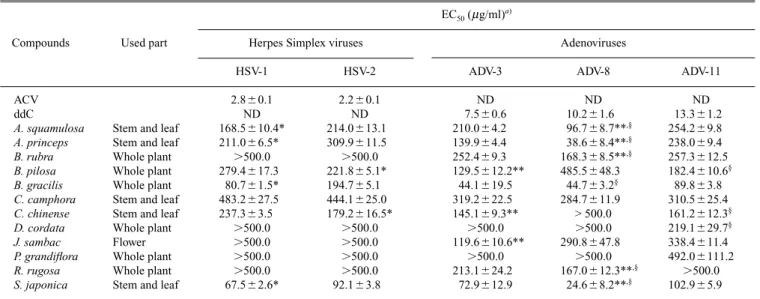
Antiviral Activity of Twelve Commonly Used Medicinal Plants in Taiwan Results showed that hot water (HW) ex-tract of twelve commonly used medicinal plants in Taiwan exhibited in vitro anti-HSV and anti-ADV activities at differ-ent magnitudes of potency (Table 1). ACV and ddC were used as a reference compound for anti-HSV and anti-ADV assays, respectively.
The EC50for twelve tested HW extracts against HSV-1 in-fection was in the range of 67—484m g/ml. B. gracilis and S.
japonica showed potent anti-HSV-1 activity with EC50 of 80.761.5 and 67.562.6 mg/ml, respectively. The anti-HSV-1 activity of A. squamulosa was at moderate potency with EC50 of 168.5610.4 mg/ml. Other nine HW extracts were either mild or little at activity to suppress HSV-1 infection.
When tested for anti-HSV-2 activity, S. japonica showed smallest EC50value. The EC50of S. japonica was 92.163.8 m g/ml. Beside S. japonica, only two HW extracts had an EC50smaller than 200m g/ml. There were three HW extracts which had EC50values in the range of 200—400m g/ml, and five HW extracts with EC50values higher than 500m g/ml.
For anti-ADV-3 activity, there were B. gracilis and S.
japonica that had EC50 value smaller than 100m g/ml. The EC50value of B. gracilis and S. japonica was 44.1619.5 and 72.9612.9 mg/ml, respectively. A. princeps, B. pilosa, C.
chi-nense and J. sambac had EC50 value between 100— 150m g/ml. D. cordata and P. grandiflora had an EC50higher than 500m g/ml.
Our results revealed that four HW extracts possessed EC50 smaller than 100m g/ml when tested for anti-ADV-8 activity. These four HW extracts were A. squamulosa, A. princeps, B.
gracilis and S. japonica with EC50of 96.768.7, 38.668.4, 44.763.2 and 24.668.2 mg/ml, respectively. B. rubra and R.
rugosa had an EC50 between 100—200m g/ml. There were three HW extracts that had EC50higher than 500m g/ml.
Besides ADV-3 and ADV-8, the extracts were also tested for anti-ADV-11 activity. B. gracilis was the most potent ex-tracts with an EC50 of 89.863.8 mg/ml. Three HW extracts possessed an EC50 between 100—200m g/ml, four HW ex-tracts between 200—300m g/ml, two HW extracts between
300—400m g/ml, and two HW extracts higher than 450 m g/ml.
Cell Cytotoxic Effect and Selectivity Index of Twelve Commonly Used Medicinal Plants in Taiwan Table 2 shows the cell cytotoxic effect of HW extracts of the twelve medicinal plants. Overall, all HW extracts showed CC50 higher than their EC50. These observations indicated that the antiviral activity of HW extracts was not a result of their cy-totoxic effect toward cells. The CC50values ranged from 720 to 4860m g/ml.
With the EC50and CC50data, the selectivity index (SI) was calculated by dividing CC50 by EC50. The SI for the anti-HSV-1 assay was in the range of 1.6—37.6, and 1.8—15.6 for the anti-HSV-2 assay. For anti-3, 8 and ADV-11 assays, the SI ranged from 2.4 to 68.7, 5.6 to 67.8 and 2.5 to 91.1, respectively.
DISCUSSION
Medicinal plants have been traditionally used for different kind of ailments including infectious diseases. Some of them are reported to exhibit antiviral activity in literature.21—23) According to the Cragg’s report, approximately 60% of anti-tumor and anti-infective agents that are commercially avail-able or in the late stages of clinical trials today are of natural product origin.24)There is therefore no doubt that traditional medicinal plants can serve as a potential resource in the de-velopment of new antiviral agents in the future. Since current chemotherapy agents for ADV and HSV infections are either insufficient in quantity or limited in efficiency, there is thus a need to search for new and more effective antiviral agents for future therapy in ADV and HSV infections.
In this study, XTT assay was used for the evaluation of an-tiviral activity because it is a simple, fast and efficient Table 1. In Vitro Antiviral Activity of Twelve Commonly Used Medicinal Plants in Taiwan
EC50(m g/ml) a)
Compounds Used part Herpes Simplex viruses Adenoviruses
HSV-1 HSV-2 ADV-3 ADV-8 ADV-11
ACV 2.860.1 2.260.1 ND ND ND
ddC ND ND 7.560.6 10.261.6 13.361.2
A. squamulosa Stem and leaf 168.5610.4* 214.0613.1 210.064.2 96.768.7**,§ 254.269.8
A. princeps Stem and leaf 211.066.5* 309.9611.5 139.964.4 38.668.4**,§ 238.069.4
B. rubra Whole plant .500.0 .500.0 252.469.3 168.368.5**,§ 257.3612.5
B. pilosa Whole plant 279.4617.3 221.865.1* 129.5612.2** 485.5648.3 182.4610.6§
B. gracilis Whole plant 80.761.5* 194.765.1 44.1619.5 44.763.2§ 89.863.8
C. camphora Stem and leaf 483.2627.5 444.1625.0 319.2622.5 284.7611.9 310.5625.4 C. chinense Stem and leaf 237.363.5 179.2616.5* 145.169.3** > 500.0 161.2612.3§
D. cordata Whole plant .500.0 .500.0 .500.0 .500.0 219.1629.7§
J. sambac Flower .500.0 .500.0 119.6610.6** 290.8647.8 338.4611.4
P. grandiflora Whole plant .500.0 .500.0 .500.0 .500.0 492.06111.2
R. rugosa Whole plant .500.0 .500.0 213.1624.2 167.0612.3**,§ .500.0
S. japonica Stem and leaf 67.562.6* 92.163.8 72.9612.9 24.668.2**,§ 102.965.9
a) Concentration that inhibited 50% virus infection. ACV: Acyclovir; ddC: 29,39-dideoxycytidine. ND: Not done. Each value represents the mean6S.E. of three separate ex-periments. ∗: p,0.05 (compared between HSV-1 and HSV-2); ∗∗: p,0.05 (compared between ADV-3 and ADV-8); §: p,0.05 (compared between ADV-8 and ADV-11).
Table 2. Cell Cytotoxic Effect and Selectivity Index of Twelve Commonly Used Medicinal Plants in Taiwan Selectivity Index (SI)b)
Compounds CC50(m g/ml)
a) Herpes Simplex viruses Adenoviruses
HSV-1 HSV-2 ADV-3 ADV-8 ADV-11
ACV 126.8 45.1 58.0 ND ND ND ddC 259.2 ND ND 34.6 25.3 19.5 A. squamulosa 1698.7 10.1 7.9 8.1 17.6 6.7 A. princeps 3519.7 16.7 11.4 25.2 91.1 14.8 B. rubra 2358.0 ND ND 9.3 14.0 9.2 B. pilosa 2705.6 9.7 12.2 20.9 5.6 14.8 B. gracilis 3032.6 37.6 15.6 68.7 67.8 33.8 C. camphora 777.6 1.6 1.8 2.4 2.7 2.5 C. chinense 724.0 3.1 4.0 5.0 ND 4.5 D. cordata 2643.1 ND ND ND ND 12.1 J. sambac 2829.5 ND ND 23.7 9.7 8.4 P. grandiflora 4853.2 ND ND ND ND 9.9 R. rugosa 2289.9 ND ND 10.7 13.7 ND S. japonica 1575.2 23.3 17.1 21.6 63.9 15.3
a) Concentration that showed 50% cell cytotoxic effect against BCC-1/KMC cells. Each value represents the mean of three separate experiments. b) SI is the ratio of CC50 to EC50. ACV: Acyclovir; ddC: 29,39-dideoxycytidine. ND: Not done due to high EC50(.500.0 mg/ml) of HW extract.
B. gracilis is also named as Anredra cordifolia (Tenore) van
Steen. In Taiwan, it is traditionally used as the treatment for gastric pain, cough, diabetes and liver diseases.27) Previous studies demonstrated that B. gracilis showed weak antimuta-genic activity.28)S. japonica, also known as Japanese serissa, is commonly used for the treatment of carbuncle on the back and edema in Taiwan.29)Our studies revealed that B. gracilis and S. japonica suppressed four (HSV-1, ADV-3, ADV-8, ADV-11) and five (HSV-1, HSV-2, ADV-3, ADV-8, ADV-11) virus infections, respectively.
The HW extracts of these two medicinal plants also showed noteworthy SI value. Although they are less effective than the reference compounds, ACV for HSV assay and ddC for ADV assay, their SI, however, were valuable. For exam-ple, the SI of B. gracilis against all tested ADV infections was generally higher than that of ddC. Also S. japonica had higher SI against ADV-8 infection than that of ddC.
Another interesting observation was the anti-ADV-8 activ-ity of A. squamulosa and A. princeps. HW extracts of these two medicinal plants had smaller EC50against ADV-8 infec-tion than that of two other tested ADV infecinfec-tions, ADV-3 and ADV-11 ( p,0.05). Human ADV have at least 51 serotypes and are divided into six groups (A—F) on the basis of their physical, chemical, and biological properties.30) Their DNA is .90% in homology for the members of a given group but is ,20% in homology between the members of different groups. In classification, ADV-3 and ADV-11 are group B ADV, and ADV-8 is group D ADV. The stronger potency of
A. squamulosa and A. princeps against ADV-8 infection than
against ADV-3 or ADV-11 infection suggested that these two medicinal plants target some unique properties of ADV-8. Further investigations are necessary to clarify the underlying mechanism action of A. squamulosa and A. princeps against ADV-8 infection.
Our previous study showed that hot water extract of Biden
pilosa LINN. var. minor (Blume) SHERFF (Compositae)
(HWBPLS) possessed in vitro anti-HSV-1 and anti-HSV-2 activities.31)In this study, we showed that hot water extract of Biden pilosa LINN. (Compositae) (HWBPL) exhibited
anti-HSV and anti-ADV activities. By comparing the EC50values for both medicinal plants, it was revealed that HWBPL was more effective against HSV replication than that of HWB-PLS. The EC50values of HWPBL against HSV-1 and HSV-2 infection were 279.4 ( p,0.05, compared with HWPBLS) and 221.8m g/ml ( p,0.05, compared with HWPBLS), whereas those of HWPBLS were 655.4 and 960.0m g/ml, re-spectively. Also, the SI values of HWBPL were smaller than those of HWPBLS (The SI values of HWBPL against HSV-1 and HSV-2 were 9.7 and 12.2, and of HWPBLS were .1.53 and .1.04, respectively). Since the same virus strain, host cell, procedures of antiviral activity assessment and extrac-tion method of medicinal plants, etc. were used for both
stud-anti-ADV activities of B. gracilis and S. japonica, and the anti-ADV activity of A. squamulosa and A. princeps are en-couraged for further investigation.
REFERENCES
1) De Clercq E., J. Pharmacol. Exp. Ther., 297, 1—10 (2001). 2) Naesens L., De Clercq E., Herpes, 8, 12—16 (2001).
3) Christophers J., Clayton J., Craske J., Ward R., Collins P., Trow-bridge M., Darby G., Antimicrob. Agents Chemother., 42, 868—872 (1998).
4) Nugier F., Colin J. N., Aymard M., Langlois M., J. Med. Virol., 36, 1— 12 (1992).
5) Englund J. A., Zimmerman M. E., Swierkosz E. M., Goodman J. L., Scholl D. R., Balfour H. H., Jr., Ann. Intern. Med., 112, 416—422 (1990).
6) Zahradnik J. M., Spencer M. J., Porter D. D., Am. J. Med., 68, 725— 732 (1980).
7) De Jong P. J., Valderrama G., Spingland I., Horwitz M. S., Lancet, 1, 1293—1296 (1983).
8) Stalder H. J., Hierholzer J. C., Oxman M. N., J. Clin. Microbiol., 6, 257—265 (1977).
9) Avila M. M., Carballal J., Rovaletti H., Ebekian B., Cusminsky M., Weissenbacher M., Am. Rev. Respir. Dis., 140, 634—637 (1989). 10) Dudding B. A., Wagner S. C., Zeller J. A., French J. T., Top F. H., Jr.,
N. Engl. J. Med., 286, 1289—1292 (1972).
11) Dudgeon J., Bhargva S. K., Ross C. A. C., Br. J. Ophthalmol., 53, 530—533 (1969).
12) De Oliverira C. B. R., Stevenson D., LaBree L., McDonnell P. J., Trousdale M. D., Antiviral Res., 31, 165—172 (1996).
13) Sircar S., Keyvani-Amineh H., Weber J. M., Antiviral Res., 30, 147— 153 (1996).
14) Ribaud P., Scieux C., Freymuth F., Morinet F., Gluckman E., Clin. In-fect. Dis., 28, 690—691 (1999).
15) Gordon Y. J., Araullo-Cruz T. P., Johnson Y. F., Romanowski E. G., Kinchington P. R., Invest. Ophthalmol. Vis. Sci., 37, 2774—2778 (1996).
16) Chang R. S., Yeung H. W., Antiviral Res., 9, 163—176 (1988). 17) Chiang L. C., Chiang W., Yu H. S., Sheu H. M., Chen H. Y.,
Kaohsi-ung J. Med. Sci., 10, 170—176 (1994).
18) Reed J., Muench H., Am. J. Hyg., 27, 493—497 (1938).
19) Chiang L. C., Chiang W., Chang M. Y., Ng L. T., Lin C. C., Antiviral Res., 55, 53—62 (2002).
20) Weislow O. S., Kiser R., Fine D. L., Bader J., Shoemaker R. H., Boyd M. R., J. Natl. Cancer Inst., 81, 577—586 (1989).
21) Vlietinck A. J., Vanden Berghe D. A., J. Ethnopharmacol., 32, 141— 153 (1991).
22) Kaij-a-Kamb M., Amoros M., Girre L., Pharm. Acta Helv., 67, 130— 147 (1992).
23) Kurokawa M., Ochiai H., Nagasaka K., Neki M., Xu H., Kadota S., Sutardjo S., Matsumoto T., Namba T., Shiraki K., Antiviral Res., 22, 175—188 (1993).
24) Cragg G. M., Newman D. J., Snader K. M., J. Nat. Prod., 60, 623— 639 (1997).
25) Sudo K., Konno K., Yokota Y., Shigeta S., J. Virol. Methods, 49, 169— 178 (1994).
26) Kodama E., Shigeta S., Suzuki T., De Clercq E., Antiviral Res., 31, 159—164 (1996).
27) Chiu N. Y., Chang K. H., “The Illustrated Medicinal Plants of Tai-wan,” Vol. 3, ed. by Chiu N. Y., Chang K. H., SMG Publishing Inc., Taipei, 1995, p. 49.
28) Yen G. C., Chen H. Y., Peng H. H., Food Chem. Toxicol., 39, 1045— 1053 (2001).
29) Kao M. T., “Handbook of Taiwan Medicinal Plants,” Southern Materi-als Center Inc., Taipei, 1981, p. 409.
30) De Jong J. C., Wermenbol A. G., Verweij-Uijterwaal M. W., Slaterus
K. W., Wertheim-Van Dillen P., Van Doornum G. J., Khoo S. H., Hier-holzer J. C., J. Clin. Microbiol., 37, 3940—3945 (1999).
31) Chiang L. C., Chang J. S., Chen C. C., Ng L. T., Lin C. C., Am. J. Chin. Med., 31, 355—362 (2003).