Anomalous diamagnetic shift for negative trions in single semiconductor quantum dots
Y. J. Fu, S. D. Lin,*
and M. F. TsaiDepartment of Electronics Engineering, National Chiao Tung University, Hsinchu 30010, Taiwan H. Lin, C. H. Lin, H. Y. Chou, S. J. Cheng, and W. H. Chang
Department of Electrophysics, National Chiao Tung University, Hsinchu 30010, Taiwan
共Received 21 February 2010; published 30 March 2010兲
We report on the magnetic response of negative trions X−in single self-assembled InAs/GaAs quantum dots.
Unlike the conventional quadratic diamagnetic shift for neutral excitons, the observed X−diamagnetic shifts are
small and nonquadratic. In particular, we also observed a reversal in sign of the conventional diamagnetic shift. A theoretical analysis indicates that such anomalous behaviors for X− arise from an apparent change in the electron wave function extent after photon emission due to the strong Coulomb attraction induced by the hole in its initial state. This effect can be very pronounced in small quantum dots, where the electron wave function becomes weakly confined and extended much into the barrier region. When the electrons gradually lose confinement, the magnetic response of X−will transit gradually from the usual quadratic diamagnetic shift to
a quartic dependence, and finally into a special paramagnetic regime with an overall negative energy shift. DOI:10.1103/PhysRevB.81.113307 PACS number共s兲: 78.67.Hc, 78.20.Ls, 78.55.Cr
The diamagnetic shift of confined excitons has long been used as a measure of the spatial extent of the excitonic wave functions in various semiconductor nanostructures such as quantum wires,1–4 quantum dots共QDs兲,4–6as well as quan-tum rings.7In a weak magnetic field B, the exciton diamag-netic shift is expected to exhibit a quadratic B dependence, i.e.,⌬E=␥B2, with a diamagnetic coefficient␥proportional to the area of the excitonic wave function, which reflects both the spatial confinements and interparticle Coulomb interactions.8 For excitons 共X兲 strongly confined in QDs, where the single-particle energies dominate over the Cou-lomb energies, ␥ is a measure of the spatial confinement of the QDs, while the magnetic responses of interparticle Cou-lomb energies only appear as correction terms to the overall diamagnetism. This simple picture is also true for biexcitons 共XX兲 and trions 共X+or X−兲 strongly confined in QDs, except for a slight but systematic difference in␥due to the different magnetic responses of interparticle Coulomb energies.6 On the other hand, when excitons are weakly confined in QDs such that Coulomb energies dominate over the single-particle energies, ␥ becomes a measure of the magnetic response of Coulomb energies. For exciton complexes weakly confined in QDs, the diamagnetic behaviors are expected to be more complicated because of the more elaborate Coulomb interac-tions. In particular, it has been theoretically predicted that a weakly confined negative trion共X−兲 in large-size QDs would exhibit a negative magnetic dispersion,5based on the inter-pretation of the reported weak negative magnetic dispersion for X−in two-dimensional systems.9,10However, such an un-usual behavior of X−has not yet been observed in past works focused on charged trions in QD system,11,12 probably be-cause the condition to observe this anomalous behavior is critical as we shall explain in this Brief Report.
In this Brief Report, we report on the magnetic response of negative trions 共X−兲 in single InAs/GaAs self-assembled QDs. We show that X− fell into a special regime where the conventional quadratic diamagnetic shift failed to describe its magnetic response. Our measurements show that the X− diamagnetic shifts in most QDs investigated are relatively
small and nonquadratic or even exhibit a negative energy shift. A theoretical analysis indicates that such anomalous behaviors for X−arise from an apparent change in the elec-tron wave function extent after photon emission due to the strong Coulomb attraction induced by the hole in its initial state. We point out that when the electrons gradually lose confinement, the magnetic response of X−will transit gradu-ally from the usual quadratic diamagnetic shift to a quartic B dependence, and finally into a special paramagnetic regime with an overall negative energy dispersion.
The InAs QDs 共LM4596兲 were grown on a GaAs 共100兲 substrate using the Stranski-Krastanow mode by a Varian Gen II molecular beam epitaxy system. The sample structure and growth condition were detailed previously.6 The InAs QDs were grown without substrate rotations yielding a gra-dient in area dot density ranging from 108 to 1010 cm−2. To isolate individual QDs, a 100-nm-thick aluminum metal mask was fabricated on the sample surface with arrays of 0.3 m apertures using electron-beam lithography. Single QD spectroscopies were carried out at 5–8 K in a specially designed microphotoluminescence 共-PL兲 setup, where the sample was mounted in a low-temperature stage and inserted in the bore of 6 T superconducting magnet for magneto-PL measurement. A He-Ne laser beam was focused onto the ap-erture through a microscope objective 共NA=0.5兲. The PL signals were collected by the same objective, analyzed by a 0.75 m grating monochromator, and detected by a liquid-nitrogen-cooled charged-coupled device camera, which yield a resolution limited spectral linewidth of about 60 eV. Several apertures containing only one QD have been inves-tigated and all of which showed similar spectral features, which in general consist of four emission lines associated with the recombination of neutral excitons 共X兲, biexcitons 共XX兲, and positive and negative trions 共X+ and X−兲. These excitonic spectra have been unambiguously identified ac-cording to power-dependent and polarization-resolved PL measurements.6
MagnePL measurements have been performed on a to-tal of seven QDs with X energy distributed over the range of
PHYSICAL REVIEW B 81, 113307共2010兲
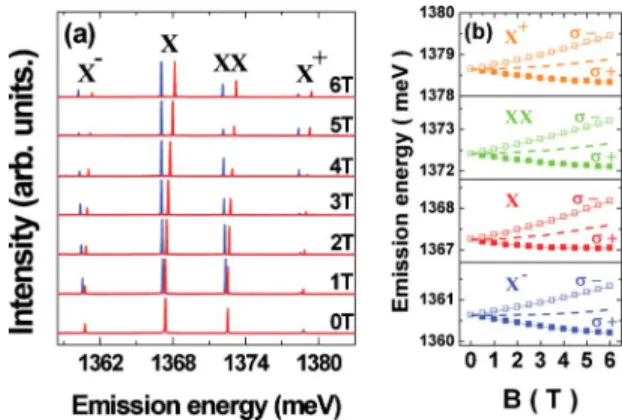
1349–1385 meV. Representative spectra selected from one particular dot共QD1兲 are shown in Fig. 1. When a magnetic field B was applied along the QD growth direction共Faraday geometry兲, each line splits into a doublet through the Zee-man effect. As shown in Fig. 1共b兲, the average energy of each Zeeman doublet increases with the increasing B, known as the diamagnetic shift. In Fig.2, the measured diamagnetic shifts for the four excitonic emission lines are plotted as a function of B2. For X, X+, and XX, the measured diamagnetic shifts show a quadratic dependence ⌬E=␥B2, with a clear trend of␥X⬎␥XX⬵␥X+. This trend holds for all investigated
dots and is a consequence of different magnetic responses of interparticle Coulomb energies, as has been discussed previously.6In very strong contrast, the diamagnetic shift for the X−does not follow the quadratic dependence. If we still use a quadratic dependence to fit the anomalous diamagnetic shift, the diamagnetic coefficient ␥X− was found to be the
smallest one among the four excitonic species as depicted in Fig.3.
The reduced optical diamagnetic coefficient of X− could be caused either by relatively localized particle wave func-tions of the initial X− state or the extended electron wave function in the final 1e state. In the latter, the electron wave function is free of interparticle interactions and determined solely by the confining potential of QD. By contrast, a par-ticle in a few-parpar-ticle X−complex is subjected to additional interparticle 共e-e and e-h兲 interactions. The extents of the
particle wave functions of the X−and 1e states could become substantially different if the interparticle interactions are comparable to or even stronger than the confining strength of QD. As shown by Ref.6, the hole wave functions are much more localized than those of electrons in such small QDs. The imbalanced e-h and e-e interactions yield a net Coulomb attraction to electrons in X−and thus make the extent of the electron wave function of the X−state smaller than that of the 1e state. To confirm such a scenario for the explanation of the observed anomalous diamagnetic behavior, we perform the numerical simulation for the wave functions of interact-ing particles in X complexes implemented by usinteract-ing the finite element method within the Hartree approximation.13,14
In the Hartree approximation, the Schrodinger equation of a particle in an interacting X complex confined in QD is written as
关Hsp共rជi兲 + VH共rជi兲兴n共rជi兲 = n i
n共rជi兲, 共1兲
where rជi denotes the position coordinate of the ith particle, Hsp共rជi兲 stands for the Hamiltonian of the 共noninteraction兲
electron or hole,n i
the eigenenergy,n共rជi兲 the particle wave
function of the eigenstate 兩n典, and VH共rជi兲 is the Hartree
po-tential, a sum of the electrostatic potentials induced by other charged particles besides the considered particle itself.
In the calculation, cone-shaped QDs of various sizes sit-ting on a 0.4-nm-thick wetsit-ting layer are considered. The ma-terial parameters including the effective mass, dielectric con-stant, band offset, and band gap with the consideration of strain effect are taken from Ref. 15. For an N-particle X complex, the N-coupled equations for each particle accord-ing to Eq. 共1兲 are self-consistently solved by using an itera-tive approach. The total energy of the N-particle X complex is then determined by the sum of single-particle energies兵i其
but subtracted by the doubly counted interparticle interaction energy. The simulated results of diamagnetic coefficients for four different exciton complexes are plotted in Fig. 3. The diamagnetic coefficients are obtained by taking the second derivative of magnetoenergy spectra with respect to B using three-point numerical differentiation.
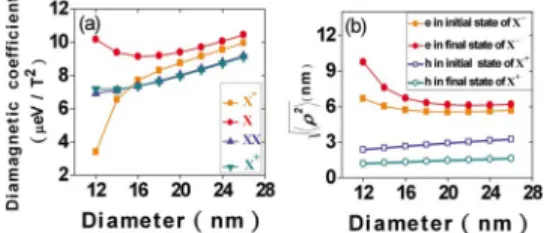
We first discuss the QD’s size effect on the diamagnetic shifts. The calculated diamagnetic coefficients for the four exciton complexes in QDs with a diameter ranging from 12 to 26 nm are shown in Fig. 4共a兲. For large-sized QDs 共D ⬎16 nm兲, the diamagnetic coefficients of the four exciton complexes show similar increasing trends with the QD size. Because the diamagnetic coefficient is proportional to the
FIG. 1. 共Color online兲 共a兲 The magneto-PL spectra for QD1 under a magnetic field B = 0 – 6 T.共b兲 The corresponding peak en-ergies of different excitonic species as a function of B for QD1, where− and + in each form a Zeeman doublet. The dashed line is the average energy of− and +.
FIG. 2. 共Color online兲 Emission energy of exciton complexes shift with B2for QD1. The simulated QD is 11.6 nm in diameter
and 1.1 nm in height. Points are the measured data and lines are the simulated result.
FIG. 3. 共Color online兲 The diamagnetic coefficient of the exci-ton complexes for the two typical QDs共QD1 and QD2兲. The simu-lated parameters are diameter of 11.6 nm and height of 1.1 nm 共QD1兲; diameter of 11 nm and height of 1.4 nm 共QD2兲.
BRIEF REPORTS PHYSICAL REVIEW B 81, 113307共2010兲
area of the carrier’s wave function, it will reflect the dot diameter for large-size QDs.4,16 However, for smaller QD sizes共D⬍16 nm兲, the calculated values of␥Xincrease with
the decreasing dot size, while those of ␥XX and ␥X+ remain
nearly unchanged. The most striking feature is that the cal-culated ␥X− drops rapidly with the decreasing dot size. It is
worth to mention that our self-consistent calculations repro-duce the experimental finding of ␥X⬎␥XX⬵␥X+ very well,
consistent with previous calculations based on configuration-interaction methods.
For the emission of negative trion X−, the initial state consists of two electrons and one hole leaving one electron in its final state after recombination. The X− diamagnetic shift thus reflects the diamagnetic responses of both the ini-tial and final states. To understand the anomalous behavior for the X−, it is necessary to take a closer look at the lateral extentᐉe⬅
冑
具e2典 of the electron wave functions before and after photon emission. Figure4共b兲shows the calculated wave function extentsᐉe,iandᐉe,ffor the initial-state and the
final-state electrons of X−, respectively. One can see that theᐉ
e,fis
always more or less larger than ᐉe,i. This can be realized from the presence of the hole in its initial state, which con-tracts the electron wave function by the Coulomb attraction. When the sizes of QDs are larger than about 16 nm, the differences betweenᐉe,iandᐉe,f are small; i.e., the presence
of the hole does not change the electron wave function sig-nificantly. However, as the QD sizes reduces, ᐉe,f increases
rapidly, with a rate even faster than ᐉe,i. Such an increasing
trend forᐉe,f indicates that the electron gradually loses
con-finement as the dot size reduces, which pushes the electron level toward the wetting-layer continuum, resulting in a very extended electron wave function penetrating into the barrier material. In such a case of weak confinement regimes, the very extended initial-state electron becomes sensitive to the long-range Coulomb attractive potential produced by the hole, by whichᐉe,iwill be contracted and become apparently
smaller thanᐉe,f. As a result, the final-state diamagnetic shift
increases, so that the overall diamagnetic shift in X− is re-duced. This explains why the X−diamagnetic shift decreases rapidly for small-sized QDs shown in Fig.4共a兲.
Likewise, for the emission of positive trion X+, the initial state consists of one electron and two holes leaving one hole in its final state after recombination. As shown in Fig. 4共b兲, unlike X−, the lateral extents of hole wave functions ᐉ
h
⬅
冑
具h2典 in the initial and final states are almost identical for all QD sizes. Due to the larger effective mass of holes, their
wave functions are well confined even in such small QDs. In this case, the Coulomb attractive potential produced by the weakly confined electron becomes less important, so that the size dependence of ␥X+behaves as usual.
Now one may ask the question why the X− diamagnetic shift exhibits a nonquadratic B dependence. In general, a quadratic diamagnetic shift holds only in the weak-field limit, i.e., when the magnetic length ᐉM=
冑
ប/eB is largecompared to the lateral extents of the carrier’s wave func-tions ᐉ=
冑
具2典. We noted that ᐉM= 15 nm at B = 3 T, which
becomes comparable with ᐉe,f= 10 nm for the final-state
electron in a QD with a base diameter of 12 nm. In this regime, the diamagnetic shift would deviate from the typical
B2 dependence. To illustrate this behavior, we consider the diamagnetic shift in the carrier’s single-particle energy and expand it in powers of B as ⌬␣SP共B兲=␥␣B2+
␣B4+¯, where the quadratic and quartic coefficients are ␥␣ = e2ᐉ␣2/8m␣and␣= −e4ᐉ␣6/128m␣ប2, in which␣= e or h de-notes the electron or hole, and m␣ represents the effective mass of the electron or hole. Because 兩/␥兩 varies as ⬃ᐉ4, the contribution from the B4 term becomes increasingly im-portant as ᐉ⬃ᐉM. By taking into account the difference
be-tween ᐉe,i and ᐉe,f, a simple algebraic analysis for the X−
diamagnetic shift⌬EX−共B兲 gives the following expression:
⌬EX−共B兲 ⬇␥X−B2+X−B4+ ¯ , 共2兲
where␥X−=共2␥e,i+␥h,i兲−␥e,fandX−=共2e,i+h,i兲−e,f.
Be-cause of ᐉh⬍ᐉe and mhⰇme, the ␥h,i and h,i for the hole
only have minor influences on the overall diamagnetism. Ac-cordingly, we obtain ␥X−⬇2␥e,i−␥e,f= e2共2ᐉe,i
2 −ᐉ
e,f
2 兲/8m
e
andX−⬇2e,i−e,f= −e4共2ᐉe,i6 −ᐉe,f6 兲/128meប2. Equation共2兲
makes clear how the difference in ᐉe,i and ᐉe,f can lead to
anomalous diamagnetic behaviors for the emission energy of
X−. We first consider a normal case ofᐉ
e,i⬇ᐉe,f=ᐉe; we have
␥X−⬇␥e⬇␥X and 兩␥X−兩Ⰷ兩X−兩, as long as ᐉe⬍ᐉM. That is,
the X−diamagnetic shift behaves as the usual quadratic de-pendence with a coefficient similar to that of X, which is just the case for large-size QDs shown in Fig.4共a兲. A very inter-esting case occurs when
冑
2ᐉe,i=ᐉe,f; i.e., ᐉe,i of theinitial-state electrons were contracted to ⬃70.7% of its final-state extension ᐉe,f by the hole. In this special case, the condition
2␥e,i=␥e,f cancels out the B2 term leading to a dominant
quartic dependence on B. As the difference between ᐉe,iand ᐉe,f becomes even larger 共
冑
2ᐉe,i⬍ᐉe,f兲, the magneticre-sponse of X− goes into a new regime where the quadratic coefficient␥X−is negative; i.e., the energy shift is
paramag-netic. This anomalous behavior can be best seen from the
calculated results shown in Fig. 5共a兲, where we keep ᐉe,f
= 10 nm but varyingᐉe,ifrom 7.6 to 6.6 nm. The magnetic response of X−emissions transited gradually from the usual quadratic diamagnetic shift to quartic dependences, and fi-nally into an overall negative energy shift, resembling para-magnetic behaviors. In Fig. 5共b兲, we selected four typical QDs that could represent the behaviors in different regimes in qualitative agreement with our calculations.
The magnetic responses of negative trions X− in single self-assembled InAs/GaAs quantum dots have been investi-gated. Unlike the conventional quadratic diamagnetic shift
FIG. 4. 共Color online兲 The simulation for QDs with various diameters, the diamagnetic coefficients 共a兲, and the mean radiuses of electron and hole wave functions in their initial and final states 共b兲.
BRIEF REPORTS PHYSICAL REVIEW B 81, 113307共2010兲
for neutral excitons, the X−diamagnetic shifts in most of the investigated dots were found to be considerably small and
nonquadratic. In particular, we also observed a reversal in sign of the conventional diamagnetic shift. A theoretical analysis indicates that such anomalous behaviors for X−arise from an apparent change in the electron wave function extent after photon emission due to the strong Coulomb attraction induced by the hole in its initial state. This effect can be very pronounced in small quantum dots, where the electron wave function becomes weakly confined and extended much into the barrier region. When the electrons gradually lose con-finement, the magnetic response of X−will transit gradually from the usual quadratic diamagnetic shift to a quartic de-pendence, and finally into a special paramagnetic regime with an overall negative energy shift.
This work was financially supported by the National Sci-ence Council of Taiwan under Contracts No. 2120-M009-004, No. 2221-E009-161, and No. NSC97-2112-M-009-015-MY2. We thank the Center for Nanoscience and Technology 共CNST兲 at National Chiao Tung University for their strong support.
*Corresponding author; [email protected]
1Y. Nagamune, Y. Arakawa, S. Tsukamoto, M. Nishioka, S.
Sasaki, and N. Miura, Phys. Rev. Lett. 69, 2963共1992兲.
2T. Someya, H. Akiyama, and H. Sakaki, Phys. Rev. Lett. 74,
3664共1995兲.
3R. Rinaldi, R. Cingolani, M. Lepore, M. Ferrara, I. M. Catalano,
F. Rossi, L. Rota, E. Molinari, P. Lugli, U. Marti, D. Martin, F. Morier-Gemoud, P. Ruterana, and F. K. Reinhart, Phys. Rev. Lett. 73, 2899共1994兲.
4M. Bayer, S. N. Walck, T. L. Reinecke, and A. Forchel, Phys.
Rev. B 57, 6584共1998兲.
5C. Schulhauser, D. Haft, R. J. Warburton, K. Karrai, A. O.
Go-vorov, A. V. Kalameitsev, A. Chaplik, W. Schoenfeld, J. M. Garcia, and P. M. Petroff, Phys. Rev. B 66, 193303共2002兲.
6M. F. Tsai, H. Lin, C. H. Lin, S. D. Lin, S. Y. Wang, M. C. Lo,
S. J. Cheng, M. C. Lee, and W. H. Chang, Phys. Rev. Lett. 101, 267402共2008兲.
7T. C. Lin, C. H. Lin, H. S. Ling, Y. J. Fu, W. H. Chang, S. D.
Lin, and C. P. Lee, Phys. Rev. B 80, 081304共R兲 共2009兲.
8S. N. Walck and T. L. Reinecke, Phys. Rev. B 57, 9088共1998兲. 9A. J. Shields, M. Pepper, M. Y. Simmons, and D. A. Ritchie,
Phys. Rev. B 52, 7841共1995兲.
10G. Finkelstein, H. Shtrikman, and I. Bar-Joseph, Phys. Rev. B
53, 12593共1996兲.
11N. I. Cade, H. Gotoh, H. Nakano, and H. Okamoto, Phys. Rev. B
73, 115322共2006兲.
12H. Sanada, T. Sogawa, H. Gotoh, Y. Tokura, H. Yamaguchi, H.
Nakano, and H. Kamada, Phys. Rev. B 79, 121303共R兲 共2009兲.
13E. Kaxiras, Atomic and Electronic Structure of Solid共Cambridge
University Press, Cambridge, England, 2003兲, Chap. 2.
14W. A. Harrison, Solid State Theory 共Dover Publication, New
York, 1980兲, Chap. 2.
15C. E. Pryor and M. E. Pistol, Phys. Rev. B 72, 205311共2005兲;
we use the material parameters in this Brief Report except the hole effective mass of 0.5m0.
16U. Bockelmann, W. Heller, and G. Abstreiter, Phys. Rev. B 55,
4469共1997兲. FIG. 5. 共Color online兲 The theoretical 共left兲 and experimental
共right兲 anomalous diamagnetic shifts in small QDs.
BRIEF REPORTS PHYSICAL REVIEW B 81, 113307共2010兲