June 6, 2012
Antiviral activity of Isatis indigotica extract and its derived indirubin
against Japanese encephalitis virus
Shu-Jen Chang1 Yi-Chih Chang2 Kai-Zen Lu2 Yi-Yun Tsou1,2
Cheng-Wen Lin2,3*
1School of Pharmacy, China Medical University, Taichung, Taiwan
2Department of Medical Laboratory Science and Biotechnology, China Medical
University, Taichung, Taiwan
3Department of Biotechnology, College of Health Science, Asia University, Wufeng,
Taichung, Taiwan
*Corresponding author: Cheng-Wen Lin, PhD, Professor. Department of Medical Laboratory Science and Biotechnology, China Medical University, No. 91, Hsueh-Shih Road, Taichung 404, Taiwan
Telephone: 886-4-22053366 ext 7210 Fax: 886-4-22057414. Email: [email protected] 1 2 3 4 5 6 7 8 9 10 11 12 13 14 15 16 17 18 19 20 21 22
Abstract
Isatis indigotica is widely used in Chinese Traditional Medicine for clinical treatment of virus infection, tumor, and inflammation, yet its antiviral activities remain unclear. This study probed antiviral activity of I. indigotica extract and its marker compounds against Japansese encephalitis virus (JEV). I. indigotica methanol extract, indigo, and indirubin proved less cytotoxic than other components, showing inhibitory effect (concentration-dependent) on JEV replication in vitro. Time-of-addition experiments proved the extract, indigo, and indirubin with potent antiviral effect by pre-treatment (before infection) or simultaneous treatment (during infection), but not post-treatment (after entry). Antiviral action of these agents showed correlation with blocking virus attachment and exhibited potent virucidal activity. In particular, indirubin had strong protective ability in a mouse model with lethal JEV challenge. The study could yield anti-JEV agents.
Keywords: Japanese encephalitis virus, Isatis indigotica, indigo, indirubin, virucidal
activity 1 2 3 4 5 6 7 8 9 10 11 12 13 14 15 16
1. Introduction
Isatis indigotica is an herb distributed widely in China and traditionally used in clinical treatment of viral diseases like influenza, hepatitis, and encephalitis [1, 13]. Accumulated experimental evidence indicates it and related components as associated with antiviral activity against influenza A, SARS-coronavirus, foot-and-mouth disease, rabies and human immunodeficiency virus Type 1 (HIV-1), among others [1, 5-7, 10-12, 15]. Among natural compounds identified from I. indigotica—e.g., indican, isatin, indirubin, indigotin [15]—indirubin exhibits multiple immunomodulatory and anti-viral effects [7, 12].
Japanese encephalitis virus (JEV) belongs to genus Flavivirus of the Flaviviridae family, an arthropod-borne micro-organism [14]. Vaccines against it are currently available and effective, yet viruses’ zoonotic characteristic and occasional infections cause JEV to rank as a leading cause of high morbidity and mortality rate in Southeast Asia and the Western Pacific region [2]. 30-50% of JE patients develop permanent neuropsychiatric sequelae while 20-30% of JE cases result in death [9]. Extensive study to develop new therapeutic strategy may be needed. This study rated inhibitory effect of ethyl acetate, methanol, and water extracts of I. indigotica, along with its related natural compounds, on JEV replication. We proved that pre-treatment of I.
indigotica extracts, indigo, and indirubin greatly inhibit JEV replication in vitro.
1 2 3 4 5 6 7 8 9 10 11 12 13 14 15 16 17 18 19
These agents blocked JEV attachment, which correlated with a potent virucidal activity.
2. Materials and methods
2.1. Viruses and cells
JEV strain T1P1 was used as previously described [8], vero cells for JEV amplification maintained in Dulbecco’s modified Eagle’s medium (DMEM), as well as BHK-21 cells used to determine JEV plaques grown in minimum essential medium (MEM) supplemented with 10% fetal bovine serum (FBS). Human promonocytic HL-CZ cells cultured in RPMI-1640 medium served to determine JEV yield in vitro.
2.2. I. indigotica extracts and related marker compounds
Crude extract powder of I. indigotica was obtained from Sun Ten Pharmaceutical Co., Ltd., a Taiwanese manufacturer of concentrated herbal extracts. For each extract tested, 1 g of powder was dissolved in 40 ml ethyl acetate or methanol, then gently shaken overnight at room temperature. Extract solutions were collected following centrifugation at 12,000 rpm for 20 min, filtered using a Whatman No. 1 filter paper, then lyophilized using in a freeze dryer (IWAKI FDR-50P). Each lyophilized extract powder was kept in sterile bottles at -20 °C. Stock extract solutions (1 mg/ml) were dissolved in phosphate buffered saline (PBS), sterilized using a 0.44 µm syringe filter 1 2 3 4 5 6 7 8 9 10 11 12 13 14 15 16 17 18 19 20
and stored at -80°C until used. Marker compounds of I. indigotica like adenosine, betulin, indigo, indirubin, tryptathrin, lupeol and 2-benzoxazolinone were purchased from Sigma Chemical Co. (St. Louis, MO). Stock solution of marker compounds (20 mg/ml) was dissolved in dimethyl sulfoxide (DMSO), diluted with PBS. DMSO (0.005%, 0.05%, 0.5% and 5%) was tested as solvent control.
2.3. Cell viability assay
To calculate cytotoxicity to BHK-21 cells and human promonocytic cells, cells were cultured overnight on 96-well plates. Medium containing DMSO (0.005, 0.05, 0.5 or 5%), I. indigotica extracts or marker compounds (0 μg/ml, 0.1 μg/ml, 1 μg/ml, 10 μg/ml and 100 μg/ml) were added and incubated for another 48 hours. living cells and total HL-CZ cell count with(out) treatment were measured by staining with 0.4% trypan blue; viability was estimated as ratio of living/total cell counts. Quadruplicate wells were analyzed for each concentration. Cytotoxic concentration showing 50% toxic effect (CC50) was derived by computer program (provided by John Spouge, National Center for Biotechnology Information, National Institutes of Health).
2.4. Quantitative assay of virus yields using plaque assay
To test inhibitory effect of I. indigotica on JEV yields in human promonocytic cells, HL-CZ cells infected with JEV at multiplicity of infection of 0.5 and treated 1 2 3 4 5 6 7 8 9 10 11 12 13 14 15 16 17 18 19 20
with DMSO (0.005, 0.05 or 0.5%), I. indigotica extract (1, 10, 100 μg/ml) or marker compound (0.1, 1, 10 μg/ml) at the same time. At 24 and 48 h after inoculation, cultured supernatant from (un)treated JEV-infected cells was collected for measuring virus yields by plaque assay. A 10-fold serial dilution of cultured medium was added into the well of BHK-21 cell monolayer at 37 °C for 1 h and overlaid with MEM medium containing 1.1% methylcellulose. Viral plaques were stained with naphthol blue-black dye after three-day incubation.
2.4. Plaque reduction and time-of-addition assay
To gauge inhibitory effect of I. indigotica by time-of-additon on JEV replication in vitro, pre-treatment (prior to infection), simultaneous treatment (at the same time as infection), and post-treatment (after entry) experiments were performed. For the pre-treatment experiment, BHK-21 cell monolayer was pretreated with/without various DMSO concentrations (0, 0.005, 0.05 or 0.5%), I. indigotica extract (0, 1, 10, 100 μg/ml) or marker compound (0, 0.1, 1, 10 μg/ml) 1-h before infection. BHK-21 cell monolayer was overlaid with MEM medium containing 1.1% methylcellulose 1 h post infection, viral plaques stained with naphthol blue-black dye after three-day incubation. For simultaneous treatment, medium with/without various DMSO concentrations (0, 0.005, 0.05 or 0.5%), I. indigotica extract (0, 1, 10, 100 μg/ml) or 1 2 3 4 5 6 7 8 9 10 11 12 13 14 15 16 17 18 19
marker compound (0, 0.1, 1, 10 μg/ml) was mixed along with JEV at 100 pfu, then forthwith added into the well of BHK-21 cell monolayer at 37 °C for 1 h and overlaid with MEM medium containing 1.1% methylcellulose for viral plaque assays. In post-treatment assay, BHK-21 cell monolayer was infected with JEV at 100 pfu for 1 h, followed by 1-h incubation with drug solutions and overlaid with MEM medium containing 1.1% methylcellulose, as described in plaque assay. Data represent means± SD of three independent experiments. Inhibitory concentration showing 50% JEV plaque reduction (IC50) was determined by computer program (John Spouge, National
Center for Biotechnology Information, National Institutes of Health).
2.5. Virus attachment assay
JEV (120 pfu) was mixed with medium containing various concentrations of DMSO (0, 0.005, 0.05 or 0.5%), I. indigotica extract (0, 1, 10, 100 μg/ml), or marker compound (0, 0.1, 1, 10 μg/ml), then immediately incubated with BHK-21 cell monolayer at 4 °C to allow attachment. After 1-h incubation, each extract/virus or compound/virus mixture was removed, cell monolayer washed with cold PBS and overlaid with MEM medium containing 1.1% methylcellulose. After 3-day incubation at 37 °C in a 5% CO2 incubator, plaques were stained, as described in
plaque assay. 1 2 3 4 5 6 7 8 9 10 11 12 13 14 15 16 17 18 19 20
2.6. Virucidal activity assay
Virucidal assay was based on prior reports [3, 4]. JEV (105 pfu) was mixed
with medium containing DMSO (0.005%, 0.05%, 0.5%), I. indigotica extract (1, 10, 100 μg/ml) or marker compound (0.1, 1, 10 μg/ml) and incubated for 60 min at 4 °C. A 1000-fold dilution of each extract/virus or compound/virus mixture was added onto BHK-21 cell monolayer in 6-well plates. After 1-h incubation, mixtures were removed and washed with PBS while monolayer was overlaid with MEM medium containing 1.1% methylcellulose; residual infectivity and inhibitory concentration showing 50% JEV plaque reduction (IC50) were determined, all as
described in plaque assay.
2.7. Mouse protection assay
Groups (n = 10) of 2-week-old BALB/c mice were intracerebrally infected with 1 × 10⁵ p.f.u of virulent JEV strain Beijing-1, then underwent three intracerebral
treatments with 30μg/100μl of I. indigotica extract or marker compound (1 mg/kg of body weight) using100μl syringes at 2, 24, and 48 h post infection. Two additional groups were infected with JEV and received PBS or DMSO (0.05%) treatment as solvent controls. Survival rates were monitored every day for one week.
2.8. Statistical analysis 1 2 3 4 5 6 7 8 9 10 11 12 13 14 15 16 17 18 19 20
ANOVA using SPSS program(version 10.1, SPSS Inc., IL, USA) or Student t-test analyzed data, p value less than 0.05considered statistically significant.
3. Results
3.1. Cytotoxicity of I. indigotica extracts and related marker compounds
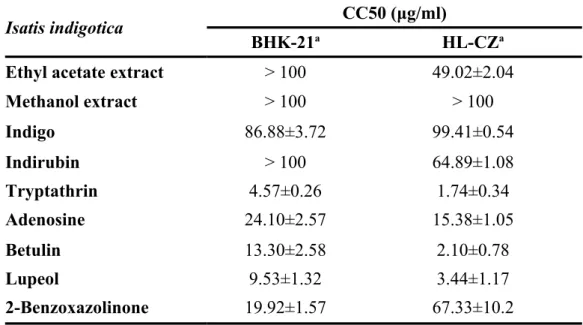
To test cytotoxicity, BHK-21 and HL-CZ cells were treated with both I. indigotica extract and related marker compounds at concentrations of 0.1-1000 μg/ml. Since diluted solutions of indigo and indirubin contained 0.0005% 0.005%, 0.05%, 0.5%, and 5% DMSO, cells were also treated with serial dilution of DMSO as solvent control. Cytotoxicity assay indicated extracts of I. indigotica by ethyl acetate and methanol less toxic to BHK-21 kidney cells (CC50 ≧ 100 μg/ml) than human
promonocytic HL-CZ cells (CC50 = 49.02 μg/ml). In solvent controls, both cell types
had maximum DMSO tolerance under 0.5%; viability of indigo- and indirubin-treated cells was gauged at concentrations of 0.1-100 μg/ml containing less than 0.5% DMSO. CC50 values of indigo and indirubin varied from 26.88 μg/ml (BHK-21 cells
treated with indigo) to 57.47 μg/ml (BHK-21 cells treated with indirubin) (Table 1). Other I. indigotica related marker compounds like tryptathrin, adenosine, betulin, lupeol and 2-benzoxazolinone showed high toxicity to both cell lines (CC50 < 25
μg/ml). Compared to ethyl acetate and methanol extracts, indigo and indirubin manifested low toxicity to such cells, being available for in vitro and in vivo activity 1 2 3 4 5 6 7 8 9 10 11 12 13 14 15 16 17 18 19 20
against JEV.
3.2. Inhibition of JEV yield by indigo and indirubin
To detect inhibition of virus yield in human promonocytic HL-CZ cells by I. indigotica, virus titers in cultured supernatants for JEV-infected HL-CZ cells with or without treatment were measured 24 and 48 hours post-infection, using plaque assay (Fig. 1). I. indigotica extract, indigo and indirubin showed dose-dependent inhibition of JEV replication in HL-CZ promonocytic cells, but no time-dependent inhibitory effect on JEV production in vitro. Particularly, indigo (10 μg/ml) and indirubin (10 μg/ml) showed virus yield reduced by approximately 40% after 24-h incubation.
3.3. Inhibition of JEV replication by pre-treatment of I. indigotica extracts, indigo and indirubin
To ascertain time-of-addition effect of I. indigotica on JEV replication, BHK-21 cells were pre-treated (prior to infection), simultaneously treated (at the same time as infection), or post-treated (after entry) with various concentrations of I. indigotica extracts, indigo and indirubin as well as serial dilution of DMSO (solvent control). With simultaneous treatment, both indigo and indirubin showed concentration-dependent inhibition of JEV plaques in vitro: IC50 plaque reduction values of 91.57
µg/ml for ethyl acetate extract, 78.47 µg/ml for methanol extract, 37.49 µg/ml for 1 2 3 4 5 6 7 8 9 10 11 12 13 14 15 16 17 18 19 20
indigo, and 13.68 µg/ml for indirubin (Fig. 2 and Table 2). Both indigo and indirubin tallied a therapeutic index (CC50/IC50) of > 10. Meanwhile, each dilution of DMSO
had no significant effect on plaque reduction (data not shown).
Both pre- and post-treatment plaque reduction assays tested antiviral effect of I. indigotica on JEV replication. In treatment assay, both indigo and indirubin pre-treated before JEV adsorption showed antiviral activity similar to simultaneous treatment assay (Fig. 2 and Table 2). However, post-treatment of I. indigotica extracts, indigo and indirubin was ineffective in antiviral activity after virus entry. Results demonstrated pre-treatment of I. indigotica extracts, indigo and indirubin affects JEV replication in vitro.
3.4 Inhibition of virus attachment by indigo and indirubin
To rate inhibitory effect of I. indigotica on virus attachment, JEV mixture (120 pfu) with I. indigotica extract, indigo, indirubin or 0.5% DMSO (solvent control) was immediately incubated at 4 °C with BHK-21 cell monolayer to allow attachment alone. After virus attachment at 4 °C for 1 h, each mixture was removed and cell monolayer washed with PBS. Residual infectivity derived by plaque assay yielded IC50 values of methanol extract, indigo and indirubin below pre- and simultaneous
treatment (Fig. 3, Table 2). However, 0.5% DMSO had no significant effect on virus attachment (data not shown). These results demonstrated a potent inhibitory effect of 1 2 3 4 5 6 7 8 9 10 11 12 13 14 15 16 17 18 19 20
methanol extract, indigo and indirubin on JEV attachment.
3.5. Virucidal activity of indigo and indirubin
To ascertain whether I. indigotica has a virucidal action by directly interfering with virus particles, JEV was pre-incubated with both indigo and indirubin at 4 °C for 1 h and residual infectivity tested by plaque assay (Fig. 4, Table 2). Both indigo and indirubin exhibited concentration-dependent virucidal activity as well as significant inhibitory effect on residual infectivity compared to controls. Virucidal IC50 values
against JEV were 65.79 µg/ml of ethyl acetate extract, 22.17 µg/ml of methanol extract, 3.03 µg/ml of indigo, and 0.47 µg/ml of indirubin. Moreover, virucidal IC50
values were below pre-, simultaneous and post-treatment as well virus attachment assay (Table 2), revealing that I. indigotica directly inactivated JEV particles, exhibiting a potently virucidal action
3.6. Protection against lethal challenge in mice by indigo and indirubin
To investigate in vivo protective potential of I. indigotica, groups of mice were intracerebrally challenged with lethal dose of virulent JEV strain Beijing-1 and treated with extracts, indigo, indirubin, PBS or 0.5% DMSO at 2, 24, and 48 h post infection. Survival rate of the indirubin-treated group on Day 6 post-infection was 70%, starkly higher than others: e.g., indigo- (50%) and ethyl acetate extract-treated (20%) (Fig. 5). 1 2 3 4 5 6 7 8 9 10 11 12 13 14 15 16 17 18 19 20
None in the methanol extract-, PBS- or DMSO-treated groups survived, indicating indirubin as superior to indigo, ethyl acetate extract better than methanol extract in mouse protection against lethal i.c. challenge with JEV.
4. Discussion
This study demonstrated I. indigotica extracts as having low cytotoxicity and concentration-dependently inhibitory effects on JEV replication in vitro: e.g., reducing virus yield, blocking virus attachment, and virucdial activity (Figs. 1-4, Tables 1-2). I. indigotica extract displays multiple anti-viral and immunomodulatory activity against foot-and-mouth disease, rabies, HIV-1, influenza A, and SARS-coronavirus [1, 5-7, 10-12, 15]. Our results indicate antiviral potential of I. indigotica against JEV.
Among related compounds, indirubin manifested potent anti-JEV activities with plaque reduction (IC50=13.68 μg/ml via simultaneous treatment), virus attachment
inhibition (IC50=5.10 μg/ml) and virucidal inactivation (IC50=0.47 μg/mL) (Figs. 2-4,
Table 2). Indirubin also concentration-dependently reduced virus yield in cell cultures (Fig. 1B). Indigo effectively inhibited JEV replication in vitro, reduced virus yield and attachment (Figs. 1B and 3B), showing greater virucidal activity (IC50 = 3.03 μg/mL)
than I. indigotica extracts. Indirubin and indigo had a potent virucidal activity through directly inactivating virus particles, linking with a better inhibition of JEV replication 1 2 3 4 5 6 7 8 9 10 11 12 13 14 15 16 17 18 19 20
by pre-treatment, and a significant reduction of virus attachment and yield in vitro. Similar anti-viral effect of indirubin against pseudorabies virus has been also reported [7]. The inconsistency in anti-JEV abilities among reducing virus yield, virus attachment and virucidal activity could be due to the possibility that cells rapidly uptakes indirubin and indigo, then metabolized them as inactive production, being supported in a prior report [16].
Indirubin had potent in vivo protection against intracerebral JEV challenge at lethal dose, more than indigo, ethyl acetate extract, or methanol extract (Fig. 5). Indirubin likewise regulates immunomodulatory activity on RANTES expression in influenza-infected bronchial epithelial cells [12], showing broad-spectrum antiviral activity and more effective virucidal action against JEV. In sum, I. indigotica contains potential antiviral components against JEV, etc. through virucidal actions. Among major I. indigotica components, indirubin manifests potential for antiviral activity against JEV infection, which could yield new anti-JEV agents.
Acknowledgements
This project was supported by grants from China Medical University (CMU99-NSC-03(2/3), CMU99-S-23, CMU100-S-33), and the Republic of China National Science Council (NSC 99-2628-B-039-006-MY3).
1 2 3 4 5 6 7 8 9 10 11 12 13 14 15 16 17 18 19 20
References
[1] L. Chen, T. Lin, H. Zhang, Y. Su,
[2] K. Sugihara, S. Kitamura, T. Yamada, T. Okayama, S. Ohta, K. Yamashita, M. Yasuda, Y. Fujii-Kuriyama, K. Saeki, S. Matsui, T. Matsuda, “Aryl hydrocarbon receptor-mediated induction of microsomal drug-metabolizing enzyme activity by indirubin and indigo,” Biochem Biophys Res Commun vol. 318, no. 2, pp. 571-578, 2004 1 2 3 4 5 6 7 8 9
Figure Legends
Fig. 1. Inhibition of virus yield by I. indigotica extract, indigo and indirubin.
HL-CZ cells were infected with JEV at a MOI of 0.5 at the same time as treatment with serial dilution of I. indigotica extracts (A), indigo and indirubin (B). Cultured supernatants in infected cells were harvested at 24 and 48 h post infection. Virus yield was performed as described in plaque assay.
Fig. 2. Plaque reduction of JEV by I. indigotica and its major components in pre-, simultaneous and post-treatment assays. Serial dilutions of ethyl acetate and
methanol extracts of I. indigotica (A) and its components indigo and indirubin (B) were pre-treated before virus absorption, simultaneously with virus infection, or post-treated after virus absorption (JEV at 100 pfu/well). BHK-21 cell monolayer was incubated with virus/compound mixture at 37 °C for 1 h, then overlaid with MEM medium containing 1.1% methylcellulose. Viral plaques were stained with naphthol blue-black dye after 3 days of incubation.
Fig. 3. Inhibition of virus attachment by I. indigotica extract, indigo and indirubin. I. indigotica extracts (A), indigo and indirubin (B) were serially diluted
and mixed with JEV (120 pfu), each mixture incubated 1 h with BHK-21 cell monolayers at 4 °C. Then virus/compound mixture was removed and cell 1 2 3 4 5 6 7 8 9 10 11 12 13 14 15 16 17 18 19 20
monolayer washed with cold PBS. Residual infectivity was performed as described in plaque assay.
Fig. 4. Virucidal activities of I. indigotica and its major components. I. indigotica
extracts (A), indigo and indirubin (B) were serially diluted and mixed with JEV. Each virus/compound mixture was incubated at 4 °C for 1 h, then added onto the BHK-21 cell monolayer at 37°C for another 1 h. The virus/compound mixture was removed from 6-well plates and cell monolayer washed with PBS. Residual infectivity was performed as described in plaque assay.
Fig. 5. Mouse protection against lethal JEV challenge by I. indigotica. Groups of
2-week-old BALB/c mice were intracerebrally infected with JEV at 1 × 10⁵ p.f.u,
then underwent three intracerebral treatments with I. indigotica extract, indigo, or indirubin (1 mg/kg of body weight) at 2, 24, and 48 h post-infection. Two additional groups were infected with JEV and received PBS or DMSO (0.05%) treatment as solvent controls. Survival rates were monitored daily.
1 2 3 4 5 6 7 8 9 10 11 12 13 14 15 16
Table 1. Cytotoxic effect of I. indigotica extracts and its marker components on BHK-21 and HL-CZ cells
Isatis indigotica CC50 (μg/ml)
BHK-21a HL-CZa
Ethyl acetate extract > 100 49.02±2.04
Methanol extract > 100 > 100 Indigo 86.88±3.72 99.41±0.54 Indirubin > 100 64.89±1.08 Tryptathrin 4.57±0.26 1.74±0.34 Adenosine 24.10±2.57 15.38±1.05 Betulin 13.30±2.58 2.10±0.78 Lupeol 9.53±1.32 3.44±1.17 2-Benzoxazolinone 19.92±1.57 67.33±10.2
a Measured using trypan blue staining
1 2
Table 2. Antiviral effect of I. indigotica extracts and its marker components against JEV
Isatis indigotica IC50 (μg/ml) ofpre-treatment IC50 (μg/ml) ofsimultaneous
treatment
IC50 (μg/ml) of
post-treatment virus attachmentIC50 (μg/ml) of IC50 (μg/ml) ofvirucidal assay
Ethyl acetate extract 138.81±3.71 91.57±3.54 > 200 > 200 65.79±3.54
Methanol extract 85.46±8.54 78.47±3.06 > 200 50.57±2.12 22.17±3.06
Indigo 11.79±0.10 37.49±3.18 > 50 5.15±0.18 3.03±3.18
Indirubin 23.50±0.89 13.68±2.83 > 50 5.10±1.32 0.47±2.83
1
1 2