L
Journal of Alloys and Compounds 355 (2003) 72–78
www.elsevier.com / locate / jallcom
D
amping characteristics of TiNi binary and ternary shape memory alloys
a ,
*
bS.K. Wu
, H.C. Lin
a
Department of Materials Science and Engineering, National Taiwan University, Taipei 106, Taiwan b
Department of Materials Science, Feng Chia University, Taichung 407, Taiwan
Abstract
High damping materials are currently attracting much attention in engineering applications. TiNi shape memory alloys (SMAs) could exhibit high damping capacity, as well as excellent shape memory effect and superelasticity. The high damping capacity of TiNi SMAs is mainly related to the hysteretic movement of martensite variants, twin planes and parent–martensite interfaces. The addition of a third element has a substantial effect on the damping capacity of TiNi SMAs. In this paper, the damping characteristics of the binary and ternary TiNi SMAs are systematically investigated. Also, effects of alloy’s microstructures and crystal defects on damping characteristics of TiNi SMAs are discussed.
2003 Elsevier Science B.V. All rights reserved.
Keywords: Intermetallics; Surfaces and interfaces; Strain
1 . Introduction in the temperature range of a thermoelastic martensitic transformation [9,10]. Such thermoelastic damping is TiNi alloys are known as the most important shape frequently amplitude independent and proportional to the memory alloys (SMAs) because of their many applications transformation rate. In this paper, by using both flexural based on the shape memory effect (SME) and pseudo- resonant-bar and low frequency inverted torsion pendulum elasticity (PE). This comes from the fact that TiNi alloys techniques[11],the damping characteristics of TiNi binary have superior properties in ductility, fatigue, corrosion and ternary SMAs are investigated in the high-temperature resistance, biocompatibility and recoverable strain, etc. It cubic B2 phase, the low temperature monoclinic B199 is also reported that TiNi alloys can exhibit a high martensite, and the intermediate rhombohedral R phase or mechanical damping and are promising for the energy orthorhomic B19 phase. The dominant damping mecha-dissipation applications [1–5]. Damping mechanisms, in nisms occurring in these phases and the characteristics general, involve the stress-induced movement of defects. associated with the thermoelastic transformations of TiNi For high-damping metals, the major mechanisms are the SMAs are also discussed.
stress-induced movement of dislocations or planar defects
[6].Most of these mechanisms can be phenomenologically
split into three classes: dynamic hysteresis, static hyster- 2 . Low-frequency internal friction damping esis, and transformation mechanisms. Dynamic hysteresis
21
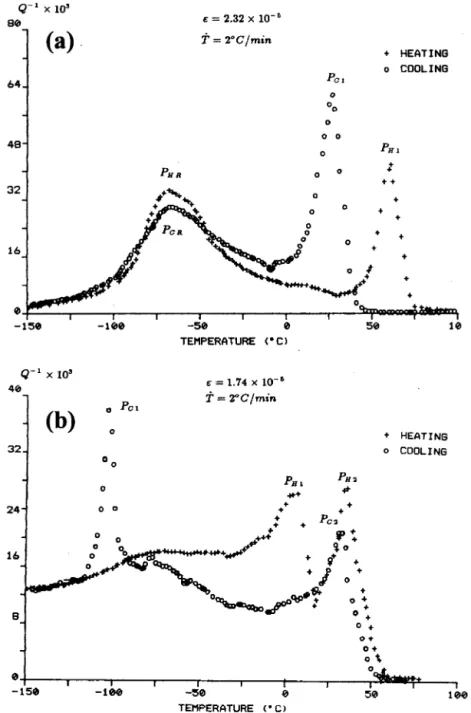
is produced by the stress-aided ordering of defects over- Fig. 1a and b show the internal friction Q of coming local barriers by thermal activation and yields Ti49.8Ni50.2alloy and 400 8C35 h aged Ti Ni49 51 alloy as a damping that is frequency dependent and amplitude in- function of temperature, respectively. InFig. 1b,peaks PH1
dependent. Static hysteresis appears due to the stress- and PH2 appear in heating and peaks PC1 and PC2appear in induced ‘unpinning’ or ‘break-away’ process of the defects cooling. It has been confirmed [3,11] that peaks PH2 and
[6–8], and yields damping that is frequency independent PC2 are associated with the B2↔R transformation and and amplitude dependent. Some metals exhibit a high level peaks PH1 and PC1 are associated with the R↔B199 of damping in the region of a transformation, for example, transformation. All these peaks also correspond to the minima of frequency[3], indicating that the lattice soften-ing phenomenon occurs dursoften-ing these transformations.Fig.
*Corresponding author. Tel.: 7846; fax:
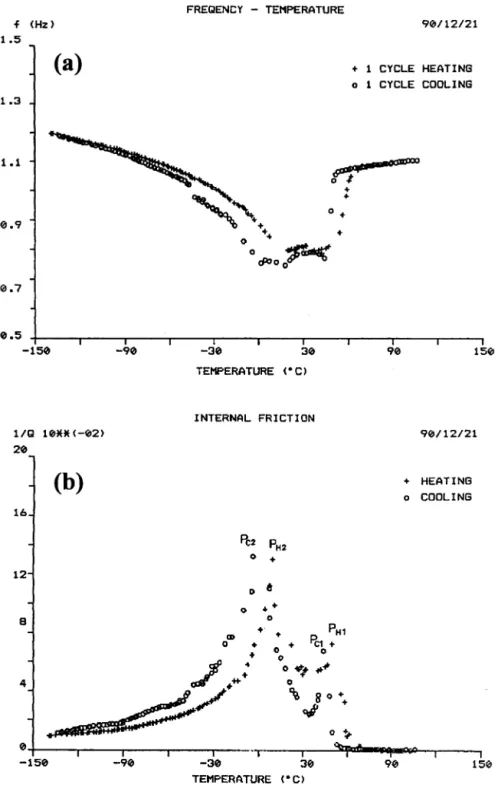
1886-2-2363-2a and b show the frequency and internal friction of
4562.
E-mail address: [email protected](S.K. Wu). Ti Ni Cu50 40 10 alloy as a function of temperature,
respec-0925-8388 / 03 / $ – see front matter 2003 Elsevier Science B.V. All rights reserved. doi:10.1016 / S0925-8388(03)00279-2
Fig. 1. The internal friction vs. temperature curves for (a) Ti49.8Ni50.2 alloy, (b) 400 8C35-h aged Ti Ni49 51alloy.
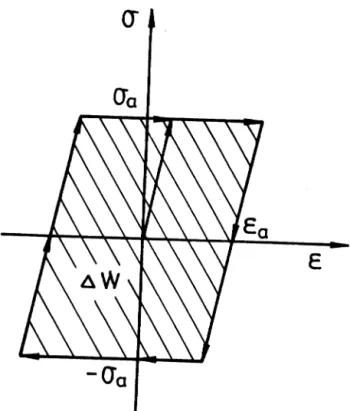
tively. InFig. 2b,there are two sharp peaks, PC1 and P ,C2 involve the stress-induced movement of defects. Point on cooling, and two sharp peaks, PH1 and P , on heating.H2 defects give rise to damping in the range of low to These peaks correspond to wide frequency minimum intermediate levels, line defects give rise to damping levels plateaus, as shown in Fig. 2a. Peaks PC2 and PH2 are in the intermediate to high range, and planar defects give associated with the B2↔B19 transformation, while peaks rise to damping levels in the high range. It is well known PC1 and PH1 are associated with the B19↔B199 trans- that there are abundant twin boundaries in the B19 / B199 formation[12]. martensite and R phase of TiNi SMAs[13,14].These twin From Figs. 1 and 2, one can find that both martensite boundaries can be easily moved by the external stress to and R phase exhibit the same order of damping capacity accommodate the strain. The stress–strain diagram for the which is larger than the B2 phase, and the highest damping accommodation process during the damping test is capacity appears in the transformation regions in TiNi schematically drawn in Fig. 3. It is shown that after an
21
SMAs. Furthermore, the Qmax for peaks of B19↔B199 elastic response to the stress, an accommodated strain ´ ina
transformation in Ti Ni Cu50 40 10 alloy can reach 0.14, some microdomains can be produced at a critical value of which is ultrahigh as compared to those of the TiNi binary the stress, s . This strain is due to the stress-induceda
Fig. 2. (a) Frequency, (b) internal friction vs. temperature curves for the Ti Ni Cu50 40 10 alloy.
martensite or R phase. The accommodated strain is re- esis of lattice defects, such as vacancy, interstitial or tained during the unloading but can be reoriented to the dislocation. Because the dynamic / static hysteresis of lat-opposite direction due to the movement of twin boundaries tice defects generally dissipates a smaller quantity of induced by the following opposite-direction stress, 2s .a energy, the damping capacity in the B2 phase of TiNi This opens up a relatively large hysteresis loop, DW, for SMAs is smaller.
the cyclic movement of twin boundaries. Therefore, the InFigs. 1 and 2,there are peaks of damping capacity in martensite and R phase of TiNi SMAs have a higher the transformation regions. The maximum value of the damping capacity. No twin boundaries exist in the parent damping capacity occurring in the temperature ranges of B2 phase of TiNi SMAs, and the damping capacity is transformation is two times or even higher than that suggested simply to come from the dynamic / static hyster- occurring in martensite or R phase. Delorme et al. [15]
21
Fig. 4. The internal friction peak heights Qmaxvs. temperature changing rate (dT / dt) for the 400 8C35-h aged Ti Ni49 51alloy.
driving force, but either can be formed by the applied external stress. In TiNi SMAs, the deformation behavior shows that the stress-induced transformation occurs before the reorientation of variants of martensite or R phase in the temperature range of forward transformations on cooling
[17].Hence, the damping capacity appearing at dT / dt 50 on cooling, as shown in Fig. 4, is ascribed to the stress-induced transformation. Tadaki et al. [18] have reported that the volume change and shape strain associated with
Fig. 3. Schematic stress–strain diagram for the martensite / R phase
accommodation process. DW indicates the energy loss for the cyclic the martensitic transformation are much larger than those
movement of twin boundaries. associated with the R-phase transformation. Based on this
report, dc(V ) / dV for martensitic transformation is largerm m
have shown that all the first-order phase transformations than that for R-phase transformation. Therefore, the inter-should be accompanied with internal friction peaks and nal friction of the R→M transformation should be much
21
have deduced the internal friction factor Q as a function larger than that of the B2→R transformation. Therefore, of temperature changing rate dT / dt, as shown in Eq. (1): the PC1 peak (R→M) at dT / dt 50 is much higher than the PC2 peak (B2→R) at the same strain amplitude. However,
21
Q 5 1 /v dc(V ) / dV dV / dT dT / dtm m m (1) in the heating process, the existing martensite or R-phase variants should be reoriented to accommodate the applied where Vm is the volume fraction of martensite, v is the strain. As discussed above, the damping capacities due to angular frequency of applied stress, and c(V ) is am the stress-induced movement of the twin boundary in the
monotonic function associated with the transformation
accommodation process for martensite and R phase have
volume change and / or shape strain. Eq. (1) indicates that 21
nearly the same magnitude. Hence, the peak heights Q
21 max
the internal friction factor Q is proportional to the
of PH1and PH2at dT / dt 50 have nearly the same values, as heating and cooling rate, dT / dt. Dejonghe et al. [16], in
shown inFig. 4.
order to take account of the special character of the martensite which can be induced or reoriented by an external stress s, introduced the stress dependence to
3 . High-frequency resonant-bar damping dV / dt as follows:m
In order to understand the high-frequency damping dV / dt 5 ≠V / ≠T ≠T / ≠t 1 ≠V / ≠s ≠s / ≠tm m m (2)
property of TiNi SMAs, the flexural resonant-bar damping In Eq. (2), the first term is identical to the Delorme’s tests were carried out at various temperatures in which model and the second term is the stress-dependent one. In TiNi SMAs exhibit different phases during cooling and
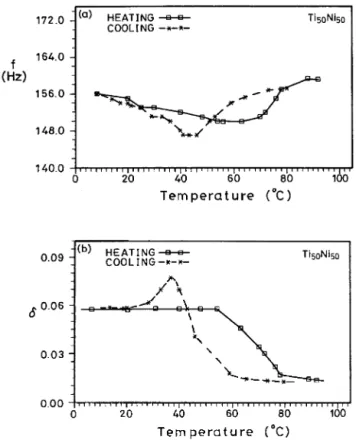
Fig. 4, an approximately linear variation of peak heights heating cycles.Figs. 5 and 6show the damping capacity d
21
Qmax of P , P , P , and PH1 C1 H2 C2 vs. dT / dt (dT / dt 51, 2, vs. temperature and resonant frequency f vs. temperature,
21
3 8C min ) for TiNi SMAs is observed. This result for Ti Ni50 50 and Ti Ni Cu50 40 10 alloys, respectively.Fig. 5a
indicates that both martensitic and R-phase transformations shows the frequency minima in the temperature ranges of agree with the Delorme’s model at dT / dt 51 to B2↔B199 transformation during the cooling and heating
21
3 8C min . Besides, in Fig. 4, as dT / dt is extrapolated to cycles for the Ti Ni50 50 alloy. Fig. 5b shows that the zero, the peak heights are higher than the background. At damping capacity of B199 martensite is larger than that of dT / dt 50, no martensite or R phase is formed by a thermal the B2 phase. Meanwhile, a damping peak appears in the
temperature range of B2→B199 transformation, although it is not significant during the B199→B2 reverse transforma-tion. InFig. 6afor the Ti Ni Cu50 40 10 alloy, wide frequency minimum plateaus are observed in the temperature ranges
* * * *
of M1 to M2 on cooling and A1 to A2 on heating. In the
* * * *
same temperature ranges (M1 to M2 and A1 to A ), there2
are plateaus for high damping capacity, as shown in Fig. 6b.
Mercier et al.[19],Lotkov et al.[20]and Ren et al.[21]
investigated the anomalies of elastic properties of TiNi binary and ternary single crystals. They reported that the lattice-softening phenomenon promotes shear transforma-tion due to thermal or mechanical driving forces and forms a minimum yield stress around the M temperature. Thiss
means that, during the martensitic transformation, the movement of twin boundaries or martensite / parent inter-faces is easy and most of the energy is dissipated in the transformation region. This causes the peak of damping capacity to appear in the transformation region, as shown in Fig. 5 for the Ti Ni50 50 alloy. However, no damping capacity peak occurs on heating in Fig. 5. The damping capacity maintains a nearly constant value and then gradually decreases to a lower value after B199 martensite has transformed to B2 parent phase. This phenomenon can be explained as follows. In the resonant-bar test (dT / dt 5
Fig. 5. (a) The resonant frequency f and (b) the damping capacity d vs.
0), the damping capacity peak associated with the forward
temperature curves for the Ti Ni50 50alloy.
transformation of B2→B199 can be attributed to both stress-induced transformation and stress-induced twin ac-commodation. The lattice softening can promote stress-induced transformation and increase damping capacity. However, during reverse transformation, the damping capacity can only be contributed by the stress-induced twin accommodation because there is no obvious softening phenomenon on heating [22], and stress-induced reverse transformation is difficult. In other words, during the reverse transformation, the damping capacity arises from the movement of twin boundaries existing in the marten-site. Therefore, the damping capacity on heating maintains a near-constant value and then decreases to a lower value after the martensite has transformed to the B2 parent phase.
Fig. 6 shows that the Ti Ni Cu50 40 10 alloy has high plateaus of damping capacity d in the temperature ranges of B19 martensite on both cooling and heating cycles. As discussed in a previous paper [12], the B2→B19 trans-formation should exhibit a dramatic lattice-softening phe-nomenon because the yielding stress decreases signifi-cantly during the transformation. Hence, related to the stress-induced transformation and stress-induced twin ac-commodation, the damping capacity can increase rapidly during the B2→B19 transformation. Meanwhile, as re-ported in Ref.[12], the yielding stress of B19 martensite maintains such a low value with temperature variation of
* *
M1 to M . This indicates that the movement of twin2
boundaries is always quite easy in the temperature range of
Fig. 6. (a) The resonant frequency f and (b) the damping capacity d vs.
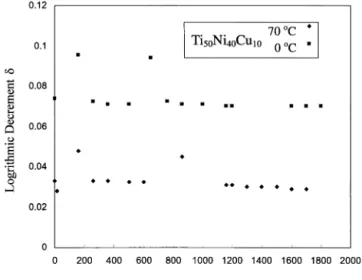
To understand the frequency effect on the damping property of TiNi SMAs, the flexural resonant-bar damping tests were carried out at frequencies of 0–2000 Hz. The damping capacity (indicated by the logarithmic decrement
d ) vs. testing frequency are presented inFigs. 7 and 8for the B199 martensite and B2 parent phase of Ti Ni50 50 and Ti Ni Cu50 40 10 alloys, respectively. Careful examination of
Figs. 7 and 8finds that, except at the resonant frequencies, the testing frequency has only slight effect on the damping capacity of TiNi SMAs, no matter in their B199 martensite or B2 parent phase. This frequency-independent phenom-enon indicates that the damping capacity of TiNi SMAs predominantly originates from the static hysteresis due to the stress-induced ‘unpinning’ or ‘break-away’ process of the defects [6–8].
Fig. 7. The damping capacity d vs. testing frequency for Ti Ni50 50alloy at
4 . Conclusion
at 0 and 70 8C.
Damping characteristics of TiNi SMAs have been high plateau. Because the yielding stress of B199 marten- systematically studied by using resonant-bar and low site is higher than that of B19 martensite, the movement of frequency inverted torsion pendulum techniques. Both twin boundaries in B199 martensite is more difficult than B19 / B199 martensite and R phase have high damping that in B19 martensite. This causes the damping capacity capacities due to the stress-induced movement of twin to be lower after the transformation of B19→B199 occurs. boundaries. The parent B2 phase has a smaller damping On heating, the damping capacity increases rapidly with capacity which is suggested simply to come from the the increasing transformation volume of B199→B19 and dynamic / static hysteresis of lattice defects. In the trans-then maintains a high plateau which is similar to that on formation regions, there are damping capacity maxima cooling. This is reasonable because, in the B19 region on which are two or more times higher than the damping the heating or cooling cycles, the damping capacities come capacity of martensite or R phase. Two contributions from a similar mechanism, that is, movement of the twin account for the occurrence of the maxima of damping boundaries in B19 martensite. When B19 martensite gradu- capacity. One arises from the plastic strain and twin-ally transforms to B2 parent phase, the damping capacity interface movement during the thermal-induced trans-also gradually decreases to the lower value of B2 parent formation, and the other originates from the stress-induced
phase. transformation caused by the applied external stress.
In the resonant-bar test, the damping capacity peak associated with the forward B2→B199 transformation of Ti Ni50 50 alloy is attributable to both stress-induced trans-formation and stress-induced twin accommodation. How-ever, no peak appears during reverse transformation be-cause there is no obvious softening phenomenon on heating, and the damping capacity can only be produced by the stress-induced twin accommodation. The Ti Ni Cu50 40 10
alloy has high plateaus of damping capacity in the tem-perature ranges of B19 martensite on both cooling and heating cycles. These high damping capacity plateaus arise from the easy movement of the twin boundaries of B19 martensite because its yielding stress remains at a re-markably low value with temperature variation. The testing frequency has only slight effect on the damping capacity of TiNi SMAs. This frequency-independent phenomenon indicates that the damping capacity of TiNi SMAs pre-dominantly originates from the static hysteresis due to the stress-induced ‘unpinning’ or ‘break-away’ process of the
Fig. 8. The damping capacity d vs. testing frequency for Ti Ni Cu50 40 10
[10] J . Van Humbeek, in: Proceedings of the ASM Materials Week and A cknowledgements
TMS /AIME Fall Meeting, Role of Interfaces on Materials Damping, ASM, Materials Park, OH, 1985, p. 5.
The authors sincerely acknowledge the financial support [11] H .C. Lin, S. K Wu, M.T. Yeh, Metall. Trans. A 24 (1993) 2189. of this research by National Science Council (NSC), [12] H .C. Lin, S.K. Wu, Y.C. Chang, Metall. Trans. A 26 (1995) 851.
Taiwan, under Grants NSC82-0405-E002-080 and NSC90- [13] T . Saburi, S. Nenno, in: Proceedings of the International Conference on Solid to Solid Phase Transformation, ASM, Materials Park, OH,
2216-E002-030. The authors thank Dr T.S. Chou,
Land-1982, p. 1455.
sfair Technology Corporation, Taiwan for his excellent
[14] S . Miyazaki, C.M. Wayman, Acta Metall. 36 (1988) 181.
assistance in the internal friction measurement. [15] J .F. Delorme, R. Schmid, M. Robin, P. Gobin, J. Phys. C 32 (1971)
2–101.
[16] W . Dejonghe, R. de Batist, L. Delaey, Scripta Metall. 10 (1976) 1125.
R eferences
[17] S . Miyazaki, K. Otsuka, Metall. Trans. A 17 (1986) 53. [18] T . Tadaki, Y. Nakata, K. Shimizu, Trans. JIM 28 (1987) 883. [1] K . Iwasaki, R. Hasiguti, Trans. JIM 28 (1987) 363. [19] O . Mercier, K.N. Melton, G. Gremaud, J. Hagi, J. Appl. Phys. 41 [2] O . Mercier, K.N. Melton, Acta Metall. 27 (1979) 1467. (1980) 1833.
[3] S .K. Wu, H.C. Lin, T.S. Chou, Acta Metall. 38 (1990) 95. [20] A .I. Lotkov, A.V. Kuznetsov, A.A. Botaki, in: Y. Chu, T.Y. Hsu, T. [4] C .M. Jackson, H.J. Wanger, R.J. Wasilewski, NASA-SP 5110 (1972) Ko (Eds.), Proceedings of the International Shape Memory Alloys
35. Symposium, China Academic Publishers, Guilin, China, 1986, p.
[5] D .E. Hodgson, Mater. Sci. Forum 394–395 (2002) 69. 153.
[6] I .G. Ritchie, Z.L. Pan, Metall. Trans. A 22 (1991) 607. [21] X . Ren, N. Miura, J. Zhang, K. Otsuka, K. Tanaka, M. Koiwa, T. [7] A .S. Nowick, B.S. Berry, Anelastic Relaxation in Crystalline Solids, Suzuki, Yu.I. Chumlyakov, M. Asai, Mater. Sci. Eng. A 312 (2001)
Academic Press, New York, 1972, 176 pp. 196.
[8] D .W. James, Mater. Sci. Eng. 4 (1969) 1. [22] Y . Liu, P.G. McCormick, Iron Steel Inst. Jpn. Int. 29 (1989) 417. [9] R . de Batist, J. Phys. C (1983) 4–39.