國 立 交 通 大 學
電信工程研究所
博 士 論 文
綠色無線接取網路之通訊協定設計與實作
Protocol Design and Implementation for
Green Wireless Access Networks
研 究 生: 劉 文 俊 (Wen-Jiunn Liu)
指 導 教 授: 方 凱 田 (Kai-Ten Feng)
綠色無線接取網路之通訊協定設計與實作
Protocol Design and Implementation for
Green Wireless Access Networks
研究生:劉文俊
Student:Wen-Jiunn Liu
指導教授:方凱田 博士
Advisor:Dr. Kai-Ten Feng
國立交通大學
電信工程研究所
博士論文
A Dissertation
Submitted to Institute of Communications Engineering
College of Electrical and Computer Engineering
National Chiao Tung University
in Partial Fulfillment of the Requirements
for the Degree of Doctor of Philosophy
in
Communications Engineering
Hsinchu, Taiwan
綠色無線接取網路之通訊協定設計與實作
學生:劉文俊 指導教授:方凱田 博士
國立交通大學
電信工程研究所博士班
摘要
近年來由於節能省電與環境友善議題發酵,綠色觀念 (Green Concept) 得到
了很多方面的注意。如何設計一個綠色無線接取網路也已經在通訊領域變成一個
相當熱門的主題。在網路系統設計方面,通訊堆疊最重要的部分通常為網路層
(Network Layer)、資料連結層 (Data Link Layer) 和實體層 (Physical Layer),因
為這三層最被通訊端點與通訊中介點所使用。然而實體層通常與所存取的媒介體
相關,因為不同的媒介體會有不同的訊號產生與調變方式。因此在設計與媒介體
獨立的演算法或通訊協定方面,網路層和資料連結層吸引了更多的注意。於是為
了要建立一個綠色無線接取網路,本論文在網路層和資料連結層上提出了一系列
的節能通訊協定設計與相關的實作方式。
在網路層通訊協定設計方面,基於貪婪選徑演算法 (Greedy Forwarding,
GF),本論文分別為二維平面與三維空間,提出貪婪抗無效問題選徑演算法
(Greedy Anti-void Routing, GAR) 和 三 維 貪 婪 抗 無 效 問 題 選 徑 演 算 法
(Three-Dimensional Greedy Anti-void Routing, 3D-GAR) 作為低通訊消耗且保證
到達的單播演算法 (Unicast)。對於低通訊消耗多播演算法 (Multicast) 設計方
面,本論文也提出了一個節能省電多播選徑演算法 (Energy Conserving Multicast
Routing, ECMR),用以減少多播樹 (Multicast Tree) 通訊中介點的個數。此演算
法可以顯著的降低非必要的通訊花費。此外,本論文基於 Linux 嵌入式系統提
出了元件導向選徑實作平台 (Component-based Routing Platform, CRP) 用以實現
這些所提出的選徑演算法。以上所提出的網路層通訊協定可以直接使無線接取網
路更省電綠化,因為通訊花費的節省可以直接降低能源的消耗。
在資料連結層通訊協定設計方面,依同樣能源消耗下,系統吞吐量的加強可
以視為一種非直接的方式實現綠色無線接取網路,因為平均傳輸每單位資料所消
耗的能源可以被降低。因此本論文提出了一種貪婪快速移動區塊確認演算法
(Greedy Fast-Shift Block Acknowledgement, GFS),透過減少傳統區塊確認演算法
中緩慢移動確認窗(Acknowledgement Window) 所帶來的負面效應,最後加強整
個系統的吞吐量。除了加強系統吞吐量這種非直接方式,另外還有一種直接的方
式,即:透過節能省電排程演算法可以直接達成節能省電的目的。節能省電排程
演算法可以透過適當的封包傳輸安排,減少最終的總能源消耗量。因此本論文對
於此直接省電的分類,也提出了一種訊框聚集節能省電排程演算法 (Frame
Aggregation-based Power-Saving Scheduling Algorithm, FAPS),此演算法可以將數
個未填滿的訊框合併成為一個填滿的訊框,進而達到節能省電的目的。另外值得
注意的是本訊框聚集節能省電排程演算法仍然可以維持住每個封包的服務品質
(Quality-of-Service, QoS)。此外,訊框聚集節能省電排程演算法在輸入皆為階梯
狀允許空間 (Stepwise Grant Space Set) 的條件之下,也可以產生最少的聆聽訊框
(Listen Frame)。相關的正確性證明皆整理並提供於本論文之內。最後多數的系統
訊框皆可以處於在睡眠模式之下,睡眠模式可以消耗相對於正常模式還少的能
源,因此可以達成節能省電的目的。透過本論文所提出在網路層與資料連結層上
的軟體通訊協定設計與實作,綠色無線接取網路將可以被廣泛的建立與使用。
Protocol Design and Implementation for
Green Wireless Access Networks
Student: Wen-Jiunn Liu Advisor: Dr. Kai-Ten Feng
Institute of Communications Engineering
National Chiao Tung University
ABSTRACT
In recent years, the green concept has received more attention due to the energy
efficient and environmentally friendly issues. How to develop the green wireless
access network also has become a hot topic in the communications society. In terms
of the network system design, the most important parts of the communication stacks
are in general the network layer, the data link layer, and the physical layer since these
three layers are utilized mostly in the terminal hosts and the intermediate nodes.
However, the physical layer is usually medium dependent for signaling different
transmission media. As a result, the network layer and the data link layer will gain
more attraction in designing the medium independent algorithms and protocols.
Therefore, in order to achieve the green wireless access networks, the protocol design
and implementation on the network layer and the data link layer are collectively
proposed in this dissertation.
In the network layer protocol design, a greedy anti-void routing (GAR) protocol
and the three-dimensional greedy anti-void routing (3D-GAR) protocol for both
two-dimensional and three-dimensional environments are proposed as the
low-overhead delivery-guaranteed unicast routing protocols based on the well-known
greedy forwarding (GF) algorithm. In the low-overhead multicast routing protocol
design, an energy conserving multicast routing (ECMR) protocol is also proposed to
reduce the total number of relaying nodes for the construction of a multicast tree,
which can significantly eliminate the unnecessary communication overheads.
Moreover, based on the Linux embedded systems, the associated component-based
routing platform (CRP) for implementing routing protocols is also introduced. These
proposed network layer protocols can make the wireless access networks greener
directly since the reduction of the communication overheads can effectively suppress
the energy expenses.
On the other hand, in the data link layer protocol design, the system throughput
enhancement under the same power consumption can be considered an indirect way to
realize the green wireless access networks since the power expenses can be degraded
for transmitting the same amount of information. As a result, the greedy fast-shift
block acknowledgement (GFS) mechanism is proposed for enhancing the system
throughput by reducing the inefficiency caused by the slow sliding of the
conventional acknowledgement window. Thanks to the fast shifting property of the
acknowledgement window in our proposed GFS scheme, significant throughput
enhancement can therefore be observed. In addition to the indirect method of
enhancing the system throughput, the direct method for achieving the green concept
should be the power-saving scheduling algorithm, which can arrange the packets with
the proper transmission schedules, suppressing the total energy consumption. The
frame aggregation-based power-saving (FAPS) scheduling algorithm is therefore
proposed for this type of direct methods by aggregating several under-utilized frames
into fully-utilized ones. The quality-of-service (QoS) of each data packet can still be
maintained in our proposed FAPS algorithm. In addition, the optimality on the
minimum number of listen frames in the proposed FAPS algorithm is also provided
under the stepwise grant space set and further verified via the correctness proof.
Finally, more number of system frames can be in the sleep mode, which consumes
less energy compared to the active mode. With our proposed software protocol design
and implementation in the network layer and the data link layer, the green wireless
access networks can therefore be achieved.
Acknowledgements
I would like to show my gratitude to my supervisor, Dr. Kai-Ten Feng, whose encourage-ment, guidance and support enabled me to complete this dissertation. Moreover, I owe my deepest gratitude to my family, who helped me when I had any request. I also would like to thank my colleagues in the mobile intelligent network technology (MINT) laboratory and the friends around the world, who enriched my school life and expanded my international views. Furthermore, I would like to acknowledge those associations and companies which had ever given me the financial support and scholarships during my degree program. Lastly, I offer my regards and blessings to all of those who supported me in any respect during the completion of the dissertation.
Contents
Chinese Abstract i
English Abstract iii
Acknowledgements v
Contents vi
List of Tables xi
List of Figures xii
1 Dissertation Overview 1
1.1 Introduction . . . 1
1.2 Problem Statement . . . 7
1.3 Contribution . . . 9
1.4 Dissertation Organization . . . 11
2 Greedy Anti-Void Routing Protocol 12 2.1 Introduction . . . 13
2.2 Network Model and Problem Statement . . . 17
2.3 Proposed Greedy Anti-Void Routing (GAR) Protocol . . . 18
2.3.1 Rolling-ball UDG Boundary Traversal (RUT) Scheme . . . 19
2.3.1.2 Boundary Traversal Phase . . . 21
2.3.1.3 Termination Phase . . . 21
2.3.2 Detail Description of Proposed GAR Protocol . . . 21
2.3.3 Proof of Correctness . . . 22
2.4 Realization of Proposed GAR Protocol . . . 24
2.4.1 Implementation of GF Scheme . . . 24
2.4.2 Implementation of RUT Scheme . . . 24
2.4.2.1 Algorithm Complexity Problem . . . 24
2.4.2.2 Concept of Boundary Map . . . 25
2.4.2.3 Construction of Boundary Map . . . 28
2.4.3 Proof of Correctness . . . 33
2.5 Enhanced Mechanisms for Proposed GAR Protocol . . . 34
2.5.1 Hop Count Reduction (HCR) Mechanism . . . 34
2.5.2 Intersection Navigation (IN) Mechanism . . . 36
2.5.3 Partial UDG Construction (PUC) Mechanism . . . 37
2.6 Performance Evaluation . . . 38
2.6.1 Grid Topology . . . 39
2.6.1.1 Simulation Results for UDG Network . . . 41
2.6.1.2 Simulation Results for Non-UDG Network . . . 44
2.6.2 Random Topology . . . 46
2.6.2.1 Simulation Results for UDG Network . . . 47
2.6.2.2 Simulation Results for Non-UDG Network . . . 49
2.7 Summary . . . 51
3 Three-Dimensional Greedy Anti-Void Routing Protocol 52 3.1 Introduction . . . 53
3.2 Network Model and Problem Statement . . . 54
3.3.1 Proposed Three-Dimensional Rolling-ball UBG Boundary Traversal
(3D-RUT) Scheme . . . 56
3.3.2 Detailed Descriptions of Proposed 3D-GAR Protocol . . . 58
3.3.3 Proof of Correctness . . . 60
3.4 Protocol Implementation . . . 62
3.5 Performance Evaluation . . . 64
3.6 Summary . . . 65
4 Component-based Routing Platform and Energy Conserving Multicast Routing Protocol 66 4.1 Introduction . . . 67
4.2 Proposed Energy Conserving Multicast Routing (ECMR) Protocol . . . 69
4.2.1 Heuristic Structure Construction and Data Packet Forwarding . . . 69
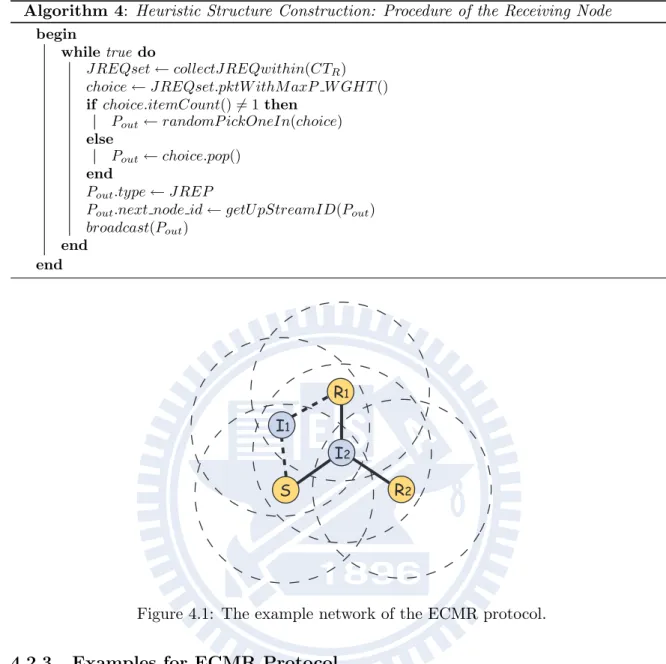
4.2.2 Pseudo Code Implementation of Heuristic Structure Construction . . . 71
4.2.3 Examples for ECMR Protocol . . . 74
4.3 Proposed Component-based Routing Platform (CRP) with Encapsulated Software Design . . . 76
4.3.1 Platform Overview . . . 76
4.3.1.1 Software Platform . . . 76
4.3.1.2 Hardware Platform . . . 77
4.3.2 Encapsulated Software Components (ESCs) . . . 77
4.3.3 ESC-based Packet Flow . . . 78
4.4 Performance Evaluation . . . 79
4.4.1 Parameters for Protocol Implementation . . . 79
4.4.2 Experiment Results . . . 80
4.5 Summary . . . 83
5 Greedy Fast-Shift Block Acknowledgement Mechanism 84 5.1 Introduction . . . 85
5.2.1 Conventional Greedy Scheme . . . 88
5.2.2 Proposed Greedy Fast-Shift (GFS) Scheme . . . 89
5.3 Proposed Markovian Chain-based Analytical Models for Block Acknowledgement Mechanisms . . . 91
5.3.1 Analytical Model for Conventional Greedy Scheme . . . 91
5.3.1.1 Internal States . . . 92
5.3.1.2 State Transition Diagram . . . 94
5.3.1.3 State Transition Probability . . . 94
5.3.1.4 Window Utilization . . . 96
5.3.2 Analytical Model for Proposed Greedy Fast-Shift Scheme . . . 97
5.3.2.1 Internal States . . . 98
5.3.2.2 State Transition Diagram . . . 100
5.3.2.3 State Transition Probability . . . 101
5.3.2.4 Window Utilization . . . 103
5.4 Performance Evaluation . . . 107
5.4.1 Model Validation . . . 107
5.4.2 Performance Comparison . . . 109
5.5 Summary . . . 113
6 Frame Aggregation-based Power-Saving Scheduling Algorithm 115 6.1 Introduction . . . 116
6.2 Problem Formulation . . . 118
6.2.1 IEEE 802.16e Sleep Mode Operation . . . 118
6.2.2 Inefficiency of IEEE 802.16e Sleep Mode Operation . . . 120
6.2.3 Packet-based Power-Saving Scheduling (PPS) Problem . . . 121
6.3 Proposed Frame Aggregation-based Power-Saving Scheduling (FAPS) Algorithm . . . 123
6.3.1 Frame Aggregation (FA) Procedure . . . 124
6.3.1.2 Backward Push Mechanism . . . 125
6.3.1.3 Packet Padding for Backward Push Mechanism . . . 127
6.3.2 Backward Adjustment (BA) Procedure . . . 129
6.3.2.1 Recursive Backward Movement . . . 130
6.3.2.2 Packet Padding for Recursive Backward Movement . . . 132
6.4 Optimality of Proposed FAPS Algorithm . . . 133
6.5 Performance Evaluation . . . 145
6.6 Summary . . . 149
7 Conclusion 150
List of Tables
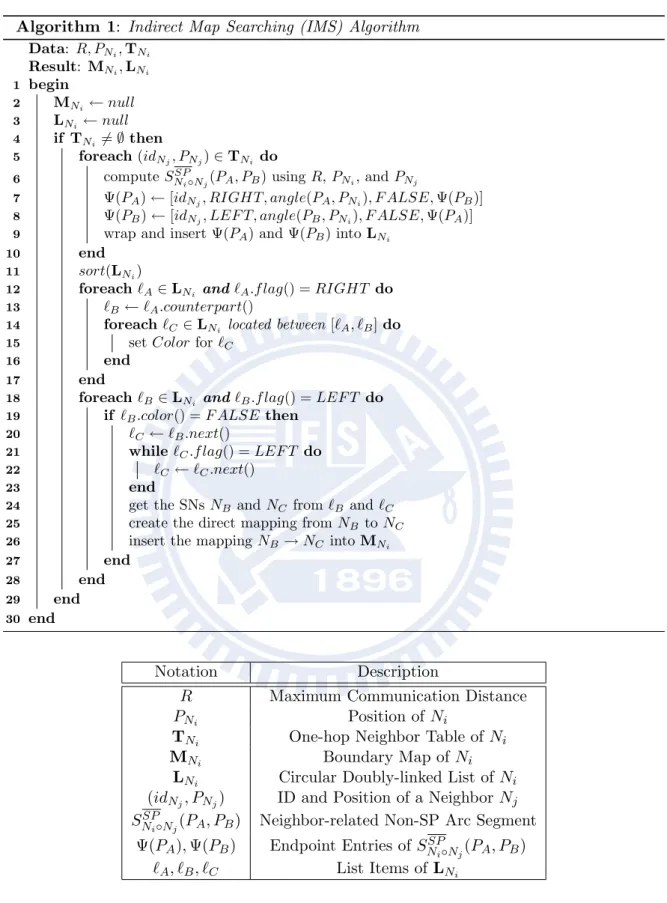
2.1 Notations for IMS Algorithm . . . 26
2.2 Simulation Parameters . . . 40
4.1 Parameter Values for the ECMR Protocol . . . 79
4.2 Parameter Values for the ODMRP Protocol . . . 79
List of Figures
1.1 The OSI reference model and the data transmission paradigm. . . 4
1.2 The core issues and the corresponding problems with solutions in this dissertation. 7 2.1 The example routing paths constructed by using the proposed GAR protocol and the conventional schemes under the existence of the void problem. . . 15
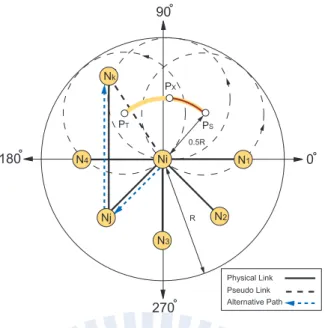
2.2 The rolling-ball UDG boundary traversal (RUT) scheme. . . 20
2.3 The converged SP and non-SP arc segments w.r.t. Ni and the boundary map. . 27
2.4 The process flow of the IMS algorithm. . . 30
2.5 The hop count reduction (HCR) and the intersection navigation (IN) schemes. 35 2.6 The partial UDG construction (PUC) mechanism. . . 37
2.7 The simulation scenario of the grid topology. . . 40
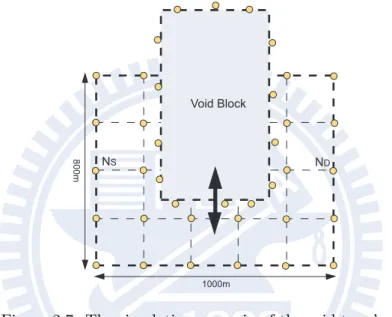
2.8 Performance comparison for UDG networks with grid topology. . . 42
2.9 Performance comparison for non-UDG networks with grid topology. . . 45
2.10 Performance comparison for UDG networks with random topology. . . 48
2.11 Performance comparison for non-UDG networks with random topology. . . 50
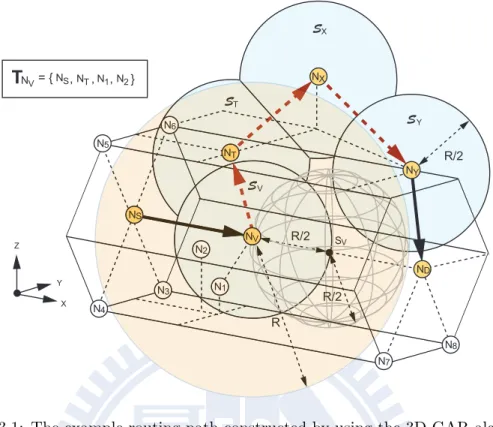
3.1 The example routing path constructed by using the 3D-GAR algorithm. . . 54
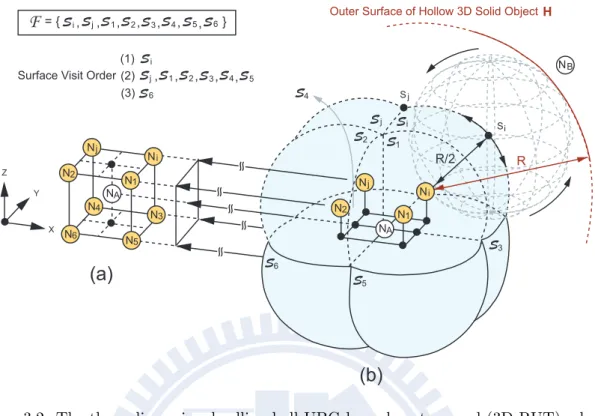
3.2 The three-dimensional rolling-ball UBG boundary traversal (3D-RUT) scheme. 56 3.3 Performance evaluation for the proposed 3D-GAR protocol. . . 63
4.1 The example network of the ECMR protocol. . . 74
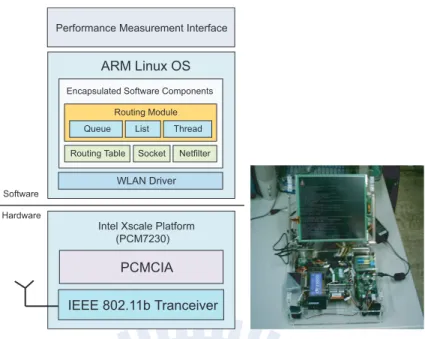
4.2 The software and hardware systems of the proposed CRP platform and the snapshot of the PCM-7230 embedded platform. . . 76
4.3 The schematic diagram of the packet flows for implementation. . . 78
4.4 The network topology for field experiments. . . 81
4.5 Energy consumption for relaying data packets versus round index. . . 81
4.6 Packet delivery ratio versus packet interdeparture time. . . 82
5.1 Examples for the two block ACK mechanisms under window size W = 4: (a) the conventional greedy scheme (GS), and (b) the proposed greedy fast-shift (GFS) scheme. . . 88
5.2 The three critical parameters for the internal state definition of the GS scheme: (a) the transmitter correctness bitmap, (b) the middle union, and (c) the state index. . . 92
5.3 State transition diagram for the conventional GS scheme under the window size W = 3: each state transition is represented as a unidirectional link with the causal middle union of width W . . . 93
5.4 The five critical parameters for the internal state definition of the proposed GFS scheme: (a) the transmitter correctness bitmap, (b) the receiver correctness bitmap, (c) the state index, (d) the correctness array, and (e) the middle union. 98 5.5 State transition diagram for the proposed GFS scheme under the window size W = 3: each state transition is represented as a unidirectional link with the causal middle union of width 2W − 1. . . 101
5.6 Model validation: window utilization versus packet error probability under window size W = 3. . . 108
5.7 Model validation: window utilization versus packet error probability under window size W = 6. . . 108
5.8 Performance comparison: blocking overhead versus packet error probability under the window size W = 64. . . 110
5.9 Performance comparison: end-to-end delay versus packet error probability un-der the window size W = 64. . . 110
5.10 Performance comparison: throughput versus packet error probability under the window size W = 64. . . 111 5.11 Performance comparison: blocking overhead versus window size under packet
error probability pe= 0.1. . . 112 5.12 Performance comparison: end-to-end delay versus window size under packet
error probability pe= 0.1. . . 113 5.13 Performance comparison: throughput versus window size under packet error
probability pe= 0.1. . . 114
6.1 Power-saving classes defined in the IEEE 802.16e. . . 119 6.2 Schematic diagram of three connections with sleep mode operation between the
BS and the MSS with the conventional IEEE 802.16e power-saving algorithm. . 120 6.3 The grant space Gi(si, gi, ti) with the delay constraint Di and its start and
termination frames. . . 122 6.4 The whole system is modeled by multiple grant spaces acquired from multiple
connections. . . 123 6.5 The strictly stuck subgroup SS
Gand the non-strictly stuck subgroup SSG. . . 126
6.6 The arrangement of the strictly stuck subgroup SSG. . . 127 6.7 The complete arrangement of the strictly stuck subgroup SS
G and the
non-strictly stuck subgroup SSG. . . 128 6.8 The scheduling result of the proposed frame aggregation procedure in the
ex-ample system with multiple connections. . . 129 6.9 The proposed backward adjustment procedure for the scheduling exceptions of
the frame aggregation procedure. . . 130 6.10 The exemplified packet arrangement in the first round of the proposed backward
push mechanism. . . 134 6.11 The flow of the correctness proof for the proposed FAPS algorithm. . . 134 6.12 The performance comparison of sleep frame ratio versus number of connections
6.13 The performance comparison of grant delay versus number of connections under different maximum frame accommodation A = Fmax = 5, 10, 15. . . 146 6.14 The performance comparison of sleep frame ratio versus number of connections
under different connection period P = 6, 8, 10. . . 147 6.15 The performance comparison of grant delay versus number of connections under
Chapter 1
Dissertation Overview
1.1
Introduction
A wireless access network is a type of communication networks that exchange information and interconnect with network stations via the wireless media, such as infrared, laser, ultrasound, and radio waves [1]. As a result of the wireless characteristics, the wireless access network has many advantages against its wired counterpart, e.g., support of device mobility, simple installation, and ease of deployment. In the developing countries, the telecommunications companies may abandon the traditional wired telephones and directly migrate to the wireless access systems, e.g., the global system for mobile communications (GSM) and the universal mobile telecommunications system (UMTS), since the operating cost and the construction fee of the network infrastructures can be greatly reduced. In addition to cutting the money expenses, the wireless network systems can also be considered environmentally friendly since the deployment of the wireless system can result in less damage to the natural environment compared to the placement of wire lines. It is much close to the green concept which is popular and urgent in these years due to the global warming and the climate changes. The definition of green [2] is shown as follows:
Definition 1 (Green). Energy efficient. Environmentally friendly. The term is applied to
The wireless access networks account for a large portion of total power consumption of the communication systems in these years. This situation is expected to be enlarged with the growth of the Internet traffics and the popularity of the information and communication tech-nology (ICT). The total power consumption of the future wireless networks is considered unaffordable if the energy expense per unit data maintains the current level [3]. Therefore, making the wireless access networks greener, i.e., more energy efficient, can not only reduce the greenhouse gas emissions and protect our natural environment, but also help to main-tain the future system operation of the telecommunications companies. With proper protocol design and implementation of the green wireless access network, the protection of the nat-ural environment and the long-term profitability of the system operators can be ultimately achieved.
In terms of the size of wireless coverage, several categories for classifying the wireless networks can be described as follows: The largest one is the wireless regional area network (WRAN), which is targeted at bringing broadband access to the rural and remote areas. The IEEE standards association establishes a standard series of IEEE 802.22 for this type of networks. The wireless wide area network (WWAN) is the second largest category which can cover a whole nation, even up to multiple countries. The representative technologies will be the IEEE 802.20 standard suite and the 2G and 3G cellular systems. The next one is the wireless metropolitan area network (WMAN), which can help to support the network services from several blocks of buildings to the entire city. The IEEE 802.16 standard series belong to this category. The wireless local area network (WLAN) is considered the most popular one in our daily life since the IEEE 802.11 standard series or the Wi-Fi technologies have gained the remarkable success in both design and deployment. The transmission range of the WLAN devices will be in several hundred meters, and the WLAN will usually be installed in the office or at home in order to provide the networking devices, e.g., the laptop computers, with the high speed Internet access. Moreover, the category of the wireless personal area network (WPAN) can be constructed to replace the physical cable line between the computer and its peripherals, such as the earphones and the portable storage. The famous IEEE 802.15 standard suite and the commercial Bluetooth and ZigBee protocols fall into this category.
Based on the specific characteristics, there are also plenty of wireless networks specialized for different applications. The wireless mobile ad hoc network (MANET) is a general type distributed system consisting of wireless-capable nodes which can communicate with each other via the multi-hop forwarding manner. The representative application is the military communication systems since there do not exist fixed or functioning infrastructures in the battle fields, i.e., lack of centralized controllers to organize the radio links and schedule the packet transmissions. If these wireless-capable nodes are small sensors with limited available resources, such as the limited battery life time and the small transmission range, this type of networks can be categorized as the wireless sensor network (WSN), which usually handles the environmental sensing tasks, such as the forest and slope monitoring. In general, there will be a sink node to gather the information reported by all the other sensor nodes. Since a large portion of environmental sensing occurs in the ocean, the underwater wireless sensor network (UWSN) has therefore received its popularity in the field of oceanographic engineering, includ-ing data collection, water monitorinclud-ing, pollution control, and ocean surveillance. The major characteristics are the three-dimensional (3D) network spaces and the usages of the acoustic wave to overcome the high frequency radio wave absorbtion in the water. The acoustic wave will elongate the propagation delay in the packet transmission, which can significantly reduce the performance on the system throughput.
The wireless vehicular ad hoc networks (VANET) is another type of MANETs whose interconnected members consist of the vehicles and the road side units, i.e., the fixed equip-ments on the road. These vehicles will have constrained or similar statistical mobility model. For example, in the highways, the vehicle drivers should drive along the road or follow the highway directions to get off from the interchanges. On the other hand, the road side units can communicate with each vehicle and provide information for the drivers, such as the traffic conditions and the car accidents. The next wireless network category is the wireless mesh network (WMN), which is a special type of wireless ad hoc networks. Compared with the equal view to the network members in the traditional ad hoc networks, the members in WMNs will often be labeled as in different types of the mesh clients, mesh routers and gateways. The mesh clients will forward or receive data from the mesh routers; while the mesh routers will
Application Presentation Session Transport Network Data Link Physical Application Presentation Session Transport Network Data Link Physical Network Data Link Physical
Terminal Node 1 Terminal Node 2
Intermediate Node
Transmission Medium
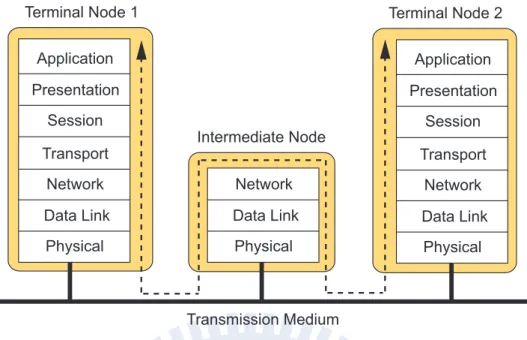
Figure 1.1: The OSI reference model and the data transmission paradigm.
also help to relay data from the gateways. When some network members are out of operation, the others can still help to maintain the network connectivity by using intermediate nodes, which is the merit of the mesh networks.
Due to the urgent needs of green wireless access networks mentioned in the beginning of this section, the researchers and the engineers are now trying to let the network systems more power efficient either in the direct or indirect ways, such as reducing the communication overhead or enhancing the system throughput under the same power consumption. Compared to the hardware evolutions, the more feasible and convenient way to make the wireless network greener is from the software point of view. The International Organization for Standardization (ISO) proposes the famous open system interconnection (OSI) reference model for dividing the entire system into seven parts, i.e., the seven layers. As shown in Fig. 1.1, the modular seven layers from the user application to the transmission medium are respectively the application layer, the presentation layer, the session layer, the transport layer, the network layer, the data link layer, and the physical layer. The application layer will interact with the users and generate the corresponding application data. The presentation layer handles the data representation, encryption, and decryption; while the host-to-host communication negotiation is conducted by the session layer. The traffic flow control and the connection reliability are
maintained by the transport layer. The network layer will try to find a feasible path to the destination with proper medium access control provided by the data link layer. Finally, the physical layer transmits the data signals over the transmission medium to the other network station.
As shown in Fig. 1.1, the information flow from the terminal node 1 to the terminal node 2 can be constructed via intermediate nodes. The data generated by the application of the terminal node 1 will be sent to the lower layers till the physical layer. The physical layer data signals will be received by the intermediate node from the transmission medium, and then the data signals will be decoded and forwarded to the upper layers. In the network layer, the routing decision will be made, and subsequently the intermediate node will conduct the packet forwarding down to the physical medium. If there is any other intermediate node, the same procedure will be repeated. Finally, the terminal node 2 will receive the data from the transmission medium. Moreover, as can be seen in Fig. 1.1, the most important parts of the network stacks are the network layer, the data link layer, and the physical layer since these three layers are utilized mostly in the terminal hosts and the intermediate nodes. However, the physical layer is usually medium dependent for signaling different transmission media. As a result, the network layer and the data link layer will receive more attention in designing the medium independent algorithms and protocols for the green wireless access networks.
Based on the aforementioned reasons, the protocol design and implementation for the green wireless access networks will mainly focus on the network layer and the data link layer. According to the green concept defined in Definition 1, the algorithms or software systems to save energy directly or indirectly can be considered green or environmental friendly. In the traditional protocol design of the network layer, there are more communication overhead observed in both the unicast and multicast routing algorithms, such as the control packet flooding and the periodic route maintenance. In this dissertation, a greedy anti-void routing (GAR) protocol and the three-dimensional greedy anti-void routing (3D-GAR) protocol for both two-dimensional (2D) and three-dimensional (3D) environments are proposed as the low-overhead delivery-guaranteed unicast routing protocols based on the well-known greedy forwarding (GF) algorithm [4]. In the low-overhead multicast routing protocol design, an
energy conserving multicast routing (ECMR) protocol is also proposed to reduce the total number of relaying nodes for the construction of a multicast tree, which can significantly eliminate the unnecessary communication overheads. Moreover, based on the Linux embedded systems, the associated component-based routing platform (CRP) for implementing routing protocols is also introduced. These proposed network layer protocols can make the wireless access networks greener directly since the reduction of the communication overheads can effectively suppress the energy expenses.
On the other hand, in the data link layer protocol design, the system throughput en-hancement under the same power consumption can be considered an indirect way to realize the green wireless access networks since the power expenses can be degraded for transmitting the same amount of information. As a result, the greedy fast-shift block acknowledgement (GFS) mechanism is proposed for enhancing the system throughput by reducing the inef-ficiency caused by the slow sliding of the conventional acknowledgement window. Thanks to the fast shifting property of the acknowledgement window in our proposed GFS scheme, significant throughput enhancement can therefore be observed. In addition to the indirect method of enhancing the system throughput, the direct method for achieving the green con-cept should be the power-saving scheduling algorithm, which can arrange the packets with the proper transmission schedules, suppressing the total energy consumption. The frame aggregation-based power-saving (FAPS) scheduling algorithm is therefore proposed for this type of direct methods by aggregating several under-utilized frames into fully-utilized ones. The quality-of-service (QoS) of each data packet can still be maintained in our proposed FAPS algorithm. In addition, the optimality on the minimum number of listen frames in the proposed FAPS algorithm is also provided under the stepwise grant space set and further verified via the correctness proof. Finally, more number of system frames can be in the sleep mode, which consumes less energy compared to the active mode. With our proposed software protocol design and implementation in the network layer and the data link layer, the green wireless access networks can therefore be achieved.
The rest of this chapter is organized as follows: The core issues of this dissertation and the corresponding problems for achieving the green wireless access networks are illustrated
Network Layer
Core Issues: Development of Green Wireless Access Networks
Data Link Layer
Multicast Routing Protocol
Embedded Routing Implementation Platform
Low Cost High Packet Delivery Ratio
Throughput Enhancement Issues Power-Saving Scheduling Issues Void Problem
Boundary Finding Problem Algorithm Complexity Problem
Two Dimensional (2D) Three Dimensional (3D) Unicast Routing Protocol
Quality-of-Service Support Inefficiency of Block Acknowledgement
3D-GAR
ECMR
CRP GAR
GFS FAPS
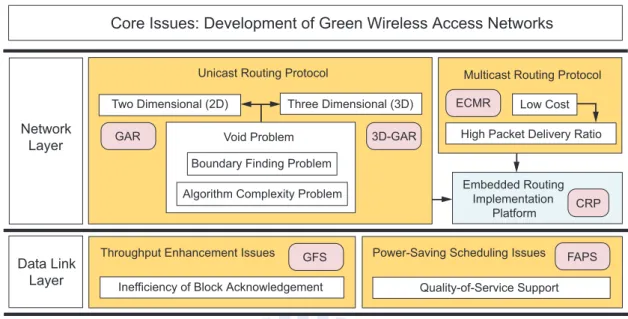
Figure 1.2: The core issues and the corresponding problems with solutions in this dissertation. in Section 1.2. Section 1.3 further describes the contribution of this dissertation; while the organization of this dissertation is finally provided in Section 1.4.
1.2
Problem Statement
The core issues in this dissertation are on the software techniques for developing the green wireless access network in the aspects of the network layer and the data link layer protocols, which can be identified as follows:
Problem 1 (Core Issues). How to develop the green wireless access network in terms of
the protocol design and implementation within the network layer and the data link layer?
In the network layer unicast routing protocol design, for fulfilling the green concept defined in Definition 1 and solving the core issues stated in Problem 1, the greedy forwarding (GF) technique [4] is therefore considered a superior scheme mainly due to its extremely low routing overhead. Based on the current one-hop neighbor information, the GF algorithm will always forward packets to the node which is the closest to the destination. However, the void problem [5], which makes the GF technique unable to find its next closer hop to the destination, will cause the GF algorithm failing to guarantee the delivery of data packets. The void problem not
only exists in the two-dimensional (2D) plane but also occurs in the three-dimensional (3D) space. Different recovery techniques should be considered to guarantee the packet delivery and retain the merits of low routing overhead. The formal definitions of the void problem under the 2D and 3D environments can be found in Chapter 2 and Chapter 3, respectively. In addition to the void problem, the implementation related issues, such as the boundary finding problem and the algorithm complexity problem, will be further stated in the corresponding chapters.
On the other hand, the multicast routing protocol should also be considered in the de-velopment of the green wireless access networks due to the popularity of the multiple host applications, such as the instant messaging and the online games. Therefore, how to provide low energy consumption and high packet delivery ratio becomes another issue in the green multicast protocol design. In the wired networks, the Steiner tree [6] technique is regarded as the optimal approach for constructing the multicast structure for specific senders and re-ceivers. However, this technique can not be directly applied to the wireless environment due to the wireless broadcast nature. Different techniques should further be investigated. More-over, the lack of a friendly embedded implementation platform is another issue for realizing the routing protocols. If there exists such an embedded platform for the performance evalua-tion and the field experiments on the routing protocols, the development of the green wireless access networks will further be boosted and accelerated.
Subsequently, in the data link layer protocol design, two techniques can be deemed as the fulfillment of the green concept defined in Definition 1. The first one is the indirect method which enhances the overall system throughput since the same information can be transmitted with less power consumption. The existing inefficiency problem has been found in the conven-tional block acknowledgement mechanism due to its slow movement of the acknowledgement window. The other one is the direct method of the power-saving scheduling algorithm for achieving the aforementioned green concept. The power-saving scheduling algorithm should arrange the packets with the proper transmission schedules, reducing the total number of high power consumption active frames. Moreover, the QoS for each data packet must be guaranteed, i.e., the packet arrangement can not violate the QoS requirements. The
respec-tive protocols for these two types of techniques should be proposed collecrespec-tively for enhancing the performance of the green wireless access networks. Finally, the core issues and the cor-responding problems for this dissertation are illustrated and summarized in Fig. 1.2, which completes the description of problem statement.
1.3
Contribution
The contribution of this dissertation can be described in Fig. 1.2 as follows. In the unicast routing for achieving the green wireless access network, a greedy anti-void routing (GAR) protocol is proposed to resolve the void problem due to the low-overhead green concept-based GF algorithm under the 2D environment. The proposed GAR protocol can guarantee the packet delivery with increased routing efficiency based on the unit disk graph (UDG) settings. According to the proposed GAR protocol, a rolling-ball UDG boundary traversal (RUT) scheme is proposed to resolve the boundary finding problem. The network boundary can therefore be obtained and utilized to escape from the void region where the void problem occurs, guaranteeing the packet delivery. In the GAR realization, the boundary map (BM) and the indirect map searching (IMS) algorithm for the BM construction are proposed as feasible computer procedures to reduce the impractically high algorithm complexity that is required by the traditional brute-force method.
Furthermore, the associated three additional mechanisms are also exploited to enhance the system performance, including the hop count reduction (HCR), the intersection navigation (IN), and the partial UDG construction (PUC) schemes. The HCR scheme is a short-cutting technique that acquires information by listening to one-hop neighbor’s packet forwarding. With the occurrence of the void node, the IN mechanism determines its rolling direction based on the criterion of smallest hop counts (HCs) for the boundary traversal. Moreover, in order to meet the network requirement for the RUT scheme under non-UDG networks, the PUC mechanism is utilized to transform the non-UDG into the UDG setting for the nodes that are adopted for boundary traversal. On the other hand, in the 3D space of the green wireless access networks, a three-dimensional greedy anti-void routing (3D-GAR) protocol is
proposed to solve the void problem under the unit ball graph (UBG) settings. The associated three-dimensional rolling-ball UBG boundary traversal (3D-RUT) scheme is exploited within the 3D-GAR algorithm with the assurance for packet delivery. The proofs of correctness and the enhanced performance gain can be obtained and observed, which shows the achievement of the green wireless access networks in the aspects of the unicast routing protocols.
In the green concept-based low-overhead multicast routing protocol design, an energy conserving multicast routing (ECMR) protocol is proposed to reduce the total number of relaying nodes for the construction of a multicast tree, which can significantly reduce the unnecessary communication overheads. Based on the performance evaluation results, the low overhead and high delivery ratio can be observed. The multicast routing for the green wireless access network can therefore be constructed. Moreover, a component-based routing platform (CRP) for implementing routing protocols is also proposed based on the Linux embedded systems. The software interfaces for the Linux kernel in the proposed CRP system have been well developed, which can let the protocol designers conduct the field experiments more easily. The proposed ECMR protocol is also realized on the proposed CRP system for the performance evaluation and the validation of the proposed CRP implementation platform.
As shown in Fig. 1.2, for the data link layer of the green wireless access networks, two types of methods can be utilized to achieve the green concept, including the throughput enhancement and the power-saving scheduling algorithm. In the throughput enhancement aspect, a greedy fast-shift (GFS) block acknowledgement mechanism is proposed to provide the receiver-defined starting sequence number (SSN), which can both implicitly acknowledge the correctly received packets before the SSN and explicitly identify the correctness infor-mation for the packets after the SSN. In order to evaluate the protocol effectiveness, the analytical models for both the proposed GFS scheme and the conventional greedy scheme are also proposed based on the throughput-related performance metric of the window utilization. Compared to the conventional scheme, it is observed from the simulation results that the proposed GFS method can provide better performance and effectively reduce the inefficiency caused by the conventional block acknowledgement scheme owing to its fast-shift behavior on acknowledgement window.
In the power-saving scheduling algorithm aspect for constructing the green wireless access networks, a frame aggregation-based power-saving scheduling (FAPS) algorithm is proposed to achieve the green concept by aggregating multiple under-utilized frames into fully-utilized ones. The scenarios of multiple connections and their QoS constraints are also considered in the algorithm design. The proposed FAPS scheme can maintain the QoS requirements and maximize the number of sleep frames, which can lead to the significant energy saving required by the green concept since the sleep frame has less power consumption. The optimality on the minimum number of listen frames in the proposed FAPS algorithm is also provided under the stepwise grant space set and further verified via the correctness proof. Simulation results validate that the power efficiency metric of sleep frame ratio in the proposed FAPS algorithm can outperform the baseline protocols with tolerable delay. In the end, with the help of these green protocol designs in both the network layer and the data link layer, the core issues of this dissertation in Definition 1 can be alleviated for the green wireless access network.
1.4
Dissertation Organization
The rest of this dissertation is organized as follows: The greedy anti-void routing (GAR) proto-col and the associated proofs of correctness are described in Chapter 2. The three-dimensional greedy anti-void routing (3D-GAR) protocol and the corresponding proofs of correctness are provided in Chapter 3. Chapter 4 proposes the component-based routing platform (CRP) and the energy conserving multicast routing (ECMR) protocol. Chapter 5 shows the greedy fast-shift (GFS) block acknowledgement and the corresponding analytical models. The frame aggregation-based power-saving (FAPS) scheduling algorithm is introduced in Chapter 6. Chapter 7 draws the conclusions of this dissertation.
Chapter 2
Greedy Anti-Void Routing Protocol
Chapter Overview
In the network layer unicast protocol design for achieving the green wireless access networks, a greedy anti-void routing (GAR) protocol is proposed in this chapter with the main theme of the wireless sensor network (WSN) since the WSN has stringent requirements on the energy saving issues. Exploiting the boundary finding technique for the unit disk graph (UDG), the proposed GAR protocol solves the void problem, i.e., the unreachability problem, incurred by the low-overhead green concept-based greedy forwarding (GF) algorithm associated with increased routing efficiency. The proposed rolling-ball UDG boundary traversal (RUT) is employed to completely guarantee the delivery of packets from the source to the destination node under the UDG settings. The boundary map (BM) and the indirect map searching (IMS) scheme are proposed as efficient algorithms for the realization of the RUT technique. Moreover, the hop count reduction (HCR) scheme is utilized as a short-cutting technique to reduce the routing hops by listening to the neighbor’s traffic; while the intersection navigation (IN) mechanism is proposed to obtained the best rolling direction for boundary traversal with the adoption of shortest path criterion. In order to maintain the network requirement of the proposed RUT scheme under the non-UDG networks, the partial UDG construction (PUC) mechanism is proposed to transform the non-UDG into UDG settings for a portion of nodes that facilitate boundary traversal. These three schemes are incorporated within the GAR
protocol to further enhance the routing performance with reduced communication overhead. The proofs of correctness for the GAR scheme are also given in this chapter. Comparing with the existing localized routing algorithms, the simulation results show that the proposed GAR-based protocols can provide better routing efficiency. These proposed GAR-GAR-based protocols can therefore be adopted as the unicast protocols in the green wireless access networks.
2.1
Introduction
A wireless sensor network (WSN) consists of sensor nodes (SNs) with wireless communication capabilities for specific sensing tasks. Due to the limited available resources, efficient design of localized multi-hop routing protocols [7] becomes a crucial subject within the WSNs. How to guarantee delivery of packets is considered an important issue for the localized routing algorithms. The well-known greedy forwarding (GF) algorithm [4] is considered a superior scheme with its low routing overheads. However, the void problem [5], which makes the GF technique unable to find its next closer hop to the destination, will cause the GF algorithm failing to guarantee the delivery of data packets.
Several routing algorithms are proposed to either resolve or reduce the void problem, which can be classified into based and graph-based schemes. In the non-graph-based algorithms [8–19], the intuitive schemes as proposed in [8] construct a two-hop neighbor table for implementing the GF algorithm. The network flooding mechanism is adopted within the GRA [9] and PSR [10] schemes while the void problem occurs. There also exist routing protocols that adopt the backtracking method at the occurrence of the network holes (such as GEDIR, [8], DFS [11], and SPEED [12]). The routing schemes as proposed by ARP [13] and LFR [14] memorize the routing path after the void problem takes place. Moreover, other routing protocols (such as PAGER [15], NEAR [16], DUA [17], INF [18], and YAGR [19]) propagate and update the information of the observed void node in order to reduce the probability of encountering the void problem. By exploiting these routing algorithms, however, the void problem can only be either (i) partially alleviated or (ii) resolved with considerable routing overheads and significant converging time.
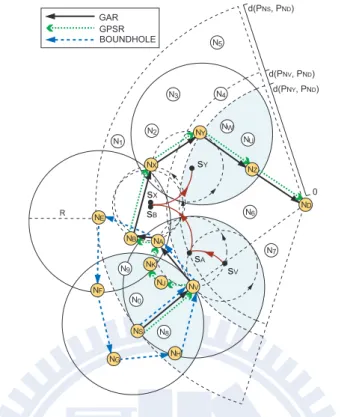
On the other hand, there are research works on the design of graph-based routing al-gorithms [5, 20–27] to deal with the void problem. Several routing schemes as surveyed in [20] adopt the planar graph [28] derived from the unit disk graph (UDG) as their network topologies, such as GPSR [5], GFG [21], Compass Routing II [22], AFR [23], GOAFR [24] GOAFR+ [25], GOAFR++ [20], and GPVFR [26]. For conducting the above planar graph-based algorithms, the planarization technique is required to transform the underlying network graph into the planar graph. The Gabriel graph (GG) [29] and the relative neighborhood graph (RNG) [30] are the two commonly-used localized planarization techniques which aban-don some communication links from the UDG for achieving the planar graph. Nevertheless, the usage of the GG and RNG graphs has significant pitfalls due to the removal of critical communication links, leading to longer routing paths to the destination. As shown in Fig. 2.1, the nodes (NS, ND) are considered the transmission pair; while NV represents the node that the void problem occurs. The representative planar graph-based GPSR scheme can not forward the packets from NV to NA directly since both the GG and the RNG planarization rules abandon the communication link from NV to NA. Considering the GG planarization rule for example, the communication link from NV to NAis discarded since both NJ and NK are located within the forbidden region, which is defined as the smallest disk passing through both NV and NA. Therefore, based on the right-hand rule, the resulting path by adopting the GPSR protocol can be obtained as {NS, NV, NJ, NK, NA, NB, NX, NY, NZ, ND}. The two unnecessary forwarding nodes NJ and NK are observed as in Fig. 2.1.
Furthermore, the planar graph-based schemes, e.g., the GPSR and GOAFR++ algorithms, will in general lose their properties of guaranteed packet delivery due to the unexpected net-work partition within the non-UDG netnet-works. The reason is also attributed to the situations that critical communication links are removed by adopting the GG and RNG planarization techniques. In order to resolve the network partition problem, a cross-link detection pro-tocol (CLDP) is therefore suggested in [31] for planarization of the underlying non-UDG networks. However, for the purposes of both detecting the cross links and planarizing the underlying network, the CLDP planarization will introduce excessive control overhead since all communication links are required to be probed and frequently traversed. Moreover, the
sV sA sB sY sX R GAR BOUNDHOLE 0 NE NF NG NH NW NU N0 N1 N2 N3 N4 N5 N6 N7 N8 N9 d(PNS, PND) d(PNV, PND) d(PNY, PND) GPSR NS NV NJ NK NA NB NX ND NY NZ
Figure 2.1: The example routing paths constructed by using the proposed GAR protocol and the conventional schemes under the existence of the void problem.
problems of multiple cross links and concurrent probing can further enlarge the total number of communication overhead within the CLDP technique.
Due to the drawbacks of link removal from the planar graph-based algorithms, the adop-tion of UDG without planarizaadop-tion for the modeling of underlying network is suggested. A representative UDG-based routing scheme, i.e., the BOUNDHOLE algorithm [27], forwards the packets around the network holes by identifying the locations of the holes. However, due to the occurrence of routing loop, the delivery of packets can not be guaranteed in the BOUNDHOLE scheme even if a route exists from the source to the destination node. For example, as shown in Fig. 2.1, it is assumed that the node NX is located within the transmis-sion range of NB; while it is considered out of the transmission ranges of nodes NA and NE. Based on the minimal sweeping angle criterion within the BOUNDHOLE algorithm, NA will choose NE as its next hop node since the counter-clockwise sweeping from NV to NE (hinged at NA) is smaller comparing with that from NV to NB. Therefore, the missing communication link from NB to NX can be observed, and the resulting path by adopting the BOUNDHOLE
scheme becomes {NS, NV, NA, NE, NF, NG, NH, NV}. It is observed that the undeliverable
routing path from the source node NSis constructed even with un-partitioned network topol-ogy. Moreover, two cases of edge intersections within the BOUNDHOLE algorithm [27] result in high routing overhead in order to identify the network holes.
In this chapter, a greedy anti-void routing (GAR) protocol is proposed to guarantee packet delivery with increased routing efficiency by completely resolving the void problem based on the UDG setting. The GAR protocol is designed to be a combination of both the conventional GF algorithm and the proposed rolling-ball UDG boundary traversal (RUT) scheme. The GF scheme is executed by the GAR algorithm without the occurrence of void problem; while the RUT scheme is served as the remedy for resolving the void problem, leading to the assurance for packet delivery. Moreover, the correctness of the proposed GAR protocol is validated via the given proofs. The implementation and computational complexities of the GAR protocol are also explained, including that for the proposed boundary map (BM) and the indirect map searching (IMS) algorithm for the BM construction.
Furthermore, the associated three additional enhanced mechanisms are also exploited, in-cluding the hop count reduction (HCR), the intersection navigation (IN), and the partial UDG construction (PUC) schemes. The HCR scheme is a short-cutting technique that acquires in-formation by listening to one-hop neighbor’s packet forwarding; while the other short-cutting method as proposed in [32] requires information from two-hop neighbors which can result in excessive control packet exchanges. With the occurrence of void node, the IN mechanism determines its rolling direction based on the criterion of smallest hop counts for boundary traversal. Similar to the CLDP method [31], the IN scheme acquires information over mul-tiple hops in order to process its algorithm. However, it is required for the CLDP technique to traverse all the communication links in the networks; while the IN scheme only exploits a small portion of network links for conducting the boundary traversal. Moreover, in order to meet the network requirement for the RUT scheme under non-UDG network, the PUC mechanism is utilized to transform the non-UDG into the UDG setting for the nodes that are adopted for boundary traversal.
communi-cation overhead of the original GAR algorithm can further be improved. The performance of the proposed GAR protocol and the version with the enhanced mechanisms (denoted as the GAR-E algorithm) is evaluated via simulations under both the UDG network for ideal case and the non-UDG setting for realistic scenario. The simulation results show that the GAR-based schemes can both guarantee the delivery of data packets and pertain better routing performance under the UDG network. On the other hand, comparing with the other existing schemes, feasible routing performance with reduced communication overhead can be provided by the GAR-based algorithms within the non-UDG network environment.
The remainder of this chapter is organized as follows. Section 2.2 describes the network model and the problem statement. The proposed GAR protocol is explained in Section 2.3; while Section 2.4 provides the practical realization of the GAR algorithm. Section 2.5 exploits the three enhanced mechanisms, including the hop count reduction (HCR), the intersection navigation (IN), and the partial UDG construction (PUC) mechanisms. The performance of the GAR-based protocols is evaluated and compared in Section 2.6. Section 2.7 summarizes this chapter.
2.2
Network Model and Problem Statement
Considering a set of SNs N = {Ni| ∀ i} within a two-dimensional Euclidean plane, the loca-tions of the set N, which can be acquired by their own positioning systems, are represented by the set P = {PNi| PNi = (xNi, yNi), ∀i}. It is assumed that all the SNs are homogeneous and equipped with omnidirectional antennas. The set of closed disks defining the transmis-sion ranges of N is denoted as D = {D(PNi, R) | ∀ i}, where D(PNi, R) = {x | kx − PNik ≤
R, ∀ x ∈ R2}. It is noted that PNi is the center of the closed disk with R denoted as the
radius of the transmission range for each Ni. Therefore, the network model for the WSNs can be represented by a UDG as G(P, E) with the edge set E = {Eij| Eij = (PNi, PNj), PNi ∈
D(PNj, R), ∀ i 6= j}. The edge Eij indicates the unidirectional link from PNi to PNj whenever
table for each Ni is defined as
TNi = {[IDNk, PNk] | PNk ∈ D(PNi, R), ∀ k 6= i}, (2.1)
where IDNk represents the designated identification number for Nk. In the greedy forwarding (GF) algorithm, it is assumed that the source node NS is aware of the location of the destina-tion node ND. If NS wants to transmit packets to ND, it will choose the next hop node from its TNS which (i) has the shortest Euclidean distance to ND among all the SNs in TNS and (ii) is located closer to ND compared to the distance between NS and ND (e.g., NV as in Fig. 2.1). The same procedure will be performed by the intermediate nodes (such as NV) until
ND is reached. However, the GF algorithm will be inclined to fail due to the occurrences of voids even though some routing paths exist from NS to ND. The void problem is defined as follows.
Problem 2 (Void Problem). The greedy forwarding (GF) algorithm is exploited for packet
delivery from NS to ND. The void problem occurs while there exists a void node (NV) in the
network such that no neighbor of NV is closer to the destination as
{PNk| d(PNk, PND) < d(PNV, PND), ∀ PNk ∈ TNV} = ∅, (2.2)
where d(x, y) represents the Euclidean distance between x and y. TNV is the one-hop neighbor
table of NV.
2.3
Proposed Greedy Anti-Void Routing (GAR) Protocol
The objective of the GAR protocol is to resolve the void problem such that the packet delivery from NS to ND can be guaranteed. Before diving into the detail formulation of the proposed GAR algorithm, an introductory example is described in order to facilitate the understanding of the GAR protocol. As shown in Fig. 2.1, the data packets initiated from the source node
NS to the destination node ND will arrive in NV based on the GF algorithm. The void problem occurs as NV receives the packets, which leads to the adoption of the RUT scheme
as the forwarding strategy of the GAR protocol. A circle is formed by centering at sV with its radius being equal to half of the transmission range R/2. The circle is hinged at NV and starts to conduct counter-clockwise rolling until an SN has been encountered by the boundary of the circle, i.e., NA as in Fig. 2.1. Consequently, the data packets in NV will be forwarded to the encountered node NA.
Subsequently, a new equal-sized circle will be formed, which is centered at sA and hinged at node NA. The counter-clockwise rolling procedure will be proceeded in order to select the next hop node, i.e., NB in this case. Similarly, same process will be performed by other intermediate nodes (such as NB and NX) until the node NY is reached, which is considered to have a smaller distance to ND than that of NV to ND. The conventional GF scheme will be resumed at NY for delivering data packets to the destination node ND. As a consequence, the resulting path by adopting the GAR protocol becomes {NS, NV, NA, NB, NX, NY, NZ, ND}. In the following subsections, the formal description of the RUT scheme will be described in Subsection 2.3.1; while the detail of the GAR algorithm is explained in Subsection 2.3.2. The proofs of correctness of the GAR protocol are given in Subsection 2.3.3.
2.3.1 Rolling-ball UDG Boundary Traversal (RUT) Scheme
The RUT scheme is adopted to solve the boundary finding problem, and the combination of the GF and the RUT scheme (i.e., the GAR protocol) can resolve the void problem, leading to the guaranteed packet delivery. The definition of boundary and the problem statement are described as follows.
Definition 2 (Boundary). If there exists a set B ⊆ N such that (i) the nodes in B form a
simple unidirectional ring and (ii) the nodes located on and inside the ring are disconnected with those outside of the ring, B is denoted as the boundary set and the unidirectional ring is called a boundary.
Problem 3 (Boundary Finding Problem). Given a UDG G(P, E) and the one-hop
neigh-bor tables T = {TNi| ∀ Ni∈ N}, how can a boundary be obtained by exploiting the distributed
si sj sk sl sm R 1/2R Nl Nm Ni Np Nj Nk Nq Eij
Figure 2.2: The rolling-ball UDG boundary traversal (RUT) scheme.
There are three phases within the RUT scheme, including the initialization, the boundary traversal, and the termination phases.
2.3.1.1 Initialization Phase
No algorithm can be executed without the algorithm-specific trigger event. The trigger event within the RUT scheme is called the starting point (SP). The RUT scheme can be initialized from any SP, which is defined as follows.
Definition 3 (Rolling Ball). Given Ni ∈ N, a rolling ball RBNi(si, R/2) is defined by (i)
a rolling circle hinged at PNi with its center point at si∈ R2 and the radius equal to R/2; and
(ii) there does not exist any Nk∈ N located inside the rolling ball as {RB∼
Ni(si, R/2)∩N} = ∅,
where RBN∼i(si, R/2) denotes the open disk within the rolling ball.
Definition 4 (Starting Point). The starting point of Ni within the RUT scheme is defined
as the center point si ∈ R2 of RBNi(si, R/2).
As shown in Fig. 2.2, each node Ni can verify if there exists an SP since the rolling ball
RBNi(si, R/2) is bounded by the transmission range of Ni. According to Definition 4, the
in Lemmas 1 and 2, all the SPs will result in the red solid flower-shaped arcs as in Fig. 2.2. It is noticed that there should always exist an SP while the void problem occurs within the network, which will be explained in Subsection 2.3.2. At this initial phase, the location si can be selected as the SP for the RUT scheme.
2.3.1.2 Boundary Traversal Phase
Given sias the SP associated with its RBNi(si, R/2) hinged at Ni, either the counter-clockwise or clockwise rolling direction can be utilized. As shown in Fig. 2.2, RBNi(si, R/2) is rolled counter-clockwise until the next SN is reached (i.e., Nj in Fig. 2.2). The unidirectional edge
Eij = (PNi, PNj) can therefore be constructed. A new SP and the corresponding rolling ball hinged at Nj (i.e., sj and RBNj(sj, R/2)) will be assigned, and consequently the same
procedure can be conducted continuously.
2.3.1.3 Termination Phase
The termination condition for the RUT scheme happens while the first unidirectional edge is revisited. As shown in Fig. 2.2, the RUT scheme will be terminated if the edge Eij is visited again after the edges Eij, Ejk, Ekl, Elm, and Emi are traversed. The boundary set initiated from Ni can therefore be obtained as B = {Ni, Nj, Nk, Nl, Nm}.
2.3.2 Detail Description of Proposed GAR Protocol
As shown in Fig. 2.1, the packets are intended to be delivered from NS to ND. NS will select NV as the next hop node by adopting the GF algorithm. However, the void problem prohibits NV to continue utilizing the same GF algorithm for packet forwarding. The RUT scheme is therefore employed by assigning an SP (i.e., sV) associated with the rolling ball
RBNV(sV, R/2) hinged at NV. As illustrated in Fig. 2.1, sV can be chosen to locate on the
connecting line between NV and ND with R/2 away from NV. It is noticed that there always exists an SP for the void node (NV) since there is not supposed to have any SN located within the blue-shaded region (as in Fig. 2.1), which is large enough to satisfy the requirements as in Definitions 3 and 4. The RUT scheme is utilized until NY is reached (after traversing
NA, NB, and NX). Since d(PNY, PND) < d(PNV, PND), the GF algorithm is resumed at NY and the next hop node will be selected as NZ. The route from NS to ND can therefore be constructed for packet delivery. Moreover, if there does not exist a node NY such that
d(PNY, PND) < d(PNV, PND) within the boundary traversal phase, the RUT scheme will be terminated after revisiting the edge EV A. The result indicates that there does not exist a routing path between NS and ND.
2.3.3 Proof of Correctness
In this subsection, the correctness of the RUT scheme is proven in order to solve Problem 3; while the GAR protocol is also proven for resolving the void problem (i.e., Problem 2) in order to guarantee packet delivery.
Fact 1. A simple closed curve is formed by traversing a point on the border of a closed filled
two-dimensional geometry with fixed orientation.
Lemma 1. All the SPs within the RUT scheme form the border of a shape that results from
overlapping the closed disks D(PNi, R/2) for all Ni ∈ N, and vice versa.
Proof: Based on Definitions 3 and 4, the set of SPs can be obtained as S = R1 ∩ R2 =
{si| ksi − PNik = R/2, ∃Ni ∈ N, si ∈ R2} ∩ {sj| ksj − PNjk ≥ R/2, ∀Nj ∈ N, sj ∈ R2}
by adopting the (i) and (ii) rules within Definition 3. On the other hand, the border of the resulting shape from the overlapped closed disks D(PNi, R/2) for all Ni ∈ N can be denoted as Ω = Q1 − Q2 = SNi∈NC(PNi, R/2) −SNi∈ND(PNi, R/2), where C(PNi, R/2)
and D(PNi, R/2) represent the circle and the open disk centered at PNi with a radius of R/2 respectively. It is obvious to notice that R1 = Q1 and R2 = Q0
2, which result in S = Ω. It
completes the proof. ¤
Lemma 2. A simple closed curve is formed by the trajectory of the SPs.
Proof: Based on Lemma 1, the trajectory of the SPs forms the border of the overlapped closed
geometry is a simple closed curve according to Fact 1. Therefore, a simple closed curve is constructed by the trajectory of the SPs, e.g., the solid flower-shaped closed curve as in Fig.
2.2. It completes the proof. ¤
Theorem 1. The boundary finding problem (Problem 3) is resolved by the RUT scheme.
Proof: Based on Lemma 2, the RUT scheme can draw a simple closed curve by rotating the
rolling balls RBNi(si, R/2) hinged at PNi for all Ni ∈ N. The closed curve can be divided
into arc segments S(si, sj), where si is the starting SP associated with Ni; and sj is the anchor point while rotating the RBNi(si, R/2) hinged at PNi. The arc segments S(si, sj) can be mapped into the unidirectional edges Eij = (PNi, PNj) for all Ni, Nj ∈ U, where U ⊆ N. Due to the one-to-one mapping between S(si, sj) and Eij, a simple unidirectional ring is constructed by Eij for all Ni, Nj ∈ U.
According to the RUT scheme, there does not exist any Ni ∈ N within the area traversed by the rolling balls, i.e., inside the light blue region as in Fig. 3. For all Np ∈ N located inside the simple unidirectional ring, the smallest distance from Np to Nq, which is located outside of the ring, is greater than the SN’s transmission range R. Therefore, there does not exist any Np ∈ N inside the simple unidirectional ring that can communicate with Nq ∈ N located outside of the ring. Based on Definition 2, the set U is identical to the boundary set,
i.e., U = B. It completes the proof. ¤
Theorem 2. The void problem (Problem 2) in unit disk graphs is solved by the GAR protocol
with guaranteed packet delivery.
Proof: With the existence of the void problem occurred at the void node NV, the RUT
scheme is utilized by initiating an SP (sV) with the rolling ball RBNV(sV, R/2) hinged at NV. The RUT scheme within the GAR protocol will conduct boundary (i.e., the set B) traversal under the condition that d(PNi, PND) ≥ d(PNV, PND) for all Ni ∈ B. If the boundary within the underlying network is completely traveled based on Theorem 1, it indicates that the SNs inside the boundary (e.g., NV) are not capable of communicating with those located outside of the boundary (e.g., ND). The result shows that there does not exist a route from the void