Ying-Yu Tzou,
Member, IEEE,Shih-Liang Jung,
Student Member, IEEE,and Hsin-Chung Yeh
Abstract— An adaptive repetitive control scheme is proposed and applied to the control of a pulsewidth-modulated (PWM) inverter used in a high-performance ac power supply. The pro-posed control scheme can adaptively eliminate periodic distor-tions caused by unknown periodic load disturbances in an ac power supply. The proposed adaptive repetitive controller con-sists of a voltage regulator using state feedback control, a repet-itive controller with tuning parameters, and an adaptive con-troller with a recursive least-squares estimator (LSE). This adap-tive repetiadap-tive controller designed for ac-voltage regulation has been realized using a single-chip digital signal processor (DSP) TMS320C14 from Texas Instruments. Experimental verification has been carried out on a 2-kVA PWM inverter. Simulation and experimental results show that the DSP-based adaptive repetitive controller can achieve both good dynamic response and low total harmonic distortion (THD) under large-load disturbances and uncertainties.
Index Terms— AC power supply, adaptive repetitive control, DSP control, pulsewidth-modulated inverter.
I. INTRODUCTION
C
LOSED-LOOP-regulated pulsewidth-modulated (PWM) inverters have been widely applied in various types of ac power-conditioning systems, such as uninterruptible power supply (UPS) systems, automatic voltage regulators (AVR’s), and programmable ac sources (PAS’s). One major requirement of these applications is that the system is required to maintain a low-distortion waveform under transient or periodic load disturbances. Some research has examined the closed-loop regulation of PWM inverters to achieve good dynamic response and most of them have focused on transient response improvement through instantaneous feedback control [1]–[7]. Although satisfactory results have been obtained for transient load disturbances, periodic distortions in the output waveform remain when the load disturbance is cyclic by nature.Repetitive control theory [8]–[10] originating from the in-ternal model principle [11] provides a solution for eliminating periodic errors which occur in a dynamic system. A repetitive controller can be viewed as a periodic waveform generator
Manuscript received June 20, 1997; revised March 9, 1999. This work was supported by the National Science Council, Taipei, Taiwan, R.O.C., under Project NSC83-0404-E-009-003. Recommended by Associate Editor, S. Y. R. Hui.
Y.-Y. Tzou and S.-L. Jung are with the Department of Electrical and Control Engineering, National Chiao Tung University, 30050 Hsinchu, Taiwan, R.O.C.
H.-C. Yeh is with Afreey, Inc., 10075 Taipei, Taiwan, R.O.C. Publisher Item Identifier S 0885-8993(99)07280-4.
augmented within the control loop of a control system, which is closed-loop regulated by a feedback controller, so that the periodic errors can be eliminated. A number of repetitive control schemes have been developed and applied to various industrial applications [12]–[14]. Haneyoshi et al. [15] and Nishida and Haneyoshi [16] have applied the repetitive control technique to eliminate periodic distortions in a PWM inverter. In their approaches, the repetitive controller was designed based on the exact model of the closed-loop-controlled system with one-step prediction. Therefore, the performance and stability of such a repetitive control system is highly dependent upon the robustness of the original feedback control system.
To relax the stringent stability requirement of a repetitive control system, a modified repetitive control scheme with finite frequency mode elimination has been developed [17]. However, the convergence of such a system will deteri-orate due to plant uncertainties. For time-varying systems or systems with large plant uncertainties, adaptive repetitive control schemes were developed to eliminate periodic errors [18], [19]. Although these methods can track the changing plant dynamics, they have the drawback that the number of parameters to be estimated is proportional to the frequency modes selected to be cancelled.
In this paper, we have developed a new adaptive repetitive control scheme that employs an auxiliary compensator to stabilize the closed-loop system, and its parameters are tuned by an adaptive tuning controller which recursively on line identifies the plant dynamics. The adaptive repetitive controller will guarantee the closed-loop stability under plant variations and, at the same time, eliminate periodical errors resulting from all frequency modes below the closed-loop bandwidth.
Section II introduces the operational principle. The stability criterion and convergence of the periodic error of a repetitive control system are also derived. Section III describes the pro-posed adaptive repetitive control scheme in detail. Section IV describes the modeling and the DSP-based repetitive control of a PWM inverter for ac-voltage regulation. Section V illustrates the simulation and experimental verification of the proposed control scheme, and Section VI gives the conclusion.
II. REPETITIVE CONTROL SYSTEM A. Principle of Repetitive Control
A servomechanism system is required to regulate the controlled variables to follow the corresponding reference
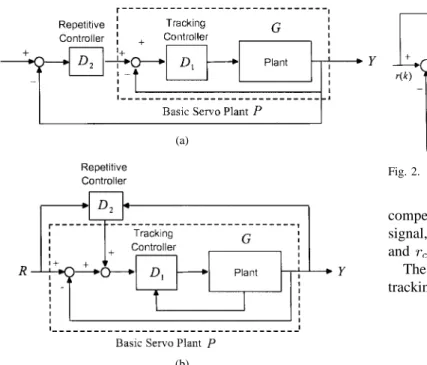
(a)
(b)
Fig. 1. Configurations of repetitive control systems.
commands without steady-state error in the presence of unknown and unmeasurable disturbance inputs. In servomech-anism system design, the internal model principle proposed by Francis and Wonham [11] plays an important role. The internal model principle states that the controlled output tracks a set of reference inputs without steady-state error if the model which generates these references is included in the stable closed-loop system. The internal model principle therefore reveals that high-accuracy, asymptotic, and tracking properties for periodic exogenous inputs can be achieved by locating the model, which generates a set of periodic signals, within the control loop. Repetitive control is a control scheme in which the frequency modes of the periodic error to be eliminated are included in the stable control loops. Repetitive control can be easily realized using a microprocessor-based digital controller. With the advance of high-performance microprocessors and digital signal processors (DSP’s), more frequency modes can be included in the control loops. This reveals the feasibility of implementation of ultraprecision servomechanism systems. In a repetitive control system, a repetitive controller is inserted in the control loop in addition to the conventional tracking controller. There are various control configurations for the repetitive control systems. Fig. 1 shows two basic control structures of the repetitive control system. Fig. 1(a) shows a cascaded-type repetitive controller, in which it is cascaded as an outer loop controller. Fig. 1(b) provides a feedforward path to the repetitive controller. The major purpose of the tracking controller is to improve the system transient response so that it is insensitive to external disturbances, while the repetitive controller is designed to reduce periodic errors caused by periodic references or disturbances.
Fig. 2 shows the block diagram of the proposed repetitive control system, where represents the closed-loop transfer function of the plant which is closed-loop regulated by a tracking controller, and are the auxiliary
Fig. 2. Block diagram of a discrete-time repetitive control system.
compensators of the repetitive controller, is the reference signal, is the system output, is the tracking error, and is the compensated reference command.
The transfer function from the disturbance input to the tracking error in Fig. 2 is
(1)
where and are transforms of and
The corresponding frequency response in domain is (2) If is a periodic disturbance with period of , then the Fourier series representation of can be expressed as
(3)
where denotes the Fourier coefficients. In a special case, if and is stable, we can obtain
at (4)
This reveals that these frequency modes of the periodic error have been eliminated by the repetitive controller, and perfect tracking can thus be achieved under such a condition. How-ever, perfect tracking imposes a stringent stability requirement in the synthesis of In practice, we can relax this requirement by choosing , a low-pass filter, or a constant less than unity such that
at
(5) where specifies the attenuation factor of each frequency mode of the periodic disturbance.
B. Stability Analysis
From Fig. 2, we can find
Fig. 3. Block diagram representation of the error convergence.
and
(7) Eliminating from (6) and (7), we can get
(8) Fig. 3 shows the block diagram representation of (8), and we can observe that if
for all (9) and is stable and then is bounded which implies that the system is stable.
The design of and is a compromise between the relative stability and the convergence rate of the periodic error. For simplicity, if we choose to be a constant less than and close to unity, we can arbitrarily choose an with very small gain to satisfy the stability criterion of (9). However, the periodic error may still be large. To satisfy both requirements (5) and (9), we can choose
to be a constant less than and close to unity and to be a digital filter with phase-lead characteristics. An optimal choice of in terms of large relative stability and fast convergence rate can be achieved when
possesses a nearly zero-phase-shift characteristic [19]. This can be accomplished by choosing as the inverse of and augmented with a realizable low-pass filter with appropriate cutoff frequency.
C. Convergence Analysis
The in the stability criterion of
(9) can also be viewed as a performance index for the conver-gence of periodic error. A smaller
results in a faster error convergence. The convergence index is defined as
(10) If , the periodic error concerned can be eliminated after one cycle. However, such a condition requires a perfect match of the plant model , and this is obviously unrealistic. To avoid such situation, we define
(11)
Fig. 4. The proposed adaptive repetitive control scheme.
where is a constant between zero and unity and is a realization time constant.
III. ADAPTIVE REPETITIVECONTROL SYSTEM
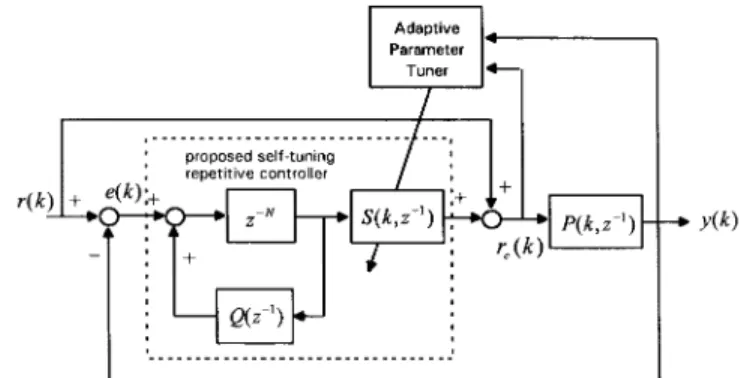
Fig. 4 shows the proposed adaptive repetitive control scheme. In addition to the conventional repetitive controller, an adaptive parameter tuner is included in the control loop to adjust the control parameters of according to the identified plant dynamics. Let be the transfer function of a second-order time-varying system and represented by
(12)
where the parameters and are left to be identified. There are a number of well-known parameter estimation techniques that have been successfully applied to the iden-tification problem [20]. The recursive least-squares estimator (LSE) has the advantages of being unbiased, fast convergent, and can be applicable to a wide range of applications in which other statistical estimation theories may be difficult to apply [21]. In the application of an adaptive control system, the most important factor to be considered is whether the designed control law can be realized with an acceptable sampling rate. The recursive LSE (RLSE) parameter identification algorithm used in this paper is
(13)
(14) (15) (16)
(a) (b)
(c) (d)
Fig. 5. Parameter identification of a PWM inverter connected with a bridge–rectifierRC load: (a) output voltage and current waveforms, (b) estimated parameter using the RLSE, (c) estimated parameter using the modified RLSE, and (d) estimated parameters of the averaging model using modified RLSE.
Fig. 6. Discrete adaptive repetitive controller.
where is the initial guess of the parameters to be iden-tified, is a positive definite measure of the estimation error, and its elements tend to decrease as the identification reaches its steady state. The scalar is a forgetting factor to weigh new data more heavily than old data. When , all data are weighed equally. For , more weight is placed on recent data than on past data. A smaller will result in fast convergence, but the identified parameters will be more sensitive to measurement noise.
The PWM inverter used in an ac-voltage regulator is fre-quently connected to a bridge–rectifier load with its output waveforms as shown in Fig. 5(a). Fig. 5(b) shows the estimated parameters of (12) using RLSE, in which we can see that rapid convergence with large oscillation has occurred whenever the rectifier switches change their state. One way to avoid this phenomenon is that when the load transition is detected, a set of nominal parameters are used to set the RLSE
parameters. Fig. 5(c) shows the estimated parameters of (12) using the modified RLSE.
Fig. 5(d) shows the estimated parameters of the averaging model using the modified RLSE method. The estimated param-eters of the averaging model are derived using the following algorithms:
(17)
(18)
where is the number of samples during one-half period of the output waveform. The auxiliary compensator
of the repetitive controller is adjusted by using the estimated parameters of as shown in Fig. 6.
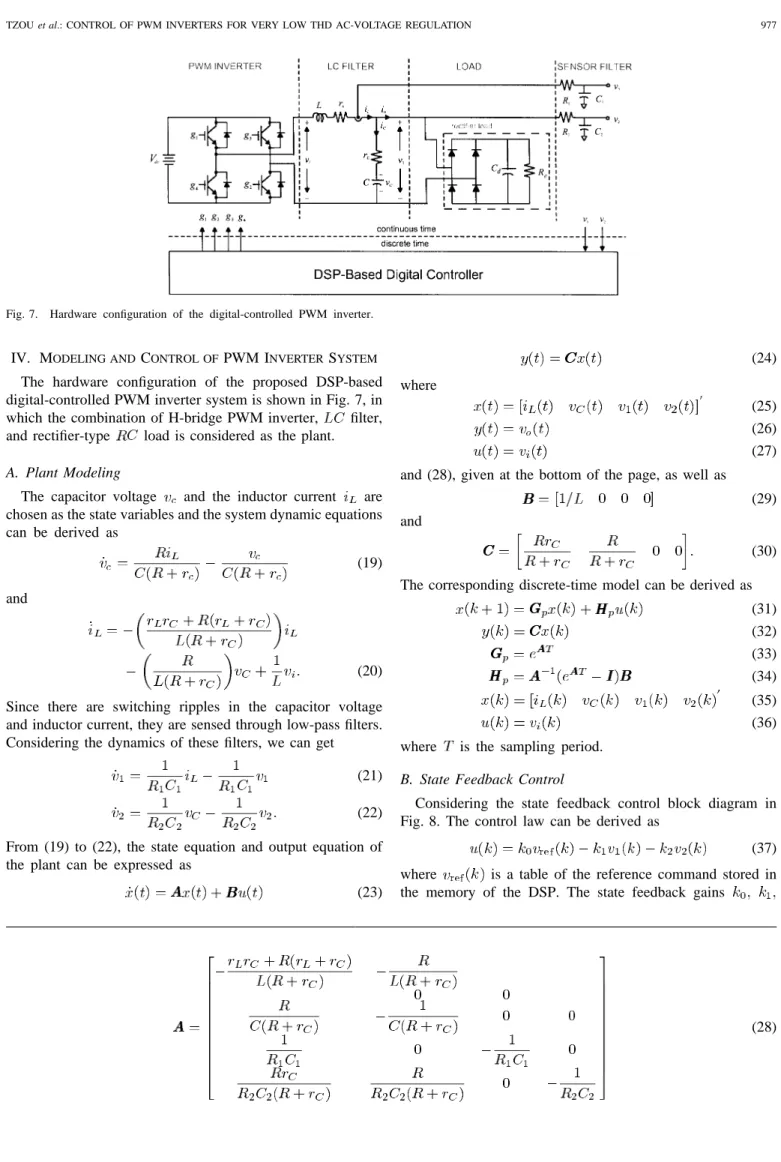
Fig. 7. Hardware configuration of the digital-controlled PWM inverter.
IV. MODELING ANDCONTROL OFPWM INVERTERSYSTEM
The hardware configuration of the proposed DSP-based digital-controlled PWM inverter system is shown in Fig. 7, in which the combination of H-bridge PWM inverter, filter, and rectifier-type load is considered as the plant.
A. Plant Modeling
The capacitor voltage and the inductor current are chosen as the state variables and the system dynamic equations can be derived as
(19) and
(20) Since there are switching ripples in the capacitor voltage and inductor current, they are sensed through low-pass filters. Considering the dynamics of these filters, we can get
(21) (22) From (19) to (22), the state equation and output equation of the plant can be expressed as
(23) (24) where (25) (26) (27) and (28), given at the bottom of the page, as well as
(29) and
(30) The corresponding discrete-time model can be derived as
(31) (32) (33) (34) (35) (36) where is the sampling period.
B. State Feedback Control
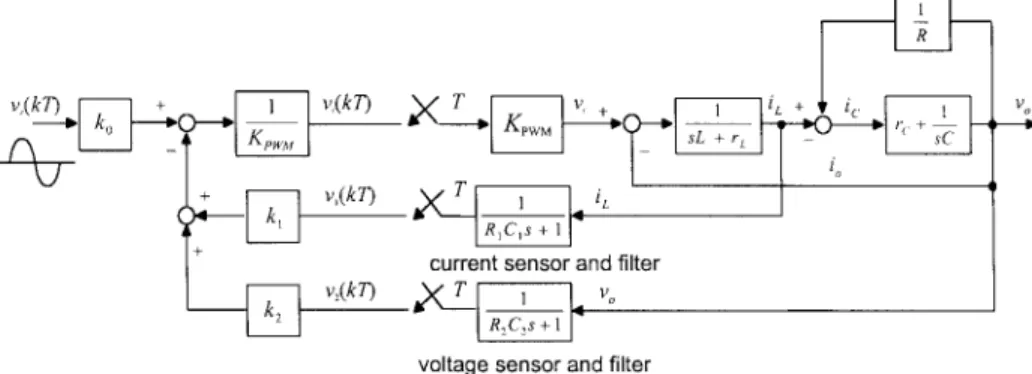
Considering the state feedback control block diagram in Fig. 8. The control law can be derived as
(37) where is a table of the reference command stored in the memory of the DSP. The state feedback gains
Fig. 8. State feedback control block diagram of PWM inverter with nominal load R = 40 .
TABLE I
PARAMETERS OF THEPWM INVERTERSYSTEM
and can be determined by the method proposed in authors’ previous research [22]. Combining (31), (32), and (37), we can obtain the state-space equation of the digital-controlled system as (38) (39) where (40) (41) and (42) The discrete-time transfer function from reference command to output voltage is
(43) It should be noted that the plant model is derived based on a nominal operating point, and in practical condi-tion it will encounter large model uncertainties due to load variations.
C. Design Example
Table I lists some of the key parameters of the PWM inverter system used for 60-Hz 110-V (RMS) ac-voltage
(a)
(b)
Fig. 9. (a) Frequency responses of the state feedback-controlled PWM inverter systemPn(z01) and the approximate model Pa(z01): (b) Nyquist
plot of Q(z01) 0 0:5Pn(z01)Pa(z01); which shows stability of the
repetitive control system whenS(z01) = 1=Pa(z01):
regulation. A single-chip DSP TMS320C14 from Texas In-struments has been adopted to realize the proposed adaptive repetitive controller. The sampling frequency of the digital controller is 15 kHz and there are 250 samples in each cycle of the sinusoidal output. The tuning rate of the adaptive parameter
(a)
(b)
Fig. 10. (a) Simulation results of the error convergence using the proposed adaptive repetitive control scheme. (b) Time responses of the estimated parameters of the approximate average model.
tuner is 120 Hz, and it adjusts the control parameters of the repetitive controller in every half cycle.
The state feedback gain and are determined to minimize the output voltage distortion due to transient load disturbance and the feedforward gain is a scaling factor to let the system have a unity gain at 60 Hz. With the given parameters as shown in Table I, and
are selected as the state-feedback gains and the corresponding feedforward gain is 0.56. The nominal transfer function of the digital state-feedback-controlled PWM inverter is
(44) The recursive LSE method has been used to identify the transfer function of the closed-loop-controlled PWM inverter based on a second-order model of (12). The identified plant
model is
(45) The frequency responses of and are shown in Fig. 9(a), and close resemblance between and
(a)
(b)
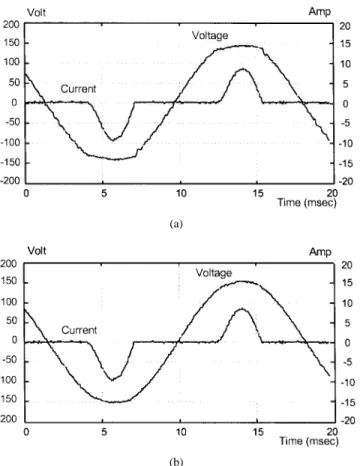
Fig. 11. (a) The 60-Hz-output waveforms for rectify load and current crest factor three with only state feedback control. (b) Output waveform when the adaptive repetitive control is applied.
can be observed. To assure enough stability margin, the scalar is chosen as 0.5 and the auxiliary filter is set as a constant gain of 0.95. The Nyquist plot of
is shown in Fig. 9(b), and it can be observed that it is within the stability boundary. This guarantees the stability of the repetitive control system.
V. SIMULATION ANDEXPERIMENTAL VERIFICATION
Fig. 10 shows the simulation results of a DSP-controlled PWM inverter using the proposed adaptive repetitive control scheme for ac-voltage regulation. Fig. 10(a) shows a three-dimension plot of the output voltage of the PWM inverter connected to bridge–rectifier load. The output waveforms in successive cycles after the adaptive repetitive controller applied are demonstrated in the same plot for convenience. The proposed control scheme does help to eliminate the periodic distortion and the output ac voltage becomes more sinusoidal after compensation. Fig. 10(b) shows the time responses of the estimated parameters of the second-order approximate, average model.
The experimental verification of the proposed adaptive repetitive control scheme is carried out on a 2-kVA PWM inverter connected to a rectifier load with current crest factor of three. Fig. 11(a) shows the experimental results of the output voltage and current of the PWM inverter using only the digital state feedback control. Fig. 11(b) shows the results under the same loading condition with the adaptive repetitive controller included. Fig. 12 shows the error of the
Fig. 12. Error convergence of the PWM inverter.
output ac voltage of the PWM inverter during the convergent process as the repetitive control is applied. The proposed control scheme does help to reduce the periodic error caused by cyclic disturbances. It can be observed that it takes about 12 cycles for the settling of the periodic error. For a 60-Hz output, it corresponds to 0.2 s to suppress the periodic disturbance caused by a step-changed rectifier load.
VI. CONCLUSION
An adaptive repetitive control scheme is proposed and successfully applied to the closed-loop regulation of a PWM inverter used in a high-performance ac power supply. Simula-tion and experimental results show that the proposed control scheme can effectively eliminate periodic waveform distortion resulting from unknown cyclic disturbance. The repetitive controller helps to reduce the peak actuating force under cyclically changed load condition due to the adoption of the a priori information about the period of the disturbance. With the same dc-link voltage, the periodic error can be suppressed more easily than cases without repetitive com-pensation. As compared to conventional repetitive control methods, the proposed adaptive repetitive control scheme can not only achieve a faster convergence rate, but also guarantees stability robustness under large-load variations. The total harmonic distortion (THD) for the rectifier load with current crest factor of three can be reduced from 8% to 1% within 0.2 s after the proposed adaptive repetitive controller is applied. An important merit of the proposed adaptive repetitive control scheme is that it can be designed and implemented independently without knowing the exact model of the PWM inverter system. This shows the feasibility for inserting an adaptive repetitive control module into an analog-controlled PWM inverter to improve the quality of the output ac voltage.
REFERENCES
[1] A. Kawamura and R. G. Hoft, “Instantaneous feedback controlled PWM inverter with adaptive hysteresis,” IEEE Trans. Ind. Applicat., vol. 20, pp. 769–775, July/Aug. 1984.
[2] H. J. Cha, S. S. Kim, M. G. Kang, and Y. H. Chung, “Real-time digital control of PWM inverter with PI compensator for uninterruptible power supply,” in IEEE IECON Conf. Rec., vol. 2, 1990, pp. 1124–1128.
[3] A. Kawamura and T. Yokoyama, “Comparison of five different ap-proaches for real time digital feedback control of PWM inverter,” in IEEE Ind. Appl. Society Conf., vol. 2, 1990, pp. 1000–1005.
[4] A. Kawamura, T. Haneyoshi, and R. G. Hoft, “Deadbeat control PWM inverter with parameter estimation using only voltage sensor,” in IEEE PESC Conf. Rec., 1986, pp. 576–583.
[5] C. Hua and R. G. Hoft, “High performance deadbeat controlled PWM inverter using a current source compensator for nonlinear loads,” in IEEE PESC Conf. Rec., 1992, pp. 443–450.
[6] S. L. Jung and Y. Y. Tzou, “Discrete feedforward sliding mode control of a PWM inverter for sinusoidal output waveform synthesis,” in IEEE PESC Conf. Rec., 1994, pp. 552–559.
[7] Y. Y. Tzou, L. H. Ho, and R. S. Ou, “Fuzzy control of a closed-loop regulated PWM inverter under large load variations,” in IEEE IECON Conf. Rec., vol. 1, 1993, pp. 267–272.
[8] T. Inoue, M. Nakano, and S. Iwai, “High accuracy control of servomech-anism for repeated contouring,” in Proc. 10th Annu. Symp. Incremental Motion Contr. Syst. Devices, 1981, pp. 258–292.
[9] T. Inoue and M. Nakano, “High accuracy control of a proton synchrotron magnet power supply,” in IFAC, vol. 20, 1981, pp. 216–221. [10] S. Hara, Y. Yamammoto, T. Omata, and M. Nakano, “Repetitive control
system: A new type servo system for periodic exogenous signals,” IEEE Trans. Automat. Contr., vol. 33, no. 7, pp. 659–666, 1988.
[11] B. A. Francis and W. M. Wonham, “The internal model principle for linear multivariable regulators,” Appl. Math. Opt., vol. 2, pp. 170–194, 1975.
[12] M. Nakano and S. Hara, “Microprocessor-based repetitive control,” Microprocessor-Based Control Systems. Holland: Reidel, 1986, pp. 279–296.
[13] T. Inoue, “Practical repetitive control system design,” in IEEE Proc. 29th Conf. Decision and Control, 1990, pp. 1673–1678.
[14] K. Amanuma, M. Kozaki, and Y. Sakasi, “State feedback compensation for repetitive servo system of dc-dc converter,” in IEEE Proc. Int. Tele. Energy Conf., 1991, pp. 268–274.
[15] T. Haneyoshi, A. Kawamura, and R. G. Hoft, “Waveform compensation of PWM Inverter with cyclic fluctuating loads,” IEEE Trans. Ind. Applicat., vol. 24, pp. 582–589, 1988.
[16] Y. Nishida and T. Haneyoshi, “Predictive instantaneous value controlled PWM inverter for UPS,” in IEEE PESC Conf. Rec., 1992, pp. 776–783. [17] K. K. Chew and M. Tomizuka “Steady-state and stochastic performance of a modified discrete-time prototype repetitive controller,” ASME/IEEE J. Dynamic Syst., Meas., Contr., vol. 112, pp. 35–41, 1990.
[18] J. Hu and M. Tomizuka, “A new plug-in adaptive controller for rejection of periodic disturbances,” ASME/IEEE J. Dynamic Syst., Meas., Contr., vol. 33, pp. 1–5, 1991.
[19] , “Adaptive asymptotic tracking of repetitive signals—A fre-quency domain approach,” in Proc. Amer. Contr. Conf., vol. 3, 1991, pp. 2621–2627.
[20] L. Ljung, System Identification: Theory for the User. Englewood Cliffs, NJ: Prentice-Hall, 1988.
[21] L. Ljung and T. Soderdtrom, Theory and Practice of Recursive Identi-fication. Hong Kong: Asco, 1983.
[22] S. Jung, L. H. Ho, H. C. Yeh, and Y. Y. Tzou, “DSP-based digital control of a PWM inverter for sine wave tracking by optimal state feedback technique,” in IEEE PESC Conf. Rec., 1994, pp. 546–551.
Design Engineer in the Control System Department. From 1983 to 1986, he was with Microtek Automation, Inc., as a Project Manager for the development of a computer numerical controller (CNC) for machine tools. He is currently a Professor in the Department of Electrical and Control Engineering, National Chiao Tung University, and also serves as an industrial consultant for many local power electronics and automation companies. He was the Director of the Institute of Control Engineering from 1992 to 1994. His special interests now are sensorless ac drives, intelligent UPS, FPGA-based control IC’s for motor drives and power converters, real-time network control techniques, and DSP applications in power electronics and motion control.
Shih-Liang Jung (S’93) was born in Hsinchu, Tai-wan, R.O.C., on September 15, 1969. He received the B.S. and Ph.D. degrees in control engineering from National Chiao Tung University, Hsinchu, in 1991 and 1996, respectively.
From 1996 to 1997, he was a Post-Doctoral Research Fellow at National Chiao Tung University. He is with the army for military duty and has served as an Instructor at the training center of Military Integral Communication Command (MICC) since July 1997. His research interests include variable structure systems, DSP-based digital control techniques, control of power electronic systems, and microwave communication systems.
Taipei, an optical data storage system company, where he engages in the design of a high-speed DVD ROM. His research interests include DSP-based digital control, control of power electronic systems, and optical data storage systems.