
基於專利佈局以及專利訴訟之價值星系 - 政大學術集成
136
0
0
全文
(2) Value Constellation: a Perspective Based on Patent Strategy and Patent Litigation 基於專利佈局以及專利訴訟之價值星系. by Hsun-Fang Chang. 政 治 大 A Dissertation 立Proposal Submitted in Partial Fulfillment of. ‧ 國. 學. the Requirement for the Degree of Master of Philosophy. ‧ y. sit. io. Management information Systems. n. al. er. Nat. In. Ch. engchi. i Un. v. Supervisor: Soe-Tysr Yuan, Professor, MIS, NCCU. NATIONAL CHENGCHI UNIVERSITY July2013 ©Hsun-Fang Chang.
(3) ACKNOWLEDGEMENT To accomplish the first thesis in my life might be really hard, and I am so lucky there are a lot of people to help and support me. The most important person in my graduate life must be Prof. Yuan Soe-Tsyr. In research, from the early stage of coming up the research topic and domain to data collection period, professor really gave me inspirations and assistance. Besides, her ambition, attitude and kindness have become my role model. Professor Yuan really the one of the best teacher I have ever met, and I am truly happy that I chose to join this lab. SSRC Lab is also the most joyous and warm lab. Not only the seniors give us many suggestions and supports, but also postdoctoral fellows share their valuable. 政 治 大. experiments. Also I met the great team members, juniors and even an exchange student from China. We experienced the hard but also shared the delight together. Even though,. 立. we often joke with each other, but it might mean all of us get alone well.. ‧ 國. 學. I really thank those people who accepted my interview, and gave me valuable information and suggestion selflessly. If one of you did not provide the help, my. ‧. research could not finish perfectly.. Thank you! My family! You encouraged me to apply Chengchi University which I. y. Nat. sit. did not have a hope to join this school. If there was not your encouragement, I could not. al. er. io. have a chance to experience the different lifestyle in Taipei. Thanks for your tolerance; I. n. rarely go home with my research carrying on. But without your support and. Ch. i Un. v. understanding, I could not focus on my research and what I want to do. At last, I think I. engchi. should thank you again to let me choose the two-year graduate life, and from now on, it’s time for me to become the support of our family..
(4) 論文題目:基於專利佈局以及專利訴訟之價值星系 校(院)系所組別:政治大學資訊管理學系碩士班 研究生:張薰方 指導教授:苑守慈 論文頁數:135 關 鍵 詞:服務、價值星系、專利佈局、訴訟、專利訴訟 摘要 服務是一連串的價值共創,在這個價值共創的系統裡可能包含合作夥伴、競爭者、. 政 治 大. 供應商和顧客等,在價值星系中他們共同創造價值、共同享受成果並達成各自最 終的目標。. 立. ‧. ‧ 國. 學. 無形資產對於現代企業的重要性與日俱增,智慧財產權也漸漸受到重視,其中, 專利尤其成為保護企業內部知識的重要手段。此外,為了完善管理企業擁有的專 利、規劃未來的發展,專利佈局成為企業政策中不可或缺的一環。現今許多企業 間正進行著激烈的訴訟戰爭,許多公司將訴訟視為一種手段,或視訴訟為一種判 斷指標,其目的可能為了獲取科技技術、壟斷市場、聯盟等。因此,雖然專利佈. n. al. er. io. sit. y. Nat. 局所要考量的因素很多,但是不管從單一企業的角度,或者從整個商業的觀點來 看專利佈局,它都是必須要被重視、且重要的一環。本研究的目的是利用資訊科 技,基於企業的訴訟、專利佈局和其它因素的觀點來提供各種結合不同操作性資 源的價值星系,讓企業在制定專利布局之前,了解整個市場網絡的個體和彼此間 的關係,進而掌握整個市場聯盟和競爭的狀態,並且降低企業制定專利布局所需 要的人力和成本達到企業利潤最大化之終極目標。. Ch. engchi. i Un. v.
(5) Abstract Service has been widely recognized as value co-creation yielding useful change those results from purposeful interactions among distinct service system entities. In addition, value does not occur in sequential chains but in complex constellations, in which system entities engage in both tangible and intangible exchanges to achieve economic or social good. Intellectual Property (IP) is getting more and more attention with the increasingly recognized importance of intangible assets. Especially with the rapid growth of technology, patent is indispensable for companies to strategically. 政 治 大. manage their prized knowledge, do business and make patent strategy. Litigation,. 立. nowadays, also plays an important role among firms, such as enterprises taking. ‧ 國. 學. litigation as a means to forge an alliance to prevent being involved in lawsuit war, to. ‧. compete with their competitors so as to snatch the key technology or monopolize the market, etc. The purpose of this study is to devise an IT-facilitated approach aiming at. y. Nat. er. io. sit. visualizing possible ways of value constellations using the identified strategic operant resources across different enterprises from the perspective of patent strategy and patent. n. al. Ch. i Un. v. litigation. This approach, assisted by Google API and external IP knowledge bases, can. engchi. facilitate enterprises to well perceive the whole allied and competitive situations between business strategy and patent strategy, reducing human resource and budget in exploring the network of actors and their relationships that can jointly create value from the IP intangible asset perspective. Keywords: service, value constellation, patent strategy, litigation, patent litigation.
(6) Table of Contents CHAPTER 1. INTRODUCTION.................................................................................. 1 1.1 BACKGROUND ......................................................................................................... 1 1.2 RESEARCH MOTIVATION AND QUESTIONS ................................................................ 3 1.3 RESEARCH OBJECTIVES AND CONTRIBUTIONS ......................................................... 5 1.4 RESEARCH METHODS .............................................................................................. 5 1.5 CONTENT ORGANIZATIONS ...................................................................................... 6 CHAPTER 2. LITERATURE REVIEW ...................................................................... 9 2.1 INTELLECTUAL PROPERTY ..................................................................................... 10 2.2 PATENT STRATEGY ..................................................................................................11. 治 政 ............................................................................................. 12 大 立 ............................................................................................... 15 ‧. ‧ 國. 學. 2.3 PATENT EVALUATION 2.4 PATENT LITIGATION 2.5 BUSINESS STRATEGY ............................................................................................. 16 2.6 VALUE NETWORK .................................................................................................. 17 2.7 VALUE CONSTELLATION......................................................................................... 18 2.8 SERVICE DOMINANT LOGIC ................................................................................... 19. n. al. er. io. sit. y. Nat. CHAPTER 3. MOTIVATION APPLICATION ......................................................... 22 3.1 TAIWAN’S ECONOMIC STRENGTHS AND CURRENT ECONOMIC LANDSCAPE ........... 22 3.2 THE “PROSPERITY” IN PROSPERITY TAIWAN .......................................................... 23 3.3 VISION OF PROSPERITY TAIWAN ............................................................................. 23 3.4 CULTURE, ARTS AND CREATIVITY AS AN EXAMPLE ................................................ 23 3.5 INTELLIGENT SERVICE MACHINES TO AID ECONOMIC TRANSFORMATION .............. 25 3.6 SYSTEM SCENARIO ................................................................................................ 29. Ch. engchi. i Un. v. CHAPTER 4.METHODOLOGY ............................................................................... 32 4.1 CONCEPTUAL FRAMEWORK ................................................................................... 32 4.2 SYSTEM ARCHITECTURE ........................................................................................ 35 CHAPTER 5.APPLICATION SCENARIO ............................................................... 47 5.1 APPLICATION SCENARIO ........................................................................................ 47 5.2 PROCESS DIAGRAMS .............................................................................................. 51 CHAPTER 6.EVALUATION ...................................................................................... 54 6.1 PROPOSITIONS........................................................................................................ 55 6.2 ASSUMPTIONS ........................................................................................................ 60 6.3 EXPERIMENTS AND RESULTS .................................................................................. 61.
(7) CHAPTER 7.CONCLUSION ................................................................................... 100 7.1 CONTRIBUTIONS .................................................................................................. 100 7.2 LIMITATIONS ........................................................................................................ 102 7.3 FUTURE WORK .................................................................................................... 103. 立. 政 治 大. ‧. ‧ 國. 學. n. er. io. sit. y. Nat. al. Ch. engchi. II. i Un. v.
(8) List of Figures FIGURE 1.1 DESIGN SCIENCE RESEARCH FRAMEWORK (ALAN ET AL. 2004) 7 FIGURE 2.1 PATENT STRATEGY AND STRATEGIC PATENT (MURRAH 2002) ..11 FIGURE 2.2 THE VALUE OF INVENTIONS AND THE VALUE OF PATENTS ...... 13 FIGURE 2.3 STATISTICS OF PATENT LITIGATION FROM U.S. DISTRICT COURT ........................................................................................................................................ 15 FIGURE 3.1 A SIMPLE SERVICE MACHINE IS A HYBRID OF STS AND SSME . 25 FIGURE 3.2 THE V+ PLATFORM ............................................................................... 26 FIGURE 4.1 INTANGIBLE VALUE AS A % OF TOTAL MARKET CAPITALIZATION BY SECTORS ............................................................................... 33. 政 治 大 FIGURE 4.2 PATENT ACQUISITION 立 AND PATENT STRATEGY (STPI2012)........ 34. ‧ 國. 學. FIGURE 4.4 SYSTEM ARCHITECTURE .................................................................... 37. ‧. FIGURE 4.5 CONCEPT OF CHECK RELEVANT PATENT AND SEARCH SPECIFIC PATENT MODULE........................................................................................................ 39 FIGURE 4.6 CONCEPT OF RELEVANT LITIGATION AND ASSIGNEE'S. Nat. sit. y. RELATION MODULE .................................................................................................. 43. er. io. FIGURE 4.7 THE PART OF ASSUMED OUTPUT OF CONCEPTION NETWORK 45. al. n. iv n C FIGURE 5.2 KEYWORD SEARCHING 49 h e nAREA hi U g c........................................................... FIGURE 5.1 AREAS OF PLATFORM .......................................................................... 48. FIGURE 5.3 DETAILS DATA AREA............................................................................ 50 FIGURE 5.4 VISUALIZING NETWORK AREA ......................................................... 51 FIGURE 5.5 SERVICE BLUEPRINT ........................................................................... 52 FIGURE 5.6 INTERNAL PROCESS MAPS TO SYSTEM CONCEPTS .................... 53 FIGURE 6.1 PROPOSITIONS RELATED ENTERPRISE’S SECTIONS ................... 56 FIGURE 6.2 THE PROCEDURE COMPARISON ....................................................... 63 FIGURE 6.3 ENTERPRISE ATTITUDE SCHEMATIC DIAGRAM ........................... 70 FIGURE 6.4 THE COMPLEXITY OF DECISION-MAKING PROCESS OF RECEIVING LEGAL CONFIRM LETTER.................................................................. 77. III.
(9) FIGURE 6.5 COMPARISON OF PROCESS BEFORE AND AFTER USING IP+ ..... 91. 立. 政 治 大. ‧. ‧ 國. 學. n. er. io. sit. y. Nat. al. Ch. engchi. IV. i Un. v.
(10) LIST OF TABLES TABLE 2.1 VALUATION OF INTELLECTUAL PROPERTY .................................... 14 TABLE 2.2 CONCEPTUAL TRANSITIONS (LUSCHAND VARGO2006) ............... 21 TABLE 4.1 EXAMPLES OF SYSTEM USERS’ BASIC INFORMATION ................. 38 TABLE 4.2 AMOUNT OF LED PATENT GRANTED BY U.S (STPI 2012) .............. 41 TABLE 4.3 THE DATA OF BUILD NETWORK ......................................................... 44 TABLE 6.1 DESIGN EVALUATION METHODS(HEVNERET AL. 2004) ................ 55 TABLE 6.2 PROFILE OF ENTERPRISES ................................................................... 65. 治 政 TABLE 6.4 INTERVIEW SCHEDULE ......................................................................... 67 大 立 TABLE 6.5 IP TEAM RELATED PATENT STRATEGY ............................................. 68 TABLE 6.3 RESPONDENTS OF EACH COMPANY .................................................. 65. ‧ 國. 學. TABLE 6.6 THE RESULT OF PROPOSITION 1 ......................................................... 70. ‧. TABLE 6.7 INTERVIEW DATA ENCODING TOWARD PROPOSITION 1 (ACCORDING TO APPENDIX D:TABLE D-1) .......................................................... 72. sit. y. Nat. TABLE 6.8 MANAGERS RELATED BUSINESS STRATEGY .................................. 73. io. al. er. TABLE 6.9 THE RESULT OF PROPOSITION 2 ......................................................... 75. n. TABLE 6.10 INTERVIEW DATA ENCODING TOWARD PROPOSITION 2 (ACCORDING TO APPENDIX D: TABLE D-2) ......................................................... 76. Ch. engchi. i Un. v. TABLE 6.11 CONNECTION BETWEEN PATENT STRATEGY AND BUSINESS STRATEGY .................................................................................................................... 78 TABLE 6.12 THE RESULT OF PROPOSITION 3 ....................................................... 80 TABLE 6.13 INTERVIEW DATA ENCODING TOWARD PROPOSITION 3 (ACCORDING TO APPENDIX D: TABLE D-3) ......................................................... 81 TABLE 6.14 THE NOVELTY OF AN ENTERPRISE .................................................. 82 TABLE 6.15 NON-OBVIOUSNESS OF AN ENTERPRISE ........................................ 83 TABLE 6.16 INDUSTRIAL APPLICATION OF AN ENTERPRISE ........................... 84 TABLE 6.17 THE RESULT OF PROPOSITION 3-1 TO 3-3 ....................................... 85 TABLE 6.18 INTERVIEW DATA ENCODING TOWARD PROPOSITION 3-1 TO 3-3 V.
(11) (ACCORDING TO APPENDIX D: TABLE D-4) ......................................................... 87 TABLE 6.19 THE USAGE OF IP+ ................................................................................ 89 TABLE 6.20 THE RESULT OF PROPOSITION4 ........................................................ 91 TABLE 6.21 INTERVIEW DATA ENCODING TOWARD PROPOSITION 4 (ACCORDING TO APPENDIX D: TABLE D-5) ......................................................... 94 TABLE 6.22 DATA ENCODING SUMMARY ............................................................. 96. 立. 政 治 大. ‧. ‧ 國. 學. n. er. io. sit. y. Nat. al. Ch. engchi. VI. i Un. v.
(12) CHAPTER 1. INTRODUCTION. 1.1 Background More and more companies profit from their service nowadays. Comparing with the past business models of just gaining from selling products, enterprises either combine the service and product, or turn to be a service-oriented enterprise now. Service is known a value co-creation that takes place when different entities interact, and it will. 政 治 大 aware of value constellations 立 (Normann and Ramírez 1993), so it could not be. produce a valuable outcome. Furthermore, value arises in an intricate situation which is. ‧ 國. 學. explained comprehensively in traditional circumscription value chain or a simple sequential chain. Value constellation uses interactive knowledge flow to reinforce static. ‧. knowledge stock. In value constellation, to reach the goal, enterprises involve their. Nat. sit. y. tangible and intangible exchanges.. n. al. er. io. Especially in the knowledge-based economic, intangible assets are more and more. i Un. v. important for enterprises. Intellectual property right is regarded as an intangible asset. It. Ch. engchi. includes patents, trademarks, copy rights, trade secrets, and industrial design rights. International Chamber of Commerce reveals that today’s economic trend is toward more investment in intangible asset early on 2005(International Chamber of Commerce 2005). Even OECD talked about government measures of different countries to encourage SMEs to develop IP(OECD Conference 2004).. For those enterprises, how. to manage theses intangible assets and get the profit from these assets will be the top issue (OECD Conference 2004). Therefore most companies have their own intellectual property strategy, especially patent strategy. Patent Strategy is a process of patent portfolios. The difference between patent strategy and patent portfolio is that patent 1.
(13) strategy is always a set of patents with a goal or some purposes, and patent portfolio can be a set of patents of technology, technologic domain, time, or region (STPI 2012).Many enterprises use patent transaction, patents granting, or cross -licensing to enhance their patent strategy. However, even though enterprises regard as important the IP development and they are encouraged to apply patents. But the plenty of patents doesn’t show the high level of quality. The World Economic Forum published a report showing that Taiwan was the top one on the number of the US utility patents per million population, better than. 政 治 大. United State (The Global Competitiveness Report 2010–2011). But most of key patents,. 立. valuable patents do not belong to Taiwan. On the other hand, using evaluated methods. ‧ 國. 學. to measure a patent might get high value, but patent with high value might not actually be used in real world.“Patent quality is the premise of the patent value, and the patent. ‧. value is the practice of patent quality” (Jou 2006). If patent could not be used in the real. y. Nat. sit. world, the patent could not really be called valuable. The actually utilization could. n. al. er. io. embody the really value of patent.. i Un. v. Len Smith (2009) generalized basic methods of patent evaluation, cost method,. Ch. engchi. market method, and income method, for instance. Except these key methods, there are a lot of methods to evaluate a patent, just in order to improve the evaluating way, provide more details, and make patent valuation more precise. For example Collan and Heikkilä (2011) proposed 'pay-off' method. Pay-off method is often used with the three methods, based on value scenarios, and creates a distribution. The pay-off method offers a graphical comparison, and helps calculate the real option valuation. Although all of the evaluated methods are generally used in patent evaluation, but most of them rely on expert's opinions and experiences. It will be a huge cost for companies in patent strategy, if we need expert to help us evaluate the patent. Evaluating the patent need company's 2.
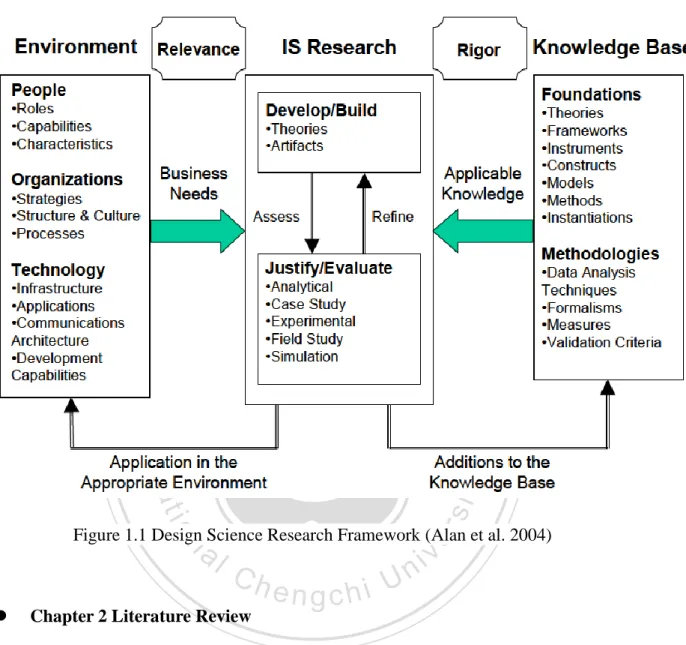
(14) internal information, even the secret financial data, it's not easily available. Furthermore, the calculated value of patent is difficult to be precise. Therefore the step of evaluation will be an obstacle for enterprise.. 1.2 Research Motivation and Questions Recently, there have been more and more patent litigations between enterprises. The patent litigation becomes a key factor to affect patent strategy. Patent litigation generally occurs when infringing other’s patent rights. But enterprises increasingly use. 政 治 大. patent litigation to challenge and compete with their rivals (Jean and Mark 2000).. 立. Enterprise would utilize litigation to get the crucial patent or technology to make their. ‧ 國. 學. service or product better. Jean and Mark stated that high litigation rate would cause. ‧. reputation effects, and gain attentions (2000).It would make the patent prized, and then expose the company to public. Enterprise could also avoid being sued and fulfill their. y. Nat. litigation plays an important role in making patent strategy.. n. al. Ch. er. io. sit. patent strategy by analyzing the litigation relations between companies. Hence,. i Un. v. On the other hand, although patent litigation is gradually emphasized, most of. engchi. researches don’t attach much weight to the relationships within litigations. Most of recent researches focus on the connection between litigation and specific technology or industry (Ziedonis 2003), but litigation among enterprises sometimes is the master key factor nowadays and it could determine the way of developing, lead to evolution of a company or it might bankrupt a company (Fenwick & West LLP 2005). So research of the relations among enterprises based on litigations will be the gap need to be filled. Also, the litigated relations within firms would not involve only two companies, if we take alliance and competition behind companies into consideration, the relationships. 3.
(15) would be complicated. The relation with a third-party company partnering with cooperated firms is not necessarily coadjutant; on the other hand, we might collaborate with a company partnering with a rival firm. In this way, the network built on litigated relations among enterprises is closely related to every company. Besides, regardless of patent, litigation, patent strategy, or business strategy, they are treated as property, obstacle, planning, and profit model. They seldom are considered as operant resources (Vargo and Lusch 2004);nevertheless, enterprises could create higher benefits from the perspective of operant resources which inlaid abundant. 政 治 大. knowledge and act in accordance with others resources.. 立. IT technology has been adopted to manage intellectual property efficiently (OECD. ‧ 國. 學. Conference 2004), or applied to analyze the patent citations (Lee et al. 2010), find strategic partners (Jeon et al. 2011). Some systems rented by patent and law offices, for (http://www.delphion.com). and. Chemical. Nat. might. Abstracts provide. the. sit. (https://stneasy.cas.org/html/english/login1.html?service=STN),. y. DELPHIN. ‧. instance. n. al. er. io. search function, but the information is connected only to different type of patents,. i Un. v. applying patent or approved patent for instance. These systems don’t offer litigations. Ch. engchi. related information and the IP-based enterprises relations are not connected either. However, it is yet to be explored about how to build a visualizing tool that can manifest the possible value constellation networks based on patent litigations and patent strategy (i.e., value as the integration of owner patents under litigations), how to use the tool to facilitate making patent strategy, or even stimulate formulating business strategy. These issues would then be one of our research questions to investigate.. 4.
(16) 1.3 Research Objectives and Contributions The purpose of this IS research is to integrate operant resources from different companies, considering IP value based on litigation and strategies of patent and business are also included, through the use of an IT supported engine. Many technology company use patent litigation to protect their own patent and remain the value, preventing the development of competitors', or even revoking their patents. All these actions could be a part of patent strategy, and patent strategy is also just a part of business strategy. Thus, this research wants to take advantage of many factors that. 政 治 大. related to patent, litigation, and company, to build a value constellation network based. 立. on these elements, and then users could find the relations around enterprises, litigations. ‧ 國. 學. and network.. ‧. Hence, enterprises can take further actions, for example well arrange their patent strategy, reduce costs, save tax, find cooperated partners, or fight their competitors. The. y. Nat. er. io. sit. network proposed by this research would visualize possible ways of value constellation which takes objective factors into consideration, quantity, quality, value, and litigation. n. al. Ch. i Un. v. of patent, for instance. Thence, enterprises can well utilize operant resources from. engchi. different companies, then decrease human resource and budget in exploring the network of actors and their relationships, and do more research and design for gaining new technique, patent, or products, finally achieve the goal of profit maximization. This will create a positive cycle in the company, and inspire the competition between enterprises.. 1.4 Research Methods The goal of this research is to build a visualizing tool which integrates operant resources from different companies and reduces the complexity of decision-making in 5.
(17) the process concerning to make patent and business strategy. The first thing we need to do is to find the suitable database, which could provide plentiful patent information and Taiwan relating litigation information. And these databases are open and could be accessed by programming. Except the public database, we also have a system database that stores information of each enterprise. Second, we provide a visualizing tool that users could understand easily. Enterprise could find detailed information and relations about patent and litigations in this system. And they could reference these data to make decisions.. 政 治 大. Third, we also designed an interactive platform that user could add some records of. 立. patents or litigations that have not been found in database yet. After that, the network. ‧ 國. 學. we provide could be more close to what they need.. Therefore, our system (named IP+) could practically give helps or facilitate the. ‧. process in the enterprise, and reach the goal and the attempted contributions of this. er. io. sit. y. Nat. research.. n. a. l C 1.5 Content Organizations. hengchi. i Un. v. This research is followed the framework of Design Science In Information System Research, which was reported by Alan, Salvatore, Jinsoo, and Sudha on 2004 (Figure 1.1). In this framework, we would define the Environment of our research problem, what we did in Chapter 1, and then we discuss researches to build the Knowledge Base in Chapter two Literature Review. After that, in the IS Research part, we will Develop a system to solve the relevant problem, and use the method of case study to Evaluate which also follows the Rigors.. 6.
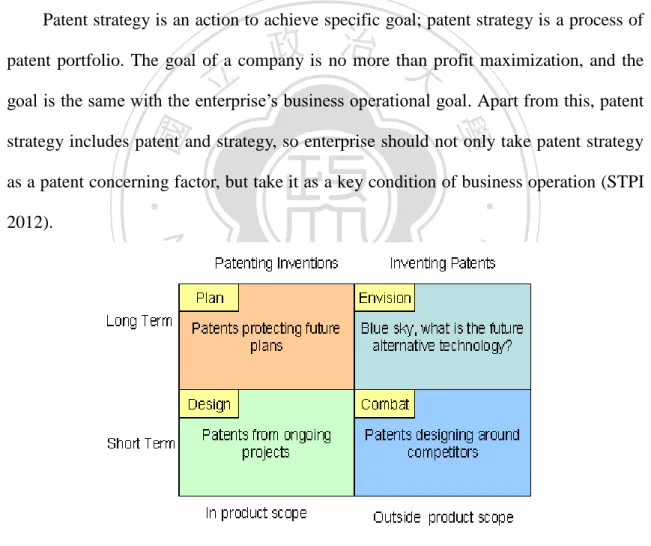
(18) There are five chapters comprised in the dissertation proposal, the remainder proceeds as follows:. 政 治 大. 立. ‧. ‧ 國. 學 er. io. sit. y. Nat. Figure 1.1 Design Science Research Framework (Alan et al. 2004). n. al. . Ch. Chapter 2 Literature Review. engchi. i Un. v. Survey the related research done by others, providing the theoretical basis for this research. The investigated fields of research include intellectual property, patent strategy, patent evaluation, patent litigation, and value network.. . Chapter 3 Motivation Application. 7.
(19) Provides background of motivation and goal to the Prosperity Taiwan integrated project to which our research is circumstanced, interprets how each engine works and connects, and gives a simple application example of research project.. . Chapter 4 Methodology Establish the conceptual framework of research which is followed by developing the system. In addition, demonstrates system architecture of engine, explaining which modules compose the whole system and how they are enabled by IT.. . 政 治 大. Chapter 5Application Scenario. 立. Proposes a scenario including these: (1) how our research help reach the goal of. ‧ 國. 學. prosperity Taiwan, (2) how the users interact with the system, co-create the value of system and (3) what they gain from our system. ‧. . Chapter 6 Evaluation. y. Nat. sit. In this chapter, we would propose some propositions in order to verify our goals,. n. al. er. io. also assumptions are also raised. Then the results would be provided, and the. i Un. findings will be discussed in the end of this chapter.. . Ch. engchi. v. Chapter 7Conclusion This chapter elaborates conclusions, limitations, and future work of this research. Subsequent scholars might get inspiration from future work, and extend the research to break up the limitations. Also the contributions are manifested toward academic and the real market.. 8.
(20) CHAPTER 2. LITERATURE REVIEW Chapter 2 will expound these domains of research: (1) Intellectual Property: indicates how intellectual property enlivens in the world, how enterprises face this trend to manage their knowledge and intangible assets and keep their competitive advantage. (2) Patent Strategy: proposes the concept of patent strategy that every company should learn. It is an essential process if the company wants to protect their intellectual. 政 治 大. property rights, make alliance ,and compete with others, apart from this, they should. 立. well make and analyze the patent strategy.. ‧ 國. 學. (3) Patent Evaluation: knows the value of patent is important for enterprise to make. ‧. policy decision, either to buy a patent, cross-licensing, or do R&D themselves. (4) Patent Litigation: litigation could affect the whole ecosystem in a company, so. y. Nat. er. io. sit. how to prevent lawsuit and even use litigations conversely to win the leading position in the related market would be a key point when making patent strategy. Also, this is the. n. al. Ch. i Un. v. new measurement recommended by this research to judge the value of patent and a factor to build the value network.. engchi. (5) Business Strategy: generally, we could say simply the top goal of business strategy is profit maximization, but what we need to consider when make the business? It is really complex. So the business strategy would also be briefed in this section. (6) Value Network: elaborates why using value network to explain the relations among enterprises, and the advantages of using value network. (7) Value Constellation: it is difficult to explain value constellation, if we look on it as traditional value chain or sequential chain. So the meaning of value constellation. 9.
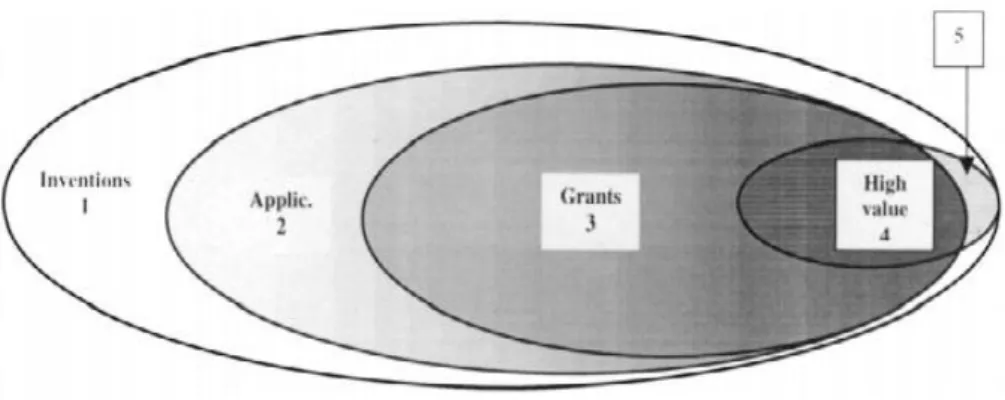
(21) would be surveyed carefully here. (8) Service Dominant Logic: in the last of literature review, we want to inquire service dominant logic which will be the key factor which penetrates our whole research. This chapter will survey the related research, found the theoretical basis as the required rigor to sustain the research.. 2.1 Intellectual Property. 政 治 大. Early in the 21st century, intellectual property has become the economic base of. 立. United State owing to the industrial structure transforming from basic manufacturing. ‧ 國. 學. industry to high technology industry (Mossinghoff and Bombelles 1996). When. ‧. intellectual property protects inventions, inventors could obtain benefits from claiming their rights, at least making a balance between revenue and cost, for the reason that it. y. Nat. er. io. sit. would be a positive cycle (Silverman 1990). With the growth of knowledge based economy, the development of technology is. n. al. Ch. i Un. v. prompted by knowledge, and the evolution of technology will enhance the quality of. engchi. life. Knowledge could be a measurement of standard of living (Harris 2001). Therefore, knowledge is often a firm’s key competitive advantage, so most people and enterprises need to protect their own knowledge and keep the advantage, intellectual property rights could be a way to defend others infringing their rights (OECD Conference 2004). Because of the highly proportion of high-tech industries in Taiwan such as information and electronic, the patent system has also rapidly grown. If without patent system, the progress of knowledge and economy might be obstructive (Machlup 1958). Taiwan owned the most number of the US utility patents per million population on 2012,. 10.
(22) even more than United State (The Global Competitiveness Report 2010–2011). Therefore, the importance and the expansibility of patent cannot be underestimated.. 2.2 Patent Strategy Macdonald stated patent was deemed a final mean to protect innovations, but this condition had been changed since patents were added the value of strategy (Macdonald 2004). Patent strategy is an action to achieve specific goal; patent strategy is a process of. 政 治 大. patent portfolio. The goal of a company is no more than profit maximization, and the. 立. goal is the same with the enterprise’s business operational goal. Apart from this, patent. ‧ 國. 學. strategy includes patent and strategy, so enterprise should not only take patent strategy. 2012).. ‧. as a patent concerning factor, but take it as a key condition of business operation (STPI. n. er. io. sit. y. Nat. al. Ch. engchi. i Un. v. Figure 2.1 Patent Strategy and Strategic Patent (Murrah 2002). Murrah divided patent strategy into four segmentations by time and process, as shown in Figure 2.1. Most companies will start at the “Design” section when they want 11.
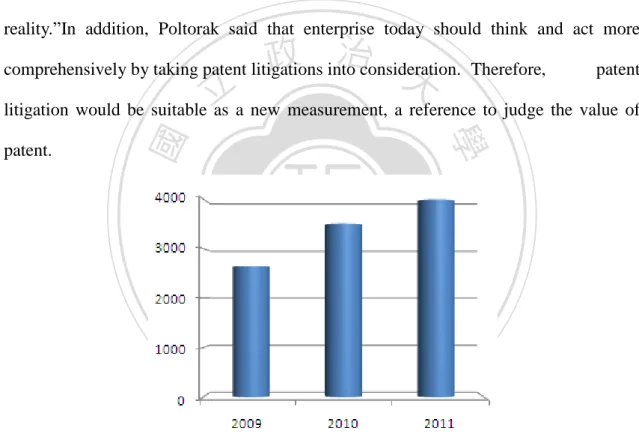
(23) to initiate patent strategy, this section is applying patents for current designs and innovations; the “Plan” section is to apply patents for future products, and these two are considered in a product scope. If out of product scope, patent strategy will be the means to reserve options and engage market. The potential technique and market trend would be the purpose for company to invent in the “Envision” part, and patents are regarded as weapons to fight with competitors when enterprise is in the state of “Combat” (Murrah 2002). So even SMEs just want to protect their own products, innovations, and R&D. 政 治 大. results, from being violated by others, this action would be the first step of patent. 立. strategy.. ‧ 國. 學 ‧. 2.3 Patent Evaluation. Enterprises would like to obtain valuable patents, in order to reach the goal of. y. Nat. er. io. sit. profit maximization, thus how to evaluate a patent is an indispensable step of patent strategy. Patent could be evaluated by valuation models, such as arbitrage pricing theory. n. al. Ch. i Un. v. (Ross 1976), Black–Scholes (Black and Scholes 1973), fuzzy pay-off method for real. engchi. option valuation (FPOM or pay-off method) (Collan et al. 2009), etc. Not only new ways could be used to measure the price of patent but old, classic methods could be minute adjusted for the purpose of using in evaluating intellectual property as well. Apart from valuation models, there are special ways only for evaluating patents. Harhoff(2002) reported that citations and referenced-by were significantly correlated with the patent value, and the family size of patent would be related to the value of patent.. 12.
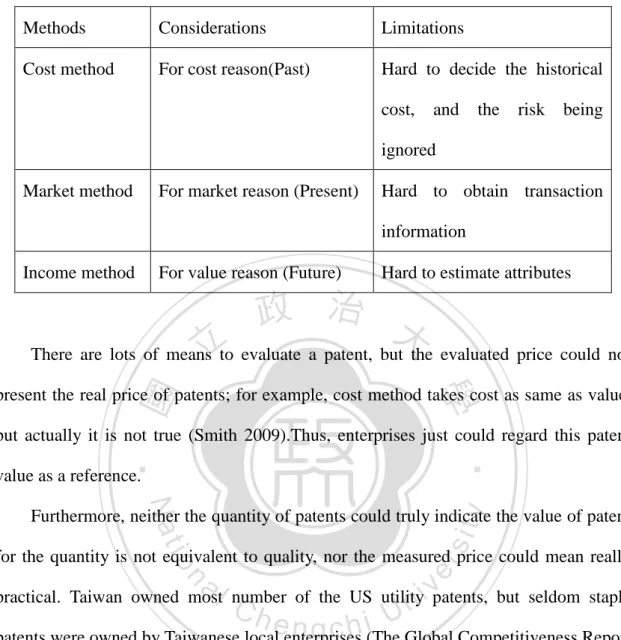
(24) Figure 2.2 The value of inventions and the value of patents (Guellec D. and Potterie B.V. 2000). 政 治 大 Figure 2.2 shows the difference level of inventions’ value, the darker part is more 立. ‧ 國. 學. valuable of inventions. And we could found that patents are more valuable than inventions. Guellec and Potterie(2002) declared that the highest value is patents with. ‧. more citations or referenced-by, the difference between area 3 and area 4.Hall even. sit. y. Nat. asserted that the market value of firm was associated with the patent citations (Hall et al.. io. er. 2000).Hence, the value of patent is really desirous to be revealed, either for knowing. al. iv n C U by Smith, so as to evaluate The most basic and commonlyhused e nway g cwash ideclared n. whether the patent is priced or not or measuring the value of a firm.. the patent value (Smith 2009), demonstrate as Table 2.1.. 13.
(25) Table 2.1 Valuation of Intellectual Property Methods. Considerations. Limitations. Cost method. For cost reason(Past). Hard to decide the historical cost,. and. the. risk. being. ignored Market method. For market reason (Present). Hard to obtain transaction information. Income method. For value reason (Future). 立. Hard to estimate attributes. 政 治 大. There are lots of means to evaluate a patent, but the evaluated price could not. ‧ 國. 學. present the real price of patents; for example, cost method takes cost as same as value, but actually it is not true (Smith 2009).Thus, enterprises just could regard this patent. ‧. value as a reference.. y. Nat. sit. Furthermore, neither the quantity of patents could truly indicate the value of patent. n. al. er. io. for the quantity is not equivalent to quality, nor the measured price could mean really. i Un. v. practical. Taiwan owned most number of the US utility patents, but seldom staple. Ch. engchi. patents were owned by Taiwanese local enterprises (The Global Competitiveness Report 2010–2011). Moreover, Jou (2006) said “Patent quality is the premise of the patent value, and the patent value is the practice of patent quality”. If the measured value is high no matter from the point of view of citations or family size, etc; but patent could not be utilized in industry, commercialized, traded, authorized and litigated, the patent could not be considered useful.. 14.
(26) 2.4 Patent Litigation The cases of patent litigation exceed 4000 in 2011, 11 cases a day. By comparing with 2011, the cases of patent litigation were over 2000 and in average 8 cases a day, the amounts of litigation have continued to increase (U.S. ITC 337 2012 ), illustrate as Figure 2.3. Poltorak(2011) said “Patent plays an essential role in war of ecosystems, and the courtrooms became part of the playground, not just the marketplace. It's a new reality.”In addition, Poltorak said that enterprise today should think and act more. 政 治 大. comprehensively by taking patent litigations into consideration. Therefore,. 立. patent. litigation would be suitable as a new measurement, a reference to judge the value of. ‧. ‧ 國. 學. patent.. n. er. io. sit. y. Nat. al. Ch. engchi. i Un. v. Figure 2.3 Statistics of patent litigation from U.S. District Court (Unit: Number of Cases) (STPI 2012). However, patent litigation takes long time and the charge is definitely not cheap, not every company could afford it (Fenwick & West LLP 2005). If a company encounters patent litigation, it might have negacyclic effect on the R&D section such as. 15.
(27) shortage of research funding (Lanjouw and Schankerman2011). Large enterprise would take patent into account with their every strategy and policy, but small company cannot afford it (Macdonald 2004). But till now, there are few researches focusing on an overall value network. Most past researches concentrated on digging out the factors which would affect patent litigation (Lanjouw and Schankerman 2011), or how to prevent getting involved in lawsuit (Meurer 1989). This research propose a value network by bringing the concept of enterprise themselves, building up the relations based on patent litigations, then facilitating tomake patent strategy.. 學. ‧ 國. 立. 政 治 大. 2.5 Business Strategy. ‧. The main goal of business strategy is to reach the ultimate target of enterprise which most of time is profit maximization (Naget al. 2007). We could say the business. y. Nat. er. io. sit. strategy is a process, and the task, goal, and planning of enterprise could be defined by business strategy (Lamb 1984), also the resources of company should be allocated and. n. al. Ch. i Un. v. integrated. And the process of decision making takes place every day (Sullivan 2000).. engchi. The considerations of business strategy includes plans, market situation, market and industry position, suppliers, customers, human resources, cost, and ability or competitiveness (Porter 1980, Boar 1994, and Alter 2002).An enterprise should use business strategy to develop or maintain their competitiveness, and try to cultivate the new, potential business strategy for the future development (D’Aveniand Gunther 1995, and Hamel and Prahalad 1994), and most important the business strategy should be fulfilled in the future, or it is just a buncombe (Boar 1994). As we mentioned in section 2.1, the intellectual property get more and more. 16.
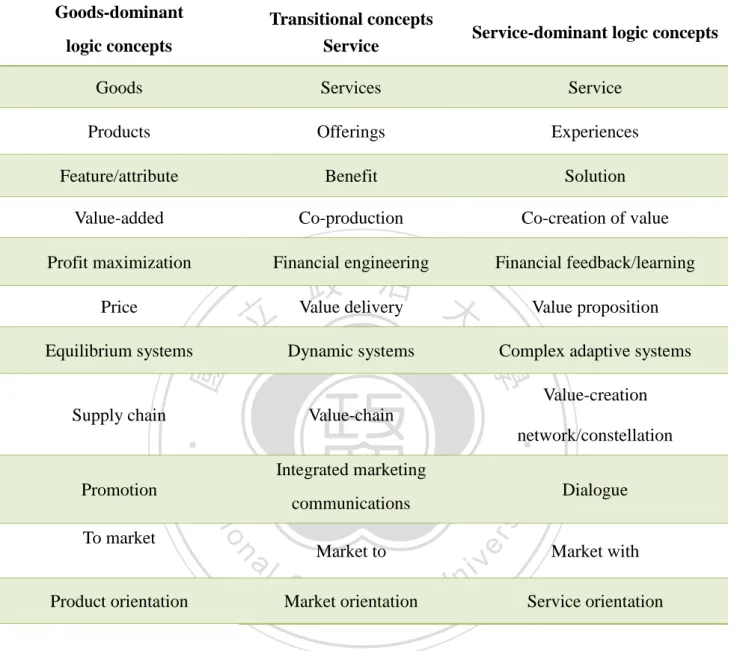
(28) attentions. According to this trend, intellectual property could be the key competitiveness of strategy, which would affect enterprise’s future (Rivette and Klein 2000). Besides, for fulfilling the top goal of business strategy, they should consider the profit from both side- tangible and intangible assets. But nowadays, most of these intangible assets (intellectual property) are utilized and relied on individual enterprise or organization which research, design and develop the assets (Bontis 2000). Thus, it could not be included in others strategy, it might reduce its value. After all, if these assets could be used as operant resources which we are going to discuss in section 2.8, it could. 政 治 大. create more cooperating opportunities and have powerful barging ability. Hence,. 立. because there are too many factors needed to be taken into consideration when making. ‧ 國. 學. business strategy, this research tries to facilitate enterprise whenever they need to formulate their patent/litigation-based business strategy.. ‧ y. Nat. er. io. sit. 2.6 Value Network. The notion of network was proposed early in twenty century, both used in. n. al. Ch. i Un. v. marketing and supply chain management (Achrol 1991; Webster 1992;Achrol and. engchi. Kotler 1999).Simple value chain could not present the complicated economy today. Value network is a new concept to better interpret the economic conditions, because value network is used to analyze the competitive ecosystem (Peppard and Rylander 2006). Besides, supply chain is taken as a part of value network (Lusch et al. 2009). Therefore, value network is better to embody the economic and industrial state than only to consider the value chain or the supply chain, value network is more encompassing (Madhavan et al. 1998; Todeva and Knoke 2005). In the time of knowledge-based economy, how to utilize and manage intangible. 17.
(29) assets would take precedence to think over for enterprises. The value network analysis proposes a way that enterprise could ameliorate its performance by transform their tangible and intangible assets to other forms which could be used by others (Allee 2008); for instance, the knowledge could be concrete in the form of patent, and patent could convert into competitive advantage. The intangible asset is the cornerstone of a firm which wants to be successful, and the success is relied on the company could transform the value into different forms efficiently. Lusch, Vargo and Tanniru (2009) mentioned three purposes of value network: (1). 政 治 大. co-produce service offerings, (2) exchange service offerings, and (3) co-create value.. 立. Thus, this research offers a value network, facilitate enterprises to make the patent. ‧ 國. 學. strategy, so as to co-produce with alliances, cross-licensing to exchange service offering, and improve the value of company together to compete with the rivals.. ‧. IP+ would put enterprise (i.e., each system user) in the center of value network to. y. Nat. sit. display the overall network, because the most valuable resources and information are. n. al. er. io. centralized. Letting enterprise in the heart of the network would well allocate the relations with others for enterprise.. Ch. engchi. i Un. v. 2.7 Value Constellation Today, if an enterprise want to success, they could not just concentrate on how to add value to their product or service, they also need to pay attention to how to reinvent the value (Normann and Ramírez 1993). Before, the business strategy needs to think how to help enterprise to find the right position in the value chain, but now the way of creating the value is new, therefore, they need to define the position in value constellation.. 18.
(30) Value constellation here means regrouping the relationship between manufacturers and customers, and co-creates value with suppliers, partners, strategic alliances, competitors, employees and customers; this is just like a constellation (Normann and Ramírez 1993). The customer is the center, and their needs are captured. Thence, the enterprise should expand the domain, and design a new system of value creation that enterprise could break the old frame, create value toward customers (Normann and Ramírez 1993). Briefly, if the role of customer is changed, the process of enterprise integrating. 政 治 大. value is changed, and the position of enterprise in value constellation is changed, this. 立. would be a new perspective of service dominant logic (Michel et al. 2008).. ‧ 國. 學. In summary, the difference between value chain and value constellation is that value constellation concerns more factors such as the exchanges of knowledge, the. ‧. relations alliance or competition while value chain just thinks about the real exchanges. y. Nat. sit. of products/services and monetary values. Therefore, IP+ wants to stand on the view of. n. al. er. io. value constellation, help enterprise to create the new value- facilitating to make better. i Un. v. strategy, which might combine the value from different enterprises, and they also can. Ch. engchi. play the role of customer, and to get their real needs.. 2.8 Service Dominant Logic In this era of service assumes leadership, many enterprises start to develop their service. Service today could not be thought as one kind of product which is provided unilaterally, and it is the new way regard as value co-creation owning complex configurations of resources (Stephen et al. 2008). Lusch reported that the main emphasis of service should evolve from goods-dominant logic to service dominant logic. 19.
(31) (Luschand Vargo2006). Service dominant logic emphasis that service is not simply an output, such as a product, or an entity, service is more likely a process. And it focuses more on operant resource but not operand resource (Vargo and Lusch 2004).The operand resource is like natural resources or goods and operant resource is like ability of enterprise which might have an influence on others resources. Also, we could see from Table 2.2, this main concept of this research is more close to service-dominant logic concepts. IP+ provides service and solutions embedded, users could co-create the value, that is, user could add their information in to system to. 政 治 大. complete network, and the system is an exemplification of value constellation.. 立. We want to regards every resource in IP+ as operant resources which include. ‧ 國. 學. enterprise itself, patent, patent quantity, and date of patent applying, patent strategy, business strategy, and litigations. So enterprise could find their cooperators, or take use. ‧. of the information and make strategy to create values.. n. er. io. sit. y. Nat. al. Ch. engchi. 20. i Un. v.
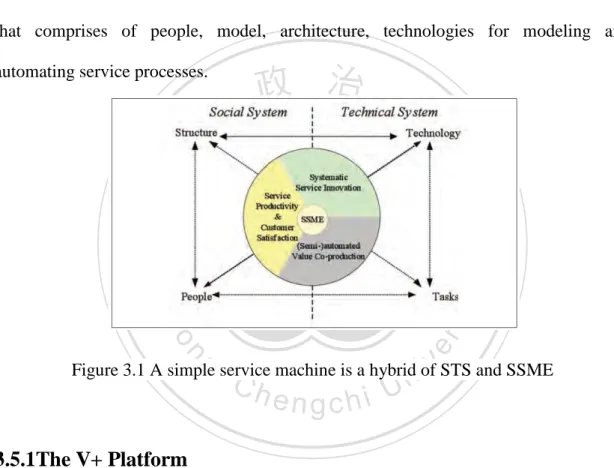
(32) Table 2.2 Conceptual Transitions (Luschand Vargo2006) Goods-dominant logic concepts. Transitional concepts Service. Service-dominant logic concepts. Goods. Services. Service. Products. Offerings. Experiences. Feature/attribute. Benefit. Solution. Value-added. Co-production. Co-creation of value. Profit maximization. Financial engineering. Financial feedback/learning. Price. 立. Equilibrium systems. ‧ 國. Value-creation. ‧ Integrated marketing. Market to. Ch. engchi U. Market orientation. 21. sit. y. al. er. communications. n Product orientation. Complex adaptive systems. network/constellation. io. To market. Dynamic systems. Value-chain. Nat. Promotion. Value proposition. 學. Supply chain. 治 政 大 Value delivery. v ni. Dialogue. Market with Service orientation.
(33) CHAPTER 3. MOTIVATION APPLICATION The task of my research is part of a larger research project dubbed “Prosperity Taiwan”. To create a set of IT-enabled policies and workflows that aids Taiwan’s economic transformation is the main goal of “Prosperity Taiwan”.. 3.1 Taiwan’s Economic Strengths and Current Economic Landscape. 政 治 大 As one of the Four Asian Tigers, Taiwan’s economic growth from 1960s to 1990s 立. ‧ 國. 學. has been exceptional, maintaining at a growth rate excess of 7% per year. Taiwan’s. economic strength originates from its manufacturing capabilities, especially in terms of. ‧. information technology related products. Most of Taiwan’s business comes from. sit. y. Nat. building and manufacturing white-label products that is later branded with American or. io. er. European brands. However, Taiwan’s greatest economic strength turns out to be its. al. iv n C h e ntoday landscape i U several g c hpresents. n. biggest liability in recent years due to changes in the global economic landscape. The global economic. challenges for the. Taiwanese economy: increase in cheaper manufacturing alternatives such as manufacturers from China or Brazil. This leads to increased price competition, severely cutting profit margins for Taiwanese manufacturers, and damage the market balance in Taiwan. There is also an increased premium placed on brand recognition and intellectual property such as the brand named “made in Taiwan (MIT)”; despite Taiwanese’s manufacturing prowess when it comes to building world class hardware such as iPhone, iPods and other globally recognized devices, Taiwanese manufacturers often receive up to only 3 to 5% of the profit share of each device sold. This is because only extreme 22.
(34) minority of goods has their brands known worldwide; most of the Taiwanese manufacturers do not own the brand and or intellectual property of the device. In response to the above challenges, the Taiwanese government highlighted several industries poised for growth including medical services, bio-technology, green energy, culture/arts/creativity and high technology agricultural.. 3.2 The “Prosperity” in Prosperity Taiwan. 政 治 大 material wealth, we are interested in creating comprehensive prosperity. They are 立 Prosperity comes in various forms. While most people associate “Prosperity” with. ‧. ‧ 國. Prosperity.. 學. namely: Material Prosperity, Spiritual Prosperity, Physical Prosperity and Social. sit. y. Nat. 3.3 Vision of Prosperity Taiwan. n. al. er. io. The vision for Prosperity Taiwan is to create sustainable development in economy. i Un. v. by moving up the value chain. The five primary targets are as follows:. Ch. engchi. 1. Enhance university-industrial cooperation. 2. Kick start Taiwan’s economic transformation by creating “industrial modules” 3. Create a model for industry transformation 4. Start small, go big 5. Internationalize based on successful industrial transformation. 3.4 Culture, Arts and Creativity as an Example For a start, Prosperity Taiwan centralizes on the culture/arts/creativity industry. The. 23.
(35) research team believes that the culture/arts/creativity is Taiwan’s sweet spot due to Taiwan’s unique heritage and mix of Chinese and Western influences. We also believe that this group of people and its related stakeholders will benefit most from our research work. We find that the following characteristics define the culture, arts and creativity industry: . Not limited liability or private limited companies. . They have limited ability to scale its production capabilities. . Typically lack financial support or lack knowledge on funding options. . Business owners are at best conservative regarding the growth prospects of. 學. ‧ 國. 立. 政 治 大. the culture and arts. ‧. On an industry level, the market exhibits the following characteristics:. Nat. . Industry lacks interdisciplinary talent. . Lack of financial support or lack transparency in terms of funding options. . The industry lacks economies of scale to support growth. . Multiple stakeholders with political, economical, social and environmental. Ch. engchi. er. n. al. sit. y. Market lacks a system for evaluating intangible assets. io. . i Un. v. objectives.. To combat the above issues, we propose the use of intelligent service machines to assist industry transformation.. 24.
(36) 3.5. Intelligent. Service. Machines. to. aid. Economic. Transformation Intelligent Service Machine(s) (Tung and Yuan, 2010) refers to an intelligent design of the service machine featuring the embodied cognition of co-production in terms of modeling and automating the cognitive process and knowledge representations as required. Conceptually, a simple service machine is a socio-technical system (STS) that comprises of people, model, architecture, technologies for modeling and automating service processes.. 立. 政 治 大. ‧. ‧ 國. 學. n. er. io. sit. y. Nat. al. i Un. v. Figure 3.1 A simple service machine is a hybrid of STS and SSME. Ch. engchi. 3.5.1The V+ Platform The V+ platform (Figure 3.2) is an intelligent service machine that consists of 5 simple service engines aimed at solving problems of industry transformation as exemplified in the independent industrial enterprise and the industry as a whole.. 25.
(37) Figure 3.2 The V+ Platform On a macro-level, we have Capital+ forming the foundation of the V+ platform, for every stage of a product life cycle in various industries will most likely involve some form of funding activities. On top of Capital+, next, we have Discover+ which helps. 政 治 大. businesses discover new insights, which can be further strengthened or extended by the. 立. design insight patterns recommended by Design Intelligence+. After that, Sourcing+ can. ‧ 國. 學. readily translate design insights into market opportunities by bringing about various. ‧. operant resources from possible stakeholders in an industry under a holistic system thinking view. Finally, Intellectual Property (IP+) comes into play by ensuring that. y. Nat. n. al. er. io. Sourcing+... sit. proper IP strategies can be formed based on the operant resources identified in. Ch. On a micro-level, each engine works as such: . engchi. i Un. v. Capital+: designed to solve the problem of funding and investment on an individual level and the industry as a whole. It provides a prediction model for individuals to estimate which investor(s) has a higher possibility of funding them. In addition, Capital+ provides general industry growth models based on the evolution of investors and companies within an industry.. . Discover+: an IT-artifact with common sense knowledge directed to facilitate design insight discovery process. The common sense knowledge in this engine is. 26.
(38) powered by ConceptNet. Discover+ is targeted at assisting novice and enterprise designers with only the goods-dominant logic mindsets. . Design Intelligence+: is developing the framework and method to externalize, formalize and facilitate “insight combination” that is a process of discovering connection between “insights” and “design patterns” and integrating them to emerge idea or inspiration for service design.. . Sourcing+: a service machine targeted at Small and Medium Sized enterprises (SMEs) to enable them to discover niche markets as stipulated in the Long Tail. 政 治 大. Theory when given design insights. Sourcing+ is also an IT-enabled system that. 立. exploits open new operant sources from various stakeholders to provide. ‧ 國. . 學. discovery of market opportunities found in the Long Tail.. Intellectual Property+ (IP+): aims at fostering the use of intellectual property as. ‧. a means for moving up the value chain either through forging alliances or as a. y. Nat. sit. litigation/patent strategy according to the identified operant resources by. n. al. er. io. Sourcing+. It provides a framework based on value constellation that helps. i Un. v. companies to pursue, manage and maneuver their IP strategy.. Ch. engchi. V+ platform is designed to act as a generic service engine that can be applied to most situations. For simplicity and demonstration sake, we explain an application scenario of how V+ platform can be applied in the next section.. 3.5.2 Application Scenario of V+ platform Consider the various issues ranging from political, economical, environmental and social factors when a company or business builds a factory in a less developed region. Very often, the company may face protests from local residents or even local 27.
(39) governments due to concerns over environmental pollution, negative impact on way of life of local residents or even adverse effect on the local economy. The V+ platform works by helping various stakeholders search and suggest possible solutions to this problem. Let us assume that the agreed solution is to create a museum to educate the general public on environmental protection. In this scenario, we are expecting multiple stakeholders and not all funding for setting up the museum will come from the company. Therefore, V+ platform can help to search for multiple investors based on the stakeholders involved. This can happen at. 政 治 大. various stages of the construction of the museum. The main engine used for sourcing. 立. investment is done via Capital+.. ‧ 國. 學. Discover+ creates new insights based on the stakeholders’ objectives. These stakeholders include the local residents, governments, potential visitors to the museum. ‧. and the companies involved. After gathering the stakeholders’ requirements, these. y. Nat. sit. requirements are used as inputs for the Discover+ engine, where new and potential. n. al. er. io. insights maybe generated for framing and reframing process. Such information is useful. i Un. v. for museum designers or related service designers. The output of Discover+ is then used. Ch. engchi. as an input for Sourcing+. Design Intelligence+ then helps elevate the insights to foster the degree of impacts in terms of the scalability of stakeholders involved or the service values incurred. Sourcing+ analyzes the insights provided by Discover+ and maps out possible required market intelligence and or related trends. For example, what can one expect from a museum? What form of services, artifacts, displays, etc. can one expect from a museum given various stakeholders? Sourcing+ helps answer these questions by integrating current trends and expectations, such as screening documentaries or educational movies on environmental protection, interactive learning for children and so 28.
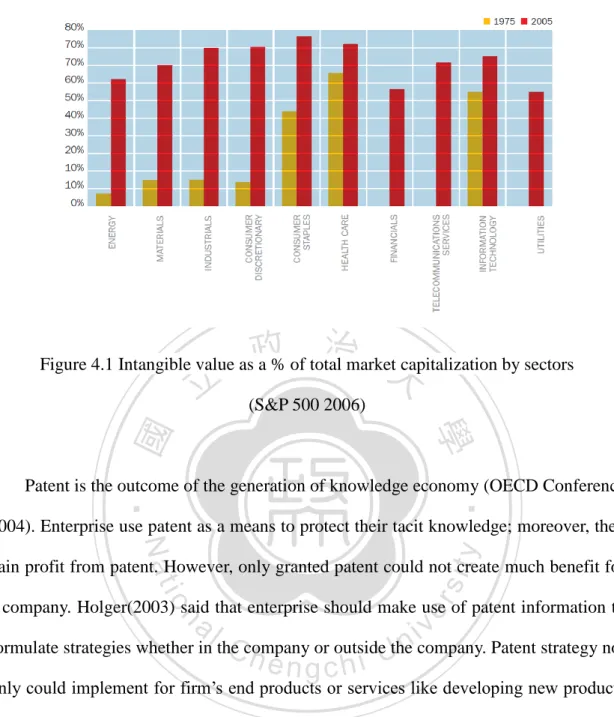
(40) on as inputs for market sensing. The market sensing capabilities of Sourcing+ then facilitates research between various stakeholders and generates possible answers to aforementioned questions. IP+ adds support to our scenario by providing IT-enabled assistance for understanding the overall patent value based on the operant resources identified by Sourcing+. Take for instance, the museum might be interested in deploying an operant resource of interactive TV. The related technologies and hence patents may be related to such as those used in Microsoft’s Kinect. Such knowledge will aid potential. 政 治 大. implementation avoid litigation and hence pave the overall patent/litigation and. 立. 學. ‧ 國. business strategy.. 3.6 System Scenario. ‧. The county like Yunlin in Taiwan, except the traditional industry, agriculture and fisheries, for instance, it is also an important city of industry. Because the low-priced. y. Nat. io. sit. land could significantly decrease the budget for industrial enterprise, there are more and. n. al. er. more industrial zones set up in Yunlin. There is an enterprise “E” that is an industrial. Ch. i Un. v. enterprise in Yunlin, and they want to make their contributions back to society by. engchi. building up a museum, helping children foster environmental awareness and letting the general public realize the importance of environmental protection. From the financial point of view, they could get funding from Capital+ in every stage of constructing the museum. At the early stage of proposal, the stage just before erecting the museum or after the total engineering project is finished. The investment could come from government, education units, or other enterprises who also want to give their feedback to society. Then Discover+ will generate an insight which will give the “E” enterprise an inspiration and the direction. For example, the enterprise might. 29.
(41) have no idea how to attract local public to visit the museum, how to let people better know the importance of environmental protection. The output of Discover+ would be like this, “Children need to read interesting stories about environment protection because stories can help children to have motivation to learn.” Design Intelligence+ here could further strengthen the insight comes from Discover+ by combining with the design patterns. Sourcing + then takes output from Discover+ and Design Intelligence+ as input, the outcome of Sourcing+ would be the new chances and market trends as new operant sources. The examples of the output of Sourcing+ are likes “Interactive. 政 治 大. Learning,” “Mini Short Video,” “EBook,” and “Interactive TV Wall.” After Sourcing+. 立. suggests the operant sources, the enterprise could choose which suggestions to. ‧ 國. 學. implement in the museum.. Assuming the enterprise “E” chooses to set up the “Interactive TV Wall” in their. ‧. museum as the main feature to provide interesting stories and make interaction with. y. Nat. sit. children. Therefore, the enterprise might choose to develop their own interactive TV. n. al. er. io. wall for the museum. First, they would want to know which company controls this key. i Un. v. technique, and the overall patent network concerning interactive TV, in order to set up. Ch. engchi. the TV wall with least cost and human resources. The user could get the overall patent value network provided by IP+ just searching with the key word from Sourcing+, “interactive TV”, for instance. Besides, user may come up with the new idea- let TV wall work and interact with children like kinect, not just providing a big touch screen, which is stimulated by the outcomes from Sourcing+. Therefore, user may search with key words that are the technologies used in kinect, for instance, “sensor”, “scanning”, and etc. After IP+ got the key word from system user “E”, it will search with the key word for the related patents from Google Patent, and find the assignees of these patents. Next, 30.
(42) it will dig the litigated news from STPI website, and establish the network according to the patent litigations. The enterprise could clearly know the related market status from value network. For example, Microsoft controls the main related patents of kinect (Image contrast enhancement in depth sensor, patent- U.S. 8054290), and which firm had litigated relationship with Microsoft. If the system user “E” wants to add the new node- Maxiken, a company devotes to interactive technology suggested by Sourcing+ and it is the one enterprise “E” is interested to cooperate with. IP+ will rebuild the network with the key word derived. 政 治 大. from Maxiken. Finally, the system user could make comprehensive patent strategy, IP+. 立. could help enterprises to save time and resources to develop the interactive TV wall. ‧. ‧ 國. 學. through the patent and litigation based value network.. n. er. io. sit. y. Nat. al. Ch. engchi. 31. i Un. v.
(43) CHAPTER 4.METHODOLOGY Chapter 4 illustrates the details of making use of patents and patent litigations to work up the system. The purpose in this chapter is to clarify how to utilize patents, patent litigations as main elements to set up a value network. It will be presented in system architecture first, then thoroughly elaborate each module which constitutes the whole system. Except, clears the unique and innovative contribution. In this chapter,. 治 政 each other, how the whole system operates, and how the大 system interacts with users. 立. there are some examples to demonstrate the way about how every module connects with. ‧ 國. 學. 4.1 Conceptual Framework. ‧. The economy transformed from manufacturing into service based on knowledge,. Nat. sit. y. more companies got profit from their intangible asset, and influx of investment is more. n. al. er. io. toward intangible asset. S&P 500 reported the transformation of intangible asset from. i Un. v. 1975 to 2000. In the examination (Figure. 4.1), we could see the percentage of. Ch. engchi. intangible asset in different industries extremely increased. In fact, we would have developed epoch-making technologies and initiated new industries as time goes on, so the intangible asset would increase definitely, for instance, the industry like telecommunication. But the figure shows that not only the new service sectors increased, the percentage of all industries raised. So we could affirm the significance of intangible assets for all enterprises and industries.. 32.
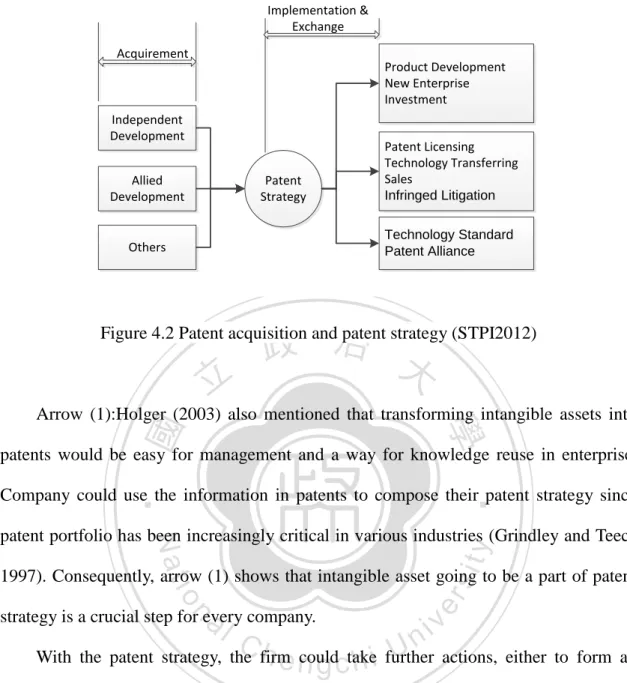
(44) 政 治 大. Figure 4.1 Intangible value as a % of total market capitalization by sectors. 立. (S&P 500 2006). ‧ 國. 學 ‧. Patent is the outcome of the generation of knowledge economy (OECD Conference 2004). Enterprise use patent as a means to protect their tacit knowledge; moreover, they. y. Nat. er. io. sit. gain profit from patent. However, only granted patent could not create much benefit for a company. Holger(2003) said that enterprise should make use of patent information to. n. al. Ch. i Un. v. formulate strategies whether in the company or outside the company. Patent strategy not. engchi. only could implement for firm’s end products or services like developing new products or services, but also is deemed as a fundamental for helping patent licensing, technology transferring, transaction, and infringed litigation. Furthermore, patent strategy could be seen from a macro point of view as a technology standard or patent alliance (STPI 2012).. 33.
(45) Implementation & Exchange Acquirement. Product Development New Enterprise Investment. Independent Development Allied Development. Patent Licensing Technology Transferring Sales Infringed Litigation. Patent Strategy. Technology Standard Patent Alliance. Others. 政 治 大. Figure 4.2 Patent acquisition and patent strategy (STPI2012). 立. ‧ 國. 學. Arrow (1):Holger (2003) also mentioned that transforming intangible assets into patents would be easy for management and a way for knowledge reuse in enterprise.. ‧. Company could use the information in patents to compose their patent strategy since. sit. y. Nat. patent portfolio has been increasingly critical in various industries (Grindley and Teece. io. al. er. 1997). Consequently, arrow (1) shows that intangible asset going to be a part of patent. iv n C U actions, either to form an With the patent strategy, the h firm e ncould h i further g ctake n. strategy is a crucial step for every company.. alliance through cross-licensing or to compete with large company by mergers and acquisitions (Holger Ernst 2003). As mentioned in Section 1, the issue of litigation among enterprises has become increasingly significant in competitive market and industry (Fenwick & West LLP 2005). Consequently, it is imperative for patent strategy embodying the strategic consideration of patent litigations. Arrow (2) and (3): Allying and competing can be regarded as policy decisions ofthe patent strategy. Enterprises might ally in order to weaken the power of rivals by preventing them to get resources from outside firms and ally with other companies 34.
(46) (Gomes 1994). On the other hand, company might also heighten their capability by relatively intense means. So Arrow (2) and (3) would be actionable policies for enterprises to intensify their patent strategy. Arrow (4) and (5): When implementing the actionable policies, an enterprise need to consider the overall litigation relations (across different relevant industries) including licensing, cross-licensing, merging and acquisition (that would possibly involve third-party companies partnering with the alliances or competitors of the enterprise), resulting into the shaping a network of specific market to realize the business strategy. 政 治 大. embodying the strategic patent litigation relations.. Nat. (3). Competition. io. (5). n. er. Figure 4.3 Conceptual Framework. al. Patent-Based Business Strategy. ‧. Litigation-Aware Patent Strategy. y. (1). (4). Alliance. sit. Intangible Assets. (2). 學. ‧ 國. 立. Ch. 4.2 System Architecture. engchi. i Un. v. The purpose of this research is to establish a network analysis service based on patent litigations and patent strategies by IT system. We provide a new method for enterprises, facilitating their decisions making, and company operating. In other words, enterprise could improve their patent strategy, find the appropriate partners, and avoid the rivals’ litigated actions. Figure 4.4 shows the system architecture. User will start at the Check Relevant Patent module at the beginning of the service. System will search patents according to the basic user's data storing in the User. 35.
(47) Database. Apart from searching by the enterprise’s specialized field, this system combine the sphere which user is interested in, so user can search their interested patent type by Search Specific Patent module. After collecting some patents that user wanted, these patents' data will be passed down to the Find Patent's Assignee module to find assignees from patents. In the module of Search Assignee's Relevant Litigation, system makes use of assignees to do contrast in STPI Database, in order to discover the concerning litigations. Besides searching relevant litigations, Find patent's Assignee module will pass assignees to Find Assignee's Relation module to check whether these. 政 治 大. assignees have litigated relations set up by litigations. In the final step, Build Network. 立. module, system works on a network in line with these litigations and assignee's relations,. ‧ 國. 學. displaying the connections of each firm. User can adjust the final outcome, revise the link amidst enterprises, and then they will get the output which can be used to make. Nat. y. ‧. patent strategy, and the outcome is what enterprises really need.. sit. By means of this system, it will reach the research goal, establishing a service of. n. al. er. io. network analysis using patent litigations and strategies. It also offers a new way to assay. i Un. v. relations behind patents, advancing user to make suitable patent strategy. Therefore,. Ch. engchi. enterprises will gain a positive cycle, applying the information of patent strategies and patent litigations to make the better patent strategies preventing harmful litigation war.. 36.
(48) Google API. Find Patent’s Assignee Search Specific Patent. Search Assignee’s Relevant Litigation. 立. Find Assignee’s Relation. 政 治 大. ‧ 國. Build Network. 學. Facilitating Enterprise to Make PAtent/Business Strategy. ‧. io. n. al. er. Nat. Figure 4.4 System Architecture. y. Patent Database. Check Relevant Patent. sit. User Database. STPI Database. i Un. v. Check Relevant Patent Module and Search Specific Patent Module. Ch. engchi. The function of Check Relevant Patent Module is to grabble patents automatically from Patent Database-Google Patent, on the basis of User Database storing concerning information of enterprise users, and this module is assisted by Google API. When users start to access the service, they need to register. At this step, they need to provide their basic information, and their information would be saved in User Database, the samples are showed in Table 4.1. The User Name could be a person or a company name, and the Industry comes from Standard Industrial Classification of Council of Labor Affairs published by Taiwan Executive Yuan (1996).Specific Field is the subclasses under each Industry. Besides, users need to fill Product/Service Name 37.
(49) and Patent number if they already had products and services, or applied patents. The system would search with more accurate keywords from Product/Service Name, if users have no Product/Service Name, keyword would be Specific Field instead. After the keyword is determined, system would start to search, the search engine is supported by Google Customer search API. The target patent database is Google Patent (https://www.google.com/?tbm=pts). Google Patent includes U.S patents from 1790 till now, we can search with number, name, inventor, assignee, Filing date, Issue date, U.S. Patent Classification (USPC) and International Patent Classification (IPC) of patent.. 政 治 大. And the documents of patent consist of abstract, citations, referenced by, claims, etc.. 立. Hence, the keyword would come from User Database - Product/Service Name or. ‧ 國. 學. Specific Field as a patent name to search in Google Patent. Except searching patent with keyword, the system adds date of published as filter and the granted patent as condition.. ‧. The date of publishing is set from now to two years ago, assuming that the technology. Nat. sit. y. rapidly grow and the range of date wouldn’t need to be a long time. Also, the system. n. al. er. io. only search patents that have got permission, since we are not sure the patents under applications would be accepted or not in the end.. Ch. engchi. i Un. v. Table 4.1 Examples of System Users’ Basic Information User. Industry. Specific Field. Name HTC. Product/Service. Patent. Name Manufacturing. Communications. Smart phone. US6,999,800. Priceline.com. US8,229,773. equipment manufacturing Priceline. Business and. Information services. Services. 38.
(50) Google API. Field: LED Google Patent. Product: High Power LED, SMD LED. Search. LED. User Database. Check Relevant Patent. Start Date: 2010-08-01 End Date: 2012-08-01. Search Specific Patent Patent Database. All patent status Applying patents Granted patent. 政 治 大. Keyword: LED. 立. ‧ 國. 學. Patent 7943952 - Method of uniform phosphor chip ... Patent 7858408 - LED with phosphor tile and ... Patent 8129734 - LED package with stepped aperture. Nat. sit. y. ‧. …. io. er. Figure 4.5 Concept of Check Relevant Patent and Search Specific Patent Module. al. n. iv n C For Example, “L” company ishaeLED n gproduction c h i U company (Figure 5), and they decide to develop their own new product. So in the first step, the system should get keyword which is from Company’s Product/Service Name or company decided, as to check and search patents. Product/Service Name –High Power LED and SMD LED, would be used to search in Google Patent. The outcomes are granted patents which contain “LED” in the patent name and published from two years ago. After the Check and Search module, relevant and specific patents will be found, and these data would be passed down to Find Patent’s Assignee. If enterprises have no idea how to set up their patent strategy, or they haven't 39.
數據
+7

相關文件
files Controller Controller Parser Parser.
Because the nodes represent a partition of the belief space and because all belief states within a particular region will map to a single node on the next level, the plan
“The Connectivity Map: using gene-expression signatures to connect small molecules, genes, and disease.” Science 313(5795): 1929–1935.
The algebraic homology functor assigns to a chain complex its sequence of ho- mology groups and to a chain map the induced homomorphisms on homology defines a functor from the
It is concluded that the proposed computer aided text mining method for patent function model analysis is able improve the efficiency and consistency of the result with
These kind of defects will escape from a high temperature wafer sort test and then suffer FT yield, so it is necessary to add an extra cold temperature CP test in order to improve
IPA’s hypothesis conditions had a conflict with Kano’s two-dimension quality theory; in this regard, the main purpose of this study is propose an analysis model that can
Clay Collier, “In-Vehicle Route Guidance Systems Using Map-Matched Dead Reckoning", Position Location and Navigation Symposium, IEEE 1990, 'The 1990's - A Decade of Excellence in the
