行政院國家科學委員會專題研究計畫 成果報告
高安定性及高活性 Pt-M/C 雙金屬觸媒電極的研製及其對甲
醇及 CO 氧化反應機制與催化作用之探討
研究成果報告(精簡版)
計 畫 類 別 : 個別型 計 畫 編 號 : NSC 99-2221-E-151-059- 執 行 期 間 : 99 年 08 月 01 日至 100 年 10 月 31 日 執 行 單 位 : 國立高雄應用科技大學化學工程與材料工程系 計 畫 主 持 人 : 卓錦江 公 開 資 訊 : 本計畫可公開查詢中 華 民 國 101 年 01 月 30 日
中 文 摘 要 : 本研究以含浸法,使用 NaBH4 作為還原劑,製備不同組成之 PtRu/C、Pt-M/C 及 PtRuTa/C 複合電極觸媒,有系統地探討 各種觸媒對甲醇氧化之催化活性及穩定性。經由實驗研究不 同掃描速率對於 Pt 及 Pt-M 組成觸媒對甲醇起始氧化電位 (Methanol oxidation on-set potential VMOSP)及 CO 起始 氧化電位(CO oxidation on-set potential VCOSP)判讀之影 響,發現 PtRu 電極觸媒中的 VMOSP 遲滯現象可隨著掃描速率 降低而趨於減緩,且正向及逆向掃描所顯示 VMOSP 值隨著掃 描速率降低而趨於相同之定值,由此方式判讀 VMOSP 可避免 遲滯現象所致之誤差,求得 VMOSP 精確值。據此以循環伏安 法(CV)量測 PtRu 觸媒在甲醇水溶液中對甲醇氧化活性之結果 顯示,當 Ru 含量達 50 atm%以上時,PtRu 觸媒具有最負之 VMOSP;另一方面,其他 Pt-M/C 觸媒對於催化甲醇氧化之研 究結果顯示:添加第二金屬 Ir 及 Sn 之電極觸媒所得之 VMOSP 與 Pt/C(約 0.45 V vs. SCE)無明顯差異,與 PtRu/C 觸媒之 VMOSP(約 0.25 V)相較,並無顯著 bifunctional mechanism 或 ligand effect 可促進 Pt 觸媒對氧化甲醇活性 之效果。此外,利用循環伏安法(CV)及計時安培法(CA)進行 PtRuTa/C 觸媒對於甲醇氧化反應的電化學特性分析,結果顯 示:當 Ta 添加含量小於 5mol%時,可有效分散 PtRu 觸媒提 升其比催化活性,Pt 之比催化活性隨著 Ta 含量增加而增 加,然而當大於 5 mol %之後,則因 PtRu 觸媒之部份表面積 被 Ta 覆蓋,比催化活性隨著 Ta 含量增加而呈下降趨勢。此 外,經由在 0.5 M 硫酸的甲醇水溶液中,於定電位(0.40 V vs. SCE)下,進行計時安培 CA 法量測之結果顯示,複合電極 觸媒中添加 Ta 組成可有效發揮其在酸液中之耐腐蝕特性,防 止 PtRu 在酸液中之溶解現象發生,且隨著觸媒中的鉭含量增 加而使其穩定性上升,達到持續催化甲醇氧化的安定效果; Ta 含量約 5 mol %時,PtRuTa 電極觸媒可兼具有促進催化活 性及安定性的最適化效果。 中文關鍵詞: 直接甲醇燃料電池、甲醇起始氧化電位、PtRu 催化活性、釕 溶解、穩定性
英 文 摘 要 : The characteristics and activities of Pt-M/C bi-metallic electrocatalysts and PtRuTa/C tri-bi-metallic electrocatalysts prepared by impregnation method were studied in this work in an attempt to obtain high performance catalysts for methanol oxidation reaction (MOR). Electrochemical measurements, including cyclic voltammetry (CV), chronoamperometry method (CA) and CO stripping voltammetry, were employed for examining
the activities and stabilities of the electrodes. The results show that the hysteresis phenomenon in the CV curves on the PtRu/C electrodes at various scan rates is less significant compared with that on Pt/C
electrodes. The hysteresis decreases with the decrease of scanning rate. The methanol oxidation onset potentials (VMOSP) found on the forward and backward CV scan, respectively, approach to a same value, showing that the accurate VMOSP value with no hysteresis interference can be obtained by this approach. The VMOSP shifts negatively with the increase of the Ru content in the catalysts and approach to the values of the CO oxidation onset potentials (VCOSP) on the electrodes when the Ru content is higher than 50 atom%. This result indicates that the optimum Ru content in the PtRu catalysts for MOR is around 50 atom%. The VMOSP obtained on the PtRu/C (50 atom% Ru) and Pt/C
electrocatalysts is 0.25 V and 0.45 V, respectively. Moreover, the negative shifts of VMOSP obtained at PtSn/C and PtIr/C electrocatalysts, compared with the Pt/C catalysts, were found to be insignificant,
indicating that the improving effects of the Ir and Sn contents in the catalysts is minor as compared with the Ru contents.
Besides, the electrochemical measurements for the PtRuTa/C tri-metallic electrocatalysts show that the Ta contents in the PtRuTa catalyst effectively
depress the dissolution of Pt and Ru and enhance the stability of the electrocatalysts during the CV tests. The stability of the electrocatalysts
increases with the increase of the Ta contents in the catalysts. In addition, the Ta contents improve the distribution of electrocatalysts and increase the specific current (Isp) for MOR based on Pt in the range of 0-5 mol%. However, the Isp decreased with the increase of the Ta content when the Ta content was higher than 5 mol% due to part of active sites of PtRu catalyst were covered by the Ta oxides. The optimum Ta content for a highest Isp of the
英文關鍵詞: DMFC, methanol oxidation onset potential,
electrocatalytic activity, dissolution of ruthenium, stability
行政院國家科學委員會補助專題研究計畫
■成果報告
□期中進度報告
高安定性及高活性 Pt-M/C 雙金屬觸媒電極的研製及
其對甲醇及 CO 氧化反應機制與催化作用之探討
Preparations of Pt-M/C bi-metallic electrocatalysts with high
stability and high activity for MeOH oxidation
計畫類別:■個別型計畫 □整合型計畫
計畫編號:NSC 99 - 2221 - E - 151 - 059 -
執行期間:99 年 08 月 01 日至 100 年 10 月 31 日
計畫主持人:卓錦江
執行機構及系所:國立高雄應用科技大學化學工程與材料工程系
聯絡電話:(07) 3814526-5109
E-mail address:[email protected]
成果報告類型:■精簡報告 □完整報告
中 華 民 國 100 年 12 月 30 日
中文摘要
本研究以含浸法,使用 NaBH4作為還原劑,製備不同組成之 PtRu/C、Pt-M/C
及 PtRuTa/C 複合電極觸媒,有系統地探討各種觸媒對甲醇氧化之催化活性及穩 定性。經由實驗研究不同掃描速率對於 Pt 及 Pt-M 組成觸媒對甲醇起始氧化電位 (Methanol oxidation on-set potential VMOSP)及 CO 起始氧化電位(CO oxidation
on-set potential VCOSP)判讀之影響,發現 PtRu 電極觸媒中的 VMOSP遲滯現象可隨
著掃描速率降低而趨於減緩,且正向及逆向掃描所顯示 VMOSP值隨著掃描速率降
低而趨於相同之定值,由此方式判讀 VMOSP 可避免遲滯現象所致之誤差,求得
VMOSP精確值。據此以循環伏安法(CV)量測 PtRu 觸媒在甲醇水溶液中對甲醇氧
化活性之結果顯示,當 Ru 含量達 50 atm%以上時,PtRu 觸媒具有最負之 VMOSP;
另一方面,其他 Pt-M/C 觸媒對於催化甲醇氧化之研究結果顯示:添加第二金屬 Ir 及 Sn 之電極觸媒所得之 VMOSP與 Pt/C(約 0.45 V vs. SCE)無明顯差異,與 PtRu/C
觸媒之 VMOSP(約 0.25 V)相較,並無顯著 bifunctional mechanism 或 ligand effect 可促進 Pt 觸媒對氧化甲醇活性之效果。此外,利用循環伏安法(CV)及計時安培 法(CA)進行 PtRuTa/C 觸媒對於甲醇氧化反應的電化學特性分析,結果顯示:當 Ta 添加含量小於 5mol%時,可有效分散 PtRu 觸媒提升其比催化活性,Pt 之比催 化活性隨著 Ta 含量增加而增加,然而當大於 5 mol %之後,則因 PtRu 觸媒之部 份表面積被 Ta 覆蓋,比催化活性隨著 Ta 含量增加而呈下降趨勢。此外,經由在 0.5 M 硫酸的甲醇水溶液中,於定電位(0.40 V vs. SCE)下,進行計時安培 CA 法 量測之結果顯示,複合電極觸媒中添加 Ta 組成可有效發揮其在酸液中之耐腐蝕 特性,防止 PtRu 在酸液中之溶解現象發生,且隨著觸媒中的鉭含量增加而使其 穩定性上升,達到持續催化甲醇氧化的安定效果;Ta 含量約 5 mol %時,PtRuTa 電極觸媒可兼具有促進催化活性及安定性的最適化效果。
關鍵字:直接甲醇燃料電池、甲醇起始氧化電位、PtRu 催化活性、釕溶解、穩 定性。
II
Abstract
The characteristics and activities of Pt-M/C bi-metallic electrocatalysts and PtRuTa/C tri-metallic electrocatalysts prepared by impregnation method were studied in this work in an attempt to obtain high performance catalysts for methanol oxidation reaction (MOR). Electrochemical measurements, including cyclic voltammetry (CV), chronoamperometry method (CA) and CO stripping voltammetry, were employed for examining the activities and stabilities of the electrodes. The results show that the hysteresis phenomenon in the CV curves on the PtRu/C electrodes at various scan rates is less significant compared with that on Pt/C electrodes. The hysteresis decreases with the decrease of scanning rate. The methanol oxidation onset potentials (VMOSP) found on the forward and backward CV scan, respectively, approach to a
same value, showing that the accurate VMOSP value with no hysteresis interference can
be obtained by this approach. The VMOSP shifts negatively with the increase of the Ru
content in the catalysts and approach to the values of the CO oxidation onset potentials (VCOSP) on the electrodes when the Ru content is higher than 50 atom%.
This result indicates that the optimum Ru content in the PtRu catalysts for MOR is around 50 atom%. The VMOSP obtained on the PtRu/C (50 atom% Ru) and Pt/C
electrocatalysts is 0.25 V and 0.45 V, respectively. Moreover, the negative shifts of VMOSP obtained at PtSn/C and PtIr/C electrocatalysts, compared with the Pt/C
catalysts, were found to be insignificant, indicating that the improving effects of the Ir and Sn contents in the catalysts is minor as compared with the Ru contents.
Besides, the electrochemical measurements for the PtRuTa/C tri-metallic electrocatalysts show that the Ta contents in the PtRuTa catalyst effectively depress the dissolution of Pt and Ru and enhance the stability of the electrocatalysts during the CV tests. The stability of the electrocatalysts increases with the increase of the Ta contents in the catalysts. In addition, the Ta contents improve the distribution of electrocatalysts and increase the specific current (Isp) for MOR based on Pt in the range of 0-5 mol%. However, the Isp decreased with the increase of the Ta content when the Ta content was higher than 5 mol% due to part of active sites of PtRu catalyst were covered by the Ta oxides. The optimum Ta content for a highest Isp of the electrodes for methanol oxidation is about 5 mol %.
keywords : DMFC, methanol oxidation onset potential, electrocatalytic activity, dissolution of ruthenium, stability.
一、前言
直 接 甲 醇 燃 料 電 池 (Direct methanol fuel cell, DMFC)擁有高能轉 換效率,可操作於低溫並汙染性低, 已被視為解決未來能源危機的重要選 擇之ㄧ。鉑(Platinum)通常做為DMFC 陽極觸媒材料,但因Pt催化甲醇的脫氫 氧化反應過程中,生成中間物ㄧ氧化 碳易吸附於Pt表面,造成Pt觸媒毒化 (Poisoning)以致活性降低。目前解決Pt 觸媒CO毒化的問題,主要是在Pt觸媒 中添加氧化活性較高的第二金屬觸 媒,諸如Ru、Ir、Sn、Co等金屬[1-6] 提供活性氧將CO氧化成CO2,藉以提 昇電極催化活性及穩定性 。 其中釕 (Ruthenium)生成氧氣過電位極低,钌 氧化物易吸附溶液中之水分子,分解 生成Ru-OH,促進Pt表面吸附的CO氧 化成CO2,使Pt恢復到最初之活性表 面,為最有效的第二金屬觸媒。 文獻上研究探討陽極觸媒的催化 性能,大多利用甲醇及CO在工作電極 的 起 始 氧 化 電 位 (Methanol oxidation on-set potential VMOSP,CO oxidation
on-set potential VCOSP) 測試之。然而本
研 究 室 利 用 含 浸 法 (Impregnation method)製備不同Pt-Ru觸媒組成之複 合 電 極 , 有 系 統 探 討 各 個 組 成 之 Pt-Ru/C電極觸媒對甲醇起始氧化電位 及CO起始氧化電位,發現量測之VCOSP
和VMOSP隨掃瞄之速率(scanning rate)
增大而有遲滯的現象導致無法精確判 讀VMOSP;此外,Ru最適比例由文獻報 告上並無一致之結論,文獻上也曾提 出觸媒的活性與其晶面結構及粒徑大 小有關[7-8],但整體上,觸媒組成仍 是影響觸媒催化活性的主要因素。 除了上述複合電極觸媒的催化活 性外,觸媒的安定性亦是電極觸媒在 商業應用上不可或缺的條件。許多研 究報告顯示Pt-Ru電極活性,經短時間 運作後有嚴重活性衰退現象 [9-12]。 此外,鉑釕觸媒本身微溶於酸性溶液 中[13-15],因此提昇鉑釕觸媒之穩定 性,仍是目前DMFC複合觸媒商業化重 要的考量。 Takasu等人研究指出,添加了閥金 屬氧化物作為質子交換膜燃料電池之 陰極觸媒可以增加電極觸媒在酸性溶 液之穩定性 [16-20]。另一方面,Ueda 等人則提出,添加TaOx之鉑釕複合陽 極觸媒可抑制甲醇氧化反應中間物CO 在鉑金上的表面吸附率,有助提高Pt 的比催化活性[21]。然而,目前為止, 少有文獻探討閥金屬氧化物對鉑釕複 合觸媒的活性和安定性的作用。 本研究以含浸法製備奈米陽極複 合觸媒Pt-M/C,並進行觸媒特性分析 以及探討其對提昇Pt催化性能的作用 和其在實際操作條件下的最佳組成。 另一方面,針對PtRuTa/C三金屬陽極 複合觸媒探討Ta的含量對於電極觸媒 催 化 甲 醇 氧 化 反 應 的 活 性 及 其 在 DMFC酸性電解液中安定性之影響,期 望利用鉭氧化物抗腐蝕的特性以改善 PtRu觸媒在酸性電解液的溶解現象, 並提升電極觸媒之催化活性。 二、實驗方法 (一)還原 Pt-M/C 複合電極觸媒(M = Ru, Ir, Sn) 1.取相同濃度之 3mM H2PtCl6與 3 mM M 溶液,各取 50 ml 同體積混合, 並使用磁石攪拌 30 min。 2. 依 20wt%觸媒承載量,加入 XC-72
2 碳材至於含 25 ml 去離子水中,以超 音波震盪 30 分鐘後取出並加入適量 前驅物混合溶液,攪拌 1 小時使碳材 充分吸附金屬混合溶液。 3.調整溶液 pH 值至 7 後,接著慢慢低 加過量 0.25M NaBH4還原劑並以磁 石強力攪拌 2 hr 後,靜置 6 hr 使觸 媒沉澱。 4.移去上層澄清液,使用抽氣過濾法過 濾之,再以大量 DI water 清洗,取下 層液於坩鍋中以 80℃烘乾,得各種 Pt-M/XC-72 觸媒粉末。 (二) 還原 Pt-Ru-Ta /C 複合電極觸媒 本節製作之金屬觸媒其 Pt/Ru 之 原子比皆為 1:1。取相同濃度之 3 mM H2PtCl6與 3 mM RuCl3溶液,各取 50 ml 同體積混合;再將 TaCl5溶於異丙 醇中配置成 3 mM 鉭前驅物溶液,分 別取出 0、5、10、30、50、70 及 100 ml 之鉭前驅物溶液加入等體積比例之 PtRu 前驅物溶液中混合,並使用磁石 攪拌 30 min。隨後依上述(一)中之步驟 2~4 , 可 得 不 同 Ta 含 量 之 Pt-Ru-Ta/XC-72 觸媒粉末。 (三) 陽極觸媒電極之製作 秤取 4 mg 觸媒粉末加入 0.7 ml 去離子水與 0.3 ml 乙醇溶液中,超音 波震盪 30 分鐘使觸媒分散成為觸媒 ink。取 20μl ink 滴在玻璃碳電極上並 烘乾,再以 5μl 5 wt% Nafion 溶液覆 蓋電極觸媒表面,待其在常溫下乾燥 後作為陽極觸媒電極(工作電極)。 (四) 實驗方法及實驗流程 本實驗之觸媒分析包括物性分析 及電化學分析兩種。物性分析含:X 光 繞 射 分 析 (X-ray diffractometer , XRD) 、 感 應 耦 合 電 漿 質 譜 分 析 儀
(Inductively Coupled Plasma-Mass Spectrometer,ICP-MS)、穿透式電子 顯 微 鏡 (Transmission Electron Microscope,TEM)及掃描式電子顯微 鏡 (Scanning electron microscope , SEM);電化學分析含:循環伏安法 (Cyclic voltammetry,CV)、一氧化碳 剝除實驗(CO-stripping voltammetry)及 計時安培法(Chronoamperometry,CA)。 三、結果與討論 (一) PtRu 電極觸媒對於催化甲醇氧化 之遲滯現象 圖 1 (A) 與 (B) 分 別 為 Pt/C 與 Pt80Ru20/C 電極觸媒掃描速率與正向掃 描及逆向掃描所測得之 VMOSP 的關 係。由圖顯示,Pt/C 正向掃描所得之 VMOSP會隨掃描速率愈慢,愈往負電位 位移,而逆向掃描則反之,此現象顯 示 Pt 電極觸媒掃描行為的遲滯現象會 導致 VMOSP 判讀的誤差。而藉由改變 掃描速率可發現正向與逆向掃描所測 得之 VMOSP,皆隨著掃描速率愈慢而愈 趨近於一點,此表示 Ru 可提升 Pt 對 甲醇氧化催化能力,且利用此一方法 可快速得到 Pt 觸媒之精確 VMOSP。 為進一步探討 Pt/C 及 PtRu/C 之遲 滯現象,在循環伏安法測試中,於高 電位(0.5V vs. SCE)維持一段時間,結 果如圖 2(A)與(B)所示。Pt/C 及 PtRu/C 相較於未經保持高電位之掃描,皆有 較大之氧化電流,且 PtRu/C 相較 Pt/C 無明顯的遲滯現象產生,此結果亦說 明 PtRu 觸媒上 Ru(OH)x 的快速氧化還 原 可 逆 性 , 發 揮 bifunctional mechanism,有效促進 Pt 上吸附的 CO 氧化。 (二) PtRu/C 電極觸媒中 Ru 含量對於
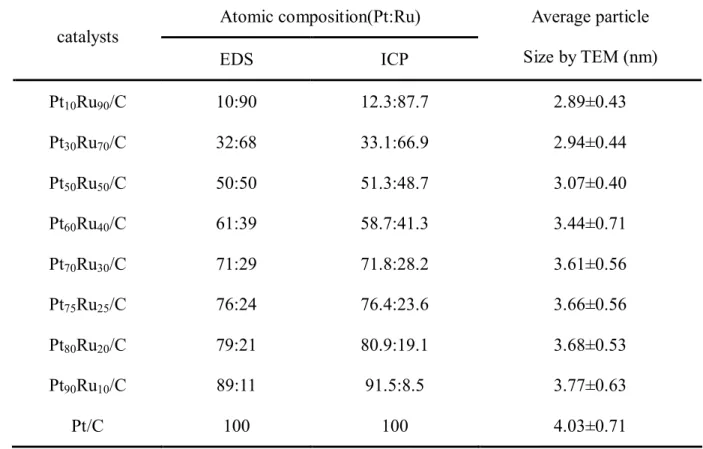
催化甲醇氧化之影響 以 含 浸 法 合 成 之 PtRu 觸 媒 由 XRD 及 TEM 結果得到 PtRu 之結晶特 性與顆粒大小,而觸媒組成分析經由 EDS 與 ICP 測量結果則顯示 Pt 與 Ru 組成比例與原先配置溶液的濃度比例 一致。此外,Pt 與 Ru 形成結晶,其平 均粒徑隨著 Ru 含量愈多而愈小,其相 關數據整理於表 1 中。 圖 3(A)為不同組成之 PtRu/C 電極 觸 媒 在 不 同 掃 描 速 率 所 測 得 之 VMOSP。VMOSP隨著電極中 Ru 含量降 低,而有往正電位方向位移的趨勢。 圖 3(B)中為 VCOSP及 VMOSP與各 Pt-Ru
組成關係,結果顯示:當 Ru 組成小於 50 atm%時,Pt-COads 的移除為甲醇氧 化之速率決定步驟,此乃因 Pt-COads 主要藉由與 Ru-OH 將其移除,且 Ru 含量太少,須在電極達較高電位時才 可產生足夠的活性氧基氧化 CO。而 Ru 組成比例大於 50atm%時,VMOSP 及 VCOSP 無明顯差異。由此可知,Ru
組成比例為 50 atm%時,VCOSP與 VMOSP
相等,該比例之觸媒具有最佳之甲醇 氧化催化效果。 (三) Pt-M/C 電極觸媒對於甲醇氧化之 催化作用 (M = Ru, Sn, Ir) 以含浸法合成之 Pt-M/C 觸媒的組 成,其測量結果如表 2 所示,EDS 與 ICP 分析顯示 Pt 與金屬 M 組成比例與 原 先配置溶液的濃度比例一致 , 由 TEM 結果得到,PtRu/C 與 PtIr/C 之觸 媒平均粒徑(約 3.02±0.47 nm)皆小於 Pt/C 之粒徑(4.03±0.71 nm),顯示添加 第二金屬 Ir 及 Ru 可增加其分散性,提 高 Pt 觸媒利用效率。 圖 4 為在不同掃描速率下測量 Pt-M/C 電極觸媒得到之 V 。結果 顯示:添加第二金屬 Ir 及 Sn 之 PtSn/C 及 PtIr/C 電極觸媒所得之 VMOSP 與 Pt/C(約 0.45 V vs. SCE)無明顯差異,與 PtRu/C 觸媒之 VMOSP(約 0.25 V vs. SCE)
相較之 下 , 並 無顯 著的 bifunctional mechanism 或 ligand effect 可促進 Pt 觸 媒對氧化甲醇活性之效果。 (四)PtRuTa/C 電極觸媒對於催化甲醇 氧化之活性與穩定性探討 以含浸法合成之不同 Ta 添加含量 之 PtRuTa/C 電極觸媒,在高倍率 SEM 操作下所得到之觸媒表面形貌以及含 50.0 mol% Ta 的 PtRuTa 觸媒之 EDS 測 量結果,如圖 5 所示。結果顯示:觸 媒表面上的 PtRu 顆粒呈多孔洞球型結 構,並隨著 Ta 添加量愈多而愈趨團 聚,此乃因 Ta 以非結晶型態存在於 PtRu 觸媒之間。 圖 6(A)為 PtRu/C 觸媒於甲醇水溶 液中,以 25mVs-1掃描得到之 CV 圖(每 隔 50 圈紀錄之),圖中顯示 PtRu/C 觸 媒電極之甲醇氧化電流隨著 CV 掃描 之圈數增加而降低,此觸媒的活性退 化現象可歸因於陽極觸媒上的 Pt 與 Ru 經過長時間的反應後,於酸性硫酸溶 液中溶解以及觸媒表面的結構改變。 圖 6(B)則為 Ta 含量對 PtRuTa 觸媒安 定性影響的測試,利用 CA 法於電位 0.4V 下進行之。測試起始時,PtRuTa 觸媒 之單位觸媒所提供比催化活性 (Isp 值)皆小於 PtRu 觸媒之 Isp,但 PtRuTa 電極觸媒衰退情形較為緩慢, 當測試時間達 600 秒後,其 Isp 反而比 PtRu 電極觸媒的 Isp 大,顯示在 PtRu 電極觸媒中添加 Ta,可發揮閥金屬在 酸性電解質中安定之特性,有助於改 善 PtRu 電極觸媒因長時間操作而溶解 的問題。
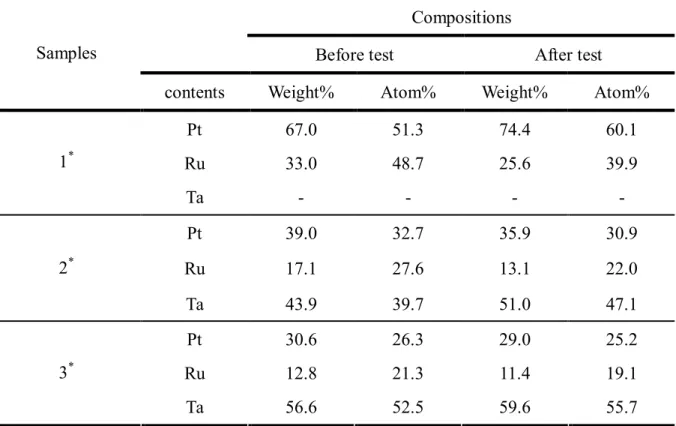
4 表 3 為 PtRuTa/C 觸媒於測試 500 圈 CV 法前後之觸媒表面組成經 EDS 分析之結果。由結果中可知,PtRu 中 的 Ru 組成在長時間測試後有嚴重的 損失情形,反之,PtRuTa 電極觸媒中 之 Ru 組成含量的減少則有較趨於緩 和,且隨著 Ta 含量之增加對於減少 Ru 的損失更趨於明顯。 圖 7 為不同組成的 PtRuTa 複合電 極觸媒,利用 CA 法於定電位(0.4V vs. SCE)下經 3600 秒測試其安定性,忽略 初始較不穩定階段(600 秒),以 I3600s / I600s 表示之。添加 Ta 0 mol %與 50 mol%的電極觸媒,經過 3600 秒後分別 衰退了約 50 和 25%;整體而言,隨著 Ta 含量增加,衰退情形也較減緩。另 一方面,考慮其比催化活性,在低 Ta 含量(約 5 mol %)時,因 Ta 促進 PtRu 觸媒之分散,提升其比催化活性而具 有較高之 Isp;反之,在高 Ta 含量(大 於 5 mol%)時,PtRu 觸媒上的部分表 面積則因被 Ta 所覆蓋,使其比催化活 性隨著 Ta 含量增加而降低。由上述結 果得到,複合電極觸媒中添加 Ta 組成 可有效發揮其在酸液中之耐腐蝕特 性,有助於防止 PtRu 在酸液中之溶解 現象發生,達到持續催化甲醇氧化的 效果。換句話說,Ta 含量約 5 mol % 時,PtRuTa 電極觸媒可兼具有促進催 化活性及安定性的效果。 四、結論 本研究以含浸法製備不同組成之 PtRu/C、Pt-M/C 及 PtRuTa/C 複合電極 觸媒,並以 XRD、EDS、ICP-MS、 TEM、CA 及 CV 分析其特性、組成、 粒徑、穩定性及催化活性。 Pt 電極觸媒掃描的遲滯現象所導 致的 VMOSP 判讀誤差可藉由降低掃描 速率而趨於減緩,正向及逆向掃描之 VMOSP 皆隨著掃描速率愈慢而愈趨近 於相同值,由此方式判讀 VMOSP可避 免遲滯現象所致之誤差,求得 VMOSP 精確值。而以此方式探討 PtRu 觸媒中 最佳 Ru 組成之 VMOSP結果顯示,當 Ru 組成為 50 atm%時,該比例之觸媒 具有最負之 VMOSP。此外,添加第二金 屬 Ir 及 Sn 之電極觸媒所得之 VMOSP與 Pt/C 之 VMOSP無明顯差異,與 PtRu/C 觸媒相較下,並無明顯的 bifunctional mechanism 或 ligand effect 可促進 Pt 觸 媒對氧化甲醇活性之效果。
PtRuTa/C 電極觸媒因添加 Ta 可有 效分散 PtRu 觸媒,Ta 含量小於 5 mol% 時,可有效提升 Pt 對甲醇氧化之比催 化活性;因 Ta 在酸液中具有耐腐蝕特 性,PtRuTa/C 觸媒中 Ta 可防止 PtRu 發生溶解,達到增加電極安定性的作 用,其安定性隨著 Ta 含量增加而增 加。PtRuTa 電極觸媒中 Ta 含量在約 5 mol %時,同時具有促進催化活性及安 定性之最佳效果。 五、自我評比 1. 本研究有系統地探討不同組成之雙 金屬 PtM/C 電極觸媒對甲醇氧化的催 化活性,針對各種不同的電極觸媒在 CV 量測時的遲滯現象及其中甲醇起 始氧化電位的精確量測作深入分析。 結果發現:利用遲滯現象隨著掃描速 率之降低而趨於減緩,正向及逆向掃 描時所得之起始氧化電位趨近於相同 定值,可對甲醇起始氧化電位作精確 判讀,並可據以作為研發各種新高性 能的 DMFC 陽極觸媒最簡單而有效的 判斷及篩選。
2. 本 研 究 開 發 高 活 性 及 高 安 定 的 DMFC 陽極觸媒,製備 PtRuTa/C 觸 媒,利用 Ta 組成提昇 PtRu 的分散性 及安定性。結果發現添加 Ta 組成(≦5 mol%)可有效提升 PtRu 觸媒之分散 性,增加其可催化反應之面積而提升 觸媒催化活性。此外,在 PtRu 電極觸 媒中添加閥金屬 Ta,可有效發揮閥金 屬在酸性溶液中之耐腐蝕特性,防止 Pt 與 Ru 觸媒在酸性溶液中發生溶解, 提升電極觸媒在甲醇氧化時之安定效 果及 Pt 與 Ru 觸媒之使用效率、延長 燃料電池陽極觸媒之使用壽命。 3. 本實驗後續研究結果目前正補充整 理中,準備投稿至相關學術期刊。 六、參考文獻
[1] J. Guo, G. Sun, S. Sun, S. Yan, W. Yang, J. Qi, Y. Yan, Q. Xin, J. Power Sources 168 (2007) 299. [2] A. E. Russell, S. C. Ball, S.
Maniguet, D. Thompsett, J. Power Sources 171 (2007) 72.
[3] J. R. C. Salgado, E. Antolini, E. R. Gonzalez, J. Power Sources 141 (2005) 13.
[4] J. R. C.Salgado, E. Antolini, E. R. Gonzalez, J. Power Sources 138 (2004) 56.
[5] D. Lee, S. Hwang, I. Lee, J. Power Sources 145 (2005) 147. [6] W. Chrzanowski, A. Wieckowski,
Langmuir 14 (1998) 1967.
[7] Y. Takasu, T. Fujiwara, Y. Murakami, J. Electrochem. Soc. 147 (2000) 4421.
[8] J. F. Drillet, A. Ee, J. Friedemann, R. Ko¨tz, B. Schnyder, V. M.
Schmidt, Electrochim. Acta 47 (2002) 1983.
[9] Y. Liang, J. Li,Q.C. Xu, R.Z. Hu, J.D. Lin, D.W. Liao, J. Alloys Compd 465 (2008) 296.
[10] D.J. Guo, L. Zhao, X.P. Qiu, L.Qu. Chen, W.T. Zhu, J. Power Sources 177 (2008) 334.
[11] Y. Tang, L. Zhang, Y.Wang, Y. Zhou, Y. Gao, C. Liu, W. Xing, T. Lu, J. Power Sources 162 (2006) 124.
[12] G.S. Park, C. Pak, Y.S. Chung, J.R. Kim, W.S. Jeon, Y.H. Lee, K. Kim, H. Chang, D. Seung, J. Power Sources 176 (2008) 484. [13] Z. X. Liang, T. S. Zhao, J. B. Xu,
J. Power Sources 185 (2008) 166. [14] X. Li, J. Liu, Q. Huang, W.
Vogel, D. L. Akins, H. Yang, Electrochim. Acta 56 (2010) 278. [15] Y. Takasu, M. Suzuki, H. Yang,
T. Ohashi, W. Sugimoto, Electrochim. Acta 55 (2010) 8220.
[16] A. Ishihara, K. Lee, S. Doi, S. Mitsushima, N. Kamiya, M. Hara, K. Domen, K. Fukuda, K.I. Ota, Electrochem. Solid-State Lett. 4 (2005) A201.
[17] A. Ishihara, M. Tamura, K. Matsuzawa, S. Mitsushima, K.I. Ota, Electrochim. Acta 55 (2010) 7581.
[18] A. Ueda, Y. Tamada, T. Ioroi, N. Fujiwara, K. Yasuda, Y. Miyazaki, T. Kobayashi, Catal. Today 84 (2003) 223.
6
Fig.1 VMOSP measured in (●) forward scan and (□) backward scan of cyclic
voltammograms at (A) Pt/C and (B) Pt80Ru20/C in 0.5 M H2SO4 + 2.0 M CH3OH.
Fig.2 Cyclic voltammograms with a reaction period at the higher limit potential during measurement for methanol oxidation on (A)Pt/C and (B) Pt80Ru20/C
electrocatalysts in 0.5 M H2SO4 + 2 M CH3OH. Scan rate: 5 mV s-1.
Fig.3 Compositions of (A) VMOSP obtained at various scan rates for PtRu/C
electrocatalysts with different Pt/Ru atomic ratio and (B) VCOSP (○) and VMOSP (●) of
Fig.4 A comparison of VMOSP obtained at various scan rates on the forward scan of
methanol oxidation for different bimetal Pt-M/C electrocatalysts.
Fig.5 SEM images of PtRu/C electrocatalysts with: (a) 0, (b) 4.8, (c) 23.1, (d) 33.3 and (e) 50 mol% of Ta. Inset shows the EDS graph of PtRuTa/C (50 mol% Ta) electrocatalyst.
8
Fig.6 (A) CV of PtRu/C electrode at 25 mVs-1 rate (recorded every 50 cycles). (B) CA curves of various PtRuTa/C electrocatalysts at a given potential of 0.4V during 0-3600 s. Electrolyte: 0.5M H2SO4 + 2.0M CH3OH solution. Isp = the current of methanol
oxidation per milligram Pt. Ratio of Pt: Ru = 1:1.
Fig.7 Dependence of normalized specific current (I600s / I60s) on the Ta content of the
PtRuTa/C electrocatalysts for methanol oxidation at 0.4V. (□) is the Isp on the various PtRuTa/C electrocatalysts.
Table 1 A summary of the composition and physicochemical properties of carbon supported Pt-Ru catalysts.
Atomic composition(Pt:Ru) catalysts EDS ICP Average particle Size by TEM (nm) Pt10Ru90/C 10:90 12.3:87.7 2.89±0.43 Pt30Ru70/C 32:68 33.1:66.9 2.94±0.44 Pt50Ru50/C 50:50 51.3:48.7 3.07±0.40 Pt60Ru40/C 61:39 58.7:41.3 3.44±0.71 Pt70Ru30/C 71:29 71.8:28.2 3.61±0.56 Pt75Ru25/C 76:24 76.4:23.6 3.66±0.56 Pt80Ru20/C 79:21 80.9:19.1 3.68±0.53 Pt90Ru10/C 89:11 91.5:8.5 3.77±0.63 Pt/C 100 100 4.03±0.71
Table 2 A summary of the composition and particle size of Pt-M/C catalysts. Atomic composition(Pt:M) Catalystsa EDS ICP Average particle Size by TEM (nm) Pt/C 100 100 4.03±0.71 PtRu/C 50:50 51.3:48.7 3.07±0.40 PtIr/C 64:40 57.8:42.2 3.02±0.47 PtSn/C 54:46 62.2:37.8 4.00±0.63 a
Volume of precursor solution of M is 50 ml and used to mix with 50 ml H2PtCl6
10
Table 3 Compositions of various PtRuTa/C before and after 500 CV cycling test. Compositions
Before test After test Samples
contents Weight% Atom% Weight% Atom% Pt 67.0 51.3 74.4 60.1 Ru 33.0 48.7 25.6 39.9 1* Ta - - - - Pt 39.0 32.7 35.9 30.9 Ru 17.1 27.6 13.1 22.0 2* Ta 43.9 39.7 51.0 47.1 Pt 30.6 26.3 29.0 25.2 Ru 12.8 21.3 11.4 19.1 3* Ta 56.6 52.5 59.6 55.7 *
1, 2 and 3: catalyst prepared from the precursor solution with 0, 33.3 and 50 mol% Ta, respectively.
國科會補助計畫衍生研發成果推廣資料表
日期:2012/01/19國科會補助計畫
計畫名稱: 高安定性及高活性Pt-M/C雙金屬觸媒電極的研製及其對甲醇及CO氧化反應機 制與催化作用之探討 計畫主持人: 卓錦江 計畫編號: 99-2221-E-151-059- 學門領域: 電化學無研發成果推廣資料
99 年度專題研究計畫研究成果彙整表
計畫主持人:卓錦江 計畫編號:99-2221-E-151-059- 計畫名稱:高安定性及高活性 Pt-M/C 雙金屬觸媒電極的研製及其對甲醇及 CO 氧化反應機制與催化作 用之探討 量化 成果項目 實際已達成 數(被接受 或已發表) 預期總達成 數(含實際已 達成數) 本計畫實 際貢獻百 分比 單位 備 註 ( 質 化 說 明:如 數 個 計 畫 共 同 成 果、成 果 列 為 該 期 刊 之 封 面 故 事 ... 等) 期刊論文 0 0 0% 研究報告/技術報告 1 1 100% 研討會論文 2 2 100% 篇 論文著作 專書 0 0 0% 申請中件數 0 0 0% 專利 已獲得件數 0 0 0% 件 件數 0 0 0% 件 技術移轉 權利金 0 0 0% 千元 碩士生 2 2 100% 博士生 0 0 0% 博士後研究員 0 0 0% 國內 參與計畫人力 (本國籍) 專任助理 0 0 0% 人次 期刊論文 0 0 0% 研究報告/技術報告 0 0 0% 研討會論文 0 0 0% 篇 論文著作 專書 0 0 0% 章/本 申請中件數 0 0 0% 專利 已獲得件數 0 0 0% 件 件數 0 0 0% 件 技術移轉 權利金 0 0 0% 千元 碩士生 0 0 0% 博士生 0 0 0% 博士後研究員 0 0 0% 國外 參與計畫人力 (外國籍) 專任助理 0 0 0% 人次其他成果