
捷克非營利組織的公共關係策略: 以「People in Need」為例 - 政大學術集成
78
0
0
全文
(2) PUBLIC RELATIONS OF CZECH NPO. 捷克非營利組織的公共關係策略: 以「People in Need」為例 Public Relations of Czech NPO: Case of “People in Need”. 研究生: 韋嘉敏 指導教授:陳憶寧. Advisor: Dr. Yi-Ning Katherine Chen. 政 治 大 國立政治大學. 國際傳播英語碩士學位學程. 學. ‧ 國. 立. Veronika Tomanova. 碩士論文. ‧ sit. y. Nat. A Thesis. er. io. n. Submittedato International Master’s Program in. l. iv. n C hCommunicationUStudies International engchi. National Chengchi University. In partial fulfillment of the Requirement For the degree of Master of Arts. 2014 年 7 月 July 2014.
(3) PUBLIC RELATIONS OF CZECH NPO i Acknowledgement Twenty years from now you will be more disappointed by the things that you didn't do than by the ones you did do. So throw off the bowlines. Sail away from the safe harbor. Catch the trade winds in your sails. Explore. Dream. Discover. --Mark Twain It feels almost like yesterday when I first arrived to Taiwan. With giant suitcase, lots of hopes and many more doubts. I guess it is never easy to leave one chapter of life behind, especially when the time was filled with warmth, love and security. I increasingly felt in love. 政 治 大. with journalism, foreign languages and various cultures. These are not things that one can access. 立. from little village in the South East of Czech Republic. Therefore, I felt too restless, I had to. ‧ 國. 學. choose: move closer to my interests or stay home and find another ones. Now I know I chose the better one.. ‧. After two years of living in Taiwan I can look back with my head held high. Completing. y. Nat. io. sit. Master’s Program in International Communication at one of the Taiwanese leading universities,. n. al. er. one of the biggest challenges and also objective of my stay in Taiwan is now about to be. Ch. i n U. v. accomplished. This thesis is one of the last step towards it. I feel touched to be now editing the last pages.. engchi. During this project many people helped me along the way to complete it. First of all I would like to thank to my advisor Katherine Chen as well as the two other committee members Wen-Ying Liu and Hongchi Shiau for their valuable support and recommendations. Beign my paper focus on Czech NPO People in Need, I feel very honored that I got the opportunity to work with its principal representatives. I would like to thank: Simon Panek,.
(4) PUBLIC RELATIONS OF CZECH NPO ii Tereza Hronova, Tomas Urban and Tomas Vyhnalek for the time and patience they took to answer my questions in depth and detail on the topic of public relations in the nonprofit sphere. I would also like to thank to my schoolmate Edward Ramsey who, as well as many times during the past two years, has helped me with the English corrections of my papers. I am very grateful to my parents for their support during my studies. Although at first they could not fully understand my decision of going to study as far as 10 000 kilometers from home, they still accepted my choice and did not leave me alone. I am really grateful. Gradually,. 政 治 大. they understood my decision a bit more and I dare to say that they might even feel proud in this. 立. moment.. ‧ 國. 學. Finally, I want to thank my boyfriend who was very patient with me when I felt tired and. ‧. annoyed during the thesis writing. He listened to me, helped me to review the ideas I was not sure about and tried to make me laugh when I needed it. No matter what, whether day or night, I. y. Nat. n. er. io. al. sit. knew that there was going to be a hug for me.. Ch. engchi. i n U. v.
(5) PUBLIC RELATIONS OF CZECH NPO iii. Abstract. This study deals with the topic of public relations in the context of the nonprofit sector in Czech Republic. It focuses on the Czech NPO People in Need, established shortly after the Fall of communism with aim to facilitate humanitarian aid and has grown into one of the largest NPOs in Central and Eastern Europe over the past two decades. The aim of this study is to monitor how People in Need uses public relations in order to support their organizational goals.. The. 治 政 大relations and the reflection of the communicate with the public, the ways NPO access the media 立 research covers the communication channels and the strategies used by People in Need to. cooperation between journalists and NPO representatives. Data for this qualitative study were. ‧ 國. 學. gathered employing technique of in-depth interviews.. ‧ y. Nat. n. al. er. io. sit. Keywords: nonprofit organization, public relations, media relations, in-depth interview. Ch. engchi. i n U. v.
(6) Table of Contents Chapter 1 Introduction................................................................................................................. 4 Chapter 2 Literature review ........................................................................................................ 7 2.1 Public Relations Practices ..................................................................................................... 7 Specifics of Public Relations in Nonprofit Sphere .................................................................. 8 2.2. Nonprofit organizations and principles of their functioning ................................................ 9 Similarities and differences of NPOs and businesses ............................................................ 10 Relationship marketing .......................................................................................................... 11 . 政 治 大. Nonprofit Sector and its Role in Civil Society ...................................................................... 12 Communication of Nonprofit Organizations ......................................................................... 14 . 立. Gatekeeping and Agenda Setting .......................................................................................... 15 . ‧ 國. 學. 2.3 Nonprofit Sector in Czech Republic ................................................................................... 17 History of Nonprofit Organizations in Czech Republic ........................................................ 17 Public Relations of NPOs in Czech Republic ....................................................................... 19 . ‧. Studies on communication of Czech nonprofit sector ........................................................... 20 . y. Nat. 2.3 Nonprofit organization People in Need ............................................................................... 22 . sit. History of People in Need ..................................................................................................... 22 . al. er. io. Structure of PIN ..................................................................................................................... 26 . n. Goals and activities ................................................................................................................ 27 . Ch. i n U. v. Examples of activities ............................................................................................................ 28 . engchi. Communication of PIN on social sites .................................................................................. 28 Chapter 3 Methodology .............................................................................................................. 30 3. 1 Aim of the study and research questions ............................................................................ 30 3. 2. The research method ......................................................................................................... 30 Semi structured in-depth interviews ...................................................................................... 31 Respondents of the study ....................................................................................................... 32 Data collection procedures .................................................................................................... 34 Chapter 4 Results ........................................................................................................................ 36 4.1 . Media relations ............................................................................................................... 37 . System of PR ......................................................................................................................... 37 Methods of communication with media ................................................................................ 39 1.
(7) PUBLIC RELATIONS OF CZECH NPO. 4.2 . Journalists ....................................................................................................................... 41 . View of NPO ......................................................................................................................... 41 View of journalist .................................................................................................................. 43 4.3 . Role of mass media ........................................................................................................ 44 . Media image .......................................................................................................................... 45 Public discussion ................................................................................................................... 46 Campaigns ............................................................................................................................. 47 4.5 . Communication with public ........................................................................................... 48 . Public events .......................................................................................................................... 48 The websites .......................................................................................................................... 49 . 治 政 Paid advertisement ................................................................................................................. 51 大 立 Support................................................................................................................................... 51 Social sites ............................................................................................................................. 50 . ‧ 國. 學. 4.5 Public relations strategy ...................................................................................................... 52 Goals of PR............................................................................................................................ 53 4.6 . ‧. Expert voice ........................................................................................................................... 54 Summary of findings ...................................................................................................... 55 . y. Nat. Chapter 5 Discussions and Conclusion ..................................................................................... 58 . sit. Communication with public: The sources of public support................................................. 58 . er. io. Public relations findings ........................................................................................................ 59 . al. iv n C Conclusion ............................................................................................................................. 64 hengchi U References .................................................................................................................................... 66 n. Media relations findings ........................................................................................................ 61 . Appendix A: Structure of the interviews.................................................................................. 71 Appendix B: Logo of the NPO .................................................................................................. 73 . 2.
(8) PUBLIC RELATIONS OF CZECH NPO. List of figures Figure 1 Activity map of NPO People in Need for years 1992- 2013 .......................................... 24 Figure 2 Organizational structure of PIN...................................................................................... 26 Figure 3 List of websites administrated by People In Need ......................................................... 29 . List of tables Table 1 List of countries where PIN has been active between 1992 and 2003 ............................ 25 Table 2 Advantages and disadvantages of the use of technology for conduction interviews....... 32 . 立. 政 治 大. ‧. ‧ 國. 學. n. er. io. sit. y. Nat. al. Ch. engchi. 3. i n U. v.
(9) PUBLIC RELATIONS OF CZECH NPO. Chapter 1 Introduction In recent years, many nonprofit organizations have become increasingly confronted with market pressures typical of for-profit organizations, like competition for funding and the need to earn money to fulfil their mission (Dolnicar, Irvine & Lazarevski, 2008). This trend creates a growing interest of non-profit organizations to use practices and ideas that are imported from the business sector (Herman, 2005). One of the most significant practices adopted by nonprofit organizations is that of public relations. Nonprofit organizations need support of the public in order to fulfil. 政 治 大 important allies. Representing the most effective channel to distribute messages to a large 立 their goals. The media - newspapers, television, radio, the Internet - is one of an NGO’s most. ‧ 國. 學. audience, the media greatly influence the scope and depth of public debate1. Furthermore, the media provide the NGOs with opportunities to promote its agenda, to inform potential donors. ‧. about its activities, to educate potential beneficiaries about its work, and to create opportunities. sit. y. Nat. for networking with other organizations (Wei, 2006)2. Therefore, developing good relations with. io. er. the media is a crucial task for an NGO.. Public relations practices vary across the world and there is still much to learn about the. al. n. iv n C development of international practices of public relations (Scanlan & Turk, 1999; Sriramesh & he ngchi U Vercic, 2003). Van Leuven and Pratt (1996) noted that there is a continuum of public relations. development in the world. One end of the continuum is represented by nations in the West where private sector organizations practice public relations to pursue commercial endeavors. At the opposite end of this continuum, there are the governments in developing countries which often use public relations for nation building. Public relations practices in Eastern Europe belong 1. Coalition for the International Criminal Court, "NGO Media Outreach: Using the Media as an Advocacy Tool," 1, http://www.iccnow.org/documents/CICC_MediaOutreachManual_Sep03.pdf (accessed December 15, 2013).. 4.
(10) PUBLIC RELATIONS OF CZECH NPO. somewhere in the middle of this continuum. Taylor (2004), a researcher who completed several studies on the public relations of countries from the East European region noted the following: “Eastern Europe is an important area to study because unlike other regions, where multinational corporations introduced the practice, Eastern European public relations is making a transition from a government propaganda function to an organization-public relationship building function.” (p.146) According to Taylor & Kent (1999), nations in transition3 provide excellent opportunities to. 治 政 大the practice of public relations in economic and political environments. This study focuses on 立. study how public relations are both influencing and, in turn being influenced by the new social,. Czech Republic as one of the transition countries which re-gained independence after the. ‧ 國. 學. collapse of Soviet Union.. ‧. One of the freedoms restored4 in post-communist Czech Republic was the opportunity to form and participate in independent associations. Many existing groups became independent and. y. Nat. io. sit. new associations rapidly emerged. Even with only limited levels of support, the Czech nonprofit. n. al. er. sector has expanded and matured so that nonprofit organizations even influenced political decision-making (Brhlikova, 2004).. Ch. engchi. i n U. v. 3. Transitional, or transformational, economies are characterized by powerful shifts in economic exchange patterns. In the Czech Republic, economic transition has been in response to multiple dislocations and challenges that have occurred over the last 15 years: the collapse of the Soviet empire, internal political change, the “velvet revolution” (1989), and more recently moves towards accession into the EU, which took place in June 2004. In Czech Republic, as well as in other transitional economies, economic transformation cannot be uniquely located in the economy itself, or in markets. Instead, the change process is more diffuse and complex involving social, political, and cultural institutions (Pribova and Savitt, 1995). 4. During the 40 years of communism civil society was nonexistent, with individuals unable to express religious views, alternative political or social agendas. There was no private or public topography: the whole landscape was dominated by the state.. 5.
(11) PUBLIC RELATIONS OF CZECH NPO. When it comes to academic research, the nonprofit sector in Czech Republic has remained rather unexplored. While there have been a number of studies addressing the marketing development within the Czech Republic (Savitt, 2001), and marketing trends within Czech firms (Kloudova, Medway & Byrom 2004), most of the studies have all focused on the emergent private, or for-profit, sector. Studies of the nonprofit sector in the Czech Republic focusing on public relations issues have usually been written in Czech (Fric, 1999; Fric and Goulli, 2001; Potucek, 1997) and captured the first trends of the emerging nonprofit sector. There are a very. 治 政 大 the European Union) and also decade (especially after 2004 when Czech Republic entered 立 limited number of studies which focus on the development of the nonprofit sector in the last. studies which would deal with public relations of nonprofit organizations in particular.. ‧ 國. 學. This qualitative study focuses on the Czech NPO People in Need, one of the largest. ‧. NPOs in Central and Eastern Europe. It has budget of 22 million US dollars5 and operates in 28 countries around the world. For the purpose of this study, in-depth interviews with the NPO’s. y. Nat. n. al. er. io. interviewed.. sit. representatives were conducted. In addition, a journalist who specializes on NPO topics was. Ch. i n U. v. The goal of the study is to contribute original qualitative research to the academic field. engchi. concerning the non-profit sector being a segment that plays a very significant role within transformative economies - and situate Czech public relations practices within its historical and cultural context.. 5. Source: Annual report, 2012. Available at http://www.clovekvtisni.cz/uploads/file/1379421640CVT_VZ_2013_ENG_final_web_dvoustrany.pdf. 6.
(12) PUBLIC RELATIONS OF CZECH NPO. Chapter 2 Literature review This chapter reviews the theoretical framework and literature as the conceptual establishment of the current study. The first part begins with the introduction of public relation practices and their specifics in the nonprofit sphere. The second part goes through the nonprofit organizations and principles of their functioning including their role in the public sphere. The fourth part is dedicated to the nonprofit sector in Czech Republic and finally, the last part is dedicated to People in Need, a Czech nonprofit organization.. 2.1 Public Relations Practices. 立. 政 治 大. The British Institute of Public Relations (IPR) defines public relations practice as "deliberate,. ‧ 國. 學. planned and sustained effort to establish and maintain mutual understanding between an organization and its publics" (Grunig & Hunt, 1984 p.7). The purpose of using public relations. ‧. practices by any company or organization is to achieve good relations with their internal and. sit. y. Nat. external publics. According to Hendrix (2001:3) that “one way of defining public relations has. er. io. been simply to invert the term so that it becomes "relations with public". Public relations helps. al. iv n C facilitate desirable change. Lattimore ethal. e (2004) h i U the following description: "Public n g cprovided n. organizations, be it governmental or non-governmental, to achieve organizational objectives and. relations is a leadership and management function that helps achieve organizational objectives … and facilitate organizational change" (p. 5). Public Relations serves a wide variety of institutions in society such as business, trade unions, government agencies, voluntary associations, foundations, hospitals, educational and religious institutions. To achieve their goals, these institutions must develop effective relationships with many different audiences or publics such as employees, members, customers, local communities, shareholders and other institutions and with society at large (Grunig & Hunt, 7.
(13) PUBLIC RELATIONS OF CZECH NPO. 1984). Every organization, whether for-profit or nonprofit, needs to communicate with the stake holders, defined as any person or group that affects or is affected by the organization. The building and maintaining of relationships is an important element of any public relations program.. According to Springston, Keyton, Leichty & Metzger (1992), recognizing an. organization’s interdependence with relevant publics and cultivating long-term relations with them provides a strong theoretical basis for application to public relations practice. In recent years, with growing pressure in the nonprofit sector 6 , NPOs have been. 治 政 大With the decreasing emphasis on image of the organization play an important role for NPOs. 立 motivated to engage more in public relations activities. The support of the public and positive. government funding and increased reliance on independent sources of funding (Frumpkin, 2005),. ‧ 國. 學. funders want to know that their money will be used wisely and the media coverage represents a. ‧. platform where this can be demonstrated. Therefore, media relations represent one of the most important elements of the public relations practice.. sit. y. Nat. Specifics of Public Relations in Nonprofit Sphere. io. n. al. er. Although some aspects of public relations are shared between NPOs and businesses, there are. Ch. i n U. v. other aspects which differ. Development NPOs are not offering products and therefore they are. engchi. not trying to increase their sales (as it is the case for many private companies). Compared to governments, NPOs are allocating much smaller funds and also the personal capacity (and so the personal capacity taking care of public relations is much smaller). When it comes to the goals of public relations activities of development NPOs, they would be raising funds, spreading awareness about developing countries and promoting sustainable development.. 6. The pressure is mainly economical – such as competition for funding and the need to earn money to fulfil their mission (Dolnicar et al., 2008).. 8.
(14) PUBLIC RELATIONS OF CZECH NPO. According to Svoboda (2004), "the core of nonprofit originations is that they are trying to allocate resources for their functioning (mainly money). Their focus on the public is based on principles of humanitarianism7 or religious beliefs" (p. 15). Further, Svoboda (2004) notes that if the public relations of the organization would focus solely on resource allocation – such as gaining finances or volunteers – and the public would not be aware of their organization’s activities, the public would not offer those resources to NPOs.. 2.2. Nonprofit organizations and principles of their functioning. 政 治 大 distributing profits to stakeholders or directors, pursuing public purposes" (Salamon, 1994). 立. Nonprofit organizations (NPOs) are "self-governing private organizations, not dedicated to. NPOs exist to provide programs and services for public benefit. It most cases, these programs. ‧ 國. 學. and services are not provided by local or state entities, but established by private individuals.. ‧. Even though the NPOs are able to make a profit, such earnings must be put aside for future. y. Nat. programs and services. The first NPOs were established in North America in the 1960s. In. er. io. sit. Russia and Eastern Europe, NPOs began popping up after the collapse of the Communistic regime. This is also the case in the Czech Republic, where nonprofit organizations started to. n. al. Ch. emerge after the Velvet Revolution in November, 1989.. engchi. i n U. v. The NPOs are nowadays active in various fields of activities and there is also heterogeneity in how the nonprofit organization is institutionalized. The international classification of the nonprofit organizations (Salamon & Anheier, 1996) defines 12 fields for these entities:. 7. humanitarianism is understood as an ethic of kindness, benevolence, and sympathy extended universally and impartially to all human beings. 9.
(15) PUBLIC RELATIONS OF CZECH NPO. 1. Culture 2. Education and research 3. Health 4. Social services 5. Environment 6. Development 7. Civic and advocacy 8. Philanthropy 9. International 10. Religious congregations 11. Business and professional unions 12. Other. 政 治 大. Similarities and differences of NPOs and businesses. 立. There are many aspects in which the functioning of nonprofits and private businesses are. ‧ 國. 學. common. The non-profit sector has characteristics of marketplace problems (Kotler, 1979) where memberships decline, costs soar, and competition is fierce. Both nonprofits and businesses have. ‧. to deal with multiple stakeholders and many of the partnerships fail because of bad relationships. sit. y. Nat. and poor interpersonal connections (O’ Malley & Tynan, 2001). Therefore, communication is an. er. io. important element for each NPO. In order to create healthy relations with stakeholders, NPOs. al. iv n C h eNPOs interaction, h i U “friends n g cestablish. n. need to inform stakeholders directly and receive their feedback. In order to create a more complete database for future. portfolio” (Conway and. Whitlock, 2004) which helps them repeat interactions with stakeholders and also to identify the best funders and volunteers. Apart from the attributes that are common in the nonprofit and for-profit sectors, there are attributes specific to the nonprofit organizations. Some authors (Gonzalez et al. 2002 and Bruce 1995) propose that “customer” should remain a term for the private sector and that the nonprofit sector should utilize the term “beneficiary” (as the one who receives benefit from the non-profit). Sargeant (2008) listed the differences as follows: 10.
(16) PUBLIC RELATIONS OF CZECH NPO. 1. Two distinct markets, the market for resource attraction (funders) and the market for resource allocation (beneficiaries) 2. Multiple constituencies or publics 3. Need for societal, non-market orientation 4. Non-financial objectives 5. Services and social behaviors rather than physical goods 6. Collaboration, not competition 7. Public scrutiny / non-market pressures 8. Higher ethical standards In addition, other researchers see one of the crucial specifics of NPOs as the need to create balance between financial pressure and the mission (Gallagher & Weinberg, 1991). Due to. 治 政 大 and needs (Brennan & Brady, choose a marketing technique suited to their own characteristics 立. differences between entities of nonprofit and for-profit entities, it is recommended that NPOs. Cronway & Whitelock, 2004).. ‧ 國. 學. Relationship marketing. ‧. Many scholars have argued that possibly one of the marketing practices that is in conjunction with the goals of nonprofit organizations is relationship marketing. NPOs seek long-term. y. Nat. io. sit. relationships, mainly with customers, but also with donors and within the organization itself. n. al. er. (volunteers or staff and board members). According to Kinnel and MacDoughall (1997). Ch. i n U. v. relationship marketing was born as a reaction against over-use of the definition of marketing mix. engchi. of four P’s – product, prices, place and promotion - that focus on selling the goods to customers. The added value of relationship marketing is communication with the customers to foster longterm relationships. According to Pai Po Lee (2013), "Relationship marketing considers the identification, maintenance, and increases the custom from the best customers, through long term, value-added relationship" (p.134). Developing relationships with everyone who is critical of their work can help NPOs understand who gives money to charity and why, ultimately allowing them to create closer ties 11.
(17) PUBLIC RELATIONS OF CZECH NPO. that may result in an increase of donations (Waters, 2009). Therefore, it is in the interest of this study to focus on public relations practices as practices aimed at creating and maintaining relationships with the public. Nonprofit Sector and its Role in Civil Society Throughout the world, nonprofit organizations have become highly visible and influential actors with many organizations serving as key players in developing solutions to national, regional and local problems (Princen, 1994). Nonprofit organizations are active in the social, cultural, and political arenas. Non-governmental organizations operate within civil society where they create. 治 政 大 stresses the importance of civil balanced relationships between state and society. Castells (2008) 立 society as follows: ‧ 國. 學. “Without an effective civil society capable of structuring and channeling citizen debates. ‧. over diverse ideas and conflicting interests, the state drifts away from its subjects. The state’s interaction with its citizenry is reduced to election periods largely shaped by the. y. Nat. io. sit. political sphere” (p.30).. n. al. er. According to Habermas (1996), the core part of the civil society is the public sphere. Ch. i n U. v. characterized as “a network for communicating information and points of view” (p. 360). The. engchi. public sphere is seen as an essential component of sociopolitical organization because it is the space where people come together as citizens in order to influence the political institutions of society. Importance of NPOs within Civil Society As individuals cannot accomplish certain tasks alone, they typically fall to voluntary associations or civil society organizations, which exist to change or challenge the existing structures and processes underlying exclusion or disadvantage (Lewis 2002; Sternberg 2010).. Non-. governmental organizations (NGOs) represent one of the most common platforms where citizens 12.
(18) PUBLIC RELATIONS OF CZECH NPO. can get involved. NGOs rose to prominence on the basis of their strengths as local, grassrootslevel development organizations which offered the potential for innovative bottom-up agendas based on the “needs and wants” of local communities and disadvantaged groups (Hulme & Blanks, 2012). The views of NGOs and their activities have developed over time from ‘heroic’ organizations towards increasingly professional organizations with a de-politicized nature. Some of the concerns connected to NGOs are connected to the limitations in promoting long-term structural change and also the fact of their closer proximity to donors and governments than. 治 政 Hulme and Blanks (2012) pointed out that "NGOs大 could no longer be viewed as the 立. intended beneficiaries.. autonomous, grassroots-oriented, and innovative organizations that they once were, raising. ‧ 國. 學. questions about their legitimacy and sustainability" (p.19). Although failing to respond to these. ‧. criticisms, Hulme and Blanks (2012) suggested that NGOs remain an important part of an emerging civil society and that an increasing recognition of NGOs as only one component of. y. Nat. n. al. er. io. strengthening civil society.. sit. broader civil society has drawn attention to the need to find a more effective role for NGOs in. Ch. i n U. v. Nowadays, civil societies are not limited only by borders of their own country and we. engchi. speak about a “global civil society” (Kaldor, Anheier, & Glasius, 2006). This trend brings alone “the rise of nongovernmental organizations (NGOs) with a global or international frame of reference in their action and goals” (Hulme & Blanks, 2012). They act outside government channels to address global problems. Although they can be addressing different issues, international NGO’s have in common an affirmation of values that are universally recognized but politically manipulated in their own interest by political agencies, including governments. In other words, international NGOs claim to be the enforcers of unenforced human rights (Hulme & 13.
(19) PUBLIC RELATIONS OF CZECH NPO. Blanks, 2012). Some examples are: Amnesty International, Medecins Sans Frontieres, Oxfam, and Greenpeace. These organizations typically espouse basic principles and/or uncompromising values8 and they cover entire spans of the human experience, from poverty to illnesses, from hunger to epidemics, from women’s rights to the defense of children, and from banning land mines to saving the whales. Communication of Nonprofit Organizations The communication of nonprofit organizations is taking place on both internal (within the organization) as well as the external level (between the organization and other subjects and. are most relevant: The communication with public and the media.. 學. ‧ 國. 治 政 大 other NGOs and others. In this people). The organizations interact with the public, politicians, 立 work we focus on the public relations, and therefore two kinds of external communication which ‧. Mass media nowadays represent the main channel for communication with the public. Generally, mass media are the most effective way to reach the public. In order to effectively. y. Nat. io. sit. obtain the media coverage of their activities, the nonprofits develop media relations strategies.. n. al. er. Organizations try to follow the content of the media in regard to their specific field and create a. Ch. i n U. v. media list – a list of possible media outlets, which may be interested in an organization's information.. engchi. Therefore, when a "newsworthy" event occurs in an organization, a media list can assist in determining which media outlet may be the most interested in a particular story (Ridgway, 1996). Some of the relevant mass media recourses of NPOs include newspapers, TV, Online media (Social sites, TV, radio, newspapers), Radio and Press Agencies. Each kind of mass media has its specifics. In order to create positive working relationships with media personnel of an. 8. For instance, torture is universally decried even as a means of combating greater “evils.” 14.
(20) PUBLIC RELATIONS OF CZECH NPO. NPO is to become deeply familiar with their "beats" and areas of interests. There is a vast amount of media and also many conditions influencing the background on which information becomes news – important role play news values9, gatekeeping and agenda setting. Gatekeeping and Agenda Setting The decision making is connected to every step of journalistic production from the moment a reporter brings in a news topic, through the decision making of the editorial board until the news is published. The process of filtering the events and deciding what makes a news story has been coined as gatekeeping10. The gatekeeping framework is largely based on the assumption that. 政 治 大. there is a given, finite, knowable reality of events in the ‘real world’, from which it is the task of. 立. the media to select according to appropriate criteria of representativeness or relevance (McQuail,. ‧ 國. 學. 1994). The concept of gatekeeping is relevant for the study of public relations of NGOs as the. ‧. organizations are trying to communicate with the public through the media so their agenda is accepted or denied by the gatekeeper.. y. Nat. sit. Another media routine influencing whether a topic will be covered in the news is agenda. n. al. er. io. setting. This theory is connected to the most powerful influences of the media: the ability to tell. i n U. v. us what issues are important. The agenda setting theory was developed by Max McCombs and. Ch. engchi. Donald Shaw in a study of the 1968 US presidential election. The researchers studied the media agenda (news on presidential candidates) and the agenda in voter’s decisions of the candidates (McCombs & Shaw, 1972), and found a strong correlation between the media agenda and the public agenda. Agenda setting theory is important for the study of public relations of NGOs as. 9. News values, determine how much prominence a news story is given by a media outlet, and the attention it is given by the audience. Some news values for example are: conflict, negativity and personalization. 10 The term gatekeeping was introduced by Kurt Levin in 1943. Seven years later, in 1950, gatekeeping was officially put into context of media production by David Manning White who examined the factors an editor takes into consideration when deciding which news will be published in the newspapers and which will not (White, 1950).. 15.
(21) PUBLIC RELATIONS OF CZECH NPO. the organizations are trying to raise awareness about issues such as human rights and poverty and facilitating the change in society and those issues becoming the part of public agenda is one of the steps in doing so. Communication with Public Gaining news coverage is one of the most common ways of how to turn attention of the public to the desired topic. Nevertheless, it is not the only way. Further, the NPOs use proportion materials (content of leaflets and web sites) and also propagation (advertisement), public correspondences, organizing events, happenings, demonstrations, petitions and face to face meetings. One of the. 治 政 main channels for communication between NGOs and the大 public is new media 立 websites and social sites.. 11. , especially. ‧ 國. 學. One of the characteristics which differs new media from “the old ones” is the. ‧. interactivity. In 1984, Rice defined new media as communication technologies that enable or facilitate user-to-user interactivity and interactivity between user and information (Schorr,. y. Nat. io. sit. Schenk & Campbell 2003). In the era of new media, the "one-to-many" model of traditional. n. al. er. mass communication is replaced by "many-to-many" web of communication. Any individual. Ch. i n U. v. with the appropriate technology can now produce his or her own online media and include. engchi. images, text, and sound about whatever he or she chooses (Croteau & Hoynes, 2003). While increased use of new media is a growing trend in public relations, this is particularly relevant for nongovernmental organizations. These media enable activists to mobilize citizens across the globe by efficiently transcending national boundaries at minimal costs. In particular, the nature of open communications provides a normative approach to excellence in dealing with social issues, especially for activist groups (Grunig, & Dozier, 2002). . 11. Most technologies described as "new media" are digital, often having characteristics of being manipulated, networkable, dense, compressible, and interactive (Flew, 2008). 16.
(22) PUBLIC RELATIONS OF CZECH NPO. 2.3 Nonprofit Sector in Czech Republic The nonprofit sector in the Czech Republic has gained economic, social, and political importance and attracted almost universally growing attention over the last two decades (Brhlikova, 2004). There are alternative names for the nonprofit sector common in the country: one of them is “third sector” since it complements government and market in the provision of services especially in health, education, and social fields. Other alternative names of the sector are in conjunction with distinguishing characteristics: voluntary (employing volunteers), independent (from the state) or civil (dealing with the problems of the civil society).. 政 治 大. Since the nonprofit sector in the Czech Republic is part of a relatively new development,. 立. there is a lack of studies dealing with who would analyze the latest development of the sector.. ‧ 國. 學. Two extensive quantitative studies of the Czech nonprofit sector are Fric and Goulli (2001) and. ‧. Salamon et al. (1999). Fric and Goulli analyzed the evolution of the Czech nonprofit sector after the fall of the Communistic regime after 1989. Salamon et al. provided a summary of these. y. Nat. io. sit. findings focusing on size, structure, and philanthropy and compared nonprofit sectors in 22. n. al. er. countries. Both studies are based on data from 1995. Therefore, it is only the first five years of the Czech nonprofit sector that is covered in the studies.. Ch. engchi. i n U. v. History of Nonprofit Organizations in Czech Republic The history of the Czech nonprofit sector is not characterized by continual development, but rather by periods when civic activities were very active and periods when they were completely restricted or banned. Evolution of the Czech nonprofit sector culminated in the period of the First Czechoslovak Republic (1918-1939) when the organizations focused on three fields: health, education, and social services12. The development of the nonprofit sector was interrupted by. 12. For the more detailed history of the Czech nonprofit sector see Fric and Goulli (2001). A brief summary can be also found in Salamon et al. (1999).. 17.
(23) PUBLIC RELATIONS OF CZECH NPO. German occupation in 1939 when many nonprofits got banned and others were reorganized in order to fulfil the state purposes. The activities of nonprofit organizations were renewed after World War II, however many organizations became influenced by political parties and the further evolution of the nonprofit sector was blocked by the Communist regime (Brhlikova, 2004). The possessions of churches as well as other organizations were confiscated. From 1948 until 1989, it was only state-controlled groups which were allowed to exist. During that time, most unions, cultural associations, social organizations, and sporting groups. 治 政 大 or expression of ideas and (Wolchik, 1991). Rather than serving as a forum for exchange 立. were dominated by communist party members, centralized, and subordinated to the party. interests, these organizations provided a way for the party to impart ideology and to structure. ‧ 國. 學. social life (Nelson, 1980). Organizations were united into the "voluntary organization" called. ‧. National Front representing a roof institution for unions, political and voluntary organizations. The membership in the National Front was considered to be an expression of loyalty to the state. io. sit. y. Nat. (Fric & Goulli, 2001).. n. al. er. The political pressure of the state slowly faded in the 1960's. During this time, citizens. Ch. i n U. v. started to be more involved in public affairs and several nonprofit organizations were re-. engchi. activated. This period was interrupted by a military invasion of the Warsaw Pact countries and the normalization period (1969–87) that followed. This development returned the nonprofit sector to the conditions before the 1960s. Civic involvement didn’t begin to awaken until the 1980s. At that time, the Communistic regime started to tolerate environmental, educational and scientific activities. Other civic organizations which were officially not allowed, worked informally and their activities culminated in the 1989 Revolution (Salamon et al.,1999).. 18.
(24) PUBLIC RELATIONS OF CZECH NPO. The opportunity to form and participate in independent associations was one of the freedoms restored in post-communist Czechoslovakia13. Following the revolution in 1989, many existing groups became independent and new associations rapidly emerged. Even with only limited levels of support, the Czech nonprofit sector has expanded and matured so that nonprofit organizations even influenced political decision-making. Public Relations of NPOs in Czech Republic The current situation of NPOs in the Czech Republic is reflected in the annual Report on nonprofit sector. Comparing the reports from previous years, there is a growing interest of NPOs. 治 政 utilizing more public relations practices and there is also a 大 growing interest in the activities of 立 NGOs by the public. The latest report from 2012 notes that there is improvement of the ‧ 國. 學. cooperation between media and NPOs:. ‧. “The organizations are more and more realizing the necessity to maintain good relations with journalists and media in general. Media are more often utilizing the expert knowledge of. y. Nat. io. sit. NPO employees in creating areas and are presenting them as sources in the day to day news.”. n. al. er. (Report on nonprofit sector, 2012). Ch. i n U. v. Apart from improving cooperation between nonprofits and journalists, the 2012 report. engchi. also notes the lack of transparency. The research conducted in 2012 by Paul Bachmann (2012) 14 showed that only 69% of the religious communities, about 31% of public benefit organizations and foundations and only 8.5% of citizens' associations annually publishes the annual report on its website.. 13. Czech republic existed within Czechoslovakia until 1992 when they split into two independent countries – Czech Republic and Slovakia 14 The research is available at http://www.avpo.cz/sdata/Bachman_monografie_141.pdf. 19.
(25) PUBLIC RELATIONS OF CZECH NPO. Studies on communication of Czech nonprofit sector There is several studies that analyze Czech nonprofit sector in general. One of the most extensive studies is written by Fric and Goulli (2001), who analyzed the evolution of nonprofit sector since 1989. Salamon et al. (1999) provided father summary of these findings taking in account the size, structure and philanthropy and compared nonprofit sectors in 22 countries. Both studies are taking in account only first five years of Czech nonprofit sector, as they utilize data from 1995, were extended by Brhlikova (2004) who analyzed the development after 1995. Brhlikova (2004) noted that too little emphasis on accountability and transparency of nonprofit entities negatively. 政 治 大. affects trustworthiness of the nonprofit sector.. 立. Although each nonprofit needs to communicate with public, there is lack of studies. ‧ 國. 學. focusing on public relations of NPOs or communication in general. The public relations of Czech nonprofit organizations were surveyed in 2003. 15. . The results showed that nonprofit. ‧. organizations consider public relations as a necessary part connected to NGOs. Although 90 %. y. Nat. sit. of respondents were convinced about the importance of PR in nonprofit organizations, in many. n. al. er. io. nonprofit organizations the utilization of PR is rather rare. The majority of respondents were also. i n U. v. convinced that the public relations of the NPOs influenced the fundraising. Despite the. Ch. engchi. proclaimed importance that non-profit organizations attribute to PR activities, the respondents do not feel satisfied with their level of knowledge in the area of public relations. Every second organizations consider the level of knowledge and the risk in public relations as the field that should be improved in the future. The respondents also indicated PR as an area for improvement. The survey showed that PR is not a new element in the nonprofit sector. NPO’s have a basic idea of PR activities but the most frequently problem mentioned is connected to the lack of finances. 15. The data were collected through online questionnaires and the survey had 462. 20.
(26) PUBLIC RELATIONS OF CZECH NPO. For this reason, non-profit organizations prefer the cheaper forms of representation (websites, promotional materials) to organizing events and/or using commercial advertisement. Further, there is study by Bulla and Starr-Glass (2004) who investigated understanding and role marketing used by Czech nonprofit organizations. While marketing was identified as an interesting and powerful concept, non-profit policy makers generally had limited understanding of marketing theory. There is also study covering communication of Amnesty International as NPO advocating human rights (Pasekova, 2010) and study focusing on public relations of. 治 政 大 NPOs There is no study so far that would focus on development 立. environmental NPOs (Slabinova, 2011).. 16. . Development NGO’s. in the Czech Republic are involved in a wide range of activities including education, advocacy of. ‧ 國. 學. policies connected to developing countries and raising awareness about development aid among. ‧. the public. Nevertheless, the core of the activities is primarily the implementation of humanitarian aid and the development assistance17. Since many of those projects are happening. y. Nat. io. sit. in places distant from the Czech Republic and are gaining attention and support among the. n. al. er. people in the Czech Republic, it represents one of the challenges for each NGO. The way Czech. Ch. i n U. v. development NGOs utilize public relations practices in order to reach their goals is the focus of this study.. engchi. 16. Definitions and justifications for the emergence of this kind of NGOs have centered on their ability to offer a ‘development alternative’, making a set of claims about the more effective approaches necessary for addressing poverty and challenging unequal relationships (Lewis and Kanji 2009) and justifying a role for NGOs in filling the gaps caused by inefficient state provision of services. 17. It is expected that in the section of development assistance is to grow in the future. Source: http://www.rozvojovka.cz/neziskovy-sektor-a-rozvojova-spoluprace. 21.
(27) PUBLIC RELATIONS OF CZECH NPO. 2.3 Nonprofit organization People in Need People in Need (PIN) is a Czech nonprofit, non-governmental organization that implements humanitarian relief and long term development projects, educational programs, and human rights programs in crisis regions all over the world. Its director is Simon Panek. Already in 2012, PIN operated in 28 countries. With 753 employees and a budget of about 22 million US Dollars18, PIN is one of the largest NGOs in Central and Eastern Europe. This section is dedicated to provide an overview of the nonprofit organization “People in Need” that is in the focus of the study. First, the historical overview of the organization is. 政 治 大. provided and then it will be addressed the structure, goals and activities of the nonprofit. 立. organization.. ‧ 國. 學. History of People in Need. ‧. People in Need was the first NGO from a post-communist country that started to assist victims of disasters, conflicts or human rights violations abroad. The organization was established among. y. Nat. n. al. er. It gradually became established as a professional humanitarian organization. io. facilitate aid.. sit. foreign correspondents who used to complete assignments in war region regions and decided to. i n U. v. striving to provide aid in troubled regions and support adherence to human rights around the world.. Ch. engchi. The roots of the organization date back to the devastating 1988 earthquake in Armenia19, which gave rise to the very first abroad-focused action of civil society in Czechoslovakia (at that time still deeply chained up behind the Iron curtain). The donations collected were used for the Armenian earthquake victims. The charitable collection was lead by Jaromir Stetina, a war. 18. Source: Annual report, 2012. Available at http://www.clovekvtisni.cz/uploads/file/1379421640CVT_VZ_2013_ENG_final_web_dvoustrany.pdf 19 Devastating 6.8 earthquake which ripped through Armenia. It killed 45,000 people have died and a further 500,000 remained homeless.. 22.
(28) PUBLIC RELATIONS OF CZECH NPO. correspondent from conflict areas of former Soviet Union and Simon Panek, student who later become one of the student leaders in the 1989 Velvet Revolution. The group surrounding Stetina and Panek continued their efforts until it evolved into complete organization. In 1992, a humanitarian team called Epicentrum consisting mainly of journalists from Lidove noviny daily organized a charity collection to alleviate the crisis in Nagorno-Karabakh20. By the end of the year the relief program became a part of the Lidove noviny Foundation (LN Foundation), which initiated the Week for Bosnia campaign and sent out the first humanitarian. 治 政 In 1993, The LN Foundation launched the biggest 大 humanitarian operation in the post立. supplies to the war-ravaged country.. communist countries to help the people of Bosnia and Herzegovina21. Aid convoys loaded with. ‧ 國. 學. food and hygiene kits headed towards the besieged capital Sarajevo and the municipalities of. ‧. Tuzla, Gorazde, and Maglaj. In addition to that, three air shipments with medical supplies were sent to Sarajevo hospitals.. y. Nat. io. sit. During 1994 the organization became an official partner of UNICEF for aid programs in. n. al. er. former Yugoslavia. Meanwhile, the LN Foundation stretched its aid spectrum to different. Ch. i n U. v. continents as it launched the help programs for Somalia and Mongolia. Furthermore, during this. engchi. same year the LN Foundation merged with Czech Television, and thus establishing the People in Need under the Auspices of Czech Television organization.. 20. The Nagorno-Karabakh War was an armed conflict that took place in the late 1980s to May 1994, in the enclave of Nagorno-Karabakh in southwestern Azerbaijan, between the majority ethnic Armenians of NagornoKarabakh backed by the Republic of Armenia, and the Republic of Azerbaijan In the spring of 1993, Armenian forces captured regions outside the enclave itself, threatening the involvement of other countries in the region. By the end of the war in 1994, the Armenians were in full control of most of the enclave and also held and currently control approximately 9% of Azerbaijan's territory outside the enclave. As many as 230,000 Armenians from Azerbaijan and 800,000 Azeris from Armenia and Karabakh have been displaced as a result of the conflict. Source: BBC News. 2008 http://web.archive.org/web/20080309004207/http://news.bbc.co.uk/2/hi/europe/7278871.stm 21. The overall volume of aid provided between 1995 and 1998 in Bosnia was approximately 7.5 million US Dollars.. 23.
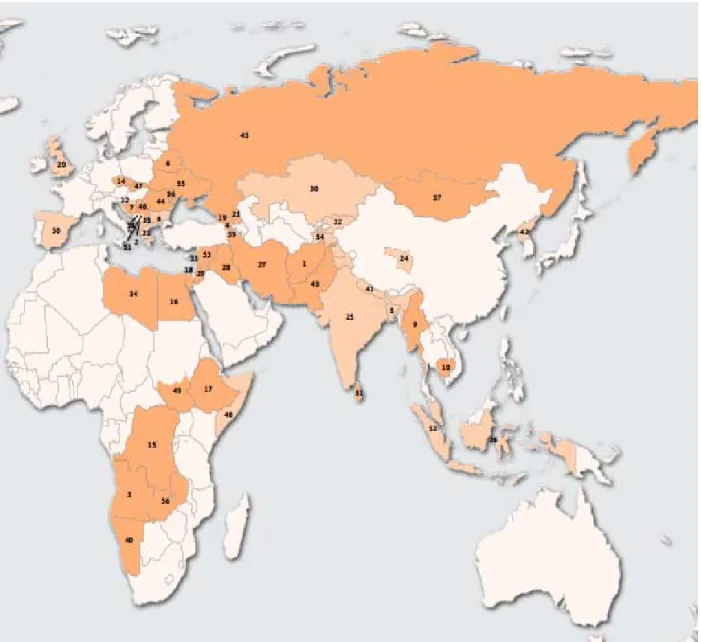
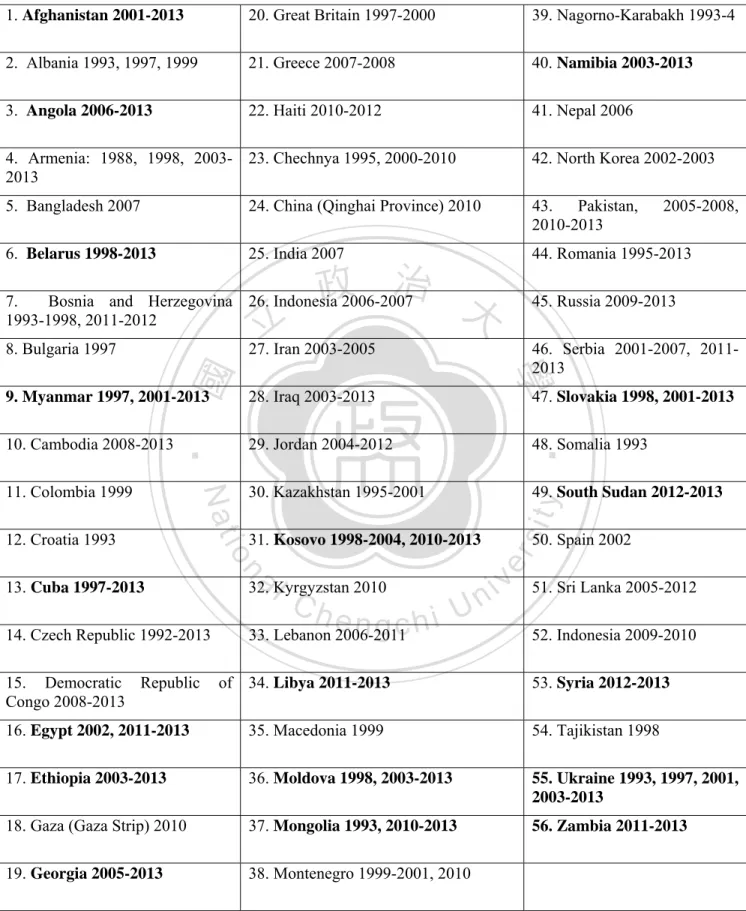
(29) PUBLIC RELATIONS OF CZECH NPO. Since its start in 1992 the NPO People in Need22 has been leading projects in 56 countries around the world (see in Picture 1 and Table 1). Apart from humanitarian aid and human rights, it also started targeting the field of education as well as helping people living in social exclusion. For capacity reasons, it is impossible to provide details of all of them in this study. Figure 1 Activity map of NPO People in Need for years 1992- 2013. 立. 政 治 大. ‧. ‧ 國. 學. n. er. io. sit. y. Nat. al. Ch. engchi. i n U. v. Note: The countries marked with dark orange are where People in Need has been active in 2012/2013. The countries marked with light orange are countries are where PIS was active before 2012. 22. The NPO is using name People in Need since 1999. 24.
(30) PUBLIC RELATIONS OF CZECH NPO. Table 1 List of countries where PIN has been active between 1992 and 2003 1. Afghanistan 2001-2013. 20. Great Britain 1997-2000. 39. Nagorno-Karabakh 1993-4. 2. Albania 1993, 1997, 1999. 21. Greece 2007-2008. 40. Namibia 2003-2013. 3. Angola 2006-2013. 22. Haiti 2010-2012. 41. Nepal 2006. 4. Armenia: 1988, 1998, 2003- 23. Chechnya 1995, 2000-2010 2013. 42. North Korea 2002-2003. 5. Bangladesh 2007. 24. China (Qinghai Province) 2010. 43. Pakistan, 2010-2013. 6. Belarus 1998-2013. 25. India 2007. 44. Romania 1995-2013. 政 治 大. 2005-2008,. 7. Bosnia and Herzegovina 26. Indonesia 2006-2007 1993-1998, 2011-2012. 45. Russia 2009-2013. 8. Bulgaria 1997. 46. Serbia 2001-2007, 20112013. 立. 28. Iraq 2003-2013. 10. Cambodia 2008-2013. 29. Jordan 2004-2012 30. Kazakhstan 1995-2001. 49. South Sudan 2012-2013. 14. Czech Republic 1992-2013 15. Democratic Republic Congo 2008-2013. al. n. 13. Cuba 1997-2013. sit. y. 48. Somalia 1993. 31. Kosovo 1998-2004, 2010-2013. io. 12. Croatia 1993. 47. Slovakia 1998, 2001-2013. 50. Spain 2002. er. 11. Colombia 1999. Nat. 9. Myanmar 1997, 2001-2013. ‧. 學. ‧ 國. 27. Iran 2003-2005. 32. Kyrgyzstan 2010. Ch. engchi. 33. Lebanon 2006-2011. i n U. of 34. Libya 2011-2013. v. 51. Sri Lanka 2005-2012 52. Indonesia 2009-2010 53. Syria 2012-2013. 16. Egypt 2002, 2011-2013. 35. Macedonia 1999. 54. Tajikistan 1998. 17. Ethiopia 2003-2013. 36. Moldova 1998, 2003-2013. 55. Ukraine 1993, 1997, 2001, 2003-2013. 18. Gaza (Gaza Strip) 2010. 37. Mongolia 1993, 2010-2013. 56. Zambia 2011-2013. 19. Georgia 2005-2013. 38. Montenegro 1999-2001, 2010. 25.
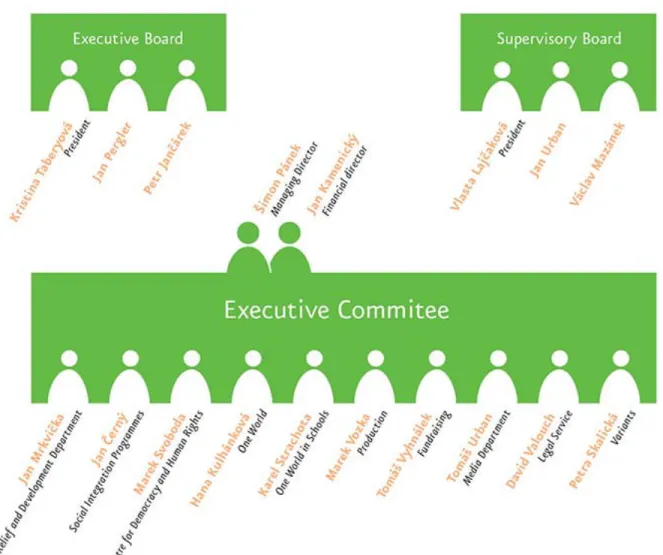
(31) PUBLIC RELATIONS OF CZECH NPO. Structure of PIN There are 10 sections within the organization. The statutory body consists of an Executive board, Supervisory board and the Director The structure is illustrated in Picture 2. The headquarters is based in Prague. Figure 2 Organizational structure of PIN. 立. 政 治 大. ‧. ‧ 國. 學. n. er. io. sit. y. Nat. al. Ch. engchi. 26. i n U. v.
(32) PUBLIC RELATIONS OF CZECH NPO. Goals and activities Nowadays, the foundation’s activities are focused on four main areas: 1. Emergency relief and development cooperation. The People in Need provides emergency relief to people during natural disasters or at times of major international crises. At the same time, PIN focuses on delivering long-term aid to people living in poverty and deplorable living conditions. In countries across Africa, Asia and Europe it conducts development programmes, whose aim is to improve the access of the local population to education, health care and drinking. 政 治 大. water, raise hygiene awareness and help develop local means of subsistence as well as to. 立. encourage people’s engagement in activities which may influence social processes in their home. ‧ 國. 學. country.. ‧. 2. Human Rights Support. The human rights team concentrate their efforts (such as helping dissidents and support for civil society) on working in several dictatorships, authoritarian. y. Nat. io. sit. regimes and countries sharing similar experience of democratic transition as the Czech Republic.. n. al. er. Nowadays, the programmes for support of human rights are being carried out in Cuba, Myanmar,. Ch. Belarus, Russia, Moldova, and Ukraine.. engchi. i n U. v. 3. Social Integration Programs: The team of Social Integration Programmes promotes social improvement for the poor or vulnerable families through counselling and educational services. 4. Educational and informational programs: People in Need works to increase knowledge within Czech society about the problems of poverty, development cooperation, migration, and human rights violations. It also seeks to combat prejudice regarding race and origin, and directly addresses the problem of xenophobia within the Czech society.. 27.
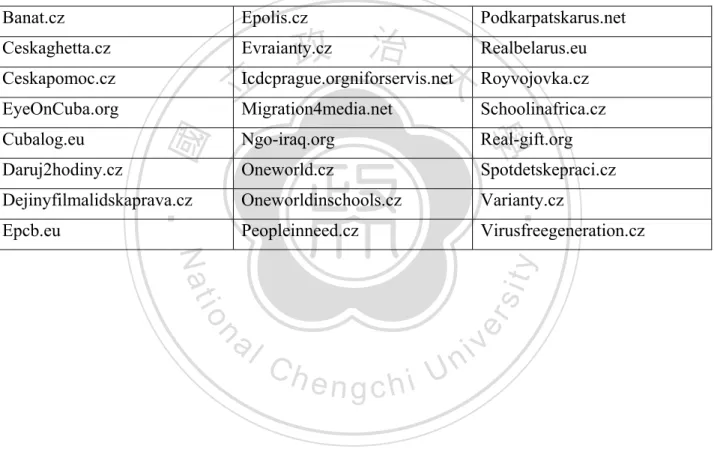
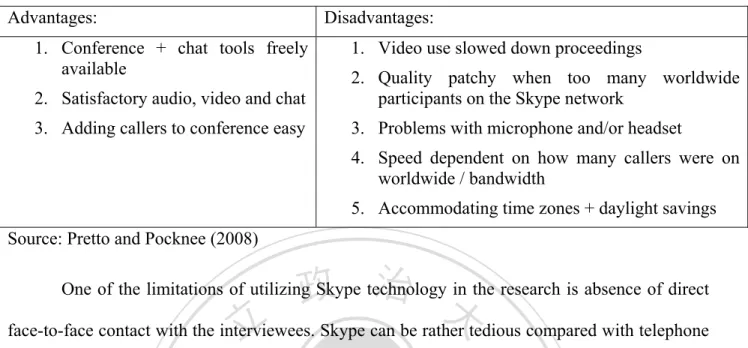
(33) PUBLIC RELATIONS OF CZECH NPO. Examples of activities Due to wide portfolio of projects, it is not possible to present all projects within this study. The following projects illustrate the activities completed by PIN in 201223. . PIN as first international humanitarian organization opened a permanent office in Aleppo, Syria’s largest city. PIN delivers humanitarian assistance to Syria.. . One World International Festival organized in Czech Republic attracted a record 110,372 viewers, who watched 106 documentary films from 44 countries.. 政 治 大 where documentary films and educational materials are available online. 立. . PIN launched a new audiovisual portal for Czech teachers and pupils called www.jsns.cz,. . PIN trained hundreds of community health volunteers in Angola, who examine. ‧ 國. 學. 225,000 children possibly suffering from malnutrition caused by droughts in the country.. ‧. Nearly one fifth of them are malnourished, and these are provided with the special. y. sit. PIN has been dealing with issues of child labor and trafficking of children in Ethiopia.. io. er. . Nat. nutrition they need. Additionally, PIN teaches their parents how to prevent malnutrition.. Over three years PIN helped 1,100 children return to their families and prepared an. al. n. iv n C awareness and education campaign for the general U h e n g c h i public. Several low-threshold centers for abused children have also been established. Communication of PIN on social sites PIN is communicating with public at various events, through the mass media, websites and also social sites. PIN operates 28 websites (see Table 2). Social sites, representing the newest form of communication, allow the nonprofit to communicate with their supporters directly. PIN is active on following Social Sites: 23. The information about People In Need projects was gathered from Annual report 2012. http://www.clovekvtisni.cz/uploads/file/1379421640-CVT_VZ_2013_ENG_final_web_dvoustrany.pdf. 28.
(34) PUBLIC RELATIONS OF CZECH NPO. Facebook (main page24): 17 104 likes Linked In: 660 YouTube: 471 followers Twitter: 1905 followers. Google plus: 175 followers Instagram: 13 followers Figure 3 List of websites administrated by People In Need Banat.cz. Podkarpatskarus.net. Evraianty.cz. Realbelarus.eu. 政 治 大 Icdcprague.orgniforservis.net 立 Migration4media.net. Ceskaghetta.cz Ceskapomoc.cz EyeOnCuba.org. Royvojovka.cz Schoolinafrica.cz Real-gift.org. Oneworld.cz. Spotdetskepraci.cz. Dejinyfilmalidskaprava.cz. Oneworldinschools.cz. Varianty.cz. Epcb.eu. Peopleinneed.cz. Virusfreegeneration.cz. Daruj2hodiny.cz. ‧. ‧ 國. Ngo-iraq.org. 學. Cubalog.eu. Epolis.cz. n. er. io. sit. y. Nat. al. 24. Ch. engchi. i n U. v. Apart from the main Facebook site several sections run their own Facebook page. 29.
(35) PUBLIC RELATIONS OF CZECH NPO. Chapter 3 Methodology This chapter introduces the research methodology used for this study and how it has guided data collection and analysis. First, five research questions are introduced. The following sections describe the data collection phase for this study, which consisted of in-depth interviews.. 3. 1 Aim of the study and research questions The aim of the study is to monitor how People in Need uses public relations in order to support. 政 治 大. their organizational goals. The research covers the communication channels and the strategies. 立. used by People in Need to communicate with the public, the ways NPO access the media. ‧ 國. 學. relations and the reflection of the cooperation between journalists and NPO representatives. This study aims to answer the following main research questions:. ‧. RQ1: What is the level of importance of media relations for PIN?. y. Nat. RQ3: How does mass media impacts PIN’s public relations?. n. al. er. io. sit. RQ2: What is the level of cooperating between journalists and PIN representatives?. i n C h media relations? RQ4: Through which channels PIN practices engchi U. v. RQ5: What are the goals of NIP’s communication strategy?. 3. 2. The research method The intention of this empirical paper is to cover the concrete and detailed opinions of representatives of selected non-profit organization on the public relations and media relations. For this reason their evaluation will be most effectively conducted through a qualitative, rather than the quantitative level. Therefore, this empirical paper will be base on qualitative data retrieved using methodology of semi structured in-depth interviews. Under this criterion the 30.
(36) PUBLIC RELATIONS OF CZECH NPO. research will follow the next steps: 1) 2) 3) 4) 5) 6). Selection of the methodology: semi structured in-depth interviews Prepare the interview questions Conduct the interviews with the selected subjects through the best tool available Create a transcript of the interviews Analyze the material Answer the research questions through the findings. To have a better understanding why semi-structured in-depth interviews is the most suitable methodology for the current research, lets proceed with the explanation.. 政 治 大 These types of interviews are generally organized around a set of predetermined open-ended 立 Semi structured in-depth interviews. ‧ 國. 學. questions, with other questions emerging from the dialogue between interviewer and interviewee(s) (Rubin, 2005). Semi-structured in-depth interviews are the most widely used. ‧. interviewing format for qualitative research and can occur either with an individual or in groups.. sit. y. Nat. According to Chilban (1996), the individual in-depth interview allows the interviewer to. io. er. delve deeply into social and personal matters, whereas the group interview allows inter-viewers to get a wider range of experience but, because of the public nature of the process, prevents. n. al. i n delving as deeply into the individual C perspective. hengchi U. v. Conducting interviews in person was not possible due to limited budget of the study. In. order to substitute the personal contact, the communication from gram Skype25 was utilized for the interviews. The advantages and disadvantages of using Skype for conducting interviews are listed in Table 2.. 25. Skype has over past 10 years since its launch become a popular communication tool around the world25. There was 300 million active users in 2013. Low software demands and also low costs (the basic features are free) are one of the main reasons why it is also adopted by researchers.. 31.
(37) PUBLIC RELATIONS OF CZECH NPO. Table 2 Advantages and disadvantages of the use of technology for conduction interviews Advantages:. Disadvantages:. 1. Conference + chat tools freely available. 1. Video use slowed down proceedings. 2. Satisfactory audio, video and chat. 2. Quality patchy when too many worldwide participants on the Skype network. 3. Adding callers to conference easy. 3. Problems with microphone and/or headset 4. Speed dependent on how many callers were on worldwide / bandwidth 5. Accommodating time zones + daylight savings. Source: Pretto and Pocknee (2008). 政 治 大. One of the limitations of utilizing Skype technology in the research is absence of direct. 立. face-to-face contact with the interviewees. Skype can be rather tedious compared with telephone. ‧ 國. 學. interviews. Nevertheless, there are researchers suggesting (Sturges & Hanrahan, 2004) that there are no significant differences between face-to-face and telephone interviews.. ‧. Taking in account the above-mentioned points, including the obstacles connected with. er. io. program as suitable for the purposes of this study.. sit. y. Nat. the use of Skype for research purposes, the author of the text still considers this communication. al. n. iv n C NGO People in Need has a total of 753h employees. e n g c62% h i ofUthem are abroad on missions and 38 Respondents of the study. % of them are present in Czech Republic. Respondents were selected based on the function they are charged with within the organization. As the main topic of the paper is public relations, two of the respondents are involved in public relations of the NPO. In order to learn about public relations in context of overall functioning of the NPO, two other respondents are from departments other than the public relations department: One is head of fundraising and another is NPO of People in Need who is also a founder of the organization. Since the study aims to provide a comprehensive view on public relations of NPOs, where an important role belongs to 32.
(38) PUBLIC RELATIONS OF CZECH NPO. media relations, one further interview with a journalist who covers the non-profit topic in the media was conducted. In total five interviews were conducted for the purposes of this study. Four respondents are employees of People in Need and they work in PIN’s headquarters in Prague. The fifth respondent is a journalist employed by Czech radio who had been covering topics on People in Need. The following section includes characteristic of each respondent in regards of his or her. 政 治 大. working position, motivation to work for People in Need, education and age. Tereza Hronova (Mrs.). 立. ‧ 國. 學. Tereza Hronova is media coordinator within the Relief and Development section. She has been working in People in Need for four years. She decided to work in PIN as she considered it an. ‧. interesting job which involves some journalistic work where she gets the space to write her own. sit. y. Nat. texts. Ms. Hronova has gained master’s degree in Journalism and Social work. Currently, she is. io. al. n. Simon Panek (Mr.). er. in the fourth year of her doctor studies. She is 28 years old.. Ch. engchi. i n U. v. Simon Panek is CEO of People in Need. He has been involved in the runnning of the organization since its beginning. As student leader of the Velvet revolution in 1989, he become one of the first personalities of the new emerging nonprofit sector in Czech Republic. His motivation was to help Armenia and other countries suffering from various conflicts. Mr. Panek has completed secondary school and he is 46 years old.. 33.
(39) PUBLIC RELATIONS OF CZECH NPO. Tomas Urban (Mr.) Tomas Urban is the Head of Media department and has 7 years’ experience working in People in Need. He decided to work for PIN based on the good reputation of the NGO and also because he wanted to learn new things and was interested in gaining additional sources of information about what is going on around the world. Mr. Urban attained his master’s degree in Religion and Theology. He is 36 years old. Tomas Vyhnalek (Mr.). 政 治 大. Mr. Vyhnalek is the head of the fundraising section. He has been working in PIN since 1996 and. 立. he started to lead the fundraising section 7 years ago. He started to work in PIN as he wanted to. ‧ 國. 學. change the world and protect it. Also, he likes the job. Mr. Vyhnalek has gained his master’s degree in Regional Territory Studies and he is 40 years old.. ‧. Zuzana Rejchova (Mrs.). Nat. sit. y. Mrs. Rejchova is a journalist for Czech radio. She worked for the station Radio Wave from 2006. n. al. er. io. to 2014 and now she is an employee at a station called Radiojournal. During her work for Radio. i n U. v. Wave, she focused on the topic of the nonprofit sector. She anchored a program called Crossings. Ch. engchi. that focused on migrants in Czech Republic. The project was in cooperation with (People in). Mrs. Rejchova gained her bachelor’s degree in Humanism and is 34 years old. Data collection procedures The respondents of the study where approached via email communication, all of them agreed to participate in the study. The interviews were conducted in the spring of 2014. Initially, the interviews were planned for the second week in April, but two respondents were unavailable for that as they were traveling abroad. The interview with Tereza Hronova therefore took place two weeks earlier, and the interview with Zuzana Rejchova took place one month later. 34.
(40) PUBLIC RELATIONS OF CZECH NPO. The interviews were conducted via the communication program Skype. The respondents were asked a series of open-ended questions. The structure of the interview (see in appendix) covered activities of each respondent in relation to public relations and media relations. The respondents who worked with the NPO were asked about the role of media in relations of their organization and also their opinions on PR. The respondent who does not work for the NPO – the journalist – was mainly asked about cooperation with various NPOs and media coverage. Most interviews took about one hour (with the exception of the interview with Head of Media. 治 政 大when conducting interviews via The researcher encountered minor technical difficulties 立. department that lasted two hours). Interviews were recorded and transcribed for later reference.. Skype. The obstacle was the low speed of the Internet, which had an impact on quality of the. ‧ 國. 學. audio and the video. The most technical difficulties were encountered during the call with CEO. ‧. Simon Panek who was staying in Ukraine as the sound quality lowered significantly several times and the interview, nevertheless, thanks to the willingness of interviewees to repeat the. y. Nat. io. sit. answers it was possible to transmit most of the information. During this and the other two. n. al. er. interviews, the researcher decided to stop using the video camera as it lowered the quality of the. Ch. i n U. v. sound to the crucial level and therefore only the audio was used in the interview.. engchi. 35.
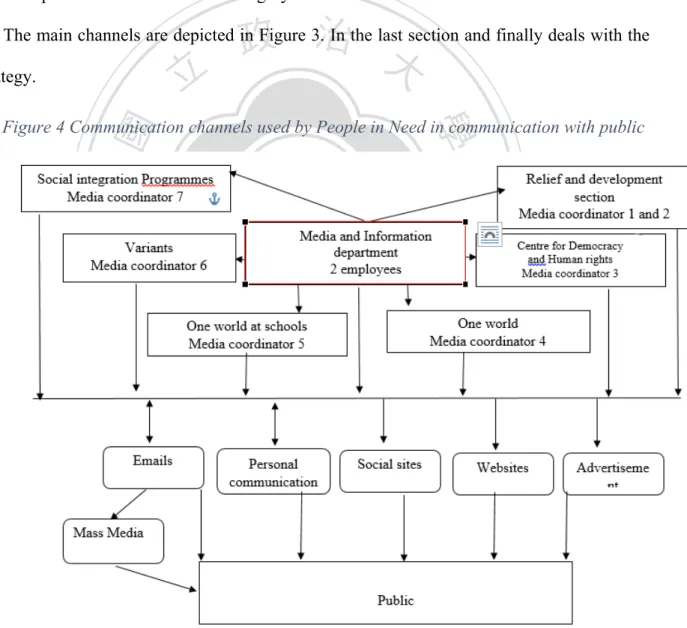
(41) PUBLIC RELATIONS OF CZECH NPO. Chapter 4 Results This section is dedicated to the findings of the study. The results are organized based on the five research questions into five following categories: Media relations, Journalists, Role of the media, Communication with public, and PR strategy. First category deals with the system of public relations and methods used to communication with media. Second chapter focuses on the communication between journalists and NPO representatives. The third category covers channels used for communication with. 政 治 大. public. The main channels are depicted in Figure 3. In the last section and finally deals with the. 立. PR strategy.. ‧. ‧ 國. 學. Figure 4 Communication channels used by People in Need in communication with public. n. er. io. sit. y. Nat. al. Ch. engchi. 36. i n U. v.
數據

+4
相關文件
Robinson Crusoe is an Englishman from the 1) t_______ of York in the seventeenth century, the youngest son of a merchant of German origin. This trip is financially successful,
fostering independent application of reading strategies Strategy 7: Provide opportunities for students to track, reflect on, and share their learning progress (destination). •
Strategy 3: Offer descriptive feedback during the learning process (enabling strategy). Where the
How does drama help to develop English language skills.. In Forms 2-6, students develop their self-expression by participating in a wide range of activities
Now, nearly all of the current flows through wire S since it has a much lower resistance than the light bulb. The light bulb does not glow because the current flowing through it
O.K., let’s study chiral phase transition. Quark
According to the Heisenberg uncertainty principle, if the observed region has size L, an estimate of an individual Fourier mode with wavevector q will be a weighted average of
The existence of cosmic-ray particles having such a great energy is of importance to astrophys- ics because such particles (believed to be atomic nuclei) have very great
