行政院國家科學委員會專題研究計畫 成果報告
在無線 Ad-hoc 網路上針對多媒體資料流以雜訊為基礎且具
有動態調整優先權的媒介存取控制
計畫類別: 個別型計畫
計畫編號: NSC94-2213-E-110-018-
執行期間: 94 年 08 月 01 日至 95 年 07 月 31 日
執行單位: 國立中山大學電機工程學系(所)
計畫主持人: 許蒼嶺
報告類型: 精簡報告
報告附件: 出席國際會議研究心得報告及發表論文
處理方式: 本計畫可公開查詢
中 華 民 國 95 年 9 月 18 日
行政院國家科學委員會專題研究計畫成果報告
在無線 Ad-hoc 網路上針對多媒體資料流以雜訊為基礎
且具有動態調整優先權的媒介存取控制
Jamming-based Medium Access Control with Dynamic Priority Adjustment
for Multimedia Traffic in Wireless Ad-hoc Networks
計畫編號:NSC 94-2213-E-110-018
執行期限:94 年 8 月 1 日至 95 年 7 月 31 日
主持人:許蒼嶺 國立中山大學電機工程學系
E-mail:[email protected]
一、中文摘要 本計畫的第一年主要是在無線Ad Hoc 網路 上設計出一套能夠提供差異性服務並且能夠動 態調整優先權的媒介存取控制機制。在本機制的 運作下,各個移動結點藉由發出一段長度不等的 雜訊干擾通道來競爭媒介使用權,發送最長干擾 雜訊的節點將會贏得資料傳輸的機會。每次競爭 成功的節點都會對其他的節點廣播自己的局部 優先權(local priority)來更新他們所記錄的總體優 先權(global priority)。總體優先權的值是用來當作 網路上的節點參與下一回媒介競爭的門檻;任何 局部優先權小於總體優先權的節點將被禁止參 加。本機制的設計創意之一乃是移動結點的優先 權 可 以 隨 著 網 路 上 的 競 爭 及 壅 塞 狀 況 動 態 調 整,所以能夠避免低優先權資料流的 starvation 和高優先權資料流之間的無效競爭。為了驗證所 提出的機制的效能,我們在ns-2 模擬器上進行模 擬;結果證明了我們所提的機制不僅能夠提供不 同服務品質保證的差異性服務,而且也能夠改善 通道的使用效率。關鍵詞: Jamming noise, Ad Hoc 網路、動態優 先權調整、媒介存取控制
Abstract
In the first year of this project, we present a jamming-based MAC (JMAC) with dynamic priority adjustment for multimedia services in wireless ad hoc networks. The proposed scheme differentiates multimedia traffic into classes with different priority levels. A mobile node is prioritized in frame transmissions by issuing a pre-calculated length of jamming noise; the one with the longest jamming length can win the frame transmission. The winner immediately broadcasts its current priority level (local priority) to update the global priorities of all the neighboring nodes.
The global priority is used as a contention baseline, which prevents any node with a local priority lower than the baseline from participating in the next contention. One of the innovative designs in the proposed scheme is right in that the priority of a mobile node can be dynamically adjusted according to network conditions so that any possible starvation of low-priority traffic or any ineffective contention of high-priority traffic can be avoided. The proposed JMAC scheme is simulated on NS-2. The performance metrics of our interest include the contention-success probability, the packet dropping ratio, the medium access delay, and the system throughput. The simulation results show the effectiveness and the superiority of our proposed scheme over other previous works.
Keywords: Jamming noise, Ad Hoc networks, dynamic priority adjustment, MAC
二、背景與目的
Carrier Sense Multiple Access (CSMA)已成為 無線 Ad-Hoc 網路上最普遍使用的媒介存取控制 技術,網路上的移動結點(Mobile Node)藉由偵測 通道是否在閒置狀態來啟動資料訊框的傳輸。然 而,當網路擁塞時,碰撞仍會發生。雖然現有的 IEEE 802.11[1]使用了不同的訊框間隔(Interframe Space)給不同類型的傳輸,並且設計了隨機後退 (Random Backoff)的機制來紓解碰撞問題,還是 無法提供適用於多媒體資料流的差異性服務。 所以,802.11 Working Group E 發展出一套新的 機制[2]-EDCA (Enhanced Distributed Channel Access)-來支援日趨增加的各種不同優先權之 資料流。近來,許多更新式的機制[3-9]被提出來 改善EDCA 的效能;其中有些是根據網路上的狀 況 來 動 態 調 整 一 些 競 爭 參 數 (Contention Parameters),有些則是修改 EDCA 的指數型隨機 後退演算法。另一方面,有一類利用發送雜訊干
擾通道,使其他的節點偵測到通道忙碌,以取得 無線媒介使用權的相關機制[10-14]被提出來保 障即時資料流的服務品質(QoS)。無論如何,以上 所提的機制不是存在低優先權資料流始終無法 取得服務的問題,就是需要有難以在 Ad-Hoc 網 路上實現的時脈同步設計。有鑒於以上的缺點, 本計劃所提出的具有動態優先權調整的以雜訊 為基礎的媒介存取控制機制(JMAC)是先將無線 網 路 上 的 多 媒 體 資 料 流 分 成 兩 種 以 上 的 優 先 權,讓所有等級的資料流一開始就使用我們所提 的機制競爭無線媒介使用權;再者,為了防止低 優先權資料流的Starvation,特別設計在發送雜訊 (Jamming Noise)之後夾帶優先權的訊息,使得移 動結點可以動態調整競爭媒介的優先權。如此一 來,我們所發展的機制能夠根據資料流的優先權 給予各種QoS 的保證,特別是在網路擁塞時。 三、JMAC 機制 我們所提出的 JMAC 機制考慮 M 種不同的 資料類別;假使m1小於m2,則資料流 m1 的優 先權低於 m2 的。當網路上的移動結點欲傳送資 料時,先等傳輸媒介閒置一段 AIFS 時間之後, 發出長度不等的Jamming Noise 來干擾媒介,基 本上是優先權越高者所發出的Jamming Noise 越 長,越有可能搶得媒介使用權。以下是一個移動 結點 i 在本機制中所使用的相關參數。 ․ mi: 移動結點 i 的資料類別。 ․ Li: 移動結點 i 的局部優先權。 ․ Ci: 移動結點 i 所經歷的失敗競爭回 合數。 ․ Lcfi: 移動結點 i 可以發出的 Jamming Noise 長度。 ․ S: 各個節點的Jamming Noise 長度 之間的差異調整因數。 ․ G: 總體優先權,其值為最新的競爭 優勝者的局部優先權。 ․ Rlimit: 一個訊框最多可參與的競爭回 合數。
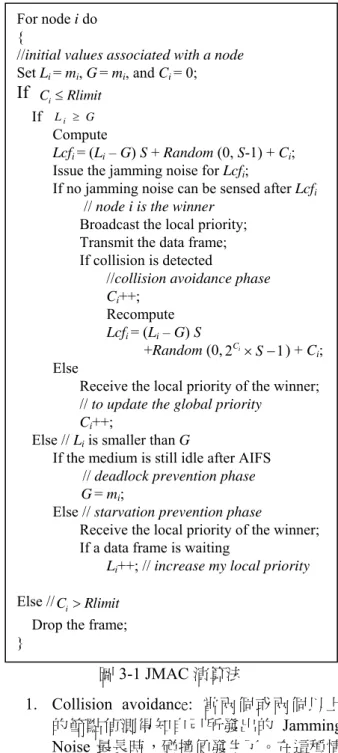
圖3-1 所示為 JMAC 演算法的 pseudo- code。 在每一競爭回合中,只有移動結點 i 的局部優先 權(Li)大於或等於網路的總體優先權(G)才可以加 入競爭。在發出長度為 Lcfi的Jamming Noise 後, 若偵測到媒介為閒置狀態,表示自己所發出的 Jamming Noise 長度最長,即贏得此一回合的競 爭。接著傳送帶有優先權訊息的廣播訊框讓其他 的節點更新所記錄的總體優先權值,然後傳送資 料訊框。除了發出最長的Jamming Noise 以贏得 媒介使用權,JMAC 演算法還包括了以下所敘述 的 collision avoidance, deadlock prevention, 和 starvation prevention 三個處理程序。 圖3-1 JMAC 演算法 1. Collision avoidance: 當兩個或兩個以上 的節點偵測得知自己所發出的 Jamming Noise 最長時,碰撞便發生了。在這種情 況下,在下一競爭回合的Jamming Noise 長度計算公式中的亂數範圍會加倍。 2. Deadlock prevention: 當網路上一個擁有 最高局部優先權的節點完成了所有的資 料傳輸,其他的節點都無法進入下一回合 的競爭,Deadlock 就發生了。這種情形就 是發生在媒介閒置一段AIFS 時間之後, 仍然為閒置的狀態。此時,結點 i 會自動 將所記錄的總體優先權還原成初始值。 3. Starvation prevention: 當網路上有許多的 For node i do {
//initial values associated with a node Set Li = mi, G= mi, and Ci = 0;
If
Ci≤RlimitIf Li ≥ G
Compute
Lcfi = (Li – G) S + Random (0, S-1) + Ci;
Issue the jamming noise for Lcfi;
If no jamming noise can be sensed after Lcfi
// node i is the winner Broadcast the local priority; Transmit the data frame; If collision is detected
//collision avoidance phase
Ci++; Recompute Lcfi = (Li – G) S +Random (0, 2Ci× − ) + CS 1 i; Else
Receive the local priority of the winner; // to update the global priority
Ci++;
Else // Li is smaller than G
If the medium is still idle after AIFS // deadlock prevention phase
G= mi;
Else // starvation prevention phase
Receive the local priority of the winner; If a data frame is waiting
Li++; // increase my local priority
Else //Ci>Rlimit
Drop the frame; }
高優先權資料流在傳輸時,低優先權的資 料流將難以贏得媒介使用權。為了避免低 優先權資料流的Starvation,結點 i 在每一 失敗競爭回合之後,會將正在等待傳輸的 資料訊框之局部優先權提升一級。 注意,如果一個資料訊框經過 Rlimit 次的競 爭回合,仍然無法成功傳送出去,就會被丟棄。 所以,Ci的最大值為 Rlimit。 四、結果與討論 為了驗證所提出的JMAC 機制的效能,我們 透過修改和新增 ns-2[15]的一些模組作為模擬的 網路環境。整個無線 Ad Hoc 網路是由 100 個節點 形成;相關的參數設定如表 4-1;每個節點最多 產生一條資料流,資料流的類別為其上為固定位 元數率(CBR)的 UDP 封包。在本節中,所有的圖 示結果都是模擬 10 次的平均值,每一次模擬時間 為 30 秒。 表4-1 使用在模擬中的參數設定值
Frame payload 100~800 bytes
MAC header 224 bits
PHY header 192 bits
ACK 112 bits + PHY header
RTS 160 bits + PHY header
CTS 112 bits + PHY header
Channel capacity 10 Mbps
Propagation delay 1 us
SIFS 10 us
DIFS/AIFS SIFS +σ
Slot time (σ) 20 us
The scaling factor (S) 7σ The total no. of traffic classes (M) 4
圖 4-1 所示為各類資料流的競爭成功機率隨 著網路上的資料流數目變化的情形。平均成功搶 得媒體使用權的機率計算方式是在一個節點要 傳送訊框參與競爭開始,就啟動一個計數器,經 過每一回合要加一,直到成功搶得媒體的使用權 為止;計數器所記錄值的倒數極為平均競爭成功 的機率。由圖中可知每一資料流競爭成功的機率 會隨著網路的資料流數目增加而減少;優先權越 高的資料流競爭成功的機率也就越高。另外,因 為低優先權資料流 (TC1,TC2) 藉著我們所設計 的 Starvation Prevention (SP) 機制可以提高自己的 局部優先權,達到參與媒體競爭的門檻( Li ≥ G ) 後,即可發出 Jamming Noise 參與競爭,獲得成功 的機會,所以當資料負載大時,也不會驟降為零。 再來,我們將JMAC 機制與即將制定為標準 的EDCA 做比較。四種優先權的 EDCA 相關參數 設定如表 4-2。因為這兩種機制的設計在本質上 並 不 相 同 , 所 以 我 們 只 比 較 整 體 系 統 的 Throughput。如圖 4-2 所示,我們的機制在整個系 統Throughput 的表現上永遠優於 EDCA。雖然我 們所提的機制沒有採用隨機後退演算法,而有了 較佳的系統頻寬使用率,但也付出了一些微小的 功率傳送 Jamming Noise 來競爭媒介使用權。 表4-2 EDCA 的參數設定值 AIFS [1] SIFS +2σ AIFS [2] SIFS +σ AIFS [3] SIFS +σ AIFS [4] SIFS +σ CWmin [1], CWmax [1] 31, 1023 CWmin [2], CWmax [2] 31, 1023 CWmin [3], CWmax [3] 15, 31 CWmin [4], CWmax [4] 7, 15 圖4-1 各類資料流的競爭成功機率 圖4-1 JMAC 與 EDCA 的比較 五、結論
我們所提出的JMAC 採用 Jamming- based 的 觀念取代傳統Binary Exponential Backoff 機制。 JMAC 主要的概念是移動結點在等待通道閒置一 0 0.1 0.2 0.3 0.4 0.5 5 10 15 20 Number of flows Su cc es s p ro b ab ility TC 1 TC 2 TC 3 TC 4 0 1 2 3 4 5 6 5 10 15 20 Number of flows S ys te m t hr ou ghp ut JMAC EDCA
段 AIFS 時間之後,發出 Jamming noise 干擾媒 介,發出越長的雜訊者越有利於贏得媒介使用 權,其中發出最長 Jamming noise 的節點可接著 傳送帶有優先權訊息的廣播封包,接著傳送資料 封包;至於其他的節點,則在收到夾帶在Jamming noise 之後的優先權廣播訊息,會根據此一訊息來 更新內部所記錄的總體優先權值。而在下一回合 的競爭中,局部優先權比總體優先權小的節點, 將被禁止參與競爭媒介使用權,但會將自己的局 部優先權往上提升一級。 模擬結果證明我們所提的JMAC 機制不僅能 夠提供不同服務品質保證的差異性服務,同時也 改善了通道的使用效率。此外,先前在文獻上出 現的相關機制所存在的問題,如低優先權資料流 的 Starvation 和網路擁塞時的高碰撞率,也獲得 了解決。 References
[1] IEEE 802.11-1999, “Part 11: Wireless LAN Medium Access Control (MAC) and Physical Layer (PHY) Specifications,” 1999.
[2] IEEE 802.11e Draft/D13.0, “Part 11: Wireless LAN Medium Access Control (MAC) and Physical Layer (PHY) Specifications: Medium Access Control (MAC) Enhancements for Quality of Service (QoS),” Jan. 2005.
[3] I. Aad and C. Castelluccia, “Differentiation mechanisms for IEEE 802.11,” Proc.
INFOCOM 2001, vol. 1, pp.209-218, April
2001.
[4] W. Pattara-Atikom, P. Krishnamurthy, and S. Banerjee, “Distributed mechanisms for quality of service in wireless LANs,” IEEE Wireless
Communications, vol. 10, no. 3, pp.
26-34, June 2003.
[5] Kanghee Kim, A. Ahmad, and Kiseon Kim, “A wireless multimedia LAN architecture using DCF with shortened contention window for QoS provisioning,” IEEE Communications Letters, vol. 7, no.
2, pp.97-99, Feb. 2003.
[6] L. Romdhani, Qiang Ni, and T. Turletti, “Adaptive EDCF: enhanced service differentiation for IEEE 802.11 wireless ad-hoc networks,” Proc. WCNC
2003, vol.2, pp.1373-1378, March 2003.
[7] Hao Zhu et al., “EDCF-DM: a novel enhanced distributed coordination function for wireless ad hoc networks,” Proc. ICC’04, vol. 7, pp. 3886-3890, June 2004.
[8] A. Banchs, M. Radimirsch, and X. Perez, “Assured and expedited forwarding extensions for IEEE802.11 wireless LAN,”
Proc. of the Tenth International Workshop on Quality of Service, pp. 237-246, May 2002.
[9] X. Pallot and L. E. Miller, “Implementing message priority policies over an 802.11 based mobile ad hoc network,” Proc.
MILCOM 2001, vol.2, pp.860- 864, Oct.
2001.
[10] João L. Sobrinho and A. S. Krishnakumar, “Quality-of-service in ad hoc carrier sense multiple access wireless networks,” IEEE J.
Selected Areas in Communications, vol. 17,
no. 8, pp. 1353-1368, Aug. 1999.
[11] Wen-Tsuen Chen, Bo-Bin Jian, and Shou-Chih Lo, “An adaptive retransmission scheme with QoS support for the IEEE 802.11 MAC enhancement,” Proc. VTC, vol. 1, pp. 70-74, May 2002.
[12] Chi-Hsiang Yeh and Tiantong You, “A QoS MAC protocol for differentiated service in mobile ad hoc networks,” Proc. ICPP, pp. 349-356, Oct. 2003.
[13] Tiantong You, Chi-Hsiang Yeh, and H. Hassanein, “A new class of collision prevention MAC protocols for wireless ad hoc networks,” Proc. ICC’03, vol.2 pp.
1135-1140, May 2003.
[14] Tiantong You, Chi-Hsiang Yeh, and H. Hassanein, “CSMA/IC: a new class of collision-free MAC protocols for ad hoc wireless networks,” Proc. ISCC’03, vol. 2, pp. 843-848, 2003.
[15] Network Simulator – ns (version 2). [Online.] Available: http://mash.cs.berkeley.edu/ns