Highly efficient red electrophosphorescent devices based on an iridium complex with
trifluoromethyl-substituted pyrimidine ligand
Yu-Hua Niu, Baoquan Chen, Sen Liu, Hinlap Yip, Julie Bardecker, Alex K.-Y Jen, Jakka Kavitha, Yun Chi, Ching-Fong Shu, Ya-Hsien Tseng, and Chen-Han Chien
Citation: Applied Physics Letters 85, 1619 (2004); doi: 10.1063/1.1786369 View online: http://dx.doi.org/10.1063/1.1786369
View Table of Contents: http://scitation.aip.org/content/aip/journal/apl/85/9?ver=pdfcov
Published by the AIP Publishing
Articles you may be interested in
Correlation of photoluminescent quantum efficiency and device characteristics for the soluble electrophosphorescent light emitter with interfacial layers
J. Appl. Phys. 104, 024511 (2008); 10.1063/1.2959817
White polymeric light-emitting diode based on a fluorene polymerIr complex blend system
Appl. Phys. Lett. 86, 121101 (2005); 10.1063/1.1873046
Increased electrophosphorescent efficiency in organic light emitting diodes by using an exciton-collecting structure
J. Appl. Phys. 97, 044505 (2005); 10.1063/1.1853500
Red electrophosphorescence devices based on rhenium complexes
Appl. Phys. Lett. 83, 365 (2003); 10.1063/1.1592633
Highly efficient electrophosphorescent devices based on conjugated polymers doped with iridium complexes
Appl. Phys. Lett. 80, 2045 (2002); 10.1063/1.1461418
This article is copyrighted as indicated in the article. Reuse of AIP content is subject to the terms at: http://scitation.aip.org/termsconditions. Downloaded to IP: 140.113.38.11 On: Thu, 01 May 2014 04:14:17
Highly efficient red electrophosphorescent devices based on an iridium
complex with trifluoromethyl-substituted pyrimidine ligand
Yu-Hua Niu, Baoquan Chen, Sen Liu, Hinlap Yip, Julie Bardecker, and Alex K.-Y Jena)
Department of Materials Science and Engineering, Box 352120, University of Washington, Seattle, Washington 98195-2120
Jakka Kavitha and Yun Chi
Department of Chemistry, National Tsing Hua University, Hsinchu 300, Taiwan
Ching-Fong Shu, Ya-Hsien Tseng, and Chen-Han Chien
Department of Applied Chemistry, National Chiao Tung University, Hsinchu 30035, Taiwan (Received 20 April 2004; accepted 22 June 2004)
Highly efficient red-emitting electrophosphorescent devices were fabricated by doping an iridium
共Ir兲 complex containing trifluoromethyl 共CF3兲-substituted pyrimidine ligand into a conjugated bipolar polyfluorene with triphenylamine and oxadiazole as side chains. The device efficiency can be enhanced through effective exciton confinement using a layer of 1,3,5-tris (N-phenylbenzimidazol-2-yl)benzene on the cathode side and a layer of in situ polymerized tetraphenyldiamine-perfluorocyclobutane on the anode side. For a blend with 5 wt % of the Ir complex, a maximum external quantum efficiency of 7.9 photon/electron % and a maximum brightness of 15800 cd/ m2are reached with Commission Internationale de L’Eclairage chromaticity coordinates of x = 0.65 and y = 0.34. © 2004 American Institute of Physics.
[DOI: 10.1063/1.1786369]
Organic and polymer light-emitting diodes(LEDs) based on fluorescent molecules or polymers have attracted great interest because of their potential for applications in flat-panel displays. However, the probability of singlet exciton formation in the charge recombination process of fluorescent LEDs is only 25% by simple spin-pairing statistics. Thus, the highest efficiency achievable of these devices is quite lim-ited. Fortunately, this upper limit can be overcome by using phosphorescent complexes as dopants in LEDs to harvest both singlet and triplet excitons. This phenomenon increases the internal quantum efficiency to that of almost 100%.1,2
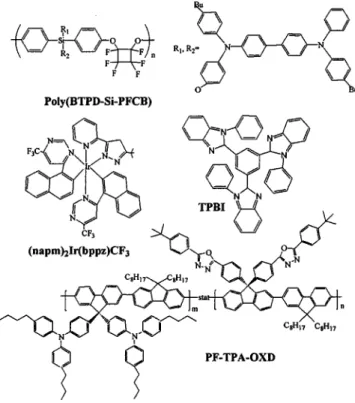
The iridium complexes developed by Thompson et al.3 containing the 2-phenyl pyridine type cyclometalated ligands, such as Ir共ppy兲3, have been extensively studied for the fabrication of green LEDs.3The strong emission occur-ring atmax= 514 nm is believed to originate from the triplet manifold containing both the intraligand –* and the metal-to-ligand charge transfer(MLCT) characters. It is an-ticipated that color tuning from green to red can be achieved by lowering the energy gap of either the–* or the MLCT excited states. To test this hypothesis, we replace the pyridine by a pyrimidine fragment, which contains two electronega-tive nitrogen atoms on the aromatic-skeleton, and incorpo-rate an additional electron-withdrawing CF3 group. As a re-sult, a red-emitting iridium complex with two CF3-substituted pyrimidine ligands, 共napm兲2Ir共bppz兲CF3
(Ir-1, Fig. 1), was synthesized.4
In solid state, when excited, the Ir-1 exhibits a pure red emission peak at 638 nm, as shown in Fig. 2. From the featureless broad emission, it can be judged as the characteristic of triplet metal-to-ligand charge-transfer共3MLCT兲.5
To use this complex as the electroluminescent(EL) layer in LEDs, it is crucial to blend the triplet emitter into a
suit-able host. In general, there are two possible mechanisms in-volved in this process: The Förster/Dexter energy transfer or the direct charge-trapping and recombination mechanism. In the former process, excitons that are formed in the host mi-grate to the triplet dopant via the dipole resonance coupling or charge exchange.6,7 In the latter process, charge carriers are directly trapped by the guest and await the arrival of opposite carriers for recombination.8 In either case, a host
a)Electronic mail: [email protected]
FIG. 1. Chemical structures of the cross-linked hole-transport material, poly(BTPD-Si-PFCB), the electron-transport material, TPBI, and the host
polymer, PF-TPA-OXD.
APPLIED PHYSICS LETTERS VOLUME 85, NUMBER 9 30 AUGUST 2004
0003-6951/2004/85(9)/1619/3/$22.00 1619 © 2004 American Institute of Physics This article is copyrighted as indicated in the article. Reuse of AIP content is subject to the terms at: http://scitation.aip.org/termsconditions. Downloaded to IP:
with balanced electron and hole transport abilities should be beneficial. Therefore, a bipolar blue-emitting polyfluorene with hole-transporting triphenylamine (TPA) and electron-transporting oxadiazole (OXD) as side chains (PF-TPA-OXD, Fig. 1) was chosen as host.9
To realize high efficiency, hole blocking at the cathode side and electron-blocking at the anode side as well as effec-tive exciton confinements are necessary. In this letter, we adopt a tetraphenyldiamine-based hole-injection/transport layer (HTL), poly(BTPD-Si-PFCB) (HP1, Fig. 1),10 which functions both as an electron-blocking and an exciton-confinement layer at the anode side. In the meantime, a layer of 1,3,5-tris(N-phenylbenzimidazol-2,yl)benzene (TPBI, Fig. 1) electron-injection/transport layer (ETL) was also used at the cathode side for hole blocking and exciton confinement.11 For a blend with 5 wt % of the Ir complex in PF-TPA-OXD, a maximum external quantum efficiency of 7.9 photon/ electron 共ph/el兲% and a maximum brightness of 15 800 cd/ m2 are reached with Commission Internationale de L’Eclairage(CIE) chromaticity coordinates of x=0.65 and
y = 0.34. These results are outstanding for red LEDs using a
phosphorescent emitter as dopant in conjugated polymer. Solution blending of Ir-1 and PF-TPA-OXD was carried out at specific volume ratios using separate solution matrices with a concentration of 10 mg/ ml in p-xylene. Compared with the process of using multisources cosublimation in or-ganic LEDs the solution blending process can control the ratio precisely. The LEDs were fabricated on indium-tin-oxide(ITO) covered glass substrates. A layer of robust HP1
共⬃30 nm兲 with good solvent resistance was prepared by spin
coating its precursor(with the concentration of 10 mg/ml in dichloroethane) onto ITO and thermally cross linking it at 225 ° C for 40 min under argon. The control devices were prepared by spin coating a layer of polyethylene dioxythiophene polystyrene sulfonate (PEDOT:PSS, Bayer AG) film共⬃30 nm兲 on ITO as the HTL. Light-emitting layer
(EM) with a nominal thickness of⬃40 nm was spin coated
on top of HP1, or on the vacuum dried PEDOT: PSS in some cases. TPBI was then sublimed as the ETL共⬃30 nm兲 under a vacuum below 1⫻10−6Torr. Cesium fluoride with thick-ness of 1 nm and aluminum with thickthick-ness of 200 nm were evaporated subsequently as cathode.12
The ultraviolet–visible(UV-VIS) absorption spectrum of Ir-1 and the photoluminescence (PL) spectrum of the PF-TPA-OXD are shown in Fig. 2. The absorption peaks of Ir-1 at⬃360 nm, ⬃470 nm and ⬃540 nm correspond to the singlet metal-to-ligand charge-transfer 共1MLCT兲 transition,
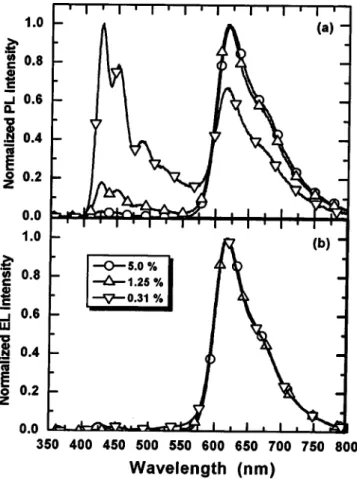
the ligand-centered–* transition and the3MLCT transi-tion, respectively. From the moderate overlap between the PL spectrum of PF-TPA-OXD and the1MLCT absorption, it implies that the energy transfer between PF-TPA-OXD and Ir-1 will only be moderate. Consistent with this, Fig. 3(a) shows that for spin-coated films on glass, a blend of more than 5 wt % of Ir-1 in PF-TPA-OXD is necessary to fully quench the emission from the host. However, in a sharp con-trast to the PL behavior, the EL spectra [Fig. 3(b)] from LEDs with HP1 as the HTL and TPBI as the ETL show only the guest3MLCT emission for Ir-1 dopant concentration as low as 0.31 wt %. The dramatic difference between the EL and PL spectra is a very good indication of the dominating role of direct charge trapping and recombination in the EL process. The CIE coordinates from a LED based on the 5 wt % Ir-1 blend are x = 0.65 and y = 0.34, very close to the NTSC red standards, x = 0.67 and y = 0.33.
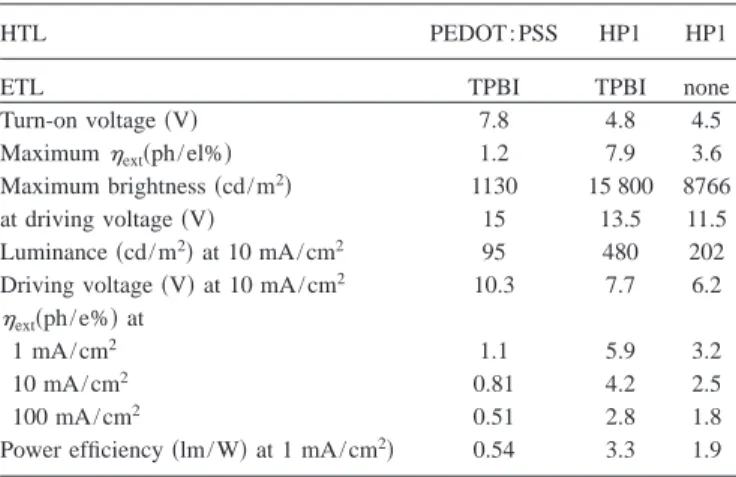
Among the blends with an Ir-1 content of 5, 1.25, and 0.31 wt %, the 5 wt % one shows the best device perfor-mance. The performance parameters of LEDs based on the 5 wt % blend with different HTL and ETL configurations are listed in Table I for comparison. The device with exciton-confinement layer at both the anode and the cathode side, i.e., the one with structure ITO/ HP1 / EM/ TPBI/ CsF/ Al, gives the highest performance. Compared to the device that does not use the TPBI as the ETL, the maximum efficiency and brightness are almost doubled. The turn-on voltage is 4.8 V and the maximum external quantum efficiency reaches 7.9 ph/ el% at low current density. Even at a high current density of 100 mA/ cm2, the external quantum efficiency can FIG. 2. UV-VIS absorbance spectrum 共䊏兲 and PL spectrum 共䉭兲 of the
Ir-complex and PL spectrum of the host, PF-TPA-OXD共䊊兲.
FIG. 3. (a) PL spectra of the spin-coated films of the PF-TPA-OXD:Ir-1
blends with different Ir-1 content.(b) EL spectra from corresponding LEDs with the blends as EL layer.
1620 Appl. Phys. Lett., Vol. 85, No. 9, 30 August 2004 Niuet al.
This article is copyrighted as indicated in the article. Reuse of AIP content is subject to the terms at: http://scitation.aip.org/termsconditions. Downloaded to IP: 140.113.38.11 On: Thu, 01 May 2014 04:14:17
still retain at 2.8 ph/ el%. The current density–voltage共J–V兲 and brightness–voltage共B–V兲 characteristics shown in Fig. 4 reveal clearly that without TPBI as the hole-blocking/ exciton confinement layer, most of the injected holes can penetrate through the device, being wasted without contrib-uting to the light emission. The clear difference of the device performance demonstrates the advantages of confining exci-tons, as depicted by the energy levels of HP1, PF- TPA-OXD, and TPBI(inset of Fig. 4).
It is interesting to notice that for a device with PEDOT: PSS as the HTL, the performance is very poor. It
may be partially due to the lack of electron-blocking/exciton confinement in these devices. Another possible reason may be due to the serious quenching effect caused by the acidic nature of PEDOT: PSS or the unfavorable phase separation between Ir-1 and PF-TPA-OXD host caused by the hydro-philic characteristic of the lower PEDOT: PSS layer. De-tailed investigation on the mechanisms and the effect of dif-ferent HTLs on the photophysical characteristics of the phosphorescent devices is under way and the results will be published elsewhere.
In conclusion, highly efficient red phosphorescent LEDs are fabricated using an Ir共III兲-complex containing two CF3-substituted pyrimidine ligands in a bipolar polyfluorene. A maximum external quantum efficiency of 7.9 ph/ el% and a brightness of 15 800 cd/ m2are reached with the CIE chro-maticity coordinates of x = 0.65 and y = 0.34. Efficient and balanced charge injection and transport, as well as effective carrier blocking and exciton confinement, at both electrode sides contribute to the high performance.
This work was supported by the National Science Foun-dation (NSF-STC Program under Agreement No. DMR-0 120967) and the Air Force Office of Scientific Research
(AFOSR) under the MURI Center on Polymeric Smart
Skins. One of the authors(Y.C.) thanks the National Science Council of Taiwan, R.O.C. for the financial support (NSC 91-2119-M-002-016) and (NSC 91-2113-M-007-006). An-other author(A.K.-Y.J.) thanks Boeing–Johnson Foundation for its support.
1
C. Adachi, M. A. Baldo, M. E. Thompson, and S. R. Forrest, J. Appl. Phys. 90, 5048(2001).
2
M. Ikai, S. Tokito, Y. Sakamoto, T. Suzuki, and Y. Taga, Appl. Phys. Lett.
79, 156(2001).
3
M. A. Baldo, M. B. Thompson, and S. R. Forrest, Nature(London) 403, 750(2000).
4
J. Kavitha, Y. Chi, Y-H. Song, S.-L. Wang, Y.-H. Niu, A. K.-Y. Jen, C.-F. Shu, R. Dodda, and F-I. Wu(unpublished).
5
J. B. Birks, Photophysics of Aromatic Molecules(Wiley-Interscience,
Lon-don, 1970).
6
T. Förster, Discuss. Faraday Soc. 27, 7(1959).
7
D. L. Dexter, J. Chem. Phys. 21, 836(1953).
8
X. Gong, J. C. Ostrowski, D. Moses, G. C. Bazan, and A. J. Heeger, Adv. Funct. Mater. 13, 439(2003).
9
C.-F. Shu, R. Dodda, K-I. Wu, M. S. Liu, and A. K.-Y. Jen, Macromolecules 36, 6698(2003).
10
X. Jiang, S. Liu, M. S. Liu, P. Herguth, A. K.-Y. Jen, H. Fong, and M. Sarikaya, Adv. Funct. Mater. 12, 745(2002).
11
Y. Li, M. K. Fung, Z. Xie, S.-T. Lee, L.-S. Hung, and J. Shi, Adv. Mater.
(Weinheim, Ger.) 14, 1317 (2002).
12
T. M. Brown, R. H. Friend, I. S. Millard, D. J. Lacey, J. Burroughes, and F. Cacialli, Appl. Phys. Lett. 93, 6159(2003).
TABLE I. Performance of LEDs based on blend of 5 wt % Ir-1 in PF-TPA-OXD with different HTL and ETL configurations.
HTL PEDOT: PSS HP1 HP1
ETL TPBI TPBI none
Turn-on voltage共V兲 7.8 4.8 4.5 Maximumext共ph/el%兲 1.2 7.9 3.6
Maximum brightness共cd/m2兲 1130 15 800 8766
at driving voltage共V兲 15 13.5 11.5 Luminance共cd/m2兲 at 10 mA/cm2 95 480 202
Driving voltage共V兲 at 10 mA/cm2 10.3 7.7 6.2
ext共ph/e%兲 at
1 mA/ cm2 1.1 5.9 3.2
10 mA/ cm2 0.81 4.2 2.5
100 mA/ cm2 0.51 2.8 1.8
Power efficiency共lm/W兲 at 1 mA/cm2兲 0.54 3.3 1.9
Note: HP1 denotes poly(BTPD-Si-PFCB).
FIG. 4. J – V(open) and B–V (solid) characteristics of the LEDs based on
blend of 5% Ir-1 in PF-TPA-OXD. The rectangular corresponds to a LED with structure ITO/ PEDOT: PSS/ EM/ TPBI/ CsF/ Al, the circle to ITO/ HP1 / EM/ TPBI/ CsF/ AL, while the triangle to ITO/ HP1 / EM/ CsF/ AL. Inset: Energy levels of HP1, PF-TPA-OXD, and TPBI.
Appl. Phys. Lett., Vol. 85, No. 9, 30 August 2004 Niuet al. 1621
This article is copyrighted as indicated in the article. Reuse of AIP content is subject to the terms at: http://scitation.aip.org/termsconditions. Downloaded to IP: 140.113.38.11 On: Thu, 01 May 2014 04:14:17