Energy states and magnetization in nanoscale quantum rings
O. Voskoboynikov,1Yiming Li,1,2Hsiao-Mei Lu,3Cheng-Feng Shih,1and C. P. Lee1 1Department of Electronics Engineering, National Chiao Tung University, Hsinchu 300, Taiwan 2National Nano Device Laboratories, Hsinchu 300, Taiwan
3National Tsing Hua University, Hsinchu 300, Taiwan 共Received 14 April 2002; published 3 October 2002兲
In this paper we calculate electron energy states and magnetization for torus shaped nanoscale quantum rings with external magnetic fields. We use the three-dimensional effective one-band Hamiltonian, the energy and position-dependent quasiparticle effective mass approximation, and the Ben Daniel-Duke boundary conditions. The dependence of the energy spectrum on the sizes and shapes of the quantum rings was calculated and the result agrees with experimental observations. Penetration of the magnetic field into torus region results in an aperiodic oscillation of magnetization at zero temperature. It saturates with the increasing of the magnetic field strength.
DOI: 10.1103/PhysRevB.66.155306 PACS number共s兲: 73.21.⫺b
I. INTRODUCTION
Microscale and mesoscale metallic and semiconductor quantum rings have been received a considerable attention for decades.1,2Advances in the fabrication of semiconductor nanostructures have allowed us to construct nanoscale sys-tems with a wide range of geometries. Recent experimental results on InGaAs torus shaped quantum nanorings demon-strated such capabilities 共the typical lateral sizes and height are about 100 nm and 2 nm, respectively.3– 8兲 The realization of such semiconductor nanorings bridges the gap between quantum dots and mesoscale ring structures. Unusual excita-tion properties4 –12 and the capability of trapping a single magnetic flux in such nonsimply connected quantum systems make them attractive for potential practical applications.
The quantum mechanical properties of ring structures have long fascinated physicists. Most of theoretical studies however, either use the traditional one-dimensional 共1D兲 model or assume that the electrons move in a two-dimensional 共2D兲 plane confined by a parabolic potential 共see, for instance5,6,10,13–16 and references therein兲. Only re-cently, three-dimensional simulations are performed for torus shaped rings with rectangular17,18 and cut circle cross sections.12 These calculations provide explanations for ex-perimental observations in the far-infrared region. It shows an importance of the full 3D description of the nanoscale quantum rings.
To the best of our knowledge, theoretical investigations of the electronic magnetization for 3D nanoscale quantum rings have never been done. It goes without saying that the 3D simulations can obviously provide us with much better un-derstanding of the magnetic quantum phenomena in the nanoscale quantum rings which are expected to be rather different from those in mesoscale rings.
In this paper, we theoretically investigate electron energy systems and magnetization for 3D nanoscale quantum rings. The calculations are done for realistic 3D models of InAs/ GaAs quantum rings with the finite hard-wall confinement potential. We use the effective 3D one band Hamiltonian, the energy-dependent 共nonparabolic approximation兲 and position-dependent quasiparticle effective-mass
approxima-tion, and the Ben Daniel-Duke boundary conditions. One of the important goals is to go beyond the 1D and 2D parabolic confinement potential pictures. In the 1D approach, varying magnetic field strength B only changes the phase of the elec-tronic wave function, resulting in periodic oscillations in magnetization 共the Aharonov-Bohm effect兲. In the 2D con-finement parabolic potential approach the effects of the ring’s finite width and the finite hard-wall confinement potential are not considered. In a realistic 3D description, penetration of the magnetic field into the torus region can result in an ape-riodic and saturated oscillations in magnetization. Because the main purpose of this paper is to study the effect of ring sizes and geometry on electronic magnetization, we concen-trate on a noninteracting electron model at zero temperature. It is known that electron-electron interaction can change electron energy spectrum and the magnetization of nanoscale semiconductor objects.10 While for single electron quantum ring we present a correct results, calculations of the magne-tization of few electron rings are done for reference pur-poses.
II. THREE-DIMENSIONAL MODEL OF SEMICONDUCTOR QUANTUM RINGS
We assume that quantum rings are formed with the hard-wall confinement potential that is induced by a discontinuity of conduction-band edge of the system components. This model is commonly used to calculate electron energy states in quantum heterostructures19and allows us to solve the 3D Schro¨dinger equation with a minor number of additional ap-proximations. The effective one-band electron Hamiltonian is given in the form
Hˆ⫽⌸r 1
2m共E,r兲⌸r⫹V共r兲⫹B g共E,r兲
2 B, 共1兲
where⌸r⫽⫺iប“r⫹eA(r) stands for the electron momen-tum operator, “r is the spatial gradient, A(r… is the vector potential (B⫽curlA), m(E,r) is the energy and position-dependent electron effective-mass defined by
1 m共E,r兲⫽ 2 P2 3ប2
冋
2 E⫹Eg共r兲⫺V共r兲 ⫹E⫹E 1 g共r兲⫺V共r兲⫹⌬共r兲册
, 共2兲 and g共E,r兲⫽2再
1⫺ m0 m共E,r兲 ⌬共r兲 3关E⫹Eg共r兲⫺V共r兲兴⫹2⌬共r兲冎
共3兲 is the Lande´ factor. In the equations above: V(r) is the con-finement potential, Eg(r) and ⌬(r) stand forposition-dependent energy-band gap and spin-orbit splitting in the valence band, P is the momentum matrix element, is the vector of the Pauli matrices, m0 and e are the free electron mass and charge. For systems with sharp discontinuity of the conduction-band edge between the inner region of the ring 共material 1兲 and environmental crystal matrix 共material 2兲 the hard-wall confinement potential can be presented as
V共r兲⫽
再
0, r苸1
V0, r苸2.
We consider a cylindrically symmetrical quantum ring, which is generated by rotation of a generating contour about z axis. When the magnetic field is directed along the z axis we can treat the problem in cylindrical coordinates (,,z). The origin of the system is lying in the center of the ring. The generating contours used in the calculation are: an el-lipse for torus shaped共TS兲 rings 关see, insert in Fig. 1共a兲兴 and a cut ellipse for cut torus shaped共CTS兲 ‘‘volcano-type’’ rings 关see, insert in Fig. 2共a兲兴.12,20
Because of the cylindrical symmetry, the wave function can be represented as
⌿共r兲⫽F共,z兲exp共il兲,
where l⫽0,⫾1,⫾2,•••, is the orbital quantum number. This leads to a 2D problem in the (,z) coordinates, and the Schro¨dinger equation is reduced to
FIG. 1. Electron energy states for TS-InAs nanorings with various inner radii共a兲in⫽8 nm, 共b兲in⫽18 nm, 共c兲in⫽28 nm, and 共d兲 in⫽38 nm, respectively.
⫺ ប 2 2mi共E兲
冉
2 z2⫹ 2 2⫹ 1 ⫺ l2 2冊
Fl i共 ,z兲 ⫹冋
mi共E兲⍀i 2共E兲2 8 ⫹s B 2 gi共E兲B⫹ ប⍀i共E兲 2 l ⫹V0␦i2⫺E册
Fl i共 ,z兲⫽0; i⫽1, 2, 共4兲 where ⍀i共E兲⫽ eB mi共E兲 ,and s⫽⫾1 refers to the orientation of the electron-spin along z axis. The Ben Daniel-Duke boundary conditions19 can be written as the following:
Fl 1共,z兲⫽F l 2共,z兲, z⫽ f 共兲; 1 m1共E兲
冋
Fl 1共 ,z兲 ⫹ d f共兲 d Fl 1共 ,z兲 z册
冏
z⫽ f () ⫽m1 2共E兲冋
Fl 2共 ,z兲 ⫹ d f共兲 d Fl 2共 ,z兲 z册
冏
z⫽ f () , 共5兲 where z⫽ f () presents the generating contour of the ring on兵,z其 plane.
The energy states and wave functions of the electrons confined in the quantum ring are found by the nonlinear iterative method. The solution scheme is described some-where else.20,21
III. CALCULATION RESULTS
The quantum rings used in the calculation consist of InAs/ GaAs heterostructure. For InAs inside the rings we chose: E1g⫽0.42 eV, ⌬1⫽0.38 eV, and m1(0)⫽0.024m0. For GaAs outside the rings: E2g⫽1.52 eV, ⌬2⫽0.34 eV, m2(V0)⫽0.067 m0, and V0⫽0.77 eV.22 The energy eigen-values of the problem 共4兲–共5兲 are numerated by a set of quantum numbers兵n,l,s其, where n⫽0, 1, 2, . . . is the main quantum number. In Fig. 1 we show the electron energy spectrum versus magnetic fields for TS quantum rings with different inner radii in. The height h⫽2.4 nm and width
⌬⫽out⫺in⫽24 nm (out is the outer radius兲 of the rings
are fixed. Only E0,l,⫹1(B) states are shown for the reason of clarity. It should be mentioned, that for the geometries cho-sen, the energy difference between two sets 兵0,l,s其 and
兵1,l,s其of energy states is controlled by the ring cross-section area and is about the same for all chosen inner radii: ⌬E ⫽E1,0,s⫺E0,0,s⯝0.298 eV. However, as it can be seen in Fig. 1, the difference between states of the same n and dif-ferent l are strongly dependent on the total lateral size of the rings.
In Fig. 2, we present the lowest energy states for two CTS rings of the same height h⫽2.4 nm, inner radius in
⫽10 nm, and different outer radii. It should be noted that for bulk InAs共unlike for GaAs兲 the Lande´ factor is rather large in absolute value and negative关g1(0)⬇⫺15兴 and, therefore, the Zeeman spin-splitting should be taken into consideration. Unfortunately, the Lande´ factor behavior in nanoscale semi-conductor system has not been well investigated yet and there is a discrepancy in experimental data共see, for instance Refs. 23–26 and references therein兲. In our calculation the Zeeman spin-spliting is controlled by an average magnitude of the Lande´ factor
具
g(E)典
defined as具
g共E兲典
⫽2冕
g共E;,z兲兩Fl共,z兲兩2ddz.Energy of the lowest states are close for the geometries and sizes chosen 共see Fig. 1 and Fig. 2兲 and the Lande´ factor depends only weakly of the ring parameters. Our calculation suggests that for instance for the system in Fig. 2共b兲
具
g(E0,0,⫹1;B⫽0)典
⫽⫺3.94 which is close to results calcu-lated in Ref. 27 for small InAs quantum dots. This leads to a small Zeeman spin spliting 共even for relatively large mag-netic fields it is about a few meV, see, Fig. 2.兲 which is of no FIG. 2. Electron energy states for CTS-InAs nanorings withsignificance for the following description. In addition, the diamagnetic shift of the energy states for, relatively, weak magnetic fields one can estimate to be proportional to
具
l 2典
B2,28 –30where具
l 2典
⫽2冕
2兩F l共,z兲兩 2ddz.This causes the widening of the energy-band width with re-spect to the magnetic field: the wider is the ring the wider is the band width both for TS and CTS共see, Fig. 1 and Fig. 2兲. We stress that the calculated energy difference⌬E is 21.9 meV for CTS with out⫽60 nm. That is very close to the experimental data6and results of other authors calculations.12 It is worth to be noted, that in contrast to Ref. 12 we do not need to adjust the material band parameters. The averaged effective mass at the lowest level in CTS without⫽60 nm is estimated to be m1(E0,0,⫹1;B⫽0)⫽0.042m0, which is close to the parameter chosen in Ref. 12.
It is well known that for the quasi-one-dimensional spin-less model the single electron ground-state energy of a quan-tum ring of radius R0 is given by
El⫽Emin⫹ ប2
冉
l⫹⌽ ⌽0冊
2 2m1共0兲R0 2 , 共6兲where⌽⫽R02B is the magnetic flux in the ring and ⌽0 is the flux quanta. With increasing magnetic field, the ground-state changes from a ground-state with l⫽0 to states with l⫽⫺1,
⫺2, ⫺3, . . . and the energy demonstrates a periodic oscillations.1,2 Crossings between states occur at ⌽cross/⌽0 ⫽k/2, where k⫽1, 3, 5, . . . and the ground state energy minima occur at ⌽min/⌽0⫽p, where p⫽0, 1, 2, 3, . . . . This Aharonov-Bohm effect1,2 is a phenomenon inherent to one-dimensional quantum rings.
TABLE I. The k˜ parameter for CTS InAs nanorings.
Ring First crossing Second crossing Third crossing
out⫽30 nm 2.6 7.5 15.2
out⫽60 nm 2.3 7.1 14.5
1D 1 3 5
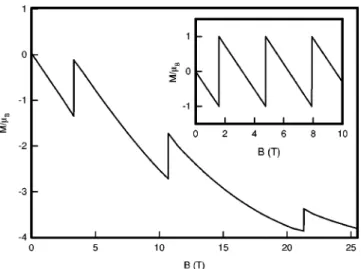
FIG. 3. Magnetization of a single electron CTS-InAs nanoring with out⫽30 nm. The insert is the magnetization for a 1D ring
with R0⫽20 nm.
FIG. 4. Magnetizations of CTS-InAs nanorings with a few non-interacting electrons (out⫽30 nm): 共a兲 two, 共b兲 three, and 共c兲 four
For the 3D nanoscale rings, Fig. 1 and Fig. 2 show a different behavior of the electron ground state. Taking an estimation ⌽l⫽
具
l2典
B one can evaluate k˜⫽2⌽l/⌽0 when the crossing points between states and the ground-state en-ergy minima occur. In Table I, we present results of our calculation for few crossing points in 3D CTS quantum rings. We also found that the lowest point in energy occurs only at ⌽0/⌽0⫽0 共only with p⫽0). The Zeeman spin-spliting leads to small shifts for the crossing points共see Fig. 2兲. Obviously the oscillatory behavior is not periodic. This difference from the simple rule 共6兲 conforms with experiment5,6 and demonstrates the importance of a correct three-dimensional description of nanoscale quantum rings.The aperiodic oscillations have been calculated recently5,13–15 also in 2D models of the rings. We should notice, that 2D approach allows to study merely the ‘‘lateral spectrum’’ of the rings.16,20 Parameters of the 2D confine-ment potential and crossing points of the energy states are subjects of a fitting procedure5,8,13 and one cannot control effects of inner radius and real lateral width of the rings. In contrast, 3D simulations provide us with the adequate choice for quantitative modeling of the electron energy states in nanorings.
Our calculation approach allows us to investigate the magnetization of nanorings. The total magnetization at zero temperature is defined by M⫽⫺Etot B , 共7兲 where Etot⫽
兺
n,l,s N En,l,sis the total energy for a given N electron system.
It is well known that the magnetization depends drasti-cally on the electron number N. The single-particle picture is yet powerful for magnetic properties of large two-dimensional rings.15 In Fig. 3 we plot calculated M in units of the effective Born magnetonB*⫽eB/m1 as a function of B for single electron CTS ring. The magnetization is an
ape-riodic and negative function of B and is very different from that obtained by the 1D model共6兲 共see, insert in Fig. 3兲. The curve jumps at crossing points of the single electron states. With the increase of the magnetic field the magnetization oscillations become smaller and the magnetization eventu-ally saturates for at large magnetic fields.
For small rings with a few electrons a self-consistent cal-culation is desirable.13 Nevertheless, in this work for refer-ence we perform a simulation of the magnetization of quan-tum rings with a few noninteracting electrons. The simulation results are presented in Fig. 4. The magnetization demonstrates the shell filling sequence. The cylindrical sym-metry leads to a complete filling of shells at N ⫽2, 6, 12, . . . and the magnetization of such systems is zero at B⫽0. At the same time, half filled shells provide with a large positive magnetization at B⫽0.
IV. CONCLUSIONS
In this paper, we calculated energy states and magnetiza-tion for nanoscale semiconductor rings. A 3D model of the torus shaped and cut torus shaped rings with various sizes in external magnetic field has been solved numerically.
The calculated dependence of the energy spectrum on ring sizes and shapes agrees with experimental results. At zero temperature, magnetization of the rings oscillate aperiodi-cally as the magnetic field is increased and saturate at very high fields. This is quite different from the Aharonov-Bohm periodic unsaturated oscillation in mesoscopic rings.
Although the internal electronic structure of quantum rings has been explored by far-infrared absorption and other spectral analysis, no measurements of the magnetizations have been made. Based on our theoretical study presented here such measurement of energy shell structure of the nanoscale rings reveal very interesting.
ACKNOWLEDGMENTS
This work was supported in part by the National Science Council of Taiwan under Contracts Nos. NSC-90-2215-E-009-022 and NSC-90-2112-M-317-001.
1A.G. Aronov and Yu.V. Sharvin, Rev. Mod. Phys. 59, 755共1987兲. 2A. Fuhrer, S. Lu¨scher, T. Ihn, T. Heinzel, K. Ensslin, W.
Weg-scheeider, and M. Bichler, Nature共London兲 413, 822 共2001兲. 3J.M. Garsia, G. Medeiros-Ribeiro, K. Schmidt, T. Ngo, J.L. Feng,
A. Lorke, J.P. Kotthaus, and P.M. Petroff, Appl. Phys. Lett. 71, 2014共1997兲.
4
A. Lorke and R.J. Luyken, Physica B 256-258, 424共1998兲. 5A. Lorke, R.J. Luyken, A.O. Govorov, J.P. Kotthaus, J.M. Garcia,
and P.M. Petroff, Phys. Rev. Lett. 84, 2223共2000兲.
6A. Emperador, M. Pi, M. Barranco, and A. Lorke, Phys. Rev. B
62, 4573共2000兲.
7R.J. Warburton, C. Scha¨flen, D. Hafl, F. Bickel, A. Lorke, K. Karrai, J.M. Garcia, W. Schoenfeld, and P.M. Petroff, Physica. E
9, 124共2001兲.
8R. Blossey and A. Lorke, Phys. Rev. E 65, 021603共2002兲. 9A. Puente and L. Serra, Phys. Rev. B 63, 125334共2001兲. 10A. Emperador, M. Pi, M. Barranco, and E. Lipparini, Phys. Rev.
B 64, 155304共2001兲.
11A. Emperador, M. Barranco, E. Lipparini, M. Pi, and L. Serra, Phys. Rev. B 59, 15301共1999兲.
12
J. Planelles, W. Jasko´lski, and J.I. Aliaga, Phys. Rev. B 65, 033306共2002兲.
13T. Chakraboty and P. Pietila¨inen, Phys. Rev. B 50, 8460共1994兲. 14V. Halonen, P. Pietila¨inen and T. Chakraboty, Europhys. Lett. 33,
377共1996兲.
15W.C. Tan and J.C. Inkson, Phys. Rev. B 60, 5626共1999兲. 16Z. Barticevic, M. Pacheco, and A. Late´, Phys. Rev. B 62, 6963
17A. Bruno-Alfonso and A. Latge´, Phys. Rev. B 61, 15887共2000兲. 18S.S. Li and J.B. Xia, J. Appl. Phys. 89, 3434共2001兲.
19G. Bastard, Wave Mechanics Applied to Semiconductor Hetero-structures共Les Edition de Physique, Les Ulis, 1990兲.
20Y. Li, O. Voskoboynikov, C. P. Lee, C.-F. Shih, S. M. Sze, and O. Tretyak, in Proceedings of the 2001 First IEEE Conference on Nanotechnology, IEEE-NANO, 2001, edited by C. Lau 共IEEE, Maui, Hawaii, 2001兲, p. 11.
21Y. Li, O. Voskoboynikov, C.P. Lee, S.M. Sze, and O. Tretyak, J. Appl. Phys. 90, 6416共2001兲; Y. Li, O. Voskoboynikov, C.P. Lee, and S.M. Sze, Comput. Phys. Commun. 141, 66共2001兲; Solid State Commun. 120, 79共2001兲.
22Handbook Series on Semiconductor Parameters, edited by M. Levinshtein, S. Rumyantsev, and M. Shur共World Scientific, Sin-gapore, 1999兲.
23A.S.G. Thornton, T. Ihm, P.C. Main, L. Eaves, and M. Henini, Appl. Phys. Lett. 73, 354共1998兲.
24M. Bayer, A. Kuther, F. Scha¨der, J.P. Reithmaier, and A. Forchel, Phys. Rev. B 60, R8481共1999兲.
25J.-M. Meyer, I. Hapke-Wurst, U. Zeitler, R.J. Haug, and K. Pierz, Phys. Status Solidi B 224, 685共2001兲.
26G. Medeiros-Ribeiro, M.V.B. Pinheiro, V.L. Pimentel, and E. Marega, Appl. Phys. Lett. 80, 4229共2002兲.
27A.A. Kiselev, E.L. Ivchenko, and U. Ro¨ssler, Phys. Rev. B 58, 16353共1998兲.
28J.J. Field and D.G. Thomas, Phys. Rev. 122, 35共1961兲. 29A.V. Chaplik, Zh. Exp. Theor. Fiz. 119, 193共2001兲 关JETP 92, 169
共2001兲兴.
30K.L. Janssens, F.M. Peeters, and V.A. Schweigert, Phys. Rev. B