.?;1t~(~t~~e'1ea~~at
&~~a~ti~~~
~
Volume 2. Number 5 Nay-Dec. 1996
Olympiad Corner
~ BiJ ~ Ii aq II fiJ (-)
25th United States of America
Mathematical
Olympiad:
~ S m
Part I (9am-noon, May 2, 1996)
Pr bl IPr th th fth :W:~~~~:fj::;or\"m.m~fiiJ ' ~:5J,~ 0 em ..o:e at e average 0 .e ~ffij:1fif~#;~~fiiJ'l1.:W~f&~~~
num~s n sm n (n = 2, 4, 6, ...,180) IS ~P).ljf- 0
~:(£3!.1if~~Mir{j\l:i-cot 1 .~m.~~~fiiJJEJJ.' !i1JQ~~~~
Problem 2. For any nonempty set S of fiiJ~WJ. 0 real numbers, let a(S) denote the sum of
the elements of S. Given a set A of n
positive integers, consider the collection -. of all distinct sums a(S) as S ranges over
the nonempty subsets of A. Prove tbat this collection of sums can be partitioned into n classes so that in each class, the ratio of the largest sum to the smallest
sum does not exceed 2. B
Problem 3. Let ABC be a ttiangle. Prove that there is a line 1 (in the plane of triangle ABq such that the intersection of the interior of triangle ABC and the interior of its reflection A' B' C' in I h~ area more than 2/3 the area of triangle ABC.
&
AF FB Area of MCP Area of ABCP ~ .l:. jzI!;'=-~.1:\ ~ 1JI.!J;f§ * ~O ~ ~ CJ Mftm
.:fJtfrlj:$'r.~~:PJ~tt'g-flM¥[fij":m:
~tt'g'l1.W~~ :
AF BD CE=1 0 FB DC EA ~ ~ JJ. ~ ~ * iflJ A "@"][ (GiovanniCeva)1£+-t;-tlt*C~a~fI'i1 ' ffrPJf&
A fi Z ~ r"@"][ (Ceva) ~ JJ. j 0 "@" ][~JJ."CJm~lPJlJ~m~)! , f.§.-.t~ m~):5~:tiP.ifIJm T m"III~OOtRffi ~fI'i1:=f:.~ ' f~ff**mm 0c
(II-)
!il-~moo':='~~:;FJ/;}#~AD'
~irJ~~~~
' ~!l:t
Area of MBD=-0
BD DC Area of MDCg§][~:@.~~$Q~~{t?~Vi?m
m~$Q,tt.~re~$Q~~*.ff
~°tt.g§][~:@.*~'~~~$Q
~:
~.=.~ ~ABC~g§][~
(Cevians)
[~
rn~:¥.Jj;iJ;~~~]AD"
BE~CF~
Jf:.
~
fIt-(continued on page 4) A F AF BD CE=1
FB DC EA RU!l:t=-g§"K~#1!i 0 (*);~..
.::.t: /..- :~ B D C (1].::.)W;Jlt
111=, iii ~ (J{j
~ ~ AD ' BE~D
CRf§ ~ ~ fii] -~ p 0 ~IJ ffll:.))I!; #.iI .:=. ~ ~ (J{j ,~ ':tl ijJ ~ AreaofMBD --BD AreaofMBD Area of MDC DC Area of MDCmffl$}.~'~ :
a c a c;E=-=- , ~U-=-=
b d b d 1l:t~~:@. al;Jm$~ I!i ~ DJ ff§: ffl ~ ~ :@.: B~=-~][.f!:'f'-~#I5' fH ;tt~~*g§][.f!£\~#15 0 ~irlJDJ ~ADfOBE:3(~P (III=-) ~p{lp~ ][.f!CG, ~U~.~.~=1
(**)
GR DC EA Aa-c
b-d ECJlf
BD DC Area of MBP Area of MCP B D CI)-=-)IRJ~
CE
EA Area of MCPMathematical Excalibur. Vol. 2. No. Nav-Dec. 96 Pa~e 2
~gffl~~~~fiiJ
(-)
(continued from page 1)
Error Correcting Codes (Part I)
Tsz-Mei Ko
.l:t~ (*):fa (**)"DJ~
AF AG
-=-
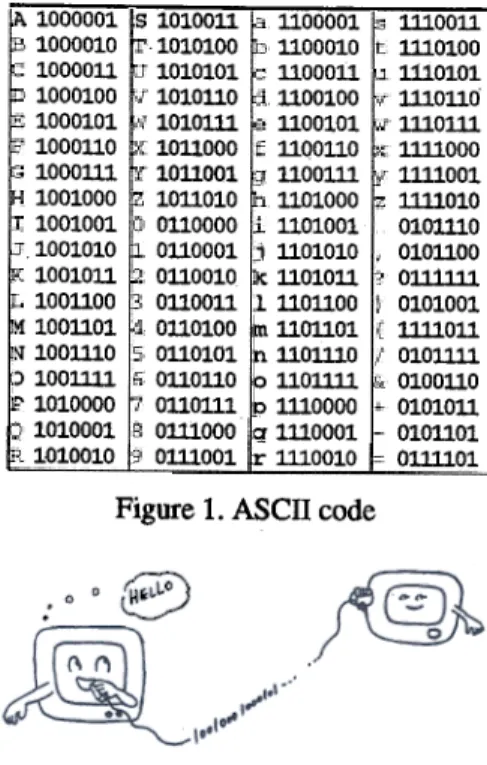
Suppose one would like to transmit amessage, say "HELLO.. .", from one computer to another. One possible way is to use a table to encode the message into binary digits. Then the receiver would be able to decode the message with a similar table. One such table is the American Standard Code for Information Interchange (ASCII) shown in Figure 1. The letter H would be encoded as 1001000, the letter E would be encoded as 1000101, etc. ~igure 2).
A 1000001 S 1010011 1100001 1110011 1000010 1010100 1100010 1110100 1000011 10101011100011 1110101 1000100 1010110 1100100 1110110 1000101 1010111 11001011110111 1000110 1011000 11qO110 l1l1000 1000111 1011001 1100111 l1l1001 1001000 1011010 1101000 l1l1010 1001001 '0110000 1101001 0101110 1001010 0110001 11101010 0101100 1001011 0110010 Ic 1101011 0ll1111 1001100 0110011 1 1101100 0101001 M 1001101 0110100 '
~
1101101 l1l1011 N 1001110 0110101 1101110 010l1l1 J 100l1l1, 0110110 110l1l1 0100110 '" 1010000 I 011011111110000 I I 0101011 1010001 0111000 c:r 1110001 0101101 1~10010 0111001 r 1110010 0l1l101FB GB
~Jl:tFWG~ABJ::~IffJ-1!i 0 :gg-][:iE~fII\]~:iE~~{PJ.~~ .f.§:$ .L~.t87E-~Wfll\]E-i'lm~'~...:E-I=P *1 (medians) # I!i' E-~
(altitudes)
# I!i' E- $j- ~ *1
(angle-bisectors) ~ I!i 0 ~ E- i'l1!i $j- 7J tl ;:g t£m'L' (centroid)' ~ 'L' (orthocentre)~D
rf'\JWIiI'L'(incentre) 0
=- ~.#l!im
-.w-ar PJ.~H~~i1!?
~-gg-][::iE:JJ.£J'iJ~::iE:JJ.tf.m'rRJ~frj
m~~o **£-arjfrJffl#jf=-~~
~OO~~'f*' ~m (::I:/L\re~..$t
JjX,pjij~~~2:1£J'iJ.~)
m-~:!6'!1.
ft"o=-~#1!i1l:t'~'1fijJ;fIJ
m Ja~ =-~~
3Ift~=-~~"'I;~~~.m'{tl.
f3J~rI1J~irJ~a~~o
ij, '--I-.
E,'...,."
Figure 4. Even parity code
Is there an encoding method so that the receiver would be able to correct transmission errors? Figure 5 shows one such method by arranging the bit sequence (e.g., 1001) into a rectangular block and add parity bits to both rows and columns. For the example shown, 1001 would be encoded as 10011111 (by fIrst appending the row parities and then the column parities). If there is an error during transmission, say at position 2, the receiver can similarly arrange the received sequence 11011111 into a rectangular block and detect that there is an error in row 1 and column 2.
=-~~(l{j5j-~~::[email protected]~
~.~~:
A
Figure 1. ASCII code
B D
c
(/I)~)
Figure 2. Two computers talking
The receiver will be able to decode the message correctly if there is no error during transmission. However, if there are transmission errors, the receiver may decode the message incorrectly. For example, the letter H (1001000) would be received as J (1001010) if there is an error at position 6. ~1I:t.
~??)
BD
AB -=-0 DC AC -=- 9J- flj ;f,m # I!i.:;l- ~ '/1 ijJ m 11}] JJ:t ~ .J:\~ilio~
'I)( 0 I I ,/ I I ,Ix*
0 I °1 1 I I(f~.)
Figure 5. A code that can correct 1 error.
Figure 3. Error at position 6.
One possible way to detect transmission errors is to add redundant bits, i.e., append extra bits to the original
The above method can be used to correct one error but rather costly. For every four bits, one would need to transmit an extra four redundant bits. Is there a better way to do the encoding? In 1950, Hamming found an ingenious method to
(continued on page 4) message. For an even parity code, a 0 or 1 is appended so that the total number of 1's is an even number. The letters Hand E would be represented by 10010000 and 10001011 respectively. With an even parity code, the receiver can detect one transmission error, but unable to correct it. For example, if 10010000 (for the letter H) is received as 10010100, the receiver knows that there is at least one error during transmission since the received bit sequence has an odd parity, i.e., the total number of l' s is an odd number.
Mathematical Excalibur, Vol. 2, No. Nov-Dec. 96
P~e3
Problem Corner
We welcome readers to submit solutions to the problems posed below for publication consideration. Solutions should be preceded by the solver's name, address, school affiliation and grade level. Please send submissions to Dr. Kin-Yin li, Dept of Mathematics, Hong Kong University of Science and
Technology, Clear Water Bay, Kowloon. The deadline for submitting solutions is Ian 31, 1997.
Problem 46. For what integer a does X2 -x +a divide Xl3 + x + 90?
Problem 47. If x, y, z are real numbers such that X2 + y2 + Z2 = 2, then show that x + y + z ~ xyz + 2.
Problem 48. Squares ABDE and BCFG are drawn outside of triangle ABC. Prove that triangle ABC is isosceles if DG is parallel to AC.
Problem 49. Let UI, U2, U3, ...be a sequence of integers such that UI = 29, U2 = 45 and Un+2 = Un+? -Un for n = 1, 2, 3, Show that 1996 divides infinitely many terms of this sequence. (Source:
1986 Canadian Mathematical Olympiad
with modification)
Problem 42. What are the possible values of oJ X2 + x + 1 -.J;2 ~ as x ranges over all real numbers?
Solution: William CHEUNG Pot-man (STFA Leung KauKui College, Form 6). Problem 50. Four integers are marked
on a circle. On each step we simultaneously replace each number by the difference between this number and next number on the circle in a given direction (that is, the numbers a, b, c, d are replaced by a b, b c, c d, d -a). Is it possible after 1996 such steps to have numbers a, b, c, d such that the numbers Ibc -adl, lac -bdl,
lab-cd I are primes? (Source: unused
problem in the 1996 IMO.)
Problem 44. For an acute triangle ABC, let H be the foot of the perpendicular from A to BC. Let M, N be the feet of the perpendiculars from H to AB, AC, respectively. Define LA to be the line
through A perpendicular to MN and similarly define LB and Lc. Show that LA, LB and Lc pass through a common point O. (This was an unused problem proposed by Iceland in a past IMO.) Let A=(x,O), B=(-t,~), c=(t,~).
The expression.J X2 + x + 1 -j;2=-;1 is just AB -AC. As x ranges over all real numbers, A moves along the real axis and the triangle inequality yields
-1 =-BC<AB-,.AC< BC= 1. All numbers on the intergal (-1,1) are possible.
Other commended solvers: CHAN Ming Chiu (La Salle College, Form 6), CHENG Wing Kin (S.K.H. Lam Woo Memorial Secondary School, FOrm 5), LIU Wai Kwong (Poi Tak Canossian College), POON Wing Chi (La Salle College, FOrm 7), YU Chon Ling (HKU) and YUNG Fai (CUHK).
Solution: William CHEUNG Pok-man (STFA Leung KauKui College, F0ffil6).
*****************
Solutions
*****************
MBC at A and E. Since LAMH = 900 =Let LA interSect the circumcircle ofLANH, A, M, H, N are concyclii::. So LMAH = LMNH = 90° -LANM = LNAE = LCBE. Now LABE = LCBE + LABC= LMAH + LABC = 90°. So AE is a dianleter of the circumcircle and Problem 41. Find all nonnegative
integers x, y satisfying (xy -7Y = x2- +
2-y.
Problem 43. How many 3-elemen'tsubse~ of the setX= {I, 2, 3, ..., 20} are there such that the product of the 3 numbers in the subset is diVisible by 4?
Solution: Gary NG Ka Wing (STFA
Leung Kau Kui College, Form 4). (continued on page 4)
Suppose x, y are nonnegative integers such that (xy 7)2 = r + y2. Then (xy -6)2 + 13 = (x + y)2 by algebra. So
13 = [(x+y) + (xy-6)][(x+y) -(xy-6)]. Since 13 is prime, the factors on the right side can only be :tl or :t13. There are four possibilities yielding (x,y) = (0,7), (7,0), (3,4), (4,3).
Other commended solvers: CHAN Ming Chin (La Salle College. Form 6), CHENG Wing Kin (S.K.H. Lam Woo Memorial Secondary School, Form 5), William CHEUNG Pok-man (S.T.F.A. Leung Kau Kui College, Form 6), Yves CHEUNG Yui Ho(S.T.F.A. Leung Kau Kui College, Form 5), CHING Wai Hung (S.T.F.A. Leung Kau Kui College, Form 5), CHUI Yuk Man (Queen Elizabeth School, Form 7), LIU Wai Kwong (pui Tak Canossian College), POON Wing Chi (La Salle College, Form 7), TING Kwong Chi & David GIGGS (SKH Lam Woo Memorial Secondary School, Form 5), YU Chon Ling (HKU) and YUNG Fai (CUHK).
Solution: CHAN Ming ChiD (La Salle College, Form 6), CHAN Wing Sum (HKUST), CHENG Wing Kin (S.K.H. Lam Woo Memorial Secondary School, Form 5), CHEUNG Cheuk Lun (S.T.F.A. Leung Kau Kui College, Form 6), William CHEUNG Pok-man (S.T.F.A. Leung Kau Kui College, Form 6), Yves CHEUNG Yui Ho (S.T.F.A. Leung Kau Kui College, Form 5), CHUI Yuk Man (Queen Elizabeth School, Form 7), FUNG Tak K wan (La Salle College, Form 7), LEUNG Wing Lon (STFA Leung Kau Kui College, Form 6), LIU Wai Kwong (Poi Tak Canossian College), Henry NG Ka Man (STFA Leung Kau Kui College, Form 6), Gary NG Ka Wing (STFA Leung Kau Kui College, Form 4), POON Wing Chi (La Salle College, Form 7), TSANG Sai Wing (Valtorta College, Form 6), YU Chon Ling (HKU), YUEN Chu Ming (Kiangsu-Chekiang College (Shatin), Form 6) and YUNG Fai (CUHK).
There are C;O = 1140 3-element subsets of X. For a 3-element subset whose 3 numbers have product not divisible by 4, the numbers are either all odd (there are
cjO = 120 such subsets) or two odd and one even, but the even one is not divisible by 4 (therc are C~O x5=225 such subsets). So the answer to the problem is 1140 -120 -225 = 795.
Mathematical Excalibur. Vol. 2, No. 5, Nov-Dec. 96 PMe4
point P such that LPAB = 10°, LPBA = 20°, LPCA = 30°, LPAC = 40°. Prove that triangle ABC is isosceles.
Problem Corner
(continued from page 3)LA passes through the circumcenter O. Similarly, LB and Lc will pass through O.
:
~
0 , , Co
6
)(
Problem 6. Determine (with proof) whether there is a subset X of the integers with the following property: for any integer n there is exactly one solution of a + 2b = n with a, b E X.
~'""DC><::5~--Error Correcting Codes (part I)
(continued from page 2)
add the redundancy. To encode a four-bit. sequence PIP1P3P4 (say 1001), one would first draw three intersecting circles A, B, C and put the information bits Pl, Pl, PJ, P4 into the four overlapping regions AnB, AnC, BnC and AnBnC (Figure 6). Then three parity bits Ps, P6, P1 are generated so that the total number of l's in each circle is an even number. For the example shown, 1001 would be encoded as 1001001.
Other commended solvers: Calvin CHEUNG Cheuk Lon (STFA Leung Kau Kui College, FOrin 5), LIU Wai Kwong (Pui Tak Canossian College), POON Wing Chi (La Salle College, Foml 7) and YU Chon Ling (HKU).
Figure 6. Hamming code
Problem 45. Let a, b, c> 0 and abc=l
Show that
ab bc ca""
l
+ +~
as+bs+ab bs+cs+bc cs+as+ca
(This was an unused problem in
IMO96.)
Solution: YUNG Fai (CUHK) ,
Expanding (a3 -b3)(a2 -b1 ~ 0, we get a5 + b5 ~ a2b2(a+b). So using this and abc = 1, we get ab ab
x-
C2 2 C c.ti:;t: J:.tt3) as + b5 + ab ()f')~
,~ ~ t> A~'~"" j-a'\~~
t> ~i~ a+b+cAdding 3 such inequalities, we get the desired inequality. In fact, equality can occur if and only if a = b = c = I.
-..
..
Other commended solvers: POON Wing Chi (La Salle College, Form 7) and YU
Chon Ling (HKU).
~~, /jl}.~t'
.i ??~
--~""c:>C><:5" ~
Olympiad Corner
(continued from page 1)~
Part n (lpm-4pm, May 2, 1996)
Problem 4. An n-term sequence (Xl' X2, ..., xn) in which each term is either 0 or 1 is called a binary sequence of length n. Let an be the number of binary sequences of length n containing no three consecutive terms equal to 0, 1, 0 in that order. Let bn be the number of binary sequences of length n that contain no four consecutive terms equal to 0, 0, 1, 1 or 1, 1, 0, 0 in that order. Prove that bn+l =2an for all positive integers n.
.-" ~t yotl.~ A Xyz
Igo. 1~~lv1'~ ~A8c.
'; /r ". Y. z ~:fJ f3 c,C~.R8 "~1'D'~,.
L). )C Y z. 1m j 1£4t £1 /fe-c. -'I@ ~ A )( Y z. -iff) h :JtJ" ~~ ~ FtBc.1~ Co;'" ColA'" c.~nt,.t. 0~'~1'f1 G ~ 1/':", ~ £).
ABc.
..&iJ.-:1ji."
,go -, r}f";" o. f-r. H
{iiJ--1li,~~l,~A o~::~H = /=2.o!.! ! iJ.' 9~A'f ~ ..), ~~ .A X Y z.!j: I~~
50 Yo ,:tt ISOD , l<~ fJ L). X Yz. p~~
Cir-c.umC£l:Itr~ N , ~ GN : 0& : GrH
--= 1 ~ 2.. ""
'1'.'Z.
.
~~
Problem 5. Triangle ABC has the
following property: there is an interior
~)..
N ~ "of/v'
"!1 ~A. -:s: ~'f!1
,.V. ~
S. T (HA. 1-18. 11c.I N t..t: '04. ~ AASc. ~'ft. ".."e
point
If there is one error during transmission, say 1001001 received as 1011001, the receiver can check the parities of the three circles to find that the error is in circles B and C but not in A. This (7,4) Hamming code (the notation (7,4) means that every 4 information bits are encoded as a 7 bit sequence) can be generalized. For example, one may draw 4 intersecting spheres in a three-dimensional space to obtain a (15,11) Hamming code. Hamming has also proved that his coding method is optimum for single error correction.
(... to be continued)