MODLEING USER MOBILITY FOR RELIABLE PACKET DELIVERY IN MOBILE IP
NETWORKS
Jiunn Ru Lai and Wanjiun Liao
Department of Electrical Engineering and Graduate Institute of Communication Engineering National Taiwan University Taipei, Taiwan, Email: [email protected]
Abstract
-
In this paper, we analyze the handoff behavior for reliable packet delivery in Mobile IP networks. In Mobile IP, packets destined to roaming hosts are intercepted by their home agents and delivered via tunneling to its Care of Address (CoA). A mobile node may roam across multiple subnets during receiving data reliably. Upon each boundary crossing, a handoff is initiated in which the CoA is updated and a new tunnel is established. We find that reliable packet delivery in Mobile IP networks can be modeled as a renewal process. We derive the probability distribution of boundary crossings for each successfully transmitted packet. We also provide numerical examples to demonstrate how to use our model to calculate the probability distribution of boundary crossings, given the distributions of residence time and local retransmission attempts.Keywords
-
MobileIP,
boundary crossing, reliability.I. INTRODUCTION
Mobile IP [l] is the dominant standard for host mobility in the Internet. In Mobile IP, mobility service is enabled with the cooperation of mobility agents, i.e., the home agent and foreign agents, based on the operations of “binding” and “tunneling.” A mobile node (MN) in the home network does not need support from its HA. When the MN moves away from the home network, the MN registers with its home agent a care-of-address (CoA) temporarily allocated in the foreign network. The home agent will then bind the received CoA with the home IP address of the roaming node. It intercepts packets for the mobile node to the home network and forwards the packets to the roaming node via tunneling, i.e., the original packets are encapsulated in new packets destined to the CoA of the node and sent to the roaming nodes in their new locations using normal 1P delivery. Such address binding is also performed upon each handoff. As such, mobile nodes can go anywhere while retaining their home
IP
addresses to receive packets.In this paper, we study the impact of node movements on reliable packet delivery. As in IP, Mobile IP provides unreliable datagram service for mobile nodes. Packets may also be lost due to node mobility. Reliable packet delivery here refers to that packets being correctly delivered to the roaming nodes. Such a study is important because providing reliable transport service over Mobile IP, such as TCP or reliable multicast [2-41, will play an important role for
current or emerging wireless applications. To the best of our knowledge, there is no existing work on the analysis of node movements for Mobile IP.
The rest of the paper is organized as follows. In Sec. 11, the analytical model is derived. In Sec. 111, numerical examples are shown. Finally, the paper is concluded in Sec. V.
11. ANALYTICAL MODEL
In this section, the analytical model of node movements for reliable packet delivery in Mobile IP networks is derived. Let tR(i) denote a random variable representing for the residence time of an MN in subnet i, i=1,2,3,.. and tm(i) be a random variable denoting the time needed for successful packet retransmission to MN in subnet i, i=1,2,3, ..We make the following assumptions:
1. We assume that the arrival process of packets destined to 2. The handoff time (i.e., th(i) for moving to subnet i) is
an MN is a renewal process.
assumed the same for all handoff events.
3. We make no assumptions on the distributions of random variables tR(i) and tm(i), where i =1,2,
...
n, except that they are independent of each other and that {tR(i)} and{ tm(i)} are sequences of identically distributed random variables.
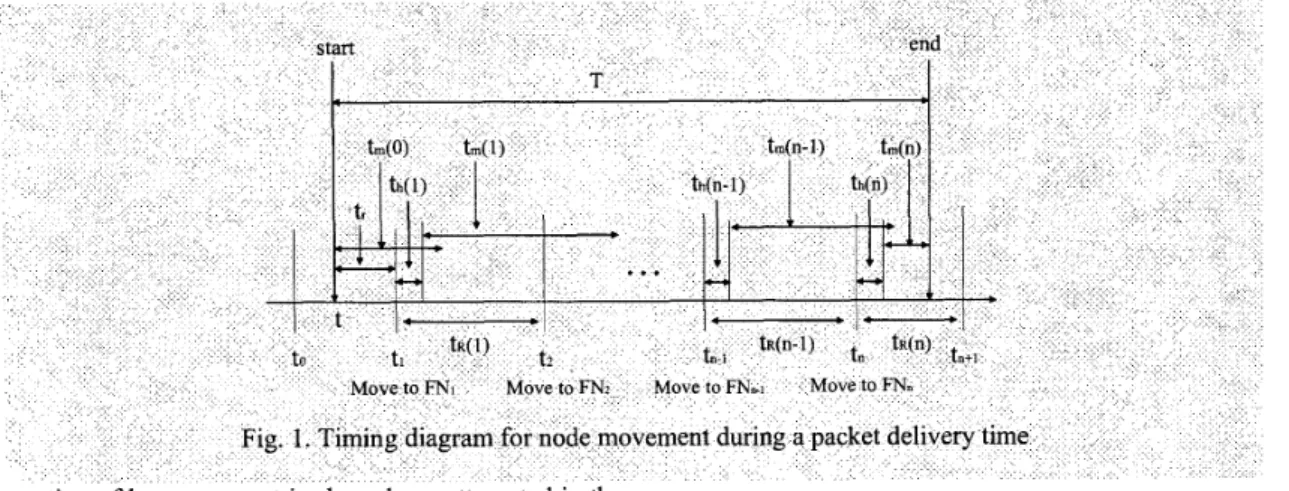
In this paper, the packet delivery time is defined as the total time between when a packet is relayed by the HA of a roaming node and when a packet is received successfully by the node. The packet may be received correctly during the period when the node stays in a subnet (called residence time in this paper), or spanning over multiple subnets. In the former case, the packet delivery time is smaller than the residence time of the node in the subnet. In the latter case, a handoff occurs whenever the node moves across a subnet boundary. On each handoff, the node needs to re-register with the home agent fits new CoA in the new foreign network. This requires a new address binding between the home agent and the roaming node. The time spent in acquiring a new CoA and rebinding is defined as the handoff time in this paper. Once a handoff occurs before the packet is successfully delivered, all the retransmission attempts made in previous subnets become useless, i.e., the packet should be sent as a new copy in the new tunnel,
0-7803-8523-3/04/$20.00 02004 IEEE.
previous subnets. Since this operation repeats after each handoff and behaves independently from the previous history, the behavior of reliable packet delivery can be modeled as a renewal process with identically and independently distributed (iid) processing times.
Fig. 1 shows the timing diagram for N handoffs in a packet delivery time. Suppose that a mobile node MN is roaming to a foreign network, say subnet FNo , and has been registered with its HA for address binding. The process begins when a packet destined for the MN is intercepted by its HA. The HA then sends the packet via tunneling to MN. Assume that the packet received by MN is in subnet FNo at time t. According to the random observer probability from the renewal theory [ 5 ] , the distribution of the residual time t, for MN staying in subnet F N o can be derived as follows. Let
f,
( t ) denote the probability density function of t, , andf,.*(s) denote the Laplace transform of
f , ( t )
.
Thus, we havewhere random variable X is the residence time of the MN receiving a new packet in subnet FN, , fx(T) is the
probability density function of X , and
1,
is the reverse of the mean residual time in subnet FN,.
Let N denote a random variable representing the number of handoffs during the packet delivery time, with the following probability distribution:
Note that we make no assumptions on the distributions of random variables f R ( i ) , t h ( i ) , and tm(i), where i =1,2,.
.
.n,except that they are independent of each other and that {tR(i)}
and { tm(i)} are sequences of identically distributed random variables. We also assume that the handoff time is identical for all handoff events. Thus, we omit the argument i.
Define Phi (n) = Pr( N = n )
.
Thus,Phi
(0) = Pr[t, I t , ]L J
where f,(t) is the probability density function of t, and fm*(s) is the Laplace transform of fm(t) ; fR(t) is the probability density function of t R and fR*(s) is the Laplace transform of f R ( t ) ; o is a sufficiently small positive number appropriately chosen for the inverse Laplace transform and
is chosen to be less than the smallest of the real parts of the poles of f R * ( - s ) .
Let g x ( f ) = P r o b ( X < t ) = , and
g x * (s) =
-
f x * ( s ).
Thus, g x ( t - T h ) =6-"
f x ( r ) d r , and its Laplace transform = e - T h x s x g,* (s) = x - f X * ( S ).
S We then derive P N ( i ) = P r ( N = i ) , i=1,2,...,n
.
Let0 = Pr[t,
+
Th > t R ].
Thus, 1 - 0 can be obtained as follows.Therefore, PN(n) = ( 1
-
PN(0)) x B"-' x ( 1 - 0).We see that the right hand side of the integrand in equations
respectively) are analytic at the right half open complex plane. If f R * ( - S ) has no branch point and has only finite possible isolated poles at the right half plane, we can apply the Residue Theorem to (1) and (2) using a semi-circular contour in the right half plane. Let R denote the set of the poles of the function f R * ( - s ) in the right half complex plane. Applying the Residue Theorem to (1) and ( 2 ) , we obtain the following results.
where
B = l + C R e s
n e 0 s=n
Interestingly, 0 can be treated as the "moving-out'' probability from a subnet for a packet delivery time in Mobile IP networks, and can be used to express P N ( n )
.
Later in the numerical example section, we will further investigate the impact of B on PN ( n ).
111. NUMERICAL EXAMPLE
In this section, we use the following example to show how to calculate the probability distribution of boundary crossings for a packet delivery time in Mobile IP networks. Let t R be exponentially distributed with probability density function f R ( r o ) = fRe-IRr0 , yo 2 0
.
The Laplace transformof f R ( r o ) is then f R * ( S ) = -
.
Substituting s inf R *
( s ) with -s, we have f R * (-s) = ~.
Therefore,( S + I R )
(-s + AR
1
Ph'(0) = f m * ( 2 , ) 3
and
P,(~z) = ( i - f m * ( / z R ) ) X P
x ( i - 8 1 ,
n=1,2,...,
where O=l-e-Thx'Rx f m * ( & ) .
Next, we consider f m ( r n o ) is exponentially distributed with rate 1,
.
Its Laplace transform f m * ( s ) can be expressed asfm*W
=-
.2,.
Substituting s in f m * ( s ) with i l R , we yield f m * ( a R ) = ~ from which P N ( 0 ) and P N ( n ) ,n = 1,2,...
,
can both be determined accordingly.( S + / z , )
( I R +'$n) '
)
E[t,l
=Os,
and R R = 0.01 E[tR1
(b) ~ 0 . 7 , and /2R = 0.01
1
Fig. 2 . P N ( n )
In Fig. 2 , Pn((n) is plotted as a function of n for exponentially distributed tR and exponentially distributed f,
.
To observe the impact of other parameters on the probability distribution of the number of boundary crossings for successful packet delivery, we vary the following ratios:E[th
1
E[fR
1
In Fig. 2, R is defined as-. We have the following observations.
The curves of P N ( n ) in all cases drop rapidly at small n. In other words, it is more likely that a packet will be delivered successfully after a few handoffs.
The curves with the same value of - E [ f m 1 have the same value at n=O, i.e., P N ( 0 ) . The smaller the value of - E [ f m , the larger the value of P N ( 0 )
.
The P N ( n ) curve drops more sharply for smaller
“moving-out’’ probability (i.e., 13 ) from a subnet.
Such moving-out speed is determined by
-
1
E[tR
1
E[tbI and
E[tR
1
m.
A smaller value of - E[tb1 will have a smallerE[fR
1
E[tR1
E[tb
1
E[tR
1
moving-out speed. This is because the value of
-
will become smaller when E[th] decreases and E[tR]
is fixed, or when E [ t b ] is fixed and E [ t R ] increases. Thus, a smaller - E[tb1 incurs less boundary crossings, leading to a higher probability to successfully deliver a packet within a subnet. Thus, the curve drops more
sharply. Similarly, a smaller will have a
smaller
8 ,
and the curve also drops more sharply.1
1
IV. CONCLUSION
AKNOWLEDGEMENTS
This work was supported by the National Science Council, Taiwan, under Grant Number NSC 92-22 13-E-002-0 13
REFERENCES
[ i ] C. Perkins, “IP Mobility Support,” IETF RFC 2002, Oct.
1996
[ 2 ] H. Balakrishnan, S. Seshan, and R.H. Katz., “Improving Reliable Transport and Handoff Performance in Cellular Wireless Networks,” Proc. ACM Wireless Networks, Dec. 1995.
[3] W. J. Liao, J.-A Ke, and J.-R. Lai, “Reliable Multicast with Host Mobility,” in Proc. IEEE Globecom 2000.
[4] [J. R. Lai and W. J. Liao, “Reliable Multicast for Mobile IP Networks: Analytical Study,” Proc. IEEE Globecom 2001.
[SI D. C. Cox, Renewal Theory, New York: Wiley, 1962
In this paper, we have modeled the node movement behavior for reliable packet delivery in Mobile IP networks. The probability distribution of the number of boundary crossings for reliable packet delivery is derived. We also provide numerical examples to demonstrate how to use our model to calculate the probability distribution of boundary crossings, given the distributions of residence time and local retransmission attempts