國
立
交
通
大
學
社會與文化研究所
碩
士
論
文
波羅地海三國政治經濟 (1992-1996 年)
The North-South Gap Revisited:
Political Economy of the Baltic States (1992-1996)
研 究 生:
Ruta Sakalauskaite (薩蓮)
指導教授:潘美玲教授
波羅地海三國政治經濟 (1992-1996 年)
The North-South Gap Revisited:
Political Economy of the Baltic States (1992-1996)
研 究 生:薩蓮
Student:
Ruta Sakalauskaite
指導教授:潘美玲
Advisor:
Mei-Lin Pan
國 立 交 通 大 學
社會與文化研究所
碩 士 論 文
A Thesis
Submitted to Graduate Institute of Social Research and Cultural Studies College of Humanities and Social Sciences
National Chiao Tung University in partial Fulfillment of the Requirements
for the Degree of Master of Arts
in
Social Research and Cultural Studies November 2009
Hsinchu, Taiwan, Republic of China
i
Abstract
Lithuania, Latvia and Estonia (the Baltic states) are presented almost invariably as the most successful cases of post-soviet development - the only ones with a consolidated democracy, a free market economy and the highest living standards among the former Soviet union countries. Yet despite similar initial conditions upon independence, the Baltic states achieved divergent degrees of economic advancement. Within a decade, Estonia has established itself as ‘economic transition miracle’ and thus taking lead, Latvia as a middle ground and Lithuania has been the slowest and least prosperous among the three.
In contrast to the existing accounts that attribute this phenomenon to economic and socio-cultural factors, I put forth political economy explanation and argue through comparative analysis that institutional and ideological differences between the three states during the initial stage of transition (1992-1996) were decisive to their subsequent development. Moreover, contrary to the existing accounts that attribute the development of Lithuania, Latvia and Estonia to a unitary model of regime change and post-soviet transition, I contend that there have been three pathways of transition in the Baltic states and argue that relationship between state-building and economic development deserves attention.
ii
Acknowledgements
I highly appreciate those who have contributed greatly to the evolution of this work - my MA advisor prof. Pan Mei-Lin (Department of Humanities and Social Sciences, National Chiao Tung University) and committee members, dr. Michelle Fei-Yu Hsieh (Institute of Sociology, Academia Sinica) and dr. Erik Ringmar (Institute of General Education and Institute for Social Research and Cultural Studies, National Chiao Tung University). I owe my interest in development studies to prof. Pan, as it was during her international class that I got a closer look at the economic development of East Asia and began to view the Baltic region from a comparative perspective. Prof. Pan provided me with a number of methodological and theoretical tools and most importantly, guided me while I was continuously re-writing this thesis and searching for the best angle to express my ideas. It is her efforts who helped me to present part of my work at the First Annual Conference of Development Studies (1st ACDS) held at the National Cheng Chi University in Taipei on 28-29 November 2009, the first academic conference in my life. She also provided me with a part of financial means to complete the last year of study. Also thanks to dr. Michelle Fei-Yu Hsieh whose sharp, throughout and constructive comments during MA thesis proposal defense and thesis final defense helped me to see my own work in a broader perspective and to discover new ways of expanding it in the future; dr. Ringmar whose honest comments suggestions kept me reflecting on what I was doing. His books and thoughts have inspired me and taught the importance of finding the right research question.
In addition, I would also thank dr. Wei Bai-Ku (Graduate institute of Russian Studies, National Cheng Chi University) for a very detailed review of the conference paper (written together with prof. Pan) and suggestions on how to improve it. I would also thank to audience of the conference – their interest in the research topic encourages me to move further.
My thanks also goes to friends who have been there when I went through the last, and also the hardest stage of study – Chenjerai (Malawi) for believing in me, Gyan (India) for the words of wisdom, and Zeyad (Jordan) for keeping smile on my face every day. Acknowledgements would be incomplete without mentioning my parents who, thousands of miles away, have always supported their single daughter and let her to chose her own way.
iii
Table of Contents
Abstract i
Acknowledgements ii
Table of Contents iii
List of Tables vi
List of Figures vii
Abbreviations viii
I. Problematique: the North-South Gap in the Baltic States
II. The Political Economy Explanation………..
1
2.1 Explanations of the North-South Gap: Missing Variables………..…. 4
2.1.1 Sharing Similarities……….….. 4
2.1.2 Existing Explanations of Divergence……… 6
2.1.3 Missing Variables on Divergence: State-Building……… 7
2.2 What is Taken to be Similar is Different………. 8
2.2.1 The Nationalist Explanation of the Post-Soviet Development……… 8
(1) Politics of Nationalism and Post-Soviet Variations……….. 9
(2)The Baltic Model According to the Nationalist Explanation……….... 12
2.2.2 What is Taken to be Similar is Different……… 16
iv
III. Politics of Nationalism and Post-Soviet State–Building in the
Baltic States……… .. 21
3.1 The Estonian Model……… 21
3.1.1 Communist Party, Popular Front and Independent Groups in Estonia………. 22
3.1.2 ‘Horizontal Contestation’………... 25
3.1.3 ‘Extraordinary Politics’ (1992-1994)……….. 26
3.2 The Latvian Model……… 29
3.2.1 Communist Party, Popular Front and Independent Groups in Latvia………..……….. 30
3.2.2 ‘Triangular Contestation’……… 31
3.2.3 Mixed Leadership (1993-1995)……….. 32
3.3 The Lithuanian Model……….. 32
3.3.1 Communist Party, Popular Front and Independent Groups in Lithuania……… 33
3.3.2 ‘Vertical Confrontation’……… 35
3.3.3 New Kind of Hegemony (1992-1996)……….. 36
IV. Three Models of Political Economy of Transition
in the Baltic States (1992-1996)………... 40
4.1 ‘Economic Nationalism’ and the ‘Shock Therapy’ in Estonia………... 40
4.2 Mixed Leadership and Fragmented Transition in Latvia……….. 43
v
V.
Conclusions………. 48
5.1 Institutional Settings, Ideologies and Contingency………..……….. 48 5.2 State-Building and Baltic Development……… 49
References 51
vi
List of Tables
Table 1 FDI in the Baltic states, as % of GDP 2 Table 2 Monthly labor costs, EUR per month, 2000-2006 2 Table 3 Index of Economic Freedom rankings of the Baltic states, 2000-2007 3 Table 4 Birth rates, immigration and percentage of native population
vii
List of Figures
Figure 1 Budget deficit and surplus in the Baltic States, 2000-2007 3 Figure 2 Post-soviet development: general framework 12 Figure 3 Baltic model of development according to
the nationalist explanation 13
Figure 4 Balance of powers in Estonia during perestroika
(horizontal contestation) 21
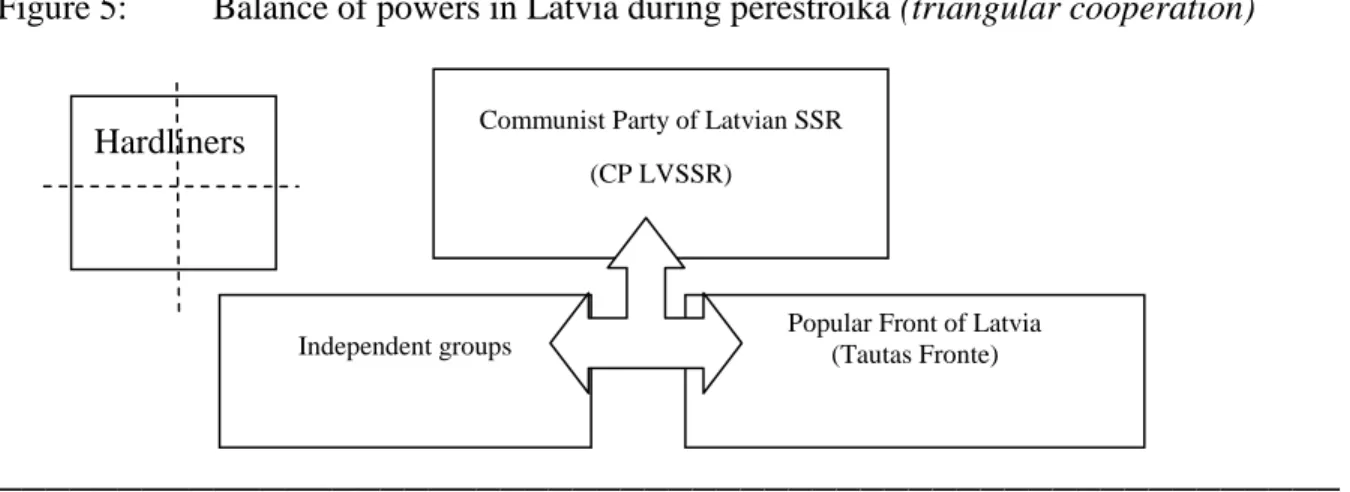
Figure 5 Balance of powers in Latvia during perestroika
(triangular cooperation) 30
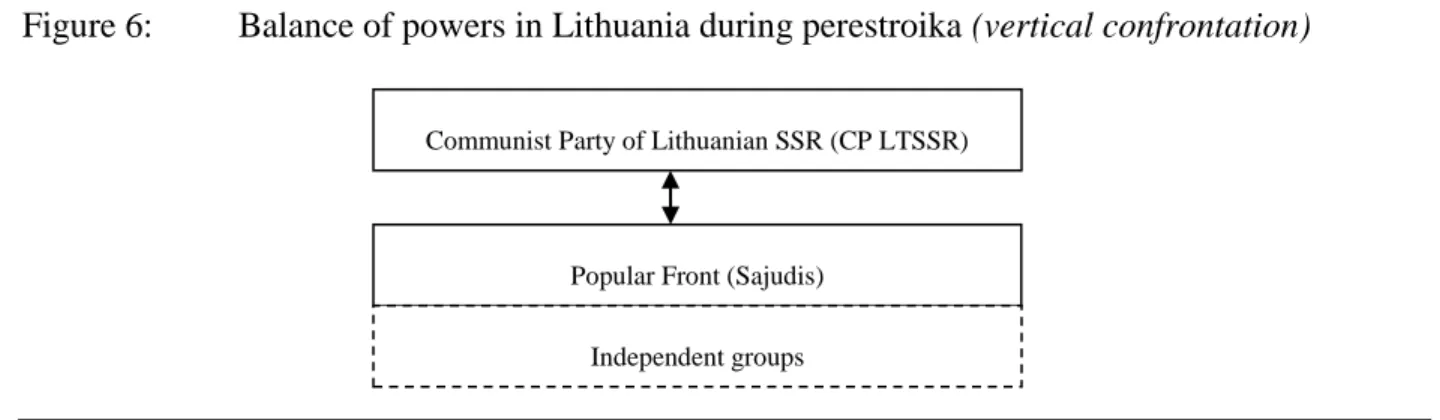
Figure 6 Balance of powers in Lithuania during perestroika
viii
Abbreviations
CEE Central and Eastern Europe
CEECs Central and East European countries CIS Commonwealth of Independent States
CP ESSR Communist party of Estonian Soviet Socialist Republic CP LTSSR Communist party of Lithuanian Soviet Socialist Republic CP LV SSR Communist party of Latvian Soviet Socialist Republic CPSU Communist party of the Soviet Union
EBRD European Bank for Reconstruction and Development EHS Estonian Heritage Society
EIU Economic intelligence unit
EKK Estonian Kroon
ENIP Estonian National Independence Party EPA Estonian Privatization Agency
ESSR Estonian Soviet Socialist Republic
EU European Union
FDI Foreign direct investment
FSU Former Soviet union
GCI Growth competitiveness index GDP Gross domestic product IEF Index of economic freedom
IME Self-managing Estonia (Estonian: Isemajandav Eesti) IMF International monetary fund
LDLP Lithuanian Democratic Labor Party
LNIM Latvian National Independence Movement LTSSR Lithuanian Soviet Socialist Republic LVSSR Latvian Soviet Socialist Republic MEBOs Manager and employer buyouts NATO North Atlantic Treaty Organization
ix SMEs Small- and medium-scale enterprises
SSR Soviet socialist republic
UNIDO United Nations industrial development organization USSR Union of Soviet Socialist Republics (Soviet Union)
VAT Value-added tax
WB World Bank
1
I. Problematique: the North-South Gap in the Baltic States
Following the collapse the Soviet Union in 1991, fifteen republics across Europe and Asia fell into an unprecedented political chaos and economic decline. The end of the Union of Soviet Socialist Republics (USSR) ended the monopoly of the communist party which has been the hegemonic institution providing all soviet republics with political control, economic planning, coordination and integration. Thus, when the tightly knit Soviet system began to erode in 1990 and eventually collapsed in 1991, the previously interrelated republics faced the devaluation of the Soviet-time currency (the rouble) which generated triple-digit inflation, the cut-off of previously cheap energy supply from Russia resulted in a dramatic decline in industrial output, which in turn translated into falling living standards. Moreover, there was an absence in the Soviet republics of technical skills, know-how as well as legal, fiscal and institutional frameworks which would work under market economy. In this way, the similarities of the previously soviet republics were substantial (Desai 1997, Dyker 1997, Lavigne 1999).
Despite these similarities at the outset, Lithuania, Latvia and Estonia (hereafter- the Baltic states or the Baltics) by now are considered to be the three most successful cases of development. Starting with the 2000s, the Baltic states were presented invariably in the reports of reputable international organizations as a subcategory within the former Soviet Union (FSU) - the only ones with a consolidated democracy and a free market economy in FSU countries and having the highest living standards among them. In 2000, the European Bank for Reconstruction and Development (EBRD) indicated that within a decade, the Baltic states have already achieved democratic form of government with transparent governance, legitimate freedom and open civil justice (EBRD Transition Report 2000). Moreover, the report indicates that Lithuania, Latvia and Estonia have created a working market economy based on an entirely free price system and trade as well as the private sector accounting for the largest share of GDP. These conclusions were echoed by the Wall Street Journal in 2003: based on the annual changes of the Index of Economic Freedom (IEF) throughout 1993-2003, the Baltic economies were considered to be the fastest economies „in the history of the Index‟ to move from a centrally-planned to a market economy. Economic freedom in Lithuania, Latvia and Estonia differed favorably from the other FSU countries. Furthermore, the Baltic states have enjoyed high rankings in Doing Business Rankings published by the World Bank throughout 2000-2007, being among the top 30 among
2
the most business-friendly countries worldwide. Moreover, the three were placed among the most competitive and innovative countries worldwide in the Growth Competitiveness Index (GCI) published by the World Economic Forum (WEF) during the same period. The potential for growth of the Baltic states were said to rest on increasing living standards, high macroeconomic stability, effective institutions conductive to increasing exports and industrial output, which were taken as particularly vital for these small economies. By any measure, the growth of the Baltic states‟ economies was unique to the post-soviet world and has led many to refer to it as a „success story‟.
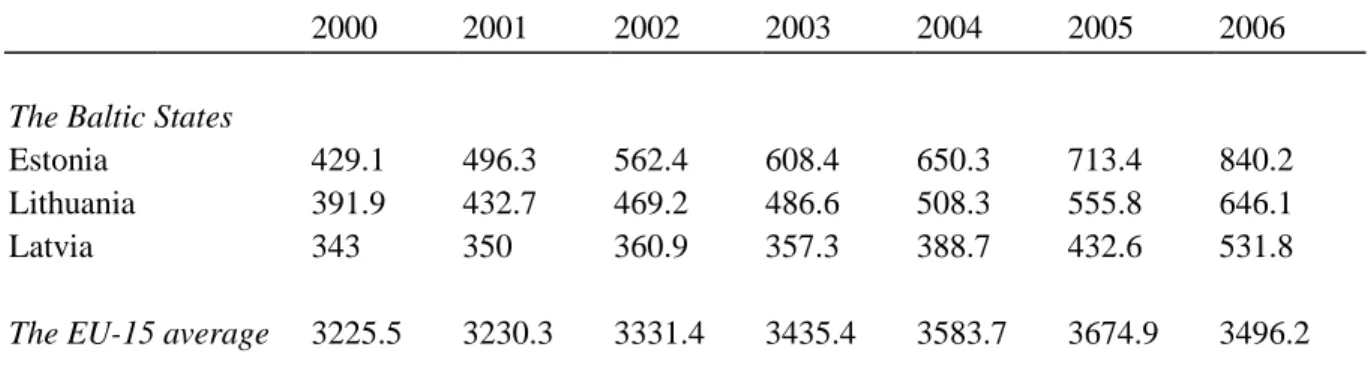
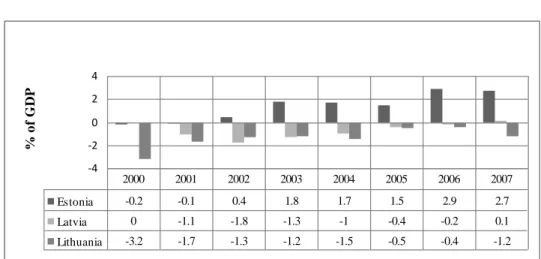
Yet despite these similarities, the three Baltic states have diverged in degrees of development. Within a decade, Estonia has established itself as taking lead with Latvia as a middle ground and Lithuania being the slowest among the three (Table 1, Table 2, Figure 1).
Table 1: FDI in the Baltic states, as % of GDP
2000 2001 2002 2003 2004 2005 Estonia 7.08 9.08 4.04 10 8.65 22.87 Latvia 5.27 1.59 2.72 2.71 4.64 4.61 Lithuania 3.31 3.67 5.04 0.97 3.44 4.03 Source: Panagioutou (2001)
Table 2: Monthly labor costs, EUR per month, 2000-2006
2000 2001 2002 2003 2004 2005 2006
The Baltic States
Estonia 429.1 496.3 562.4 608.4 650.3 713.4 840.2 Lithuania 391.9 432.7 469.2 486.6 508.3 555.8 646.1 Latvia 343 350 360.9 357.3 388.7 432.6 531.8
The EU-15 average 3225.5 3230.3 3331.4 3435.4 3583.7 3674.9 3496.2
Source: Labour statistics database (Laborsta) of the International Labor Organization (ILO), 2000-2006 at http://laborsta.ilo.org/
3
Figure 1: Budget deficit and surplus in the Baltic States, 2000-2007
-4 -2 0 2 4 % o f G D P Estonia -0.2 -0.1 0.4 1.8 1.7 1.5 2.9 2.7 Latvia 0 -1.1 -1.8 -1.3 -1 -0.4 -0.2 0.1 Lithuania -3.2 -1.7 -1.3 -1.2 -1.5 -0.5 -0.4 -1.2 2000 2001 2002 2003 2004 2005 2006 2007 Source: Panagioutou (2001)
Moreover, according to some international rankings, Estonia belongs to one of the most rapid and successful performers worldwide. During 2000-2002, the Transparency International ranked Estonia the least corrupt country in the post-communist region, and the IEF qualified Estonia as one of the most economically free in Europe and worldwide (Table 3). Estonia is leading in the world in the field of e-government: in 2005, it held the first e-elections in the world.
Table 3: Index of Economic Freedom rankings of the Baltic states, 2000-2007
2000 2001 2002 2003 2004 2005 2006 2007 Estonia 24 17 10 8 6 4 7 9 Latvia 45 47 51 43 … 28 39 34 Lithuania 64 44 43 … 22 23 23 19
Source: The Heritage Foundation, 2000-2007 Retrieved from: http://www.heritage.org/Index/
Its achievements were dubbed in some sources „economic miracle model‟ (Stanek 2006). Norkus (2007) has referred to the divergence between the three countries as North-South gap in the Baltics.
4
II. The Political Economy Explanation
In this chapter, I critically review the existing literature on Baltic development and put forth research questions. In the first part of the chapter, I summarize the fundamental aspects of development that the three Baltic countries had in common and discuss the existing accounts on their divergence. I argue that although all explanatory frameworks partially explain the North-South gap phenomenon, they underestimate political variables. The second part of this chapter is devoted to the review of what I call nationalist perspective on the post-soviet political economy – its formation, core claims, and inadequacies for explaining the Baltic development. Later, in the third part of the chapter, I put forth research questions and methodology.
2.1 Explanations of the North-South Gap: Missing Variables
2.1.1 Sharing Similarities
The Baltic states are considered to be the most successful cases of post-soviet development. Generally, the existing literature usually attributes their phenomenon to similar factors, such as the role of: (1) the market, (2) external actors, (3) historical legacies and (4) distinct politics of
nationalism.
The market explanation typically represented by economists and international institutions holds that the key to understanding the Baltic development lies in their rapid and comprehensive economic transition policies. The existing literature on transitional economics defines transition as a move from a planned socialist economy to a market economy characterized by private ownership of the means of production and market working as a major adjustment mechanism between demand and supply; the existing accounts almost invariably conclude that all the post-socialist and post-soviet countries embarked on similar „package‟ (Lavigne 1999), „ideal program‟ (Desai 1997) of reforms which consisted of three interrelated steps: (a) macroeconomic stabilization through fiscal and monetary policies, (b) liberalization of prices and trade, and (c) structural reforms. The differences emerged in sequence, speed, and scope of the chosen measures (Desai 1997; Dowlah 1992; Kolodko 2000; Kontorovich 1992; Lavigne 1999). Moreover, it was generally agreed that the speed of reforms correlated positively with the success of economic recovery and reorientation. As for the Baltic states, economic transition
5
here is generally has been conceived to be both more comprehensive and implemented more rapidly than in the other FSU countries and resembled that of the CEECs. Estonia, Latvia and Lithuania were the first to achieve macroeconomic stabilization through the earliest introduction of convertible national currencies (1992-1993), balanced their budget due to tight fiscal policies and implemented far-reaching reforms (such as privatization, banking reform, taxation) shortly after independence which created a new private sector and generated economic growth.
Another line of argument holds that the seminal factor underlying the Baltic phenomenon was its geopolitical situation and puts emphasis on external actors facilitating the Baltic development. This explanation argues that after the collapse of the USSR the Baltic states were on the borders of the European Union (EU) and Noth Atlantic Treaty Organization (NATO) and thus benefited from their guidelines. According to the view of some (Berglof and Roland 1997), it contributed greatly to the reorientation of the Baltic trade and provided them with a democratic orientation. Moreover, it was argued that the Baltic states due to agreements with the EU and NATO have not abandoned the path of capitalist market-based economy and liberal democracy even when governments were changing. After the accession to NATO and EU in 2004, Lithuania, Latvia and Estonia continued the same pathway.
In addition to these perspectives, some scholars (Hood et al. 1997) have argued that the success of the Baltic states is a regional/historical phenomenon originating from the experience of the three countries with market-based economies during the Interwar (1920-1940) period. The rationale is that in the Baltic states, which were the only ones among the Soviet countries with a history of independent democracies between the wars, had experienced the shortest period of the Soviet rule. Thus, they retained higher living standards and were advantaged with a memory of the elements of market economy at the outset of transition.
Most importantly, however, it is widely acknowledged that what has distinguished Lithuania, Latvia and Estonia from the other FSU countries, is the role of nationalism in their post-communist economic and political development. What I call nationalist explanation has been the dominant explanatory framework in explaining Baltic development. It holds that the key to understanding the Baltic „success story‟ lies in a unique model of political economy of transition implemented shortly after independence. It is a commonplace to state that specific
politics of identity emerged in the Baltics during 1985-1991, crystallized into capitalism- and
market-6
oriented reforms during the first post-soviet governments in 1992-1996 (Abdelal 2001; Tsygankov 2002; Gill 2002, 2006).
2.1.2 Existing Explanations of Divergence
Estonia, Latvia and Lithuania have shared many conditions in common, yet they have diverged a great deal despite these similarities. Why? This puzzling issue gave rise to competing explanatory frameworks that can be grouped around two main perspectives, namely: (1)
economic, and (2) socio-cultural.
Economic explanation can be brought down into two groups, each of which attributes the
divergence between Estonia, Latvia and Lithuania to different explanatory factor, namely: (a) economic structure upon independence, and (b) geographical situation. Norgaard (1996) has argued that the share of all-union heavy industry enterprises was lower in Estonia and thus the transition was easier. Kala (1994) and Kallas (1996) have pointed out that the geographical proximity of the Nordic countries (Finland, Sweden) gave Estonia an advantage of low transportation costs that increased competitiveness of its exports and attracted foreign investment.
In contrast to the views described above, Panagioutou (2001), Norkus (2007) and Bennich-Bjorkman (2007) have in different ways argued that Estonia‟s success was down to more than just economics and stated that it was cultural and social legacies accumulated during earlier periods that have contributed greatly to a more successful economic development of Estonia vis-à-vis its southern Baltic neighbors. Panagioutou (2001) has demonstrated that lower cultural and political integration into the soviet system in Estonia has proved to be beneficial to its economic restructuring upon independence: a comparatively lower participation of the population in the Communist party of Estonia and the shared Scandinavian identity generated an overall distrust and rejection of the soviet political, cultural and economic domination. Thus, according to Panagioutou, Estonia was more eager to abandon the command economy and to restructure its economy into a market-based one than Latvia or Lithuania. Norkus (2007) and Bennich-Bjorkman (2007) have stated that it was protestant legacy of Estonia that was of pivotal importance to the emergence of the North-south gap in the Baltics. They both have hypothesized that protestant ethics, such as diligent work, emphasis on individual responsibility (Norkus 2007) and a distinct civic culture that survived years of the Soviet occupation (Bennich-Bjorkman 2007)
7
might have given birth to a group of more competent policy-makers to restructure its economy in the early 1990s.
2.1.3 Missing Variables on Divergence: State-Building
All the factors discussed above undeniably address issues which have been of pivotal importance in divergent pathways of the Baltic economic transition. However, one very important variable, I contend, is missing. During the post-Soviet economic transition, all the economic transition
policies were inextricably linked with process of state-building. Contrary to the Soviet satellite
countries in the Central and Eastern Europe (CEE) which retained their autonomous state apparatuses throughout the Soviet period, the formerly constituent USSR republics had no states of their own. Thus, after the break-up of the Soviet system, they were passing not only from a centrally-planned economy to a market-based one, but also from authoritarian Soviet rule to independent statehood and democracy (Pettai and Krentzer 1998, Norgaard 1996). In such way, the post-soviet economic transition, in Mockunas (1993) words, was a „politically charged process‟. The Baltics states were not an exception.
Moreover, what is apparent to an insider but is virtually left unanalyzed in academic literature is that post-soviet state economic policies in Estonia, Latvia and Lithuania (despite the well-known similarities) were administrated in very different political contexts. Thus, I argue that Baltic politics and its relation to economic transition deserve attention. Contrary to the existing explanations attributing the emergence of the North-South gap to merely economic (initial conditions or economic decisions) or cultural (cultural and social legacies) factors, I put forth a political economy explanation which rests mainly on the reinterpretation of the
nationalist explanation, the dominant explanatory framework in explaining post-soviet Baltic
political-economic development mentioned in the previous section. Here I will specify its formation, core claims and accounts of the Baltic states. Later, I will point out the inadequacies of the nationalist explanation in accounting for post-soviet divergence in the Baltic states and put forth the research questions.
8
2.2 What is Taken to be Similar is Different
2.2.1 The Nationalist Explanation of the Post-Soviet Development
The Baltic states have served as an epitome of nationalist explanation of the post-soviet
development. Most recent accounts on the post-soviet political economy of the Baltic states
typically attribute the development of Lithuania, Latvia and Estonia to a unique model of political economy of transition. It is a commonplace to state that specific politics of identity emerged in the Baltics during 1985-1991, crystallized into capitalism- and market-oriented first post-soviet governments in 1992-1996 which in turn unambiguously led to liberal democracy and free-market economy in these states. Because of the role of nationalism is given central importance here, I call this explanation nationalist perspective.
After the break-up of the Soviet Union in 1991, there has been a widespread assumption that Western liberal democratic capitalism has scored victory over socialist centrally-planned, authoritarian systems and that former communist regimes will thus be invariably replaced by democracies. It was assumed that they will become part of the global democratic change that began in the southern Europe and extended into Latin America in the 1970s, East Asia in the 1980s and occurred in the communist world throughout the 1980s-1990s (Gill 2002). Moreover, the only one alternative to the Soviet centrally-planned economy was seemed to be a free market economy. However, as cross-country studies soon revealed, this was not the outcome. The post-soviet countries soon diverged a great deal in terms of political systems (from democratic to authoritarian) and economic orientations. The Baltic states soon emerged as a specific category within the former soviet countries: the only ones that unambiguously chose liberal democracy and free market economy as their orientation.
Explanations of divergence and the „Baltic phenomenon‟, as mentioned in the previous chapter, have been many. The most recent explanation points out that crucial in determining the political outcomes of the post-communist transition was the identity vis-à-vis the former regime (pro-Soviet/anti-Soviet or ambiguous) of those leading political actors who implemented the transition in each state.
Abdelal (2001), Tsygankov (2002) and Gill (2002, 2006) have traced the origins of divergence back to perestroika (1985-1991), the period of regime change before the official collapse of the USSR in 1991. This Soviet reform gave voice to variety of forces, each of them
9
having their own purpose/motives, and competing/cooperating with each other based on their interpretation of perestroika. Analyses in this line of argument drew cross-country comparisons and focused on divergent politics of nationalism during perestroika period and post-soviet
orientations resulting from it in each country.
(1) Politics of Nationalism and Post-Soviet Orientations
Perestroika („restructuring‟ in Russian) was a reform launched in 1985-1991 by the USSR leader
Michail Gorbachev as a response to major economic decline in the Soviet union and aimed at transforming stagnant, inefficient USSR economy into a more efficient one. In order to achieve these goals, two additional policies were launched: glasnost („openness‟) and democratizatsiya („democratization‟). Glasnost meant an increased openness about past (historical) and present problems (such as corruption, ecology, crimes etc) in media and public life, whereas democratizatsiya was aimed at transforming a previously one-party rule1 to a union with a strong centre (Moscow) and strong soviet republics. On the one hand, perestroika policies dismantled the long-standing monopoly of the communist party through the creation of new institutions (Congress of People’s Deputies, the Soviet „government‟ and Supreme Soviet, the new bicameral Soviet „parliament‟) and introduction of direct, multicandidate elections to these bodies (March 1990). On the other hand, inasmuch as perestroika was aimed at transforming the Soviet Union rather than dismantle it, the Soviet authorities were still controlling all production, trade, monetary networks and military forces were still in hands of the Communist Party of the Soviet Union (CPSU) in Moscow. By now, scholars generally agree that this paradox was one of the main reasons of the failure of perestroika. The communist party was the core of Soviet system as such, and economic and political chaos it generated as well as unintended surge of nationalism eventually turned the pace into opposite direction: after the failed coup in August 1991, the USSR ceased to exist (Dowlah 1992).
It is this process of nationalism that, according to the nationalist explanation, deserves attention. It is agreed that perestroika gave voice to new forces with their own purposes and motives which competed/cooperated with each other based on their interpretation of the
1 The USSR (Union of Soviet Socialist Republics) nominally was a centralized democracy. In fact, however, it was a
union with a strong center (Moscow) exercising hegemonic control over its constituent republics trough a single Communist party. All the Soviet state organs (judiciary, executive, legislature) and media were completely subordinated to it, and both politics and economy depended on one party (Davies 1998).
10
perestroika and USSR system as such. While perestroika was a political change occurring still within the USSR system, the proposals centered on the notions of pro- and anti- sovereignty/autonomy/independence. Moreover, these forces used the existing Soviet institutions and popular support as their main vehicles. Generally, they emerged within two levels: (1)
republican official (the incumbent republican communist parties), and (2) societal semi-official
(popular fronts) and informal (independent groups). The interplay of these actors vis-à-vis the Soviet regime during 1985-1991 is usually referred to as politics of nationalism, or identity
politics. Here follows a description of the general characteristics of each actor, common to all the
then Soviet republics:
1. Republican Communist Parties. Until 1989, the republican communist parties were merely subordinate political bodies faithful to the Communist Party of the Soviet Union (CPSU). After the perestroika was launched („strong centre and strong republics‟), their status has changed (Dyker 1992). On the one hand, they were given more of an autonomous control over their republics. On the other hand, however, they were still subordinate to Moscow as the perestroika was meant merely to reform rather than dismantle the Soviet system. Thus, when the political climate was changing, they had to balance between the CPSU and local reformists. Generally, party apparatuses have split into two groups: (1) reformists, those embracing reforms and supporting perestroika change, and (2) hardliners, or conservative, uncompromising communists unwilling to yield to any changes within the established USSR system.
2. Popular fronts. According to the definition in the Soviet times, the popular fronts were „organizations formed to mobilize the people to the building of socialism under the leadership of communist parties‟ (Clemens 1991). Under the perestroika, given the willingness of Gorbachev to receive support to mobilize people to restructuring of the system into a more decentralized one, the popular fronts were encouraged throughout the USSR as a device to accelerate the change. They were organized by local reform-minded forces and granted the authorization by the USSR authorities in Moscow. Initially, they were formed to represent all forces favoring perestroika within the system and thus covered simultaneously a number of various groups, organizations and movements. They, in contrast to other dissent
11
organizations were given access to mass media (printed press, radio). Throughout the USSR, the popular fronts included an educated and intellectual elite as well as communist party members that promoted reform.
3. Independent movements. Glasnost policy offered an opportunity for various organizations and groups to give voice to protests against environmental damage, forced industrialization, Russification and repression of national culture (Misiunas and Taagepera 1993). They were led mainly by common people, dissidents from established Soviet system (students, writers, artists etc) and all those that have been outside the ruling communist party. Gill (2006) calls them „minority nationalists‟ mainly because their voice did not reach the Soviet authorities directly since they, in contrast to popular fronts, did not have access to the media.
The politics of nationalism had the USSR system as its focal point, and the main issues have been republican sovereignty/autonomy/independence. After the break-up of the Soviet Union in 1991, the formerly Soviet republics became independent and this conflict lost its importance. When the union disintegrated, the previously central regulating power ceased to exist, and countries were deprived of political system and economic regulation. Contrary to the former Soviet satellite countries in the CEE which had retained their own institutions and had a relative autonomy over their economies during the communist rule, the countries that used to belong to the USSR had nothing of their own. Therefore, the most immediate issues after independence were simultaneous state-building and economic measures to fight down huge economic decline and destabilization. The situation itself was unprecedented: no experience, nor know-how or clear strategies existed on how to deal with the political and economic change. In such way, the nationalist approach holds that the configurations of powers that emerged during the regime change prior to the official collapse of the USSR in 1991 were the matrix from which newly independent post-soviet states were built. Namely, the powers were responsible for the adoption of constitutions, legislature, state institutions, some forces split up and formed political parties to compete for the new order. Moreover, these were the actors chiefly responsible for the building of foreign relations and economic policies in each post-soviet state, and the
interpretation of the Soviet political and economic system became crucial. This, according to this
12
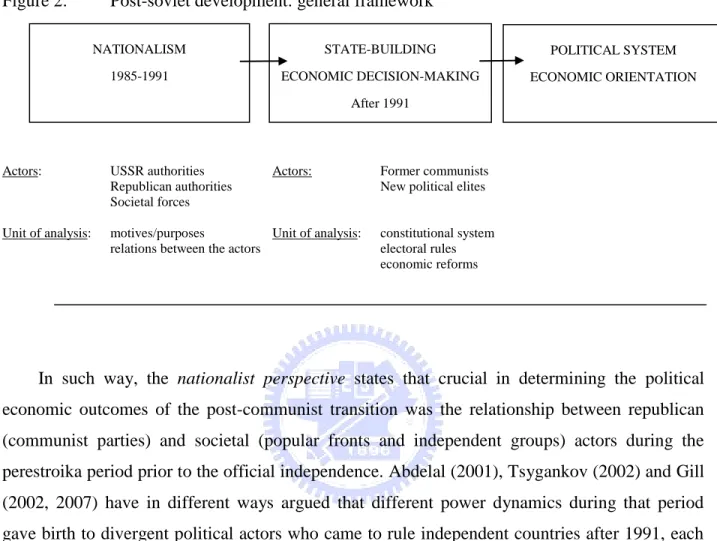
Figure 2: Post-soviet development: general framework
Actors: USSR authorities Actors: Former communists Republican authorities New political elites
Societal forces
Unit of analysis: motives/purposes Unit of analysis: constitutional system relations between the actors electoral rules
economic reforms
In such way, the nationalist perspective states that crucial in determining the political economic outcomes of the post-communist transition was the relationship between republican (communist parties) and societal (popular fronts and independent groups) actors during the perestroika period prior to the official independence. Abdelal (2001), Tsygankov (2002) and Gill (2002, 2007) have in different ways argued that different power dynamics during that period gave birth to divergent political actors who came to rule independent countries after 1991, each of them identifying as pro-Soviet, anti-Soviet or ambiguous. In other words, the main argument was that identity of those leading political actors who implemented the transition was the source of political-economic divergence in the post-soviet era.
(2) The Baltic Model According to the Nationalist Explanation
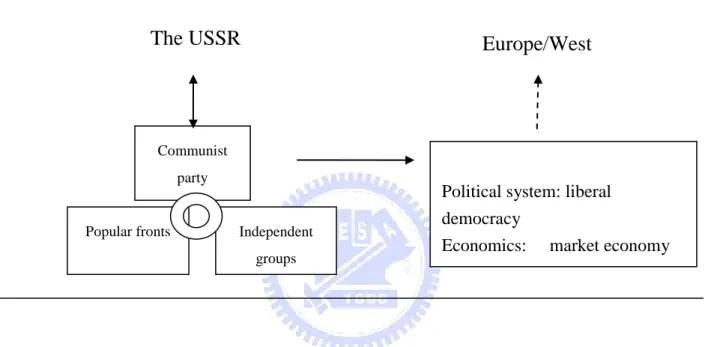
The nationalist explanation assumes that the three Baltic states formed a subgroup among the FSU countries. The existing accounts of political economy in the Baltics typically attribute the development of the three states to a uniform model. It is widely acknowledged that what has distinguished Lithuania, Latvia and Estonia from the other FSU countries, is a consensual, cooperative relationship between republican communist parties and societal forces (popular
POLITICAL SYSTEM ECONOMIC ORIENTATION STATE-BUILDING ECONOMIC DECISION-MAKING After 1991 NATIONALISM 1985-1991
13
fronts and independent groups). This symbiotic relationship is said to shape an exceptionally coherent, purposive and single-minded post-soviet political (Gill 2002, 2006) and economic (Abdelal 2001, Tsygankov 2002) orientations in these countries (Figure 3)
Figure 3: Baltic model of development according to the nationalist explanation
Gill (2002) has demonstrated that despite the similar initial conditions and widespread expectations about democratic development, political systems in the former soviet countries have diverged greatly. Based on two principal criteria for evaluation of the democratic nature of the political system - free and fair regular elections and a widespread observance of political and civil rights - Gill breaks the FSU countries down into three categories: (1) democracies (Lithuania, Latvia, and Estonia), characterized by the presence of the two components, (2)
façade democracies (Russia, Ukraine, Moldova, Armenia, and Georgia) exhibiting limited
freedom and fairness of elections and only some observance of political and civil rights, and (3)
non-democracies (Azerbaijan, Belarus, Kazakhstan, Kyrgyzstan, Tajikistan, Turkmenistan and
Uzbekistan) with noncompetitive, non-free elections and limited or absent observance of political and civil rights. Gill (2007) stated that the crucial in determining the political outcome of the post-communist transition was the identity of those leading political actors who shaped
Popular fronts Independent groups Communist
party
The USSR
Political system: liberal democracy
Economics: market economy
1985-1991 1992-1996
14
that transition. Where the transition was in the hands of popular fronts and independent groups (those proposing the idea of a „free nation‟ and rejecting Soviet rule), Gill has showed, democracy has been the outcome (the Baltic states). In contrast, where the republican Communist parties (hardliners eager to maintain the status quo of hegemonic Soviet power) remained firmly in central control and were able to exclude popular fronts and independent groups, the post-soviet political system was a non-democratic one. Following the same logic, where the transition has been shaped by republican Communist parties but under pressure from active popular fronts and independent groups, façade democracy has been built.
In addition to Gill, Abdelal (2001) and Tsygankov (2002) have been puzzled by variations in the foreign economic orientations of the post-soviet states. In particular, they have highlighted three categories of countries in relation to their stance toward the former central authority (Russia): (1) Lithuania, Latvia and Estonia, the only ones that chose a rapid disengagement from Russia and a more pro-Western orientation, the only ones among FSU countries to reject the membership in Commonwealth of Independent States (CIS)2 and unambiguously chose to re-orientate their trade relations to the Western Europe; (2) Azerbaijan, Belarus, Kazakhstan, Kyrgyzstan, Tajikistan, Turkmenistan and Uzbekistan, in contrast, preferred to maintain strong monetary ties with Russia, and (3) Ukraine, Moldova, Armenia, and Georgia falling between the two extremes. Those countries, according to them, which were endowed with historically strong and coherent national identities were more willing to break with the Soviet era, despite the economic costs of doing so (the Baltic states). Those countries, in turn, that had weaker national identities were ambiguous toward their post-soviet future or were even eager to maintain strong ties with formerly Soviet centre (Russia). In their view, similar to Gill‟s argument, the crucial to the economic orientation outcome was the relationship between the republican (communist parties) and societal (popular fronts and independent groups) actors during the perestroika period. Moreover, theoretically, Abdelal (2001) saw the post-soviet divergences as standing in a sharp contrast to the existing theories of economic nationalism as understood in the realist tradition. As traditionally understood, economic nationalism is a perspective of political economy that emerged during the 16th-18th centuries in Europe together
2
Commonwealth of Independent States (CIS) was a union created in December 1991 by the former Soviet republics. It is aimed at forming „a common economic space grounded on free movement of goods, services, labour force, capital; to elaborate coordinated monetary, tax, price, customs, external economic policy; to bring together methods of regulating economic activity and create favorable conditions for the development of direct production relations‟ (Interstate Statistical Committee of the CIS 2009).
15
with the birth of strong national states. For a long time, it has been one of the dominant ideologies of political economy and took many forms, such as protectionism, mercantilism, and statism (Gilpin 1987). The fundamental presumption of economic nationalism is that the state which is an autonomous (free from societal interests), rational and unitary entity driven by the three simultaneous objectives of security, wealth, and power, is at the core of international politics and economic development. Contrary to the economic nationalism described above, Abdelal proposed that crucial in determining the political outcomes of the post-communist transition was the identity („national purpose‟) of those leading political actors who implemented that transition.
Abdelal (2001) attributed this symbiosis to „nationalist‟ character of the incumbent communist elites. He argued that the fact of illegal Soviet annexation in 19403 nurtured patriotic sentiments of Baltic communist leaders who were communists only on the surface. Thus, Abdelal argues, after the Pandora box was opened during perestroika, the Baltic communist parties soon cooperated with powerful and active popular fronts. Moreover, the notion of „Europe‟ was central to the interpretation of the nation in the Baltic States during the late-1980s - 1990s. Lithuanians, Latvians and Estonians viewed themselves as a part of Europe, the imagined community to which they belonged culturally and historically and membership of which they were deprived by occupation. This notion of Europe was contrasted with the notion of Eurasia, and most importantly, Russia. Slightly different from Abdelal, Gill (2006) attributed the symbiotic relationship of the three forces to the strength of popular front and independent groups. These actors, according to him, were driven by long-suppressed national sentiments (cherished in underground activities during the Soviet time) and exerted influence on republican communist parties which soon embraced their ideals. Furthermore, the Baltic states modeled their post-soviet constitutions and state institutions under their Interwar (1920-1940) republics4.
3 The point to be made here is that most of the democratic countries in the world never recognized the annexation of
the Baltic states as legal. Some countries refused to recognize the incorporation of the Baltic States de jure and only recognized the Soviet governments de facto or not at all. This policy of non-recognition gave rise to the principle of legal continuity which led that de jure, the Baltic States remained independent under illegal occupation throughout 1940-1991. On the contrary, the USSR never formally acknowledged its presence in the Baltics as occupation and considered the Soviet Socialist Republics of Lithuania, Latvia and Estonia as its constituent republics. Until now, the government of the Russian Federation and state officials maintain that the Soviet annexation of the Baltic states was legitimate and that the Soviet Union liberated the countries from the Nazis.
4 The period between the two world wars (1920-1940) in the Baltics is a period of modern nation-states with
predominantly agricultural, export-oriented market economies and relatively high living standards in all three countries. It began with declarations of independence from the Russian Empire in 1918 and ended with a forced
16
To sum up, the rationale proposed by the most recent nationalist perspective is that due to widely shared historical memory of the pre-Soviet nation-states with democracy and market economies from which the Baltic states were deprived by the illegal Soviet occupation, the incumbent communist parties, popular fronts and independent groups during perestroika (1985-1992) have shared a single vision of their nations. The main focal point was Europe as an „imagined community‟ they once belonged to, and opposition to Russia/USSR, chiefly associated with alien rule. Thus, after the official independence in 1991, the three Baltic states produced coherent, nationalist-minded states responsible for economic restructuring and democratization. Thus, the orientation and the outcome was the same for the three: Western-style liberal democracy and a free market economy.
2.2.2 What is Taken to be Similar is Different
While the nationalist perspective of the post-soviet political economy contributed greatly to
illegal incorporation into the USSR in 1940. In 1918, as a result of the collapse of Germany and Russia, Lithuania (16th February), Estonia (24th February) and Latvia (18th November) gained independence from the Russian Empire and for the first time established their modern nation-states (EIU Country Profile 1993; Misiunas and Taagepera 1993; Reardon 1996; Reardon and Lazda 1993). In 1920, Estonia (2nd February), Lithuania (12th July) and Latvia (1st August) signed peace treaties with Soviet Russia (Treaty of Tartu, Latvia-Soviet Riga Peace Treaty, Soviet-Lithuanian Treaty) and began the process of nation-building. In accordance with other European countries, all three countries established democratic regimes with very liberal electoral laws and unicameral parliaments (Seimas in Lithuania, Saema in Latvia and Riigikogu in Estonia) exerting the principal power. These regimes, as opposed to Bolshevik revolution, received a broad Western support. In the realm of economy, the Baltic states soon established their own convertible currencies (Litas in Lithuania, Lats in Latvia and Kroon in Estonia). Moreover, the three Baltic states implemented land reforms which formed a new class of independent peasants and paved the way for the predominantly agrarian, export-oriented market economies. Nevertheless, due to the lack of democratic traditions and multiethnic societies, new political regimes based on nationalist ideology and strongly nationalist parties emerged. Strong presidential institutions with powerful presidents emerged: Antanas Smetona in Lithuania (1926), Karlis Ulmanis in Latvia (1934), and Konstantin Pats in Estonia (1934). The communist parties were banned, and the national intelligentsia was organized in national-liberal parties. Under strict control of the state and its economic policies, the Baltic states were among the first European countries to overcome the economic crisis that hit in the late-1920s and accumulated gold reserves which were put for safekeeping in Western banks (Norgaard 1996). However, the rise of Germany led to rivalry with the Soviet Union. On 23 August 1939, the first German- Soviet Non-Aggression Treaty (known as Molotov-Ribbentrop Pact) assigned Lithuania to the German sphere of influence. A month later, the second Molotov-Ribbentrop Pact, reassigned Lithuania to the Soviet sphere. In October 1939 the Soviets pressured Lithuanian leaders to sign a Treaty of Mutual Assistance. At first the Baltic States tried to pursue a firm policy of neutrality and to find a balance between German and Russian interests in the region. However, as a result of Molotov-Ribbentrop Pact and on the pretext that the Baltic States were not capable of defending the sovereignty by themselves, the Soviet Union demanded military bases to be placed in their territory. Getting no help from the West, the Baltic States had to yield to Soviet demands. Later on, the USSR took full control of the Baltic states. Threats and demands from the Soviet government caused the lawfully elected governments to be replaced by Soviet puppet governments which applied for admittance to the USSR in August 1940. The Baltic states thus ceased to exist.
17
explaining the similarities of political-economic orientation in the Baltic states, it fails to account for different levels of development in each of them. Moreover, although the emergence of the North-South gap phenomenon would suggest that variations in political economy of transition in each state, the existing literature tends to overlook that. The most recent accounts of the
North-South gap takes the uniform Baltic political economy model (as described above) for granted and
downplays the differences. In the post-Cold War media, academic accounts and reports of international organizations, the Baltic states were seen as „success stories‟, countries that scored a victory of capitalism over communism and market economy over centrally-planned one. This helped to assert them as one category and many scholars tended to believe that Lithuania, Latvia and Estonia took very similar pathways. This assumption is deceiving, however.
Contrary to this perspective, I contend that there have been three models of political economy in the Baltic states during 1992-1996. They resulted from divergent inter-power relations during the perestroika, and shaped divergent strategies of economic transition during that period, with long-term economic outcomes. In other words, I agree that processes of
nationalism, state building and economic restructuring were inextricably linked together, but
aim at reinterpreting the existing nationalist perspective and argue that differences in political economy have paved the way for the emergence of differences in economic transition.
2.2.3 Research Methods and Data Collection
Deceiving conclusions have been drawn while comparing the three Baltic states with the other FSU countries. Thus, I will compare the three –Lithuania, Latvia and Estonia – with each other. My analysis applies a typical method of comparison which consists of (1) distinguishing contrasting outcomes of development under similar initial conditions and (2) comparing how the relationship between particular variables differs in different contexts (Winckler and Greenhalgh 1988, Hamilton and Biggart 1988, Hsieh 2005). The fact that the Baltic states had developed different outcomes (economic transition strategies) under similar economic conditions (Soviet cultural, social, political and economic legacies, geographical position, size, natural endowments and population) has made the Baltic states ideal cases for comparison. Many scholars and analysts in the field applied this method of comparison which allowed them to draw theoretical conclusions.
18
In order to specify the focus of analysis, I have developed a periodization of the Baltic transition, making distinctions between three stages, namely:
1. Initial period of transition (1992-1995/6). Period of the most immediate post-soviet reforms going simultaneously with the process of state-building. The goal and orientation of the Baltic states have been the same – liberal democracy, free market economy and integration into Western economic and political world through transnational organizations (EU and NATO). In order to achieve the transition to a market economy, the Baltic states had to forego the dominant role of the state in economy and allow market mechanism to work. The essential precondition for the economic transition was macroeconomic stabilization carried out using monetary and fiscal policies to stabilize inflation and create conditions for future economic growth. Simultaneously with monetary stabilization, liberalization of prices and foreign/domestic trade (abandonment of fixed price regime, reduction of subsidies, introduction of tariffs etc) was implemented. In addition, structural reforms such as privatization (to create a private sector) and banking sector and financial system reforms (to create a two-tier banking system and ensure financing for state budget) had to be introduced.
2. Beginning of integration with the NATO and EU (1996/8-2004). Economic growth as a result of reforms implemented during the initial period of transition; guidance from cross-national institutions and organizations (such as the World Bank, EBRD etc); since 2000 – economic boom, also known as „Baltic Tiger‟ market by diminishing levels of unemployment, growing budget surplus and the highest GDP growth rates in the EU.
3. 2004- present. Post-EU and NATO accession period. Usage of trans-national funds to fight down the regional disparities, social problems, and developing knowledge economies. Most recently – economic crisis, with Estonia experiencing the earliest slow-down and Lithuania the latest.
In this thesis, I focus on differences between Estonia, Latvia and Lithuania that shaped divergences during this period because it set the pace for subsequent development. I argue through comparative analysis that, despite often-emphasized similarities, there have been two
19
major factors that differed in each Baltic state during the initial period of transition and were
decisive in post-soviet divergence. First factor that led grounds to divergent degrees of development was constitutional order (political system, power relations between state institutions) and state-society relations that emerged out of complex politics of nationalism during perestroika and was constitutionally/legally established after independence. Second, equally important determinant was ideology (purpose and motive) of the first post-soviet
policymakers that shaped the character of political leadership and thus set the pace for economic
transition.
Therefore, I will reinterpret the politics of nationalism during perestroika (1985-1991) and
post-soviet state-building in the Baltic states. I use the general framework of regime change in
the USSR and look at how given actors – republican communist parties, popular fronts, independent groups – competed/contested in Estonia, Latvia and Lithuania. I highlight their identities and claims about national identity and relational dynamics that rest on sovereignty/independence/autonomy goals. This clear-cut analytical framework elaborated in existing literature allows me to prove that despite the often-emphasized differences, Lithuania, Latvia and Estonia reacted to the political changes of perestroika differently. I classify politics of nationalism in the Baltic states into three generalized types, namely: horizontal contestation (Estonia), triangular cooperation (Latvia), and vertical confrontation (Lithuania). These differences in power dynamics during perestroika, in my view, resulted in different types of constitutional order, with political leaders, parties that had contrasting purposes and linkages to society.
Furthermore, I will demonstrate that divergent economic transition strategies in each of the state were linked to contrasting political motives and goals of the first post-soviet policymakers. The connection between culture/ideology and political-economic outcomes in transitional countries has been pointed out by many authors, e.g. Hamilton and Biggart (1988) and Chun (2000). Hamilton and Biggart (1988) have indicated that the three newly industrialized countries in East Asia – Japan, South Korea and Taiwan – have differed much in the degree of state intervention into their economies. They have categorized three models of state/business relationships, namely: South Korea‟s „strong state model‟, Taiwan‟s „strong society model‟, and Japan‟s „strong intermediate power model‟. The authors claimed that each model derived from a distinct strategy of legitimization of political leadership. In South Korea, the existing model was
20
a product of a Confucian ideal state, whereas in Japan it was patterned under previous imperial structure and in Taiwan the focus on family and distance to the state gave birth to „strong society model‟. In similar way to Hamilton and Biggart, Chun (2000) links a unique strategy of political legitimization of the KMT to democratization process in Taiwan. For him, the democratization of Taiwan was not the victory of individual freedom over authoritarianism as the post-Cold war explanations tend to hold, but rather an expression of hegemony of the same ruling elite which sought different ways to maintain the control over the state. Taking advantage of these insights, I look at identities, motives and purposes of the key policymakers that implemented the transition in the Baltic states. I argue that their divergences translated into different institutional frameworks for economic transition, with respective timing and economic outcomes.
Data for my empirical study consists of two groups: major and supplementary. The quarterly reports by the Economic Intelligence Unit (EIU Country Profile 1993, 1995) and annual report by the Organization for Economic Co-operation and Development (OECD, 1999) were useful sources providing detailed accounts of institutional settings and economic decision-making in each state during the initial stage of economic transition (1992-1995). Academic journal articles and books written by experts in the field have also been used in order to map out Baltic governmental institutions and their role in economic restructuring (Norgaard 1996; Reardon 1996; Reardon and Lazda 1993). In addition, data from country-specific case studies also have been collected to highlight differences between the three (Brown 1993; Lauristin and Vihalemm 2009). Audiovisual material available online gave interesting information concerning bureaucratic apparatus and decision making (Laar 2000; Laar 2006; Laar 2007).
21
III. Politics of Nationalism and
Post-Soviet State-Building in the Baltic States
The existing accounts typically attribute regime change in the Baltics during perestroika (1985-1991) and post-soviet orientations in the three states to a single model characterized by a consensual, cooperative relationship between republican communist parties and societal forces (popular fronts and independent groups). This symbiotic relationship is said to shape an exceptionally coherent, purposive and single-minded post-soviet political and economic development. Contrary to these generalizations, I demonstrate that due to demographic, cultural and social factors there have been three models of regime change (politics of nationalism) in the Baltic states, namely: horizontal contestation (Estonia), triangular cooperation (Latvia), and
vertical confrontation (Lithuania). Moreover, different constitutional order (political system,
power relations between state institutions) and state-society relations emerged out of the divergent politics of nationalism during perestroika and were constitutionally/legally established after independence.
3.1 The Estonian Model
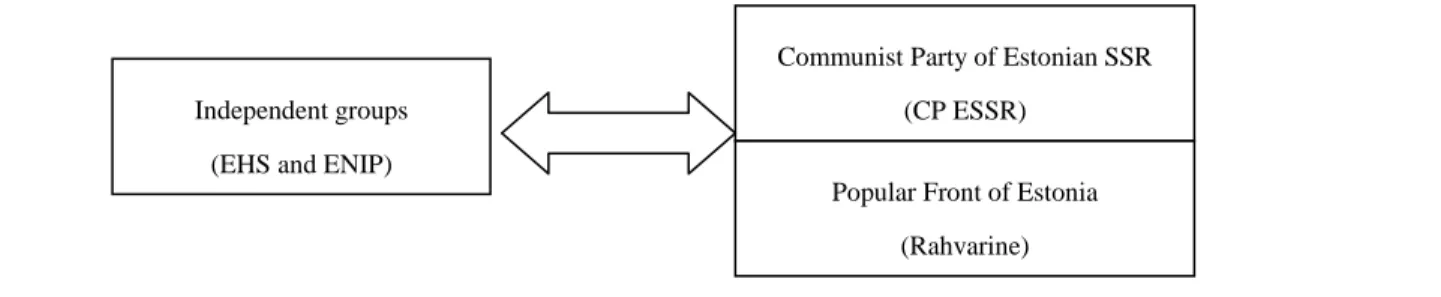
The Estonian political transition during the perestroika took a form of horizontal contestation between reform-minded communists, popular front of Estonia (Rahvarine) and a joint alliance of independent groups - three equally strong actors with different demands/strategies but all sharing a strong opposition toward the existing Soviet order (Figure 4).
Figure 4: Balance of powers in Estonia during perestroika (horizontal contestation)
Independent groups (EHS and ENIP)
Popular Front of Estonia (Rahvarine)
Communist Party of Estonian SSR (CP ESSR)
22
A strong ethnic threat (a significant part of the Estonian population was non-Estonian) had a consolidating effect on the three, and conservative hardliner communists opposing both perestroika and independence where soon marginalized and lost their voice in politics. Furthermore, the Estonian politics of nationalism during perestroika had a distinct character where the notion of sovereignty/autonomy/independence was going along with increasingly clear and consistent economic orientation towards free market economy. After the independence, the adoption of parliamentary democracy concentrated the political power in the parliament (the Riigikogu) and exclusion of a significant non-Estonian population from voting list created an opportunity for a brand new group of policymakers to come to power.
3.1.1 Communist Party, Popular Front and Independent Groups in Estonia
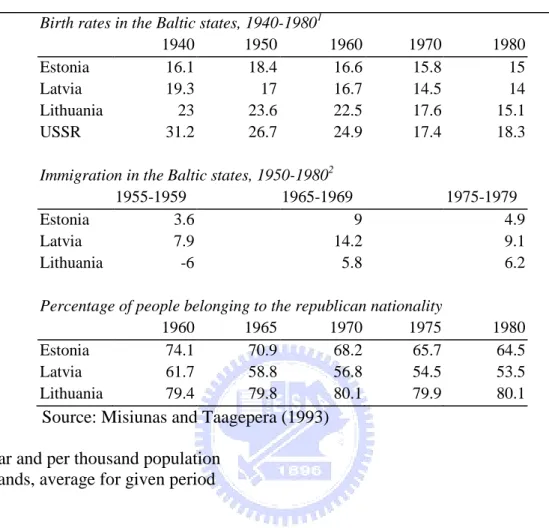
Communist party of Estonian Soviet Socialist Republic (CP ESSR). The peculiar characteristic of the CP ESSR was that it was overrepresented by Russian immigrants with native Estonians occupying only the lowest ranks and thus having virtually no control of the political, economic and social life of Estonia (Misiunas and Taagepera 1993; Steen 1997). The existing literature attributes this peculiarity to two main reasons: (1) the Soviet policies of industrialization and colonization and (2) characteristics of the Estonian society (such as low birth rates, low level of political participation, directly or indirectly related to protestant ethics). It was made clear that the Baltic states were the most economically advanced and industrially developed when the Soviet Russia occupied them, which subjected them to a higher influx of heavy industry workers from all parts of the USSR. Estonia, being the most modern and having the lowest birth rates among the three, was hit severely by this immigration. The overall composition of population changed dramatically (Table 4). This demographic situation was also reflected in the CP ESSR leadership, where most of the highest-ranks were given to non-Estonians (mostly Russians) with Estonians occupying only the lowest ranks.
23
Table 4: Birth rates, immigration and percentage of native population in the Baltic states during the Soviet occupation
Birth rates in the Baltic states, 1940-19801
1940 1950 1960 1970 1980 Estonia 16.1 18.4 16.6 15.8 15 Latvia 19.3 17 16.7 14.5 14 Lithuania 23 23.6 22.5 17.6 15.1 USSR 31.2 26.7 24.9 17.4 18.3
Immigration in the Baltic states, 1950-19802
1955-1959 1965-1969 1975-1979 Estonia 3.6 9 4.9 Latvia 7.9 14.2 9.1 Lithuania -6 5.8 6.2
Percentage of people belonging to the republican nationality
1960 1965 1970 1975 1980 Estonia 74.1 70.9 68.2 65.7 64.5 Latvia 61.7 58.8 56.8 54.5 53.5 Lithuania 79.4 79.8 80.1 79.9 80.1
Source: Misiunas and Taagepera (1993) Notes
1: Per year and per thousand population 2: Thousands, average for given period
Thus, the CP ESSR had (1) a clear ethnic divide and (2) was associated strongly with alien rule. In the light of this, driven both by the resentment with the political/economic situation as well as rational calculations, a number of native Estonian communists from lower ranks of CP ESSR attempted to push for improvement in the realm of economy. As a result, Estonia emerged as an „economic laboratory‟ since as early as the 1970s and the 1980s, a unique case in the USSR (Mockunas 1993; Panagiotou 2001). Different reforms were aimed at increasing the efficiency of the economy of Estonian SSR within the framework of the Soviet Union. The major turning point during the perestroika in Estonia was the change in leadership of CP ESSR. In 1988, the then First Secretary of the CP ESSR, Siberian-born Karl Vaino know for his reluctance to learn Estonian, was replaced by the Soviet authorities (as a part of openness policy of perestroika) with a native Estonian, relatively liberal-minded Vaino Valjas5. He became the first native communist
24
party leader of Estonia since 1940. Since then, the reformist stance became stronger and the CP ESSR began to push for the development of Estonia‟s autonomy within the USSR and regarded the attainment of sovereignty for the Estonian SSR as one of its main tasks. The native leadership gave a certain degree of legitimacy to the CP ESSR and expelled hardliner interests. In such way, the CP ESSR began to cooperate with the popular front.
Popular front of Estonia (Eestimaa Rahvarine, or Rahvarine). Founded by reformist communists of the CP ESSR, the Rahvarine was the first popular front in the USSR. It was a continuation of previous mobilizations aimed at reforming the economy of the ESSR. Rahvarinne‟s predecessor was so-called Four Man Proposal, the first proposal for economic sovereignty among all Soviet republics, published in 1987 in the Tartu newspaper „Edasi‟. Edgar Savisaar (Head of the State Plan Committee of the Estonian SSR), Siim Kallas (specialist of finance), Miik Tiima (sociologist) and Tiit Made (TV political commentator) advocated the idea of „self-managing Estonia‟ (Isemajandav Eesti, IME). The IME proposal put forth autonomy of the Estonian SSR over its budget, and its right to implement institutional reforms on the republican level (Miljan 1994). The proposal gained a widespread support from the society but was rejected by the CPSU authorities in Moscow. This compelled one of its authors, Savisaar, to create the popular front of Estonia in 1988 (announced on 13 April 1988). As in the other Baltic states, the Rahvarine initially demanded sovereignty within the reformed USSR but soon became a very broad movement counting other reformist communists and Estonian intelligentsia among its members.
Independent groups. In the late-1980s, Estonia saw a rapid growth of independent grassroots movements whose number, organization and influence was not matched in any other Soviet republic at that time. The largest of them were two: the Estonian Heritage Society (EHS) and the Estonian National Independence Party (ENIP), the first political party in the Soviet Union apart of the Communist Party of the Soviet Union (CPSU). Bennich-Bjorkman (2003) traces what he calls Estonian „counter-elite‟ to the Estonian „second society‟ during the Soviet period. Bjorkman talks about Estonian society in which informal interpersonal connections were very
appointed as Soviet ambassador to Venezuela and Nicaragua in 1986. As the Estonian independence movement gained momentum in 1988, the relatively liberal Valjas was recalled from Nicaragua and was appointed by Gorbachev to this post (Misiunas and Taagepera 1993).