Revisiting Economic Development in Post-war
Taiwan: The Dynamic Process of Geographical
Industrialization
JINN - YUH H SU* and LU- L IN C HEN G †
*Department of Geography, National Taiwan University, Taipei 106, Taiwan. Email: [email protected] †Institute of Sociology, Academia Sinica, Taipei 111, Taiwan. Email: [email protected]
(Received September 2001; in revised form January 2002)
HS UJ.-Y. and CHEN GL.L. (2002) Revisiting economic development in post-war Taiwan: the dynamic process of geographical industrialization, Reg. Studies 36, 897–908. Taiwan’s post-war economic growth has been spectacular and has attracted divergent, even contrasting, explanations from the students of economic development. While neo-classicists interpret Taiwan’s Miracle as a model of a free market economy, the statists put government policy as their main emphasis. However, neither the neo-liberalists nor the statists take the phenomena of uneven development very seriously. By ignoring the process of geographical industrialization, both discourses are not able to reveal the dynamic rhythm, and more importantly the diversity and possibility, of capitalist development. This paper tackles the issue by unraveling the divergent regional industrial trajectories and the resulting geographical and social embeddedness in post-war Taiwan.
Taiwan Developmental state Neo-liberalism Geographical industrialization Regional development
HS UJ.-Y. et CHEN GL.-L. (2002) Le de´veloppement e´cono- HSU J.-Y. and CHEN G L.-L. (2002) Ru¨ckkehr zur Wirt-mique d’apre`s-guerre au Taiwan vu sous un nouvel angle: le schaftsentwicklung in Nachkriegstaiwan: der dynamiche processus dynamique de l’industrialisation ge´ographique, Reg. Prozeß geographischer Industrialisierung, Reg. Studies 36, Studies 36, 897–908. Au Taiwan, le de´veloppement e´cono- 897–908. Taiwans Wirtschaftswachstum nach dem Kriege war mique d’apre`s-guerre a e´te´ mirobolant, d’ou` des explications spektakula¨r, und ist Gegenstand auseinandergehender, sogar divergentes de la part des e´tudiants du de´veloppement e´cono- gegensa¨tzlicher Erkla¨rungen von Wirtschaftswissenschaftlern mique. Alors que les ne´oclassicistes conside`rent le miracle gewesen. Neo-klassiker interpretieren Taiwans Wirt-taiwanais comme un mode`le type d’une e´conomie de schaftswunder als ein Modell der freien Marktwirtschaft, marche´, les e´tatistes proˆne la politique gouvernementale. wa¨hrend Befu¨rworter des Staats in erster Linie die Regi-Cependant, ni les ne´oliberaux, ni les e´tatistes ne prennent au erungspolitik betonen. Jedoch nehmen weder Letztere noch se´rieux la notion de de´veloppement irre´gulier. En ne tenant die Neoliberalen das Pha¨nomen der ungleichen Entwicklung pas compte du processus d’industrialisation ge´ographique, les sehr ernst. Da beide den Vorgang der geographischen deux discours ne peuvent de´voiler ni le rythme dynamique, Industrialisierung außer Acht lassen, sind sie nicht in der ni, ce qui est plus important, la diversite´ ni la perspective du Lage, den dynamischen Rhythmus aufzuzeigen, noch, was de´veloppement capitaliste. Cet article cherche a` aborder la wichtiger ist, Vielfalt und Mo¨glichkeiten kapitalistischer question en de´meˆlant les trajectoires industrialo-re´gionales Entwicklung. Dieser Aufsatz geht die Frage durch Entwir-divergentes et l’ancrage socio-ge´ographique dans le Taiwan rung von einander abweichender, regionaler industrieller d’apre`s-guerre qui en re´sulte. Flugbahnen an, und der sich daraus ergebenden geogra-phischen und gesellschaftlichen Verankerung Nachkriegs-taiwans.
Taiwan Etat de de´veloppement Ne´olibe´ralisme Industrialisation ge´ographique
Ame´nagement du territoire Taiwan Entwicklungsland Neoliberalismus Geographische Industrialisierung
Regionale Entwicklung
IN TROD UC TION development, particularly after the 1997 economic turmoil. While the issue of how to decode the East Asian Miracle had not been settled, the concern of Taiwan’s post-war economic growth has been
spec-how to interpret the 1997 turmoil has resulted in an tacular and has attracted divergent, even
contrast-ing, explanations from the students of economic existing divide among East Asian researchers. Those
0034-3404 print/1360-0591 online/02/080897-12 ©2002 Regional Studies Association DOI: 10.1080/0034340022000012324 http://www.regional-studies-assoc.ac.uk
who believe the success of East Asia comes from the ization in the 1970s; and the industrial upgrading toward high-tech industries in the 1980s (GER EFF I,
liberation of market forces conceive that the 1997
disaster was caused by the incompleteness of the market 1990). Variables like the Japanese colonial legacy (BARN ETT and WH YTE, 1982), government policy
released by the governments (IN TERN ATIO NA L
MON ETA RY FUN D (IMF), 1998). In contrast, those (WAD E, 1990), the international political economy
(CU M INGS, 1987), the vulgar Confucianism
who buy the idea of ‘developmental state’ tend to see
the crisis as a conspiracy of the Wall Street–Treasury– (BERG ER, 1986), labour suppression (DEYO, 1989),
and networked production (SHIE H, 1992) have been
IMF complex, which pushed East Asian governments
to abandon their ‘on-the-right-track’ regulations of selectively combined to oVer explanations as to the country’s economic success.
their own nancial system, and believe governments
have to bring back rules to weather the storm (WAD E, This paper does not aim to play as an impartial jury
or to retell history by reshuZing the variables. Instead, 1998).
These two perspectives of East Asian economic this study starts oV from the observation that those variables did not evenly shape the evolution of Taiwan’s development appear to take extremely diVerent stances:
while the neo-classical theories advocate for the retreat economy as if it was a homogeneous unit. Questioning the hidden assumption of a nation-state as the unit of of the state, the political economy approaches campaign
for the empowerment of government. However, in analysis is not entirely an academic exercise. It is also a timely response to the pressing issues facing people in reality they reach an unexpected agreement – both of
them converge on the idea that national development the turbulent world of the global economy, as the debate around the relationship between the regionaliza-is a spatially homogeneous process, and the regulation
(or deregulation) of state policy will lead the nation to tion and globalization process has intensi ed in the past decade (OM AE, 1995; SCO T T, 1998).
a new economic growth stage. Within this new stage,
new leading sectors emerge and new employments The following discussion will focus particularly on the interplay of four elements at the regional level: increase.
These views are wrong or, at least, incomplete. A industrial organization; state policy; market operation; and popular action by households, labour unions and capitalistic economy never grows in a spatial vacuum,
but in a process of geographical industrialization professional networks. First, industrial organizations vary in accordance to the standing conventions, which (STO RP ERand WALK ER, 1989). Capitalistic
develop-ment reveals itself among divergent institutional legitimate the exploitation modes of resources and constraints (STO RP ER, 1997). Second, state policies
embeddedness, structural coherence, geographical
organizations and scalar connections, as HARVE Y, carry divergent levels of capabilities to shape the
con-text for the market mechanism to operate, while the 1982, argues. Space is treated as a resource that
tempor-arily xes the necessary contradiction of capital accu- constituted market further restructures the state auto-nomies in diVerent localities (EV ANS, 1995).2 Third,
mulation.1 From a geographical perspective, the
industrialization process should not be taken as a tem- the market mechanism is the social eld where rms and institutions interact to allocate resources and the poral sequence of industrial substitution, but as a course
of regional accumulation regimes that create locational resulting well-being of each people and their surround-ing regions (BLO C K, 1990). Finally, the actions taken
factors, construct worlds of production and shape local
geographical con gurations. by the popular sectors from the bottom will resist or legitimize the dominance of the above institutions, and Both statists and neo-liberalists make the same
mis-take in taking national development to be a universal shape the diVerent industrial trajectories in diVerent regions (HERO D, 1997). Investigating the diVerence of
phenomenon, and buy into the idea that the policy
will have regular, either positive or negative, eVects on the interaction patterns in the divergent regions will illustrate the rich varieties of production worlds in the industrial system. In contrast, we diVerentiate the
divergent developmental trajectories in diVerent Taiwan’s post-war geographical industrialization pro-cess. In a sense, economic development is a historical regions, even in the same country. By doing so, we are
able to illustrate the rhythms of industrial change and question about socially-embedded industrial space and
therefore also a challenge for turning limits into
prosper-related geographical organizations, and then provide a
clearer understanding of the multiple modes of regional ity through our choices.
As is argued above, economic development is a industrialization, and multiple modes of institutional
regulation, in the presumed monolithic national historical result of the socially-embedded interaction between region and industry. Three industries are development.
Taiwan’s post-war economic growth was driven chosen as study subjects, because they represent the major stages and regions of Taiwan’s post-war economic primarily by the expansion of manufacturing exports
after 1960. It has become a commonly-accepted frame- growth. They are the footwear industry, petrochemical industry and semiconductor industry. Their economic work to divide its post-war economic development
into three stages: the early push toward manufacturing contributions (such as what percentage they have of manufacturing employment, gross value added and total exports in the 1960s; the import-substitution
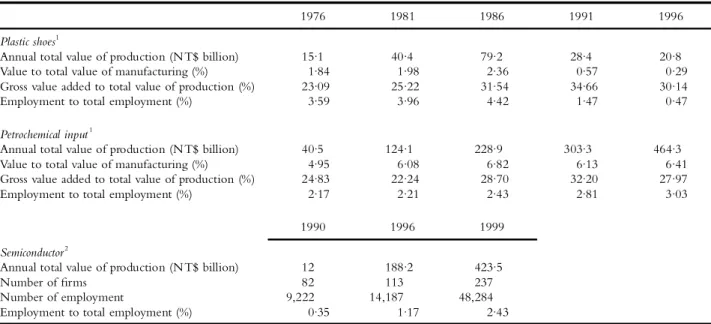
industrial-Table 1. Economic performance of the three industries studied
1976 1981 1986 1991 1996
Plastic shoes1
Annual total value of production (NT$ billion) 15·1 40·4 79·2 28·4 20·8
Value to total value of manufacturing (%) 1·84 1·98 2·36 0·57 0·29
Gross value added to total value of production (%) 23·09 25·22 31·54 34·66 30·14
Employment to total employment (%) 3·59 3·96 4·42 1·47 0·47
Petrochemical input1
Annual total value of production (NT$ billion) 40·5 124·1 228·9 303·3 464·3
Value to total value of manufacturing (%) 4·95 6·08 6·82 6·13 6·41
Gross value added to total value of production (%) 24·83 22·24 28·70 32·20 27·97
Employment to total employment (%) 2·17 2·21 2·43 2·81 3·03
1990 1996 1999
Semiconductor2
Annual total value of production (NT$ billion) 12 188·2 423·5
Number of rms 82 113 237
Number of employment 9,222 14,187 48,284
Employment to total employment (%) 0·35 1·17 2·43
Sources: 1. Industrial and commercial censuses of Taiwan-Fukien district of the Republic of China, various years. 2. Yearbook of Semiconductor Industry of ROC, various years.
value of production) are shown in Table 1. Due to data It must be admitted from the beginning that a detailed examination of the subject is impossible to availability, the input for plastic shoes and chemicals will
stand for the categories of footwear and petrochemical accomplish in a short paper. The discussions that follow are inevitably sketchy and only give some broad strokes inputs.
on the general features of these three industries in Taiwan. However, we hope that they are suYcient to
R EV I SI TIN G L OCA L E CON OM IE S OF at least reach an empirically-grounded conclusion that POS T-WA R TAIWA N there were multiple paths of growth in a country as
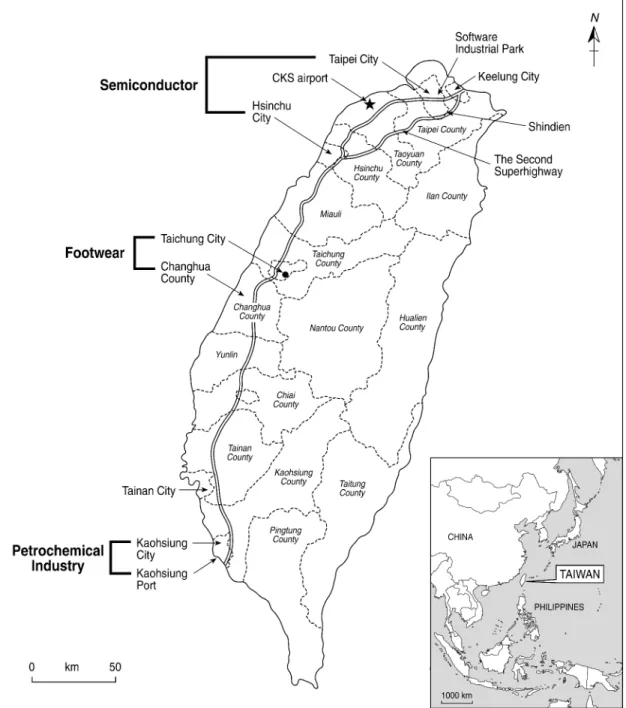
geographically small as Taiwan. More importantly, this The footwear industry, once Taiwan’s third largest
exporting industry, grew on a massive scale during the research reveals that there was an inconstant industrial-ization process in capitalist development and regions export-oriented industrialization of the 1960s. Central
Taiwan, especially the townships around its largest served as the x for the over-accumulation crisis. In a sense, geographical con gurations of capitalist develop-city, Taichung, was called the ‘shoe nest’, because it
accommodated most of Taiwan’s footwear manu- ment were key to decoding the post-war economic miracle in Taiwan.
facturers. The petrochemical industry was a representa-tive of the import-substitution industrialization, which
was ignited in the mid-1970s. Over 90% of petro- TH E FO OTW E AR I NDU S TRY IN chemical plants are concentrated around Kaohsiung’s C EN TR A L TA IWA N
port in southern Taiwan. The semiconductor industry
has become Taiwan’s new rising star of industrial Taiwan was the world’s largest footwear exporter between 1972 and 1988. The industry, especially its upgrading since the mid-1980s. All the semiconductor
plants and most of their domestic manufacturing buyers export sector, is concentrated in central Taiwan. The Taichung area, encompassing over 80% of footwear are located in northern Taiwan.
These selections certainly do not mean that the rms, is the ultimate powerhouse of the footwear industry – the ‘shoe nest’, as people in the industry have industries have no presence outside their respective
regions, nor do they imply that they monopolize the called it. The centre that has enjoyed the commanding height in this area is unarguably Taichung City, where regional economies. The cases are selected, because of
their historical af nities with development strategy and most of the buyers are located.
The spatial distribution of footwear rms reveals the regional space. To disentangle the social content of the
aYnities, this research presents the following questions. industry’s historical origin. In the delta area of the Dachia River, located about 16 miles north of Taichung What were the social conditions that spatially and
historically gave birth to those representative industries City, rushes ourished along the riverbank. Straw-hat production, which was based on women’s household of Taiwan’s postwar economic development?
Con-versely, how did the development of those industries labour, developed in adjacent villages as a by-product of agriculture in the early eighteenth century. During shape the social landscapes of regional Taiwan?
Fig. 1. Taiwan and the three regional industries
Japanese colonialism, straw-hat production reached its early entrepreneurs, who shared market opportuni-ties and technological know-how through informal historic high in 1934, mainly through exporting to
Japan (HSIEH, 1964, pp. 335–36). After the devastation networks (TAIWAN ESE FO O TW EAR MAN U FAC -TU RER S’AS SO C IATIO N (TFMA), 1989). The
presi-of World War Two, the straw-hat weaving industry
emerged again, relying on the same female household dent of a footwear factory re ects upon what was happening during the early days of his business: labour. In the early 1960s, some businessmen started
to experiment by exporting slippers made with
straw-At that time, Taiwan had just begun to push exports.
weave uppers and plastic soles. This marked the
begin-People were amazed by how making shoes could earn
ning of the footwear export industry in Taiwan. them a little fortune. They were groping for manu-In 1967 there were about 30 footwear companies facturing exports in a learning-by-doing fashion (bian-registered in Taiwan. They were concentrated in the zuo-bian-xue). Market information was passed around area between Dachia and Chingshui, two towns located friends and relatives. For example, a glue maker would on either side of the Dachia River. Signi cant produc- tell his relatives about opportunities for shoe-making which he got from his customers. A shoe maker would
tell his best friend to set up a carton factory, you know, horizontally-disintegrated production network lies at
making money together (you-qian-da-jia-zhuan). Things the core of the industry’s exible expansion.
like that were very normal at the time and people were The industry’s rst association, the Taiwanese Plastic extremely hard-working then. (Citation from CHEN G, Shoes Exporter’s Association (TPSEA), was not
estab-1996). lished until 1968. Built upon its networks with the
weaving and plastic industries,3 TPSEA proposed a
Another one described the scene from a diVerent
‘minimum price agreement’ in a national industrial perspective:
conference with the Ministry of Economic AVairs
I was then working for the CICT (i.e. the footwear (MOEA). The government responded to the proposal section of Mitsubishi) as an inspector. It was really interest- cautiously, agreeing to link export licensing with ing to see how people made shoes at that time. They private pricing only if written agreements were reached made shoes inside the duck huts along a stream, beside a
among all association members. In addition, it agreed
hog house, or in the backyard of a farmhouse. One time,
to block export permits only in a passive fashion by
the high-frequency molding of plastic shoes shut down
routinely following the approval stamps that exporters
the electric supply of an entire village for a while, and
must rst get from the association. It was the industry
some even interfered with the operation of Taichung’s
military airport where US air forces were stationed. association that intentionally made use of government
Military oYcers were surprised that the source of inter- authority for a project they initiated, coordinated and
ruption came from the hog houses. As an inspector, I had actually enforced.
seen all these. We, the inspectors of trading companies, The aggressive image of the developmental state were the unsung heroes of Taiwan[’s] footwear industry. never existed in the footwear industry. It was a passive We moved around like bees spreading pollens among institutional supporter, not a far-sighted active partici-separated manufacturers so that innovations in manu- pant. Both export volume and value doubled in 1970, facturing spread quickly. (ibid)
the following year. From 1969 to 1976, up until the eve of the Orderly Marketing Agreement (OMA), the The industry grew rapidly in the late 1960s and then
expanded into the hinterland of the Changhua plains average annual volume increase was 64%, despite the oil crises in the early 1970s.
the county just south of Taichung, in the 1970s. In the
beginning, the majority of footwear exports were sold Under mounting pressure from domestic footwear producers, the US government imposed quota restric-through Japanese trading companies. However, the
intermediate role of these Japanese trading companies tions on Taiwanese and Korean footwear exports between 1977 and 1980. Shocked by the quota, quickly declined. Taiwanese footwear producers
even-tually developed direct connections with American Taiwanese footwear producers still managed to upgrade and build even stronger ties with major footwear buyers by the mid-1960s. The footwear industry in
Taiwan essentially developed through local capital and buyers. The number of registered footwear factories increased from just 75 rms in 1969 to 708 rms in indigenous networks of the peasant economy.
Taiwan’s footwear industry is mainly composed of 1981. As the industry grew over the years, a well-integrated local industrial base, composed of supporting numerous medium to small sized rms each specializing
in a certain range of tasks and together constituting a industries like machinery, synthetic leather, compo-nents, printing and mould making, was gradually highly responsive and competitive system. This is due
to the fact that almost all the steps in footwear produc- formed, mainly around Taichung City. On the marketing side, following the steps of the early footwear tion (except nal assembly) can be subcontracted. Firms
working as subcontractors for the principal factories can importers, brand-name athletic shoe marketers came to Taiwan mostly in the late 1970s and early 1980s. By be roughly classi ed into two broad categories: parts and
processing rms. The former provide components or 1986, all the major athletic shoe brand names had well-established original-equipment manufacturing (OEM) tools for footwear assembly, like outsoles, moulds,
embroidery, patterns and cutting dies. The production supply lines in Taiwan.4 Central Taiwan had become
an indispensable hub for the densely-connected net-of those components frequently requires investment in
sophisticated machines or higher technical expertise, or works of the world’s footwear industry.
The abrupt appreciation of the Taiwanese currency specialized subcontracting.
The other category is comprised of processing rms against the US dollar directly hit the engine of footwear exports in 1986. The success story seemed to be that often did simple labour processing with less skill
and machinery involved. Two major steps contracted drawing to an end. The number of registered rms reached its peak of about 1,245 in 1988 and then fell out were upper stitching and lining cementing. In the
1970s, the contractors often passed additional work to 627 rms by 1994. In just a few years, Taiwanese footwear producers led the rst wave of oVshore invest-down to smaller workshops or households at the next
tier. This is close to what HO LM ES, 1986, calls ‘capacity ment in post-war Taiwan, a challenge that both
Taiwanese rms and the state had never experienced subcontracting’ in the sense that it provided extra
production capacity that principal rms mobilized for- before. Years after being a backbone of Taiwan’s post-war economic growth, the footwear industry became when market demand surged. The vertically- and
the forerunner of Taiwan’s international investment in that the state, without support from local private capital, pushed for the petrochemical industry to lead Taiwan’s the 1990s.
After the panic and frustration that had plagued economic structure upgrading from light industry, such as plastic shoes, to heavy industry. As CH U, 1997,
Taiwanese footwear producers dissipated, a pattern of
international operation began to emerge. The new argues, the state played a critical role in fostering the petrochemical industry, and governed the market structure is evidenced by several features: (1) nearly
85–90% of footwear exports from mainland China are mechanism to reduce the amount of uncertainty in transactions. The sheer reality of creating an industry now controlled by Taiwanese rms; (2) Chinese state
enterprises were actually discouraged from footwear through cross-sector coordination of investments trig-gered an imitation eVect on the industry’s later develop-exporting by Taiwanese producers; (3) major footwear
buyers, surprisingly even those volume retailers who ment. Private capital became less hesitant in joining projects of a much larger scale. The direct costs in are very sensitive to cost margins, remained in Taiwan;
(4) Taiwan has become the world centre of footwear constructing large networks of pipelines and the in-direct costs of the potential hazard in transporting material and machinery supply; and (5) footwear
sourc-ing transactions now operate in a triangle system where petrochemical materials over long distances were factors crucial to the geographical agglomeration of factories orders are received, materials are procured and models
are developed in Taiwan, whole production is carried in adjacent sectors of the petrochemical processing chain. A second cracker plant then joined the rst one out in the coastal towns (e.g. new shoe nests, like
Dongguang of Guandong Province) of southern China, in 1971.
The two oil crises in the early 1970s shocked Taiwan and nished goods are shipped from Hong Kong. A
new spatial strategy that globally connects sub-national into suddenly realizing that its economic growth was based on a fragile dependence on oil imports. The regions into transnationally-de ned regional networks
is now in sight (HSING, 1998). rising costs of oil worsened the problem of its under-utilization. In 1976, the ‘Ten Great Constructions’, The footwear industry overall, as a representative of
small to medium export-oriented rms in Taiwan, which were generally regarded as the beginning of import-substitution industrialization, were launched in reached its peak in the early 1970s and was concentrated
in Taiwan’s Central Region of mainly rural areas. In order to strengthen Taiwan’s infrastructure and to promote the country’s upstream supply of basic raw the ‘golden age’ of the 1960s, Taiwan’s labour-intensive
industries took oV, and achieved full employment to materials. The plan for constructing the third naphtha re nery and its downstream industrial complex for the absorb a residential population of more than 1 million
in the countryside, and alleviated the ‘rural problem’ rst time marked the petrochemical industry as a target for industrial policy. Its scale was massive, with esti-caused by the agriculture crisis (BU C K, 2000). Such a
developmental strategy met its limits while labour mated capital investment at close to NT$ 4 billion. The state’s capital was still the major investor and private wages rose, while at the same time, protectionism arose
in the major outlet, the US. As a result, this forced the and semi-private (i.e. KMT party) capital, which was encouraged by both the success of the rst re nery state to intervene and adopt a second import
substitu-tion strategy to upgrade the industrial structure. Never- and the expansion of the downstream export sector, stood at the tier of intermediate input production. theless, as the footwear case demonstrated, it was hard
to argue that the state played a leading role in the An institutional framework for governing the indus-try’s development was established under the auspices process of rural industrialization in Central Taiwan.
of the KMT government. First, the estimated outputs of the third naphtha cracker plant were pre-allocated to
TH E P ETROC HE MI CAL IN DU S TRY the prospective intermediate input producers through IN S OU TH ER N TA IWAN extensive coordination to ensure suYcient demand and
supply. Second, foreign competitors were discouraged In the 1970s, especially after the oil crises, a window
opened up for Taiwan, as well as for other developing from entering the domestic market by high tariVs (300% for some items). Third, international sourcing countries, to develop their own petrochemical
indus-tries. At the time, the area around Kaohsiung’s port in of petrochemical materials at the rm level was subject to regulation that ordained domestic supply if foreign southern Taiwan was the rst priority. Kaohsiung had
already turned into a manufacturing base for heavy prices were similar. Fourth, price xings were con-ducted through long-term supply contracts between industries by the Japanese colonial government after
the military invasion of South East Asia during World sectors of the petrochemical chain in the name of cushioning international market uctuation.
War Two. The colonization legacy allowed Kaohsiung
to take advantage of the locational window of opportu- The uncertainty that these institutional arrangements had to cope with was speci c to the industry’s techno-nity to become a major petrochemical area. In 1968,
the rst naphtha cracker plant was constructed in the production basis. The automated process of continuous production on a massive scale had a fundamental in u-Kaohsiung port area.
be assured and to be stable for the industry’s continuous particularly underdeveloped coastal areas. This has raised more confrontations between the states (both expansion, particularly export growth. The
above-mentioned institutional features support the labour– central and local levels) and environmental groups. capital compromise, mass consumption and welfare
expenditure, which are fundamentally absent in other TH E SE M ICO NDU C TOR IN DU S TRY export-led sectors such as the footwear industry. How- IN N ORTHE R N TA IWAN
ever, as the export-oriented economy recovered from
the oil crises slower than expected, the consequential Taiwan’s integrated circuits (IC) industry consists over-whelmingly of specialized small to medium sized enter-scale of the third naphtha cracker plant shrunk by
nearly half. The original plan was eventually divided prises. Unlike huge vertically integrated conglomerates, IC rms in Taiwan operate around a nely detailed divi-into two stages with the fourth naphtha cracker plant
in the planning stages to make up the diVerence. The sion of labour. By 1999, Taiwan hosted more than 230 IC rms, including 100 design houses, 5 in mask mak-fourth naphtha cracker plant was not nished until
1983 (HSU, 1995). ing, 21 fabrication rms, 42 in packaging and 33 in
test-ing. Almost all of the important rms, including the top After the mid-1980s, Taiwan’s development of its
petrochemical industry faced a new structural con ict 10 design houses, and all of the fabrication and mask making rms, are located in the Hsinchu–Taipei between a freer market with unleashed private capital
and an awakened society fuelled by political democrat- Corridor, a region 60 miles wide. The largest one is the Taiwan Semiconductor Manufacturing Corporation ization. Under authoritarianism, the high polluting
petrochemical industry had been developing in south- (TSMC) whose initial funding, partly from government initiative, was $145 million. Its sales revenues reached ern Taiwan without social resistance, which was
geo-graphically distant from the political centre of Taipei. $1·6 billion in 1998 and $2·4 billion in 1999. By 2000, TSMC employed 14,000 people (including its overseas Years of air and water pollution had caused serious
human suVering to the people living in Kaohsiung operation). It is a representative case of a developing country closing its gap with developed countries in a City, not to mention those residents who lived close
to the petrochemical industrial zones. Facing waves of high-tech industry. The foundry strategy of Taiwanese semiconductor plants was an innovation that helped labour and environmental protests in the 1980s, the
plan for the fth naphtha re nery was originally passed shape the competition in the global information indus-try. More than 85% of Taiwan’s semiconductor rms are in 1986, but could not be constructed until 1994 (ibid).
Unlike the decentralized production networks in concentrated in the Hsinchu Science-based Industrial Park (HSIP) in northern Taiwan. The HSIP, and the central Taiwan, which absorbed social con icts by
household self-exploitation, labour in the formal sector corridor spreading from Taipei to Hsinchu, has become a successful regional model of learning in the developing of the petrochemical industry was highly unionized and
had greater labour consciousness and higher leverage world (HSU, 1997; MATH EW S, 1997).
Hsinchu County is a small basin located in northern to bargain with capital. The labour movements and
environmental movements in the southern region of Taiwan. The rudimentary basis of the lighting industry, together with the petrochemical supply of natural gas, the petrochemical economy were destined to play the
spearheads of social struggle against the social costs of created the light bulb industry as a major export industry in Hsinchu before the birth of the information Taiwan’s miracle economy (HSU and HSIA, 1997).
The petrochemical industry demonstrated an ideal industry. The cheap power supply of natural gas gave rise to the glass industry, which then evolved into the type of late industrialization, as AM SD E N, 1989,
pro-posed. It was characterized by state leadership, learning light bulb industry, with Christmas string lights as the major product. The amount of light bulb factories in advantage and conglomerate domination, and was
governed by a labour–capital–state alliance, industrial Hsinchu grew from only three in 1964 to over 500 in 1980. The Hsinchu area manufactured over 80% of complex and mass consumption. Industrial policies
made by the state incubated the new industry, and state total light bulb exports from Taiwan and helped the country reach the top in world light bulb output in protection allowed the infant industry to grow and
prosper. However, it encountered two key obstacles to 1980. At that time, the HSIP opened up with strong bureaucratic support on the edge of Hsinchu City. A expansion in the 1980s. Firstly, the awakening civil
society resisted letting the environmentally-unfriendly brand-new chapter in local industrial history unfolded. Retrospectively, the HSIP and its hosted high-industry extend its borders, leading to massive social
unrest (HSU, 1995). Worst of all, cheap labour in other technology industries could not have been conceived
without top-down state intervention in strategic promo-late industrializing countries lured the downstream
industries (e.g. plastic processing and textiles) to leave tion. It represented dramatic industrial leapfrogging in Hsinchu as a result of planning. Under the advice of a and, as a result, the petrochemical rms were forced
to follow suit. The state, being threatened by this group of Chinese American engineers, the government established the Electronic Research Service Organiza-hollowing-out crisis, pro-actively helped the
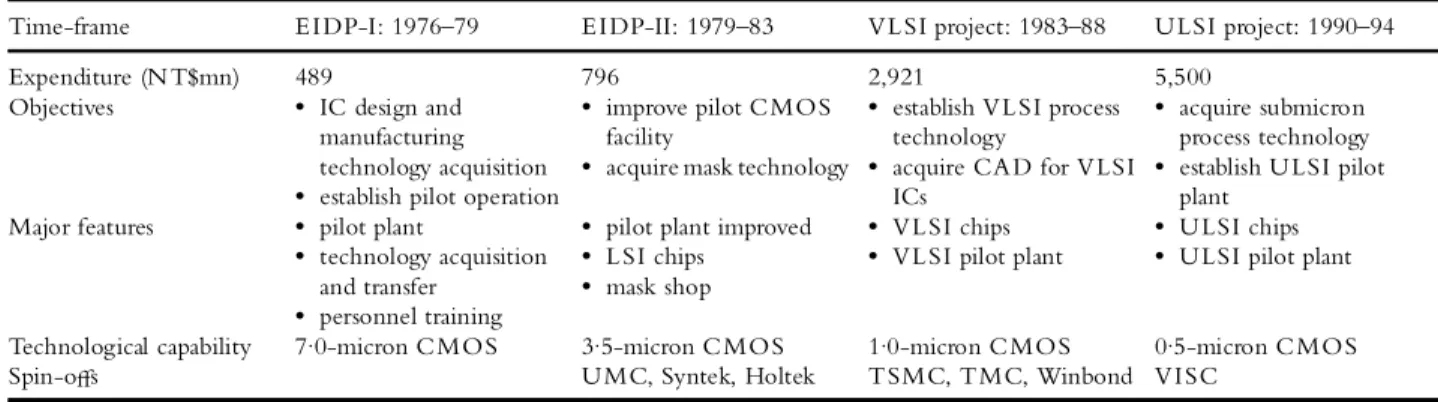
tech-Table 2. Public R&D projects for IC industry
Time-frame EIDP-I: 1976–79 EIDP-II: 1979–83 VLSI project: 1983–88 ULSI project: 1990–94
Expenditure (N T$mn) 489 796 2,921 5,500
Objectives · IC design and · improve pilot CMOS · establish VLSI process · acquire submicron
manufacturing facility technology process technology
technology acquisition · acquire mask technology · acquire CAD for VLSI · establish ULSI pilot
· establish pilot operation ICs plant
Major features · pilot plant · pilot plant improved · VLSI chips · ULSI chips
· technology acquisition · LSI chips · VLSI pilot plant · ULSI pilot plant
and transfer · mask shop
· personnel training
Technological capability 7·0-micron CMOS 3·5-micron CMOS 1·0-micron CMOS 0·5-micron CMOS
Spin-oVs UMC, Syntek, Holtek TSMC, TMC, Winbond VISC
Source: Adapted from LIU, 1993, p. 303.
nologies from foreign companies. After mastering the scale. Morris Chang, the former head of ITRI and now president of TSMC, designed a unique strategy borrowed technologies, ERSO consequently spun oV
two new local IC rms, United Microelectronics Cor- for making TSMC the world’s rst pure fabrication factory with a high yield rate, good defect control and poration (UMC) and Taiwan Semiconductor
Manufac-turing Corporation (TSMC). Aside from these major responsiveness to customer demand.6The local design
houses, no longer worried about fabrication capability, achievements, ERSO also set up an IC design centre,
and allowed its engineers to start up their own compan- consequently ourished and their sales revenue increased from NT$32 million in 1987 to NT$236 ies. The government also established an industrial park
to host these new rms, and provided nancial and tax million in 1990.7
The semiconductor industry in Taiwan entered a incentives to lure the risk investments. Through a series
of projects, the state successfully assisted the local IC new ‘phase of returnee establishments’ (HSU, 1997) in
the 1990s. Taiwan’s PC industry reached a top position industry in becoming established (see Table 2).
In 1980 United Microelectronics Corporation in the early 1990s, clearly surpassing Korea and Japan. The time lag between the introduction of new central (UMC), the rst wafer fabrication factory in Taiwan,
was established at the Hsinchu Science-based Industrial processing units (CPUs) by Intel and the commercial-ization of the personal computer (PC) in Taiwan Park, with wholesale assistance in technology,
person-nel and equipment transference from the ERSO team. shortened from three years in 1982 (80286DX), to six months in 1989 (80486), to under one month by the Under pressure from the government, private capital
reluctantly agreed to invest under the condition that time of Pentium II’s introduction.
The vertically-disintegrated networks, composed of ERSO controlled 55% of equity shares (HSU, 1997).
Similar to the situation in the petrochemical industry, specialized rms manufacturing various peripherals and add-on cards, created a potential market for the semi-the government was leading semi-the market (WAD E, 1990).
The strategy of UMC was to specialize in the fabrica- conductor industry. More than 15 new wafer plants were constructed in the HSIP during the 1990s. Some tion and testing stages, cooperate with other rms in
the other stages (for example, packaging) and focus of them were new investments undertaken by capital from other industries, who missed out on earlier oppor-on the niche market of ASIC (applicatioppor-on speci c
integrated circuit), which allowed it greater exibility.5 tunities (e.g. Formosa Plastics), some were an expansion
by UMC and TSMC, and others represented backward The company was an instant success, reaching the
break-even point in only two years. integration of PC makers (e.g. Acer). The spin-oVs of ERSO were no longer the only source of technological In 1983, climbing a steeper learning curve, ERSO
forged a joint research agreement with Vitelic, a very transfer and knowledge commercialization. Returnee start-ups, relying on the embodied knowledge of the large scale IC (VLSI) design house in Silicon Valley
founded by an overseas Chinese person, to develop founding teams and joint ventures with foreign high-tech companies became increasingly important. advanced CMOS dynamic, random access memory
(DRAM) technology. The project was initially success- Although government intervention was the single most important factor in the early phase, the regional ful with 256K DRAM. However, limited by Taiwan’s
capability to mass produce VLSI, its designs and those agglomeration of rms in the Hsinchu–Taipei corridor and the social networking that facilitates learning and of smaller design houses in Taiwan were taken to
Japanese or Korean IC factories for fabrication or sold innovation are gaining independent in uence. As HSU,
1997, demonstrates, the geographical agglomeration of to them. In 1986, TSMC (Taiwan Semiconductor
Manufacturing Corporation), another spin-oV of high technology rms in the region comes not from the static cost sharing, but from the dynamic interactive ERSO, began to produce VLSI on a commercial
learning advantage in the technical community. In the development, as well as other East Asian miracles, often ignore regional and industrial diVerences and have their learning region, the neighbouring institutions such
as the two noted engineering universities (Tsinghua own preferred industries and explanatory variables. Theories are more valid when they deal with the University and Chiaotung University) and ERSO
pro-vide not only high-quality human resources, but more industry and the stage of development that have the strongest aYnity with their core variables. While statists importantly, the information and learning networks of
friends and colleagues. These networks, added to the base their arguments about the aggressive roles played by the late-industrializing states in case studies of petro-frequent turnover of personnel and returnee
connec-tions, became far more dynamic and complex in the chemical (AM SD EN, 1985) and semiconductor sectors
(WAD E, 1990; MATH E WS, 1997), neo-liberalists
industrial world of HSIP.
The semiconductor industry in Hsinchu is both refute them by using data about small and medium sized enterprises in labour-intensive sectors to illustrate locally chained (the Hsinchu–Taipei corridor, see HSU,
1997) and globally connected (Hsinchu–Silicon Valley the exibility advantage and export orientation, which is assumed to match the free-market paradigm and is connection, see SAXE NIAN and HSU, 1999).
Com-pared with the traditional networks of friends and void of government’s spoiling subsidies and disturbing regulation. They fall short when stepping out of their relatives in the footwear industry, the social networks
in the information industry are based more on the territory, and can only convince their own true believers. Given the complexity of regional economies, achieved networks that originate from the formal
insti-tutions of college education, workplace experience, as shown above, we need a set of concepts to picture the overall structures of regional industries.
business dealings and industrial associations (HSU and
SAX ENI AN, 2000). The networks are so dynamic and This research eshes out the key roles played by
regions in national economic and social development. far reaching that they are able to create a local advantage
while preventing the rigidity and inertia that tend to Nowadays, people have increasingly realized that ‘devel-opment’ can no longer be measured quantitatively by a associate with local cohesion, but are detrimental to a
knowledge-intensive industry. monetary scale like GNP per capita (SEN and MU ELLBAU E R, 1987; BLO CK, 1990). The achieve-ment and pain of economic developachieve-ment can only be
C ON CL U S ION S AN D IM PL ICAT ION S truly evaluated by closely examining the locales where
people struggle to make a decent and sustainable living. Although Taiwan is a country with relatively little land
area, it has at least three distinctive regional economies The economic development of Taiwan is not a single story. The footwear industry of central Taiwan, the with their own unique trajectories and crucial
conjunc-tures of industrial development. This research argues petrochemical industry of southern Taiwan, and the semiconductor industry in northern Taiwan represent that industries, institutions and regions are the three
forces that together shape economic development in a three possibilities for economic development and three social landscapes of human consequences. The regional path-dependent fashion. Industries refer to each speci c
world of products with their own unique market and economies are where the stories of development begin, turn and twist.
technological sources of uncertainty. While the
foot-wear industry is characterized by a highly competitive This research also resonates the arguments made by institutional geographies, such as that which export market and massive labour utilization, the
petro-chemical industry demonstrates an extremely oligo- ST OR PER, 1997, proposed. It is suggested that the diVerent industrial trajectories taken by diVerent regions polistic domestic market and huge capital investment.
Institution refers to the various social forces that and their consequent institutionalized proactive capaci-ties will result in the uneven restructuring process as provide the means for economic coordination and
governance. The industrial association in the footwear new economic opportunities or threats emerge. For example, it is expected that Taiwan’s participation in industry settles the quota allocation issue to construct
a collective order for the numerous small rms, and the World Trade Organization by the end of 2001 (estimated) will hit the Central Region seriously by the state–capital–labour alliance contributes to the
functioning of the industrial system among the less devastating the out ow of labour-intensive industries, but bene t the Northern Region by enhancing trade than 30 petrochemical rms. As for the semiconductor
industry, the governing institutions have intermediate for high technology products (MOEA, 2000). At the same time, the emerging crossborder connections characteristics – state leadership at the initial stage and
technical community for further development. Finally, between the regions in diVerent national contexts, such as the Silicon Valley–Hsinchu connection, will build regions refer to the social mechanisms underlying the
spatial concentration of industrial networks. They up the territorial units for a globalization architecture. DiVerent governing mechanisms in divergent regions provide the temporal–spatial context for social
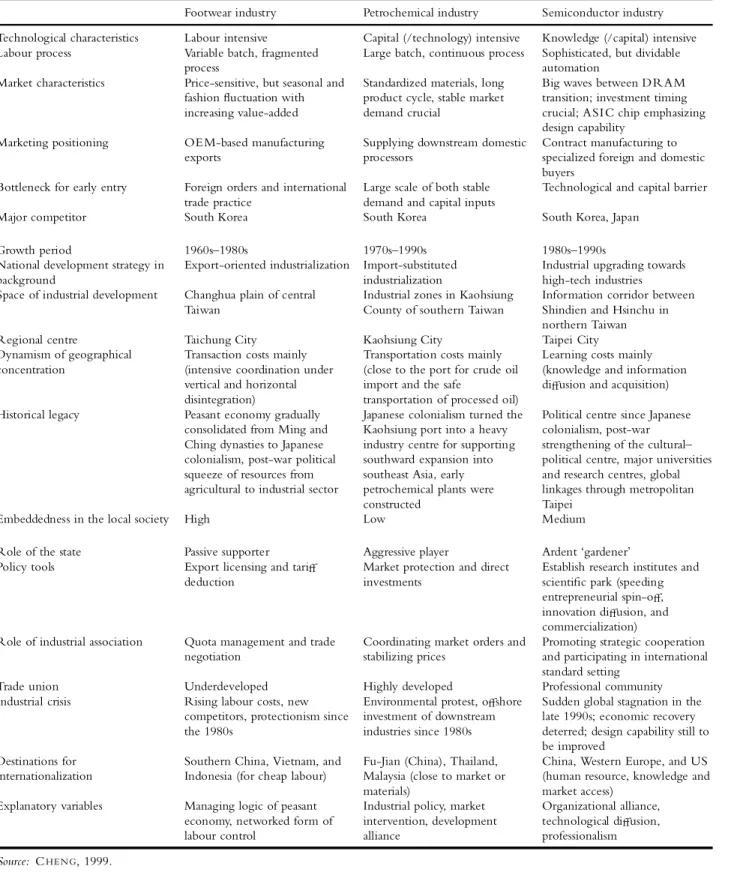
embeddedness and the locale for economic contests. will allow diVerent forms of participation in the global economy, and further transform globalization itself. Table 3 summarizes the content in a concise format.
Table 3. The formation of the three regional industries in Taiwan
Footwear industry Petrochemical industry Semiconductor industry
Technological characteristics Labour intensive Capital (/technology) intensive Knowledge (/capital) intensive Labour process Variable batch, fragmented Large batch, continuous process Sophisticated, but dividable
process automation
Market characteristics Price-sensitive, but seasonal and Standardized materials, long Big waves between DRAM fashion uctuation with product cycle, stable market transition; investment timing
increasing value-added demand crucial crucial; ASIC chip emphasizing
design capability
Marketing positioning OEM-based manufacturing Supplying downstream domestic Contract manufacturing to
exports processors specialized foreign and domestic
buyers
Bottleneck for early entry Foreign orders and international Large scale of both stable Technological and capital barrier
trade practice demand and capital inputs
Major competitor South Korea South Korea South Korea, Japan
Growth period 1960s–1980s 1970s–1990s 1980s–1990s
National development strategy in Export-oriented industrialization Import-substituted Industrial upgrading towards
background industrialization high-tech industries
Space of industrial development Changhua plain of central Industrial zones in Kaohsiung Information corridor between
Taiwan County of southern Taiwan Shindien and Hsinchu in
northern Taiwan
Regional centre Taichung City Kaohsiung City Taipei City
Dynamism of geographical Transaction costs mainly Transportation costs mainly Learning costs mainly concentration (intensive coordination under (close to the port for crude oil (knowledge and information
vertical and horizontal import and the safe diVusion and acquisition)
disintegration) transportation of processed oil)
Historical legacy Peasant economy gradually Japanese colonialism turned the Political centre since Japanese consolidated from Ming and Kaohsiung port into a heavy colonialism, post-war Ching dynasties to Japanese industry centre for supporting strengthening of the cultural– colonialism, post-war political southward expansion into political centre, major universities squeeze of resources from southeast Asia, early and research centres, global agricultural to industrial sector petrochemical plants were linkages through metropolitan
constructed Taipei
Embeddedness in the local society High Low Medium
Role of the state Passive supporter Aggressive player Ardent ‘gardener’
Policy tools Export licensing and tariV Market protection and direct Establish research institutes and
deduction investments scienti c park (speeding
entrepreneurial spin-oV, innovation diVusion, and commercialization)
Role of industrial association Quota management and trade Coordinating market orders and Promoting strategic cooperation
negotiation stabilizing prices and participating in international
standard setting
Trade union Underdeveloped Highly developed Professional community
Industrial crisis Rising labour costs, new Environmental protest, oVshore Sudden global stagnation in the competitors, protectionism since investment of downstream late 1990s; economic recovery
the 1980s industries since 1980s deterred; design capability still to
be improved
Destinations for Southern China, Vietnam, and Fu-Jian (China), Thailand, China, Western Europe, and US
internationalization Indonesia (for cheap labour) Malaysia (close to market or (human resource, knowledge and
materials) market access)
Explanatory variables Managing logic of peasant Industrial policy, market Organizational alliance, economy, networked form of intervention, development technological diVusion,
labour control alliance professionalism
Source: CHE NG, 1999.
Taiwan’s three regions bolsters the argument that a 2000). Without taking the divergent patterns of regional industrialization into account, the theoretical regional political economy (accepting as a basic premise
the intersection between a globalizing world economy explanations and their induced practical suggestions will not be comprehensive in knowledge creation and and uneven development) will be critical to the
pay attention to the shifting formation of hegemonic
Acknowledgements – Both authors have contributed
equally in the discussion, analysis and writing process for class alliance as capitalist development evolves along the geographical industrialization process (HA RVE Y, 1982). the paper. Thanks to two anonymous referees for valuable
comments. Finally, Jinn-yuh Hsu expresses gratitude for the States will take diVerent moves to cover the capital interest under varying local circumstance. In the Marxist term, nancial support from Taiwan’s National Science Council
(Grant No. NSC 89-2415-H-003-007-). The usual dis- the state is not necessarily a capitalist agent with an ability for far-sighted decision making as the statists argued, but claimer applies.
is in a dialectical process of interplay with divergent class groups. We thank Harvey for reminding us of this point at the International Critical Geography Group Conference,
N OTES
Taegu, Korea, August 9–13, 2000.
3. The executive director of the association held the same 1. Here, we agree to use the term ‘spatial x’ originated by
Harvey, rather than the term ‘spatio-temporal x’ which position at the Taiwanese Hat Exporter’s Association (THEA). The counselling committee of TPSEA was was proposed by JESS OP, 2000, in a recently published
paper. Jessop based his criticism on Harvey’s ignorance composed of the chairman of THEA and owners of the ve major plastic companies (TFMA, 1989). They of the time dimension in the capitalist regulation of
accumulation regime. For Harvey, the temporal dimen- showed the networking eVorts of the industry in its infancy to assure the stability of the resource environment. sion of capital xity and motion was incarnate in the
discussion of the process of change and structural coher- 4. The rst brand buyer to place orders in Taiwan was Adidas in early 1971, bringing in the most advanced ence between regions. Therefore, we still use ‘spatial x’
which is familiar to critical geographers. Moreover, labour production technology at the time.
5. In a sense, it is quite similar to the strategy that the geographers such as HEROD, 1997, argue that we should
pay more attention to labour’s role in the making of rms of more traditional industries in Taiwan have been following.
spatial x. It is true that labour as the active agent in the
process of production could use space as the resource to 6. The similarity of the so-called ‘specialized subcontracting’ to IEM, which has been the model for manufacturing ght against the capital accumulation strategy which
might endanger the survival and prosperity of the worker exports in Taiwan, hints of a profound industrial conven-tion in Taiwan.
community. However, one should not pretend that labour
as a collectivity possesses the same capacity and stands on 7. Following the greenhouse strategy, a spin-oV of a new mask production company based on advanced technology an equal footing with capital in shaping the economic
landscape, since diVerent collective logics exist between was built in 1988. Over 100 engineers and staV from the mask division at ERSO were transferred to the new these two agents. Herod’s argument should be treated
as being complementary, rather than substitutive, with company, Taiwan Mask Corporation (TMC). The com-pany has enjoyed revenue growth of 15–20%, from around Harvey’s.
2. From a historical materialist perspective, the state is not NT$300 million in 1989 to around NT$500 million in 1994.
just an entity, but a process. In other words, we have to
RE FE R EN CE S
AGN EW J. (2000) From the political economy of regions to regional political economy, Prog. Hum. Geogr. 24(1), 101–10. AM SDEN A. (1985) The state and Taiwan’s economic development, in EVA N S P., RUESCHE M EYER D. and SKOCP OL T.
(Eds) Bringing the State Back In. Cambridge University Press, New York.
AM SDENA. (1989) Asia’s Next Giant: South Korea and Late Industrialization. Oxford University Press, New York.
BA RN ET TR. E. and WHYT EM. K. (1982) Dependency theory and Taiwan: analysis of deviant case, Am. J. Sociol. 87, 1,064–89. BER GE R P. L. (1986) The Capitalist Revolution: Fifty Propositions about Prosperity, Equality, and Liberty. Basic Books, New York. BLOCK F. (1990) Postindustrial Possibilities: A Critique of Economic Discourse. University of California Press, Berkeley, CA. BUCK D. (2000) Growth, disintegration, and decentralization: the construction of Taiwan’s industrial networks, Environ. Plann.
A 32(2), 245–62.
CHEN GL.-L. (1996) Embedded competitiveness: Taiwan’s shifting role in the international footwear sourcing networks. Ph.D. thesis, Department of Sociology, Duke University, Durham, NC.
CHEN GL.-L. (1999) One country, three systems: local economies in Taiwan’s post-war economic development, in The Miracles and Crises of Asian Economies: A Historical Perspective, pp. 99–130. The Academy of Korean Studies, Seoul.
CHUW.-W. (1997) Demonstration eVects and industrial policy: the birth of Taiwan’s petrochemical industry, Taiwan: A Radical Quarterly in Social Studies 27, 97–138 (in Chinese).
CUM IN GSB. (1987) The origins and development of the Northeast Asian political economy: industrial sectors, product cycles, and political consequences, in DE YO F. C. (Ed) The Political Economy of the New Asian Industrialism. Cornell University Press, Ithaca, NY.
DEY O F. (1989) Beneath the Miracle. University of California Press, Berkeley, CA.
GE REF FI G. (1990) Paths of industrialization: an overview, in GERE FFI G. and WY M AN D. L. (Eds) Manufacturing Miracles, pp. 3–31. Princeton University Press, Princeton, NJ.
HE RODA. (1997) From a geography of labor to a labor geography: labor’s spatial x and the geography of capitalism, Antipode
29(1), 1–31.
HOLM ES J. (1986) The organization and locational structure of production subcontracting, pp. 80–106 in SC OTT A. and ST ORP ER M. (Eds) Production, Work, Territory: The Geographical Anatomy of Industrial Capitalism. Allen & Unwin, Boston. HS IE H C.-M. (1964) Taiwan – Illa Formosa: A Geography in Perspective, Butterworth, London.
HS IN G Y.-T. (1998) Making Capitalism in China: The Taiwan Connection. Oxford University Press, New York.
HS U J.-Y. (1995) The struggle over local space: a case study of the environmental movement in Taiwan, Capitalism, Nature, Socialism 6(1), 113–24.
HS U J.-Y. (1997) A late-industrial district? Learning network in the Hsinchu Science-based Industrial Park, Taiwan, Ph.D. thesis, Department of Geography, University of California, Berkeley, CA.
HS U J.-Y. and HSI A C.-J. (1997) Petrochemical industry and localities in Taiwan: a comparative study, Taiwan: A Radical Quarterly in Social Studies 26, 129–166 (in Chinese).
HS UJ.-Y. and SA XEN IA N A. (2000) The limits of Guanxi capitalism: transnational collaboration between Taiwan and the US, Environ. Plann. A 32(11), 1,991–2,005.
IN T ERN A TI ON ALMONET A RYFUN D (1998) IMF Survey 27(6), March.
JES SOP B. (2000) The crisis of the national spatio-temporal x and the tendential ecological dominance of globalizing capitalism, Int. J. Urban & Reg. Res. 24(2), 323–60.
LI U C.-Y. (1993) Government’s role in developing a high-tech industry: the case of Taiwan’s semiconductor industry, Technovation 13(5), 299–309.
MA T HEWS J. (1997) A Silicon Valley of the East: creating Taiwan’s semiconductor industry, Calif. Mgt. Rev. 39(4), 26–54. MI N IST R Y OFECON OM ICAF FA I RS(M OEA) (2000) Taiwan’s Industrial Policy Toward the 21st Century. MOEA, Taipei. OMA EK. I. (1995) The End of the Nation State: The Rise of Regional Economies. Free Press, New York.
SA XEN I AN A. and HSU J.-Y. (1999) Transnational entrepreneurs and regional industrialization: the Silicon Valley–Hsinchu connection, presented at the annual conference of the Association of Collegiate Schools of Planning, Chicago, October. SC OTTA. (1998) Regions and the World Economy: The Coming Shape of Global Production, Competition and Political Order. Oxford
University Press, Oxford.
SE N A. and MUELLBAU ER J. (1987) The Standard of Living. Cambridge University Press, Cambridge.
SH IEH G. S. (1992) ‘Boss’ Island: The Subcontracting Network and Micro-Entrepreneurship in Taiwan’s Development. Peter Lang, New York.
ST ORP ER M. (1997) The Regional World: Territorial Development in a Global Economy. Guilford Press, New York.
ST ORP ERM. and WA LKE RR. (1989) The Capitalist Imperative: Territory, Technology and Industrial Growth. Blackwell, New York. TA IW A N ESEFOOTW E ARMA NU FA CT URER S’AS SOCI AT I ON(TFMA) (1989) 30-Year History of Taiwan’s Shoe Manufacturing
Industry. TFMA, Taipei.
TA IW A N ESEFOOT WE ARMA NU F AC TU R ERS ’ASSOC IA T IO N (TFMA) (1995) Statistical Data. TFMA, Taipei.
WAD E R. (1990) Governing the Market: Economic Theory and the Role of Government in East Asian Industrialization. Princeton University Press, Princeton, NJ.