Simply self-restored ring-based
time-division-multiplexed
passive optical network
C.-H. Yeh,1,*C.-S. Lee,1and S. Chi2,31
Information and Communications Research Laboratories, Industrial Technology Research Institute, Chutung, Hsinchu 310-40, Taiwan
2
Department of Photonics and Institute of Electro-Optical Engineering, National Chiao Tung University, Hsinchu 300-10, Taiwan
3Department of Electrical Engineering, Yuan Ze University, Chung-Li 320-03, Taiwan
*Corresponding author: [email protected]
Received August 8, 2007; revised January 28, 2008; accepted February 9, 2008; published March 18, 2008共Doc. ID 86240兲
A simply self-restored ring-based time-division-multiplexed passive optical network by a clockwise and counterclockwise circulating fiber against the fi-ber fault in an access system is proposed and experimentally investigated. The proposed optical line terminal and optical network unit modules can be used to prevent and protect the occurrence of fiber failure in the ring-based passive optical networks (PONs). Using the proposed self-healing access net-work, the ring-based PON can be revived promptly under fiber failure. The protection and restoration time of the access network is measured within 7 ms. In addition, the performance of data traffic in the access network is also discussed. © 2008 Optical Society of America
OCIS codes: 060.4254, 060.0060.
1. Introduction
Recently, the passive optical networks (PONs) are a promising solution in overcoming the last mile bottleneck in fiber access networks [1,2]. That means that fiber access networks will provide the hugest bandwidth for both downstream and upstream traf-fic and relieve the bottleneck arising in this area due to mismatch between the present day’s capacity and growing demand. Therefore, time-division-multiplexing (TDM) PON systems such as Ethernet PON (EPON) and gigabit PON (GPON) are already standardized [3,4] and currently operating at nominal line rates of 1.25 Gbits/ s for EPON and 2.5 Gbits/ s for GPON [5]. Generally, the architectures of PONs have three basic topologies, which are the bus, tree, and ring structures. The point-to-multipoint connectivity between the optical line terminal (OLT) and multiple optical network units (ONUs) is obtained employing a passive branching device at the remote node (RN). Data traffic from an OLT to an ONU is called downstream (point-to-multipoint) and traffic from an ONU to the OLT is called upstream (multipoint-to-point). Two typical wavelengths are employed: 1310 nm 共up兲 for the upstream and
1490 nm共down兲 for the downstream transmission. When a fiber link between the OLT
and an ONU is broken or cut, the affected ONU will become unreachable to the OLT. Thus, to verify fiber network protection, the alternative protection paths should be implemented [6,7]. However, the ring-based TDM-PON was discussed and investi-gated in a few studies [6,7].
In this paper, we propose and demonstrate a self-restored architecture in the ring-based TDM-PON to protect and prevent the occurrence of fiber failure. The protection and restoration time of the access network is less then 7 ms. Moreover, the perfor-mances of the downstream and upstream traffic are also measured and discussed in the proposed ring-based TDM optical access network.
2. Proposed Architecture
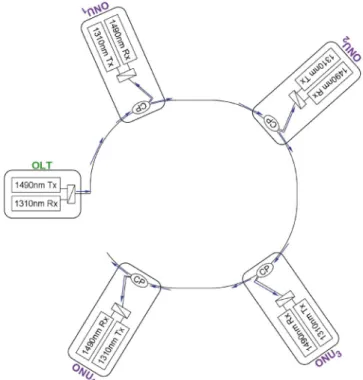
A conventional ring-based TDM-PON scheme is illustrated in Fig.1. From Fig.1, we assume four ONUs using a single fiber path for downlink and uplink data traffic. To connect data traffic between the OLT and each ONU in a ring-based PON, a 1⫻2
opti-Vol. 7, No. 4 / April 2008 / JOURNAL OF OPTICAL NETWORKING 288
cal coupler (CP) is used on each ONU, as shown in Fig.1. The blue line with an arrow in Fig.1represents the transmission of downlink traffic without fiber fault. When a fiber cut occurs between ONU2and ONU3, the data traffic will be unreachable behind
the failure point in a conventional ring-based PON, as also shown in Fig.1. Simulta-neously, the upstream signals from ONUs after the fault point will be unable to advance. To achieve desired network survivability, two optical transceivers (TRxs) in the OLT and ONU and a dual-fiber path were reported and recommended [4,6–8]. Therefore, we propose and investigate a self-restored ring-based architecture having a single fiber path and one TRx in the OLT and each ONU for the TDM-PON access sys-tem.
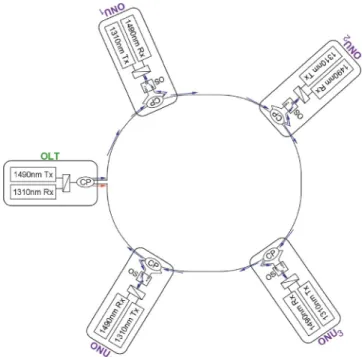
Figure2 shows the proposed self-restored ring-based architecture in TDM-PON with four ONUs. In the proposed architecture, the OLT adds a 1⫻2 optical CP in front of a 1490/1310 WDM CP to split the 1490 nm downstream beam passing through clockwise (CW) and counterclockwise (CCW) circulating paths simultaneously. Besides, each ONU also adds a 2⫻2 optical CP and a 1⫻2 optical switch (OS) in front of a 1490/1310 WDM coupler. Originally, the OS is switched to the 1 position to con-nect the uplink traffic in a CCW path. In accordance with the proposed OLT and ONU, the transmitted traffic between the OLT and each ONU (blue line with arrow) is shown in Fig.2for the data connections in the normal state. The upstream data link also transmits through the same transmission path (blue line in Fig.2). Besides, another splitting downstream signal (red line with arrow) could transmit in a CCW path without any function due to the direction of the OS, as also shown in Fig.2. Even though each ONU receives the downstream signal in a CCW path in the normal state, the OS also blocks the traffic signals from advancing. Thus, there is no collision prob-lem of upstream data in the normal state. As a result, the switching direction of the OS on each ONU is used to determine the data traffic in the CW or CCW path.
The protection operating mechanism of the new proposed self-restored ring-based TDM-PON will be introduced as follows. Assume that four ONUs are employed in the proposed ring-based access network and the downstream signal splits into two beams for the CW and CCW paths. In the normal state, the connections between the OLT and each ONU transmit through a CW path. When a fiber fault occurs between ONU2
and ONU3, as shown in Fig.3, ONU3and ONU4will not receive any information from
the 1490 nm signal. Since ONU3and ONU4 do not receive the downstream signal at
this time, the media access control (MAC) of ONU3and ONU4will control the OS to
switch to the 2 position. Then ONU3and ONU4could retrieve the downstream signal Fig. 1. Conventional ring-based time-sharing passive optical network.
through a CCW path, as shown in Fig.3. That is to say, the OS will switch automati-cally to the 1 or 2 position depending on whether the 1490 nm photodiode of each ONU receives the downstream signal. Therefore, as mentioned before, the data traffic of ONU1 and ONU2 are through the CW path (blue line) and ONU3 and ONU4 are
through the CCW path (red line), as seen in Fig.3. When the fiber failure is restored, all the ONUs will transmit data through the CW path again. Besides, the TDM-PONs use the multipoint control protocol (MPCP) method to calculate the different round-trip times (RTTs) from the OLT to each ONU due to the different transmission paths between the OLT and each ONU. Thus, the RTTs between the OLT and each ONU can be recalculated for reconnecting data traffic when the fault is occurring in the
pro-Fig. 2. Proposed self-restored ring-based architecture in TDM-PON with four ONUs in normal state.
Fig. 3. Proposed self-restored ring-based architecture in TDM-PON with four ONUs when a fault occurs between ONU2and ONU3.
posed protection PON. As a result, the proposed self-protected ring-type PON does not effect the transmission efficiency of the access network when the transmission traffic path is changed.
When two fiber faults occur simultaneously between ONU2 and ONU3 and ONU3
and ONU4, in the proposed ring-based access network (as illustrated in Fig.4) ONU3
would not connect any downstream signal from the OLT. However, this is not enough to produce the probability of two fiber faults at the same time in the proposed PON. The disconnection between the OLT and ONU may be a fiber cut or an ONU failure. The proposed architecture can be used to protect the system from the fiber cut, but cannot detect the ONU failure. Therefore, the problem of ONU failure needs more study for the proposed ring-architecture.
3. System Testing and Analysis
To verify the performance of the proposed self-restored ring-based TDM-PON system, an experiment is performed. The experimental setup is similar to Fig.2 and four ONUs are employed for the simple self-protected fiber access network. A transmission distance between the OLT and ONU4is 20 and 5 km long, respectively, when the data
traffic is in CW and CCW paths. The 1490 nm downstream and 1310 nm upstream signals have 1.25 Gbit/ s direct modulation in the test ring-based PON system. The output powers of 1490 and 1310 nm lasers are 2.1 and 1.9 dBm. Moreover, in regard to the system power budget of the PON system, the traffic signal will traverse five CPRs 共15 dB兲, an OS 共1 dB兲, and ⬃20 km of single-mode fibers (SMFs) 共4 dB兲. The total loss budget is⬃20 dB at least, when the data traffic is from the OLT to ONU4in the CW
path without protection. When the traffic is in the CCW path with protection, the total loss budget is nearly 9 dB. Besides, the system scalability of the proposed ring architecture is ⬃28 dB. The bit error rate (BER) performances are measured by a 1.25 Gbit/ s non-return-to-zero pseudorandom binary sequence (PRBS) with a pattern length of 231– 1 for the downstream and upstream traffic between the OLT and ONU4
without and with protection operating. Therefore, Figs.5(a)and5(b) show the BER performances of (a) downstream and (b) upstream traffic at 1.25 Gbit/ s modulation through CW and CCW paths between the OLT and ONU4 under the access network
without and with protection, respectively. The observed optical power penalties of Figs.5(a)and5(b)are smaller than 0.2 and 0.4 dB while the BER is 10−9without and
Fig. 4. Proposed self-restored ring-based architecture in TDM-PON with four ONUs when two faults occurs between ONU2and ONU3and ONU3and ONU4, respectively.
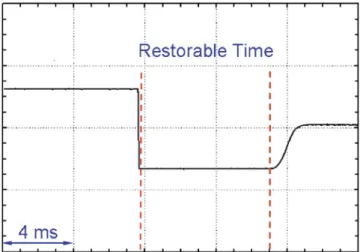
with protection operating, respectively. Moreover, in the proposed self-protected PON, the restorable time is measured within 7 ms due to the switching limitation of OS, as seen in Fig.6.
At the same time, to evaluate and verify the feasibility of the proposed architecture, we also measure the throughput performances of the 1.25 Gbit/ s downstream and upstream traffic by directly connecting a performance analyzer with a frame length of
Fig. 5. BER performances of (a) downstream and (b) upstream traffic at 1.25 Gbit/ s modulation through CW and CCW paths between OLT and ONU4under the access net-work without and with protection, respectively.
Fig. 6. The protection and restoration time of the proposed self-restored ring-based PON is within 7 ms.
1518 bytes with the same access scheme as Fig.2with four ONUs. Thus, the through-put performances of downstream and upstream traffic are measured at 95.2% and 98.8%, respectively, in the proposed ring-based access network. The percentage of packet loss caused depends on the transmission length and total users.
4. Conclusion
In summary, we have proposed and investigated a self-restored TDM-PON by a clock-wise and counterclockclock-wise circulating fiber against the fiber fault in TDM-PONs. In the ring-based TDM-PON, the proposed OLT and ONU modules can be used to protect the fiber fault from occurring. Employing the proposed self-healing access network, the ring-based PON can be revived promptly under fiber failure. Besides, the protec-tion and restoraprotec-tion time is less then 7 ms due to the limitaprotec-tion of the OS in the pro-posed self-protected architecture. In addition, the performance of data traffic in the access network was also discussed and analyzed.
References
1. F.-T. An, D. Gutierrez, K. S. Kim, J. W. Lee, and L. G. Kazovsky, “SUCCESS-HPON: a next-generation optical access architecture for smooth migration from TDM-PON to WDMPON,” IEEE Commun. Mag. 43(11), S40–S47 (2005).
2. G. Kramer and G. Pesavento, “Ethernet passive optical network (EPON): building a next-generation optical access network,” IEEE Commun. Mag. 40(2), 66–73 (2002). 3. IEEE Standard for Information Technology, IEEE Std 802.3ah-2004 (IEEE, 2004), pp.
01–623.
4. ITU-T Recommendation G.984.2-2003, “Gigabit-capable passive optical networks (GPON): physical media dependent (PMD) layer specification” (ITU, 2003).
5. M. Abrams, P. C. Becker, Y. Fujimoto, V. O’Byrne, and D. Piehler, “FTTP deployments in the United States and Japan—equipment choices and service provider imperatives,” J. Lightwave Technol. 23, 236–246 (2005).
6. K. D. Langer, J. Grubor, and K. Habel, “Promising evolution paths for passive optical access networks,” in Proceedings of the International Conference on Transparent Optical Networks
(ICTON’04) (IEEE, 2004), pp. 202–207.
7. A. D. Hossain, H. Erkan, R. Dorsinville, M. Ali, A. Shami, and C. Assi, “Protection for a ring-based EPON architecture,” in 2005 2nd International Conference on Broadband
Networks (IEEE, 2005), pp. 626–631.
8. B. T. Lee, M. S. Lee, and H. Y. Song, “Simply ring-type passive optical network with two fiber protection scheme and performance analysis,” Opt. Eng. (Bellingham) 46, 065002 (2007).